Reviewed and updated: 12 August 2026
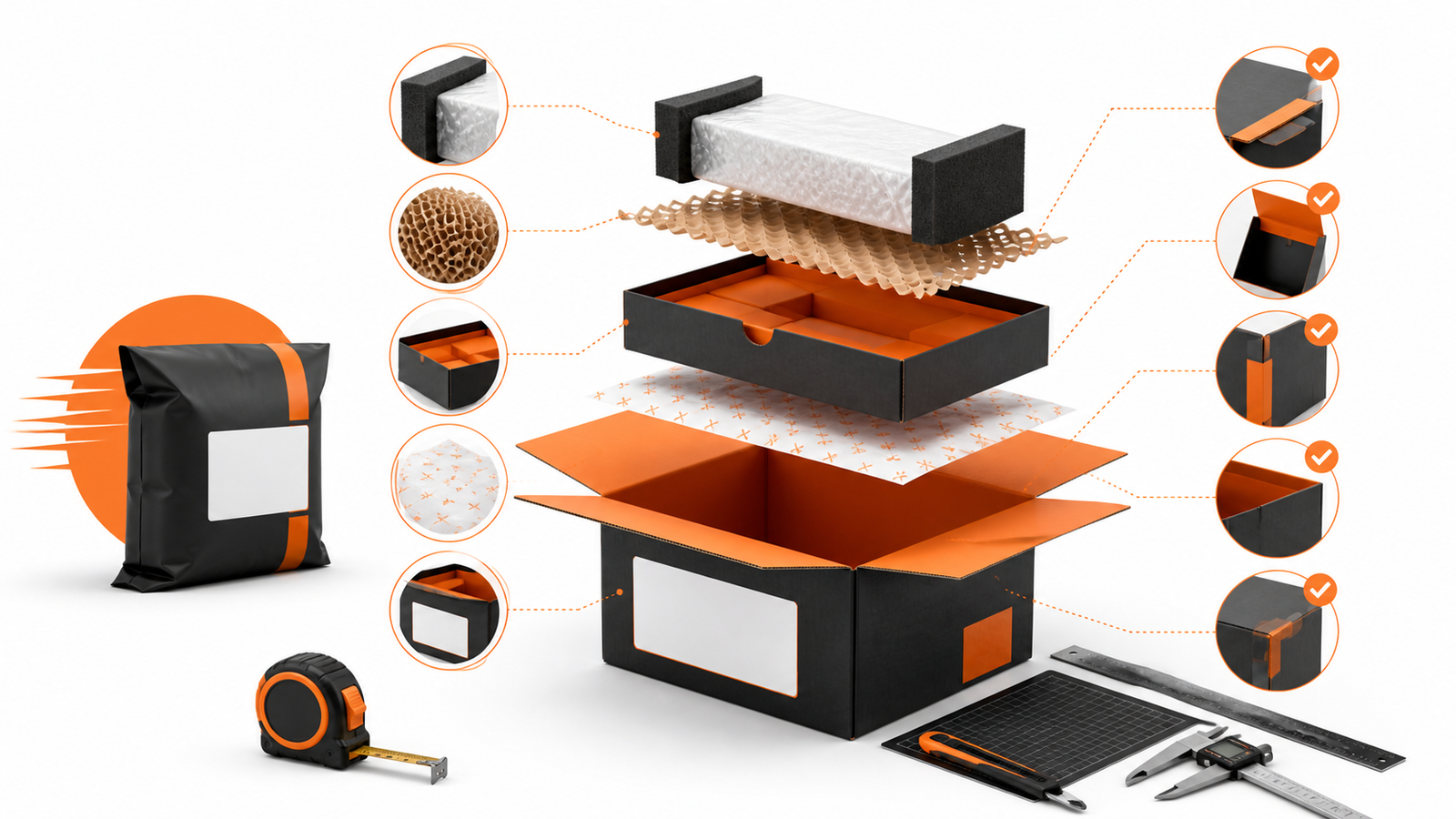
Ecommerce packaging must protect the exact product through the real delivery journey, present required and truthful information, help the customer identify and use the item, support returns and service, fit channel constraints, and remain affordable at packed weight and volume. Test physical samples with operations before approving artwork or AI-generated mockups.
This checklist owns cross-functional packaging decisions; regulated categories require current specialist review. This guide gives you an operating method, not a promise of rankings, enquiries, sales or profit. Platform policies, fees, eligibility and laws can change, so verify the linked primary sources and your own commercial records before implementation.
Table of contents
- What this guide helps you decide
- Build the source-of-truth sheet first
- A practical implementation workflow
- Use the decision table
- Apply it to Indian product businesses
- Use AI without losing business truth
- Avoid the common failure patterns
- Measure progress with operating evidence
- A 30-day implementation plan
- Frequently asked questions
What this guide helps you decide
The real question is not whether ecommerce packaging sounds useful. The question is whether it solves a defined buyer or operating problem for one product, audience and channel without breaking product truth, margin, consent or delivery capacity.
Use these diagnostic questions before spending money or assigning work:
- What hazards occur from packing through delivery and return?
- Which product, legal, handling and customer information must be visible?
- How do packed dimensions and weight change freight and damage risk?
- Who approves structure, artwork, claims and production version?
Write the answers in one decision note. If a critical answer is unknown, make discovery the next task. Do not let an attractive tool, template or competitor example silently become the strategy.
Build the source-of-truth sheet first
Every execution step should pull facts from an approved record. A source-of-truth sheet prevents a copywriter, agency, AI tool or busy salesperson from filling a gap with a plausible but wrong product promise.
| Truth item | Authoritative source | Owner | Stop condition |
|---|---|---|---|
| Product and offer facts | Approved SKU, catalogue and offer master | Product or merchandising owner | A buying-critical field is missing or inconsistent |
| Buyer need and language | Recorded enquiries, interviews and sales notes | Sales or customer owner | The audience is assumed rather than evidenced |
| Price, margin and fulfilment | Current finance, stock and delivery records | Finance or operations owner | The promise cannot be fulfilled profitably or reliably |
| Channel and permission rules | Current platform policy and consent record | Channel owner | Permission, eligibility or policy is unclear |
Add a version date to the sheet. When price, stock, specification, channel rule, audience permission or fulfilment promise changes, pause affected assets until their owner approves the update.
A practical implementation workflow
Step 1: Map the delivery journey
Record product vulnerability, warehouse handling, stacking, climate, courier and return conditions.
Evidence before moving on: A risk list for the exact SKU and channel.
Step 2: Design structure before decoration
Choose product restraint, cushioning, closure, tamper evidence and outer protection using prototypes.
Evidence before moving on: Physical sample passes defined tests.
Step 3: Build the information hierarchy
Prioritise identity, variant, quantity, use/safety, traceability, support and required declarations.
Evidence before moving on: Artwork checklist with category review.
Step 4: Calculate packed economics
Measure packed weight/dimensions, material, labour, damage and return effects.
Evidence before moving on: Approved cost and freight basis.
Step 5: Control artwork and change
Version dielines, copy, barcodes, colour references, printers and obsolete stock.
Evidence before moving on: Signed master and change log.
Do not combine all steps into one launch. A small controlled version creates evidence that can be reviewed. A large rollout creates more places for the same unnoticed error to spread.
Use the decision table
| Situation | Recommended action | Avoid |
|---|---|---|
| Product is fragile | Test structural protection and failure modes | Adding only more decorative material |
| Multiple variants look similar | Use controlled identifiers and visual hierarchy | Relying on tiny colour names |
| AI mockup looks realistic | Treat it as concept only until physical proof | Approving scale or claims from the render |
| Packaging cost threatens margin | Redesign structure and pack logic | Removing critical protection or information |
Treat this table as a starting policy. Your product risk, average order value, buying cycle, staff coverage, cash cycle and after-sales burden may require stricter gates.
Apply it to Indian product businesses
Jewellery seller
Small parts and finish need protection and identity. Use secure restraint, exact SKU/variant labelling and care/service information without implying unverified material value.
Proof to keep: Damage, mismatch and return records.
Food product
Shelf life, batch and category rules matter. Use specialist-approved declarations and actual barrier/storage testing before marketing the pack.
Proof to keep: Compliance, batch and complaint records.
Homeware ecommerce
Volumetric shipping and breakage matter. Prototype packed dimensions and drop/handling conditions for representative products.
Proof to keep: Freight, damage and return cost.
These examples are intentionally operational rather than aspirational. Replace every placeholder with current records from the actual business. Do not present a fictional example as a client result or an industry benchmark.
Use AI without losing business truth
AI can help organise approved facts, draft alternatives, summarise interviews, classify enquiries, produce controlled content variants and flag missing fields. It must not invent specifications, materials, prices, discounts, stock, delivery dates, certifications, customer consent, testimonials or commercial results.
Use a four-part control:
- Bound the input: provide only permitted, current source material.
- Constrain the output: state what may change and what must remain exact.
- Review by role: the product or commercial owner checks buying-critical facts.
- Record release evidence: keep the source version, prompt or brief, reviewer, corrections and approval date.
For customer data, use approved accounts and collect only what the workflow genuinely needs. Do not paste private buyer lists, confidential price sheets or unreleased product files into an unapproved tool. India’s data-protection requirements and implementation timelines should be checked against current official MeitY material and qualified advice for the business.
Avoid the common failure patterns
- Designing from a screen mockup: Test physical structure and readability.
- Unapproved claims: Use a claim register and specialist review.
- No version control: Lock artwork, dieline, barcode and obsolete stock.
- Ignoring returns: Test reclosure, instructions and reverse journey where relevant.
The most expensive failure is usually not weak wording. It is a mismatch between the public promise and the business that must fulfil it.
Measure progress with operating evidence
Do not use reach, clicks or message volume as proof of business value by themselves. Connect upstream activity to a verified downstream event.
| Measure | Definition | Decision it supports |
|---|---|---|
| Packaging defect rate | Orders with damage, leakage, mismatch or unreadable information | Whether structure/artwork fails |
| Packed cost and cube | Approved cost, weight and volume per unit | Whether economics work |
| Artwork error rate | Production items differing from approved master | Whether change control works |
| Return-attributable packaging cost | Mature return/damage cost tied to packaging | Which redesign has priority |
Record the denominator, time window, product or offer, channel, source and owner for every rate. Keep observed results separate from forecasts. A short test can show a problem, but it may not support a broad conclusion.
A 30-day implementation plan
Days 1 to 5: define
Choose one product, audience, channel and business outcome. Complete the source-of-truth sheet, baseline and stop rules. Name the owner who can approve or stop the work.
Days 6 to 12: build
Create the smallest usable version. Test links, mobile reading, forms or message routing, exact product facts, price basis, permissions and team handoffs. Use internal testers before real buyers.
Days 13 to 20: run a bounded pilot
Release to a limited, relevant audience or product set. Log every material exception. Do not expand merely because the asset looks polished or early engagement is positive.
Days 21 to 26: reconcile
Connect platform events to enquiry, order, delivery, return and finance records as relevant. Review complaints, mismatches, duplicate handling, response delays and workload.
Days 27 to 30: decide
Choose one outcome: keep, fix, stop or expand one variable. Record why, what changes next and when the next review occurs. Expansion should preserve the same truth, consent and approval controls.
Connect this work to the GPTWala DAA framework
Good packaging protects the promise created by DAA content all the way through delivery and repeat purchase. If your product business still depends mainly on walk-ins, dealer calls, exhibitions or forwarded catalogues, GPTWala’s free DAA workshop explains how digital presence, AI-assisted content and controlled WhatsApp-led demand generation can work as one system. The workshop is educational and does not guarantee traffic, leads, orders, sales, earnings or profit.
Frequently asked questions
What should ecommerce packaging include?
It should protect the product, identify the exact SKU or variant, carry required and truthful information, provide handling/use/support details as relevant, fit shipping and returns, and use a controlled production version.
Can AI generate packaging designs?
AI can support concepts and layout exploration, but it may invent text, symbols, barcodes, product scale and claims. Rebuild final artwork in a controlled system and obtain product, legal/category, brand and production approval.
How do I know if packaging is cost-effective?
Measure total packed economics: materials, labour, weight/volume freight effect, damage, returns, customer support and disposal or recovery requirements. Cheap material can create a higher total cost if failure rises.
Can a small Indian product business start ecommerce packaging without a large budget?
Yes, if it starts with one product, one audience, one owner and one measurable buyer action. A small budget does not remove the need for accurate product facts, realistic fulfilment, permission and a stop rule. Expand only after the first bounded version produces trustworthy operating evidence.
Can AI automate ecommerce packaging?
AI can assist with research organisation, drafting, classification and controlled variants. It should not invent product specifications, prices, stock, delivery promises, customer permission, testimonials or results. A named human owner must verify buying-critical facts and approve release.
How long should I test ecommerce packaging before deciding?
Use a test window long enough for the relevant outcome to mature. A product-page test may need enough qualified visits; a B2B workflow may need the full enquiry-to-decision cycle; retention work may need a repeat-purchase window. Define the event, denominator and review date before launch instead of choosing a universal number of days.
Leave a Reply