A loyalty programme works only when the reward is easy to understand, affordable to fund and consistently delivered at the counter. This guide turns that idea into a measurable retail system.
Updated 24 August 2026 · Practical guide for Indian product businesses
Start with the behaviour the programme should change
A customer loyalty programme is not a digital stamp card with a new name. It is a commercial agreement: the customer gives the retailer repeat attention and identifiable purchase history, and the retailer returns useful value. Begin with one behaviour, such as a second purchase within 60 days, one more store visit per quarter or adoption of a higher-margin refill.
That narrow objective keeps the programme separate from the broader repeat-purchase and customer-retention system. It also prevents a common mistake: rewarding every transaction without knowing whether the reward changed anything. Write a one-line objective, name the eligible customer group and choose a measurement window before choosing points, tiers or software.
Business situation
Useful loyalty objective
Avoid
Frequent low-ticket visits
Increase visit frequency or basket size
A distant reward that feels unreachable
Occasional high-ticket orders
Encourage planned repeat or service add-ons
Points that create a large open liability
Mixed online and store sales
Recognise the same customer across channels
Separate balances that confuse customers
New store or new category
Create a reason for a second purchase
Permanent discounts before demand is understood
Choose a loyalty model customers can understand
Spend-based points are familiar, but they are not automatically the best choice. A visit stamp may be clearer for a service-like retail rhythm. A paid membership can work when the benefit is recurring and concrete. A tier can recognise high-value customers, but too many status rules create staff errors and customer disputes.
Shopify describes POS loyalty as a rewards platform connected to checkout, which highlights an important operating principle: earning and redemption should happen where the transaction is recorded. If the retailer cannot explain the earn rule, balance and redemption rule at checkout, the design is too complex for launch.
Model
Best fit
Economic risk
Control
Spend-based points
Different basket values
Points issued faster than expected
Cap earn categories and model redemption
Visit or stamp
Similar purchase values
Low-value visits are over-rewarded
Set a qualifying minimum
Tiered benefits
Meaningful customer value spread
Costly benefits for unprofitable buyers
Qualify on contribution, not only revenue
Paid membership
Frequent, predictable use
Benefit cost exceeds fee
Model heavy users before launch
Calculate reward economics before announcing the offer
Use contribution, not headline gross margin, as the funding base. For one order, start with net product revenue and subtract product cost, payment cost, packaging, fulfilment, expected return cost and any sales-linked commission. The remainder is the contribution available for overhead, growth and loyalty.
Expected reward cost per eligible order = reward issued × expected redemption rate. If a customer earns ₹20 of value and 65 percent is expected to be redeemed, the expected cost is ₹13 before administration. Then test a high-redemption case, because a successful programme should not become unaffordable when customers use it properly. The product-business unit economics guide provides the base worksheet for this calculation.
Input
Example only
Reason to track
Contribution before reward
₹180
Sets the real funding ceiling
Reward value issued
₹20
Creates the customer-facing promise
Expected redemption
65%
Converts issued value to expected cost
Expected reward cost
₹13
Shows normal-case programme cost
Contribution after expected reward
₹167
Supports an informed go or no-go decision
The numbers above are an illustration, not a recommended rate. Model your own category mix, repeat cycle and return behaviour. Never fund a reward by quietly increasing a price without checking the broader product pricing strategy.
Write rules for earning, redemption and exceptions
Customer-facing rules should answer five questions: what qualifies, how value is earned, when it becomes available, how it can be redeemed and what happens after a return. Internal rules also need an adjustment process for missed credits, cancelled orders, employee purchases and suspected misuse.
Redemption: define minimum balance, maximum percentage of a bill and excluded products.
Returns: reverse points from the original purchase and restore redeemed value only under a documented rule.
Expiry: state the period, trigger and reminder process in plain language.
Changes: keep a dated version of programme terms and communicate material changes before they take effect.
Do not hide a difficult rule in fine print while staff promise something simpler. The checkout explanation, receipt, account view and terms page must agree.
Create a reliable member and balance record
A phone number may be convenient as an identifier, but it should not become permission for every marketing channel. Keep membership enrolment, receipt delivery and promotional consent as distinct choices. Collect only the data needed to run the programme, control access and document corrections.
Required field
Purpose
Quality check
Member ID
Links activity without relying on a name
Unique and not reused
Transaction reference
Proves why value changed
Matches POS or invoice
Earn or redeem amount
Maintains the balance
Cannot be edited without a log
Rule version
Explains which terms applied
Dated and retrievable
Consent status
Controls promotional contact
Channel and purpose recorded
If the retailer later adds WhatsApp updates, follow the consent and opt-out controls in the WhatsApp selling guide. Membership alone should not be treated as blanket marketing permission.
Design the counter workflow before the customer campaign
Retail loyalty fails visibly when one staff member credits points, another does not and a third cannot explain redemption. Build a counter script and exception path before promoting the programme. The normal transaction should need no more than identification, balance display and one earn or redeem confirmation.
Identify the member or offer enrolment without delaying checkout.
Confirm eligible spend after discounts and exclusions.
Show value earned and current available balance.
Record any redemption against the same transaction reference.
Give a receipt or account message and a clear route for corrections.
Escalate manual adjustments to a named owner with an audit note.
Test the workflow during a busy period, not only in a quiet training session. A programme that adds friction to every purchase may reduce the experience it was meant to improve.
Run a controlled 30-day loyalty launch
Start with one store, one customer segment or one product family. Brief staff, publish concise terms and enrol customers who are likely to encounter the normal repeat cycle during the test. Do not judge a 90-day replenishment product after a two-week pilot.
Week
Action
Evidence
1
Configure rules, balance record and adjustment log
Test transactions reconcile
2
Train staff and enrol a controlled cohort
Counter script works at peak time
3
Monitor earning, questions and failed transactions
Issues classified by cause
4
Review cost, activation and repeat signals
Decision to revise, expand or stop
Invite feedback through the existing customer review and feedback system, but separate service feedback from public review requests. Fix recurring confusion before scaling promotion.
Measure incremental value, not just enrolments
Enrolment is an input. The programme earns its place when active members purchase more profitably, stay longer or become easier to serve than a comparable baseline. Track cohorts by enrolment month and compare behaviour before and after membership. Where possible, compare with customers of similar purchase history who were not exposed during the pilot.
Metric
Formula or definition
Decision use
Activation rate
Members with an earn or redeem event ÷ enrolled members
Shows whether enrolment creates use
Redemption rate
Value redeemed ÷ value available
Tests attractiveness and liability
Reward cost rate
Redeemed reward cost ÷ member revenue
Protects programme economics
Repeat purchase rate
Members who reorder ÷ eligible members
Connects the programme to behaviour
Contribution after rewards
Member contribution minus reward and programme cost
Prevents revenue-only conclusions
Do not credit the programme for every repeat order. Seasonality, store changes and promotions can affect both members and non-members.
Avoid the loyalty traps that damage trust
The most damaging problems are not a missing app feature. They are broken promises and unowned economics. Avoid surprise expiry, rewards that cannot be used on normal products, balances that differ by channel, staff overrides without a record and repeated discounting that trains customers to wait.
Keep loyalty distinct from a customer referral programme. A buyer may be both a member and a referrer, but each action needs its own objective, reward budget and fraud control. Review the programme every quarter and retire benefits that no longer create customer value or sustainable contribution.
Frequently asked questions
What is the best loyalty program for a small retail store?
The best starting format is usually a simple spend-based or visit-based reward that staff can explain in one sentence. Choose the format that fits purchase frequency and gross margin, then test it with a small customer group before expanding.
How much should a loyalty reward be worth?
Work backwards from contribution margin. Set a maximum reward cost per order, include likely redemption and expiry, and make sure the programme remains profitable when participation rises.
Should loyalty points expire?
Expiry can control liability and prompt a return visit, but the rule must be clear and fair. Give advance reminders, use a reasonable period, and avoid surprising customers at redemption.
How do local retailers track loyalty without expensive software?
Start with a POS customer record, phone-linked account or controlled spreadsheet. The important fields are member ID, eligible spend, rewards issued, rewards redeemed and adjustment history.
Is a loyalty programme the same as a referral programme?
No. Loyalty rewards repeat purchases by the same customer, while a referral programme rewards a customer for introducing a new buyer. They can support each other but need separate rules and reporting.
Which loyalty metrics matter most?
Track member enrolment, active-member rate, reward cost, redemption rate, purchase frequency, repeat revenue and contribution after rewards. Compare members with a similar non-member group where possible.
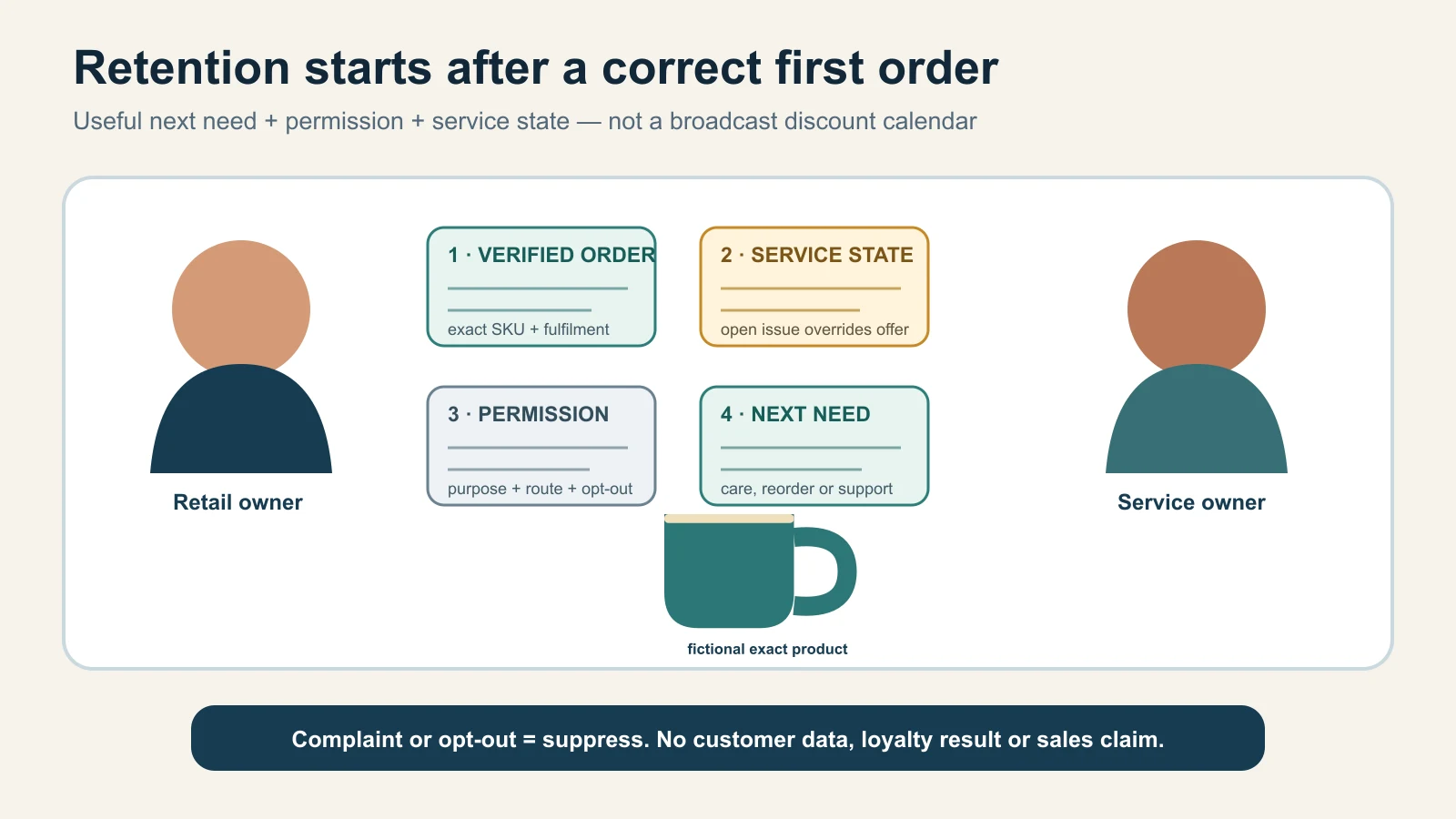
Original GPTWala editorial illustration using fictional people, one fictional exact product and blank operating cards. It is not a client result, loyalty dashboard or sales claim.
Reviewed and updated: 12 August 2026
To improve repeat purchase and customer retention, a local retailer should start with a correct completed-order record, not a promotional list. Record the exact product and variant, fulfilment outcome, service or replenishment logic, customer’s chosen communication route, permission purpose and opt-out state. Then send only the next message that is useful for that product lifecycle: care or service, a genuine replenishment need, a compatible recommendation, a relevant seasonal range or a respectful win-back. Stop when the customer opts out, complains, the source facts are uncertain or the offer no longer fits.
Retention is the business’s ability to keep delivering value after the first transaction. Repeat purchase is one possible outcome. A durable appliance may create retention through reliable service rather than frequent buying; a neighbourhood grocery may see regular replenishment; a jewellery shop may retain a customer through care, repair and trust. The system should fit the product—not force every customer into the same discount calendar.
This guide owns the post-purchase retention operating system. The WhatsApp selling guide owns enquiry-to-order and fulfilment. The WhatsApp follow-up templates own active-enquiry messages before purchase. The digital catalogue guide owns product-master structure, and the future product-business unit-economics guide will own contribution, margin and affordable-acquisition calculations.
The examples below are fictional operating models, not GPTWala client results. Messaging, privacy, consumer, loyalty, product and sector requirements vary; verify the current rules and the actual customer/data flow before implementation.
Customer retention is not “message everyone who ever bought.” It is the continuation of a worthwhile customer relationship through accurate products, fulfilled promises, relevant service and permissioned communication.
Separate the outcomes
Outcome
What it means
What it does not mean
Successful first order
Correct product, terms, payment and fulfilment completed
Customer wants marketing
Retained customer
Relationship remains useful and in good standing over a defined period
Customer must buy frequently
Repeat purchase
Customer completes another eligible order
The reminder caused the order
Reorder
Same or related product is purchased again based on a real need
Every product has a fixed cycle
Service retention
Customer returns for care, support, repair or warranty route
Service interaction is permission to upsell
Referral
Customer makes a genuine introduction/recommendation
Business may use their name or contacts without permission
Reactivation
A previously inactive customer completes a new relevant action
A promotional send itself is a win-back
A retailer can improve one outcome while damaging another. A discount may create an early second order but teach the customer to wait, compress margin or increase returns. A high message volume may create replies and opt-outs at the same time.
Write a retention objective with a boundary
Use this pattern:
Help [defined completed-order cohort] get the next legitimate value from [exact product/category] through [service/replenishment/compatible range], using [permitted channel/purpose], while protecting [margin, product truth, opt-out and complaint guardrails].
Fictional example:
Help customers who bought the exact two-tier steel tiffin receive care guidance and, only where permission exists, see compatible replacement seals when the approved service interval or customer request creates a real need; stop promotional sends on complaint or opt-out.
That is more useful than “increase retention by 20%”, especially when no baseline or evidence supports the target.
Choose the business record that proves the outcome
Use completed orders, verified refunds/returns, support/service records and the business’s customer record. Do not treat these as repeat purchases:
message delivered;
catalogue opened;
coupon clicked;
“interested” reply;
item reserved but never paid/collected;
duplicate order record;
test order; or
exchange that merely corrects the first transaction.
Choose the real customer lifecycle
Different products create different reasons to return.
Assuming the new phase matches the old specification
Do not invent a replenishment interval because marketing software asks for one. Use product size, documented use guidance where applicable, actual order history and customer preference. A bottle of shampoo, a bag of rice and a water purifier filter do not share a cadence.
Map the relationship state
Useful post-purchase states include:
fulfilment pending;
delivered/collected, verification pending;
issue or complaint open;
successful use/onboarding;
service/care due by a verified rule;
replenishment may be relevant;
compatible cross-sell may be relevant;
seasonal/collection interest with permission;
inactive but permission still valid under current rules;
opted out/suppressed; and
closed/deleted/archived under the business’s policy.
A customer with an unresolved issue should not enter the promotional lane because a calendar date arrived.
Define inactivity by product, not ego
Someone who buys a sofa once in three years is not necessarily a “lost customer” after 60 days. A weekly-grocery buyer may be genuinely inactive after a much shorter business-defined interval. Use observed purchase patterns and product logic; do not publish a universal dormant-customer benchmark.
Create an order-to-retention handoff
Retention starts when the first order is confirmed correctly and fulfilled. Build the handoff before creating campaigns.
The retention-ready order card
Field group
Record
Why it matters
Customer/account
Controlled ID, buyer type and preferred name/language as appropriate
Connects orders without relying on chat memory
Product
Exact SKU, variant, pack, quantity and approved product name
Prevents wrong recommendations
Offer
Price/discount basis, included items and material terms
Separates first-order promise from future offer
Fulfilment
Delivery/collection date, status and any exception
Starts service only after reality is known
Service
Care, installation, warranty/service route and relevant schedule source
Supports useful post-purchase help
Permission
Channel, purpose/category, source, date and expectation
Controls subsequent messaging
Suppression
Opt-out, complaint, sensitive-case or do-not-promote state
Stops harmful sends
Next need
Rule and earliest review trigger—not a guessed date
Routes service/replenishment responsibly
Owner
Person/team responsible for service, offer and suppression
Prevents unowned automation
Do not put payment credentials, identity documents or unnecessary sensitive notes into a shared marketing sheet.
Confirm product truth before recommending anything
The retention record must identify what the customer actually received, not merely what appeared in the abandoned cart or first quote. Check:
exact SKU and variant;
package/version;
quantity and included accessories;
delivery or exchange outcome;
compatibility details genuinely known;
warranty/service status as applicable; and
any complaint or product-safety restriction.
If the customer exchanged size M for L, a later “more like your size M” message is both irrelevant and a data-quality warning.
Close the first-order defects first
Before promotion, confirm:
delivery/collection completed;
payment/refund state reconciled;
missing/damaged/wrong item issue routed;
installation or onboarding need handled;
promised document/invoice/warranty path delivered; and
customer preference/opt-out captured.
Retention cannot be repaired by sending a coupon over an unresolved service failure.
Record permission, purpose and suppression
Permission is not one permanent yes/no cell. It has a source, channel, purpose, expectation and current state.
Use a communication-permission record
Field
Example of a controlled value
Avoid
Channel
WhatsApp / SMS / email / call / app
“All channels” by default
Purpose
Order service / care / replenishment / new collection / loyalty
“Marketing” with no expectation
Source
Checkout choice, in-store form, conversation request or contract route
“Number is in billing system”
Date/version
Timestamp and notice/wording version
No evidence of what was agreed
Scope
Product/category/store/region as appropriate
Unlimited unrelated promotions
Frequency expectation
Customer-facing description or preference
Hidden high-frequency automation
Status
Active / paused / opted out / suppressed / unresolved
Deleted opt-out message with no action
Actioned across
WhatsApp list, CRM, SMS/email tool and manual sheet
Suppressed in one place only
Do not infer promotional permission from an invoice, warranty registration, support request, public phone number or saved contact.
Separate service from marketing
Examples of service/task continuation may include an order update, a requested invoice, an applicable care instruction or a response to a warranty question. A replenishment offer, new collection, cross-sell, birthday coupon, referral reward or “we miss you” message may be marketing.
The exact classification and permitted route depend on the channel, content, context and current rules. WhatsApp’s current Business Messaging Policy requires the person’s number plus opt-in permission for subsequent messages/calls, requires opt-outs to be honoured and places responsibility for notices, permissions and legal compliance on the business. Its Platform-specific message categories and service-window controls must not be copied casually onto another channel or product.
Make opt-out a system action
When a customer says stop, unsubscribe, do not message or an equivalent clear instruction:
acknowledge without adding a promotion;
suppress the relevant purpose/channel promptly;
cancel pending scheduled sends;
update every sending source, not only the chat label;
keep only the minimum suppression record needed under the approved policy; and
define who can reverse a suppression and on what new evidence.
Do not force the customer to visit the store, call another number or complete a long form to stop promotional messages.
Treat legal timing as current work
India’s data-protection framework has phased commencement. The official DPDP Act commencement record records commencement beginning 13 November 2025 with many core provisions scheduled later. That is a freshness warning—not a ready-made consent script. Verify current law, rules, channel policy, customer context and data flow before implementation.
Segment by the next legitimate need
Useful segmentation changes what the business should do. Decorative labels such as “VIP”, “gold” or “high value” often change only tone.
Start with lifecycle and fit
Segment
Entry evidence
Appropriate action
Stop/exit
New fulfilled customer
First completed order, no open issue
Care/onboarding and preference check
Complaint, return or opt-out
Replenishment eligible
Exact product plus supported consumption/order-history rule
Ask whether a reorder is useful
Customer says not needed; product unavailable
Service due
Verified product and documented service schedule
Service reminder/booking route
Service completed, product disposed/transferred or opt-out as applicable
Compatible recommendation
Exact owned product plus verified compatibility
Show one relevant option and why
Compatibility uncertain or customer declines
Seasonal opt-in
Recorded category/season interest and permission
Curated current range
Permission ends, season/stock changes
Lapsed relationship
Business-defined inactivity plus valid route/purpose
One respectful relevance check or stop
No interest, complaint, invalid permission or opt-out
Complaint/recovery
Open issue/service failure
Human resolution only
Close only after documented outcome
Suppressed
Opt-out, policy or risk state
No promotional action
Authorised new permission/evidence only
Do not segment with unsupported inference
Avoid assuming or deriving sensitive or intimate traits from product history or conversations. Do not infer health conditions, religion, pregnancy, financial hardship, relationship status or personal events to make a promotion feel personalised.
Use the least information needed:
exact purchased product;
relevant variant/compatibility;
transaction date and quantity;
service area;
chosen language/channel;
permission purpose; and
explicit preferences the customer actually provided.
Keep value and risk separate
A high-spend customer with an unresolved complaint should not receive a “VIP upgrade” before resolution. A low-spend customer may be an excellent long-term relationship. Maintain separate fields for:
commercial history;
service/complaint state;
permission state;
product/compatibility facts; and
next legitimate need.
Do not let a single score override a hard stop.
Build an event-driven retention map
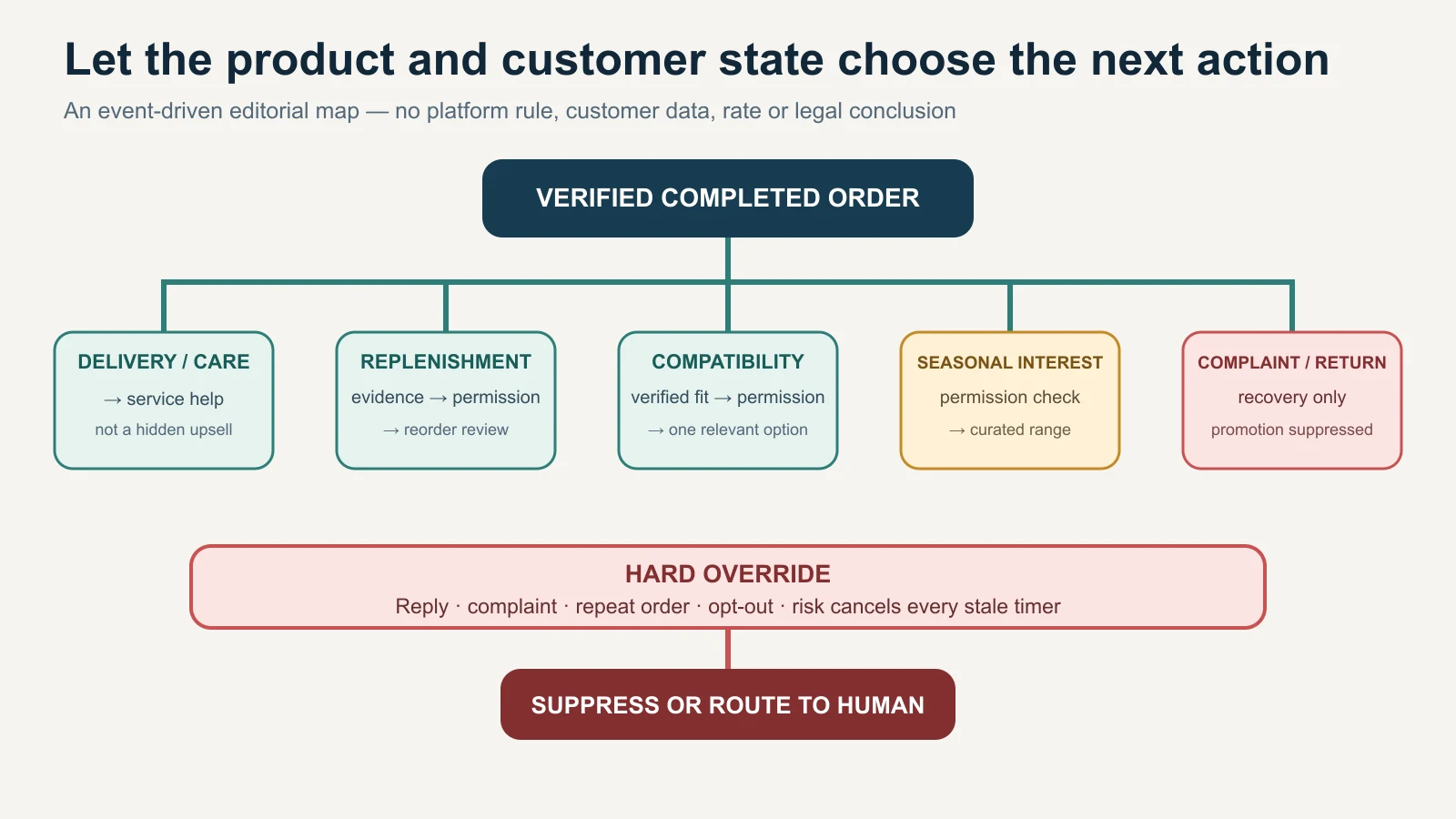
Calendar blasts are easy to schedule. Event-driven messages are more likely to be explainable.
Trigger library
Trigger
Source required
Message job
Hard stop
Delivery/collection completed
Fulfilment record
Confirm receipt/care/support path
Delivery unresolved or wrong item
Care/setup window
Product-specific instruction and actual fulfilment
Help correct use/maintenance
Advice not approved or safety issue
Replenishment review
Exact product/pack plus customer/order pattern
Ask if restock is useful
Timing guessed, product expired/discontinued or no permission
Documented service due
Product/service schedule and serial/order reference as applicable
Offer official service route
Schedule/product identity uncertain
Compatible accessory
Exact product plus verified compatibility
Explain one relevant accessory
Compatibility not documented
Seasonal/new collection
Current range, stock basis and category permission
Curated discovery
Wrong segment, false scarcity or no permission
Price/offer change
Approved offer version
Communicate accurate terms to eligible segment
Old price, unavailable product or misleading saving
Customer request
Recorded question/preference
Respond to stated task
Request withdrawn or already resolved
Complaint/return
Support record
Resolve and learn
Any promotional automation
Recall/safety correction
Authoritative incident/compliance process
Urgent factual service communication
Marketing team improvises wording
Use a trigger decision card
Before each send, answer:
Which exact customer/order/product qualifies?
What event or evidence created the need?
Is the purpose service, marketing or another defined category?
Is the chosen channel permitted under current policy/law?
What current product, price, stock and claim sources support the content?
What response should move or stop the flow?
Who owns exceptions and opt-outs?
Which record proves the action and outcome?
If an automation cannot answer these fields, it is not ready.
Event beats timer
If a customer replies, complains, returns the product, purchases again, changes preference or opts out, cancel the old timer and route the new state. Never keep sending a scheduled “time to reorder” sequence after the customer reports that the product caused an issue or was returned.
Original GPTWala operating diagram with no customer data, result or legal conclusion. Complaints, repeat orders and opt-outs override stale timers.
Make service the foundation of retention
The first post-purchase message should reduce uncertainty, not manufacture another purchase.
Design the service layer
Depending on the product, include:
receipt/delivery check;
setup, care or storage guidance from an approved source;
invoice or warranty-document route;
correct support contact and hours;
installation or service booking;
exchange/return process as applicable;
product-safety or usage limits; and
clear escalation for damage, missing parts or wrong variant.
Do not turn a legal or contractual consumer right into a “special loyalty benefit”. The CCPA’s Guidelines for Prevention of Misleading Advertisements and Endorsements, 2022 include a condition that an advertisement should not present rights conferred by law as a distinctive feature of the advertiser’s offer.
Use a service-close record
For an issue or request, capture:
order/SKU and issue type;
date reported and owner;
evidence supplied/checked;
agreed next step and deadline;
actual resolution;
refund/replacement/service record where applicable;
customer confirmation or documented closure state; and
product/process root cause.
Do not mark a complaint “resolved” because the promotional calendar needs the customer back in an active segment.
repeated care questions → catalogue/landing-page content update; and
opt-outs after one campaign → permission, relevance and frequency review.
Service recovery is not only a customer-message problem.
Design repeat offers without discount addiction
A repeat offer should solve the next need more clearly than another seller, not merely be cheaper.
Use five repeat-purchase value routes
Convenience: saved exact product/variant, easier reorder and known service route.
Relevance: compatible or genuinely adjacent products, not the whole catalogue.
Continuity: same specification, shade, size, pack or documented replacement.
Service: installation, care, alteration, repair, refill or pickup where genuinely offered.
Recognition: transparent loyalty benefit or early access within permission and stock reality.
Price can be part of the offer. It should not be the only reason the relationship exists.
Write a repeat-offer truth card
Field
Required decision
Exact product/offer
Same SKU, replacement, compatible accessory or new range?
Buyer fit
Why is it relevant to this segment?
Price/benefit basis
Fixed, tiered, coupon, points or quote; current conditions
Availability
Source and last checked; no fake scarcity
Inclusion/quantity
Exact unit, pack and exclusions
Claim evidence
What proves quality, compatibility, saving or performance?
Timing
Product/customer event—not an arbitrary automation date
Channel/permission
Current purpose and opt-out route
Margin/operations
Can the business fulfil it responsibly?
Stop owner
Who pauses it for stock, complaint, data or claim failure?
The product-business unit-economics guide should be used when live to test whether discounts, delivery, returns, service and staff time leave acceptable contribution.
Avoid false urgency and fake personalisation
Do not write:
“Your favourite is almost gone” when favourite/stock is inferred;
“Only for you” when the offer is public;
“Last chance” when the deadline will reset;
“You need a replacement now” without a verified basis;
“Best customer price” without defined comparison; or
“We saved this for you” when nothing is reserved.
Truthful urgency can exist when a real, dated stock/offer/service condition supports it. Record the source and stop the message when it expires.
Build a simple, honest loyalty programme
A programme is useful only when customers and staff can understand and operate it.
Start with one behaviour and one benefit
Examples:
verified points on eligible completed purchases;
a clearly defined reward after a stated number/value of eligible orders;
member price on named products/periods;
paid or earned service/alteration benefit;
early access to a limited current assortment; or
referral benefit after the referred customer completes the stated action.
Do not launch points, tiers, cashback, referrals, birthdays and paid membership together if the business cannot reconcile one.
Publish the programme rules clearly
State:
who can join;
what earns value and what does not;
how returns/cancellations affect it;
how and where benefits can be used;
exclusions, limits and expiry where lawful/applicable;
how balances/corrections are handled;
data and communication choices;
opt-out/closure route; and
contact/escalation path.
Avoid tiny-text expiry, surprise exclusions, hidden automatic enrolment or a reward that cannot realistically be redeemed.
Treat points and benefits as controlled records
Assign owners for:
rule/version approval;
balance/reward calculation;
adjustment authority;
fraud/error review;
returns/reversals;
financial/accounting treatment;
customer support; and
programme pause/closure.
A handwritten stamp card can work for a small shop if it is clear and reconcilable. A complicated app is not automatically more trustworthy.
Handle complaints, returns and recovery
Complaint handling is not a cross-sell opportunity.
Apply the recovery-first rule
When a complaint or return opens:
suppress unrelated promotions;
identify the exact order/product/variant;
acknowledge the issue without inventing the cause;
follow the current return, warranty, service and legal route;
give a named next step and owner;
record the actual outcome; and
correct the product, offer, fulfilment or content source when needed.
Do not offer a coupon on the condition that the customer withdraws a complaint or posts a positive review. Do not use AI to decide fault or eligibility from an emotional chat summary alone.
Separate goodwill from rights and facts
A goodwill gesture may be appropriate under approved authority. It should not:
replace an applicable right or promised remedy;
require a misleading review;
hide a safety/quality issue;
imply the customer accepted fault;
become a public promise for every case unless intended; or
be calculated by an unapproved AI rule.
Learn at product level
Group issues by exact SKU, batch/pack/version where relevant, store, supplier, fulfilment route and issue type. A rising complaint count may reflect more sales; use rates with denominators and severity, not raw counts alone.
Escalate safety, regulatory, counterfeit, recurring defect or data incidents through the appropriate specialist process. Marketing should not improvise a recall or technical statement.
Ask for feedback, reviews and referrals responsibly
Feedback is operational evidence. A public review is the customer’s representation. A referral introduces another person. Treat them differently.
Ask for honest feedback at a sensible moment
Wait until the customer has had a fair chance to receive/use the product or complete service. Ask an open question such as whether the product and experience matched expectations. Route a problem to support; do not pressure the customer to publish before help is available.
Keep review requests neutral
ask for an honest review, not a five-star review;
do not write the customer’s praise for them;
do not suppress every negative customer while asking only happy customers to publish if that would mislead;
disclose incentives/material conditions where required;
follow the review platform’s current policy; and
never fabricate a name, photo, quote, rating or purchase.
The ASCI Code requires objectively ascertainable claims to be capable of substantiation and advertising not to mislead through statement, implication, omission, ambiguity or exaggeration. A customer quote does not prove every technical or performance claim inside it.
Ask for referrals with context and permission
Better:
If another local retailer needs the same 24-piece assortment, you may share this current catalogue link. Please do not send us anyone’s number without their permission.
Avoid uploading a customer’s contacts, asking for “five numbers” or starting WhatsApp outreach to a referred person without a valid channel/purpose route.
Verify referral rewards
State who qualifies, the required action, reward, timing, reversals and exclusions. “Refer and earn” should not imply unlimited income or guarantee. Do not mark a referral successful until the defined verified action occurs.
Use WhatsApp and AI without losing trust
WhatsApp can support service and permissioned retention, but it should not become a broadcast shortcut around relevance.
Use the right WhatsApp product and message route
The Business app and Business Platform have different tools and controls. The Platform has current message-category, template, service-window and pricing rules; app features and limits can also change. Check the official Business Messaging Policy, Messaging Guidelines and actual authorised account before implementation.
Do not use scraped numbers, harmful bulk/automation behaviour, repeated unwanted contact or a personal account as a hidden mass-marketing system.
Use a five-part retention-message brief
This article does not provide a full copy library; Article 22 owns message templates. For each retention communication, record:
customer/order/product context;
trigger and purpose;
one useful fact or offer;
one truthful next action; and
stop/opt-out route where relevant.
The message should still make sense if the discount is removed.
Appropriate AI assistance
AI may help:
normalise approved product names and categories;
draft variations from supplied facts;
translate a reviewed message for human language approval;
summarise a service thread with links to the source;
flag missing fields or incompatible states;
group anonymous issue reasons for review; and
produce controlled content layouts.
Human or authoritative-system approval required
Do not let AI decide or invent:
permission, opt-out or legal basis;
customer identity or sensitive traits;
exact product, variant or compatibility;
stock, price, discount, points or reward balance;
warranty, return, refund or complaint outcome;
safety, performance, health or certification claim;
delivery/service promise;
fraud or customer fault; or
whether a customer should receive a high-pressure message.
Do not paste raw customer chats or order records into an AI tool without reviewing the selected account’s current terms, access, training, retention, deletion and business privacy position.
Use AI imagery with product truth
When creating retention creatives or a “matching product” visual:
use the exact approved product/variant asset;
preserve shape, colour, material, pattern, text and included quantity;
do not generate a fake before/after, customer, review or result;
do not show incompatible accessories;
keep prices/terms as controlled native text; and
label fictional/editorial imagery so it cannot be mistaken for customer evidence.
Measure retention with cohorts and guardrails
Retention metrics are meaningful only when the customer, order, product and time definitions are explicit.
Start with one completed-order cohort
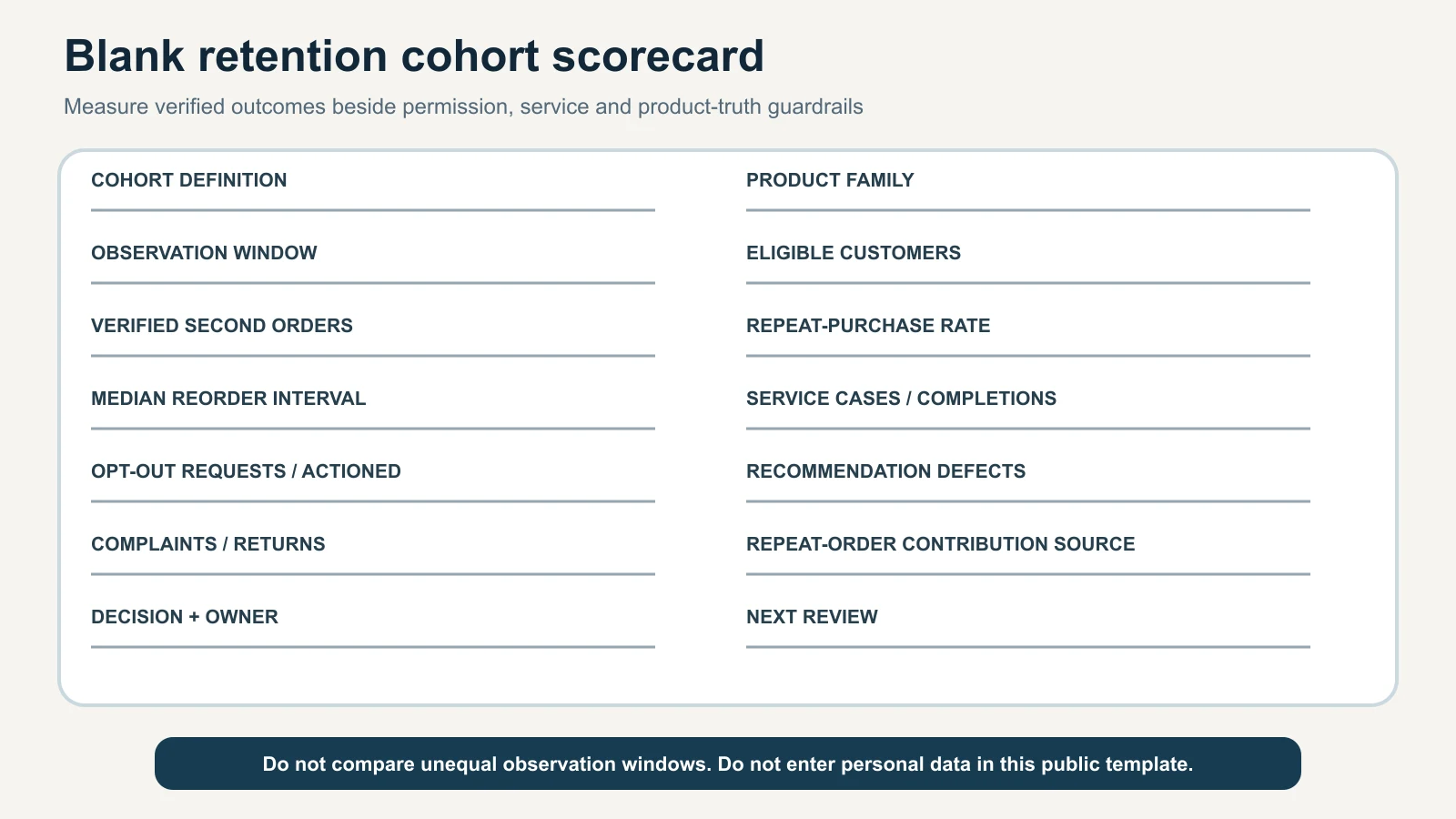
A cohort could be customers whose first eligible order in one product family completed during a defined month. Follow them for an observation window appropriate to that product lifecycle. Give every customer equal observation opportunity before comparing cohorts.
Do not compare a cohort observed for twelve months with one observed for two weeks and call the difference retention.
Useful measures
Measure
Definition
Guardrail
Cohort repeat-purchase rate
Eligible cohort customers with a verified second eligible order in the defined window ÷ eligible cohort customers
State window, exclusions and completion rule
Reorder interval
Time between eligible completed orders for repeat customers
Use product/category context; report distribution/median where useful
Purchase frequency
Eligible completed orders ÷ distinct purchasing customers in the period
Separate exchanges/tests/cancellations
Service completion
Eligible service cases completed under definition ÷ eligible service cases
Do not treat closure code as customer satisfaction
Permission coverage
Customers with current recorded route/purpose ÷ customers considered for that communication
No permission means not eligible, not “missing opportunity”
Opt-out action completeness
Opt-out requests suppressed across all relevant send systems ÷ opt-out requests
Must be 100% operationally targeted; investigate any failure
Defined complaints/returns ÷ eligible completed orders
Segment by SKU/cause/severity; raw count can mislead
Repeat-order contribution
Verified contribution from repeat orders under current cost rules
Route full calculation to A29; revenue alone is insufficient
No universal “good retention rate” is published here. Product cycle, observation window, buyer type, store model, data quality and margin structure differ.
Separate influence from cause
A customer may return because of product quality, location, staff relationship, habit, price, service, referral, season, availability or a message. Record source where possible, but do not credit the last WhatsApp message with the entire repeat order automatically.
Use guardrails beside growth
Review repeat outcomes with:
opt-outs and complaints;
wrong-product recommendations;
duplicate sends;
returns/exchanges;
discount and delivery cost;
service load;
data/permission defects;
stock/fulfilment failures; and
gross margin/contribution.
A retention campaign that raises repeat orders while creating permission failures or unprofitable fulfilment is not ready to scale.
Original blank GPTWala template. It contains no customer data, benchmark, rate or business result.
Run a controlled first retention cycle
Start with one product family, one completed-order cohort and one useful next need.
Step 1: audit the source records
Verify exact orders, fulfilment, product variants, service/complaint state, channel permissions, opt-outs and duplicates. If the data cannot distinguish an order from an enquiry or one variant from another, repair the source before messaging.
Step 2: choose one lifecycle job
Examples:
post-delivery care for a durable product;
permissioned replenishment review for one consumable pack;
documented service reminder;
compatible accessory recommendation; or
one seasonal category update for customers who chose it.
Do not combine service, cross-sell, loyalty launch, referral and win-back in the first cycle.
Step 3: write the decision rules
Record:
entry criteria;
source fields;
purpose/channel permission;
content/offer version;
timing/event rule;
response branches;
complaint/opt-out suppression;
owner and escalation; and
outcome/guardrail measures.
Step 4: rehearse fictional and staff journeys
Test at least these states without real promotional sends:
correct product and permission;
wrong variant in the record;
open complaint;
opted-out customer;
product discontinued;
no stock;
incompatible accessory;
customer already repurchased;
duplicate customer record; and
request in another language.
The goal is to find truth and routing defects, not to create a response-rate claim.
Step 5: run a small authorised cohort
Use only eligible customers under the approved route. Inspect every message and response. Give service/operations authority to pause the cycle for product, offer, stock, fulfilment, complaint, permission or data errors.
Step 6: review and decide
Choose one:
continue with the same rule;
correct a specific defect and retest;
change the lifecycle job or eligible segment;
stop because the need, permission, economics or operating control does not support the cycle.
Do not add more customers simply because few people replied.
Apply the system to Indian local retailers
These scenarios are fictional and illustrate routing decisions, not customer results.
Neighbourhood personal-care retailer
Lifecycle: replenishable products with product/skin/health claim risk.
Useful retention: receipt check, storage/use information from the approved label, and a permissioned reorder review based on the exact pack and customer preference.
Product-truth stop: do not infer a medical condition, guarantee a result, rewrite directions, recommend a different formulation as equivalent or send an expired/old-pack image. Route adverse reactions or health questions appropriately; do not treat them as sales opportunities.
Useful retention: preserve actual final size/variant after exchange, record explicit category preference, and send a curated current range rather than every arrival.
Product-truth stop: do not say “your size” when the record is uncertain, alter garment colour/print/fit in AI imagery or manufacture festival scarcity. Suppress promotions during unresolved exchange/quality issues.
Appliance and electronics retailer
Lifecycle: installation, warranty/service, compatible accessories and replacement over a long horizon.
Useful retention: verified setup/service route, documented service reminders and model-specific accessories.
Product-truth stop: do not make a paid accessory look required for warranty, recommend an incompatible part or promise same-day service without current capacity. A service reminder must not disguise a generic upgrade sale.
Jaipur jewellery retailer
Lifecycle: care, repair, appointment, exact-item/collection interest.
Useful retention: care guidance, repair/service route and permissioned appointment or matching-piece discovery using the exact item record.
Product-truth stop: do not change stone count, setting, chain, clasp, hallmark, colour or scale; do not imply purity or investment return from an image or generic testimonial.
Local homeware and kitchen shop
Lifecycle: add-on pieces, replacements and gifting/seasonal range.
Useful retention: exact compatibility for lids, seals or accessories; care support; curated opt-in collection.
Product-truth stop: do not show props as included, recommend a lid because it “looks similar” or claim food-safety/performance without an approved source.
Neighbourhood grocery or speciality-food retailer
Lifecycle: regular replenishment, availability and expiry/storage sensitivity.
Useful retention: customer-chosen list/reorder support, current pack/price/availability confirmation and category-specific storage information.
Product-truth stop: do not infer dietary/health needs, make medical/nutritional promises, substitute pack sizes silently or call a product “fresh” without a defined current basis.
Local B2B uniform or packaging retailer
Lifecycle: exact-spec reorder and seasonal/business demand.
Product-truth stop: never copy an old logo/artwork/specification or price into a new order without buyer confirmation. Repeat does not mean unchanged.
Avoid common retention mistakes
Mistake
Why it fails
Safe correction
Every past buyer enters one broadcast list
Purpose, relevance and permission differ
Record channel/purpose and lifecycle eligibility
Retention begins with a coupon
First-order/service defects stay unresolved
Complete the order-to-retention handoff first
Fixed reorder timer for every product
Need and use cycles vary
Use product/order/customer evidence
“VIP” score overrides complaints
High spend hides risk and poor experience
Keep complaint/suppression as hard gates
AI guesses preferred size or product
Wrong recommendation damages trust
Use exact fulfilled order and explicit preference
New-customer price shown as loyalty
Benefit is misleading or inaccessible
Define genuine member/repeat value and conditions
Points rules live only in staff memory
Balances and redemption become disputed
Publish versioned earning/redemption rules
Service message contains hidden upsell
Customer cannot distinguish support from marketing
Separate purpose and keep service action primary
Fake urgency drives win-back
Deadline/stock claim is untrue
Use verified time/stock basis or remove urgency
Customer must call to opt out
Friction prolongs unwanted messages
Simple channel-appropriate suppression process
Complaint closed to resume promotion
Root issue and customer state are ignored
Require documented resolution/closure
Review request asks for five stars
Feedback becomes pressured/misleading
Ask neutrally and follow platform/current rules
Referral means uploading contacts
Third parties are contacted without proper route
Ask customer to share a link or obtain permission
Delivered messages counted as retention
Communication activity replaces business outcome
Use completed-order cohorts and service records
Repeat revenue celebrated without cost
Discounts, returns and service may destroy contribution
Measure guardrails and use A29 economics
Connect retention to the DAA growth system
Retention strengthens Digital Presence when customers can find accurate care, service, reorder and support routes. AI Content Creation can make those explanations more repeatable when facts and customer data remain controlled. ₹100/day WhatsApp ads belongs to acquisition testing—not a reason to neglect existing customers or message them without permission.
GPTWala’s workshop teaches the DAA sequence: Digital Presence → AI Content Creation → ₹100/day WhatsApp ads. The budget is a taught test-system concept, not a guarantee of reach, customers, repeat orders, revenue, profit or return on ad spend. Retention still depends on product value, fulfilment, service, permission, relevance and economics.
It is the continuation of a useful customer relationship after the first order through correct fulfilment, service, relevant next needs and permissioned communication. It does not require frequent buying for every product category.
How can a small shop increase repeat purchases?
Start with accurate completed-order records, fix first-order issues, identify the product’s real next need, record communication permission, send one relevant service/replenishment/compatible offer and measure verified second orders with complaints and opt-outs beside them.
How often should I message existing customers?
There is no universal cadence. Base timing on the product lifecycle, actual order/use pattern, customer expectation, message purpose, current permission and channel rules. Replies, complaints, repeat orders and opt-outs should override scheduled timers.
Does a previous purchase mean I can market on WhatsApp?
Do not assume so. WhatsApp’s Business Messaging Policy requires the person’s number and opt-in permission for subsequent messages/calls and requires opt-outs to be honoured. Responding to an order or support task is not unlimited permission for unrelated promotions.
What customer information should a retailer keep for retention?
Keep the minimum controlled information needed: customer/account ID, exact fulfilled product/variant, order date/quantity, service or complaint state, relevant next-need rule, chosen channel/language, permission purpose/source/date and opt-out/suppression state. Restrict access and define retention/deletion.
Should I give discounts to retain customers?
Only when the benefit is clear, truthful, maintainable and economically acceptable. Convenience, relevance, compatibility, service and recognition can create repeat value without constant discounting. Measure contribution after delivery, returns, rewards and staff/service cost.
How do I calculate repeat-purchase rate?
For a defined completed-order cohort and observation window, divide eligible customers with a verified second eligible completed order by eligible cohort customers. State the product, window, exclusions and completion rule; do not compare cohorts with unequal observation time.
What is a good customer-retention rate for retail?
There is no single rate that fits groceries, apparel, jewellery, appliances and B2B supplies. Product cycle, buyer type, period, margin, data quality and definition differ. Compare like-for-like cohorts and improve against your own trustworthy baseline without sacrificing guardrails.
Can AI automate customer retention?
AI can draft from approved facts, translate for review, classify states and flag missing fields. It should not decide permission, opt-outs, product compatibility, price, stock, reward balances, complaints, refunds, safety or sensitive traits without authoritative systems and human approval.
How should I handle a customer complaint before sending promotions?
Suppress unrelated promotions, identify the exact order/product, route the current service/return/warranty process, record the outcome and fix the source defect. Resume only when the relationship and permission state support it—not because a timer expires.
Is a loyalty programme necessary for retention?
No. Reliable product truth, service, easy reorder and relevant communication may be enough. If a programme is used, start with one earning behaviour and one understandable benefit, publish the rules and control balances, returns, expiry, access and support.
How do I ask for referrals without spamming people?
Ask a satisfied, eligible customer to share a current link with someone who may genuinely need the product. Do not request or upload third-party contacts without an authorised permission route, and state any referral reward conditions clearly.
Practical decisions. Verified business truth. Clear next steps.
Use this guide as an operating checklist, then verify platform rules, commercial records and customer-facing promises before implementation.
Reviewed and updated: 12 August 2026
A good referral programme gives an eligible existing customer a simple, permission-respecting way to introduce a relevant new buyer, clearly states the reward and qualifying event, protects margin and fraud, and pays only after the defined outcome is verified. Referrals should not be disguised reviews, unsolicited bulk messages or rewards for positive sentiment.
This guide owns referral eligibility, mechanics, economics and measurement. This guide gives you an operating method, not a promise of rankings, enquiries, sales or profit. Platform policies, fees, eligibility and laws can change, so verify the linked primary sources and your own commercial records before implementation.
The real question is not whether a referral programme sounds useful. The question is whether it solves a defined buyer or operating problem for one product, audience and channel without breaking product truth, margin, consent or delivery capacity.
Use these diagnostic questions before spending money or assigning work:
Which existing customers are eligible to refer?
What exact event qualifies the new customer and reward?
How will the programme obtain permission and prevent spam?
What is the maximum affordable reward after mature contribution?
Write the answers in one decision note. If a critical answer is unknown, make discovery the next task. Do not let an attractive tool, template or competitor example silently become the strategy.
Build the source-of-truth sheet first
Every execution step should pull facts from an approved record. A source-of-truth sheet prevents a copywriter, agency, AI tool or busy salesperson from filling a gap with a plausible but wrong product promise.
Truth item
Authoritative source
Owner
Stop condition
Product and offer facts
Approved SKU, catalogue and offer master
Product or merchandising owner
A buying-critical field is missing or inconsistent
Buyer need and language
Recorded enquiries, interviews and sales notes
Sales or customer owner
The audience is assumed rather than evidenced
Price, margin and fulfilment
Current finance, stock and delivery records
Finance or operations owner
The promise cannot be fulfilled profitably or reliably
Channel and permission rules
Current platform policy and consent record
Channel owner
Permission, eligibility or policy is unclear
Add a version date to the sheet. When price, stock, specification, channel rule, audience permission or fulfilment promise changes, pause affected assets until their owner approves the update.
A practical implementation workflow
Step 1: Define the programme job
Choose new customer acquisition, local awareness, dealer introduction or category trial.
Evidence before moving on: One objective and eligible product/cohort.
Evidence before moving on: Terms are understandable before participation.
Step 3: Calculate reward economics
Use retained contribution after programme, fulfilment and acquisition costs.
Evidence before moving on: Owner-approved reward ceiling.
Step 4: Design the sharing path
Use a code/link/card that lets the referrer choose whom to contact; do not upload contacts or message people without permission.
Evidence before moving on: Consent and attribution route are documented.
Step 5: Detect abuse and reconcile
Check duplicates, self-referral, cancellations, returns, employee misuse and reward liability.
Evidence before moving on: Verified rewards and dispute process.
Do not combine all steps into one launch. A small controlled version creates evidence that can be reviewed. A large rollout creates more places for the same unnoticed error to spread.
Use the decision table
Situation
Recommended action
Avoid
Product has thin first-order contribution
Use a smaller/value-add reward or do not launch
Funding a cash reward from future hope
Referral requires customer to share contacts
Let the customer share the link directly
Collecting third-party numbers
Reward depends on positive review
Separate the systems
Buying sentiment
New customer returns the order
Apply the written maturity rule
Paying before qualification
Treat this table as a starting policy. Your product risk, average order value, buying cycle, staff coverage, cash cycle and after-sales burden may require stricter gates.
Apply it to Indian product businesses
Local apparel store
A repeat buyer shares a personal referral code. Both benefits apply only after a first eligible purchase passes the exchange window.
Proof to keep: Verified new retained customer and reward ledger.
Homeware brand
A customer introduces a friend to a starter category. The reward is a bounded value-add whose cost fits contribution.
Proof to keep: Incremental contribution and repeat behaviour.
B2B wholesaler
An existing retailer introduces another qualified retailer. The programme uses account-fit, first collected order and anti-duplication rules.
Proof to keep: Qualified new account and collection status.
These examples are intentionally operational rather than aspirational. Replace every placeholder with current records from the actual business. Do not present a fictional example as a client result or an industry benchmark.
Use AI without losing business truth
AI can help organise approved facts, draft alternatives, summarise interviews, classify enquiries, produce controlled content variants and flag missing fields. It must not invent specifications, materials, prices, discounts, stock, delivery dates, certifications, customer consent, testimonials or commercial results.
Use a four-part control:
Bound the input: provide only permitted, current source material.
Constrain the output: state what may change and what must remain exact.
Review by role: the product or commercial owner checks buying-critical facts.
Record release evidence: keep the source version, prompt or brief, reviewer, corrections and approval date.
For customer data, use approved accounts and collect only what the workflow genuinely needs. Do not paste private buyer lists, confidential price sheets or unreleased product files into an unapproved tool. India’s data-protection requirements and implementation timelines should be checked against current official MeitY material and qualified advice for the business.
Avoid the common failure patterns
Rewarding the referral click: Qualify a real mature business outcome.
Buying contact lists through customers: Use permission-respecting share mechanics.
No fraud rules: Define duplicates, self-referral, cancellations and employees.
Ignoring reward liability: Reconcile earned, pending, expired and reversed rewards.
The most expensive failure is usually not weak wording. It is a mismatch between the public promise and the business that must fulfil it.
Measure progress with operating evidence
Do not use reach, clicks or message volume as proof of business value by themselves. Connect upstream activity to a verified downstream event.
Measure
Definition
Decision it supports
Qualified referral rate
Introductions becoming eligible new customers/accounts
Whether the programme attracts fit
Retained contribution after reward
Mature contribution net of programme cost
Whether economics work
Fraud/exception rate
Referrals failing duplicate, self, return or policy checks
Whether controls are adequate
Referral repeat quality
Subsequent retained behaviour of referred cohort
Whether acquisition is durable
Record the denominator, time window, product or offer, channel, source and owner for every rate. Keep observed results separate from forecasts. A short test can show a problem, but it may not support a broad conclusion.
A 30-day implementation plan
Days 1 to 5: define
Choose one product, audience, channel and business outcome. Complete the source-of-truth sheet, baseline and stop rules. Name the owner who can approve or stop the work.
Days 6 to 12: build
Create the smallest usable version. Test links, mobile reading, forms or message routing, exact product facts, price basis, permissions and team handoffs. Use internal testers before real buyers.
Days 13 to 20: run a bounded pilot
Release to a limited, relevant audience or product set. Log every material exception. Do not expand merely because the asset looks polished or early engagement is positive.
Days 21 to 26: reconcile
Connect platform events to enquiry, order, delivery, return and finance records as relevant. Review complaints, mismatches, duplicate handling, response delays and workload.
Days 27 to 30: decide
Choose one outcome: keep, fix, stop or expand one variable. Record why, what changes next and when the next review occurs. Expansion should preserve the same truth, consent and approval controls.
Connect this work to the GPTWala DAA framework
A referral programme can complement DAA demand only when it preserves trust, permission and contribution. If your product business still depends mainly on walk-ins, dealer calls, exhibitions or forwarded catalogues, GPTWala’s free DAA workshop explains how digital presence, AI-assisted content and controlled WhatsApp-led demand generation can work as one system. The workshop is educational and does not guarantee traffic, leads, orders, sales, earnings or profit.
Frequently asked questions
How much should a referral reward be?
Base it on the mature retained contribution of the eligible product and customer cohort, after fulfilment, returns, programme cost and required reserve. There is no universal percentage or rupee amount.
Can I ask customers to share friends’ phone numbers?
A safer design lets the customer choose to share a link or code directly. Do not collect or message a third party without an appropriate lawful basis, notice and channel permission.
Is a referral reward the same as a review incentive?
No. A referral reward is tied to a defined new-customer event. It should never depend on a positive rating or public review. Keep review requests neutral and separate.
Can a small Indian product business start a referral programme without a large budget?
Yes, if it starts with one product, one audience, one owner and one measurable buyer action. A small budget does not remove the need for accurate product facts, realistic fulfilment, permission and a stop rule. Expand only after the first bounded version produces trustworthy operating evidence.
Can AI automate a referral programme?
AI can assist with research organisation, drafting, classification and controlled variants. It should not invent product specifications, prices, stock, delivery promises, customer permission, testimonials or results. A named human owner must verify buying-critical facts and approve release.
How long should I test a referral programme before deciding?
Use a test window long enough for the relevant outcome to mature. A product-page test may need enough qualified visits; a B2B workflow may need the full enquiry-to-decision cycle; retention work may need a repeat-purchase window. Define the event, denominator and review date before launch instead of choosing a universal number of days.
Practical decisions. Verified business truth. Clear next steps.
Use this guide as an operating checklist, then verify platform rules, commercial records and customer-facing promises before implementation.
Reviewed and updated: 12 August 2026
Set up a Google Business Profile only for an eligible real business, then use the business name as recognised offline, a precise address or legitimate service area, a small set of accurate categories, current hours and contact details, and truthful store photos and product information. Assign individual owner/manager access rather than sharing one password, and review the profile whenever operations change.
This checklist owns profile identity, content, access and maintenance for product stores. This guide gives you an operating method, not a promise of rankings, enquiries, sales or profit. Platform policies, fees, eligibility and laws can change, so verify the linked primary sources and your own commercial records before implementation.
The real question is not whether a Google Business Profile sounds useful. The question is whether it solves a defined buyer or operating problem for one product, audience and channel without breaking product truth, margin, consent or delivery capacity.
Use these diagnostic questions before spending money or assigning work:
Does the business meet Google’s current eligibility rules?
What identity is consistently used on signage, receipts and the website?
Which primary category best describes the core business?
Who updates hours, products, photos, reviews and access when staff or operations change?
Write the answers in one decision note. If a critical answer is unknown, make discovery the next task. Do not let an attractive tool, template or competitor example silently become the strategy.
Build the source-of-truth sheet first
Every execution step should pull facts from an approved record. A source-of-truth sheet prevents a copywriter, agency, AI tool or busy salesperson from filling a gap with a plausible but wrong product promise.
Truth item
Authoritative source
Owner
Stop condition
Product and offer facts
Approved SKU, catalogue and offer master
Product or merchandising owner
A buying-critical field is missing or inconsistent
Buyer need and language
Recorded enquiries, interviews and sales notes
Sales or customer owner
The audience is assumed rather than evidenced
Price, margin and fulfilment
Current finance, stock and delivery records
Finance or operations owner
The promise cannot be fulfilled profitably or reliably
Channel and permission rules
Current platform policy and consent record
Channel owner
Permission, eligibility or policy is unclear
Add a version date to the sheet. When price, stock, specification, channel rule, audience permission or fulfilment promise changes, pause affected assets until their owner approves the update.
A practical implementation workflow
Step 1: Confirm eligibility and duplicates
Search for existing profiles and confirm the location is a legitimate customer-facing business or eligible service-area operation before creating anything.
Evidence before moving on: One intended profile per eligible business with duplicates documented.
Step 2: Enter the real identity
Use the real-world name, precise address/service area, direct phone, website and the fewest categories needed to describe the core business.
Evidence before moving on: Fields match signage and owned customer materials.
Step 3: Add decision-useful content
Publish accurate hours, attributes, store description, products or services and representative photos. Avoid promotional claims in identity fields.
Evidence before moving on: A customer can decide whether and when to contact or visit.
Step 4: Set access and update rules
Give people individual Google-account access and define owner/manager roles. Remove departed users and record who controls recovery.
Evidence before moving on: Current access register and named profile owner.
Step 5: Operate reviews and changes
Monitor reviews, holiday hours, closures, moves, phone changes, profile edits and policy notices. Respond without exposing customer information.
Evidence before moving on: Monthly audit plus incident and correction log.
Do not combine all steps into one launch. A small controlled version creates evidence that can be reviewed. A large rollout creates more places for the same unnoticed error to spread.
Use the decision table
Situation
Recommended action
Avoid
A duplicate profile exists
Verify ownership and use the current support/merge route
Creating a third profile
Store moves
Plan the address and website update with evidence
Leaving the old location active indefinitely
Seasonal hours change
Update special hours before customers travel
Relying only on a social post
Agency manages the profile
Keep business ownership and grant role-based access
Giving away the only login
Treat this table as a starting policy. Your product risk, average order value, buying cycle, staff coverage, cash cycle and after-sales burden may require stricter gates.
Apply it to Indian product businesses
Single-location fashion store
The shop uses one name on signage and receipts. The profile matches it exactly, selects the real retail category and keeps special hours current during festivals.
Proof to keep: Identity audit and customer visit-mismatch log.
Retailer with two staffed branches
Each branch has different hours and phone. Each eligible location gets verified unique information and a matching location page.
Proof to keep: Branch-level calls, directions and correction history.
Store using an external agency
The agency posts updates and replies. The owner retains primary control, staff use their own accounts and review escalation rules protect private information.
Proof to keep: Access list, response log and offboarding test.
These examples are intentionally operational rather than aspirational. Replace every placeholder with current records from the actual business. Do not present a fictional example as a client result or an industry benchmark.
Use AI without losing business truth
AI can help organise approved facts, draft alternatives, summarise interviews, classify enquiries, produce controlled content variants and flag missing fields. It must not invent specifications, materials, prices, discounts, stock, delivery dates, certifications, customer consent, testimonials or commercial results.
Use a four-part control:
Bound the input: provide only permitted, current source material.
Constrain the output: state what may change and what must remain exact.
Review by role: the product or commercial owner checks buying-critical facts.
Record release evidence: keep the source version, prompt or brief, reviewer, corrections and approval date.
For customer data, use approved accounts and collect only what the workflow genuinely needs. Do not paste private buyer lists, confidential price sheets or unreleased product files into an unapproved tool. India’s data-protection requirements and implementation timelines should be checked against current official MeitY material and qualified advice for the business.
Avoid the common failure patterns
Keyword-stuffed name: Use the real business name shown offline.
Too many categories: Choose the fewest accurate categories around the core business.
Shared credentials: Use individual owner and manager permissions.
The most expensive failure is usually not weak wording. It is a mismatch between the public promise and the business that must fulfil it.
Measure progress with operating evidence
Do not use reach, clicks or message volume as proof of business value by themselves. Connect upstream activity to a verified downstream event.
Measure
Definition
Decision it supports
Profile field accuracy
Current required fields matching the real store and website
Whether maintenance is controlled
High-intent actions
Calls, directions, website visits or bookings relevant to store use
Which profile content helps
Correction time
Time to resolve a material hours, address, phone or access issue
Whether ownership is effective
Review response quality
Actionable reviews routed and answered under policy
Whether public trust work supports operations
Record the denominator, time window, product or offer, channel, source and owner for every rate. Keep observed results separate from forecasts. A short test can show a problem, but it may not support a broad conclusion.
A 30-day implementation plan
Days 1 to 5: define
Choose one product, audience, channel and business outcome. Complete the source-of-truth sheet, baseline and stop rules. Name the owner who can approve or stop the work.
Days 6 to 12: build
Create the smallest usable version. Test links, mobile reading, forms or message routing, exact product facts, price basis, permissions and team handoffs. Use internal testers before real buyers.
Days 13 to 20: run a bounded pilot
Release to a limited, relevant audience or product set. Log every material exception. Do not expand merely because the asset looks polished or early engagement is positive.
Days 21 to 26: reconcile
Connect platform events to enquiry, order, delivery, return and finance records as relevant. Review complaints, mismatches, duplicate handling, response delays and workload.
Days 27 to 30: decide
Choose one outcome: keep, fix, stop or expand one variable. Record why, what changes next and when the next review occurs. Expansion should preserve the same truth, consent and approval controls.
Connect this work to the GPTWala DAA framework
A well-maintained profile is a simple digital-presence asset that can connect local discovery to calls, directions, WhatsApp or the store website. If your product business still depends mainly on walk-ins, dealer calls, exhibitions or forwarded catalogues, GPTWala’s free DAA workshop explains how digital presence, AI-assisted content and controlled WhatsApp-led demand generation can work as one system. The workshop is educational and does not guarantee traffic, leads, orders, sales, earnings or profit.
Frequently asked questions
Can an online-only store create a Google Business Profile?
Eligibility depends on Google’s current rules. A profile is generally for a business with a customer-facing location or one that travels to customers as a service-area business. Do not use a virtual office or invented storefront to obtain local visibility.
Should I put keywords in my Google Business Profile name?
Use the business name as it is consistently represented and recognised in the real world. Adding products, cities or marketing phrases that are not part of the real name can violate the guidelines.
Can an agency own my Business Profile?
The business should retain ownership and grant the agency appropriate manager access. Each person should use an individual Google Account; do not share the only password or recovery route.
Can a small Indian product business start a Google Business Profile without a large budget?
Yes, if it starts with one product, one audience, one owner and one measurable buyer action. A small budget does not remove the need for accurate product facts, realistic fulfilment, permission and a stop rule. Expand only after the first bounded version produces trustworthy operating evidence.
Can AI automate a Google Business Profile?
AI can assist with research organisation, drafting, classification and controlled variants. It should not invent product specifications, prices, stock, delivery promises, customer permission, testimonials or results. A named human owner must verify buying-critical facts and approve release.
How long should I test a Google Business Profile before deciding?
Use a test window long enough for the relevant outcome to mature. A product-page test may need enough qualified visits; a B2B workflow may need the full enquiry-to-decision cycle; retention work may need a repeat-purchase window. Define the event, denominator and review date before launch instead of choosing a universal number of days.