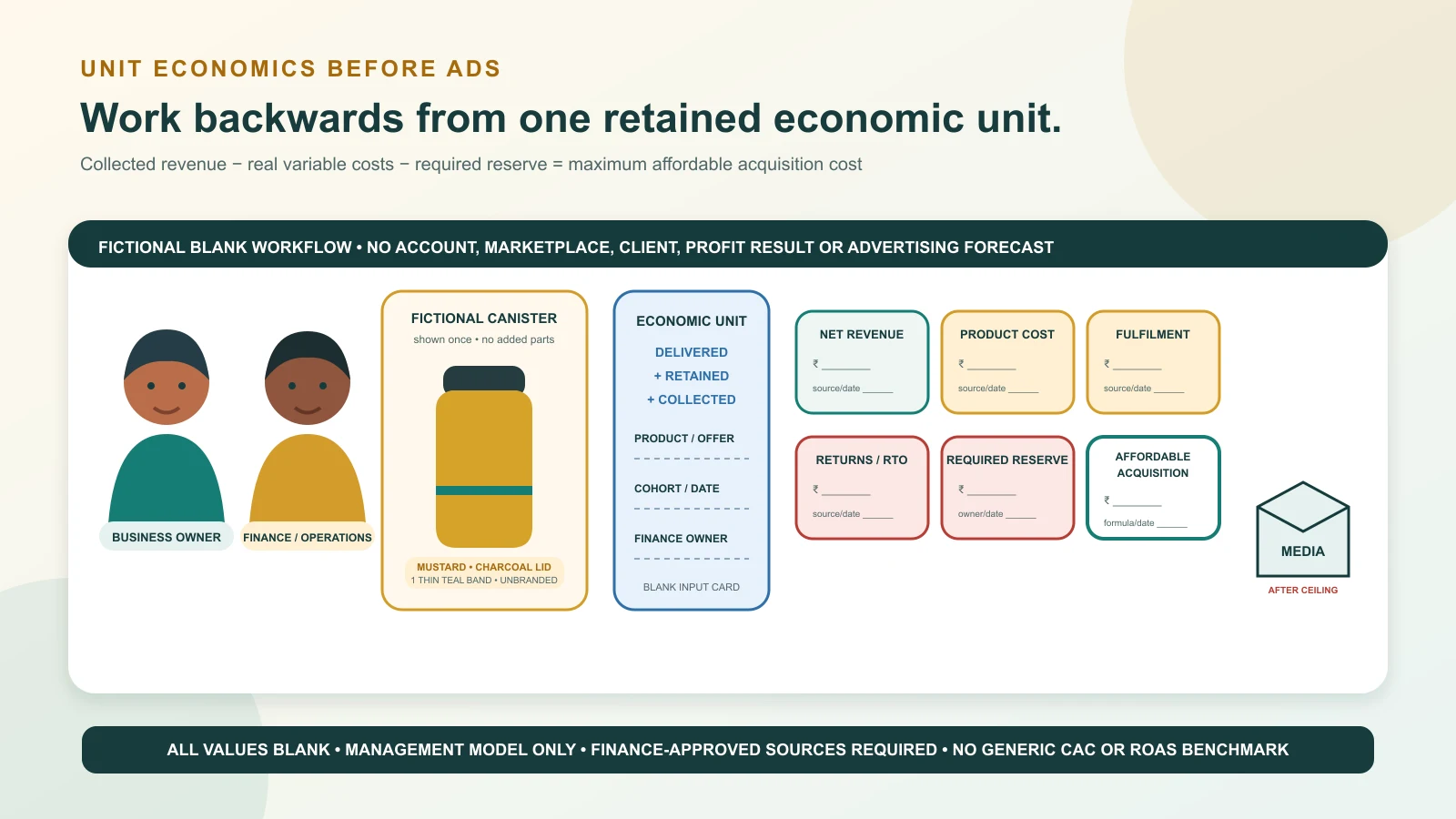
Reviewed and updated: 12 August 2026
Before spending on digital ads, calculate how much contribution one delivered, retained and collected order creates before acquisition cost. Start with finance-approved net revenue—not MRP, gross order value or a payment screenshot—then subtract the product cost and every cost that changes with the order: packaging, shipping subsidy, payment/marketplace charges, variable fulfilment labour, expected cancellations/returns/RTO, warranty/service allowance and other order-variable costs. From what remains, protect the contribution the business requires for overhead, risk, cash and profit. Only the remainder is the maximum affordable acquisition cost.
That ceiling is business-specific and dated. There is no universal “good margin”, lead cost, customer acquisition cost or ROAS for manufacturers, wholesalers, retailers, shopkeepers, apparel sellers, jewellery businesses or product brands. A ₹100/day campaign can be a useful controlled test only after the business knows what an acquired order can afford. Budget is an input; revenue is not profit; and an attributed order is not final economics until delivery, collection, returns and costs are reconciled.
This root guide owns product-business contribution logic, affordable acquisition and profitability decisions. The Meta ads readiness guide owns the pre-spend operational gates, the ₹100/day click-to-WhatsApp guide owns campaign setup/tracking, the small-budget creative testing guide owns accepted-creative economics, and the DAA offline-to-online roadmap connects these decisions to the wider growth system.
Table of contents
- Understand what unit economics should decide
- Choose the right unit and cohort
- Build a source-of-truth cost ledger
- Calculate contribution before acquisition
- Include returns, RTO, warranty and hidden variable costs
- Set a maximum affordable acquisition cost
- Translate order economics into funnel ceilings
- Use ROAS without confusing revenue and profit
- Work through a fictional example
- Compare products, offers and channels
- Adapt the model for B2B and manufacturing
- Check cash flow and working capital
- Set the economic gate before ads
- Reconcile a campaign after delivery
- Apply the model to Indian product businesses
- Protect product, price and performance truth
- Build the worksheet
- Frequently asked questions
Understand what unit economics should decide
Unit economics should help an owner answer decisions such as:
- Can this exact product/offer afford paid acquisition?
- What must be true for a ₹100/day test to be financially interpretable?
- Which product, pack, buyer or channel deserves the first test?
- Is a low cost per chat producing profitable delivered orders or cheap noise?
- Can the business offer a discount or free shipping without destroying contribution?
- Does a wholesale order remain attractive after sampling, credit, freight and sales effort?
- Are repeat purchases real enough to support a higher acquisition ceiling?
- Should the business keep, fix, stop or cautiously expand a campaign?
Unit economics is a decision model, not statutory accounts
The worksheet in this guide is a management view. Finance/accounting should approve revenue, tax, inventory-cost, expense, return, credit-note and cost-allocation treatment for the actual entity. Terms such as gross margin and contribution margin are used inconsistently across businesses, so write the formula beside every label.
Do not force the advertising worksheet to match a generic internet definition when the business’s accountant and records use a documented treatment. Reconcile the management model to the accounting/order records.
Start from the final commercial event
For many product businesses, the useful base unit is:
one new-customer order that was delivered, retained beyond the defined return/cancellation window and collected
This is stronger than:
- click;
- conversation start;
- “Hi” message;
- catalogue share;
- quote sent;
- order placed but unpaid;
- COD order shipped but returned;
- payment screenshot;
- invoiced B2B order still disputed; or
- gross marketplace order value before returns/fees.
Some businesses need a different unit. The key is to define it before examining campaign results.
Choose the right unit and cohort
Common economic units
| Business model | Useful primary unit | Why | Watch-out |
|---|---|---|---|
| D2C/retail ecommerce | delivered, retained order | Captures delivery, returns and collection | Multi-item basket mix can vary |
| Local retail/WhatsApp | delivered/picked-up paid order | Matches the real transaction | Store walk-ins may be wrongly attributed to ads |
| Apparel | delivered order after size/return window | Captures exchanges and returns | Exchange and returned inventory condition matter |
| Jewellery | collected order for exact item/quote | Supports price, making and payment treatment | Metal/stone price and returns can change economics |
| Wholesale | delivered/accepted invoice or order | Reflects pack, MOQ and freight | Credit, sales effort and bad-debt risk may dominate |
| Manufacturer | accepted production order/job | Includes setup and job-specific costs | One job can span batches, milestones and revisions |
| Dealer acquisition | activated dealer first qualified order | Separates contact from commercial activation | First order may not represent mature dealer value |
| Export | collected shipment/order | Captures logistics and payment terms | Currency, documentation, claims and delays need review |
Define new versus existing customer
Acquisition cost should not be diluted by orders the campaign did not acquire. Separate:
- verified new customers;
- existing/repeat customers;
- unknown identity;
- dealer branches treated as one or many accounts under a written rule;
- organic/direct/referral orders; and
- assisted orders influenced by several touchpoints.
If a repeat customer clicks an ad and orders, decide in advance whether the campaign is measured as acquisition, retention or mixed influence. Do not change the rule after seeing the result.
Define the cohort
A cohort needs:
- product/SKU or approved product group;
- offer/version;
- buyer type;
- channel/campaign/source;
- geography;
- order date range;
- delivery/collection cutoff;
- return/cancellation/RTO observation window; and
- attribution rule.
Do not mix a festival discount, full-price period, wholesale dealer campaign and existing-customer broadcast into one average.
Use mature enough outcomes
An early campaign view can show spend, clicks and conversations. It cannot show final contribution when deliveries, returns, credit notes or collections are incomplete. Mark the cohort provisional until its economic window closes.
Build a source-of-truth cost ledger
Every input needs a source, owner and date.
| Input | Preferred source | Owner | Common error |
|---|---|---|---|
| Net collected revenue | Accounting/order/payment reconciliation | Finance | Using MRP or gross order value |
| Tax treatment | Finance-approved tax records and current official guidance | Accountant/finance | Counting tax collected as spendable revenue |
| Product/landed cost | Purchase, BOM, production and inventory records | Finance/operations | Using an old purchase price |
| Packaging | Current packaging issue/purchase record | Operations | Omitting outer pack, labels or inserts |
| Shipping/freight | Courier/logistics invoices and customer recovery | Operations/finance | Counting only charged freight, not subsidy/RTO |
| Payment/platform charges | Actual merchant/marketplace statements | Finance | Applying headline rates to all orders |
| Variable labour | Defined time/activity cost policy | Operations/finance | Ignoring picking, packing, customisation or support |
| Discount/credit/refund | Order/credit-note record | Finance | Using list price after discount |
| Return/RTO/cancellation | Mature order cohort and logistics records | Operations/finance | Using order-placed rate as delivered rate |
| Warranty/service | Claims/service cohort | Service/finance | Assuming zero because claims occur later |
| Creative/technology | Vendor invoices and internal allocation policy | Marketing/finance | Counting media only as acquisition cost |
| Media spend | Authorised ad-account billing/reconciliation | Ads owner/finance | Using dashboard spend without invoice/payment check |
Use an input register
For every number, store:
- metric name and exact formula;
- currency and whether tax is included/excluded;
- product/channel/cohort scope;
- source file/system;
- extraction date;
- owner/reviewer;
- observation window;
- provisional/final status; and
- limitation or estimation method.
Tax is not a plug number
Whether an amount is revenue, tax, creditable input tax, expense or inventory cost depends on the entity and transaction. Use finance-approved net revenue/costs and current official sources such as the GST portal where applicable. This article does not give tax advice or prescribe a GST treatment.
Estimates need labels
If a new product has no return or warranty history, do not enter zero. Use a clearly labelled planning allowance approved by finance, show the assumption, and replace it with mature cohort evidence. Run a sensitivity range instead of hiding uncertainty behind one decimal.
Calculate contribution before acquisition
Use one documented formula. A practical management version is:
Contribution before acquisition = finance-approved net revenue − product/landed cost − order-variable fulfilment costs − expected post-order variable costs
Break it into rows.
Step 1: finance-approved net revenue
Start with the amount the business recognises for the delivered/retained order after relevant discounts, refunds and credit notes, under its accounting policy. Do not use:
- crossed-out MRP;
- cart total before discount;
- amount including a tax that finance excludes from revenue;
- cancelled order value;
- COD amount not collected;
- refunded amount; or
- a marketplace’s customer-facing total without statement reconciliation.
Step 2: product or landed cost
Depending on the model, include the finance-approved cost of:
- purchased inventory;
- raw material/components;
- direct production labour where treated as variable;
- inward freight/duty/handling allocated to the unit;
- job work;
- quality loss/scrap under the approved method; and
- product-specific packaging that belongs in landed cost.
Avoid counting the same packaging or freight twice.
Step 3: order-variable fulfilment costs
Include costs that arise because this order exists:
- outer packaging and consumables;
- pick/pack or customisation labour under the chosen policy;
- outward shipping/freight less any amount recovered from the buyer;
- COD/collection, payment-gateway or marketplace charges;
- platform commission or order fee;
- installation/service visit where order-variable;
- sample, documentation or handling cost tied to the order; and
- sales incentive/commission tied to the transaction.
Step 4: expected post-order variable costs
Use observed cohort data where possible for:
- cancellations after processing;
- RTO and failed delivery;
- customer returns and exchanges;
- reverse logistics;
- reinspection/repacking/markdown of returned inventory;
- refunds and payment reversals;
- warranty/service claims; and
- bad debt or credit loss under the approved B2B method.
Step 5: contribution before acquisition rate
Contribution-before-acquisition rate = contribution before acquisition ÷ finance-approved net revenue
State the period and product/offer/channel. A blended percentage can hide a loss-making SKU or freight zone.
Do not call this net profit
Contribution before acquisition may still need to fund:
- rent and salaried staff;
- software and professional fees;
- utilities and administration;
- inventory financing and working-capital cost;
- equipment and depreciation under finance policy;
- owner compensation;
- brand/content investment;
- tax on profit; and
- retained profit/risk reserve.
The model must reserve for those needs before calling the acquisition ceiling “affordable”.
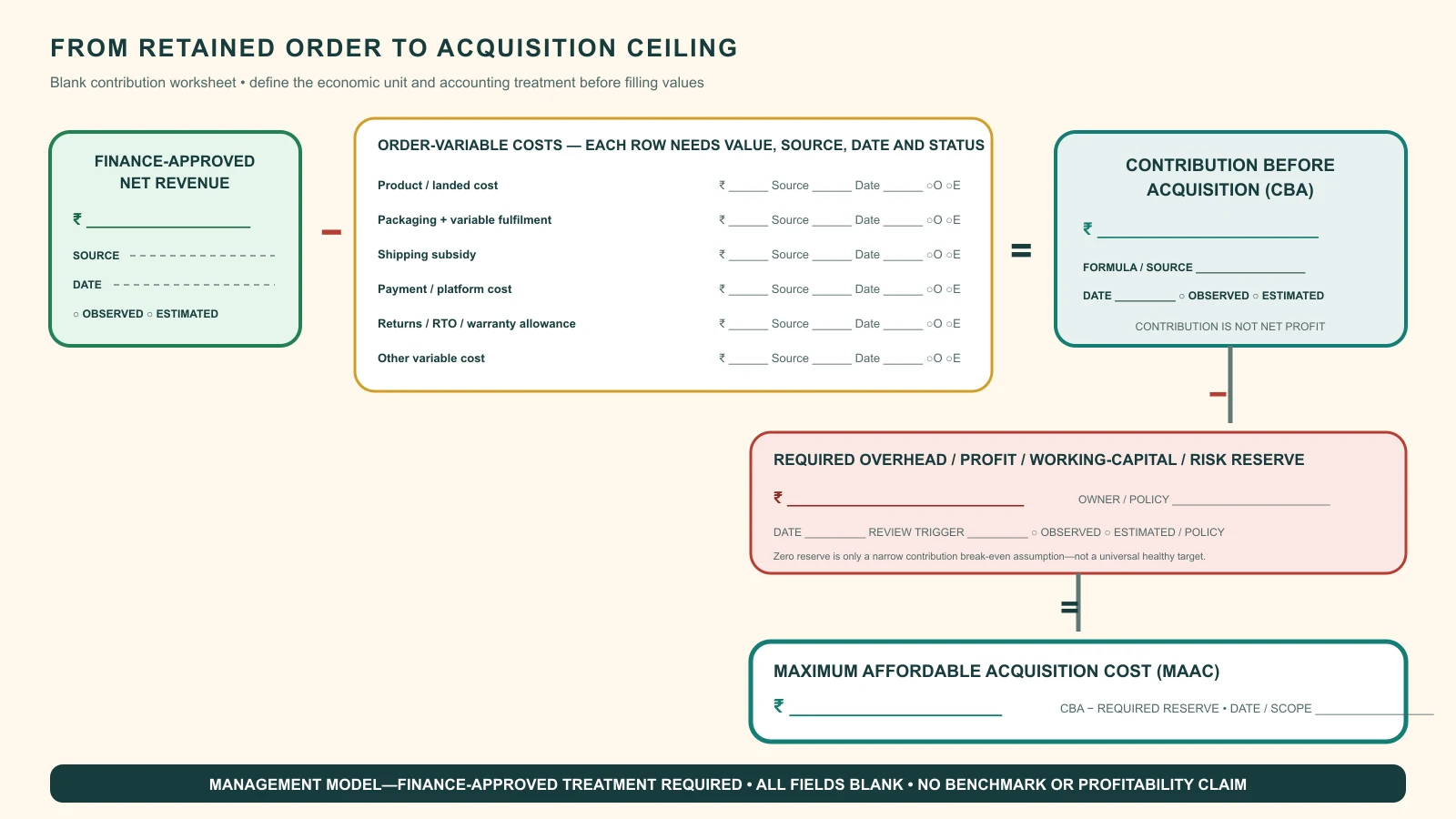
Revenue becomes decision-ready only after real variable costs, expected post-order costs and the required business reserve are visible. Every value, source, date and observed/estimated field is blank; the worksheet contains no benchmark, tax treatment, client margin or profitability claim.
Include returns, RTO, warranty and hidden variable costs
Use expected cost per placed order carefully
When analysing placed-order economics, estimate the expected downstream cost using the business’s mature cohort:
Expected return/RTO cost per placed order = total relevant reverse-logistics, lost fulfilment, processing and unrecovered product costs for the cohort ÷ placed orders in that cohort
Alternatively, analyse only delivered/retained orders and allocate the failed-order costs across those successful units. Choose one method and avoid double counting.
RTO is more than outward freight
Depending on actual contracts and product recovery, RTO may include:
- forward freight;
- return freight;
- COD/processing charges;
- packaging loss;
- handling and customer-support time;
- damage, expiry or markdown; and
- inventory blocked while in transit.
Use courier statements and operations records, not an online “India average”.
An exchange can still cost money
Even when revenue remains, a size/colour exchange may add reverse freight, reshipping, handling, packaging, markdown and support cost. Apparel sellers should distinguish:
- exchange completed;
- full return/refund;
- RTO before delivery;
- customer-paid versus seller-paid shipping; and
- item restored to full-value inventory versus marked down/damaged.
Warranty arrives later
If claims occur months after sale, a recent campaign cohort may look stronger than it is. Use a product-age cohort or finance-approved allowance. Do not claim “zero warranty cost” merely because the observation window is too short.
Creative and technology can be variable or shared
Classify:
- media spend directly tied to the campaign;
- creative production tied to one product/test;
- messaging/platform charges tied to delivered messages or conversations;
- landing-page/tool fees bought for the test;
- agency or affiliate commission tied to spend/orders; and
- shared salaries/software/brand assets.
Apply a documented allocation policy. Show both views when a cost is disputed: incremental cash decision and fully loaded management view.
Set a maximum affordable acquisition cost
Protect the required contribution first
Define:
- CBA: contribution before acquisition per economic unit;
- Required reserve: amount the business chooses to retain for overhead, working capital, profit and risk; and
- MAAC: maximum affordable acquisition cost.
MAAC = CBA − required reserve
If the result is zero or negative, that unit/offer cannot fund paid acquisition under the current assumptions. Fix price, cost, pack, channel, conversion/returns or business expectations—or do not advertise it for acquisition.
Break-even and target are not the same
If the required reserve is zero, the ceiling may describe a narrow contribution break-even before overhead and other costs. That is not necessarily a healthy target. A business needs a reserve policy, not “spend until nothing remains”.
Date and scope the ceiling
Every MAAC should state:
- ₹ amount and currency;
- per new delivered/retained order or other unit;
- product/SKU/offer;
- channel/geography;
- cohort window;
- return/warranty maturity;
- included/excluded cost rows;
- required reserve; and
- owner/review date.
Example label:
“Maximum acquisition cost: ₹[X] per verified new-customer delivered/retained order for product family [P], offer version [V], service zones [Z], based on [DATE RANGE], with [RETURN WINDOW] and required reserve ₹[R]. Provisional until [DATE].”
Use sensitivity, not false precision
Create low/base/high cases for uncertain inputs such as:
- selling price/discount;
- product cost;
- shipping zone mix;
- RTO/return rate and recovery value;
- warranty allowance;
- payment/channel fees;
- sales conversion; and
- repeat purchase.
If a small change makes MAAC negative, the offer is fragile. Do not hide that with an average.
Translate order economics into funnel ceilings
Ads generate upstream events; economics is usually decided downstream.
Define the measured path
Spend → click/visit → conversation → valid conversation → qualified enquiry → quote/order → delivered/retained new-customer order → collected contribution
Each rate needs a numerator and denominator from the same cohort.
Cost per event
- Cost per valid conversation = attributable acquisition cost ÷ valid conversations
- Cost per qualified enquiry = attributable acquisition cost ÷ qualified enquiries
- Customer acquisition cost = attributable acquisition cost ÷ verified new-customer delivered/retained orders
State whether attributable acquisition cost includes media only or media plus creative, agency, tools and variable sales handling.
Work backwards from MAAC
If the business has a sufficiently mature verified rate:
Affordable cost per qualified enquiry = MAAC × verified qualified-enquiry-to-economic-unit rate
Then:
Affordable cost per valid conversation = affordable cost per qualified enquiry × verified valid-conversation-to-qualified-enquiry rate
These are planning ceilings, not platform bids or guarantees. Rates must come from like-for-like cohorts. A few early orders, a different channel or a repeat-customer-heavy sample should not drive a precise ceiling.
Use ranges when the denominator is small
If three orders came from a small campaign, do not declare the observed order rate permanent. Show scenarios across a plausible, explicitly labelled range and cap spend while evidence matures.
Keep attribution separate from affordability
MAAC asks what an acquired unit can afford. Attribution asks which activity deserves credit. A profitable order may have come through an ad, a store visit, a dealer relationship, a repeat purchase, an organic search, a referral or several of them. Keep:
- platform-reported attribution;
- first-party source/context;
- salesperson/customer-reported source where collected appropriately; and
- accounting/order outcome
as separate fields. Reconcile; do not force certainty the data does not support.
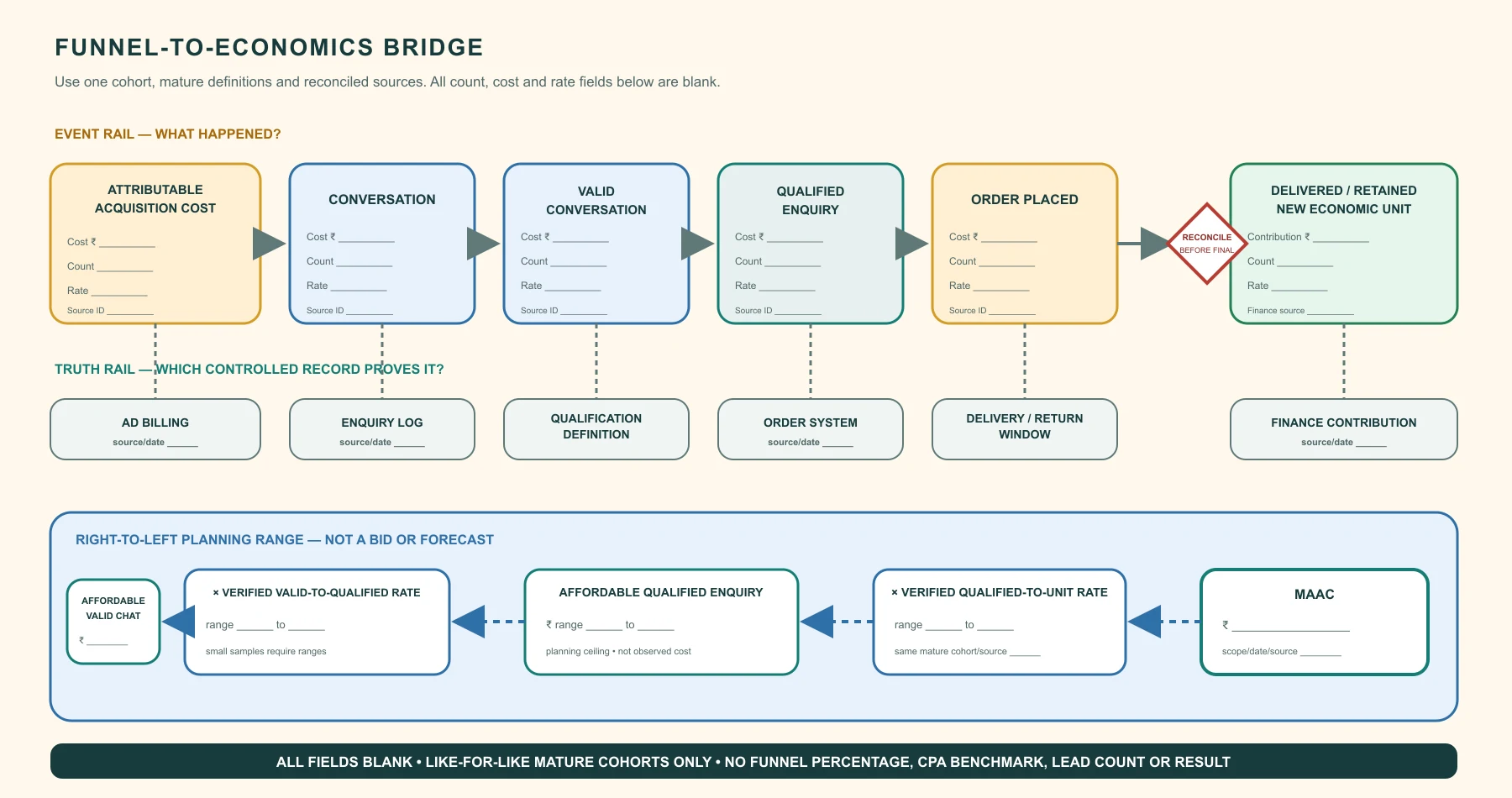
Upstream cost ceilings come from downstream verified contribution and observed stage rates—not from a generic lead-price benchmark. This blank planning bridge is not a media plan, bidding recommendation, conversion forecast or client result.
Use ROAS without confusing revenue and profit
Revenue ROAS
Revenue ROAS = attributed finance-approved revenue ÷ ad spend
It says how much attributed revenue is recorded per unit of ad spend under the chosen attribution rule. It does not subtract product cost, fulfilment, returns, fees, labour, overhead or tax treatment.
Contribution ROAS
Contribution ROAS = attributed contribution before acquisition ÷ attributable acquisition cost
Under a narrow view where acquisition cost contains all relevant acquisition costs and the required reserve is zero, 1.0 means contribution before acquisition equals acquisition cost. That is not automatically net-profit break-even. The business may still need overhead, working capital and profit reserve.
Contribution after acquisition
Contribution after acquisition = attributed contribution before acquisition − attributable acquisition cost
This is more decision-useful than revenue ROAS when product/channel variable costs differ.
Why one “break-even ROAS” can mislead
A single threshold may fail when:
- product mix has different contribution rates;
- discounts/returns vary by campaign;
- freight zones differ;
- repeat customers are mixed with new customers;
- platform revenue is not reconciled to collected/retained orders;
- creative/agency/tool cost is excluded; or
- the business needs a reserve above contribution break-even.
Show the formula, cost scope and cohort beside the target.
Work through a fictional example
The following numbers are purely illustrative arithmetic, not Indian market averages, recommended margins, normal return rates or a GPTWala client result.
Fictional retained order
A fictional local product brand analyses one new-customer delivered and retained storage-box order. Finance provides:
| Row | Illustrative amount |
|---|---|
| Finance-approved net revenue | ₹1,800 |
| Product/landed cost | −₹880 |
| Packaging and variable fulfilment | −₹90 |
| Shipping subsidy | −₹130 |
| Payment/channel charges | −₹40 |
| Mature-cohort return/RTO allowance | −₹85 |
| Warranty/service allowance | −₹25 |
| Contribution before acquisition | ₹550 |
| Required overhead/profit/risk reserve | −₹330 |
| Maximum affordable acquisition cost | ₹220 |
This does not mean ₹220 is a good CAC for another product—or even for this fictional brand next month. If product cost, discount, freight, return experience or reserve changes, the ceiling changes.
Translate to an enquiry ceiling symbolically
If the business’s verified qualified-enquiry-to-new-delivered-order rate is q, then:
Affordable cost per qualified enquiry = ₹220 × q
Do not insert a generic q. Use a mature like-for-like cohort or a labelled scenario range.
Test a free-shipping offer
If the seller absorbs another ₹100 of shipping without raising revenue or reducing another cost:
- CBA falls from ₹550 to ₹450;
- with the same ₹330 reserve, MAAC falls from ₹220 to ₹120.
The offer may improve conversion, but that improvement must be observed and large enough to compensate. “Free shipping” is not free to the economics.
Test a discount
If net revenue falls by ₹150 while costs stay the same, CBA and MAAC each fall by ₹150. A discount should be evaluated against the verified change in delivered, retained orders and contribution—not clicks or checkout starts alone.
Compare products, offers and channels
Build one row per economic slice
Do not rely only on a blended business average. Compare:
- SKU/product family;
- single item versus bundle;
- retail versus wholesale;
- prepaid versus COD;
- local versus distant shipping zone;
- full price versus discount;
- marketplace versus owned/WhatsApp route;
- new versus repeat customer; and
- campaign/creative/offer version.
A low-margin product can have a role—but name it
Possible roles include:
- acquisition entry product;
- bundle anchor;
- sampling product;
- dealer activation order;
- repeat-purchase driver; or
- store-visit trigger.
Do not assign that role after losses appear. Define the subsequent behaviour required, track it, and cap exposure until evidence exists.
Bundles need component truth
For a bundle, calculate:
- exact included SKUs and quantities;
- net bundle revenue;
- component costs;
- bundle packaging/weight/freight;
- picking complexity;
- return/refund treatment; and
- whether one component creates service/warranty cost.
AI imagery or copy must show the exact bundle. Do not add a prop that appears included or remove a costly component from the visual.
Marketplace and direct orders are not interchangeable
A marketplace order may include commissions, logistics, payment/settlement, returns, storage, advertising and other current charges under the seller’s actual statement. A direct WhatsApp order may add staff handling, payment, courier and support costs. Use actual contracts/statements; do not copy a generic fee percentage.
Compare contribution, not just selling price
A higher-price SKU may have lower contribution after freight, returns or service. A lower-price bundle may improve shipping efficiency. Let the row-level ledger reveal the result.
Adapt the model for B2B and manufacturing
Define the B2B economic unit
Possible units:
- accepted first dealer order;
- collected invoice;
- production batch;
- project/job;
- annual account cohort; or
- sample-to-order programme.
Use the unit that matches the commercial decision. The B2B lead-generation guide owns dealer/business-buyer acquisition; this page determines whether that acquisition is affordable.
Add sales and pre-order costs
B2B acquisition may include:
- sample/sample freight;
- catalogue/specification preparation;
- salesperson calls/visits and travel;
- technical review or application engineering;
- quotation/tender effort;
- dealer onboarding/training;
- credit checks and documentation; and
- channel commission.
Decide which are incremental and which are shared. Do not compare media-only B2B CAC with a fully loaded offline acquisition cost.
Calculate job contribution
For a custom manufacturing job, include:
- material and bought-out components;
- direct/job-variable labour;
- machine/setup time under the finance policy;
- tooling/design/prototype treatment;
- inspection, rejection, rework and scrap;
- job-specific packaging/documents;
- freight and installation/commissioning;
- sales/agent commission;
- credit/warranty allowance; and
- change-order/version risk.
Do not advertise a price or lead time derived from a standard product when the job requires engineering confirmation.
Separate first-order and mature-account value
A dealer’s first order may carry onboarding/sample cost and a small pack. Later orders may differ. Do not assume future repeat value to justify acquisition unless cohort records support:
- repeat rate;
- time to repeat;
- contribution by repeat order;
- churn/inactivity definition;
- service/credit cost; and
- channel conflict/returns.
Article 28 owns retention strategy. A29 allows repeat contribution into the acquisition ceiling only when the evidence and risk policy support it.
Credit changes cash and risk
An order can show positive contribution while cash remains blocked. Track payment terms, days outstanding, defaults/disputes, financing cost and inventory commitment. A high “lifetime value” account that pays late and consumes technical support may be less attractive than topline suggests.
Check cash flow and working capital
Unit economics and cash flow answer different questions.
Build a cash timeline
Record when the business pays for:
- raw material/inventory;
- packaging;
- production/job work;
- content and ads;
- marketplace/payment settlements;
- courier/freight;
- refunds/returns;
- sales commission; and
- tax/other statutory obligations under finance guidance.
Then record when cash is actually collected.
Watch the growth cash gap
Paid acquisition can increase orders while consuming cash through inventory, production, COD settlement, credit terms and returns. A profitable unit on paper may still create a funding gap.
Add a working-capital gate
Before expanding spend, ask:
- Can inventory/production support the expected range without harming core customers?
- How many days of cash are tied between acquisition spend and collection?
- What happens if return/RTO or payment delays rise?
- Is there an authorised spend cap independent of platform recommendations?
- Who can pause ads when stock, cash or fulfilment changes?
Do not use credit-card availability or platform delivery as proof that spend is affordable.
Set the economic gate before ads
Complete the pre-spend card
| Field | Required answer |
|---|---|
| Economic unit | Exact delivered/retained/collected event |
| Product/offer | SKU/group, price/discount and version |
| Cohort | Buyer, channel, geography, dates and maturity |
| CBA | ₹ amount plus formula/cost scope |
| Required reserve | ₹ amount and owner-approved purpose |
| MAAC | ₹ per verified new economic unit |
| Funnel planning range | Like-for-like observed/scenario rates with caveat |
| Attribution | Platform, first-party and accounting fields kept distinct |
| Cash gate | Spend/stock/working-capital cap |
| Stop owner | Named person with account authority |
| Review date | When provisional outcomes can be reconciled |
Do not launch on revenue ROAS alone
Before campaign setup, the ads owner should receive:
- dated MAAC;
- cost scope;
- qualified-event definition;
- new-customer rule;
- return/collection maturity date;
- provisional funnel ceiling/range;
- authorised budget cap; and
- stop triggers.
Use the Meta readiness guide for the remaining product, destination, access, payment, measurement, response and fulfilment gates.
The ₹100/day test still needs the gate
Small spend can limit financial exposure, but it does not fix a negative unit, wrong product, misleading offer, broken destination or unstaffed WhatsApp route. Meta’s official budget guidance describes budget/cost mechanics; it does not promise an outcome at ₹100/day.
Prewrite economic stop triggers
- CBA or MAAC becomes zero/negative under updated facts;
- product/offer price or cost changes materially;
- stock/fulfilment cannot support the offer;
- return/RTO/complaint evidence breaches the owner-set limit;
- attribution or order reconciliation breaks;
- spend exceeds authorised cap;
- acquired orders are uncollected or disputed; or
- working-capital/cash limit is reached.
Reconcile a campaign after delivery
Keep three views
- Platform view: spend, delivery, clicks/conversations and platform attribution.
- Sales/operations view: valid/qualified enquiries, quotes, orders, delivery, returns and source context.
- Finance view: collected revenue, credits/refunds, costs, contribution and cash timing.
Do not force one dashboard to become the sole source for all three.
Reconciliation table
| Stage | Count/value | Exclusions | Source | Status |
|---|---|---|---|---|
| Media/attributable acquisition cost | ₹ | tax/creative/agency scope stated | Ad billing + finance | Provisional/final |
| Conversation starts | count | tests/duplicates stated | Platform/WhatsApp log | Provisional/final |
| Valid conversations | count | spam/wrong intent/geography | Controlled enquiry log | Final after review |
| Qualified enquiries | count | definition locked pre-test | Sales log | Final after review |
| Orders placed | count/₹ | cancelled/unpaid not final | Order system | Provisional |
| Delivered/retained new units | count | returns/RTO/repeat separated | Order/operations | Final after window |
| Finance-approved net revenue | ₹ | credits/refunds/tax treatment | Accounting | Final |
| Contribution before acquisition | ₹ | formula/cost scope stated | Unit-economics ledger | Final/estimated |
| Contribution after acquisition | ₹ | all included acquisition cost stated | Reconciled ledger | Decision-ready |
Compare actual CAC with MAAC
- Actual CAC below MAAC does not automatically mean scale; inspect volume, confidence, capacity and cash.
- Actual CAC above MAAC does not automatically mean ads are the only problem; diagnose product, offer, creative, destination, response, qualification, returns and attribution.
- A provisional CAC should not be compared as if all orders are mature.
Keep, fix, stop or expand carefully
- Keep: economics and operations are within the dated control range.
- Fix: one diagnosed layer can be changed and versioned.
- Stop: current unit, evidence, policy, stock, cash or capacity cannot support spend.
- Expand carefully: mature evidence supports a larger bounded test; recheck the ceiling and cash gate first.
Apply the model to Indian product businesses
The following are fictional scenarios, not client results, market averages or recommended margins.
Apparel seller: include exchanges and RTO
A Surat apparel seller must calculate by collection, offer, payment method and shipping zone. The ledger includes garment landed cost, pack, forward/reverse freight, COD/payment charges, exchange reshipment, return condition/markdown and customer support. An AI model image that changes length, fit, drape, transparency or included pieces can worsen returns and also mislead the buyer; economics never excuses product drift.
Jewellery retailer: price volatility and exact-item truth
A Jaipur jewellery business uses finance-approved item/quote revenue and exact material, making, stone/component, certification/hallmark, packaging, payment, insurance/shipping and return/service treatment. It should not advertise a stable acquisition ceiling while the product price or quote basis has changed. Styled imagery cannot imply a different stone, purity, weight, setting, quantity or certification.
Local appliance retailer: delivery and installation
The order ledger includes the exact model, purchase cost, delivery subsidy, installation responsibility, payment cost, incentive and warranty/service allowance. A store-visit influenced by ads may be difficult to attribute; keep source evidence separate. “Free installation” requires real cost and scope.
Manufacturer: contribution per accepted job
A Rajkot component manufacturer chooses one job/product family, then includes material, machining/job work, setup, inspection, scrap/rework, pack, freight, sales/technical effort, credit and warranty. A quote request is not revenue; a purchase order is not collected contribution; a technical conversation is not compatibility approval.
Wholesaler: case economics and dealer activation
The wholesaler calculates case/pack contribution, freight recovery, discount, salesperson/dealer onboarding, returns/shortage claims and credit. If the first order is subsidised to activate a dealer, the expected repeat value must come from a mature dealer cohort rather than optimism.
Marketplace product brand: reconcile the statement
The brand uses the actual seller statement for commissions, fulfilment, storage, returns, refunds, ads and settlement—not a generic fee calculator. Product-level economics must match the exact listing/variant. A gross marketplace sales number is not the cash collected or contribution.
Exporter: contribution and cash by shipment
The exporter includes product/job cost, export packaging, inspection, documentation, freight/insurance under the agreed basis, agent/marketplace fees, currency/collection treatment, claims/returns and finance cost. Cross-border tax, customs, legal and accounting treatment requires authorised specialists.
Protect product, price and performance truth
Unit economics depends on the same truth the buyer sees.
Product truth
- calculate the exact SKU, variant, pack or job shown;
- separate included product from props/context;
- do not use a cheaper product’s cost under a premium product image;
- do not assume a prototype’s cost equals production; and
- version bundle contents and substitutions.
Price truth
- use actual net selling/quote price by cohort;
- make tax, freight, MOQ, eligibility and offer terms clear;
- do not manufacture a crossed-out reference price;
- do not call shipping, sample or installation “free” while hiding mandatory cost; and
- expire/review economics when price or offer changes.
Claim truth
The ASCI Code says objective claims should be capable of substantiation and visual presentation should not mislead by implication, omission, ambiguity or exaggeration. India’s official misleading-advertisement guidelines are another publication-day source.
Do not improve apparent conversion by overstating quality, origin, scarcity, stock, performance, savings, certification or customer results. Returns and complaints may reveal the commercial cost later; the communication is still wrong at publication.
Measurement truth
- state numerator, denominator, cohort and maturity;
- distinguish observed, estimated and assumed inputs;
- keep platform attribution separate from accounting fact;
- label media-only versus fully loaded CAC;
- do not cherry-pick a successful SKU/date range; and
- do not present the fictional worked example as a benchmark.
Build the worksheet
Use a workbook or controlled system with these tabs/sections.
1. Definitions
- economic unit;
- new-customer rule;
- delivered/retained/collected rule;
- product/offer/channel/geography scope;
- cohort dates and maturity window;
- attribution methods; and
- owner/approval/version.
2. Unit cost ledger
| Row | ₹ per unit/order | Source | Date | Observed/estimated | Owner |
|---|---|---|---|---|---|
| Finance-approved net revenue | |||||
| Product/landed cost | |||||
| Packaging | |||||
| Shipping subsidy | |||||
| Payment/platform cost | |||||
| Variable labour/commission | |||||
| Return/RTO allowance | |||||
| Warranty/service allowance | |||||
| Other order-variable cost | |||||
| Contribution before acquisition | Formula | ||||
| Required reserve | Owner policy | ||||
| MAAC | Formula |
3. Funnel cohort
Store spend/cost scope, clicks/visits, conversations, valid conversations, qualified enquiries, orders, delivered/retained new units, revenue, CBA and contribution after acquisition. Use formulas with error/zero-denominator handling; do not display infinite or fabricated rates.
4. Scenario table
Change one or a small named set of inputs across low/base/high scenarios. Include price, cost, freight, return/RTO, conversion, reserve and repeat assumptions. Never overwrite observed actuals with the preferred scenario.
5. Reconciliation
Tie campaign/ad account, enquiry/order IDs, finance periods and cohort status. Record unmatched items and do not silently drop them.
6. Decision log
For every keep/fix/stop/expand decision, record:
- date and owner;
- cohort/version;
- evidence and limitations;
- chosen action;
- budget/stock/cash cap;
- changed variable; and
- next maturity/review date.
Connect unit economics to the DAA framework
The DAA sequence is Digital Presence → AI Content Creation → ₹100/day WhatsApp ads. Unit economics sets the guardrail before the final paid layer: it tells the business which product/offer can be tested, what downstream event matters, what acquisition may cost and when to stop.
If your product business still depends mainly on walk-ins, dealer calls, exhibitions or forwarded catalogues, GPTWala’s DAA workshop explains how these layers connect. The workshop is educational. It does not guarantee reach, chats, enquiries, orders, sales, earnings, profit or return on ad spend.
Frequently asked questions
What is product-business unit economics?
It is a documented view of the revenue, variable costs, contribution, acquisition cost and required reserve for a defined product/order/customer unit and cohort. It helps the business decide whether an offer/channel can afford paid acquisition. It is not a replacement for statutory accounts.
What unit should I use before digital ads?
For many retailers, use a new-customer delivered, retained and collected order. Manufacturers may use an accepted job or collected invoice; wholesalers may use an accepted/delivered order; dealer programmes may use an activated dealer’s first qualified order. Define it before testing.
What costs should I subtract before ad spend?
Subtract the finance-approved product/landed cost and order-variable packaging, shipping subsidy, payment/platform charges, variable labour/commission and expected return/RTO/warranty/service costs. Add any other cost that occurs because the order exists. Document scope and avoid double counting.
Is gross margin the same as contribution margin?
Not necessarily. Businesses use these labels differently. Write the formula beside the term. This guide’s contribution-before-acquisition measure subtracts all defined order-variable costs before acquisition but may still need to fund overhead, working capital and profit reserve.
How do I calculate maximum affordable acquisition cost?
Subtract the required overhead/profit/working-capital/risk reserve from contribution before acquisition: MAAC = CBA − required reserve. Date it and state the product, offer, channel, cohort, maturity and included costs.
What is a good customer acquisition cost for an Indian product business?
There is no universal good CAC. The affordable amount depends on your exact contribution, required reserve, returns, fulfilment, repeat evidence, cash and risk. An online industry average cannot replace your ledger.
Is ₹100/day enough to test ads profitably?
It may be a bounded learning input, but it does not guarantee enough volume, a lead or profit. First establish MAAC, tracking, response capacity, stop rules and the decision the small test can realistically inform.
What is break-even ROAS?
It depends on the formula and costs. Revenue ROAS does not subtract product/fulfilment costs. Contribution ROAS compares contribution before acquisition with attributable acquisition cost. Even contribution ROAS of 1.0 may only represent a narrow pre-overhead break-even if no required reserve is included.
Should I include creative and agency costs in CAC?
State both media-only and fully loaded/incremental views when useful. Include costs tied to acquiring the cohort under a documented allocation policy. Do not compare a media-only CAC with another channel’s fully loaded cost.
How do I account for returns and COD RTO?
Use mature cohort records for forward/reverse freight, fees, packaging, handling, damage/markdown and unrecovered product cost. Choose whether to allocate failed-order costs across placed or successful orders and avoid double counting. Do not use a generic national rate.
Can I use lifetime value to justify a higher CAC?
Only with mature cohort evidence for repeat rate, time to repeat, repeat contribution, churn, returns, service, credit and retention cost. Use conservative scenarios; do not assume every first-time buyer repeats.
Why can a campaign show high ROAS but still lose money?
Platform-attributed revenue may include low-margin products, discounts, repeat customers, cancellations, returns or tax, while excluding product, freight, payment, marketplace, labour, creative, agency and overhead costs. Reconcile delivered/retained orders to finance contribution.
How often should I update the unit-economics model?
Update when price, product cost, freight, payment/platform fee, returns, warranty, offer, channel, tax/accounting treatment, cash policy or reserve changes—and before material spend expansion. Also replace provisional cohorts when outcomes mature.
What should make me stop digital ads immediately?
Stop or hold when product/offer truth breaks, MAAC becomes non-positive, stock/fulfilment fails, spend breaches authority, attribution/reconciliation fails, returns/complaints/cash exceed owner-set controls or the business cannot service valid enquiries.
Sources checked for this guide
- GPTWala DAA Framework Workshop
- Meta for Business: Ad budgets, costs and schedules
- Meta for Business: Ad review, policy and support
- WhatsApp for Business: Ads that click to WhatsApp
- WhatsApp for Business: How to create ads that click to WhatsApp
- WhatsApp Business Platform pricing
- WhatsApp Business Messaging Policy
- WhatsApp Messaging Guidelines
- Government of India GST portal
- Department of Consumer Affairs: Guidelines for Prevention of Misleading Advertisements and Endorsements for Misleading Advertisements, 2022
- Advertising Standards Council of India: The ASCI Code
Leave a Reply