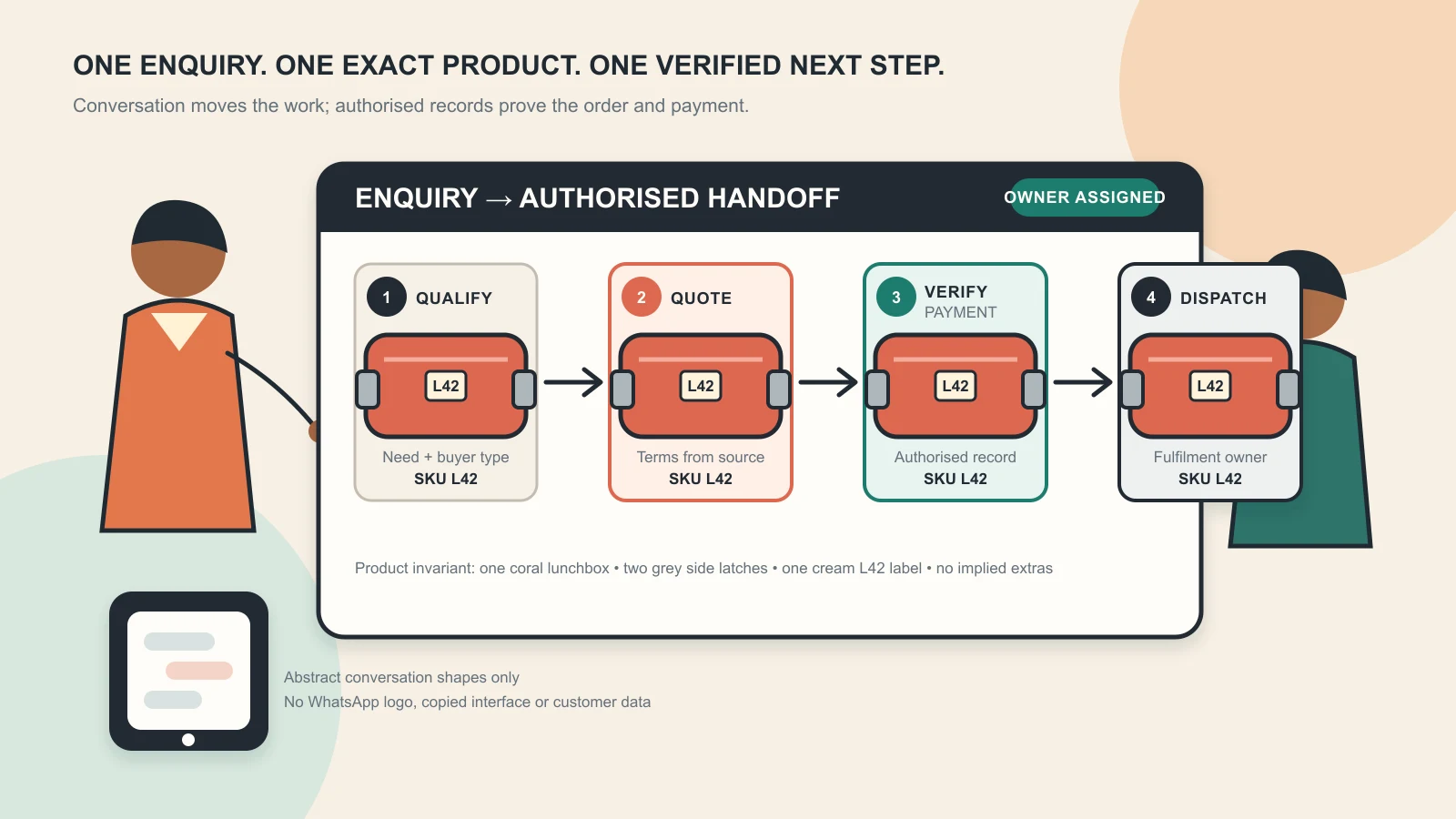
Visual disclosure: Original GPTWala editorial illustration created with AI using one fictional, unbranded coral lunchbox (SKU L42) and abstract conversation shapes. It is not a WhatsApp interface, client result or sales claim; the lunchbox geometry, two grey side latches, cream label, colour and included pieces remain identical at every stage.
Reviewed and updated: 12 August 2026
WhatsApp selling is a controlled enquiry-to-sale process, not simply replying fast or sending a catalogue. A product business should identify the buyer’s need, match an exact SKU, confirm stock and terms, send a written quote/order summary, receive explicit confirmation, verify payment or approved credit in its own system, hand the order to fulfilment and keep one owner until delivery or closure. Automation can assist; it must not invent a product, price, promise or payment status.
For an Indian manufacturer, wholesaler, retailer, shopkeeper or product brand, the key record is the confirmed order card, not the chat thread. The card connects what the buyer requested to what the business can actually supply.
This root guide owns the complete enquiry-to-sale operating system. The future WhatsApp follow-up template guide will own timed scripts and handoff messages. The digital product catalogue guide will own catalogue information architecture, while the WhatsApp Business catalogue guide will own the current app setup. The ₹100/day click-to-WhatsApp system owns that particular ad workflow.
Table of contents
- Understand what WhatsApp selling is
- Choose the Business app or Platform
- Build a product and policy source of truth
- Control entry points and permission
- Use the nine-stage enquiry-to-sale pipeline
- Qualify without interrogating the buyer
- Match and present the exact product
- Quote and confirm the order in writing
- Verify payment and hand off fulfilment
- Organise the inbox and team handoffs
- Use AI and automation with a human stop rule
- Handle follow-up, marketing and opt-out correctly
- Apply India product, ad and payment safeguards
- Use the system in different product businesses
- Measure the pipeline without invented benchmarks
- Know when chat should not be the system of record
- Frequently asked questions
Understand what WhatsApp selling is
WhatsApp can be the conversational layer of a sale. The customer can ask, compare, clarify, confirm and receive updates in one familiar thread. But the business still needs accurate product data, inventory, quotation, payment, fulfilment, service and consent controls outside the conversation.
A conversation is not automatically a lead
An inbound message can be:
- a genuine product enquiry;
- an existing customer seeking support;
- a dealer asking for a range or price list;
- a duplicate from another source;
- an enquiry outside the service area or minimum order;
- a supplier, job seeker or collaboration request;
- spam or fraud; or
- a person who has not yet said what they need.
Classify first. Do not report every “Hi” as a lead.
A “yes” is not automatically an order
“Send this”, “book it”, a screenshot or a voice note can omit the exact variant, quantity, delivery conditions or total. An actionable order needs a written summary that the buyer confirms and the business can fulfil.
A catalogue is not inventory or a quotation
A catalogue helps discovery. It may not reflect real-time stock, buyer-specific pricing, freight, tax, minimum quantity or a custom configuration. Confirm those separately. The platform itself says businesses are responsible for transactions, sales terms, taxes and fulfilment; WhatsApp is not the seller or fulfiller. See the WhatsApp Business Messaging Policy.
A sent message is not a sale
Track the pipeline through qualified enquiry, product match, quote, confirmation, verified payment/credit, dispatch and delivery. Revenue should come from the accounting/order record—not a salesperson’s count of chats.
Choose the Business app or Platform
WhatsApp currently positions the Business app for small businesses that personally manage conversations and the Business Platform for medium-to-large businesses using programmatic access at scale. See the official WhatsApp Business product overview and Business Platform overview.
Choose based on operating complexity, not status.
| Need | Business app is usually the simpler start | Platform/API route deserves evaluation |
|---|---|---|
| Conversation ownership | One owner or a small manageable team | Multiple agents, queues, routing or specialist handoffs |
| Volume | Human review of every active conversation remains reliable | Inbox volume causes missed, duplicate or unowned work |
| Product data | Small range, controlled catalogue and manual stock check | Large/dynamic range connected to catalogue, CRM, ERP or order system |
| Messaging | Inbound, personal replies and simple business tools | Approved templates, programmatic notifications or governed automation |
| Reporting | A label/list plus a small order log is enough | Auditable events, integrations and role-based reporting are needed |
| Exceptions | Owner can handle custom terms | Rules need escalation across sales, finance, fulfilment and support |
The Business app’s current official feature page lists business profiles, greetings, away messages, quick replies, labels, catalogues, carts, catalogue links and entry points such as QR codes and short links. Some features, broadcasts, payments and commerce options vary by country, eligibility or account. Check the actual app before designing a process around them. See WhatsApp Business app features.
The Business Platform has different messaging, template, pricing and automation rules. Its current pricing page uses message categories and market/category-dependent pricing; do not copy an old rate into a business plan. Verify the live WhatsApp Business Platform pricing.
Use one official business identity
Whichever route you choose:
- use an accurate business name, category and contact information;
- state service hours and expected response time;
- separate business and personal conversations;
- identify the human/business when an automated message opens the chat;
- control who can access the number, linked devices and customer data; and
- document an exit/backup plan if the primary phone, person or provider is unavailable.
WhatsApp’s policy requires a Business profile with customer-support contact information and accurate, up-to-date details, and prohibits impersonation or misleading people about the nature of the business.
Build a product and policy source of truth
Do this before driving more enquiries.
Product master
For every sellable item or configuration, store:
- SKU/product code and approved name;
- current variant, size, colour, finish and packaging;
- exact product images and buying-critical detail views;
- specifications, material and dimensions;
- included pieces and excluded/contextual props;
- minimum order, pack/case quantity and multiples;
- current stock source and last-checked time;
- approved claim wording and evidence;
- safe-use or compatibility limitations; and
- owner for product questions.
Use the AI product-photography guide and product-accuracy checklist before an AI-assisted visual is shared beside an order action.
Commercial master
Keep controlled versions of:
- retail/wholesale/dealer price logic;
- applicable tax and invoice process;
- shipping, delivery zone, freight and pickup terms;
- offer dates, coupon/discount conditions and stock limits;
- payment methods and official payee identity;
- credit approval authority for B2B orders;
- cancellation, return, exchange and refund process;
- warranty/after-sales scope; and
- quote validity.
Communication master
Approve:
- product names and words that must not be translated;
- English and regional-language terminology;
- greeting/away message and response-time promise;
- qualification questions by buyer type;
- quote and order-confirmation structure;
- payment-safety note;
- escalation messages; and
- opt-in/opt-out wording by message category.
Saved replies should pull from these masters. They are controlled shortcuts, not permanent truths; review them whenever price, stock, policy or product changes.
System-of-record map
Name the authoritative record for each fact:
| Fact | Authoritative source | WhatsApp’s role |
|---|---|---|
| Product/specification | Approved product/PIM/catalogue record | Explain and link/share the exact item |
| Stock | Inventory/owner-confirmed stock record | Communicate last verified availability |
| Price/offer | Current price/offer master | Send a dated quote |
| Customer and consent | Approved CRM/consent log where required | Capture the conversation and preference |
| Order | Order/accounting/ERP record or controlled order sheet | Obtain confirmation and send updates |
| Payment | Bank, payment gateway or authorised merchant record | Share official method; never self-certify from a screenshot |
| Dispatch | Fulfilment/courier record | Communicate verified status/tracking |
| Return/refund | Service/accounting record | Collect issue, confirm decision and update customer |
When these sources disagree, pause the sale and resolve the fact. Do not choose whichever answer closes fastest.
Control entry points and permission
Make it easy for a buyer to start the right conversation and hard for the business to send an unexpected one.
Useful customer-initiated entry points
- a short link beside the exact product/page;
- a QR code in the store, on an authorised catalogue, invoice, booth or package insert;
- a “message us” action on a controlled social profile;
- a product landing page with a prefilled product code;
- an existing customer’s support/order-update link; or
- an approved click-to-WhatsApp ad.
Use a source code or prefilled line such as SAREE-S214 / dealer catalogue so the operator knows what caused the conversation. Do not make the buyer re-explain the product shown beside the link.
The future product landing-page guide will own that page workflow. A20 owns paid click-to-WhatsApp acquisition.
Permission is not a purchased contact list
WhatsApp’s current Business Messaging Policy says a business may contact people only when it has their mobile number and opt-in permission confirming they want subsequent messages or calls. It also requires businesses to respect requests to stop or opt out and says communications must not confuse, deceive, spam or surprise people. See the current policy.
Therefore:
- record where, when and for what category a person opted in;
- do not scrape numbers or message an exhibition list simply because the number is visible;
- do not treat group membership, an old invoice or a one-time support chat as blanket permission for promotions;
- make the sending business and purpose clear;
- give a simple opt-out route and action it across the operating list; and
- keep order/service updates separate from promotional permission.
A customer who starts a product enquiry has asked for a response to that enquiry. Do not silently turn it into indefinite marketing permission.
Platform-specific 24-hour rule
For the WhatsApp Business Platform, the policy says a business may respond without a Message Template within 24 hours of the user’s last message; outside that customer-service window it may send only approved Message Templates. It also requires a clear human escalation route when automation is used. These are Platform-specific controls, not a generic instruction for every Business-app reply.
Check current templates, message categories, pricing and account eligibility before implementation. A22 will own the detailed follow-up sequence.
Use the nine-stage enquiry-to-sale pipeline
Every active chat needs a stage, an owner and a next action time.
| Stage | Required output | Exit condition | Stop/escalate when |
|---|---|---|---|
| 1. New/acknowledged | Source, time, owner and response expectation | Buyer/product context identified | Spam, abuse or wrong business |
| 2. Qualified | Buyer type, need, quantity/application, location and timing | Enough information to recommend | Regulated/high-risk need or unclear authority |
| 3. Matched | Exact SKU(s) or an honest “no match” | Buyer sees verified option/evidence | Product cannot meet stated need |
| 4. Quoted | Dated price/terms/validity from approved master | Buyer asks to proceed or declines | Stock, freight, tax, credit or claim unresolved |
| 5. Order summary sent | Complete written order card | Buyer explicitly confirms or corrects | Variant/quantity/address/terms ambiguous |
| 6. Payment/credit verified | Bank/gateway confirmation or approved B2B credit/PO status | Order authorised for fulfilment | Screenshot only, mismatch or suspicious request |
| 7. Fulfilment | Order ID, picking/production/dispatch owner and due date | Dispatched/ready for pickup | Stock variance, damage or delay |
| 8. Delivered/support | Verified delivery/pickup and issue route | Customer accepts or issue is opened | Wrong/damaged/missing item or safety concern |
| 9. Closed | Won/lost reason, final record and permission state | Record complete | Open refund, complaint, warranty or payment issue |
Do not move a chat because time passed. Move it only when the exit condition is evidenced.
Stage 1: acknowledge and set the next expectation
An acknowledgement should do four things:
- name the business/operator;
- recognise the item or request if known;
- state when a useful answer will arrive; and
- ask one easy next question.
Example structure:
“Hello, this is Meera from [Business]. I can help with product code S214. I’m checking today’s colour and case availability now. Are you buying for a retail shop or for personal use?”
This is an anatomy example, not a claim that instant replies guarantee sales.
Stage 2: qualify only what changes the recommendation
Ask the fewest questions needed to avoid a wrong match. Do not collect identity or sensitive information because it might be useful later.
Stage 3: match or say no honestly
Recommend only products supported by the product master. If there is no safe/exact match, state that and route to a product specialist. “No match” protects trust and prevents returns.
Stages 4 and 5: separate quotation from order confirmation
A quote is an offer under stated conditions. An order summary is the exact configuration the buyer asks you to fulfil. Keep separate IDs/versions if terms change.
Stages 6–9: finance and operations take ownership
Sales should not mark “paid”, “dispatched”, “delivered” or “refunded” from an assumption. The authoritative team/system supplies those states and the chat communicates them.
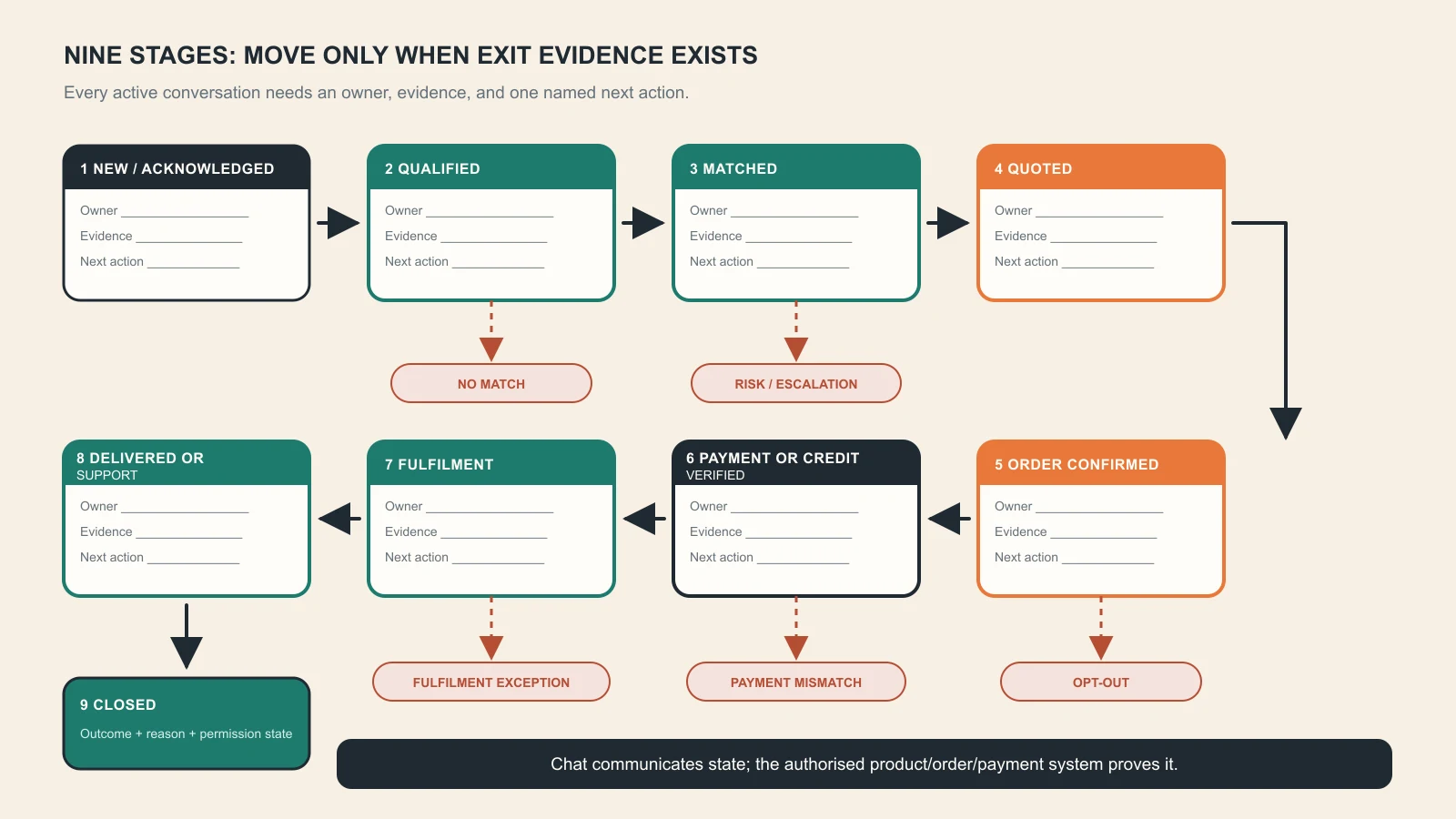
Move a conversation only when the stage’s exit evidence exists—not because time passed. Original GPTWala deterministic pipeline; it contains blank owner/evidence/next-action fields and exception exits, not customer data, platform UI or claimed results.
Qualify without interrogating the buyer
B2C qualification card
Ask only what affects serviceability and product fit:
- exact item/use case;
- size, colour, variant or compatibility need;
- serviceable city/pincode or pickup preference;
- timing/occasion if stock or customisation depends on it; and
- one decision question or constraint.
Do not ask for a complete address, ID document or payment information before it is needed.
B2B qualification card
For a dealer, retailer, wholesaler, institutional or industrial buyer, record:
- business/buyer type and city;
- product family, application or exact code;
- quantity, case/pack requirement or expected repeat pattern;
- specification/quality/packaging requirement;
- delivery location and requested timeline;
- catalogue, sample, data sheet or quotation next step; and
- purchase order, tax invoice or approved-credit process where applicable.
Do not treat every “price?” as an opportunity that sales must chase forever. If minimum order or service area does not match, answer respectfully and close with a coded reason.
Qualification should work in Indian languages
Ask the buyer’s preferred language. Preserve:
- SKU/model names;
- units, decimals and pack counts;
- technical terms that should remain in English;
- price, tax, shipping and payment meaning;
- warranty/return limitations; and
- delivery dates and addresses.
If a buyer sends a voice note, summarise the order-critical facts in writing and ask them to confirm. Voice recognition or AI translation is not the order record.
Match and present the exact product
Use a three-part recommendation
- Exact match: SKU, variant and one line explaining why it fits the stated need.
- Evidence: approved product view, data sheet, dimensions, pack contents or real demonstration.
- Boundary: what is not included, not verified or not suitable.
Example:
“Based on 24 pieces for resale, the current match is SKU J42-G, gold-tone, 12-pair dealer case. The attached real front/back/clasp views are for J42-G. Display tray and model styling are not included.”
Send fewer, better options
Do not flood a buyer with 40 unrelated images. Share one recommended option and, if useful, two meaningfully different alternatives. Explain the trade-off: material, size, pack, finish, price band, lead time or use case.
Product-image truth rules
- label every image with SKU/variant internally;
- do not mix old and current packaging;
- show required sides/details before payment;
- do not let an AI background change size, colour, texture, label, components or quantity;
- state when a lifestyle scene is illustrative and props are not included;
- use real capture for fit, drape, reflection, mechanism, scale, texture, safety and performance proof; and
- withdraw an image when the sellable product changes.
An attractive but inaccurate image is not a conversion asset. It is an order-error risk.
Quote and confirm the order in writing
The quote card
Include:
- quote ID, date and validity;
- buyer/business name where appropriate;
- exact SKU/variant and description;
- quantity, unit/pack/case logic and included pieces;
- unit price, applicable taxes/charges and discount conditions;
- shipping/freight/pickup and destination assumptions;
- dispatch or production estimate stated accurately;
- payment/credit terms;
- return, exchange, cancellation and warranty reference;
- total payable or clearly marked items still to be calculated; and
- salesperson/approver.
Do not hide a mandatory charge until the final message. If freight is unknown, say “freight pending for pincode confirmation”, not “free delivery”.
The confirmed order card
After the buyer agrees, send a new summary:
| Field | Required entry |
|---|---|
| Order/quote reference | Unique ID and version |
| Buyer | Name/business and contact |
| Item | Exact SKU, variant, pack and quantity |
| Price | Unit/line total, tax/charges, discount and final total |
| Delivery | Full address/pincode or pickup point; promised estimate |
| Terms | Payment/credit, cancellation, return/exchange and warranty reference |
| Special instruction | Only approved, operationally feasible instruction |
| Confirmation | Buyer’s explicit confirmation and timestamp |
| Internal owner | Sales plus fulfilment/finance owner |
Ask the buyer to correct any line and explicitly confirm. Do not interpret an emoji or payment screenshot as confirmation of all terms.
Changes create a new version
If SKU, quantity, price, address or terms change, issue an updated summary and ask for confirmation again. Do not edit the old message silently and hope operations notices.
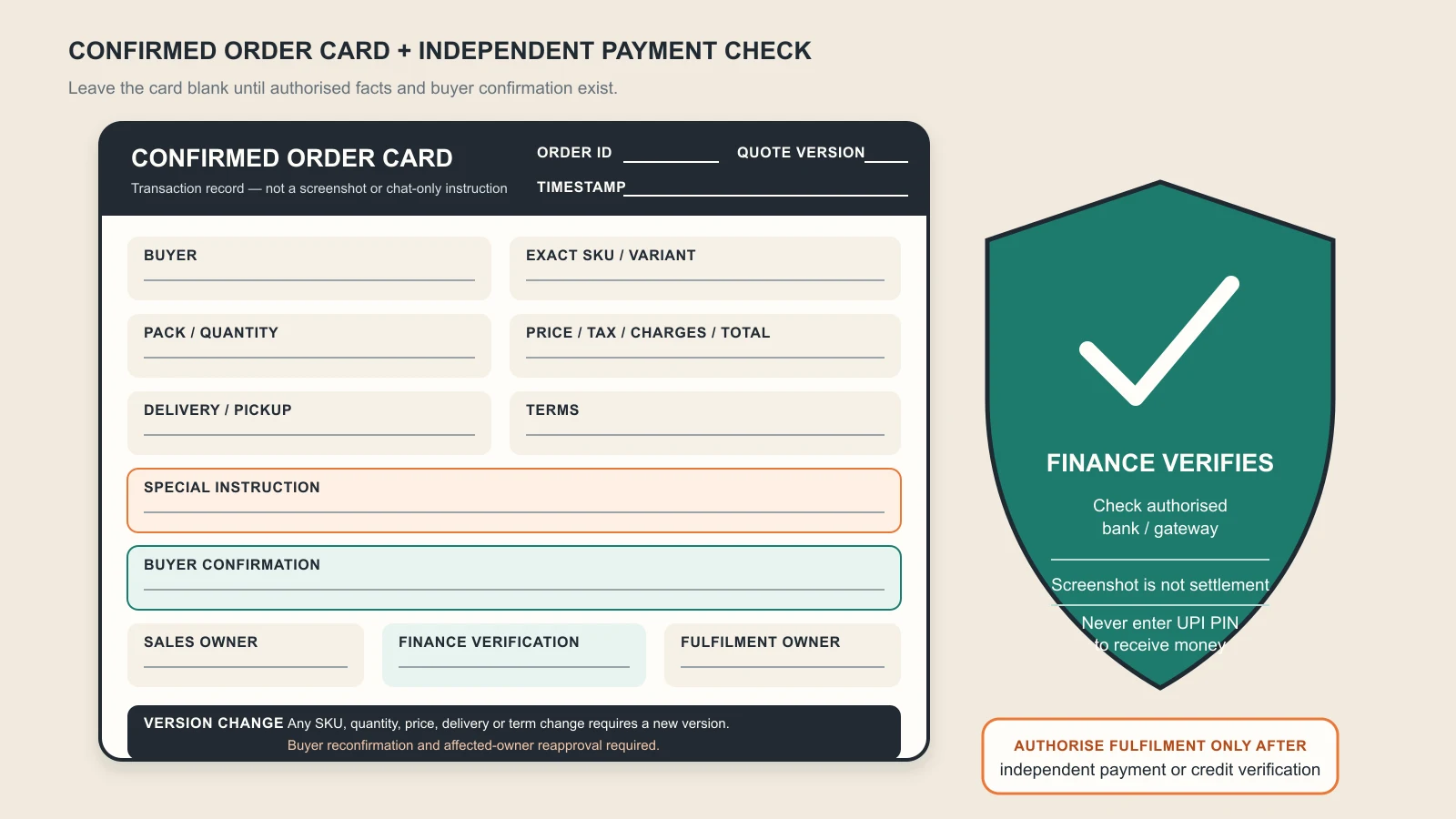
Convert chat into a versioned order card, then verify payment independently before fulfilment. Original GPTWala blank template: it contains no personal data, QR code, bank or WhatsApp logo, transaction status, filled amount or fabricated order result.
Verify payment and hand off fulfilment
Share only approved payment routes
Use the business’s authorised merchant/acquirer, payment link, bank account, UPI ID or other approved method. The payee name the customer sees should be expected and explainable. Never request a full card number, bank account credentials, UPI PIN, OTP or sensitive identity number in chat; WhatsApp’s Business policy also prohibits asking people to share full card/account numbers or other sensitive identifiers.
A screenshot is not settlement evidence
Verify payment in the business’s own bank, gateway or authorised merchant record and reconcile amount, payer/reference, order ID and status. If status is pending or mismatched, mark it pending—not paid.
NPCI’s UPI FAQ says a merchant receives money after the customer confirms payment into the merchant’s bank/pool account under the merchant arrangement. NPCI’s fraud-awareness page also warns that scanning a QR code and entering a UPI PIN is for making a payment, not receiving one. See NPCI’s UPI FAQ and NPCI Fraud Awareness.
For a seller:
- never enter a UPI PIN to “receive” a customer payment;
- never approve a collect request just because the sender says it is a refund or verification;
- train staff to verify the credit in the authorised record;
- use the official bank/acquirer complaint route for a disputed status; and
- separate payment access from casual shared-phone access.
B2B credit and purchase orders
If the buyer uses an approved credit line or purchase order, finance—not chat—authorises fulfilment. Record PO/reference, credit approval, due terms and responsible owner. “Old customer” is not a credit decision.
Fulfilment handoff
Finance/operations receives the confirmed order card, not a forwarded conversation dump. The handoff must identify:
- order ID and confirmed version;
- exact picking/production instruction;
- verified payment/credit state;
- dispatch/pickup commitment and owner;
- packing/label/customisation instruction;
- buyer delivery/contact information restricted to those who need it; and
- exception/escalation route.
Send verified updates for acceptance, dispatch, tracking, pickup readiness, delay and delivery. Do not fabricate a tracking number or promise a date operations has not accepted.
Organise the inbox and team handoffs
The Business app currently provides tools such as labels/lists, quick replies, greeting and away messages. Use the actual labels available in the current app, but keep the stage logic stable.
Minimum stage labels
- New/unowned
- Needs qualification
- Product match pending
- Quote pending
- Buyer decision
- Confirmation/payment pending
- Fulfilment
- Support/exception
- Won/closed
- Lost/closed
- Opted out/do not market
A label is not the result. A conversation can be labelled “Payment pending” only when the order summary is confirmed and finance knows what to verify.
Ownership rule
At any moment, one named person or queue owns the next action. The record should show:
- current stage;
- owner;
- next action;
- due time/date;
- blocker;
- last verified product/offer/order version; and
- escalation owner.
Avoid the shared-inbox phrase “someone please reply”. Assign the conversation.
Daily operating rhythm
At opening:
- triage new/unowned messages;
- check time-sensitive quotes, payments and fulfilment exceptions;
- verify availability changes; and
- confirm who covers the inbox.
During the day:
- update the stage when exit evidence appears;
- create order/quote records immediately;
- escalate product, finance or complaint exceptions; and
- keep replies tied to the correct source master.
At close:
- no active conversation remains unowned;
- every next action has a due time;
- payment/dispatch exceptions are handed over; and
- lost/no-decision reasons are recorded.
Team handoff note
Use five lines:
- Buyer and requested outcome
- Exact product/order version
- Facts already confirmed
- Open question/risk
- Named next action and deadline
Do not ask the customer to repeat the full conversation because internal ownership changed.
Use AI and automation with a human stop rule
AI can help a team handle repetition, but the business owns every answer and commitment.
Safe assistance tasks
- classify a conversation into a proposed stage;
- draft a reply from approved product and policy sources;
- summarise long chats or voice-note facts for human verification;
- translate an approved message while locking SKU, units and commercial terms;
- identify missing fields in the quote/order card;
- suggest a relevant catalogue item from a controlled set;
- flag an angry customer, payment-risk phrase or safety question; and
- prepare internal daily summaries with access controls.
Human approval or direct handling required
- product fit, compatibility, safety or regulated-category advice;
- non-standard discount, credit, refund or compensation;
- warranty, legal or liability language;
- stock, dispatch and custom-production commitments;
- payment/refund verification;
- complaint, threat, vulnerable customer or serious incident;
- high-value/custom B2B negotiation; and
- any answer without an approved source.
The no-source rule
If the assistant cannot retrieve the exact product/policy/transaction source, it should say what is missing and route to a person. It must never invent:
- a SKU or compatible model;
- stock, price, discount or delivery date;
- product performance or certification;
- order, payment, refund or tracking status;
- return/warranty permission; or
- a customer’s consent.
Protect customer and business data
Do not copy customer chats, invoices, addresses, IDs, unpublished pricing, dealer lists or confidential drawings into an external AI tool until the provider’s current terms, the business’s policy and applicable law permit the intended use. Limit access, retain only what is needed and keep customer data out of public prompt libraries.
For Platform automation, WhatsApp’s policy says businesses using automation within the customer-service window must provide prompt, clear and direct escalation paths, such as a human-agent transfer, phone, email, web support, store/branch or support form.
Handle follow-up, marketing and opt-out correctly
This root page defines the controls; A22 will provide the timed message sequence and reusable templates.
Service follow-up
Service messages should continue the buyer’s stated task:
- answer an open product question;
- confirm a promised quote/sample/data sheet;
- request one missing order field;
- give an authorised payment or fulfilment update; or
- resolve support/return/warranty.
Do not disguise a promotion as an order update.
Marketing follow-up
Before sending offers, launches, restock notices or recommendations:
- confirm opt-in covers that message category;
- identify the business and why the message is relevant;
- use current product/offer facts;
- choose a frequency consistent with the expectation set;
- include and honour a clear opt-out; and
- apply Platform template/category rules where applicable.
WhatsApp’s Messaging Guidelines prohibit fraud/spam and repeated unwanted contact, and prohibit unauthorised bulk messaging, auto-messaging or automation that harms WhatsApp or users. See the WhatsApp Messaging Guidelines.
Closed-lost is not “message forever”
Record why the enquiry closed:
- no product match;
- MOQ/price/timing/service area mismatch;
- no response after an allowed, expected follow-up sequence;
- buyer chose another option;
- duplicate/spam; or
- opt-out.
That reason guides product and process decisions. It does not create permission for repeated promotions.
Apply India product, ad and payment safeguards
Product and advertising truth
The Central Consumer Protection Authority’s 2022 guidelines address misleading advertisements and endorsements. The ASCI Code says advertisements should not mislead through statements or visual presentation by implication, omission, ambiguity or exaggeration. See the Department of Consumer Affairs’ official guidelines page and the ASCI Code.
The same truth discipline should govern an ad, catalogue card, status update, saved reply, product photo, quote and chat:
- exact item and pack;
- substantiated feature/performance claims;
- genuine current price/offer;
- visible material conditions;
- no fake testimonial, urgency, certification or demonstration; and
- no disclaimer that contradicts the main message.
This is operational guidance, not legal advice.
Consumer/e-commerce obligations do not disappear in chat
The Department of Consumer Affairs maintains the Consumer Protection (E-Commerce) Rules, 2020 and amendments in its official consumer-protection rules index. Applicability and exact disclosures depend on the seller’s role and model. Obtain appropriate advice and ensure the buyer receives the business/product/price/terms, grievance and transaction information required for the sale.
WhatsApp also says businesses using commerce features must comply with the Meta Commerce Policy, applicable terms/laws, and remain responsible for sales terms, privacy terms, taxes, payment and fulfilment.
Restricted and regulated products
WhatsApp’s current Business policy restricts or prohibits messaging/commerce for various illegal, regulated or restricted goods and services and contains product-, country- and surface-specific exceptions. Do not assume a licence automatically makes the Business app, Platform messaging, catalogue or payment feature permissible.
Before using WhatsApp for a regulated product:
- check the current Business Messaging and Commerce policies;
- check the specific country and Business app/Platform surface;
- confirm age, licence and geographic controls;
- obtain category-specific legal/compliance approval; and
- build enforcement and audit evidence before outreach.
Do not publish a static “allowed products” list from memory; the policy can change.
Use the system in different product businesses
The scenarios below are fictional operating examples. They are not client results, regional-market claims or promises that WhatsApp is the best channel for every business.
Surat apparel wholesaler: convert the voice note into an exact case order
A retailer sends a voice note asking for “the blue set, 24 pieces”. The seller should not forward it to packing. The operator identifies the collection/SKU, verifies whether “24” means pieces or sets, confirms size/colour assortment, case multiple, wholesale price, tax/freight, destination and buyer timeline, then sends the written order card.
Real garment images must preserve colour, construction, included pieces and pack logic. Use the AI model-photo garment-truth guide when styled visuals are shared, but keep product-only/detail evidence available.
Rajkot component manufacturer: route technical fit to a product owner
A buyer names an application but not the exact part. The operator records operating condition, required specification, existing model/connection and quantity, then routes the match to an authorised technical person. The quote links the verified data sheet and identifies assumptions.
The chatbot must not infer compatibility from a similar product name. If the application carries safety or performance consequences, WhatsApp is the handoff layer—not the engineering approval record.
Jaipur jewellery retailer: keep the exact item beside the payment decision
The customer enters from a festive lifestyle image. The operator confirms the exact SKU, real front/back/clasp views, dimensions/weight information as approved, metal/stone description, included box, price conditions, availability and return/warranty terms before sending a payment route.
AI sparkle, altered stone count or a synthetic model must not replace real product evidence. The AI jewellery photography checklist owns the detailed visual review.
Local appliance retailer: verify model and service area
A customer sends a screenshot without the model number. The operator requests the exact code, explains what is included, checks current stock and serviceable delivery/installation area, and issues a dated quote. The confirmed order card names the exact model; finance independently verifies payment.
If installation is performed by another party, state who is responsible and what is/is not included. Do not imply installation, warranty or same-day delivery from an attractive creative.
Morbi tile exporter: WhatsApp is the conversation, not the complete contract
The buyer asks for an export quotation. WhatsApp can capture size, finish, quantity, destination, sample/data requirement and timeline, but the formal quote/order system should hold packing, quality/specification, commercial terms, freight assumptions, documents and approvals. A showroom/rendered room is context, not shade, finish, slip, variation or installation evidence.
When terms are complex or high-value, move the validated requirements into the authorised commercial documents and use the chat to coordinate—not to replace them.
Measure the pipeline without invented benchmarks
Do not claim WhatsApp “converts at” a fixed rate or that messages have a universal open rate. Measure your own process with defined denominators.
Volume and ownership
| Metric | Formula | Decision use |
|---|---|---|
| New enquiries | eligible first-time enquiry records in period | Workload by source/product |
| Unowned-active rate | active conversations without an owner ÷ active conversations | Inbox control failure |
| Acknowledgement within promise | enquiries acknowledged inside stated response window ÷ eligible enquiries | Whether the promise is operationally honest |
| Next-action completeness | active conversations with owner + next action + due time ÷ active conversations | Whether follow-up can be managed |
Qualification and commercial flow
| Metric | Formula | Decision use |
|---|---|---|
| Qualification rate | qualified enquiries ÷ eligible enquiries | Source/message fit; do not assume higher is always better |
| Product-match rate | enquiries with a verified match ÷ qualified enquiries | Range/knowledge gap |
| Quote-ready rate | quotes issued from approved facts ÷ qualified enquiries | Sales operations readiness |
| Quote-to-confirmed-order rate | confirmed order cards ÷ valid quotes | Commercial fit; analyse by product/source |
| Confirmation-to-authorised-fulfilment rate | payment-verified or credit-approved orders ÷ confirmed orders | Payment/credit friction or risk |
Truth and operations
| Metric | Formula | Decision use |
|---|---|---|
| Wrong-SKU/order correction rate | confirmed orders corrected for product/variant/quantity error ÷ confirmed orders | Product/confirmation failure |
| Price/stock exception rate | quotes changed for unverified price/stock ÷ quotes | Source-master freshness |
| Payment verification exception rate | attempted handoffs with screenshot-only/mismatch/pending status ÷ payment-stage orders | Finance/safety control |
| On-time fulfilment handoff | authorised orders handed to operations by agreed internal time ÷ authorised orders | Sales-to-operations control |
| Post-order issue rate | delivered orders with wrong/missing/damaged/term-related issue ÷ delivered orders | Product/fulfilment quality; classify cause |
| Opt-out action completeness | opt-outs removed/suppressed across sending records ÷ opt-out requests | Messaging-policy control |
Business outcome
Track:
- qualified enquiries and orders by source, product, region and buyer type;
- contribution-aware order or customer-acquisition cost where attribution is credible;
- cancellation, return and refund impact;
- repeat orders from appropriately permissioned customers; and
- lost reasons that product, price, service area or process can actually address.
Do not credit WhatsApp alone when an ad, store visit, distributor relationship, price change or salesperson created the demand. The small-budget AI ad-testing guide uses qualified WhatsApp outcomes instead of chat starts; the unit-economics guide should govern profitability decisions.
Know when chat should not be the system of record
WhatsApp may remain the buyer-facing conversation while another system controls the transaction.
Escalate beyond a chat-led record when:
- SKU count, stock or buyer-specific price changes faster than humans can verify;
- multiple agents create duplicate, missed or conflicting replies;
- manufacturing/configuration requires technical approval;
- the order needs formal quotation, PO, credit, export, tax or compliance documents;
- customer/payment data needs role-based access and retention controls;
- delivery, returns or warranty need case management;
- messages must connect to inventory, CRM, accounting or ERP;
- regulated products require age, country, licence or audit controls;
- one phone/person is a business-continuity risk; or
- management cannot reconcile chats with orders and money.
Do not buy automation merely because it exists. First define the pipeline, sources, roles, consent and exception logic. Automation will scale a contradiction as efficiently as it scales a good process.
A practical first rollout
- Choose one representative product family and one enquiry source.
- Build its product, commercial and communication masters.
- Define stages, exit evidence, owners and escalation paths.
- Create the quote and confirmed-order cards.
- Test ten fictional scenarios: exact request, vague request, wrong product, out of stock, wholesale, custom, payment mismatch, change after confirmation, complaint and opt-out.
- Train the operator and finance/fulfilment owners on the handoff.
- Start with one controlled entry point and inspect every conversation.
- Measure errors and stage leakage before adding ads, broadcasts or automation.
- Add a Platform/CRM/integration only when a named operating limitation justifies it.
The goal is not “zero manual work”. It is zero unowned commitments and fewer preventable order errors.
Turn conversations into a wider online growth system
WhatsApp can convert and serve demand, but it does not create a complete digital presence by itself. Buyers may still need a trusted website/page, accurate product content, discovery, advertising and consistent follow-up.
If your product business still depends mainly on walk-ins, exhibitions, dealer calls or forwarded catalogues, GPTWala’s workshop explains the DAA path: Digital Presence → AI Content Creation → ₹100/day WhatsApp ads. The workshop connects these pieces into an online enquiry system without guaranteeing leads, sales or return on ad spend.
See the GPTWala workshop and decide whether the DAA approach fits your product business.
Frequently asked questions
Can I sell products directly through WhatsApp?
WhatsApp can support discovery, conversation, order capture and updates, and some commerce/payment features may be available by country/account. The business remains responsible for product truth, terms, payment, taxes, fulfilment, returns and applicable law. Use a confirmed order record outside or alongside the chat.
Should I use WhatsApp Business app or the Business Platform?
Start with the Business app when a small team can personally own every conversation and maintain the order record. Evaluate the Platform when you need multiple agents, routing, programmatic messages, governed automation or CRM/ERP integration. Do not choose by a fixed message number; choose by control failure and process needs.
Do customers need to opt in before I message them?
WhatsApp’s current Business Messaging Policy requires the number plus opt-in permission for subsequent business messages/calls and requires opt-out requests to be honoured. A customer-initiated enquiry permits a relevant response to that task; it should not be treated as unlimited promotional consent.
What is the 24-hour WhatsApp customer-service window?
It is a Business Platform rule: after a user’s message, a business can respond without a Message Template within the 24-hour service window. Outside it, business-initiated messages require approved templates under current policy. Recheck the live policy, category and pricing before implementing follow-up.
How should I organise WhatsApp sales leads?
Give every active chat a stage, owner, next action and due time. A practical flow is new, qualified, matched, quoted, order confirmed, payment/credit verified, fulfilment, delivered/support and closed. Labels help navigation; a controlled order/CRM/accounting record holds the transaction.
What information should I collect before confirming an order?
Collect only what the sale needs: exact SKU/variant, quantity/pack, price and charges, delivery/pickup details, applicable terms, special instruction and buyer confirmation. For B2B, add business/buyer type, PO/credit and invoice requirements as applicable. Delay sensitive data until genuinely required.
Is a UPI payment screenshot enough to dispatch an order?
No. Verify the credit and status in the business’s authorised bank, gateway or merchant record, then reconcile it to the order. Never enter a UPI PIN to receive money or approve an unexpected collect request as “verification”.
Can AI answer customers and close orders automatically?
AI may classify, draft, translate, summarise and retrieve approved facts. A human or authoritative system must control product suitability, stock, price, discounts, credit, payment/refund, delivery, warranty, safety and exceptions. If the exact source is unavailable, AI should stop and escalate.
Can I send promotions to everyone in my contacts?
No. A saved number is not automatically current, category-specific marketing permission. Record opt-in, set a clear expectation, send relevant truthful messages, provide opt-out and honour it. Do not use scraped lists or repeated unwanted contact.
What should I measure in WhatsApp selling?
Measure qualified enquiries, ownership, product match, quotes, confirmed orders, verified payment/credit, fulfilment, errors, issues, opt-outs and business outcomes by source/product. Avoid counting “Hi”, sent messages or catalogue shares as sales.
Sources checked for this guide
- WhatsApp Business Messaging Policy
- WhatsApp Messaging Guidelines
- WhatsApp for Business: App and Platform overview
- WhatsApp Business app overview
- WhatsApp Business app features
- WhatsApp Business Platform overview
- WhatsApp Business Platform pricing
- NPCI: UPI frequently asked questions
- NPCI: Fraud awareness
- Department of Consumer Affairs: Consumer Protection rules index
- Department of Consumer Affairs: Guidelines for Prevention of Misleading Advertisements and Endorsements for Misleading Advertisements, 2022
- Advertising Standards Council of India: The ASCI Code
Leave a Reply