Tag: product demo video

  • How to Make a Product Demo Video From Still Photos

    Verified product stills arranged into a short demo timeline while the physical product remains unchanged
    Editorial illustration of a stills-to-demo workflow using a fictional, unbranded lunchbox. It is not a client result, tool test or proof that generated motion preserved a real product.

    Reviewed and updated: 12 August 2026

    Editorial disclosure: no video tool, product or publishing account was tested for this article. Named capabilities come from current official documentation. The workflow, storyboard and checks are GPTWala editorial guidance; all examples and planned visuals are fictional.

    To make a product demo video from still photos, start with verified images of the exact SKU, write one truthful message, and place the photos on a simple timeline. Use cuts, native text and slow camera movement over the stills before trying generated product motion. A single photo cannot prove an unseen side, opening action, fit or performance. If the video must show the product doing something, record that action with the real product.

    Table of contents

    1. What this workflow makes
    2. Choose a safe motion level
    3. Build the still-photo pack
    4. Write the one-message brief
    5. Create the storyboard
    6. Assemble the video
    7. Use image-to-video carefully
    8. Add text, voice and music
    9. Run motion-truth review
    10. Adapt for the destination
    11. Indian product examples
    12. Failures and fixes
    13. When real video is required
    14. Frequently asked questions

    What this workflow makes—and what it cannot prove

    This page creates a short product-explainer video from real, approved photographs. It is useful when the buyer needs a quick overview of the product, its visible details, included parts and next action.

    It does not create evidence of real movement from a still image. It also does not create an AI presenter. The complete AI product-video guide for Indian product businesses owns video strategy, formats, channel roles and measurement. The AI spokesperson product-video guide owns synthetic presenters, consent, voice and disclosure. This article owns the smaller production task: verified product stills → honest timeline → reviewed demo file.

    What a still-based demo can show safely

    • the exact product from photographed angles;
    • visible material, finish, pattern, label and construction captured in those images;
    • the quantity and included components shown in a real set photo;
    • verified dimensions presented as native text;
    • a sequence such as front → detail → back → contents → offer;
    • a controlled zoom, pan or crop inside a real photograph; and
    • a background or graphic transition that does not change the product.

    What it cannot establish on its own

    • how a hinge, lid, pump, zip, wheel, mechanism or machine moves;
    • how fabric falls, stretches or fits on a person;
    • how a liquid pours, foam forms or a product performs under use;
    • the unseen back, inside or underside of a product not photographed;
    • a genuine 360-degree rotation from one view;
    • real speed, strength, capacity, waterproofing, heat resistance or other performance;
    • human handling, scale or ergonomics from a generated hand; or
    • real results, customer response or return on ad spend.

    If your intended “demo” depends on one of those facts, the correct input is real video footage—not a longer prompt.

    Choose the safest motion level that can do the job

    Motion can come from the camera, the edit or the product. Those are not equivalent.

    Level What moves Suitable use Truth risk Approval rule
    1. Static timeline — safest Nothing inside the photo; the edit cuts between real images Catalogue overview, product features, set contents Low Every still already approved; transitions add no product pixels
    2. Camera move over a still Crop window slowly pans or zooms across a real photo Reveal detail, create pace, fit a vertical frame Low to moderate Product remains within source pixels; no edge is invented
    3. Layered/parallax scene Verified product layer and background move at different speeds Controlled depth, banner-style motion Moderate Masks must not expose hidden product areas or bend geometry
    4. Generated background motion Scene changes around a retained product Secondary lifestyle or ad context Moderate to high Product, scale, shadow and reflections remain true in every frame
    5. Generated product motion — highest Tool invents in-between product states Internal concept or shoot planning High Not commerce proof; record the real action before publishing a claim

    Start at Level 1 or 2. Move higher only when the buyer benefit is clear and a reviewer can still verify the exact product frame by frame.
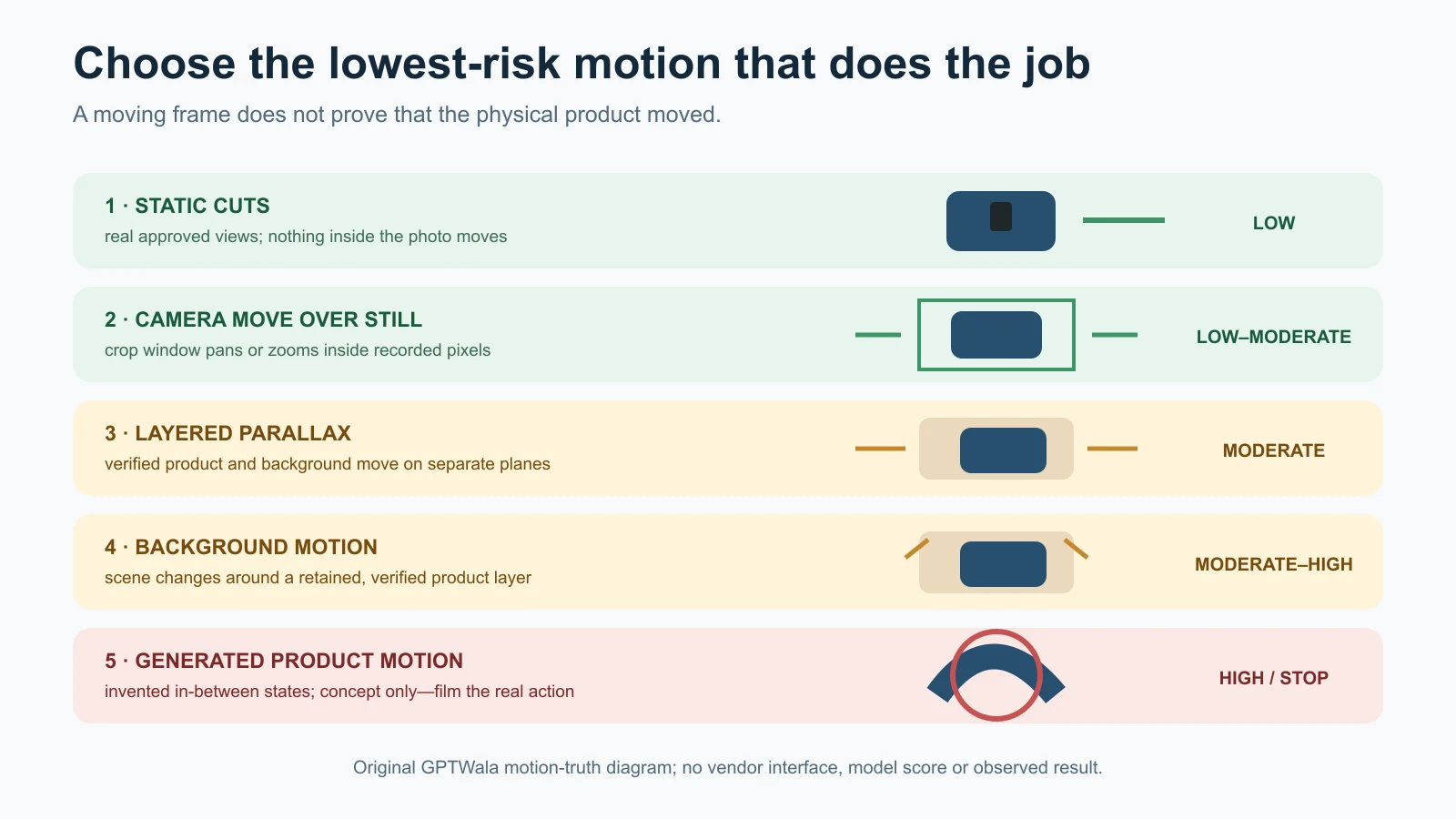
    Safe camera motion over verified stills compared with unsafe invented product movement

    GPTWala motion-truth lanes. Moving the frame is not the same as proving that the physical product moved.

    Build a truthful still-photo pack

    The video is only as trustworthy as its source images. Keep the physical product, exact child SKU and approved product data together until review is complete.

    Start with one exact SKU and offer

    Record:

    • SKU/design code and child variant;
    • colour, finish, size and current pack version;
    • quantity and every included component;
    • dimensions and weight only from controlled product data;
    • visible label/logo text;
    • material and performance claims supported by current records;
    • intended video destination; and
    • one buyer question the video must answer.

    Do not mix a blue product front, a black product back and an old package detail into one smooth-looking video. Do not show a single unit while the caption claims a set unless the offer and visuals explain the quantity clearly.

    Capture the views the video will actually use

    For a simple rigid product, a useful source pack may include:

    1. clean front or 45-degree hero view;
    2. back and side views;
    3. top, inside or underside only when actually photographed;
    4. detail images of texture, label, joint, closure or control;
    5. all included parts in one truthful set image;
    6. measured scale reference for internal review; and
    7. packaging only if it is part of the offer.

    The list is not universal. A flat notebook may need fewer views. A jewellery set, reflective vessel, printed garment, machine component or transparent bottle may need more. The phone-to-approved product-image workflow covers the full capture and approval SOP.

    Protect the untouched files

    Keep source images separate from crops, background edits and video exports. Use filenames that preserve SKU, view, version and status:

    SKU_view_source.ext
    SKU_view_approved-v01.ext
    SKU_demo-timeline_review-v02.ext
    

    If an input image has already changed the label, colour, geometry or included parts, animation will multiply the error across many frames.

    Write a one-message demo brief

    A product demo from stills needs one clear job. “Make a viral video” is not a brief.

    Use this format:

    Create a short vertical product overview for exact SKU RJK-LBX-900-MB. Show the real exterior, latch, interior divider and included spoon using approved stills. Use slow camera moves and native captions only. Do not animate the lid, hand, food, insulation effect or leakproof performance. End with “Ask for current price and stock on WhatsApp.”

    The product code is fictional. The important parts are the locked SKU, visible proof, prohibited motion and honest next action.

    Choose one buyer question

    Buyer question Still-photo answer Do not imply
    What does it look like? Real front, back, side and detail cuts A hidden angle that was not captured
    What is included? Real set layout plus native item list An extra prop or alternative colour is included
    How big is it? Verified dimensions in text and measured reference graphic Scale from a generated hand or room
    What detail makes it useful? Close-up of a real latch, texture, pocket or connector That it operates successfully if no real action is shown
    How do variants differ? Separate approved stills and labels for each child SKU Morphing one colour/design into another as if it is the sale item
    How do I enquire? Native CTA to current WhatsApp/landing page Scarcity, discount or delivery claim not verified

    Keep benefit wording tied to visible fact. “Two removable dividers included” can be shown with a real components photo. “Keeps food hot for 8 hours” requires evidence beyond a still photo and should not appear because the video looks warm.

    Build a short scene-by-scene storyboard

    Plan before opening an animation tool. Each scene should have one approved visual, one factual caption and one transition.

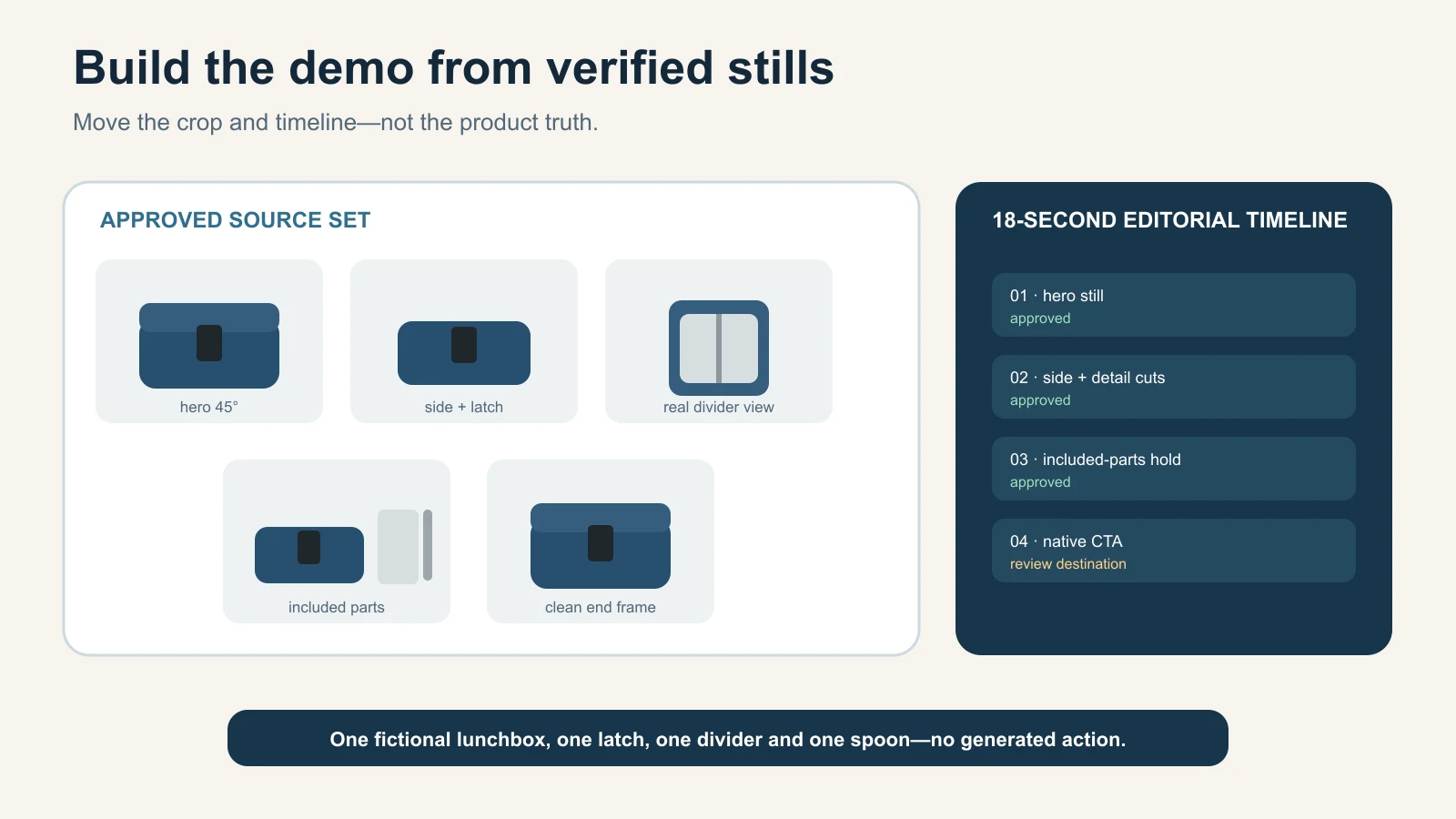
    Illustrative 18-second storyboard

    This timing is a copyable example, not a universal platform rule or tested “best length.” Adjust it after checking the real destination and viewer job.

    Time Visual Native caption Motion Truth check
    0–2 s Approved hero still Exact product name/variant Gentle scale-in within source frame Whole product remains visible
    2–5 s Front and side stills One verified visible feature Straight cut or dissolve No morph between angles
    5–8 s Detail macro Verified material/construction label Slow pan across real detail Crop never leaves recorded pixels
    8–11 s Included-parts still Exact quantity and contents Static hold with native pointers Every listed part is visible and sold
    11–14 s Measured/product-data card Verified dimensions or variant Native graphic transition Numbers match current SKU data
    14–18 s Approved hero or pack shot Honest WhatsApp/website CTA Simple fade No fake urgency or outcome claim

    Use captions outside the product pixels

    Build titles, measurements, arrows and CTA as native video text or graphics. Do not ask a video generator to draw package labels, dimensions or price inside the product image. Generated lettering may look convincing while being wrong.

    Keep text readable against a high-contrast background, leave safe margins for the actual destination and provide captions when narration carries meaning.

    Use cuts when interpolation would invent

    A cut from a real front image to a real back image is truthful. A morph that “rotates” the product between them can invent the sides, thickness, handle and label transition. If the in-between states were not recorded, use the cut.
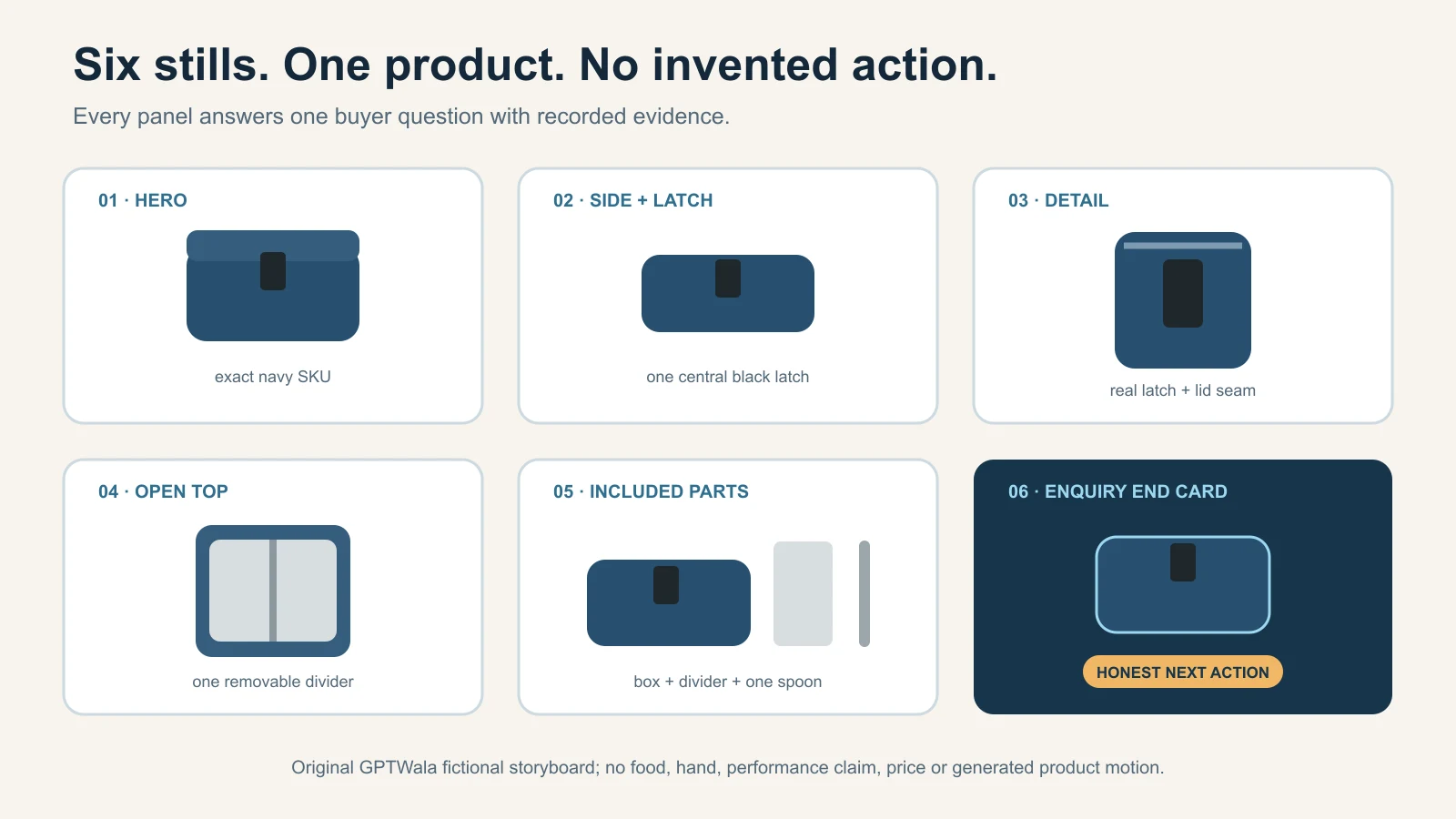
    Six still-photo scenes showing the same fictional lunchbox, details, included parts and an honest enquiry end card

    Original GPTWala fictional storyboard. It shows one lunchbox, one latch, one divider and one spoon; it is not a tool result or proof of product motion or performance.

    Assemble the first version without generating product motion

    A conventional timeline editor is the safest first tool because it can move the crop window without rebuilding the product.

    1. Set the destination canvas

    Choose the aspect ratio and resolution from the current destination requirements, not from a universal template. A vertical social video, landscape website embed and square catalogue preview have different crops. Keep one high-quality edit master and make reviewed channel copies rather than stretching one export everywhere.

    2. Place only approved stills

    Put the images in storyboard order. Match each file to the exact SKU record. Do not use an attractive draft, neighbouring variant or an AI scene that has not passed product truth.

    3. Add controlled camera movement

    For each still, set a start crop and end crop that remain inside the recorded image. Use a slow push toward a label or detail, a side-to-side pan across a wide set, or a small pull-back to reveal included parts.

    Avoid aggressive zoom that exposes blur, turns a thumbnail into a macro or crops away a component. Do not pan beyond the original edge and fill the gap with generated pixels unless that new area is background-only and reviewed.

    4. Use simple transitions

    Straight cuts, short fades and restrained slides are easier to understand and audit than liquid morphs or object transformations. A transition should connect scenes, not turn one product state into another.

    5. Add native information

    Insert product name, variant, dimensions, components and CTA from the current SKU record. Keep a source for every claim. Spell-check Hindi, English and regional-language copy with a human reviewer; do not trust text rendered inside generated frames.

    6. Export a review file

    Name it REVIEW, not FINAL. Reopen the exported file and watch it once at normal speed, once frame by frame around every transition, and once in the destination crop.

    Use generative image-to-video only inside a motion-truth lane

    Generative image-to-video creates new frames. That is exactly what makes it useful and risky.

    What current official tools document

    Google’s current Product Studio documentation describes an Animate images route from an uploaded image or Merchant Center product, with an editable generated prompt and multiple output candidates. It also states that the broader Generate Video feature is currently available to merchants in India and selected other countries, and warns that experimental features may produce unexpected results.

    Google’s separate Product Studio video guide documents choosing products and arranging product images, optional text and AI-asset labelling guidance. Availability, account access and label controls can change; verify them in the real account.

    Adobe’s current Firefly image-to-video documentation describes a first image, optional last image, text-guided transition and camera-motion choices. It also warns that availability can vary by geography, user type and regulatory requirements.

    This article did not test either tool. Documentation proves that the controls exist on the checked date; it does not prove product fidelity, cost, speed or suitability for a SKU.

    Old tutorials are especially risky. OpenAI currently says the Sora web and app experiences were discontinued on 26 April 2026, with the API scheduled for discontinuation on 24 September 2026. Do not build a production SOP around an old interface video without checking the current provider page.

    Safer generated motion

    Use generative video only for a narrow instruction such as:

    Use the supplied approved photo as the exact first frame. Keep the product completely static and unchanged. Apply only a slow virtual camera push toward the product while the plain background light shifts subtly. Preserve exact geometry, colour, finish, label text, logo, component count, included parts, scale, crop and contact shadow. Do not rotate, open, bend, deform, relight, touch or animate the product. Do not add hands, props, text, particles, liquid, food, steam or extra products. Return one candidate for frame-by-frame human review.

    A prompt is not a lock. If the tool cannot keep the product still, return to Level 1 or 2.

    Unsafe generated motion from stills

    Do not publish these as product demonstrations without real footage:

    • rotating the item to reveal an unseen side;
    • opening a lid, hinge, clasp, zip or package;
    • pouring from a bottle or operating a pump;
    • flexing fabric, footwear, cable or material;
    • spinning a wheel, fan, mixer, tool or machine part;
    • putting apparel or jewellery on a generated person;
    • showing food, cosmetics or a chemical taking effect;
    • adding steam, water, fire, impact or load to imply performance; or
    • generating a customer, worker or expert using the product.

    These actions can be useful as a storyboard for a real shoot. Label them concept-only and keep them out of commerce until recreated and verified.

    Add text, voice and music without adding false claims

    Keep copy tied to evidence

    Create a claim ledger before recording voiceover:

    Script line Evidence Safe status
    “Includes two dividers and one spoon” Real contents photo and current SKU record Use if the exact offer matches
    “Matte blue exterior” Approved colour/finish source plus physical review Use with normal colour-display caveat
    “Leakproof” A still of a closed lid Do not use; a still does not prove performance
    “Fits every lunch bag” No dimensional comparison Do not use; universal claim unsupported
    “Made in India” Current product/supplier records Use only when verified for this SKU
    “Best-selling” No current sales evidence and scope Do not use

    The CCPA’s Guidelines for Prevention of Misleading Advertisements, 2022 require truthful and honest representation and prohibit misleading exaggeration of product capability or performance. This is general compliance context, not legal advice for one video.

    Use a real or authorised voice

    A simple owner/staff narration can work if the speaker approves the recording and the script. If you use a synthetic or cloned voice, verify the speaker’s rights/consent, destination rules and disclosure requirements. A voice sounding confident does not make a product claim true.

    AI presenter and cloned-voice decisions belong in the AI spokesperson product-video guide. This still-photo workflow can work without any presenter: captions plus product images are enough.

    Treat music as licensed material

    Use music you created, licensed or are otherwise authorised to use for the destination. Record the source and licence. Do not assume a tool’s library, “royalty-free” label or subscription automatically permits every organic, paid, client or cross-platform use; check the current terms.

    Run the frame-by-frame motion-truth review

    Video review must inspect time, not only a thumbnail. Compare the source stills and exact SKU against the start, middle, end and every transition of each shot.

    Gate Inspect across frames Automatic reject
    Identity SKU, child variant, current package/design Product becomes a similar or generic item
    Geometry Shape, proportions, handles, lids, openings, edges Product bends, rotates into invented geometry or changes silhouette
    Colour/finish Buying-relevant colour, pattern, material cues Variant drifts or material changes with generated light
    Text/marks Label, logo, quantity, model code and orientation Text swims, sharpens falsely, changes or disappears
    Quantity Units, components, accessories and props Extra/missing item or prop appears included
    Scale Dimensions, hand/model/room relationship and crop Product grows, shrinks or floats
    Physical behaviour Hinges, liquid, fabric, mechanism, shadow and gravity Unrecorded function or impossible movement is shown
    Background/contact Surface, reflection, shadow, occlusion and edge Product detaches, intersects a prop or reveals a missing side
    Captions/voice Spelling, timing, language and evidence Unsupported claim, wrong variant or misleading urgency
    Disclosure/rights AI label, people/voice consent, music and source records Required disclosure/permission is missing
    Destination file Aspect, crop, resolution, captions, metadata and CTA Final export differs from approved review file

    Watch at normal speed after the frame review. A transition may pass frame-by-frame but still create a misleading impression when seen quickly.

    Use an approval record

    Field Entry
    SKU / child variant
    Video purpose and destination
    Source still IDs
    Storyboard/script version
    Tool/editor and model/version if relevant
    Generated segments and prompts
    Claims and evidence record
    Music/voice/people rights
    Disclosure decision
    Product reviewer
    Channel reviewer
    Decision APPROVE / REVISE / REJECT
    Final filename/checksum or version

    Keep the form blank until a real video is reviewed. Do not turn the illustrative storyboard into a fake approval record.

    Export and disclose for the real destination

    Verify format and crop at publication time

    Aspect ratios, duration limits, file-size limits, safe areas, caption behaviour and ad rules change. Check the actual destination account before export. Use the product-image and creative rules guide for the broader verification habit, then confirm the current video-specific page for the channel.

    Create a master with sufficient quality for planned versions, but review every crop. A vertical crop can remove a handle, included part or measurement card even when the landscape version passed.

    Disclose realistic synthetic content where required

    YouTube’s current altered or synthetic content guidance requires disclosure when content is meaningfully altered or synthetically generated and appears realistic; the upload flow includes an Altered content setting. Minor aesthetic edits may not require the same disclosure, but the examples and rules must be checked for the actual video.

    Do not use disclosure as permission to misrepresent the product. “AI-generated” does not cure a false lid movement or invented feature.

    Add video structured data only for a real embedded video

    If the finished demo is watchable on a product or article page, Google’s current VideoObject documentation describes properties such as name, description, thumbnail URL, upload date, duration and content/embed URL. Use markup that matches the visible, accessible video. Do not add VideoObject to this article until an actual video exists, and do not expect markup to guarantee a rich result.

    How Indian product businesses can use the workflow

    These are fictional operating examples, not client results or promises.

    Morbi tile manufacturer

    Use real stills of the tile face, edge/thickness, finish, back and verified dimensions. Cut between them with native specification text. Do not animate the tile bending, resisting water, preventing slips or supporting a load unless those claims and actions are captured and supported.

    Rajkot kitchenware seller

    Show the real vessel, lid, handle/joint, included parts and measured capacity from verified data. A slow pan across a real finish is safer than generated rotation. Film the actual opening, pouring, steam, heat or induction use if those behaviours matter.

    Surat apparel wholesaler

    Sequence real front, back, fabric, print/border, stitching and size-chart stills. Do not make a flat garment appear to drape, stretch or fit a generated model. Use real model footage when fall, fit and movement drive the purchase decision.

    Jaipur jewellery retailer

    Cut between real main, back, setting, clasp, measured-scale and applicable hallmark views. Do not generate sparkle, rotation or a wearing view from one photo. One changed stone, prong, chain link, hallmark or scale rejects the segment. The AI jewellery photography checklist is the category authority.

    B2B machine-part manufacturer

    Use verified front/side/back/port and dimension drawings as native graphics. Do not animate a shaft, valve, switch, load path or safety function from stills. Record the real mechanism under appropriate safety conditions and technical review.

    Local packaged-goods retailer

    Show the current pack front, back/label, seal, size and real included quantity. Keep ingredients, declarations, net quantity and expiry/batch information readable only from current real sources. Do not make particles, ingredients or outcomes swirl out of the pack as if they prove contents or performance.

    Common still-to-video failures and safe fixes

    Failure Why it happens Safe fix
    Product “breathes” or changes shape Generative interpolation redraws each frame Use a static still with camera crop movement
    Label letters swim Tool rebuilds fine text over time Keep label static; add verified native text outside product
    Fake 360 rotation One/two views cannot define hidden geometry Use cuts between real views or record a real turntable
    Extra part appears mid-shot Model invents context/occlusion Remove generated segment; simplify background
    Colour pulses Generated lighting changes material/variant Use approved stills and restrained global transitions
    Product floats Shadow/contact changes across frames Keep real contact; use static background or controlled composite
    Hand changes size or grip Generated human/product interaction is unstable Film a real authorised hand with measured product
    Transition morphs variants Tool blends child SKUs Separate variants with a cut and native label
    Zoom reveals blur Source lacks detail Recapture macro; do not upscale into false detail
    Caption claims more than still shows Script written for persuasion, not evidence Use claim ledger; delete or verify the line
    CTA covers product/quantity Destination crop/safe area ignored Reposition native CTA and preview in actual surface
    Export loses captions/audio/metadata Preset or platform processing changes file Reopen final upload/derivative and compare with approved master

    The common AI product-photography mistakes guide covers source-image defects. Fix those before video assembly; animation does not repair product truth.

    When to stop and record real video

    Record real footage when the buyer must see:

    • opening, closing, locking, folding or assembly;
    • pouring, dispensing, mixing, spraying or flow;
    • fit, drape, stretch, movement or worn scale;
    • texture changing under touch or pressure;
    • reflective/transparent material changing with angle;
    • machine, tool, wheel, valve, switch or safety operation;
    • setup time, speed, load, temperature, sound or performance;
    • a person using the product;
    • an unboxing, seal, pack contents or condition sequence; or
    • a one-off, high-value or regulated item where invented motion is unacceptable.

    Still-photo video is a presentation method. Real video is evidence of real motion. A hybrid can use real action clips plus still macros and native data cards, with every part tied to the exact SKU.

    Turn the demo into an online-growth asset

    An approved video can support a product landing page, digital product catalogue, WhatsApp follow-up or an AI ad-creative testing plan after the relevant channel review. Do not call it successful until you measure the real business outcome separately.

    The GPTWala workshop connects this AI Content Creation step to the DAA path: Digital Presence → AI Content Creation → ₹100/day WhatsApp ads. It teaches a practical system, not guaranteed views, enquiries, sales or return on ad spend.

    See the GPTWala workshop
    Learn how truthful product content can connect to a wider online-growth process.

    Frequently asked questions

    Can I make a product video using only photos?

    Yes. Use a timeline of real approved stills with cuts, native captions and slow pan/zoom movement. This can explain appearance, details, dimensions and included parts. It cannot prove an unrecorded action, hidden side, fit or performance.

    How many product photos do I need?

    There is no universal number. Capture enough approved views to support every scene without invention: hero, side/back, details, included parts and measured evidence as the product requires. If the storyboard asks for a view you do not have, recapture it or delete that scene.

    Can AI turn one product photo into a 360-degree video?

    It can generate a plausible rotation, but the unseen geometry is inferred. Do not present that as an exact-product demo. Use a real turntable video, a verified 3D model created from sufficient product data, or cuts between real views.

    What motion is safest for a still-photo product demo?

    A slow crop-window pan or zoom within a real photograph, plus simple cuts and fades. The product pixels do not need to be regenerated. Check that the crop stays inside the source and that no important component or text is lost.

    Can I animate a lid, pump, zip or machine part from a still?

    Not as evidence of real function. A generated action may invent hinges, seals, hands, intermediate positions or performance. Film the actual movement with the exact product and appropriate safety review.

    How do I stop text and logos changing in AI video?

    Keep the product/label static where possible and place captions as native video text. Frame-by-frame review is still required. If a generated segment makes label text swim, sharpen, vanish or change, reject it.

    Do I need to disclose that a product video used AI?

    It depends on the destination and the nature of the edit. YouTube currently requires disclosure for meaningfully altered or synthetic content that appears realistic. Other platforms and advertising systems have their own rules. Check the actual destination and local obligations; disclosure does not permit product misrepresentation.

    Should I use an AI spokesperson in a photo-based demo?

    It is optional and adds consent, voice, likeness, script and disclosure risks. A clear product-only video with native captions can be enough. Use the separate AI spokesperson guide before adding a synthetic presenter.

    What should make me reject a generated product-video segment?

    Reject it if identity, geometry, colour, label, quantity, scale, shadow, included parts or physical behaviour changes; if it shows an unverified claim; or if rights/disclosure evidence is missing. One serious error outweighs attractive motion.

    Sources and review method

    Reviewed 12 August 2026. Named tool capabilities, platform disclosure and schema facts were checked against current official documentation. The storyboards, motion levels, checks and examples are editorial recommendations. No tool output, merchant account, Indian checkout, upload, VideoObject implementation or performance result was tested.

  • AI Product Videos for Indian Product Businesses: Complete Guide

    Indian product team comparing real, hybrid and synthetic video methods for the same fictional product
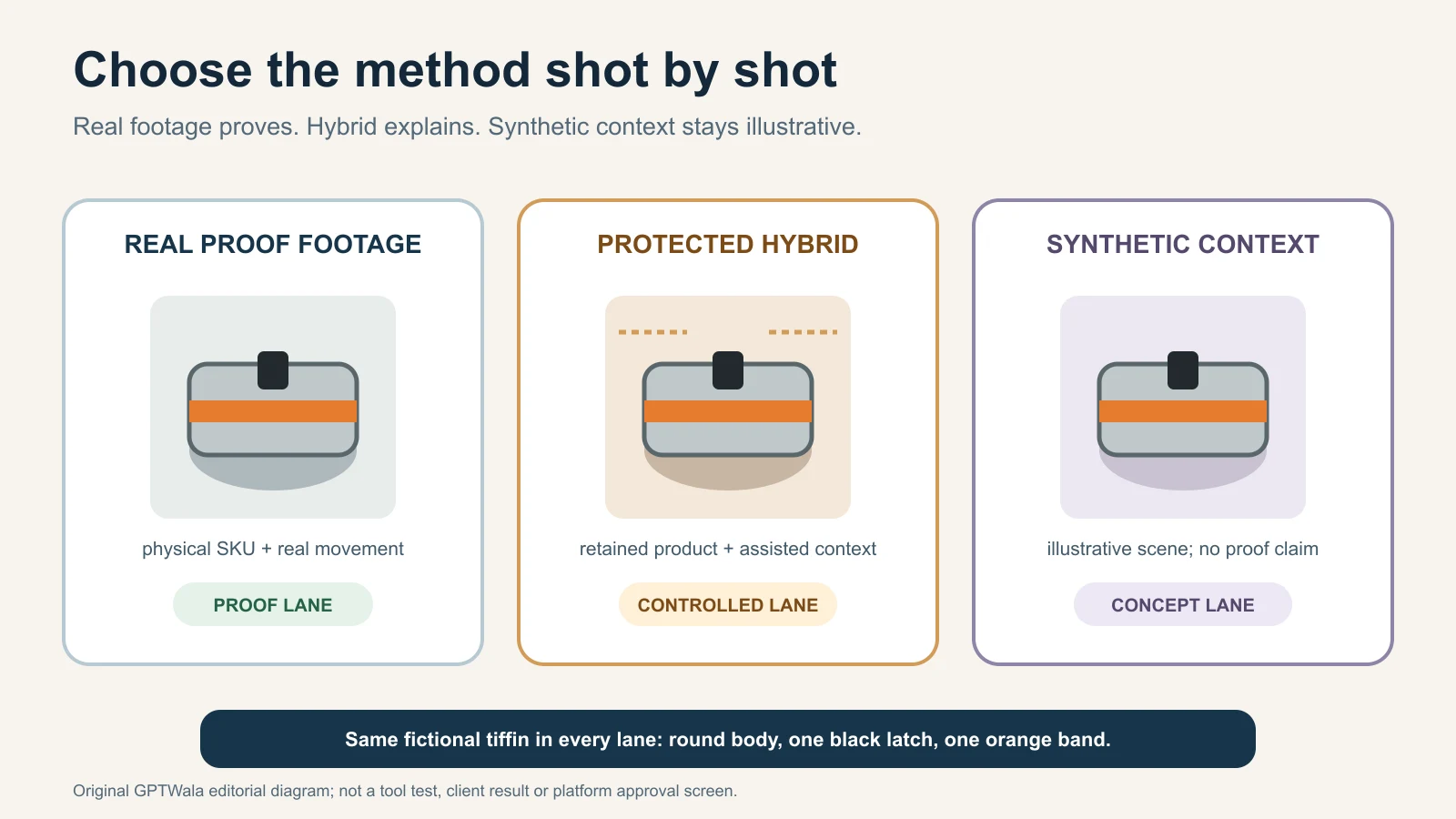
    Choose the production method shot by shot: real footage for proof, AI where it can add context without changing the product or claim. Original GPTWala diagram using one fictional tiffin; not a tool test, seller result or platform approval screen.

    Reviewed and updated: 12 August 2026

    An AI product video should begin with an exact product, a verified claim and one job for the viewer—not with a tool or a “viral” template. Use real footage when movement, fit, function, texture, scale, safety or performance must be proved. Use AI-assisted editing for scripts, cutdowns, captions and controlled presentation; use synthetic motion or scenes only when every visible and spoken implication can be verified. The safest result is often hybrid: real product evidence plus AI-assisted production.

    For an Indian manufacturer, wholesaler, retailer, shopkeeper or product brand, the key unit is an approved video master, not a generated clip. Approval means the exact SKU, motion, offer, voice, text, claims, rights, disclosure and destination version have all passed review.

    This is the root guide for deciding what kind of AI product video to make and how to govern it. The complete AI product photography guide owns approved still-image foundations. The future still-photo product demo tutorial will own the click-by-click image-to-video build. The future AI spokesperson video guide will own avatar, voice, likeness, consent and talking-head workflow in depth.

    Table of contents

    1. What counts as an AI product video
    2. Choose the video job before the format
    3. Understand product truth and motion truth
    4. Choose real, hybrid or synthetic production
    5. Build a motion-truth card
    6. Prepare the evidence pack
    7. Write a claim-led script and storyboard
    8. Use the ten-gate production workflow
    9. Review every frame, transition and sound
    10. Handle Indian languages, voice and captions
    11. Disclose realistic synthetic content and preserve provenance
    12. Prepare website, social, sales and ad versions
    13. Apply the method to Indian product businesses
    14. Measure a pilot without invented results
    15. Know when AI should stop
    16. A four-cycle first pilot
    17. Frequently asked questions

    What counts as an AI product video

    “AI video” describes several different production methods. Treating them as one category creates bad decisions.

    Method What AI does Best first use Main risk
    AI-assisted real-footage edit Helps script, transcribe, caption, remove pauses, organise clips, create versions or clean audio Demo, FAQ, dealer explainer and product-page video built from real evidence Automated edits remove context, mistranscribe facts or imply a sequence that did not occur
    Motion-design video from approved assets Moves text, diagrams, crops and approved still product layers on a timeline Feature summary, catalogue reel, launch notice, dealer presentation Camera motion or effects are mistaken for product motion; still details morph
    Image-to-video generation Creates apparent camera or object movement from a still image Secondary mood shot or controlled visual transition The unseen side, label, geometry, hand interaction or mechanism is invented
    Text-to-video generation Creates a scene from a written description Concept development, non-product moodboard, abstract background Plausible scene becomes false product evidence
    Synthetic presenter or voice Delivers a script through an avatar, generated person or voice Multilingual explanation after rights and disclosure review False endorsement, likeness/voice misuse, lip-sync or translation changes the claim
    Hybrid product video Combines real footage/product layers with AI-assisted edit or synthetic context Most sale-facing physical-product videos Viewers cannot tell which moments are proof and which are illustrative

    The production label does not determine truth. A conventional edit can mislead through cropping or timing. A synthetic background can be safe when it is clearly contextual and the product layer remains exact. Review the finished communication, not only the tool used.

    Product video is broader than an advertisement

    A product video may:

    • identify a product or range;
    • show how to assemble, open, wear, install, clean or use it;
    • explain material, finish, configuration or included parts;
    • give a B2B buyer a quick model comparison;
    • answer a recurring sales or after-sales question;
    • show a possible lifestyle or merchandising context;
    • introduce an offer and invite an enquiry; or
    • become a source for later ad creatives.

    Each job needs different evidence. A lifestyle reel can use a clearly illustrative room; an installation video cannot invent the mounting sequence.

    Choose the video job before the format

    Write one sentence:

    After watching, [specific viewer] should understand [one verified thing] and take [one next action].

    Examples:

    • “A dealer should distinguish the 500 ml and 750 ml bottle and request the current price list.”
    • “A retail buyer should see the real zip, lining and pocket arrangement and open the product page.”
    • “A machine-parts buyer should understand which port is inlet and which is outlet and ask for the data sheet.”
    • “An existing customer should follow the verified cleaning steps and avoid a common misuse.”

    Avoid “make people excited”. It gives the editor no truth boundary.

    Match the video to the buyer question

    Buyer question Useful video role Evidence burden
    What is it? Product identity/reveal Exact SKU, variant, pack and scale
    What differs between these models? Comparison Same camera logic, verified differences and no hidden configuration change
    How does it work? Demonstration Real or verified action sequence, actual timing and safe operating conditions
    What will I receive? Unboxing/offer contents Exact current pack, quantity, accessories, labels and exclusions
    How might it look in context? Lifestyle/context Exact product plus plausible, non-deceptive scene; no implied included props
    Can this solve my use case? Explainer/case application Substantiated suitability, constraints and no unverified performance promise
    What should I do next? Enquiry/offer video Current availability, price/terms where stated and a working action path

    One master can contain several roles, but every shot still needs one job. Do not hide a proof claim inside decorative B-roll.

    Understand product truth and motion truth

    An approved still image is not automatically safe to animate. Motion adds information the source never contained.

    Product truth

    Product truth asks whether the product looks like the exact sellable SKU:

    • identity and variant;
    • shape, proportions and dimensions;
    • colour, material, texture and finish;
    • print, label, logo and required marks;
    • parts, openings, seams, stones, ports and fasteners;
    • pack quantity and included accessories; and
    • current packaging generation.

    Use the AI product image accuracy checklist before a still becomes a video source.

    Motion truth

    Motion truth asks whether the video accurately represents what happens over time:

    • Can that lid, clasp, hinge, wheel, fabric or mechanism move that way?
    • Does the hand hold the product at a truthful scale?
    • Does a component appear, disappear or pass through another object?
    • Is the quantity of liquid, food, product or pack content stable?
    • Is the action sequence complete and in the correct order?
    • Does speed-ramping make a slow result seem instant?
    • Does reverse playback make disassembly look like automatic assembly or repair?
    • Does a loop conceal an ending, spill, fit problem or manual reset?
    • Do particles, shine, vapour or sound imply power, freshness, cooling, weight or quality?
    • Does the scene show an accessory or environment as if it is included, compatible or approved?

    Motion can create a claim without words

    Edit or visual Possible viewer inference Required control
    Water rolls off a surface Waterproof or water-resistant Use verified test/evidence and accurate wording, or remove the action
    Heavy impact sound Solid, metal, premium or durable construction Use truthful recorded sound or neutral audio; do not let effects substitute for material proof
    Food sizzles immediately Heating performance or speed Demonstrate under recorded conditions or label illustrative sequence clearly
    Fabric flows in slow motion Weight, softness, transparency or drape Use real garment movement when those properties matter
    Jewellery emits added sparkle Stone quality, count or brilliance Keep decorative effect clearly separate from proof; retain real macro footage
    A room assembles around a product Installation ease or compatibility Do not present synthetic assembly as instruction
    A model praises the item Testimonial or endorsement Use a genuine authorised statement or identify scripted presentation; never fabricate customer experience

    The rule is simple: if the buyer could reasonably use the motion to judge the product, the motion needs evidence.

    Choose real, hybrid or synthetic production

    Choose at the shot level. A 25-second video can contain a real demonstration, an approved animated diagram, a synthetic contextual background and a conventional CTA card.

    Lane 1: real evidence

    Use real capture when the shot must prove:

    • movement, fit, drape, opening, assembly or use;
    • colour, gloss, texture, transparency or reflection in motion;
    • exact dimensions, quantity or relative scale;
    • actual sound, timing, output or physical result;
    • a safety-critical or regulated instruction; or
    • a real person’s experience or endorsement.

    AI can still assist with captions, transcript cleanup, shot logging, noise repair and derivative versions after the evidence is recorded.

    Lane 2: protected hybrid

    Use a hybrid shot when the exact product evidence can remain real while AI changes non-product context. Examples:

    • animate a camera crop around an approved still without inventing the unseen side;
    • place a protected real product cut-out over an illustrative background;
    • combine a real hand demonstration with labels and verified callouts;
    • use a real rotation with an AI-assisted clean backdrop; or
    • turn a real longer demo into short language or destination versions.

    The AI-versus-traditional photography decision guide applies the same evidence-first thinking to source assets.

    Lane 3: synthetic illustration

    Use fully generated scenes for:

    • concept boards;
    • abstract mood or category context;
    • non-literal transitions;
    • a clearly illustrative problem/solution setup; or
    • pre-production planning.

    Do not let a synthetic illustration become the only evidence beside a purchase or enquiry action. Pair it with exact product views and mark the internal role clearly.

    Decision matrix

    Shot job Default method AI may help with Stop condition
    Exact product reveal Real or protected product layer Background, crop, light cleanup, titles SKU/label/shape changes
    Physical demo Real capture Script, shot list, captions, edit, callouts Action, timing or result cannot be verified
    Feature list Approved stills/footage plus motion design Layout and versions Visual callout points to the wrong feature
    Lifestyle context Hybrid or synthetic secondary shot Scene, props, atmosphere Scene implies false scale, included item, compatibility or performance
    Technical explanation Real detail plus verified diagram Diagram animation, narration, captions AI invents cutaway, dimensions or internal components
    Model/apparel movement Real capture for fit/drape proof Secondary styling/context Garment construction, drape or body interaction changes
    Spokesperson Real authorised person or governed synthetic presenter Language versions and layout Likeness/voice/endorsement rights or disclosure unclear

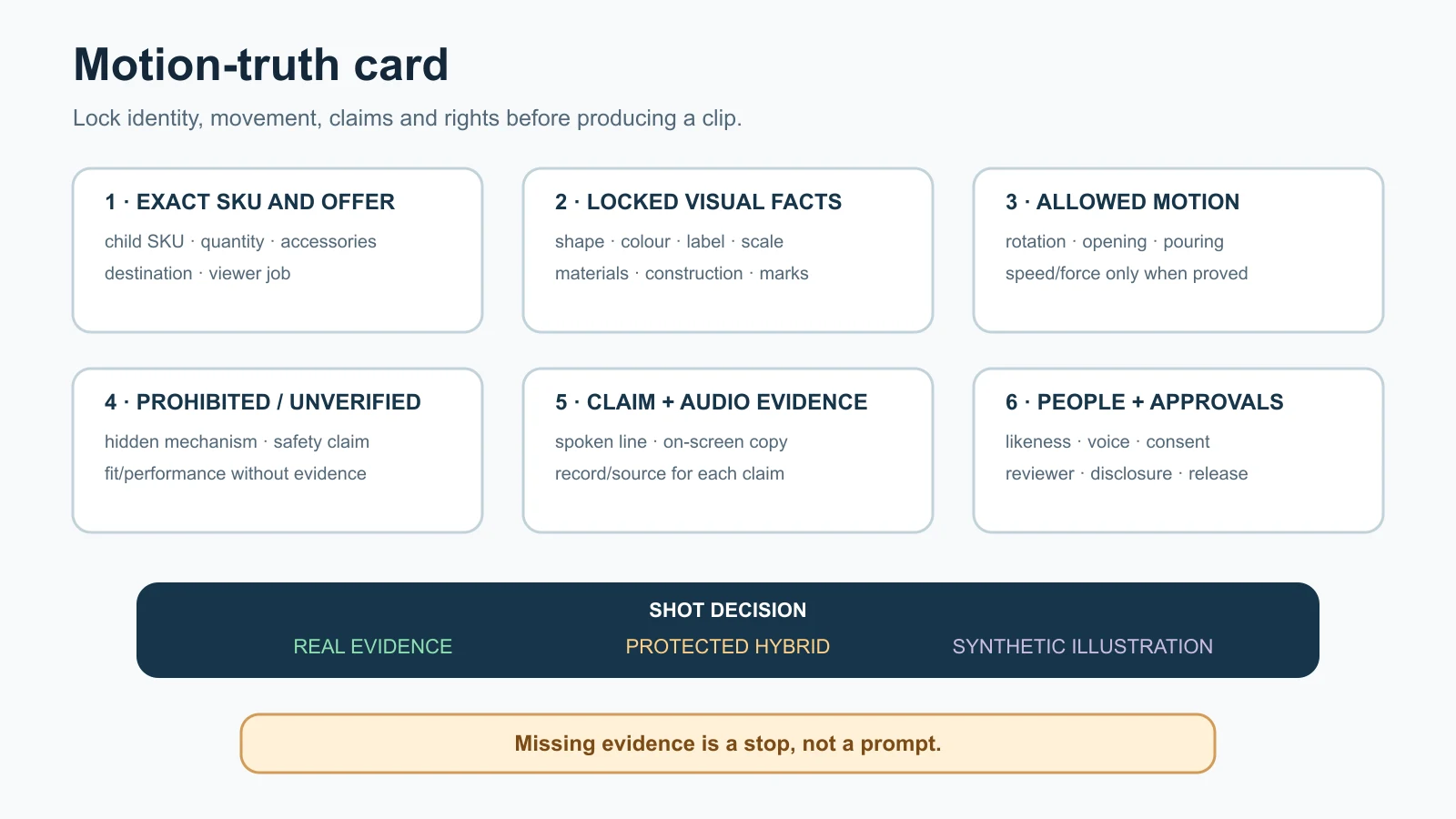
    Build a motion-truth card

    Create one card before scripting. It should fit on one page and travel with the project.

    Identity and offer

    • exact SKU, variant and product family;
    • current pack, quantity and included pieces;
    • product name and approved pronunciation;
    • destination and intended viewer;
    • video job and next action; and
    • source/product owner.

    Locked visual facts

    • shape, proportions, construction and dimensions;
    • colour, finish, print and label;
    • parts, settings, seams, ports and accessories;
    • product-facing surfaces that must remain visible; and
    • old packaging or similar variants that must not appear.

    Allowed and prohibited motion

    • motion directly observed in real footage;
    • permitted camera movement around a still or cut-out;
    • operations that require real capture;
    • actions, results, durations or environments not verified;
    • props that are contextual but not included; and
    • unsafe or off-label uses that must not appear.

    Claim and audio controls

    • approved feature and benefit wording;
    • source for objective claims;
    • words such as “fast”, “strong”, “natural”, “premium”, “waterproof” or “safe” that require evidence or removal;
    • verified units, measurements and model numbers;
    • voice, music and sound-effect rights; and
    • pronunciation/translation owner.

    People, disclosure and release

    • model, actor, employee, customer, likeness and voice permissions;
    • whether a person is real, synthetic or an authorised digital double;
    • platform upload disclosure decision and owner;
    • C2PA or other provenance route, if supported;
    • product, legal-risk and channel reviewers; and
    • real-capture stop rules.

    Motion-truth card linking exact product identity, allowed movement, claims, evidence, rights and approval

    Lock the product, permitted motion and claim evidence before any clip is generated. Missing evidence is a stop, not a prompt.

    Prepare the evidence pack

    AI cannot recover facts that were never supplied. Build the pack according to the video job.

    Product sources

    • approved front, back, side, top and detail images;
    • real footage of any action being claimed;
    • scale reference and verified dimensions;
    • current label, packaging and artwork files;
    • bill of materials or included-parts list where relevant;
    • data sheet, usage instruction and safety information; and
    • exact colour/finish reference where buying-critical.

    For a high-SKU range, use the AI catalogue photography system to prevent adjacent variants from contaminating a video job.

    Communication sources

    • approved product description and offer;
    • substantiation for objective claims;
    • known buyer question and objection;
    • glossary of product terms and forbidden substitutions;
    • brand voice and visual guide;
    • approved CTA and destination; and
    • language master plus authorised translations.

    Rights and provenance sources

    • who owns each image, clip, design, voice, music and font;
    • release/permission for identifiable people, locations and property where required;
    • tool, plan/model, project date and settings;
    • source files and generation/edit history; and
    • export and disclosure record.

    Do not upload unreleased products, customer information, confidential drawings, faces or voices until the chosen provider’s current terms and the business’s data policy permit it.

    Write a claim-led script and storyboard

    Start with evidence, then write. An AI-written script can sound fluent while changing a model number, adding a benefit or turning “may help” into “will”.

    Use a claim ledger

    Script line or on-screen statement Claim type Evidence Allowed wording Reviewer
    Product name/model Identity Product master Exact approved name Product owner
    “Includes lid and two inserts” Offer composition Pack list and physical sample Exact count only Product owner
    “Matte surface” Attribute Approved specification/sample Do not upgrade to “scratch-proof” Category reviewer
    “Ask for dealer pricing” CTA Current sales process No unavailable price/stock promise Sales owner
    Warranty or performance statement Objective claim Current written policy/test Match scope, conditions and date Authorised business/legal reviewer

    Keep a line that has no evidence out of the script. A disclaimer is not a storage place for unsupported claims.

    Use a shot ledger

    Shot Viewer job Visible product/action Method Truth risk Approval evidence
    01 Identify exact item Static front/three-quarter product Real/protected Wrong variant or pack Approved master and SKU
    02 Prove feature Real opening/connection/detail Real footage Impossible motion or hidden reset Raw clip and instruction
    03 Explain benefit Callout over verified detail Motion design Callout exaggerates attribute Claim ledger
    04 Add context Product in illustrative setting Hybrid/synthetic False scale or included props Context reviewer/disclosure decision
    05 Invite action End card Conventional Old offer, phone or URL Sales owner

    This ledger is the project’s most useful hand-off. The generator, editor and reviewer can see why every shot exists and what would make it fail.

    Storyboard for silent understanding

    View the storyboard without narration. Can a buyer still identify the exact product and avoid a false inference? Then read the script without visuals. Does the audio make a promise the product footage never proves? Review both layers separately before combining them.

    Use the ten-gate production workflow

    Gate 1: define viewer, job and action

    Choose one primary viewer and one next step. A dealer video and a consumer reel can share footage but should not share an unfocused script.

    Gate 2: approve the method lane

    Assign real, hybrid or synthetic method per shot. Escalate proof, safety, fit, performance and endorsement scenes to real evidence.

    Gate 3: approve the motion-truth card

    The product owner signs off the exact SKU, locked facts, allowed motion and stop rules before generation.

    Gate 4: complete the evidence pack

    Mark missing sources. Do not let an editor fill a blank with a plausible clip.

    Gate 5: approve script, claim ledger and storyboard

    Check identity, units, offer, language and implied claims. Separate product facts from creative direction.

    Gate 6: capture and generate shot by shot

    Record proof footage first. Generate small, replaceable components rather than asking for an entire finished commercial in one step. Keep source, prompt/instruction, output and version together.

    Gate 7: assemble picture and sound

    Add titles, callouts, narration, music and sound effects only from approved sources. Keep product labels and mandatory information readable for long enough to review.

    Gate 8: run independent truth review

    The operator checks technical quality. A product/category owner checks the exact SKU, motion, claim and offer. A language reviewer checks voice, on-screen copy and captions where needed.

    Gate 9: make destination versions

    Create versions from the approved master according to current platform, website, sales and ad requirements. Recheck crops because a vertical cut can hide a disclaimer, product part or quantity.

    Gate 10: release, log and measure

    Release only named, approved versions. Record the publication URL, upload disclosure choice, source master, date and owner. Keep rejected versions out of shared sales folders.

    Review every frame, transition and sound

    Do not review an AI product video only at normal speed on a phone. Review the full-resolution master, then inspect keyframes and transitions.

    Five review passes

    1. Identity pass: exact SKU, colour, label, pack and included parts.
    2. Geometry pass: shape, proportions, openings, seams, stones, handles and product boundaries across frames.
    3. Motion pass: physical action, contact, sequence, timing, continuity and cause/effect.
    4. Claim pass: narration, text, symbols, props, sound and implied benefit.
    5. Release pass: rights, captions, disclosure, crop, CTA, destination profile and final filename.

    Common motion failures

    Symptom Likely risk Decision
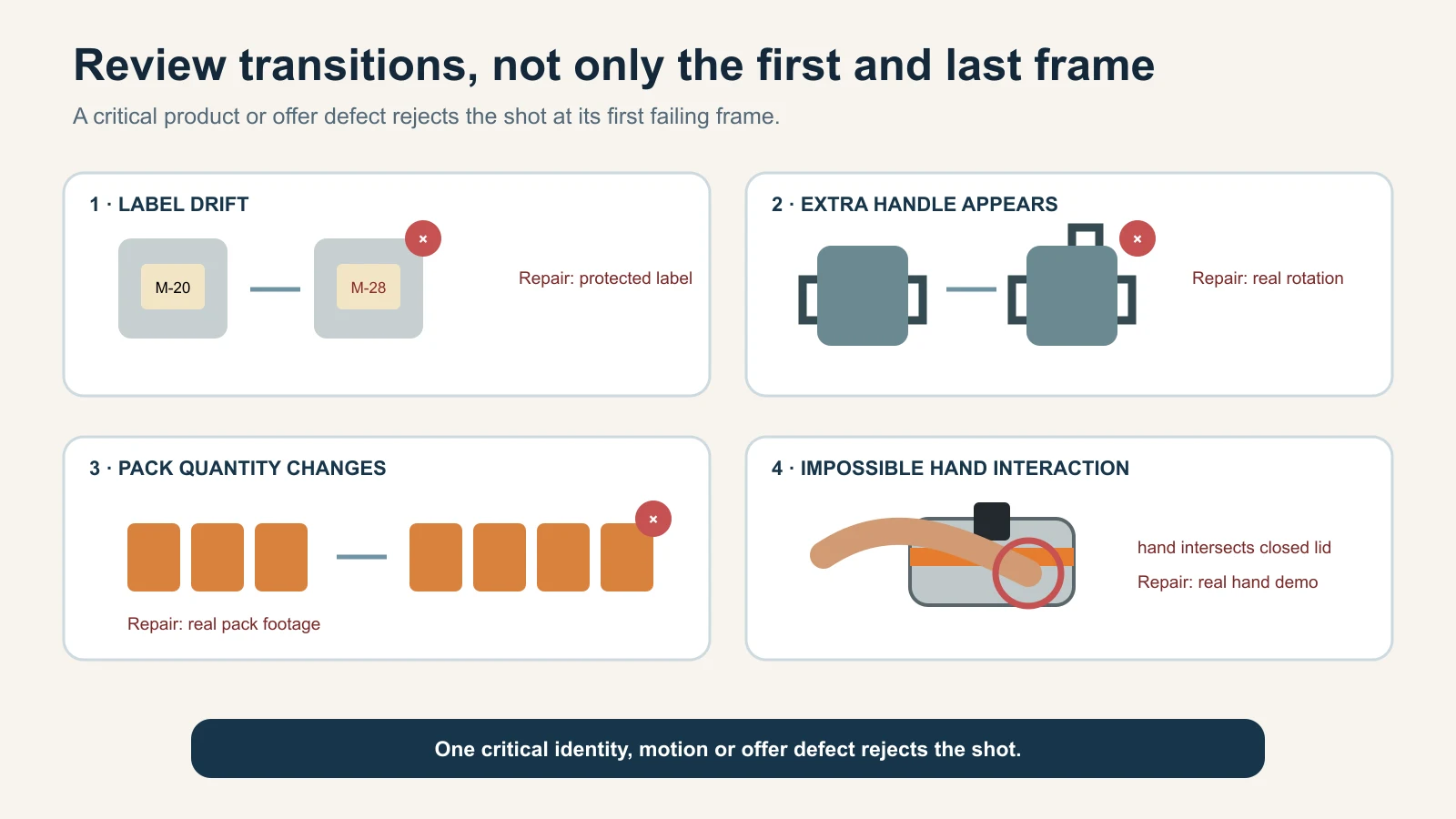
    Label letters swim or change Wrong brand, model, quantity or legal text Replace with protected real label/footage; do not patch frame by frame blindly
    Handle, clasp, port or stone count changes Product identity/geometry drift Reject shot; use real capture or protected layer
    Hand merges with product False use, scale or safety Reject; recapture real interaction
    Product rotates to reveal invented back Unseen detail fabricated Limit camera motion or supply/record the real back
    Liquid or pack contents change between frames Quantity/offer misrepresentation Reject or use real footage
    Shadow/reflection moves independently Floating or physically impossible presentation Repair only if product truth remains exact; otherwise recapture
    Cut hides a manual step Ease-of-use or performance implication Restore the step or label the edit/summary accurately
    Speed change makes outcome look immediate Timing/performance claim Show actual time/conditions or remove implication
    Voice says a stronger claim than text Unsupported audio claim Return to approved script and rerecord/regenerate
    Caption changes a unit/model number Offer or safety error Correct caption and review all language tracks

    When one critical product feature changes, reject the shot rather than averaging the rest of the video into a passing score.

    Four-frame product video review showing label drift, an extra handle, changing pack quantity and an impossible hand interaction

    Inspect transitions and keyframes; critical product details often fail between attractive start and end frames. The defects are deliberate teaching illustrations, not observed model outputs.

    Handle Indian languages, voice and captions

    India-facing product videos often mix English product terms with Hindi, Gujarati, Marathi, Tamil, Telugu, Bengali or other languages. Translation must preserve the product, not merely sound fluent.

    Create one approved fact master

    Lock:

    • product and model names;
    • technical terms that remain untranslated;
    • units, quantities, prices and dates;
    • safety, warranty and limitation wording;
    • CTA destination; and
    • terms that must not be upgraded into stronger claims.

    Use a competent reviewer for every published language. Back-translation can expose drift, but it does not replace a reviewer who understands the product and intended audience.

    Treat captions as content

    W3C’s WCAG 2.2 guidance for prerecorded synchronized media says captions should provide synchronized text for audio content, including meaningful non-speech information. See Understanding WCAG 2.2 captions for prerecorded media.

    YouTube also warns that automatic captions may misrepresent speech because of pronunciation, accents, dialects or background noise and tells creators to review and correct them. See YouTube’s automatic captioning guidance.

    For product videos, always check:

    • brand and model pronunciation;
    • Indian names and regional terms;
    • decimal points, units and pack counts;
    • phone numbers, URLs and prices;
    • speaker labels and meaningful sound cues; and
    • caption placement over product details and disclosures.

    Do not rely only on burned-in subtitles if the publishing surface supports a proper caption track. Supply both where the audience and platform need them.

    Disclose realistic synthetic content and preserve provenance

    Disclosure rules differ by platform and can change. Make the decision for each destination on the upload date.

    YouTube’s current rule

    YouTube currently requires creators to disclose content that is meaningfully altered or synthetically generated when it seems realistic. Its examples include making a real person appear to do or say something they did not, altering a real event/place, or generating a realistic scene that did not occur. It says minor production assistance such as script help, caption creation, sharpening or audio repair generally does not require that disclosure, while the list is not exhaustive. See YouTube’s GenAI disclosure guidance.

    Use the upload setting YouTube provides when the finished product video meets that test. Do not assume a caption saying “AI video” replaces the platform setting.

    YouTube’s current impersonation policy also says disclosure is not a free pass to use someone’s AI likeness or voice to falsely imply authorisation or endorsement. See YouTube’s impersonation policy.

    The AI spokesperson product video guide will cover that risk in depth. Until then, do not create a customer, expert, celebrity, employee or founder endorsement without documented permission and truthful wording.

    Keep a provenance record

    The C2PA 2.3 explainer describes Content Credentials as a cryptographically bound structure that can record an image, video, audio file or document’s origin, modifications and AI use. It also says credentials do not judge whether the underlying content is true and can be incomplete or removed. See the C2PA Content Credentials explainer.

    Therefore:

    • preserve supported Content Credentials through editing/export where practical;
    • keep a separate internal record of source, tool/model, edits, claims and approvals;
    • test whether the editor, compressor, host and platform preserve credentials; and
    • never treat provenance metadata as proof that the product or claim is accurate.

    India product-truth safeguard

    The Central Consumer Protection Authority’s 2022 misleading-advertisement guidelines apply to commercial communication, and the ASCI Code says advertising should not mislead through statements or visual presentation by implication, omission, ambiguity or exaggeration. See the Department of Consumer Affairs’ official guidelines page and the ASCI Code.

    For an AI product video:

    • show the SKU, offer and current packaging that can actually be supplied;
    • substantiate objective claims and visual demonstrations;
    • do not fabricate a testimonial, test or product result;
    • disclose material synthetic presentation where the destination or context requires it; and
    • seek category-specific legal review for regulated, safety-critical or high-consequence claims.

    This is operational guidance, not legal advice. There is no blanket claim here that every AI-assisted edit requires the same public label in India.

    Prepare website, social, sales and ad versions

    An approved master is not automatically ready for every destination. Maintain a version register with:

    • source master ID;
    • destination and account;
    • frame/aspect and safe-area profile;
    • maximum duration/file requirements from the current guide;
    • caption/subtitle track;
    • AI disclosure decision;
    • thumbnail/poster frame;
    • CTA, link and offer date;
    • reviewer and approval date; and
    • published URL.

    Do not publish universal aspect ratios, file sizes or duration limits from memory. Verify the current platform/account instructions at export time.

    Google Search Central says video discovery depends on crawlable embeds, an indexable page and a valid thumbnail at a stable URL. For eligibility in video features, it recommends a dedicated watch page where watching the single video is the main purpose; it specifically notes that a product page with a complementary 360-degree video is not a watch page. A non-watch product page can still appear as a normal text result. See Google’s video SEO best practices.

    If one product video deserves search visibility:

    • create a useful page where that video is the main content;
    • give it a unique title and description;
    • place a truthful transcript or supporting copy nearby;
    • provide a stable, accessible thumbnail;
    • add accurate VideoObject structured data if implemented correctly; and
    • monitor indexing rather than promising a video rich result.

    Google says structured data information should match the actual video and does not guarantee a specific search feature. See Google’s VideoObject documentation.

    Sales and WhatsApp use

    Create a lightweight approved derivative only after the master passes. Keep the exact product name, sales contact and current offer in the message or adjacent copy. Do not compress until label text or product detail becomes misleadingly unreadable.

    An organic or sales video is not automatically ad-safe. Advertising destinations impose additional content, offer, rights and account rules. Google Ads, for example, prohibits ads or destinations that deceive by omitting relevant product information or providing misleading information, and YouTube/Discover feed ads receive a separate review. See Google Ads’ misrepresentation policy.

    The future AI ad creatives guide should own the creative/ad system. Recheck the actual ad platform policy and account before submission; never say a video is “platform approved” merely because a tool exported the right dimensions.

    Apply the method to Indian product businesses

    The following are fictional operating examples, not client results or claims about every business in those regions.

    Rajkot cookware manufacturer: prove the mechanism, generate the kitchen

    A pressure cooker or pan video may need to show the exact handle, lid fit, valve, finish and included pieces. Capture the opening/closing and safety-relevant actions for real, following the authorised instructions. AI can help storyboard, clean the background, add verified feature callouts and create a non-proof kitchen context.

    Stop if the video changes the valve, implies instant heating, shows unsafe steam handling or adds a lid/accessory not in the pack.

    Morbi tile manufacturer: separate finish evidence from room context

    Use real footage to show surface texture, gloss, edge, face variation and scale. A generated room can help a dealer imagine a style, but it should not become evidence of shade, slip resistance, installation ease or an exact layout. Do not animate grout or tiles assembling themselves as an installation tutorial.

    For a B2B range, link every video master to the same SKU/finish records used in the catalogue system.

    Surat apparel wholesaler: movement is a product claim

    When fabric moves on a body, the viewer may judge drape, weight, transparency, flare, fit and included pieces. Use real garment movement when those properties affect the sale. A synthetic model or generated walk can distort construction and body interaction even if one frame looks convincing.

    Keep product-only and real-detail evidence available and use the AI model photos for apparel guide for fit, drape, consent and cultural-styling safeguards.

    Jaipur jewellery retailer: real macro motion before sparkle effects

    A real turntable or hand-held macro clip can prove stone arrangement, prongs, clasp, back and scale. AI sparkle, lens flare or floating motion may be decorative, but it must not change stone count, metal colour or brilliance in a way that becomes product proof.

    Use the AI jewellery photography checklist to approve the still/detail sources before motion work.

    Multi-brand wholesaler: permission and version control

    Confirm that the supplier’s clips, pack shots, trademarks, music and product claims can be reused and edited. Record the packaging generation and source date. Do not modernise a label, remove the manufacturer’s identity or make a synthetic representative “recommend” the product without authorisation.

    Measure a pilot without invented results

    Do not claim AI made video “10x faster”, cut costs by a fixed percentage or increased sales unless a defined test supports it.

    Operational measures

    Metric Formula Why it matters
    Source-ready rate projects with complete evidence packs ÷ projects started Separates source problems from tool problems
    First-pass shot approval shots approved without rework ÷ shots submitted Measures method/brief reliability
    Critical motion-defect rate shots rejected for identity, geometry, motion, claim or offer defects ÷ shots reviewed Shows product/motion-truth risk
    Rework time per approved master total rework minutes ÷ approved masters Makes hidden labour visible
    Cost per approved master all attributable production and review cost ÷ approved masters Compares methods after rejection, not before
    Caption/translation defect rate caption or language lines corrected ÷ lines reviewed Finds multilingual risk
    Disclosure completeness released versions with documented disclosure decision ÷ released versions Checks platform/process control
    Destination completion approved destination versions ÷ required versions Measures release readiness
    Post-release correction rate released videos needing a truth/offer correction ÷ released videos Tracks escaped errors

    Include real capture, subscriptions/credits, operator time, product review, language review, music/voice/licensing, rework, storage and export in cost. A generated clip that fails product truth is not an approved master.

    Audience and business measures

    Choose only metrics tied to the video’s job:

    • viewers reaching the first meaningful product proof;
    • completion of a short instruction or comparison;
    • clicks to the exact product or data sheet;
    • qualified WhatsApp enquiries tagged to that video;
    • dealer requests for a catalogue or sample;
    • reduction in a specific repeated support question; or
    • attributed orders where the measurement setup is credible.

    Do not assume views equal demand or attribute a sales change to video when price, stock, distribution, seasonality, ads or follow-up also changed. The future unit economics guide should decide whether scaled distribution makes commercial sense.

    Pilot design

    Test a small but representative set:

    • one simple product identity video;
    • one feature or comparison video;
    • one product with motion/interaction risk; and
    • one destination/language version that challenges the workflow.

    Keep the job, evidence standard and review method fixed when comparing a real, hybrid or synthetic approach. Publish no “winner” unless the test is actually run and documented.

    Know when AI should stop

    Use real capture, a verified technical animation or no video when:

    • the exact SKU, variant or pack is not available as adequate evidence;
    • movement, fit, drape, texture, reflection, timing or scale is the reason people buy;
    • AI changes product geometry, labels, counts, components or interaction;
    • a demonstration implies safety, efficacy, compatibility, durability or measured performance;
    • a generated hand/body interaction cannot be verified;
    • the script contains a testimonial, certification, comparison or guarantee without substantiation;
    • model, voice, music, location, trademark or source rights are unclear;
    • a required disclosure cannot be made accurately;
    • translation or captions change a model, unit, warning, price or offer; or
    • rework makes the hybrid/AI route less controllable than a simple phone or studio capture.

    “Use AI only for planning, captions and versions” is a successful decision when product evidence needs to stay real.

    A four-cycle first pilot

    Cycle 1: one product, one viewer, one job

    Choose a representative SKU, define the next action and build the motion-truth card.

    Cycle 2: evidence, claims and storyboard

    Complete the source pack, approve every script claim and assign real/hybrid/synthetic method shot by shot.

    Cycle 3: small-component production and review

    Capture proof first, generate replaceable elements, assemble one master and run the five review passes.

    Cycle 4: one destination, measure and revise

    Verify the current destination settings, publish one approved version, record operational metrics and fix the system before scaling across SKUs or languages.

    The production system should grow only after one honest master survives the complete hand-off.

    Turn product video into an online growth system

    A product video is an asset, not a complete growth plan. It still needs a digital place to be found, a useful message, distribution to the right people and an enquiry/follow-up path.

    If your business still relies mainly on walk-ins, dealer calls, exhibitions or forwarded catalogues, GPTWala’s workshop explains the DAA path: Digital Presence → AI Content Creation → ₹100/day WhatsApp ads. It connects approved content to a broader online enquiry system without promising leads, sales or return on ad spend.

    See the GPTWala workshop and decide whether it fits your product business.

    Frequently asked questions

    What is an AI product video?

    It is a product video in which AI helps with one or more production tasks, such as scripting, editing, captions, motion design, image-to-video generation, synthetic scenes, voices or presenters. The label says nothing about accuracy; the final product, motion, claims, rights and disclosures still need approval.

    Can I make a product video from one photo?

    You can create limited camera or design motion, but one photo does not prove the unseen sides, mechanism, hand interaction, scale or movement. Keep the product static/protected or use the future still-photo tutorial for a controlled secondary video. Record real footage when the video must demonstrate function or physical behaviour.

    Should I use real footage or AI-generated video?

    Use real footage for proof and AI for tasks that do not weaken the evidence. A hybrid video is often appropriate: real product reveal and demonstration, AI-assisted captions/editing, and a clearly contextual synthetic scene. Choose per shot, not for the whole project.

    Can an AI product video show how my product works?

    Only if the working action is based on real or otherwise verified evidence. Do not let image-to-video invent opening, assembly, flow, timing, output or safety steps. Use real capture for buying-critical or high-consequence demonstrations.

    How do I stop the product changing between frames?

    Use complete exact-SKU references, protect real product layers where possible, restrict camera/object movement, generate short components and inspect keyframes. Reject the shot if labels, geometry, parts, colour, quantity or contact points drift; do not rely on a prompt alone.

    Do AI product videos need a disclosure?

    It depends on the destination and the finished content. YouTube currently requires its disclosure when content is meaningfully altered or synthetically generated and seems realistic under its guidance. Other platforms and contexts have their own rules. Check on upload day and keep an internal disclosure decision for every released version.

    Can I use an AI avatar or cloned voice to sell a product?

    Only after confirming likeness/voice rights, script truth, disclosure, data handling and the destination’s current rules. Never create a false customer, expert, celebrity or founder endorsement. Use the dedicated AI spokesperson guide when it is live.

    How long should an AI product video be?

    There is no universal best duration. Make it long enough to complete one viewer job without hiding required steps or conditions. Test destination-specific versions using your own retention and action data; do not cut proof merely to reach an arbitrary number.

    Can I use the same video on my website, YouTube, Instagram and WhatsApp?

    Use the same approved master as a source, but make reviewed destination versions. Crops, caption support, duration, safe areas, disclosure settings, link behaviour and compression differ. Recheck every version because a crop can hide a product part, condition or disclosure.

    How should I compare AI video production with a real shoot?

    Compare cost per approved master for the same video job and evidence standard. Include capture, tools, operator time, product/language review, rights, rework, captions and exports. Also compare critical defect rate and whether the method can prove what the buyer needs.

    Sources checked for this guide