
Official product pages, pricing and terms checked: 11 August 2026
There is no universal best AI product photography tool. For an Indian seller, the right shortlist depends on the image job, the product’s accuracy risk and the way the team reviews, exports and pays for work. Compare every candidate with the same SKU, references, brief and attempt limit. Reject product-truth errors before judging beauty, then calculate subscription, generation, operator, review and rework cost per approved asset—not per generated image.
Benchmark disclosure: GPTWala did not run a controlled multi-tool same-SKU test for this edition. No output-performance winner or fidelity score is claimed. The named-tool comparison below is a documentation-only shortlist built from current official product, pricing, terms and privacy pages. Use the published protocol to test two candidates on your own product before buying. Features, limits, prices and terms can change.
Table of contents
Choose by approved output, not generated output
A tool can generate a polished scene and still change the product being sold. It may widen a sari border, remove a saucepan handle rivet, invent a jewellery stone, alter label text or show two pieces where the offer contains one. Those are not minor creative differences. They are rejection reasons.
Start with the business job, then decide what the test must reward.
| Business job | Highest-weight criterion | Immediate red flag | Workflow type to trial first |
|---|---|---|---|
| Clean a main catalogue image | Exact edges, colour, label and quantity | Product is redrawn while the background changes | Background remover or locked-layer hybrid |
| Create a secondary lifestyle image | Product truth plus plausible scale and use | Scene implies an absent feature, accessory or pack size | Reference-based editor or product-staging tool |
| Make many stable-SKU catalogue variants | Repeatability, batch handling and approval trail | Inconsistent crops, silent variant mixing or missing history | Specialist batch workflow or controlled design suite |
| Build an ad creative from an approved product master | Crop control, layout speed and export workflow | Decorative edit modifies the sale item | Design suite with a protected product layer |
| Show apparel or jewellery in context | Print, drape, setting, reflection and scale accuracy | “Realistic” output hides or invents buying-critical detail | Real photography or tightly reviewed hybrid |
This article assumes you already understand the reference-first method in the complete AI product photography guide. Tool selection is a narrower commercial-investigation job: which two workflows deserve a controlled trial for this SKU and this image role?
Why most “best AI product photography tool” lists mislead
Vendor examples are not your SKU
A home-page gallery tells you what the provider chose to show. It does not reveal how many attempts were made, what was rejected, how difficult the original was or whether the output preserved a label, seam, stone setting, texture and exact colour. The sample may be useful for discovering a feature; it cannot prove performance on your product.
That is why this guide does not turn vendor demonstrations into a ranking. Every named capability below is attributed to an official page. Fidelity remains not tested until the same input is run through each candidate.
Feature count is not product fidelity
“Background generation,” “reference image,” “local edit,” “batch” and “4K” describe functions. They do not prove that the tool will retain the correct SKU. More creative freedom can even raise risk when the job requires a locked product.
For example, Photoroom’s own Product Staging help says the feature may change lighting, position, size, zoom level and foreground, while its AI Backgrounds workflow is documented as leaving the foreground unchanged. That makes them different risk lanes inside one provider, not interchangeable checkboxes. Photoroom: Product Staging
Cheap credits can become expensive approved assets
One credit or generation is not one usable image. The seller pays for rejected attempts, an operator’s time, product-expert review, retouching, export, subscription allocation and sometimes tax or payment costs. A “free” tool can be costly if ten attractive outputs fail product truth; a paid tool can be economical if it produces a repeatable, reviewable asset quickly. Compare complete workflow cost, not the price printed beside a plan.
Documentation-only shortlist: what the official pages confirm
The table is a shortlist, not a performance leaderboard. “Confirmed” means the provider documents the capability. It does not mean GPTWala verified the result in a hands-on test.
| Candidate | Workflow class | What current official pages confirm | Material condition to test | Price/access basis checked 11 Aug 2026 | Evidence status |
|---|---|---|---|---|---|
| Google Product Studio | Merchant Center-native image workflow | Create/edit images, change or remove backgrounds, increase resolution and save to Merchant Center; up to three uploaded images in the current Create images flow | Experimental output can be inaccurate or unexpected; reviewers may see the input, output and instruction | Documented as free for Merchant Center users; India is covered by Product Studio access and India-specific terms | Documentation only; account access and outputs not tested |
| ChatGPT Images | General reference and conversational editor | Upload and edit an existing image, select an area, request transparency and choose aspect ratio; available on web, iOS and Android | Selection highlights are not always precise and edits may extend outside the selected area | Images 2.0 is documented across all tiers; official pricing does not publish a fixed consumer cost per approved image | Documentation only; no same-SKU outputs scored |
| Adobe Firefly | Creative editor with selections, references and model choice | Upload an image, edit objects/backgrounds, choose aspect ratio/resolution, use reference or subject images depending on model, retain generation history | Model choice changes controls, credits and terms; reference guidance is not a protected product layer | India page listed Standard at ₹797.68/month incl. GST and Pro at ₹1,596.54/month incl. GST; free daily generations also documented | Documentation only; prices must be rechecked at checkout |
| Canva | Design-suite composite and background workflow | Background Remover accepts common image formats, exports PNG, offers erase/restore refinement and Pro unlimited use; AI editing is governed by separate AI terms | Library content changes ownership/licence position; AI limits and country/language access can vary | Pro is required for unlimited background-remover use; an India checkout price was not independently captured | Documentation only; not treated as a specialist staging benchmark |
| Photoroom | Specialist product-image and batch workflow | Product Staging, AI Backgrounds, editing, batch access, shared credits, export quotas and plan-specific tooling | Product Staging may change the foreground; paid account is required for commercial use; uploaded images may be used for model improvement unless opted out | Public page showed Pro/Max/Ultra limits but did not expose an INR amount in this review; FAQ says GST is included and regional allowances can vary | Documentation only; India account/checkout and output quality not tested |
| Locked-layer hybrid | Human-controlled baseline | A real product cutout stays on its own layer while the background, canvas or layout changes around it | Requires competent masking, colour control and a disciplined hand-off | Software and labour depend on the team’s existing stack | Method control, not a vendor product |
Do not read “available on all tiers” as “unlimited,” “commercial use” as an infringement guarantee, or “add to Merchant Center” as automatic marketplace approval. The destination still evaluates the finished asset and the seller remains responsible for the item shown.
Five tool profiles and one hybrid control
Google Product Studio: shortlist for a Merchant Center-led workflow
Documented fit to trial: A merchant who already manages products in Google Merchant Center and wants background removal, resolution improvement, new scenes or a direct hand-off into that ecosystem.
Google documents Product Studio as a free suite inside Merchant Center or the Google & YouTube Shopify app. Its current flow can create and edit images using text, uploaded images and Merchant Center products. The documentation also says the service may produce inaccurate or unexpected content, works best when one main product is easy to identify, and excludes certain regulated-product creation. It warns that quality reviewers may view original offer images, generated assets and instructions. Google Merchant Center: Product Studio
What to verify in the account: Whether the required feature appears for the Indian merchant account; whether the exact category is supported; input/output dimensions and file details; how the tool behaves on labels and difficult edges; whether the 20-item recent-scene history is sufficient for the team’s audit; and what is stored locally on a shared device.
Who should skip or pause: A seller without Merchant Center, a regulated category the tool excludes, or a team that cannot accept the documented review and data-handling conditions. Read the country-specific Product Studio additional terms before uploading confidential designs.
ChatGPT Images: shortlist for conversational reference editing
Documented fit to trial: A small team that wants to upload a product image, describe a controlled edit, iterate conversationally and create several aspect ratios without learning a specialist interface.
OpenAI documents image creation and editing on web, iOS and Android, including upload-based edits, selected-area edits, transparent backgrounds and aspect-ratio control. The same help page explicitly says selections are not always precise and edits can extend outside the highlighted area. That warning matters for product labels, edges and locked geometry. OpenAI: Images in ChatGPT
Supported OpenAI-generated images currently include C2PA metadata and SynthID provenance signals, but OpenAI warns that provenance does not prove accuracy, legal ownership or correct context and can be degraded or stripped by later handling. OpenAI: provenance signals
For data handling, separate consumer and business plans. Consumer accounts have data controls and an opt-out; OpenAI states that ChatGPT Business, Enterprise and API inputs/outputs are not used for training by default. OpenAI: Data Controls and OpenAI: business data privacy
What to verify in the trial: Number of reference views accepted in the chosen surface, actual output dimensions, plan limits, history and download workflow, local edit leakage, text/label stability and whether the file retains provenance after your optimisation pipeline.
Who should skip or pause: A team that needs a provably locked foreground or deterministic pixel mask. A conversational instruction is a control attempt, not a product-truth guarantee.
Adobe Firefly: shortlist when selection control and a creative production stack matter
Documented fit to trial: A seller, agency or in-house designer who needs image upload, selection-based editing, reference images, model choice, resolution settings and a route into Adobe’s wider production tools.
Adobe’s current Firefly documentation shows uploaded-image editing, model selection, aspect-ratio and resolution options, reference or subject images for supported models, downloads and generation history. Adobe: edit images using text prompts Generative Fill adds a brush selection, but the result must still be checked outside the mask because visual consistency is not the same as SKU fidelity. Adobe: Generative Fill
On 11 August 2026, Adobe’s India pricing page listed Firefly Standard at ₹797.68/month including GST with 2,000 credits, and Firefly Pro at ₹1,596.54/month including GST with 4,000 credits; it also described free daily generations. Plan promotions, partner-model credit use and checkout prices can change. Adobe Firefly plans for India
Adobe says outputs from features not marked beta may be used in commercial projects and says it does not train Firefly on Creative Cloud subscribers’ personal content. It automatically applies Content Credentials to Firefly-generated content in documented workflows. Those statements support a terms review; they do not remove the seller’s duty to check input rights, trademarks, product accuracy and the exact model-specific terms. Adobe Firefly FAQ and Adobe: Content Credentials
Who should skip or pause: A non-designer who only needs quick white-background cutouts, or a buyer who has not confirmed whether the chosen Adobe or partner model is included in the quoted credit plan.
Canva: shortlist when composition and team-ready design are the main jobs
Documented fit to trial: A shopkeeper or marketing team already assembling posts, banners, catalogues and ads in Canva, especially when the immediate task is removing a background, refining a cutout and placing the retained product in a designed layout.
Canva documents automatic background removal for common upload formats, high-resolution PNG download, erase/restore refinement and unlimited usage with Canva Pro. That makes it a practical design-suite candidate for a locked-product composite test. It does not prove that every generative edit will preserve the product. Canva: Background Remover
Canva’s current AI Product Terms say users must hold rights to inputs, are responsible for outputs, own outputs subject to exceptions for licensed Canva content, and must not remove AI provenance metadata. The terms also say AI usage limits can change, some tools may not be available in all countries or languages, inputs may be shared with technology partners for the functionality, and privacy settings control some use for AI improvement. Canva AI Product Terms
What to verify in the trial: Exact Pro checkout price and tax in the Indian account, file downscaling, transparency and export resolution, whether product pixels remain unchanged during composition, library-content licence implications and the AI privacy setting used by the team.
Who should skip or pause: A seller seeking a tested specialist product-staging engine or large-scale catalogue automation. Canva can still be the final layout layer after another workflow creates an approved master.
Photoroom: shortlist for specialist product workflows and batch operations
Documented fit to trial: A reseller, retailer or catalogue team that wants specialist product-photo tools, batch access, exports and shared AI credits.
Photoroom makes an unusually useful distinction in its own documentation: AI Backgrounds changes the background and not the foreground, while Product Staging may change the foreground, lighting, position, size and zoom and may add a human element. Product Staging requires a paid subscription and AI credits. That distinction should determine the risk lane you test. Photoroom: Product Staging
The official pricing page checked on 11 August 2026 showed monthly pools of 4,250 AI credits/1,000 exports for Pro, 12,000/3,000 for Max and 20,000/10,000 for Ultra when billed yearly, while also warning that country or region can change allowances. The page did not expose an INR subscription amount in this research view, so record the actual Indian checkout price instead of copying a foreign amount. Product Staging consumed five credits on the contemporaneous credits page; higher-resolution exports and later edits consumed separate credits. Photoroom pricing and Photoroom AI credits
Commercial-use terms are plan-sensitive: Photoroom says free accounts are personal-use only and paid accounts can use AI-generated content commercially, subject to IP responsibility. Its privacy page says uploaded images may be used to improve/train products and models, with an account-level opt-out; it says API model improvement does not apply. Photoroom: commercial use and Photoroom privacy policy
Who should skip or pause: A team with unreleased product designs that has not configured the training opt-out or evaluated an API/business agreement, or a seller who assumes Product Staging will leave the product untouched.
Locked-layer hybrid: use it as the control
For the control workflow, photograph the real SKU, remove the background carefully, lock the product on its own layer, and change only the canvas, backdrop, props or copy around it. Record any colour correction separately. This takes more operator skill than one-click staging but creates a meaningful baseline: if an AI candidate is faster yet fails truth, the baseline wins.
The hybrid control is especially important for jewellery, reflective metal, transparent items, intricate prints, regulated products and any image that carries a fit, material or safety implication. It also gives the test a no-AI outcome instead of forcing one vendor to win.
The same-SKU test protocol
Use one owned or fictional, unbranded product. If it is real, obtain permission to upload it and remove confidential data before testing—unless redaction would hide the field you need to measure.
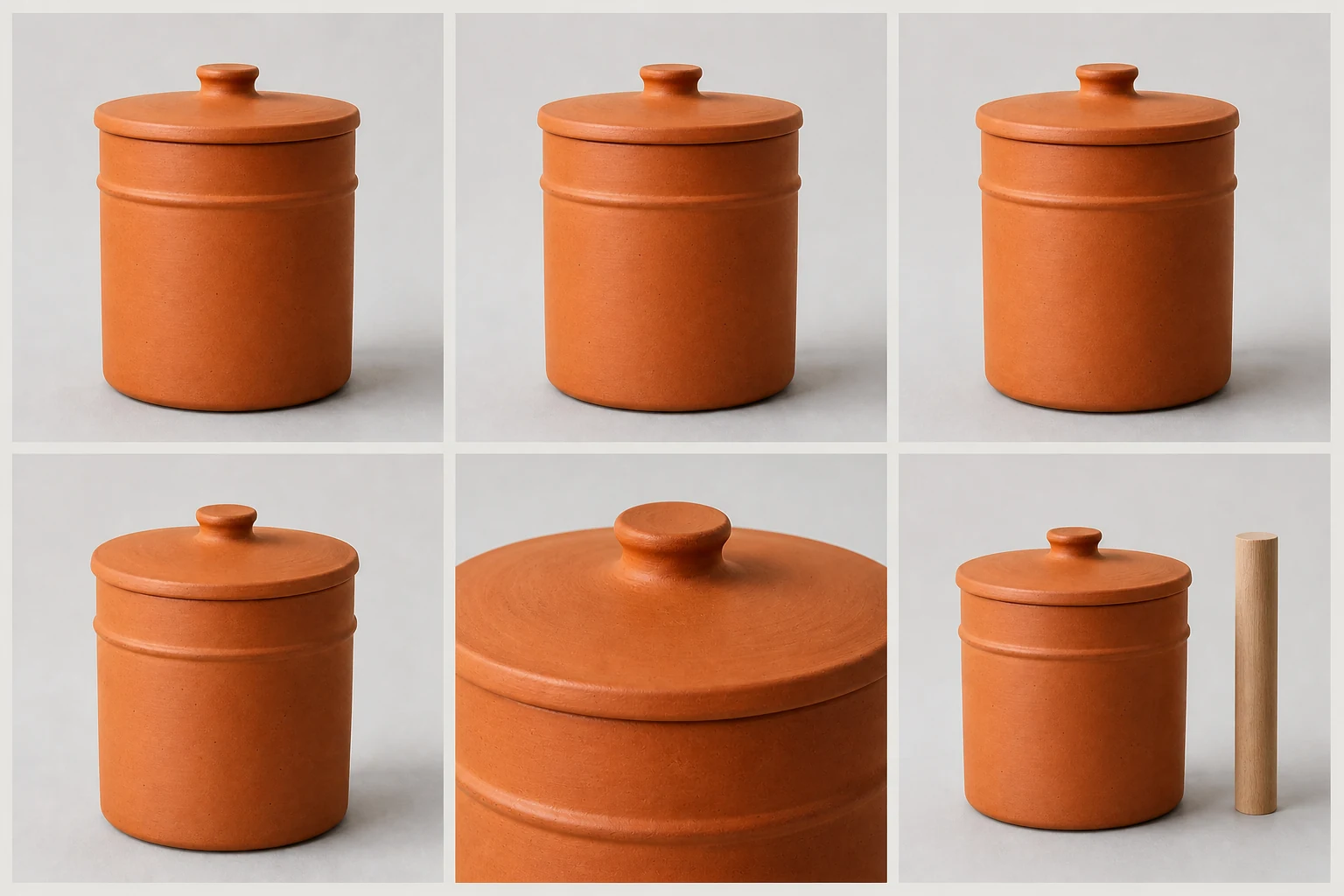
Fictional source-pack demonstration. The panels are an editorial training aid, not a real merchant SKU or evidence that a tool preserved the product.
1. Build one source pack and truth card
Create five reference images under neutral, even light:
- front;
- side or 45-degree view;
- back;
- close-up of the most failure-prone detail; and
- scale reference with measured dimensions.
Write a truth card before opening a tool.
| Truth field | Locked value to record | Stop-ship example |
|---|---|---|
| SKU and variant | Exact internal ID, colour and finish | Output shows another colourway |
| Geometry | Shape, proportion, handle/clasp/opening and major joins | Handle, prong or seam changes |
| Surface | Material, texture, print, motif sequence and reflectivity | Matte becomes glossy; motif is invented |
| Text and marks | Exact label, logo, warning, code and placement | Garbled, missing or fabricated text |
| Offer | Quantity, included parts and accessories | Extra lid, chain, piece or pack appears |
| Scale | Dimensions and contextual size | Product becomes implausibly large or small |
2. Give every tool the same three jobs
Use three jobs because a tool can perform differently by task:
- Catalogue job: retained product on a clean white or transparent background.
- Lifestyle job: retained product in a restrained, plausible scene with no unsupported accessory or use claim.
- Controlled local edit: change one background-area element without changing the product. If the tool has no local edit, record “not supported” rather than substituting another job.
Set the same output role and aspect ratio. Do not call an output marketplace-ready merely because the tool can export it. Verify the current destination rules separately; Google’s main-image requirements, for example, require the correct product/variant and require AI-generation metadata to be preserved. Google Merchant Center: main image requirements
3. Fix the attempt budget before starting
Use four attempts per job per candidate for a small trial: twelve attempts per tool. Count every click that produces a new image or deducts a credit, including repairs. Do not give a preferred tool hidden extra tries.
Save:
- tool, model, plan, device and account region;
- date and time;
- all input files;
- exact semantic instruction and any syntax adaptation;
- every output, including failures;
- credit/limit change;
- operator minutes; and
- final approval or rejection reason.
4. Keep semantic instructions equivalent
The common instruction can read:
Using the supplied photo of the exact [SKU/variant], change only [background or selected area]. Preserve exact geometry, proportions, colour, pattern, material, finish, label text, quantity and included parts. Do not redraw, add, remove or reshape the product. Create [scene], [lighting], [camera/framing] and [aspect ratio]. Reject any result that changes a locked field.
Adapt interface syntax only where necessary. Publish those adaptations so the comparison remains fair. For more examples, use the product-truth AI photography prompt pack; do not assume prompt detail can compensate for a missing mask or protected layer.
5. Review blind where practical
Rename outputs with random codes before visual review. Ask two people to score them independently: one operator and one product owner or person who handles the physical SKU. Review at full resolution and in the intended mobile crop. Record disagreements; do not average away a stop-ship defect.
Score product truth before visual appeal
Use the same 100-point scorecard for every tool and every job.
| Dimension | Weight | What earns points |
|---|---|---|
| Product truth | 35 | Correct identity, geometry, colour, pattern, material, label, quantity and components |
| Edit and control | 15 | Reference adherence, useful masks/selections, reproducibility and local revision |
| Output usability | 10 | Suitable resolution, crop, transparency, format, grounding and low artefact rate |
| Workflow and scale | 10 | Predictable retries, naming/download, history, batch, collaboration and hand-off |
| Rights, privacy and provenance | 15 | Clear input duties, commercial-use wording, data controls, retention/deletion and provenance handling |
| Cost per approved asset | 10 | Complete cost divided by outputs that pass all required checks |
| Accessibility | 5 | Usable device/interface, verified account access and support for the operator |
| Total | 100 | Fixed before the first generation |
Stop-ship cap: If an output has the wrong SKU or variant, quantity, essential component, label/claim, material, or materially altered geometry, mark it Rejected and cap that job at 49/100 even if it looks excellent.
Do not award rights/privacy points because a site says “commercial use” in a headline. Read the current terms for the chosen plan and model. Confirm the team owns the input or has permission, whether uploaded images can train models, how long content is retained, what deletion/opt-out controls exist and whether conversion strips C2PA or IPTC provenance. This is operational due diligence, not legal advice.
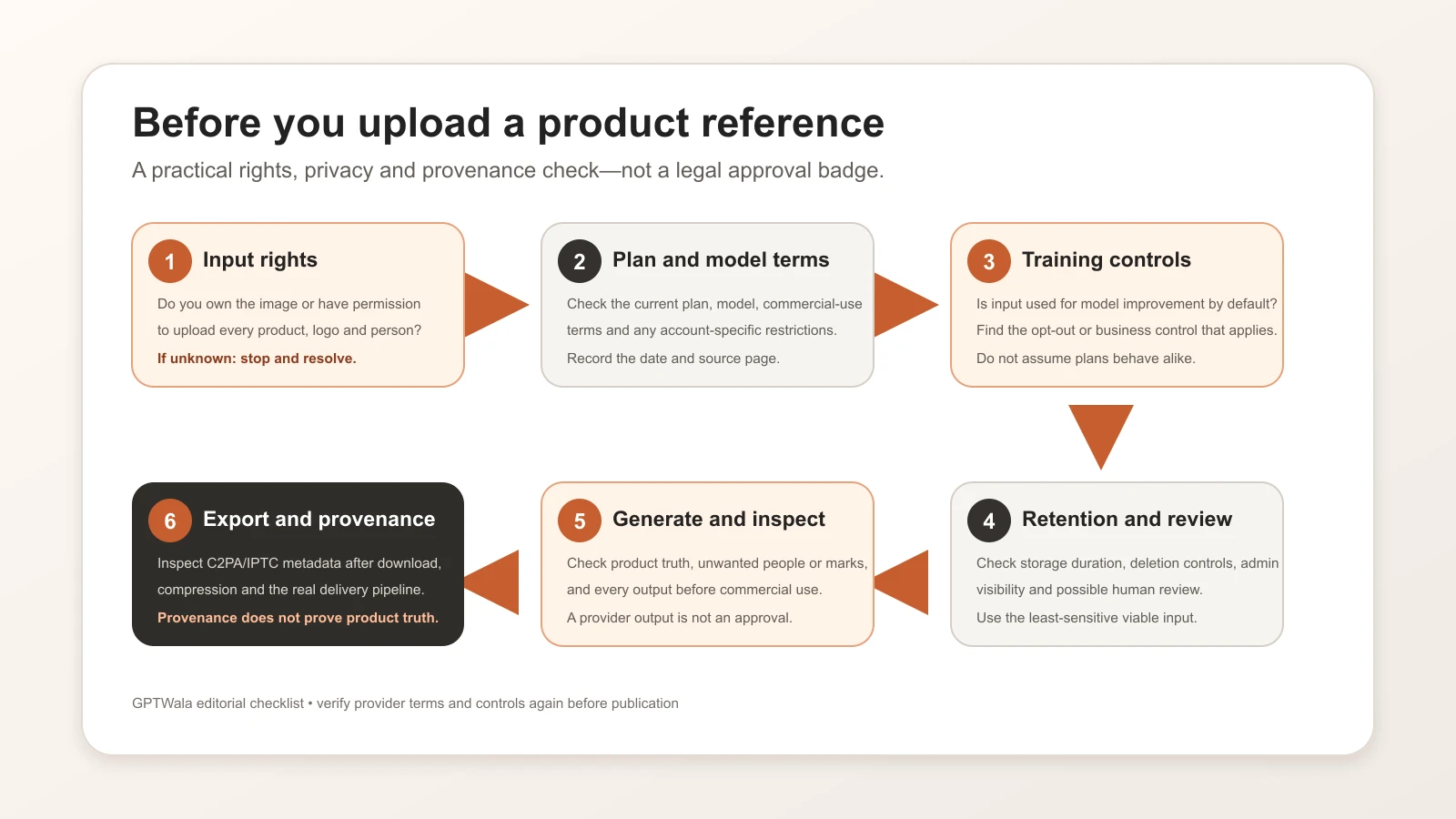
Operating checklist, not legal advice or a provider approval badge. Recheck the current terms and controls for the exact plan and model you will use.
Calculate the real cost per approved asset
Use this formula for each candidate:
Cost per approved asset = (allocated subscription + generation/credit cost + operator time + reviewer time + retouch/rework + export/storage/admin + taxes or payment costs) ÷ approved outputs
An “approved output” passes product truth, intended-use review, destination rules and final file QA. A beautiful rejection is not in the denominator.
Use a blank calculation rather than a market average:
| Cost input | Your value |
|---|---|
| Subscription allocated to this pilot | ₹___ |
| Credits/top-ups/paid exports consumed | ₹___ |
| Capture and upload minutes × loaded hourly rate | ₹___ |
| Prompt/generation minutes × loaded hourly rate | ₹___ |
| Product-owner review minutes × loaded hourly rate | ₹___ |
| Retouch, repair or recapture | ₹___ |
| Storage, naming, hand-off and tax/payment cost | ₹___ |
| Total pilot cost | ₹___ |
| Total generated outputs | ___ |
| Outputs that pass every required gate | ___ |
| Cost per approved asset | ₹___ |
Also record approval rate = approved outputs ÷ total outputs. A tool with a low apparent price but a poor approval rate may be the expensive choice. For a subscription already used for other work, calculate both the marginal cost and a fair allocated share; state which method you used.
Which workflow should an Indian product business shortlist?
This matrix narrows a two-tool trial. It does not predict a winner.
| Business profile | Candidate 1 to consider | Candidate 2/control | Decision emphasis |
|---|---|---|---|
| Merchant Center-led retailer | Google Product Studio | Locked-layer hybrid | Direct workflow, product truth, destination rules and audit trail |
| Shopkeeper already making posts in Canva | Canva retained-product composite | ChatGPT Images or a manual cutout | Operator ease, export consistency and leakage outside the edit |
| Manufacturer with many stable SKUs | Photoroom batch/specialist workflow | Locked-layer batch template | Repeatability, naming, exports, approval ownership and per-approved cost |
| Wholesaler with frequent colour/design variants | Specialist workflow with strict variant folders | Hybrid template | No cross-variant contamination; approval rate by variant |
| In-house designer or agency | Adobe Firefly/Photoshop workflow | Locked-layer manual edit | Selection control, version history, rights and production hand-off |
| Apparel seller | Tool’s apparel-specific secondary-image flow | Real model/product photography | Print, embroidery, drape, fit implication and consent |
| Jewellery or reflective-product seller | Controlled local/background edit only | Real macro photography | Stone count, prongs, hallmarks, metal colour, reflection and scale |
| Team with unreleased or confidential designs | Business/API route whose terms meet policy | Local/manual workflow | Training default, retention, human review, deletion and contract |
For a Morbi tile manufacturer, the buying-critical fields may be surface pattern, edge profile, gloss and tile scale. For a Surat apparel wholesaler, they may be base colour, motif repeat, border width and drape. For a Jaipur jewellery seller, stone count, setting, clasp and scale can dominate the score. For a Rajkot kitchenware business, handle geometry, lid fit, finish and included pieces may be stop-ship fields. These are illustrative review patterns, not claims about every business in those places.
Run a two-tool trial with your own SKU
Copy this sequence into a trial sheet:
- Choose one ordinary but representative SKU—not the easiest and not the most confidential.
- Name the exact image job and destination.
- Create the five-view source pack and truth card.
- Confirm input rights, data/training setting, plan, tax, credits and export conditions.
- Choose two candidates from different workflow classes plus a hybrid control if risk is high.
- Run three equal jobs and four attempts per job.
- Save every output and record time/credit consumption as it happens.
- Randomise output names and conduct the two-person truth review.
- Reject stop-ship defects before scoring aesthetics.
- Calculate approval rate and total cost per approved asset.
- Choose by job. It is acceptable for one tool to win catalogue work and another to win lifestyle work.
- Retest on four more SKUs before rollout; include the categories most likely to fail.
Do not upload unreleased designs, customer information, identifiable model photos or confidential labels until the team’s rights and data requirements match the provider’s current terms. Save source, instruction, output, approval and final export together so another person can audit the decision.
Turn a tool choice into a repeatable online system
A tool only produces an asset. It does not decide the product’s positioning, build a trustworthy digital presence, distribute the offer or follow up with enquiries. After the pilot, put the winning job-specific workflow into a phone-to-approved production SOP, then define ownership, file naming, review gates and retest dates in an AI adoption roadmap.
If you want the broader path from offline dependence to online demand, the GPTWala DAA workshop connects Digital Presence, AI Content Creation and a ₹100/day WhatsApp ads starting system. It is education, not an earnings or lead guarantee.
See the product-business DAA workshop
When no AI tool should win
Choose real or hybrid photography when:
- no candidate passes product truth within the fixed attempt budget;
- exact colour, finish, fit, drape, reflection, geometry or scale is the reason people buy;
- the image carries a safety, medical, regulated or performance implication;
- the product is high-value or difficult to replace;
- the team cannot meet input-rights, privacy, retention or approval requirements;
- the destination needs proof the generated result cannot provide; or
- rework makes cost per approved asset higher than a controlled shoot.
The correct result of a trial can be “use AI only for backgrounds and layout,” “use a photographer for main images,” or “do not upload this product.” A no-winner decision is evidence of a working safeguard, not a failed test.
Frequently asked questions
Which AI product photography tool is best for Indian sellers?
There is no universal winner. As of 11 August 2026, Google Product Studio, ChatGPT Images, Adobe Firefly, Canva and Photoroom represent different workflow types worth shortlisting. Pick two based on your image job and run the same SKU, source pack, prompt intent and attempt budget through both. Product truth and cost per approved asset should decide—not a vendor gallery or feature count.
Is there a free AI product photography tool?
Google documents Product Studio as free for Merchant Center users. ChatGPT Images is documented on all tiers with plan-dependent limits, and Adobe documents free daily generations. Canva and Photoroom have free access or trials for some functions, but commercial-use and feature limits differ; Photoroom explicitly limits free accounts to personal use. Always check the current Indian account, plan and terms before commercial use.
Can I use a phone photo as the input?
Yes, several shortlisted workflows accept uploaded images, and Photoroom documents mobile capture as one Product Staging input path. A phone photo is useful only if it clearly records the exact SKU. Use neutral light, multiple angles, detail shots, measured dimensions and a colour reference; a weak source cannot reliably prove what an AI edit preserved.
Does a tool make images Amazon-, Flipkart- or Google-ready?
No vendor button proves destination acceptance. Export an image, then compare it with the current official rules for the exact platform, country, category and image role. Google’s current main-image guidance, for example, requires the actual correct product and variant and requires generative-AI metadata to be retained. Verify all destination rules again on publication and upload day.
Can I use AI-generated product images commercially?
It depends on the provider, plan, model, input rights, third-party content and intended use. OpenAI, Adobe, Canva and Photoroom publish different ownership or commercial-use terms; Photoroom’s free accounts are personal-use only, while Canva library content creates licence exceptions. Read the current terms and obtain professional advice for high-risk use. “Commercial use allowed” is not a promise that an output is accurate or free of third-party rights.
Are confidential product images private when I upload them?
Do not assume so. Google documents possible quality-review access in Product Studio. Consumer and business data settings differ in ChatGPT. Canva says technology partners may process inputs for AI functionality. Photoroom says uploaded images may be used for improvement/training unless the user opts out, while its API is treated differently. Match the plan and settings to your policy before uploading unreleased designs.
Do same-SKU results generalise to my whole catalogue?
No. One SKU measures one product, source pack, tool/model, plan, prompt, date and review team. Retest at least five representative SKUs, including difficult edges, reflective materials, fine patterns, labels and variants. State the sample limit whenever results are published.
How often should I retest AI product photography tools?
Recheck price, plan limits and Indian account access before purchase and at least monthly while this page is current. Recheck terms, privacy and data-use controls quarterly or after a provider notice. Rerun the same-SKU benchmark after a material model/editor change or when approval rate changes. Keep old dated results rather than silently overwriting them.
Official sources checked
- Google Merchant Center: About Product Studio
- Google Merchant Center: Product Studio Additional Terms
- Google Merchant Center: main image requirements
- OpenAI: Images in ChatGPT
- OpenAI: provenance signals in generated content
- OpenAI: Data Controls FAQ
- OpenAI: business data privacy
- OpenAI: Terms of Use
- Adobe: edit images using text prompts
- Adobe: Generative Fill
- Adobe Firefly FAQ
- Adobe Firefly India plans
- Adobe: Content Credentials
- Canva: Background Remover
- Canva: AI Product Terms
- Photoroom: Product Staging
- Photoroom: AI credits
- Photoroom: plans and pricing
- Photoroom: commercial use
- Photoroom: Privacy Policy
Leave a Reply