GPTWala Business Hub visual guide for B2B buyer persona manufacturing.
Reviewed and updated: 12 August 2026
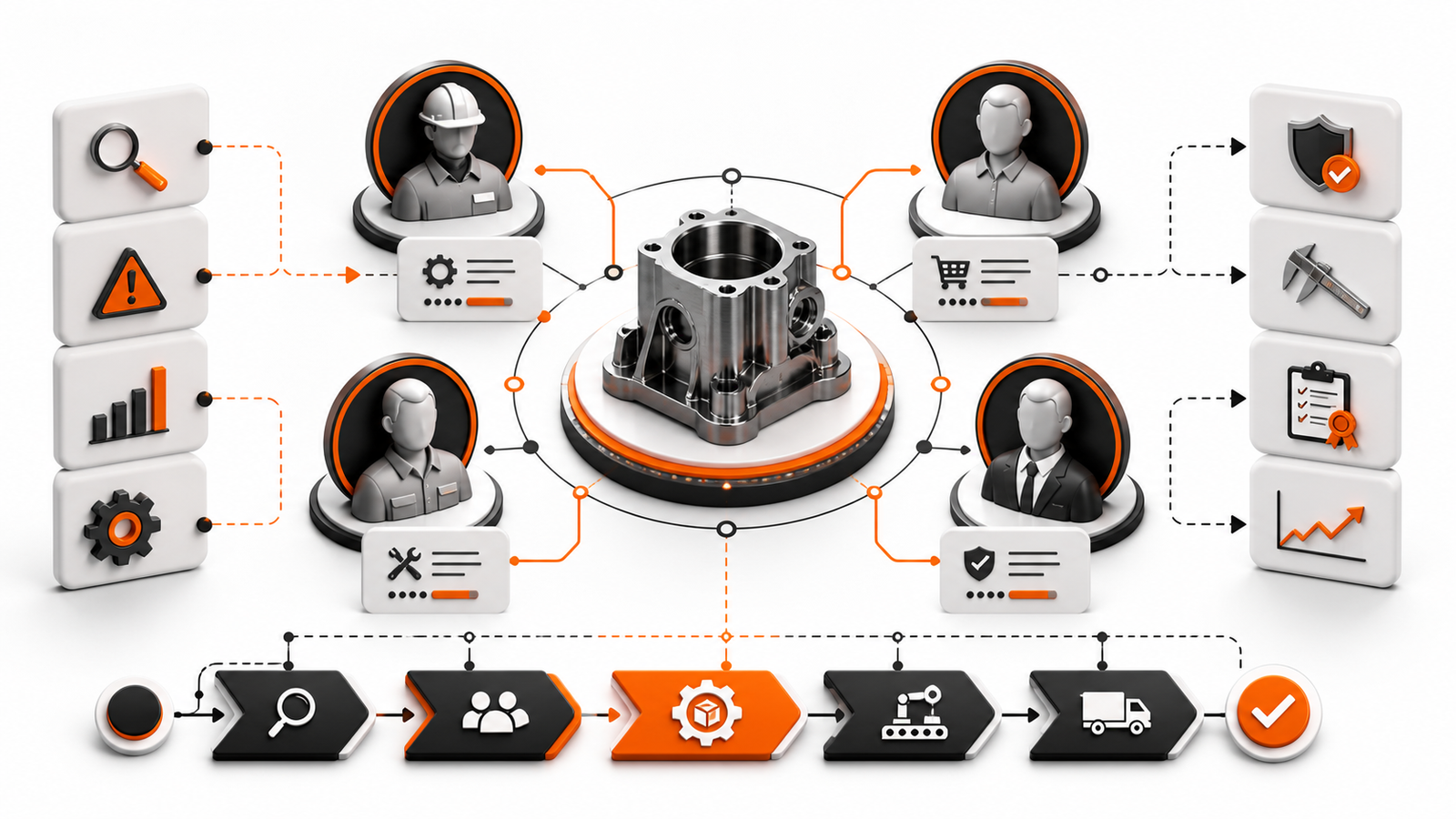
A manufacturing buyer persona should describe a real buying role inside a qualified account: what that person must achieve, which technical or commercial risk they own, what evidence they need, what questions appear at each stage and how they influence approval. Do not collapse the user, engineer, procurement, finance and final authority into one fictional person.
This guide owns buying-role research and the persona card, while the ICP defines account fit. This guide gives you an operating method, not a promise of rankings, enquiries, sales or profit. Platform policies, fees, eligibility and laws can change, so verify the linked primary sources and your own commercial records before implementation.
The real question is not whether a B2B buyer persona sounds useful. The question is whether it solves a defined buyer or operating problem for one product, audience and channel without breaking product truth, margin, consent or delivery capacity.
Use these diagnostic questions before spending money or assigning work:
Which account types fit capability and economics?
Who initiates, specifies, evaluates, approves, buys, receives and uses?
What failure is each role trying to prevent?
Which documents or demonstrations count as proof?
Write the answers in one decision note. If a critical answer is unknown, make discovery the next task. Do not let an attractive tool, template or competitor example silently become the strategy.
Build the source-of-truth sheet first
Every execution step should pull facts from an approved record. A source-of-truth sheet prevents a copywriter, agency, AI tool or busy salesperson from filling a gap with a plausible but wrong product promise.
Truth item
Authoritative source
Owner
Stop condition
Product and offer facts
Approved SKU, catalogue and offer master
Product or merchandising owner
A buying-critical field is missing or inconsistent
Buyer need and language
Recorded enquiries, interviews and sales notes
Sales or customer owner
The audience is assumed rather than evidenced
Price, margin and fulfilment
Current finance, stock and delivery records
Finance or operations owner
The promise cannot be fulfilled profitably or reliably
Channel and permission rules
Current platform policy and consent record
Channel owner
Permission, eligibility or policy is unclear
Add a version date to the sheet. When price, stock, specification, channel rule, audience permission or fulfilment promise changes, pause affected assets until their owner approves the update.
A practical implementation workflow
Step 1: Start with won, lost and rejected opportunities
Review RFQs, calls, emails, objections, revisions and post-order issues.
Evidence before moving on: A role list grounded in actual journeys.
Step 2: Interview by role
Ask about trigger, current process, risk, criteria, proof, internal approvals and disqualifiers.
Evidence before moving on: Notes separate observed facts from interpretation.
Step 3: Map stage-specific questions
Order questions from problem recognition through specification, feasibility, quote, approval, order and repeat.
Evidence before moving on: Content and sales assets have a stage owner.
Step 4: Build the persona card
Include role, job, influence, risk, evidence, objections, vocabulary, channel and next action.
Evidence before moving on: The card changes a content or sales decision.
Step 5: Validate in new opportunities
Use the card to prepare questions and assets, then log missing roles or surprises.
Evidence before moving on: Quarterly persona updates from evidence.
Do not combine all steps into one launch. A small controlled version creates evidence that can be reviewed. A large rollout creates more places for the same unnoticed error to spread.
Use the decision table
Situation
Recommended action
Avoid
User and buyer are different
Create linked role cards
Writing only for procurement
Technical evaluator appears late
Add proof earlier without bypassing process
Overpromising to the initiator
Small customer has one person in many roles
Combine roles but preserve decision questions
Assuming enterprise complexity
Persona contains private speculation
Remove unsupported or unnecessary traits
Sensitive inference
Treat this table as a starting policy. Your product risk, average order value, buying cycle, staff coverage, cash cycle and after-sales burden may require stricter gates.
Apply it to Indian product businesses
Component manufacturer
Engineer owns fit, procurement owns commercial terms and quality owns approval. The content path separates drawings, material proof, MOQ and audit requirements.
Proof to keep: Role-specific questions and approval cycle.
Packaging converter
Brand, purchase and production teams value different proof. The persona map routes artwork, material, quantity and lead-time evidence to the right stage.
Proof to keep: Revision and rejection reasons.
Equipment supplier
Operator, maintenance, finance and owner share the decision. The seller documents use, installation, service and commercial proof without inventing ROI.
Proof to keep: Qualified opportunity and acceptance record.
These examples are intentionally operational rather than aspirational. Replace every placeholder with current records from the actual business. Do not present a fictional example as a client result or an industry benchmark.
Use AI without losing business truth
AI can help organise approved facts, draft alternatives, summarise interviews, classify enquiries, produce controlled content variants and flag missing fields. It must not invent specifications, materials, prices, discounts, stock, delivery dates, certifications, customer consent, testimonials or commercial results.
Use a four-part control:
Bound the input: provide only permitted, current source material.
Constrain the output: state what may change and what must remain exact.
Review by role: the product or commercial owner checks buying-critical facts.
Record release evidence: keep the source version, prompt or brief, reviewer, corrections and approval date.
For customer data, use approved accounts and collect only what the workflow genuinely needs. Do not paste private buyer lists, confidential price sheets or unreleased product files into an unapproved tool. India’s data-protection requirements and implementation timelines should be checked against current official MeitY material and qualified advice for the business.
Avoid the common failure patterns
One “decision-maker” persona: Map the buying group and influence.
Demographic decoration: Prioritise role, risk, criteria and evidence.
Only successful deals: Study losses, no-decisions and rejected RFQs.
Persona without workflow: Connect each insight to content, question or handoff.
The most expensive failure is usually not weak wording. It is a mismatch between the public promise and the business that must fulfil it.
Measure progress with operating evidence
Do not use reach, clicks or message volume as proof of business value by themselves. Connect upstream activity to a verified downstream event.
Measure
Definition
Decision it supports
Role coverage
Qualified opportunities with named relevant buying roles
Whether discovery is complete
Question coverage
Stage-critical questions answered with approved evidence
Whether content supports decisions
RFQ completeness
Opportunities with required technical/commercial fields
Whether qualification improves
Decision-cycle exceptions
Delays caused by missing role, proof or approval
Which persona assumption is wrong
Record the denominator, time window, product or offer, channel, source and owner for every rate. Keep observed results separate from forecasts. A short test can show a problem, but it may not support a broad conclusion.
A 30-day implementation plan
Days 1 to 5: define
Choose one product, audience, channel and business outcome. Complete the source-of-truth sheet, baseline and stop rules. Name the owner who can approve or stop the work.
Days 6 to 12: build
Create the smallest usable version. Test links, mobile reading, forms or message routing, exact product facts, price basis, permissions and team handoffs. Use internal testers before real buyers.
Days 13 to 20: run a bounded pilot
Release to a limited, relevant audience or product set. Log every material exception. Do not expand merely because the asset looks polished or early engagement is positive.
Days 21 to 26: reconcile
Connect platform events to enquiry, order, delivery, return and finance records as relevant. Review complaints, mismatches, duplicate handling, response delays and workload.
Days 27 to 30: decide
Choose one outcome: keep, fix, stop or expand one variable. Record why, what changes next and when the next review occurs. Expansion should preserve the same truth, consent and approval controls.
Connect this work to the GPTWala DAA framework
The DAA content layer can answer the right manufacturing questions only after the buying roles and stages are visible. If your product business still depends mainly on walk-ins, dealer calls, exhibitions or forwarded catalogues, GPTWala’s free DAA workshop explains how digital presence, AI-assisted content and controlled WhatsApp-led demand generation can work as one system. The workshop is educational and does not guarantee traffic, leads, orders, sales, earnings or profit.
Frequently asked questions
How is a B2B buyer persona different from an ICP?
The ICP defines which account is a good fit. Buyer personas describe the people and roles inside that account who use, evaluate, influence, approve or purchase. A manufacturer usually needs both.
How many personas does a manufacturing business need?
Use only the roles that change a real decision. A simple purchase may need one combined role; a technical capital purchase may require user, engineering, procurement, finance and authority maps.
Can AI create buyer personas from my CRM?
AI can summarise permitted, clean records and suggest patterns, but it can also amplify incomplete or biased data. Remove unnecessary personal information, verify findings with people and outcomes, and never treat generated traits as facts.
Can a small Indian product business start a B2B buyer persona without a large budget?
Yes, if it starts with one product, one audience, one owner and one measurable buyer action. A small budget does not remove the need for accurate product facts, realistic fulfilment, permission and a stop rule. Expand only after the first bounded version produces trustworthy operating evidence.
Can AI automate a B2B buyer persona?
AI can assist with research organisation, drafting, classification and controlled variants. It should not invent product specifications, prices, stock, delivery promises, customer permission, testimonials or results. A named human owner must verify buying-critical facts and approve release.
How long should I test a B2B buyer persona before deciding?
Use a test window long enough for the relevant outcome to mature. A product-page test may need enough qualified visits; a B2B workflow may need the full enquiry-to-decision cycle; retention work may need a repeat-purchase window. Define the event, denominator and review date before launch instead of choosing a universal number of days.
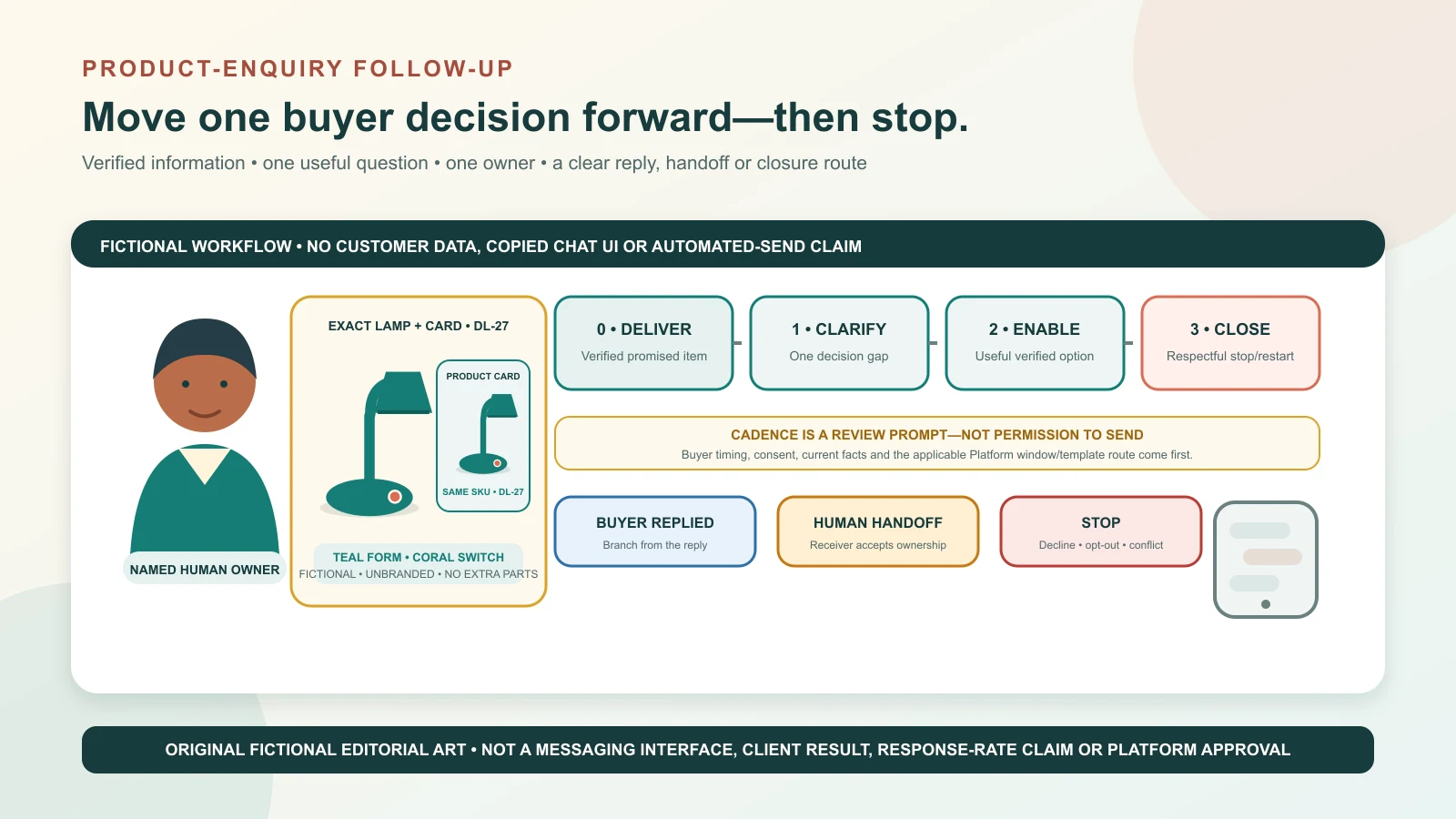
A useful follow-up advances one real buyer decision; it does not repeat “just checking” until the person replies. Original GPTWala editorial illustration using a fictional unbranded lamp and abstract message cards; it is not a messaging-platform interface, client result, response-rate claim or platform approval.
Reviewed and updated: 12 August 2026
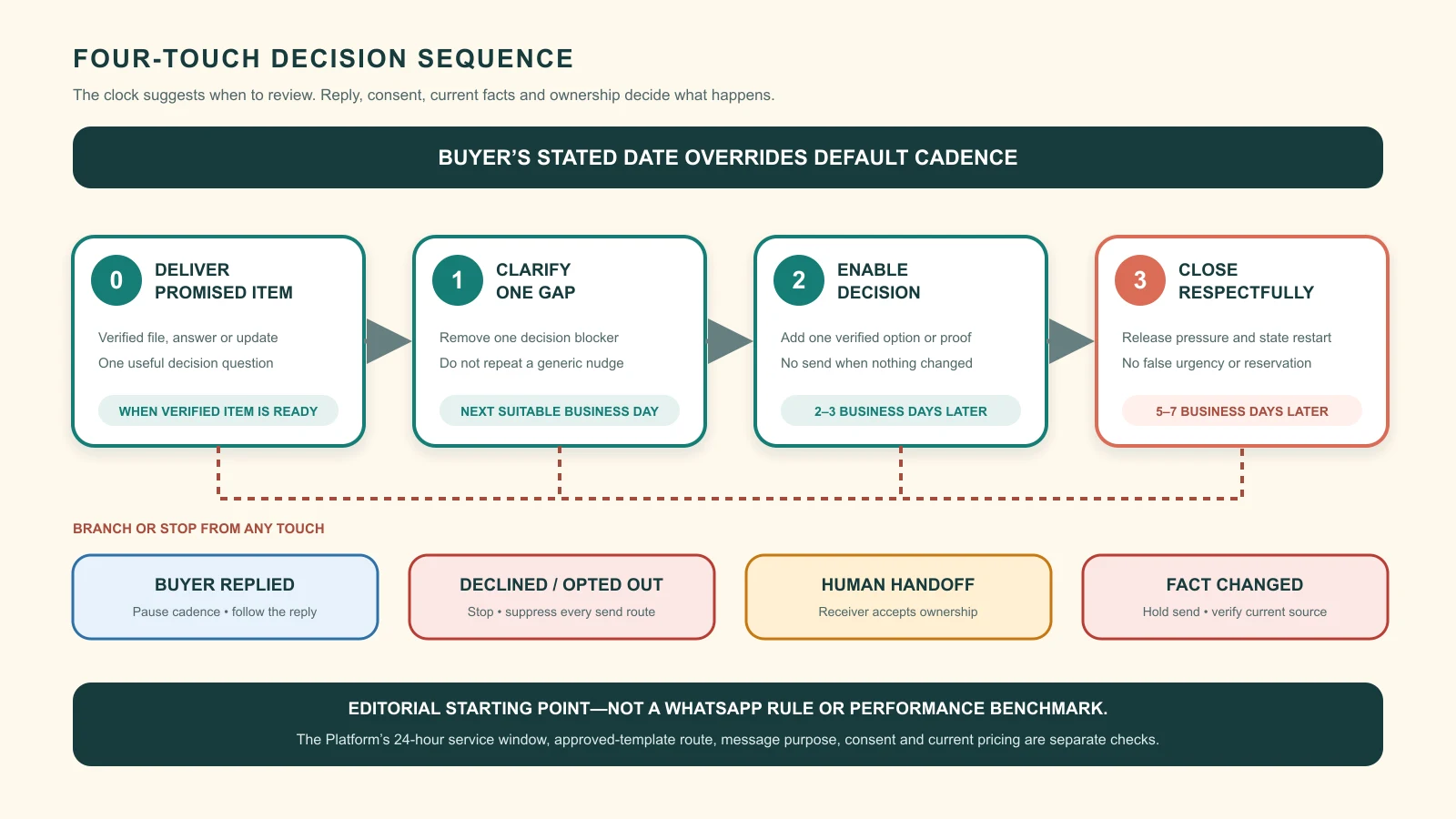
The best WhatsApp follow-up for a product enquiry gives the buyer one verified piece of decision information, asks one easy question and records one next action. It should not simply repeat “Any update?” A practical starting sequence is: send promised information as soon as it is verified, make one relevant nudge on the next suitable business day, send one decision-enabling follow-up two to three business days later, then close the enquiry politely after another five to seven business days if there is still no response. Change that timing when the buyer gave a date, the requirement is urgent, the quote has a genuine expiry or the category needs a different service rhythm.
Those intervals are GPTWala operating recommendations to test, not WhatsApp rules, legal advice or universal conversion benchmarks. On the WhatsApp Business Platform, the current policy has a separate 24-hour customer-service window and approved Message Template requirements. Permission, message purpose, current template/category rules and an opt-out must govern what can actually be sent.
This guide owns the timed product-enquiry sequence, copy templates, branch rules and human handoffs. The complete WhatsApp selling guide owns the wider enquiry-to-order pipeline. The digital product catalogue guide owns catalogue structure, and the WhatsApp Business catalogue guide owns in-app catalogue setup.
A sequence is a controlled set of decisions. Every touch should answer five questions:
Why is this person receiving a message?
What exact product or requirement is in context?
What new verified value does this message add?
What single action can the buyer take next?
When should the business stop, wait or hand off?
If the operator cannot answer those questions, the next message is probably noise.
Follow up on the open decision
Product buyers usually go silent around a specific uncertainty:
the exact variant is not clear;
the price does not include tax, freight or installation;
the buyer needs a smaller quantity or different pack;
a shopkeeper needs margin, case-mix or delivery information;
a manufacturer needs a drawing, sample, specification or compatibility answer;
the buyer is waiting for another decision-maker;
the desired item is out of stock; or
the seller has not made the next action obvious.
Follow up on that uncertainty. “Would a front-and-back view of SKU J42 help you confirm the clasp?” is more useful than “Did you see my message?”
A message is not a stage change
Do not mark an enquiry “qualified”, “quoted”, “confirmed” or “won” merely because a template was sent. Change the stage only when the required evidence exists. A buyer opening a message is not a product decision; a payment screenshot is not bank settlement; and “looks good” is not a complete order confirmation.
Stop sequences when reality changes
Pause automation and route to a person when:
the customer replies, even if the reply does not match an expected keyword;
the product, price, stock, quote or delivery fact has changed;
the buyer asks a technical, safety, legal, warranty or regulated-category question;
the chat becomes a complaint, refund, payment or fraud issue;
the buyer asks to stop, says they are not interested or chooses another supplier;
two team members appear to be handling the same enquiry; or
the business cannot verify the next message from its source records.
Separate service follow-up from marketing
“Follow-up” is an operating label, not a WhatsApp message category. The purpose and content matter.
Service or task-continuation follow-up
This continues something the buyer requested or a transaction already in progress, for example:
sending the specification the buyer asked for;
asking for one missing field needed to prepare a quote;
confirming an agreed sample, pickup or dispatch update;
answering an open product question; or
routing the buyer to a product specialist.
Keep it limited to the stated task. Do not attach an unrelated festival offer to an order update.
Promotional or re-engagement follow-up
An offer, product recommendation, cross-sell, abandoned-cart reminder or attempt to revive a dormant prospect can be marketing. WhatsApp’s official marketing-message page includes offers, product suggestions, cart reminders and re-engagement among marketing uses. The current WhatsApp Business Messaging Policy requires a business to have the person’s number and opt-in permission for subsequent messages or calls, and to honour opt-outs. Its best-practice section recommends setting expectations by message category.
Therefore, do not treat an old enquiry, an invoice, an exhibition visitor list, a business card, a group membership or a saved phone number as permanent permission to promote.
The Platform’s 24-hour control is different from this cadence
For the WhatsApp Business Platform, current policy says a business may reply without a Message Template within 24 hours of the user’s last message. Outside that customer-service window, only approved Message Templates may be sent. Business-initiated conversations must use approved templates, and automation during the service window must offer a clear path to human escalation.
The 24-hour window does not mean “send a reminder every 24 hours”. Nor does this article’s next-business-day suggestion override Platform policy. Before implementation, verify:
whether the business uses the Business app or Business Platform;
whether the service window is open;
the purpose and current category of the proposed message;
whether an approved template is required and available;
whether consent covers the message; and
current pricing and account/country eligibility.
The official Platform pricing page currently describes marketing, utility, authentication and service categories, with charges and conditions that vary by market and category. Do not hard-code an old price or assume a message will be free.
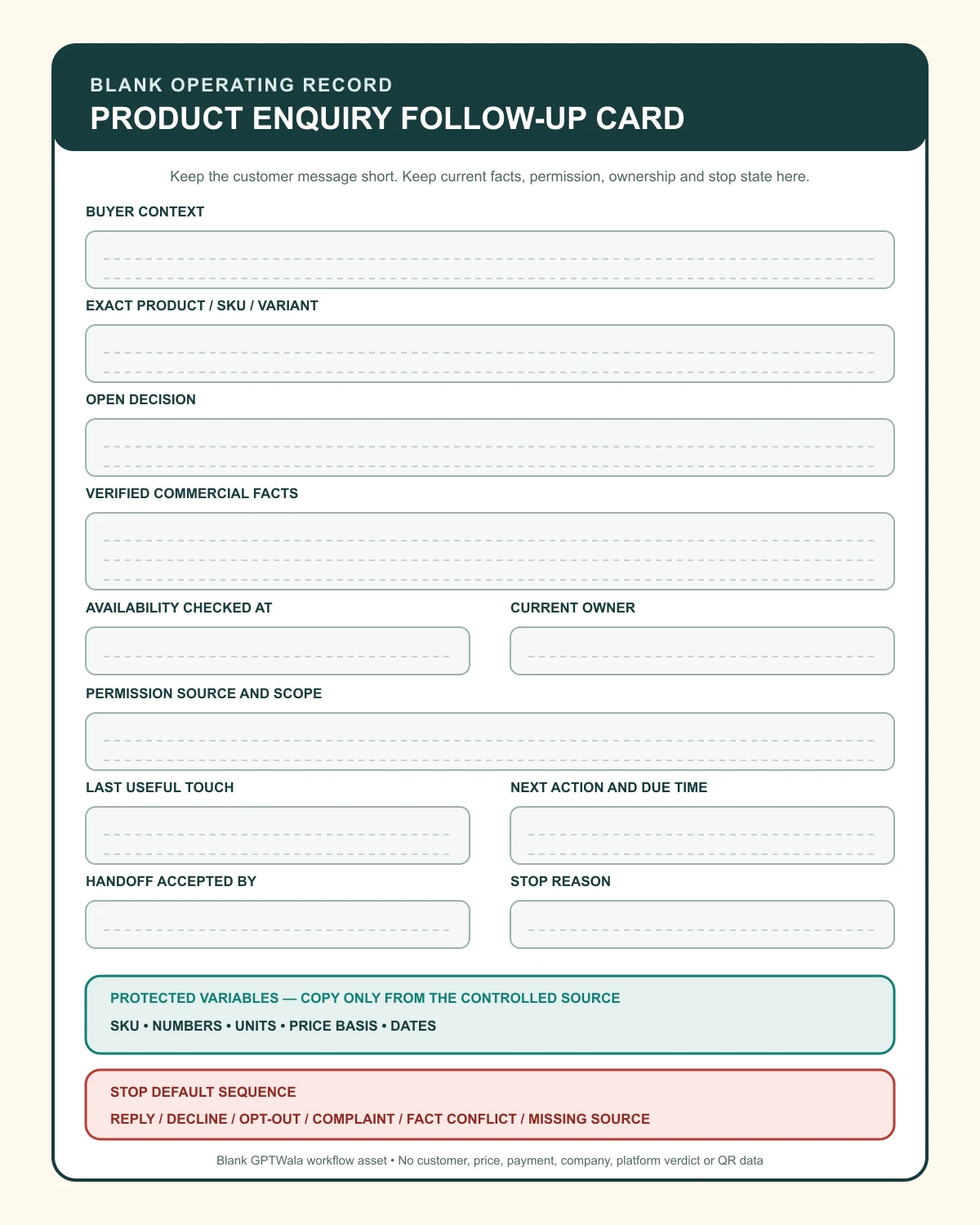
Build a verified follow-up card
Templates are safe only when their variables are safe. Create one follow-up card for every active enquiry.
Field
What to record
Truth source
Buyer context
buyer type, stated use and location if relevant
Buyer’s own message
Exact product
approved name, SKU, variant, size, finish, pack
Product master/catalogue
Open decision
the one answer or action still needed
Conversation plus stage record
Commercial facts
price, tax, freight, MOQ, quote validity
Current price/quote master
Availability
stock or production status and when checked
Inventory/production owner
Promised item
image, drawing, quote, sample update or call
Named internal owner
Permission
source, scope and opt-out state
Consent/customer record
Sequence state
last useful touch, next action and due time
Inbox/CRM/controlled log
Owner
one named person or queue
Team roster
Stop reason
replied, declined, opted out, duplicate, invalid or closed
Recorded event
Lock the buying-critical variables
Use placeholders such as:
[BUYER_NAME]
[BUSINESS_NAME]
[PRODUCT_NAME]
[SKU]
[VARIANT_SIZE_FINISH]
[PACK_OR_MOQ]
[PRICE_AND_TAX_BASIS]
[FREIGHT_OR_DELIVERY_BASIS]
[STOCK_STATUS_AS_OF_TIME]
[QUOTE_ID_AND_VERSION]
[VALID_UNTIL]
[ONE_NEXT_ACTION]
[HUMAN_CONTACT_OR_ROUTE]
Do not allow AI or a bulk tool to fill these from a similar product. Pull them from the approved record, or leave the message unsent.
Use a five-part message anatomy
A useful product follow-up can usually be built from:
Identity: who is writing.
Context: the exact enquiry, SKU or quote.
Verified value: one new fact, view, option or resolved question.
One question: the smallest decision the buyer can make now.
Exit or handoff: how to pause, decline or reach a person.
Example anatomy:
Hello [BUYER_NAME], this is [OWNER] from [BUSINESS_NAME]. You asked about [SKU / EXACT PRODUCT]. I have now verified [ONE FACT] as of [TIME]. Would you like [OPTION A] or [OPTION B]? If this requirement is on hold, tell me and I will close the enquiry for now.
This is a structure, not a claim that a certain wording increases replies.
Use the four-touch baseline
Start with this sequence, then adjust it using your own response, qualification and closure data.
Touch
Suggested trigger and timing
Job
Do not send when
0. Deliver
As soon as the promised verified item is ready, within stated business hours
Fulfil the promise and ask one decision question
The item is unverified or another owner is already replying
1. Clarify
Next suitable business day after no response
Remove one likely decision gap
Buyer gave a later decision date or asked not to be contacted
2. Enable
Two to three business days later
Add a real comparison, term, proof view or alternate route
Nothing new can be added
3. Close
Five to seven business days later
Release pressure, keep the record clean and state how to restart
There is an active order, service issue or promised internal action
These are not mandatory gaps. Use the buyer’s stated date instead of your default. A dealer who says “call Friday after my partner returns” should not receive Tuesday and Wednesday nudges. A buyer asking for same-day stock should receive a verified answer as soon as it exists, not wait for a cadence.
Event-driven messages outrank timed nudges
Send a verified event update when:
the requested quote is ready;
the correct product image or drawing is approved;
production confirms feasibility;
stock changes materially;
a sample is dispatched; or
the buyer’s requested follow-up date arrives.
Do not send both the event update and the scheduled nudge. Cancel or reset the scheduled step.
Set a response promise you can keep
If the answer needs work, acknowledge the enquiry and state a realistic next update:
Thanks for the enquiry about [SKU]. [OWNER] from [BUSINESS_NAME] is checking [STOCK / SPECIFICATION / FREIGHT]. We will update you by [DATE AND TIME]. If your requirement is urgent, reply with the needed quantity and delivery location.
Do not promise “in 10 minutes” merely to sound responsive. The response promise should match staff coverage and source availability.
The clock suggests when to review an enquiry; the buyer’s reply, consent state and verified facts decide what happens next. The intervals are editorial starting points, not messaging-platform rules, approved templates or performance benchmarks.
Copy the enquiry and qualification templates
Replace every bracket with verified information. Remove unused clauses. Never send visible placeholder text.
Template 1: acknowledgement when the answer needs checking
Hello [BUYER_NAME], this is [OWNER] from [BUSINESS_NAME]. I received your enquiry for [PRODUCT / SKU]. I’m verifying [SPECIFIC FACT] and will update you by [DATE / TIME]. To check the right option, is this for [PERSONAL USE / RETAIL RESALE / WHOLESALE / MANUFACTURING APPLICATION]?
Use when a useful answer cannot be given immediately. The deadline must be owned.
Template 2: one missing qualification field
I can prepare the right option for [PRODUCT]. Please confirm one detail: do you need [QUANTITY / SIZE / MODEL / DELIVERY PINCODE / APPLICATION]? I will use that only to check the suitable product and terms.
Ask one question, not a form disguised as a message.
Template 3: vague “price?” enquiry
The price depends on [VERIFIED VARIABLE, such as pack size or finish]. For the exact quote, should I check [OPTION A] or [OPTION B]? I will include [TAX / FREIGHT BASIS] clearly.
Do not send a misleading “starting from” figure if the buyer’s likely configuration cannot receive it.
Template 4: first no-response clarification
Hello [BUYER_NAME], following up on [PRODUCT / SKU]. To avoid sending an irrelevant list, I only need [ONE FIELD]. You can reply with [SHORT RESPONSE OPTIONS], or say “not now” and I will pause the enquiry.
Template 5: move from voice note to exact requirement
I noted [QUANTITY] and [PRODUCT FAMILY] from your voice message. Before I quote, please confirm: does [QUANTITY] mean [PIECES / SETS / CASES], and is the required variant [VARIANT]? I will send the written summary for your check.
Never infer units, colours or models from unclear audio.
Follow up after a recommendation or catalogue share
A catalogue link is not the follow-up. Help the buyer compare a small, relevant set.
Template 6: exact recommendation plus trade-off
Based on [BUYER’S STATED NEED], the current match is [PRODUCT / SKU / VARIANT]. Compared with [ALTERNATIVE], the main trade-off is [VERIFIED DIFFERENCE]. Would you like the [DETAIL VIEW / SPECIFICATION / PACK AND PRICE] for this exact SKU?
Template 7: after sharing product images
The images I sent are for [EXACT SKU / VARIANT]. The [PROP / MODEL / ROOM SETTING] is context and is not included. Would a close-up of [BUYING-CRITICAL DETAIL] help you decide?
If an image is AI-assisted, it must still preserve the exact item. Use the product-accuracy checklist before a visual supports a purchase decision.
Template 8: two-option comparison
You shortlisted [SKU A] and [SKU B]. The verified differences are: [DIMENSION 1] and [DIMENSION 2]. [SKU A] suits [SUPPORTED USE]; [SKU B] suits [SUPPORTED USE]. Which difference matters more for your order?
Do not claim one is “best” unless the recommendation follows the buyer’s criteria and approved evidence.
Template 9: catalogue-share follow-up
I shared the [COLLECTION / CATEGORY] catalogue for your [USE / STORE TYPE]. To narrow it down, send me up to three product codes and your approximate quantity. I will check the current variant, pack, stock and quote basis for those exact items.
The digital product catalogue guide explains what buyer information belongs in the catalogue; this message only moves the conversation forward.
Follow up after a quote
Do not ask “Did you check the quotation?” without making the decision easier.
Template 10: quote receipt and one decision
Hello [BUYER_NAME], I sent quote [QUOTE ID / VERSION] for [EXACT PRODUCT AND QUANTITY] on [DATE]. It includes [TAX / FREIGHT / DELIVERY BASIS]. Is the open question the product, quantity, timing or commercial terms? Reply with one and I will route it correctly.
Template 11: buyer is comparing suppliers
Understood. When comparing, please check that both quotes cover the same [SKU / MATERIAL / SIZE / PACK / TAX / FREIGHT / WARRANTY SCOPE]. If you want, send the comparison fields without the other supplier’s confidential document and I will clarify our quote.
Do not invent a competitor weakness or pressure the buyer to disclose confidential pricing.
Template 12: genuine quote validity
Quote [ID / VERSION] is valid until [DATE] because [VERIFIED REASON, if useful]. Current availability is [STATUS AS OF TIME], not a reservation. Would you like us to recheck availability, revise the quantity or close this version?
Never add a fake midnight deadline, “last piece” line or countdown. The ASCI Code requires factual claims to be substantiated and says advertising should not mislead through implication, omission, ambiguity or exaggeration. A promotional WhatsApp message should follow the same truth discipline.
Template 13: revised quote
I have prepared quote [NEW ID / VERSION] with the agreed change from [OLD FACT] to [NEW FACT]. Please ignore version [OLD VERSION]. Before we proceed, confirm [SKU / VARIANT / QUANTITY / TOTAL / DELIVERY BASIS] in the new written summary.
Never allow two live versions to compete inside a long chat.
Template 14: decision delayed to a stated date
Thanks, I have noted that you will review this on [BUYER’S DATE]. I will pause messages until then. If price, stock or lead time changes before that date, should I update you only if it affects quote [ID]?
Record the answer; do not assume permission.
Handle stock, MOQ, sample and custom requirements
Template 15: stock is unverified
I do not want to confirm availability from an old message. I am checking [SKU / VARIANT / QUANTITY] with [INVENTORY OWNER] and will update you by [TIME]. Please do not treat it as reserved until we confirm in writing.
Template 16: product is out of stock
[SKU / VARIANT] is currently [OUT OF STOCK / UNAVAILABLE] as verified at [TIME]. I can check [EXACT ALTERNATIVE] or notify you if you have opted in for a restock update. The alternative differs in [VERIFIED DIFFERENCE]. Which route do you prefer?
Do not silently substitute a similar colour, size, material or model.
Template 17: wholesale MOQ or case multiple
For [SKU], the current wholesale term is [MOQ / CASE MULTIPLE], with [PACK MIX RULE] and [PRICE BASIS]. You asked for [BUYER QUANTITY]. Would you like the nearest valid pack, a different SKU with a lower minimum, or no further follow-up?
Template 18: sample request
For the [SKU / MATERIAL] sample, the verified process is [CHARGE / CREDIT / COURIER / LEAD TIME]. A sample confirms only [DEFINED PURPOSE]; final production follows [APPROVED SPECIFICATION / TOLERANCE]. Shall I prepare the sample request with your company and delivery details?
Do not claim that one sample guarantees the appearance or performance of every production unit.
Template 19: custom or technical requirement
Your requirement for [CUSTOM DIMENSION / APPLICATION] needs review by [PRODUCT / ENGINEERING OWNER]. I have recorded [KNOWN FACTS]. The open point is [ONE TECHNICAL QUESTION]. May I hand this to [ROLE], who will respond by [TIME]?
Do not let a salesperson or AI infer compatibility, load, safety, certification or manufacturing feasibility.
Template 20: location or freight is missing
The product price is verified, but the delivered total is not complete without [PINCODE / DESTINATION / UNLOADING CONDITION]. Please share [MINIMUM NECESSARY LOCATION FIELD], or I can quote ex-[WORKS / STORE] without claiming a delivered total.
Collect only what is needed at the current stage. The WhatsApp Business policy says businesses are responsible for necessary notices, permissions and lawful data handling, and prohibits requesting full payment-card, financial-account and other sensitive identifiers.
Branch when the buyer replies
The first reply should cancel every pending automated follow-up. Then route by intent.
Buyer response
Next action
Safe reply structure
“Yes / proceed”
Build and verify an order summary
Confirm exact SKU, variant, quantity, total, delivery and terms; ask for explicit confirmation
“Send details”
Identify which detail changes the decision
Offer specification, exact view, terms or human call—not a 20-file dump
“Too expensive”
Diagnose comparison basis
Ask whether the gap is budget, quantity, pack, delivered total or specification
“Need later”
Ask for a buyer-chosen date and permission
Pause until that date; do not continue the default cadence
“No”
Record reason if volunteered and close
Thank the buyer; do not argue or trigger a discount automatically
“Stop / remove me”
Suppress further sends
Confirm the opt-out action without adding a promotion
Complaint or payment issue
Exit sales sequence
Route to support/finance with one owner and verified record
Unclear reply or language issue
Ask one clarification or use a human
Do not force it through keyword automation
Price objection template
Thanks for saying that. To compare fairly, is the issue the total budget, minimum quantity, delivered cost or required specification? I can check one approved alternative; I will not change the specification or terms without showing the difference.
“Not now” template
Understood. I will pause this enquiry. If you want a follow-up, choose a date or month; otherwise you can message us again with [SKU / QUOTE ID]. This does not add you to promotional updates.
Opt-out confirmation
Understood. We have recorded your request not to receive further [CATEGORY] messages from [BUSINESS_NAME]. You may contact us if you need service for an existing order.
The exact suppression action must occur in every sending list or system, not only as a label in the chat.
Use customer-facing and internal handoffs
A handoff is complete only when the receiver accepts ownership and the customer knows what will happen next.
Customer-facing product-specialist handoff
Your question about [TECHNICAL POINT] needs [ROLE]. I have shared only the relevant enquiry details with [NAME / TEAM]. [THEY / WE] will respond by [TIME] in this chat / through [APPROVED ROUTE]. I remain the owner until they accept the handoff.
Customer-facing shift handoff
I am handing your enquiry for [SKU / QUOTE ID] to [NEW OWNER] because [REASON]. They have the confirmed details: [ONE-LINE SUMMARY]. The next update is due by [TIME]; you do not need to repeat the full enquiry.
Internal five-line handoff
Buyer and requested outcome
Exact product, SKU, quantity and quote/order version
Verified facts and their sources
Open question, risk or consent limitation
New owner, required action and due time
Finance handoff
Internal: Buyer says payment was made for order [ID]. Do not mark paid from the chat or screenshot. Finance owner [NAME / QUEUE] must verify [AMOUNT / REFERENCE] in the authorised bank, gateway or merchant record and return status [VERIFIED / PENDING / MISMATCH] by [TIME].
Never ask a buyer for a UPI PIN, OTP, full card number, password or account credential. Payment and refund status must come from the authorised financial record.
Fulfilment handoff
Internal: Confirmed order [ID / VERSION] for [SKU / VARIANT / QUANTITY]. Buyer-confirmed delivery/pickup basis: [TERM]. Payment/credit status from finance: [VERIFIED STATUS]. Operations owner: [NAME]. Next verified update due: [TIME]. Exceptions: [NONE / LIST].
The message stays short because the operational record carries the facts, owner, permission state and next action. This blank asset contains no customer, company, price, payment, result or platform-verdict data.
Close silent enquiries respectfully
Closure is part of good follow-up. It prevents an inbox full of false “active leads” and stops repeated unwanted contact.
Template 21: final close-the-loop message
Hello [BUYER_NAME], I have not heard back about [PRODUCT / QUOTE ID], so I will close this enquiry for now and stop the follow-up sequence. If you want to restart, reply with [SKU / QUOTE ID]; we will recheck price, stock and terms then. No product or quantity has been reserved.
Template 22: close when the promised information is no longer current
The [PRICE / STOCK / LEAD TIME] shared on [DATE] is no longer safe to rely on without a fresh check. I am closing this version rather than leaving an old offer open. Message us with [SKU] if you want a current quote.
Do not manufacture urgency before closure
Avoid:
“Final chance” when the offer remains available;
“You will lose this price tonight” without an approved, genuine expiry;
“Only one left” without current inventory evidence;
“Your competitors are buying” without authorised evidence and relevance;
repeated punctuation, guilt or fear; and
a surprise discount immediately after every silence.
WhatsApp’s Messaging Guidelines prohibit spam and repeated unwanted contact. Its business policy also tells businesses not to confuse, deceive, mislead, spam or surprise people. A short, truthful closure is safer than an endless sequence.
Record a useful close reason
no response after the allowed sequence;
no product match;
price, MOQ, pack or freight mismatch;
timing or service-area mismatch;
buyer chose another option;
duplicate or invalid enquiry;
buyer deferred to a known date;
opt-out; or
complaint/support route opened.
Do not invent a reason when the buyer did not provide one. Use “no response after sequence”, not “price too high”.
Adapt templates for Indian product businesses
The following are fictional workflow examples, not client results or claims about an industry’s typical conversion rate.
Surat apparel wholesaler
A retailer asks for “24 blue sets”. The follow-up must resolve whether 24 means pieces or sets, the size ratio, fabric/collection code, case multiple, tax/freight basis and delivery city. It should not send a model image from a similar garment as proof of fit or colour. If AI-assisted apparel imagery is used, apply the garment-truth checklist and keep the exact SKU beside the order decision.
Useful next question:
For collection [CODE], should the 24-unit requirement use [APPROVED SIZE RATIO A] or [RATIO B]? I will then verify the blue variant, case and delivered quote basis.
Jaipur jewellery retailer
The buyer wants the piece shown in a styled image. The operator should send exact front, back, clasp, setting and scale views for the actual SKU, then clarify material, finish, size, inclusions and documented hallmark/certification facts where applicable. Do not imply stone identity, purity, weight or certification from appearance.
Rajkot component manufacturer
A purchasing team asks whether a component fits an application. The sales sequence pauses for engineering or product-owner review. The handoff carries drawing/version, material, dimension, quantity, application and open technical question. A catalogue similarity is not a compatibility approval.
Morbi tile manufacturer
The buyer has a room render and wants an export quote. The follow-up should identify exact tile code, nominal size, finish, batch/variation disclosure, pack, quantity, destination, incoterm/freight assumption and required documents. A room visual is context, not proof of shade, slip performance, installation result or batch uniformity.
Local appliance retailer
The buyer asks whether a model can be delivered and installed. Verify the exact model, stock, pincode/service area, included accessories, installation responsibility, warranty terms and delivery basis. Do not turn “delivery available” into a same-day promise without operations acceptance.
Use regional languages without changing commercial facts
Translate the conversational layer, but lock:
SKU and model code;
numbers, units and pack multiples;
material and specification terms;
price, tax and freight basis;
date and time;
warranty/return language; and
the opt-out meaning.
Ask a fluent reviewer to check high-stakes or ambiguous translations. Do not transliterate a technical term if it changes what the buyer may understand.
Use AI without inventing commercial facts
AI can help draft and organise; it cannot become the source of truth.
Safe assistance
suggest a shorter version of an approved message;
identify the one unanswered buyer question;
classify a proposed follow-up for human review;
translate approved copy while locking protected variables;
summarise a chat into the five-line handoff;
flag missing fields, repeated messages or an approaching due time; and
propose two question phrasings for the human owner.
Human approval required
stock, price, discount, quote validity and delivery commitment;
product fit, performance, compatibility, certification or safety;
custom feasibility, technical tolerances and regulated claims;
payment, refund, dispatch and return status;
consent scope, opt-out exceptions and message-category decisions;
complaint, warranty, legal or vulnerable-customer messages; and
any text built without an approved product/policy source.
Prompt pattern for an internal draft
Draft one concise follow-up using only the approved fields below. Preserve SKU, numbers, units, price basis, dates and policy wording exactly. Add no scarcity, guarantee, compatibility, stock, delivery, payment or performance claim. Ask one question. If any required fact is missing or contradictory, output HUMAN CHECK — [missing field] instead of a customer message. Approved fields: [CONTROLLED DATA].
Never paste customer addresses, IDs, private dealer pricing, invoices, payment details or confidential drawings into an external AI service unless the provider terms, business policy, permissions and applicable law allow that use.
Set up the workflow in the Business app or Platform
Small team using the Business app
WhatsApp’s current Business app feature page lists greeting and away messages, quick replies and labels among its tools. It also notes that some newer broadcast capabilities are limited to eligible users in selected countries. Check the actual account rather than assuming a feature is available.
A simple operating setup is:
Create labels for new, qualification, match pending, quote sent, buyer decision, handoff, closed and opted out.
Save message structures, not stale prices or stock statements, as quick replies.
Keep the follow-up card in a controlled sheet/CRM/order system appropriate to the business.
Assign one owner and next-action time to every active enquiry.
Review due follow-ups at opening and before closing each business day.
Cancel pending steps immediately on reply, handoff, decline or opt-out.
Audit a small sample weekly for product truth, duplicate sends and closure quality.
Team using the Business Platform
Add Platform-specific controls:
store the last user-message time;
distinguish the open service window from business-initiated sending;
map each proposed template to its current approved purpose/category;
maintain consent evidence and suppression centrally;
expose a clear human escalation route;
prevent overlapping campaigns and service sequences;
record template version and variables actually sent;
monitor delivery and quality signals without treating delivery as a sale; and
recheck official policies, pricing and templates before rollout.
Do not use unofficial automation, scraping or harmful bulk messaging. The current WhatsApp Messaging Guidelines explicitly prohibit scraping and bulk/auto-messaging or automation used to harm WhatsApp or users.
Pre-send checklist
Is the buyer and enquiry correctly identified?
Is the message expected and permitted for this purpose?
Is the Platform service window open, or is the correct approved template route being used?
Is every product, price, stock, quote and date field current?
Does the message add one useful fact or action?
Is there only one question?
Is another owner or automation already contacting the buyer?
Is the stop/opt-out state clear?
Is there a human route for exceptions?
If any answer is no or unknown, hold the send.
Measure the sequence without fake benchmarks
Do not claim a universal WhatsApp open rate, reply rate, conversion rate or ideal number of touches. Define and compare your own stages.
Metric
Definition
What it diagnoses
Due follow-up completion
due follow-ups completed or correctly paused ÷ due follow-ups
quotes needing correction/clarification ÷ quotes followed up
Quote clarity and product-data gaps
Handoff acceptance on time
accepted handoffs by due time ÷ handoffs due
Team continuity
Opt-out suppression completeness
opt-outs suppressed across all send systems ÷ opt-out requests
Consent control
Truth-defect rate
reviewed sends with wrong SKU/price/stock/term/claim ÷ sends reviewed
Commercial risk
Closed-with-reason rate
closed enquiries with evidenced or honest reason ÷ closed enquiries
Pipeline hygiene
Segment results by source, product group, buyer type, owner and sequence version. A click-to-WhatsApp ad, a store visit, an exhibition relationship and an existing dealer enquiry are not equivalent. The ₹100/day click-to-WhatsApp guide owns the small-budget acquisition workflow; this page starts after the enquiry exists.
Run a controlled improvement loop
Choose one enquiry type, such as retail product-price enquiries.
Use one approved sequence version for a defined period or sufficient operational sample.
Record stage outcomes and truth defects—not just replies.
Review silent conversations to identify missing decision information.
Change one element: timing, question, proof item or handoff rule.
Keep consent, product truth and closure controls unchanged.
Document the new version and compare like with like.
Do not declare a winning script from a few conversations or a seasonally distorted week.
Turn follow-up into a wider online growth system
Better follow-up prevents avoidable leakage after an enquiry, but it does not create a complete online growth system. The business still needs a trustworthy digital presence, accurate product content and a controlled way to create demand.
If your manufacturer, wholesale, retail or product brand still depends mainly on walk-ins, dealer calls, exhibitions or forwarded catalogues, GPTWala’s DAA workshop explains the path: Digital Presence → AI Content Creation → ₹100/day WhatsApp ads. It connects discovery, content and conversation into a practical operating model. It does not guarantee leads, sales, reply rates or return on ad spend.
Frequently asked questions
How many times should I follow up on a WhatsApp product enquiry?
There is no universal number. A useful starting point is the promised-information touch, one clarification, one decision-enabling follow-up and one respectful closure. Stop sooner when the person declines, opts out, gives a later date or the enquiry moves to support/order handling. Test your own sequence by buyer type and stage.
How long should I wait before the first WhatsApp follow-up?
Send promised information as soon as it is verified. If the buyer does not respond, the next suitable business day is a reasonable operating baseline for many ordinary enquiries. Use the buyer’s stated timing, urgency and business hours instead of following the clock blindly. This suggestion is not a WhatsApp rule.
What should I write instead of “just checking”?
Reference the exact product or quote, add one verified fact or useful option, and ask one small question. For example: “For quote Q14, would clarifying the case quantity or delivered total help you decide?”
Can I follow up after 24 hours on WhatsApp?
It depends on the product route and permission. On the Business Platform, current policy says free-form replies are allowed within 24 hours of the user’s last message; outside that window, approved Message Templates are required. Business-initiated messages also use approved templates. Verify current category, consent, template and pricing rules before sending. Do not interpret this as permission to send an unwanted message.
Is a product-enquiry follow-up a service or marketing message?
The label “follow-up” does not decide the category. A response that fulfils the buyer’s open request differs from an offer, recommendation or attempt to re-engage a dormant prospect. Review the message’s actual purpose against current WhatsApp guidance; do not automatically label every quote reminder as utility or service.
Can I copy these messages directly into WhatsApp?
Use them as editable structures. Replace every bracket with verified facts, remove irrelevant text, check permission and current Platform rules, and have a human approve high-risk messages. Never send an unresolved placeholder.
Should I offer a discount when a buyer does not reply?
Not automatically. Silence may mean missing information, internal approval, wrong timing or no interest. Diagnose the open decision. Use only an authorised, truthful discount with clear terms; do not manufacture scarcity or train every buyer to wait for a lower price.
How do I follow up with a wholesale or manufacturing buyer?
Reference the exact requirement, quote/drawing version, quantity, MOQ/pack, commercial basis and one open decision. Give the buyer’s internal review time. Route technical fit, custom feasibility, credit, export and production commitments to the authorised owner.
What should happen when a customer says “not now”?
Pause the default sequence. Ask whether they want a follow-up on a date they choose; if not, close the enquiry and let them restart. “Not now” is not permission for indefinite promotional messages.
Can AI automate the entire follow-up sequence?
AI can draft, classify, summarise and flag missing fields, but a controlled source must provide product, price, stock, quote, consent, payment and fulfilment facts. Human review is required for exceptions and high-risk claims. Automation must stop on reply, decline, opt-out, complaint, conflict or missing source.
How do I know whether the sequence is working?
Measure stage progress, useful information, truth defects, duplicate sends, accepted handoffs, opt-out action and qualified commercial outcomes by source and product. A delivered message or reply alone does not prove a sale or profitable acquisition.