Reviewed and updated: 12 August 2026
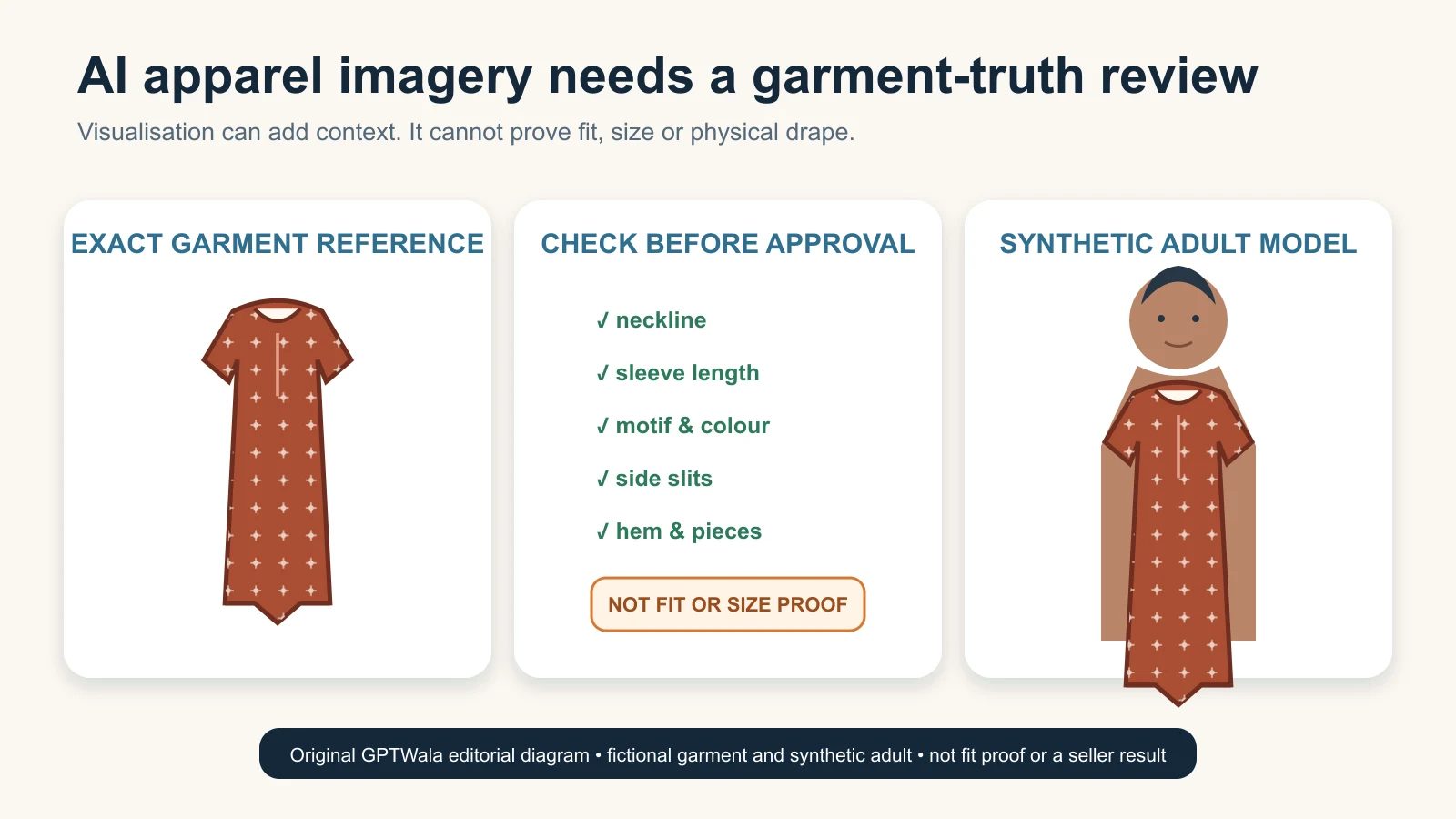
AI model photos can be useful as secondary apparel images when they show the exact garment, the model or likeness is properly authorised, and a garment expert checks every buying-critical detail. They should not be presented as proof of exact fit, size, fall or drape. If the sale depends on how a real garment behaves on a body, if a complex drape or layered outfit cannot be verified, or if AI changes the garment’s cut, construction, print, colour or included pieces, use real model photography.
This guide covers fixed marketing images created by placing or generating apparel on a model. It does not promise customer-specific virtual fitting, recommend a particular AI tool, or replace the current image rules for a marketplace. Tool features, model releases, platform policies and India’s privacy framework can change, so verify the final production setup on the date of use.
Table of contents
- What an AI apparel model image can and cannot prove
- Choose the correct risk lane before generation
- Build the exact-garment reference pack
- Create a garment-truth card
- Control model consent, likeness and data
- Review fit and drape without turning a visual into a promise
- Brief cultural and regional styling without stereotypes
- Use the eight-gate AI model-photo workflow
- Find garment changes with a structured review
- Apply the real-photography stop rules
- Run a five-SKU apparel pilot
- Frequently asked questions
What an AI apparel model image can and cannot prove
The safest mental model is visualisation, not fitting evidence. An AI system can produce a plausible person wearing something that resembles the reference garment. It has not physically put that garment on that person, felt the fabric, checked the size label or measured the ease.
Google makes the same distinction in its current customer-facing try-on documentation. It says generated images may contain errors in body shape, personal features or clothing details, and that the result does not indicate fit, suggest a size or show size availability. That is guidance for Google’s own try-on feature, not a performance assessment of every commercial tool, but it is a useful truth boundary for any seller-created AI model visual. See How Google’s try on tool works.
| Image type | What it may safely communicate after review | What it cannot establish by itself |
|---|---|---|
| Real model wearing the exact sample | Observed appearance of that sample on that model, in that pose and size | Fit for every customer or size; unseen motion or long-term wear |
| Reference-led AI model image | Styling direction, approximate wearing context and an additional visual angle | Exact fit, ease, drape, transparency, stretch, weight, size recommendation or body-specific outcome |
| Fully generated fashion concept | Campaign mood, pose or scene direction | Evidence of a purchasable SKU, actual garment details or what the buyer receives |
| Customer virtual try-on preview | A personalised visualisation within that feature’s stated limits | Measurement, tailoring advice, stock availability or guaranteed fit |
| Flat lay, ghost mannequin or product-only photo | Garment identity, construction and details visible in the source | Appearance on a moving body or exact drape in use |
Research supports the need for this caution. Recent virtual try-on work continues to focus on preserving complex text, patterns, uncommon garment details, pose, layering and resolution. An AAAI 2025 paper describes difficulty retaining intricate text and patterns in prior methods. A March 2026 research preprint reports that complete outfits and layering remain challenging for current try-on and general image-editing systems. These are research findings on specific datasets and methods, not a claim that every output fails. They show why an attractive image still needs garment-led human review. See Cascaded Diffusion Models for Virtual Try-On and the preprint Garments2Look.
The complete AI product photography guide explains the broader visual system. This page owns apparel-model truth: body interaction, garment fit and drape implications, model rights and culturally plausible styling.
Choose the correct risk lane before generation
Do not begin with “make this kurta look premium.” Begin with one image role and one risk lane.
Lane 1: low-risk styling concept
The model, outfit or scene is concept-only and is not attached to a product listing. Use it to plan a campaign, casting, backdrop or pose. Label it internally as concept-only and rebuild the sale asset with the exact garment.
Suitable for: moodboards, pre-shoot planning, colour-direction exploration.
Not suitable for: product proof, a marketplace main image, fit claims or a catalogue order page.
Lane 2: reviewed secondary model image
The exact garment is supplied as reference and appears on an adult synthetic or authorised real model. The image is an additional website, catalogue or social visual. Product-only and real-detail images remain available beside it.
Suitable for: a simple T-shirt, kurta or dress after exact-SKU review when the generated view does not claim size or fit.
Required controls: complete source pack, locked garment fields, model-rights record, garment expert approval and destination-rule check.
Lane 3: real photography or tightly controlled hybrid
Use the real garment on a real model when the image’s job is to prove fit, drape, transparency, movement, layered construction, scale or tailoring. AI may still extend a background or create a crop around protected real pixels if the final image remains truthful.
Suitable for: complex sari or dupatta drape, bridal or embellished garments, sheer layers, fit-sensitive products, size-range representation and high-value catalogue proof.
The lane can only move toward more evidence. A concept image does not become a verified product asset because it receives a logo and SKU number.
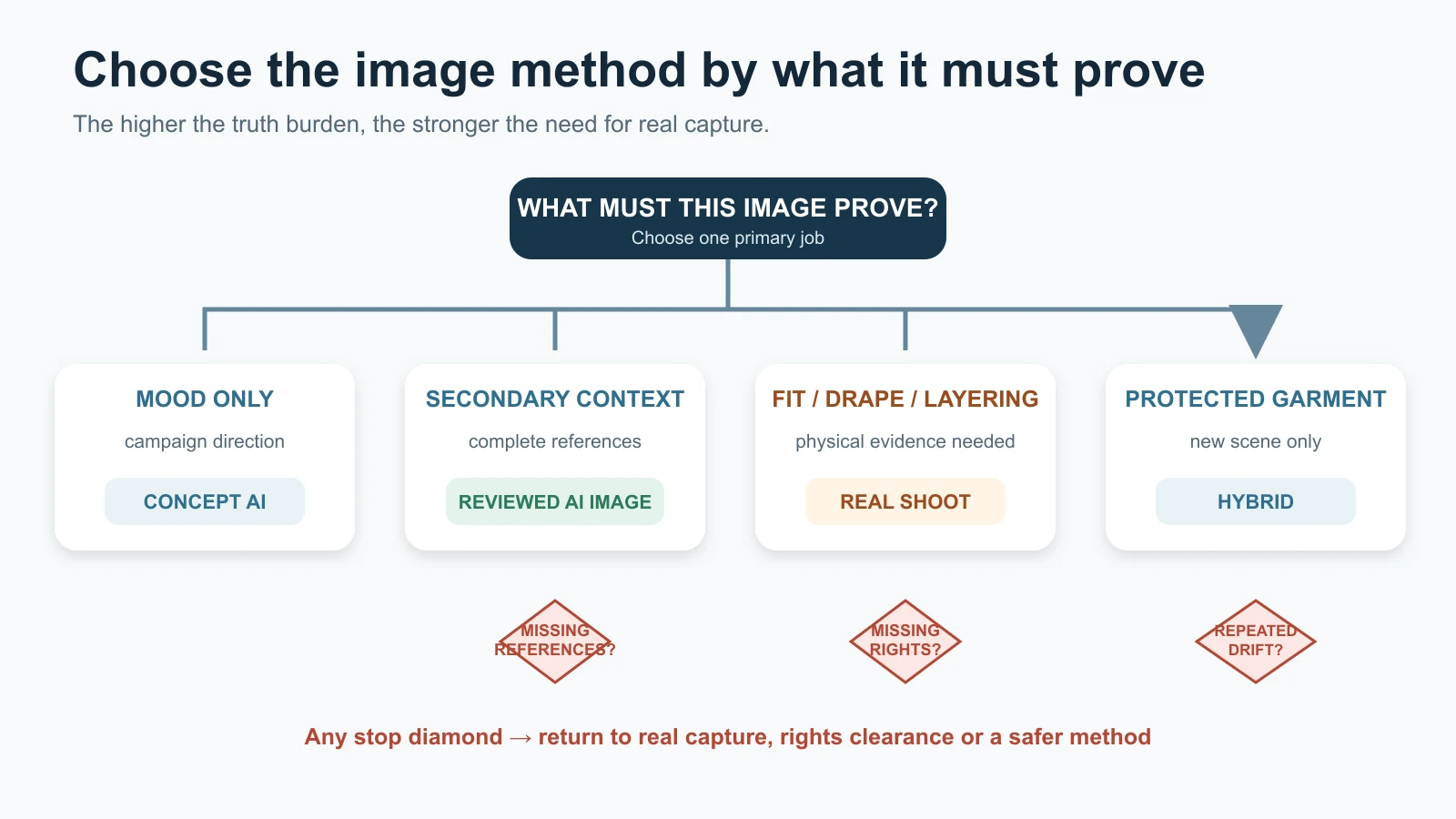
Original GPTWala decision flow. Any missing reference, missing right or repeated garment drift routes the job to a safer method.
Build the exact-garment reference pack
AI model imagery is constrained by what the team can verify. One front photo rarely reveals the back, side seam, border continuation, lining or material behaviour. Build the pack before opening a tool.
Capture the garment itself
For one exact SKU and variant, collect:
- full front and full back, squared to camera;
- left and right side where construction differs;
- inside view showing lining, facing, seam finish and labels where relevant;
- neckline, sleeve, hem, border, placket, zipper, buttons, hooks, pockets and embellishment close-ups;
- a colour reference captured under controlled light;
- a scale frame and verified garment measurements;
- every included piece, such as kurta, trousers and dupatta, photographed separately and together;
- the current packaging and size label; and
- a short real video showing movement when fall, stiffness, sheen or transparency is buying-critical.
The video is evidence for the reviewer, not an instruction to invent motion. If the real fabric forms broad structured folds, the generated image should not turn it into liquid satin. If the cloth is translucent under backlight, do not let the image silently make it opaque.
Record the exact size and physical measurements
Store the sample size, bust/chest, waist, hip where relevant, shoulder, garment length, sleeve length, hem opening and other category-specific measurements. Record whether measurements are garment measurements or body recommendations; do not mix them.
The model image should name the sample size in the internal record. Public text such as “Model is wearing M” is only valid if the visual and production method support that statement. A synthetic model did not physically wear the sample. Safer copy may be “AI-assisted styling visual; see size chart for garment measurements” when disclosure is appropriate and channel rules allow it.
Capture one verified real wearing reference when drape matters
A flat lay shows shape; it does not fully show behaviour on a body. For a garment where the selling idea depends on fall, pleats, volume, length or layering, capture at least one real wearing reference of the exact sample, even if it is not the final campaign image.
This is especially useful for:
- sari borders and pallu behaviour;
- dupatta transparency, fall and edge weight;
- anarkali flare and panel distribution;
- lehenga volume, cancan or lining;
- wide-leg trousers and palazzo movement;
- asymmetric hems;
- oversized versus regular-fit silhouettes; and
- knit stretch, rib recovery or body cling.
If no one has ever seen the exact garment worn, the team cannot honestly certify AI-generated drape from a flat reference alone.
Create a garment-truth card
The truth card turns “same dress” into fields a reviewer can approve or reject.
| Truth field | Record from the physical SKU | Automatic reject example |
|---|---|---|
| Identity | SKU, colour, size, collection and current version | Neighbouring colourway or previous season’s construction appears |
| Silhouette | Straight, A-line, fitted, oversized, flared or other verified cut | Straight kurta becomes cinched or flared |
| Proportions | Garment and sleeve length, neckline depth, waist/hem relationships | Crop length, slit height or sleeve length changes materially |
| Construction | Seams, panels, darts, pleats, gathers, closures, pockets and lining | Pocket, dart, zipper or panel is added or removed |
| Print and motif | Motif artwork, repeat direction, scale and placement | Print is regenerated, mirrored, stretched or repeated incorrectly |
| Border and embellishment | Width, sequence, count, placement and continuity | Border widens at hem; embroidery changes design or density |
| Colour and finish | Catalogue colour name plus controlled references | Rust becomes red; matte cotton becomes shiny silk |
| Fabric behaviour | Verified stiffness, fall, stretch, transparency and texture | Structured handloom cloth becomes flowing chiffon |
| Included pieces | Exact components and colours | Dupatta, belt, trousers or jewellery appears included when it is not |
| Branding and labels | Logo, label and visible text | Garbled label, invented monogram or altered logo |
| Size/fit implication | Sample size, real reference and allowed language | Image or caption implies a guaranteed body fit |
| Cultural styling | Intended drape, layer order, occasion and reviewer | Pallu, dupatta or head covering is placed in an unintended or implausible way |
Mark every field locked, context may change, or unknown—recapture. Never turn unknown into “let AI decide.” The product-truth prompt pack can express the locked fields, but prompts do not replace source evidence or review.
Control model consent, likeness and data
Garment approval and model permission are separate records. A perfect kurta reproduction can still be unusable if the team did not have the right to upload, transform or publish the person’s image.
Choose the model source deliberately
| Model source | Minimum control before use | Stop condition |
|---|---|---|
| Fully synthetic adult with no intended real-person resemblance | Tool terms permit commercial output; generation record; no celebrity, public figure or identifiable reference | Output resembles a real person, appears underage or carries an unapproved identity claim |
| Paid real model photographed by the business | Written release covers commercial channels, AI-assisted alteration, permitted derivatives, territory, duration and storage | Release is silent on AI transformation or planned use exceeds its scope |
| Employee, founder or friend | Same written, freely given and specific release as a paid model; no assumption that employment or friendship equals permission | Pressure, vague verbal permission or inability to withdraw from future optional use |
| Licensed stock or agency model | Licence explicitly permits the intended commercial use and AI/synthetic modification; keep invoice and terms version | “Commercial use” exists but synthetic alteration, derivative use or sensitive context is excluded |
| Customer or social-media photo | Separate explicit permission and a qualified rights/privacy process | Screenshot, tag, DM approval or public post is treated as a model release |
| Child or person who may appear under 18 | Specialist legal/guardian process and platform/tool review | Age is uncertain, consent is informal, or synthetic output makes an adult look like a child |
For a small apparel business, the cleanest low-risk starting point is often either a contracted adult model with a clear AI-use release or a fully synthetic adult who is not based on an identifiable person. Do not prompt for a celebrity lookalike, clone a competitor’s campaign model or use an influencer’s face without a specific agreement.
Put these fields in the model release and rights log
Ask qualified counsel or a rights professional to adapt the release to the business. Operationally, record:
- model’s verified adult status and identity record owner;
- the original shoot or source files;
- commercial purpose and named brand or entity;
- whether AI editing, virtual try-on, face/body alteration and synthetic derivatives are permitted;
- which product categories and contexts are allowed or excluded;
- channels, territories, languages and campaign duration;
- paid-media, marketplace, catalogue, website and social permissions;
- whether vendors or processors may receive the file;
- storage, access, deletion and breach-contact process;
- compensation and credit terms;
- withdrawal, expiry and takedown procedure; and
- approving person, agreement date and version.
The ASCI Code is a self-regulatory advertising standard, not a model-release statute, but its truth principles are relevant. It says advertisements should be truthful, should not mislead through visual presentation, implication or omission, and should have permission for references to a person that confer an unjustified advantage or cause ridicule or disrepute. See the current ASCI Code.
Do not oversimplify India’s DPDP commencement status
An identifiable person’s digital image may involve personal-data processing, but the exact legal analysis depends on the facts. India’s Digital Personal Data Protection Act, 2023 and the 2025 Rules have a phased commencement. The official 13 November 2025 notification brings some provisions into force immediately, some after one year, and many substantive processing and consent provisions 18 months after publication. On 12 August 2026, that 18-month point had not arrived.
Do not write “DPDP requires this release today” as a blanket claim. Maintain a specific written permission and secure data process now because it is sound rights management, and obtain current legal advice for the business, use case and effective dates. The sources of record are MeitY’s commencement notification, the DPDP Act, 2023 and the DPDP Rules, 2025. This article is operating guidance, not legal advice.
Review fit and drape without turning a visual into a promise
Fit is a relationship, not a look
Fit depends on the physical garment, pattern, labelled size, ease, stretch, construction and the wearer’s measurements and posture. A generated picture can create a convincing waist, shoulder or sleeve line without calculating any of those relationships.
Reject or qualify an image when it visually implies:
- a fitted waist for a straight-cut garment;
- a drop shoulder when the pattern has a set-in sleeve;
- extra ease or body cling unsupported by the sample;
- a shorter or longer hem than the measured garment;
- a deeper neckline or higher slit;
- a size-inclusive result that was never checked on that body range; or
- “perfect fit,” “tailored fit” or a size recommendation without evidence.
Keep the actual size chart next to the image. The image can inspire; measurements must do the size-information work. Google’s apparel guidance similarly treats size, size type and size system as explicit product data rather than something a buyer should infer only from a photograph. See Google’s apparel and accessories best practices.
Drape is physical behaviour, not just folds
Drape is affected by fabric weight, structure, weave or knit, finish, lining, cut, grain, pleating, gravity, pose and motion. AI often produces aesthetically pleasing folds that belong to a different material.
Review:
- where folds begin and end;
- whether pleats are constructed or invented;
- how the fabric hangs from shoulder, waist and hip;
- whether a border follows the real grain and edge;
- whether transparency and lining remain visible where they should;
- whether sheen is plausible for the verified material;
- whether flare and volume match the panel construction; and
- whether hands, bags or hair hide a failure.
If a reviewer cannot compare with a real wearing or movement reference, the output cannot be approved as drape proof.
Body editing is also a product-truth risk
Some systems change the body while placing the garment: narrowing a waist, lengthening legs, changing shoulder width, smoothing skin or moving hands. Apart from model-rights and representation concerns, body changes can make the garment look differently fitted.
Keep a model/body reference where a real model is used. Reject unexplained changes to body outline, pose or proportions that alter the garment’s apparent fit. For a fully synthetic model, select the body brief before generation and do not silently generate only the body type that flatters the garment most. A responsible catalogue can show range without claiming that one synthetic outcome predicts every customer.
Brief cultural and regional styling without stereotypes
“Indian model wearing ethnic outfit” is not a usable production brief. India’s garments, draping systems, occasions and customer preferences are too varied for a single default. Cultural fit means the styling is accurate for the seller’s intended product story and respectful to the audience, not that the model looks generically “traditional.”
Specify the product story, not an identity caricature
Record:
- garment and component names used by the business;
- region or tradition only when genuinely relevant to the product;
- intended occasion and customer setting;
- exact layer order and drape method;
- blouse, inner layer, trousers, petticoat or lining requirements;
- whether head, shoulders, midriff, arms or legs should be covered for the intended styling;
- footwear, jewellery and props, with a clear note that styling items are not included;
- hair, makeup and pose direction without skin-tone or body stereotypes; and
- a local merchandiser or cultural reviewer who can approve the result.
Do not add a bindi, turban, religious symbol, wedding marker, temple background or community-specific styling merely because the model is Indian. Do not “improve” authenticity by inventing accessories the buyer will not receive.
Stress-test Indian garment structures
Standard research datasets have expanded from upper-body garments to broad categories such as tops, bottoms and dresses, but that does not prove accuracy for every Indian garment or drape. The Dress Code research dataset, for example, groups front-view catalogue imagery into upper-body, lower-body and dresses. A 2026 research preprint, Virtual Try-On for Cultural Clothing, introduced saree, panjabi and salwar kameez examples specifically to study a wider clothing domain. These sources show active research expansion; they are not a commercial accuracy certificate.
For sari, lehenga, salwar-kameez, kurta sets, dupattas and layered occasion wear, test the exact tool with the exact SKU and review:
- pallu direction, length and border continuity;
- pleat count and where pleats originate;
- dupatta placement, transparency and edge weight;
- kurta side slits, trousers and layer order;
- lehenga panel distribution, flare, waistband and blouse construction;
- motif scale across folds and seams; and
- whether styling pieces appear included in the offer.
Use real photography when the drape method itself is part of the product value.
Four illustrative Indian business cases
Surat kurta-set wholesaler: The tool preserves the print at the front but invents a matching motif on the trouser and makes the dupatta opaque. Reject. Use the real flat-lay set and detail images; regenerate only when all three components and transparency remain verified.
Tiruppur T-shirt manufacturer: A simple crew-neck T-shirt can be a reasonable secondary-image pilot. Lock neck rib width, sleeve length, shoulder seam, fit category, colour and print placement. Reject if the model image narrows the torso and turns regular fit into slim fit.
Jaipur occasion-wear retailer: Dense embroidery, tassels, lining and layered flare are high risk. Use real model photography for the product page. AI may help plan the scene or extend a protected background, but not redraw the garment.
Varanasi sari seller: Border, pallu, weave appearance and drape are central buying information. A generated wearing image without a verified real drape reference is inspiration only. Retain real full-length and macro images; stop if the system repeats or widens the border.
These are illustrative operating examples, not reported case studies or claims about every business in those cities.
Use the eight-gate AI model-photo workflow
Gate 1: define one image job
Write the SKU, exact variant, channel, slot, audience and one-sentence purpose. Example:
Create one reviewed secondary website image showing fictional adult model M-07 wearing exact SKU KRT-IND-114-RUST in a neutral standing pose. Preserve the kurta’s straight cut, round neck, three-quarter sleeves, rust colour, white motif scale, side slits and measured length. Do not imply a size recommendation or include trousers, dupatta, jewellery or belt.
Gate 2: approve the reference and rights packs
Confirm the garment source pack, truth card, sample size and model-rights record. If the garment or model record is incomplete, stop before generation.
Gate 3: select a tool by control, not demo beauty
Test whether the tool accepts the required garment views, a model reference where authorised, pose controls, masks and output resolution. Read current terms for commercial use, input retention, training and prohibited content. The same-SKU AI product-photo tool comparison owns vendor selection; this article owns the apparel acceptance test.
Gate 4: generate a small candidate set
Create four to eight candidates for one SKU and one pose family. Do not generate hundreds and approve the least-wrong image. Keep the prompt, tool/version, inputs, settings, output IDs and date.
Gate 5: run garment identity review
Compare the candidate with front, back and detail references. Check every locked truth-card field. Any changed SKU, construction, motif, border, colour or included piece is an automatic reject.
Gate 6: run fit, drape and cultural review
An apparel merchandiser or pattern/garment expert checks silhouette, length, ease implication, folds, layering and styling. A cultural reviewer checks any region- or occasion-specific drape. “Looks good” is not a pass condition.
Gate 7: run model-rights and representation review
Confirm release scope, adult status, likeness, body/face changes, sensitive context, disclosure plan and file handling. Reject a celebrity resemblance, an uncertain-age appearance or a context outside permission.
Gate 8: export for one destination and record it
Check the current marketplace, Shopping feed, website or ad rules; keep required AI provenance metadata; export the exact approved file; and record where it was used. The current product-image rules guide owns Google, Amazon India, Flipkart and website requirements.
Google’s Merchant Center guidance currently recommends showing clothing on models, keeping the product central and using additional images for other angles or context. It also says Shopping images created with generative AI need the relevant IPTC source metadata. That platform guidance does not turn an inaccurate generated garment into an acceptable one.
Find garment changes with a structured review
Review at three scales
- Full frame: identity, silhouette, model pose, body proportions, length and cultural styling.
- 100% view: seams, neckline, sleeve, slit, folds, borders, closure and transparency.
- 200% detail: motif, embroidery, text, weave appearance, edge artifacts, fingers over fabric and small construction changes.
Use side-by-side comparison and an overlay where camera alignment permits. An overlay is useful for product-only or matched-pose references, but it is not a fit measurement when the model or pose changes.
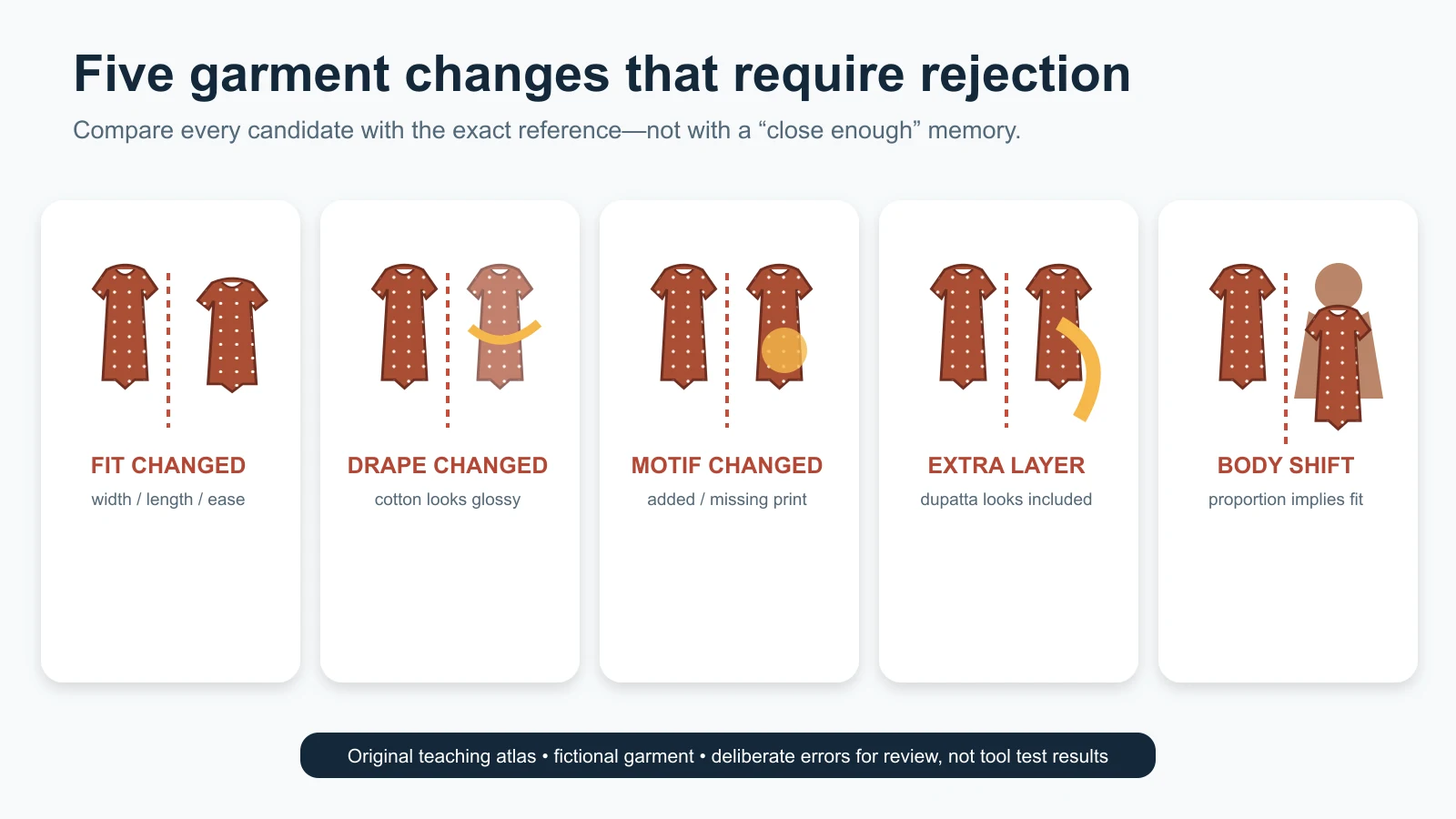
Original teaching atlas using a fictional garment. The deliberate errors are review examples, not observed tool-test results.
Use a severity-based decision
| Severity | Example | Decision |
|---|---|---|
| Critical | Wrong SKU, colour, included piece, print, silhouette, label, model rights or apparent minor | Reject and stop the asset |
| Major | Changed sleeve/hem length, neckline, border, embroidery, pocket, transparency, body proportions or drape claim | Reject; recapture or change method |
| Moderate | Recoverable background edge, contact shadow or crop issue outside the garment | Repair only if garment pixels remain protected, then re-review |
| Minor | Non-material background speck that cannot affect product meaning | Correct, document and run final review |
Do not repair a critical garment error with more prompting while keeping the corrupted output as the new reference. Return to the approved source. The product-accuracy guide covers the broader severity and audit system.
Keep a simple apparel approval record
| Field | Record |
|---|---|
| SKU/variant/sample size | Exact identifiers and measurements source |
| Image role/destination | Secondary website, catalogue, ad concept or other named use |
| Tool/version/date | Reproducible production record |
| Garment references | Source folder and verified views |
| Model source/rights | Synthetic or authorised real model, release/licence version |
| Truth-card result | Pass/reject by field |
| Fit/drape statement | “Visualisation only”; any permitted public qualifier |
| Cultural reviewer | Name/date when applicable |
| AI provenance/disclosure | Metadata and visible disclosure decision |
| Final decision | Approved, revise or reject; reviewer and rollback file |
Apply the real-photography stop rules
Use real model photography, a real mannequin/flat lay, or a protected hybrid if any of these conditions applies:
- the image must prove exact fit, size recommendation, ease or tailoring;
- a sari, dupatta, lehenga, draped or layered garment cannot be checked against a real wearing reference;
- fabric transparency, lining, stretch, stiffness, sheen or movement changes buying meaning;
- embroidery, print, border, weave, lace, text or branding is too detailed for reliable preservation;
- multiple pieces must layer in a specific order;
- the product is made-to-measure, personalised or high value and the generated view could alter expectation;
- the output changes body shape or pose enough to change apparent fit;
- model permission, licence scope, adult status or vendor data use is uncertain;
- the destination requires a real or differently structured image;
- the team cannot identify a qualified garment reviewer;
- repeated generations fail the same locked field; or
- the seller would be uncomfortable showing the AI image beside the physical garment to a customer making a return complaint.
Real photography is not a failure of AI adoption. It is the correct evidence method for a truth-sensitive job. The AI versus traditional photoshoot guide helps choose AI, studio or hybrid at the project level.
A strong hybrid apparel set
For many small Indian sellers, a trustworthy product page can use:
- real front and back images of the exact garment;
- real detail and construction close-ups;
- real model image for the key fit/drape view;
- one reviewed AI-assisted secondary context image where useful;
- an accurate measurement chart; and
- copy that explains fabric, fit category and included pieces without turning the image into a guarantee.
This gives the buyer evidence and inspiration without asking a generated image to do both jobs.
Run a five-SKU apparel pilot
Do not begin with the full catalogue. Choose five SKUs that reveal different risks:
- simple solid T-shirt;
- printed kurta;
- kurta set with two or three components;
- sheer or reflective fabric; and
- embroidered, draped or layered occasion garment.
For each SKU, produce one secondary image candidate and record:
- candidates generated;
- critical/major garment failures;
- time to approved asset;
- need for recapture or real wearing reference;
- rights-review result;
- reviewer confidence;
- destination acceptance; and
- whether the asset adds information not already supplied by real images.
Approve the workflow only for the categories it handles reliably. A pass on a solid T-shirt does not approve the same tool for a Banarasi sari or embroidered lehenga. Retire the tool or narrow its lane when review time exceeds the value of the asset.
Frequently asked questions
Can AI put my exact kurta or dress on a model?
It can create a plausible reference-led wearing image, but “exact” must be established by human comparison with the physical SKU. Lock silhouette, length, construction, print, colour, border, included pieces and fabric behaviour. Reject any changed field and keep real product images beside the AI visual.
Are AI model photos accurate for fit and sizing?
Do not treat them as exact fit or sizing evidence. Google’s own current try-on guidance says generated results do not indicate fit, suggest a size or show size availability. Use verified measurements, a size chart and real fitting evidence for fit-dependent claims.
Do I need a real model’s consent to use their photo with AI?
If an identifiable real person’s image is uploaded, transformed or published, obtain a specific written release and confirm that it covers AI-assisted alteration, commercial channels, duration, vendors and planned context. A verbal “yes,” public social post or ordinary stock licence may not cover synthetic modification. Get current legal advice.
Is a fully synthetic model free from consent risk?
It reduces the need for a real model release only when no identifiable person supplied the likeness and the tool’s commercial terms permit the use. Still check for accidental resemblance, celebrity/public-figure likeness, uncertain age, prohibited content and vendor terms. Keep a generation record.
Can I use AI model images as marketplace main images?
That depends on the current destination, country, category and image role. Do not assume permission. Check the current channel image rules and the signed-in seller account. Even when a channel accepts an AI-assisted image, it must remain truthful.
How do I stop AI from changing a print or embroidery?
Provide full garment views and high-resolution detail references, lock motif scale and placement, protect the garment region where the tool allows it, and compare at 100% and 200%. If the system repeatedly redraws the detail, stop using it for that SKU and use real photography.
Are AI model photos suitable for saris and lehengas?
They are high risk because drape, border continuity, pleats, layering, volume and embellishment can change. Use a real wearing reference and a garment expert. When the drape or construction is central to the purchase, choose real model photography and use AI only for concepting or a protected background.
Should I disclose that an apparel model image is AI-generated?
Follow the current channel, advertising and legal requirements. Google Shopping currently requires source metadata for generative-AI product images. Beyond a mandatory rule, visible disclosure can prevent a secondary visualisation from being mistaken for a real fit test. Do not use a disclaimer to excuse a materially inaccurate garment.
What should I do if the AI model looks like a real celebrity or influencer?
Do not publish it. Regenerate without names or likeness references, document the rejection and review the tool’s terms. If resemblance remains plausible or the campaign has already circulated, seek qualified rights advice.
When is a traditional apparel shoot the better choice?
Use a traditional or hybrid shoot when fit, drape, movement, transparency, layering, detailed construction, size representation or high-value product truth is the image’s job. Use AI where it adds context without weakening evidence.
Turn truthful apparel visuals into an online growth system
Better model images are one part of taking an apparel business beyond showroom visits, exhibitions and reseller messages. GPTWala’s DAA workshop connects digital presence, AI-assisted content creation and a practical WhatsApp advertising path for product businesses.
See the GPTWala workshop and decide whether it fits your apparel business.
Sources checked for this guide
- Google Merchant Center: How Google’s try on tool works
- Google Merchant Center: Best practices for advertising clothing and accessories
- Google Merchant Center: Image link requirements
- Google Merchant Center: AI-generated content
- AAAI 2025: Cascaded Diffusion Models for Virtual Try-On
- ECCV 2024: Improving Virtual Try-On with Garment-focused Diffusion Models
- CVPR Workshops 2022: Dress Code: High-Resolution Multi-Category Virtual Try-On
- 2026 research preprint: Garments2Look
- 2026 research preprint: Virtual Try-On for Cultural Clothing
- MeitY: DPDP Act commencement notification, 13 November 2025
- Advertising Standards Council of India: The ASCI Code
- Department of Consumer Affairs: Consumer Protection rules collection
- Central Consumer Protection Authority: Guidelines for Prevention of Misleading Advertisements and Endorsements, 2022
Leave a Reply