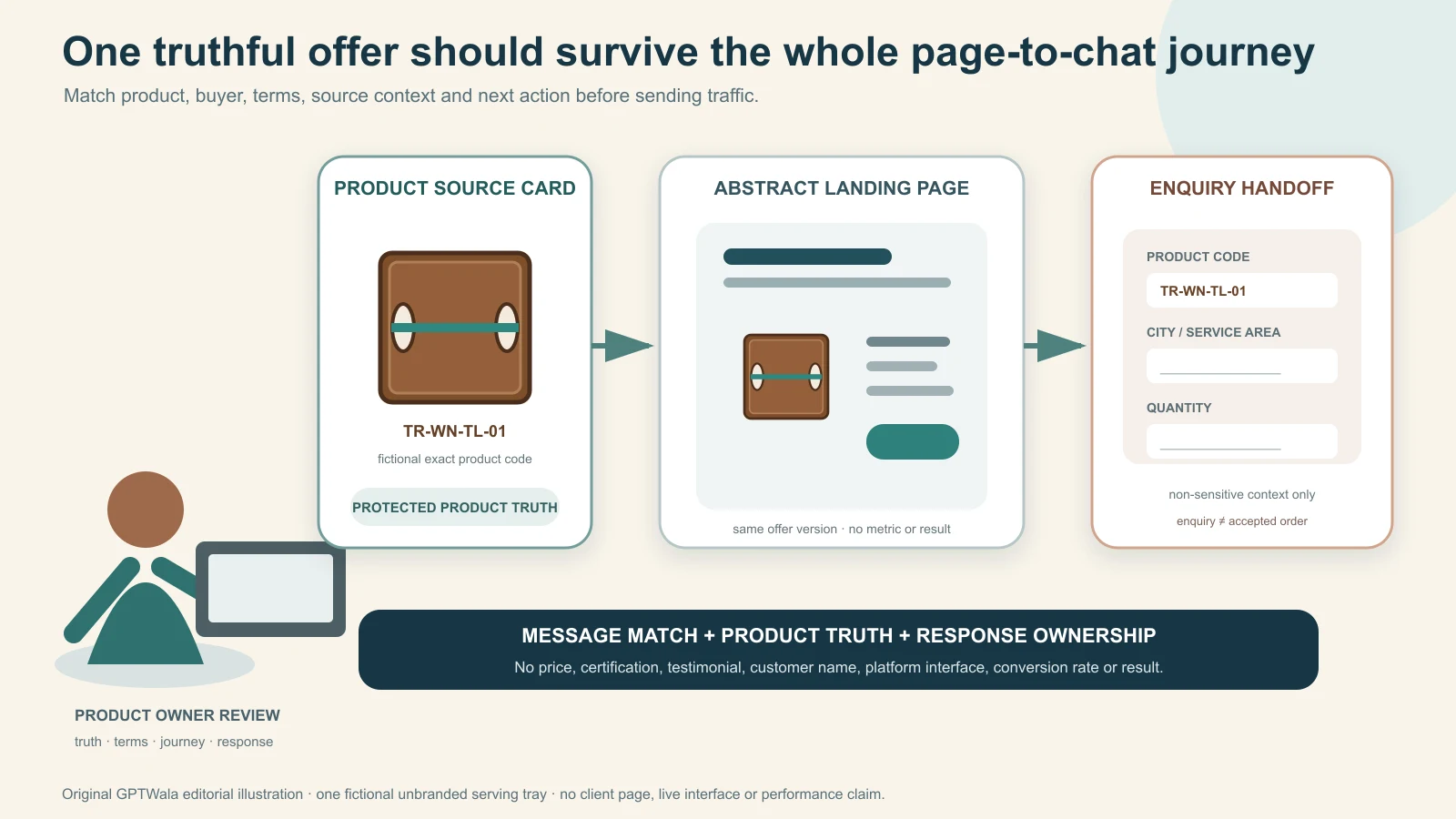
Reviewed and updated: 12 August 2026
To build a product landing page for WhatsApp enquiries, choose one buyer, one exact product or bounded offer and one next action. Match the page to the message that brought the visitor, show the real product and buying-critical facts, state price/MOQ/availability and service conditions honestly, answer the decision-stopping objections, and make the primary button open the correct business conversation with a non-sensitive product and source reference. Test the entire phone journey before sending traffic.
The page should help a suitable buyer decide, “This may fit; I know what to ask next.” It should not disguise a catalogue, quote, checkout, technical approval or confirmed order as a green chat button.
This guide owns the single-offer landing-page workflow. The digital product catalogue guide owns range structure and product information architecture. The WhatsApp selling guide owns qualification, quotation, payment verification and fulfilment after the conversation begins. The WhatsApp follow-up templates own later messages, and the ₹100/day click-to-WhatsApp system owns that specific ad setup and budget control.
All examples are fictional operating models, not GPTWala client results. This is conversion and workflow guidance, not legal advice or a promise of enquiries, sales or return on ad spend.
Table of contents
- Define the landing page’s one job
- Choose one buyer, product and action
- Write an approved offer-and-evidence card
- Match the page to the traffic message
- Use a practical landing-page structure
- Build the first screen around a truthful decision
- Show product fit, specifications and terms clearly
- Use images, video and proof without inventing trust
- Design the WhatsApp call to action
- Qualify the enquiry without building a long form
- Add privacy, consent and policy controls
- Make the page mobile, accessible and resilient
- Measure the journey without calling clicks leads
- Assemble the page in WordPress or another CMS
- Run the pre-launch phone journey
- Use the workflow for Indian product businesses
- Fix common product landing-page mistakes
- Frequently asked questions
Define the landing page’s one job
A product landing page is a focused destination for one campaign, offer, product family or exact item. It gives the visitor enough verified information to take one intended next action. In this guide, that action is an appropriate WhatsApp enquiry.
A landing page is not a smaller homepage
A homepage usually serves several audiences and paths. A landing page should remove unrelated navigation and answer the promise that led the visitor there.
It can still contain business identity, policies and supporting links. “Focused” does not mean anonymous, context-free or stripped of trust information.
A WhatsApp button is not the page’s strategy
A page with a product photo, “Best quality”, a phone number and a floating green icon gives the buyer very little help. The page must answer:
- What exactly is being offered?
- Is it for someone like me?
- Which variant, pack or configuration is shown?
- What will I receive—and what is not included?
- What are the important terms or limits?
- Why should I trust the product representation?
- What information should I send for a useful reply?
- What happens after I tap the button?
The button starts the handoff; it does not replace those answers.
A chat start is not a qualified enquiry
A visitor may tap accidentally, open WhatsApp and leave, send “Hi”, ask for an unavailable variant, fall outside the service area, be seeking a job or be a supplier. Define the business action separately from the interface event.
A useful page goal might be:
A retailer in our serviceable region sends the exact starter-assortment code, expected quantity and city, and agrees to a product-and-terms conversation.
That is not yet a quote, order, payment or sale.
Choose one buyer, product and action
The narrowest truthful offer usually creates the clearest page.
Write a one-sentence page brief
Use this pattern:
Help [specific buyer] understand whether [exact product/bounded offer] fits [job or need], then [one WhatsApp action] with [minimum useful context].
Fictional examples:
- Help independent apparel retailers assess a 24-piece cotton-kurti starter assortment, then request current trade terms with city and expected quantity.
- Help maintenance teams assess whether bearing series BR-6204 may fit their documented requirement, then send application and part/drawing reference for human review.
- Help nearby homeware shoppers understand the exact four-container set, then ask about the shown colour and delivery pincode.
Do not write “anyone interested in our products” as the buyer or “contact us” as the action.
Choose the right page scope
| Page scope | Use when | Main risk | Better control |
|---|---|---|---|
| Exact SKU | One item/variant is the message and offer | Stock or price can change quickly | Product/offer version and bounded availability language |
| Product group | Buyer must choose among a few real variants | CTA loses selected variant | Preserve variant in the button/message context |
| Curated bundle | Included items and pack are controlled | Lifestyle image implies extra inclusions | List every included item and bundle code |
| Wholesale range entry | Buyer needs a category-level decision before a catalogue | Page becomes a second full catalogue | Show range logic, qualification and link to controlled catalogue |
| Custom/technical solution | Price depends on requirements | Page implies fixed suitability or performance | State inputs needed and route to competent review |
If the page needs dozens of product cards and filters, it is becoming a catalogue. If it needs several unrelated offers, create separate pages or choose a higher-level decision.
Define who should not enquire
A clear boundary improves both honesty and response quality. State relevant exclusions such as:
- wholesale only or retail only;
- serviceable locations;
- minimum order or order multiple;
- buyer/project type;
- compatible/incompatible use;
- custom lead-time requirement;
- sample terms; or
- products/categories the business cannot supply.
Do not hide a material exclusion until after the visitor sends personal information.
Write an approved offer-and-evidence card
Do this before designing the page. The card becomes the source for the headline, product block, CTA, saved reply and any ad creative.
Offer-and-evidence card
| Field | Approved entry | Stop if… |
|---|---|---|
| Page/offer ID | Stable internal code and version | No owner can identify the live version |
| Buyer | Defined B2C, B2B, dealer, procurement or project audience | The same copy tries to serve incompatible buyers |
| Product identity | Exact SKU/group/bundle and variant | The image and record cannot be matched |
| Page promise | One supported decision/outcome | Wording implies an unproved performance result |
| Included offer | Unit, pack, accessories and exclusions | Quantity or inclusions are ambiguous |
| Price basis | Fixed/range/starting/quote, conditions and validity | Lowest slab is shown as universal price |
| Availability basis | Live source, made-to-order or confirmation route | Manual stock is labelled live |
| MOQ/order multiple | Exact unit and pack logic | “Box” or “set” has no defined quantity |
| Delivery/service | Geography, timing basis and charges as applicable | Page promises unverified nationwide service |
| Claims | Exact wording, evidence, owner and review date | “Best”, certification or performance is unsupported |
| Assets | Approved exact-product images/video and rights | Product or person consent/rights are unclear |
| CTA | Exact WhatsApp number/route, prefilled context and owner | Nobody is staffed to answer |
| Policies | Applicable privacy, delivery, return, warranty and support paths | Material terms are missing or contradictory |
| Measurement | Qualified-enquiry definition, exclusions and record source | CTA clicks are being called leads |
One person can fill the card for a small business, but the product, commercial, claim and fulfilment sources must remain identifiable.
Separate four kinds of truth
- Product truth: identity, variant, shape, material, specifications and inclusions.
- Offer truth: price basis, MOQ, availability, delivery, warranty and time conditions.
- Claim truth: evidence for performance, comparison, certification, sustainability, testimonial or scarcity language.
- Journey truth: the CTA destination, responder, qualification rule, next step and measurement definition.
The page fails if any one layer is false. A correct product image does not cure a misleading discount. A real price does not cure an unavailable WhatsApp number.
Use the no-source rule
If an exact fact is missing, do not let an AI writer, designer or salesperson fill the gap from plausibility. Mark it unresolved and ask the authoritative owner. That applies especially to:
- dimensions, capacity or material grade;
- compatibility and safety;
- colour/variant identity;
- included quantity;
- stock and lead time;
- certification or test result;
- environmental or “natural” claims;
- price, discount and scarcity; and
- delivery, return or warranty terms.
Match the page to the traffic message
The visitor should recognise the same product, buyer promise and conditions after the click.
Build a message-match table
| Entry message | Landing-page confirmation | CTA context |
|---|---|---|
| “Wholesale cotton kurtis; MOQ 24 pieces” | Same product family, trade audience and MOQ basis | Range/assortment code, city, quantity |
| “Exact blue 1.5 L lunch carrier” | Same colour, capacity, included parts and price basis | Exact SKU and delivery pincode |
| “Request a sample of matte wall tile series” | Same series, finish, sample terms and service region | Design code, project city and sample request |
| “Component for 6204 bearing requirement” | Same part family with suitability caveat | Part/drawing/application reference |
If the traffic message shows one variant and the page defaults to another, repair the route. If the ad says retail and the page says “dealer MOQ 100,” the traffic promise is wrong—not merely the button colour.
Keep one offer version across the journey
Use the same approved offer ID in:
- ad or post brief;
- landing-page record;
- product asset folder;
- WhatsApp prefilled reference;
- response card or saved reply;
- quote source; and
- measurement log.
When price, stock, product, claim or geography changes, create or approve the new version and update every live surface. Do not edit only the headline while the saved reply continues to quote old terms.
Treat destination review as a separate gate
Meta’s current ad review guidance says review can consider an ad’s creative, text, targeting and destination. That does not mean platform approval verifies the product claim, legal compliance, conversion quality or fulfilment. Test the page yourself even when no paid ad is planned.
Use a practical landing-page structure
The page should follow the buyer’s decision sequence, not a generic template’s section names.
Recommended section order
- Identity and promise: exact product/offer, intended buyer and supported benefit.
- Primary product proof: truthful main image/video and key decision facts.
- Fit and boundaries: use, buyer, geography, MOQ, compatibility or service limit.
- What is included: unit, pack, accessories and exclusions.
- Comparison/specification: attributes needed to choose the right variant.
- Commercial basis: price/quote, availability, delivery and applicable terms.
- Trust evidence: business identity, verified documents, process or genuine proof.
- Objection answers: focused FAQs or short decision blocks.
- WhatsApp action: exact context and response expectation.
- Policies and identity: support, privacy and applicable delivery/return/warranty links.
Not every page needs ten visibly separate bands. Combine adjacent material without removing a buying-critical answer.
Keep one primary action
The main action should be consistent: “Ask about SKU…”, “Request current wholesale terms”, “Check fit with a product specialist” or “Request sample terms”. Secondary actions can support people who are not ready:
- view the full catalogue;
- download an approved datasheet;
- check delivery or return terms; or
- call during stated hours.
Avoid five equal buttons for WhatsApp, phone, email, Instagram, directions and download above the fold. Focus does not require hiding alternative access; it requires a clear priority.
Repeat the CTA at decision points
A WhatsApp action can appear:
- after the first complete product-and-offer summary;
- after the detailed fit/specification block; and
- after the FAQs or final decision summary.
Use the same offer and context. Do not introduce a different discount or route in the footer.
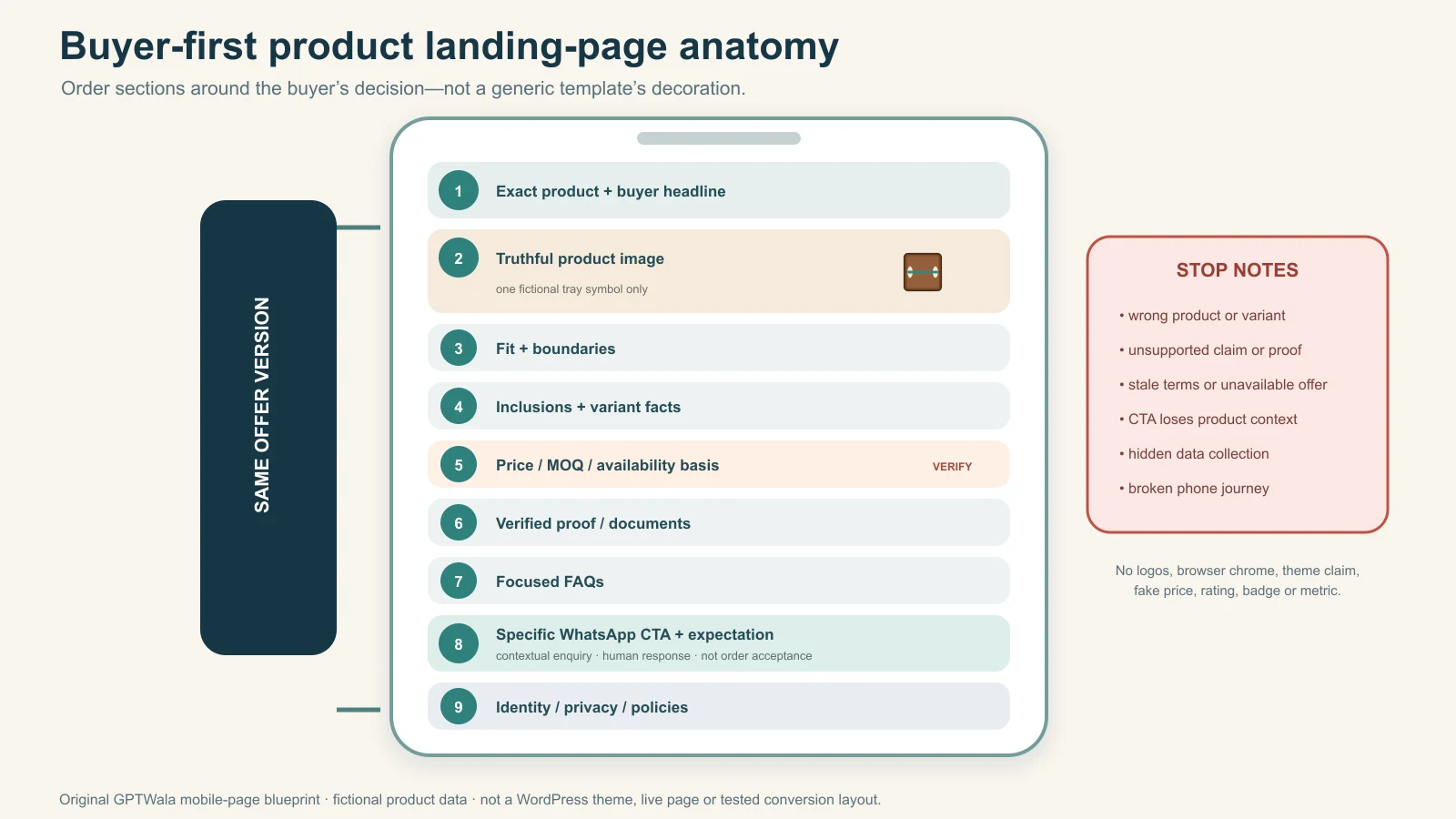
Original GPTWala buyer-first page blueprint using fictional product data. It keeps one offer version through nine decision sections and is not a WordPress theme, live page or tested conversion layout.
Build the first screen around a truthful decision
The first screen should orient the visitor, not compress the entire page into a poster.
Use a specific headline
Weak:
Transform Your Lifestyle With Premium Quality
Stronger:
24-Piece Cotton Kurti Starter Assortment for Independent Retailers
The stronger version identifies the offer and buyer. It still needs factual support for cotton composition, piece count and assortment.
Add a bounded supporting line
Explain the main difference plus a material condition:
Choose from the current straight-cut assortment with recorded size and print variants. MOQ 24 pieces; city and quantity are required for current trade terms and availability.
Do not use “direct factory price”, “lowest price”, “guaranteed margin”, “zero risk” or “pan-India delivery” unless each claim has a current, defined and supportable basis.
Show the exact product or offer
The hero asset should make the product identifiable. For a bundle, show every included item or state that the image is illustrative and give the exact list immediately. For a variant, do not use a generic family image that displays other colours as if they are included.
Add a short product-truth caption when needed:
Shown: fictional bundle KSA-24-A. Props and display rack are not included. Current assortment and availability confirmed before quotation.
Place the first CTA after enough context
The first CTA can be visible immediately, but the label should describe the real next action:
- “Ask about this 24-piece assortment”;
- “Send my requirement for fit review”;
- “Check delivery for this exact set”; or
- “Request current sample terms”.
“Buy now” is wrong if the business still needs to confirm the product, quantity, price, delivery or credit.
Show product fit, specifications and terms clearly
The middle of the page should remove uncertainty without becoming an unfiltered internal datasheet.
Explain who it is for—and not for
Use a short fit block:
Good fit when:
- the buyer type and use match;
- quantity meets the stated minimum;
- location is serviceable; and
- the product’s verified constraints suit the requirement.
Ask a specialist first when:
- technical compatibility affects safety or performance;
- custom size/material is required;
- colour or batch matching is critical;
- certification or documentation must meet a project requirement; or
- the intended use falls outside the recorded specification.
This is more useful than a generic “perfect for everyone”.
Show comparison fields in native text
For multiple variants, use a compact comparison table.
| Field | Variant A | Variant B | Buyer decision |
|---|---|---|---|
| Product code | Exact child SKU | Exact child SKU | Pass the selected code into WhatsApp |
| Size/capacity | Verified value | Verified value | Choose by actual need, not image scale |
| Material/finish | Approved description | Approved description | Do not infer unseen grade |
| Pack/inclusions | Exact list | Exact list | Prevent quantity confusion |
| MOQ/price basis | Current controlled basis | Current controlled basis | Confirm final quote/availability |
Do not rasterise this table into an image. Native text is easier to update, search, select and read with assistive technology.
Explain the complete offer
Use explicit wording:
- exact unit or bundle;
- included pieces;
- optional accessories;
- excluded props;
- MOQ and order multiple;
- public/dealer price basis;
- tax/freight/delivery basis as applicable;
- quote/offer validity where used;
- stock or made-to-order status; and
- return, exchange, warranty or service conditions as applicable.
If the page is not integrated with authoritative inventory, say “availability confirmed before quotation/order” rather than “in stock”.
Keep technical proof separate from marketing shorthand
A product landing page can summarise. Link to a current approved datasheet, drawing, certificate scope or test information when the buyer needs it. Do not convert a technical document into a broad headline it does not support.
For example, a result under defined laboratory conditions does not automatically support “works in every environment”. A material declaration does not prove performance. A certificate logo without exact applicability can mislead.
Use images, video and proof without inventing trust
Visual quality matters, but product fidelity and claim integrity come first.
Use images by decision job
- Hero image: identify the exact product/offer.
- Alternate view: show shape, back, side or construction.
- Detail view: show a buying-critical feature or label accurately.
- Scale/context view: explain use or size without changing the offer.
- Included-pieces view: show every item that comes with the purchase.
- Diagram: explain verified dimensions or part relationships with native text.
The AI product-photography guide owns the wider image strategy, and the product-accuracy audit owns detailed AI-image review.
Apply the landing-page product-truth gate
Reject an image or video when it changes or implies:
- the SKU, variant or package version;
- shape, proportions, construction or part count;
- colour, print, texture, finish or material;
- label, logo, hallmark or text;
- included accessories or quantity;
- fit, drape, scale or compatibility;
- operation, safety or performance; or
- certification, scarcity, rating or customer outcome.
An AI disclosure does not make a false product representation acceptable. The CCPA’s Guidelines for Prevention of Misleading Advertisements and Endorsements, 2022 state that valid, non-misleading advertising should contain truthful and honest representation and should not exaggerate capability or performance.
Use proof that proves the stated thing
| Claim type | Useful evidence route | Not sufficient by itself |
|---|---|---|
| Product identity | Exact SKU, current product and approved image references | Similar-looking family image |
| Material/specification | Authoritative product record/datasheet | AI-written description |
| Performance | Relevant controlled test and applicable scope | Lifestyle video or testimonial |
| Certification | Current document and exact product/entity scope | Generated badge or logo |
| Customer experience | Genuine, permissioned, accurately represented source | Fabricated quote or stock photo |
| Scarcity/availability | Current inventory/production source and timestamp | Red “few left” graphic |
| Price saving | Current real comparison/basis and conditions | Crossed-out invented price |
Do not display five-star graphics, customer counts, logos, awards or “trusted by” statements without a verifiable and authorised source.
Keep people and testimonials controlled
If the page shows a customer, model, employee, installer or expert:
- document rights/consent for the intended use;
- do not imply endorsement or experience they did not provide;
- do not give a synthetic person a real testimonial;
- verify every quote and material relationship; and
- remove or update content when permission or relevance ends.
For fit, demonstration, safety or expert claims, use an appropriate real evidence route rather than a decorative synthetic person.
Design the WhatsApp call to action
The CTA should open the correct business destination, preserve useful context and set an honest expectation.
Choose the exact business route
Use the approved business number or governed Platform route that the team currently owns. Confirm:
- visible business identity;
- current number and account access;
- supported language;
- service hours and response owner;
- backup/escalation route; and
- correct handoff into the team’s enquiry record.
Do not build the page around an employee’s personal number unless the business has explicitly approved ownership, access, privacy, recovery and continuity.
Prefill context, not sensitive data
Use the current official link/short-link method available for the chosen WhatsApp product and test the final URL. A useful prefilled message is:
I am enquiring about offer KSA-24-A from page version 2026-08. Buyer type: retailer. City: [add city]. Expected quantity: [add quantity]. Please confirm current assortment, trade terms and availability.
Keep it short enough to edit on a phone. Do not put passwords, payment details, identity documents, health data, exact home addresses or other sensitive information in the URL or prefilled text. Links and browser records can be copied, logged or forwarded.
Make the button label specific
Good labels tell the visitor what happens:
- “Ask about this exact set on WhatsApp”;
- “Request current wholesale terms”;
- “Send my application for product-fit review”;
- “Check sample terms for design MT-3060-C”; or
- “Check delivery for my pincode”.
Avoid “Get quote” if the next step only asks a qualification question and cannot produce a quote yet.
Set the response expectation beside the CTA
Use a truthful statement such as:
Messages are reviewed Monday–Saturday, 10:00–18:00 IST. We first confirm the exact variant, quantity, location and current availability before quoting.
Publish only hours and response behaviour the business can maintain. Do not promise “instant reply” because an automated greeting exists.
Explain what the tap means
Add a compact note:
Tapping opens a WhatsApp conversation with the product reference. It does not reserve stock, confirm price or place an order.
This prevents the UI from implying a transaction state the business has not reached.
Qualify the enquiry without building a long form
The landing page should do enough qualification to create a useful first message, but it should not ask every sales question before the buyer understands the offer.
Ask only decision-changing fields
For many product businesses, the minimum is:
- exact product/variant reference;
- buyer type;
- city/service area;
- quantity or pack expectation; and
- one application/use field when fit matters.
Examples:
| Business | Minimum useful context | Later human questions |
|---|---|---|
| Apparel wholesaler | Retailer type, city, assortment code, expected pieces | Size/colour mix, delivery and trade verification |
| Component manufacturer | Part/drawing reference, application, quantity, location | Tolerance, environment, technical approval and terms |
| Jewellery retailer | Exact SKU, city, appointment/delivery preference | Availability, size/customisation and terms |
| Tile manufacturer | Design/finish code, project city, approximate requirement | Batch/sample, application, timeline and freight |
| Local homeware shop | Exact set, pincode and quantity | Stock, delivery slot and payment/order confirmation |
Do not request GSTIN, full address, identity document or payment detail merely to answer an initial product question unless a valid, explained process genuinely needs it at that stage.
Preserve selected choices
If the page lets a visitor select colour, size, pack or buyer type, the CTA must carry or display that selection accurately. Test every branch. A button that always sends the default SKU can create wrong quotes and fulfilment errors.
Route unsuitable enquiries respectfully
If the buyer is outside the fit boundary, offer the appropriate alternative:
- view a retail product instead of a wholesale-only offer;
- request a distributor contact for a serviceable region;
- send a technical requirement for manual assessment; or
- state that the product is unavailable or unsuitable.
Do not force every visitor into WhatsApp simply to increase message counts.
Add privacy, consent and policy controls
This is operational guidance, not legal advice. The applicable privacy, consumer, ecommerce and sector position depends on the actual data, product, business role and transaction.
Map what the page and tools collect
Create a small data map:
| Data/event | Where it is collected | Why | Who can access | Retention/deletion route |
|---|---|---|---|---|
| Basic server logs | Website/host | Security and operation | Named technical owner/provider | Defined operational policy |
| Analytics event | Browser/tool, if enabled | Page/CTA diagnostics | Named marketing/data roles | Tool and business settings |
| Prefilled product/source code | Link/message | Route the enquiry | Sales/enquiry owner | Enquiry-record policy |
| Buyer-provided message | Respond to the stated task | Authorised business users/provider | Messaging/business policy | |
| Later order data | CRM/order/accounting system | Quote/order/fulfilment | Restricted operational roles | Applicable business/legal policy |
Do not install a tag or collect a form field merely because a plugin makes it easy.
Give an accessible privacy notice
Before or near the action, make it possible to understand:
- the business identity;
- what the page or form collects;
- why it is collected;
- relevant sharing/providers;
- how to contact the business or exercise applicable choices; and
- where fuller privacy information lives.
Do not hide the only notice behind an unreadable footer or pre-tick a broad marketing permission merely to open WhatsApp.
Treat enquiry response and later marketing separately
A buyer who starts a relevant product conversation expects a response to that task. Do not treat one enquiry as indefinite permission for unrelated promotions. WhatsApp’s current Business Messaging Policy requires businesses to have the person’s number and opt-in permission for subsequent messages/calls and to honour opt-out requests, while also placing responsibility for notices, permissions and legal compliance on the business.
The WhatsApp follow-up template guide owns the detailed service/marketing distinction and sequence.
Keep India’s data-law timing under review
India’s data-protection framework has phased commencement. The official DPDP Act commencement record on India Code records phased commencement from 13 November 2025, with many core provisions scheduled later. Do not copy an old checkbox or generic “GDPR compliant” badge. Verify the law, rules and actual data flow on the implementation date.
Add applicable consumer and transaction terms
If the page participates in ecommerce, review the current Consumer Protection (E-Commerce) Rules, 2020, amendments and applicable product/packaging requirements for the business’s real role. Make relevant seller identity, total-price basis, delivery, return/refund, warranty, grievance/support and product information clear where applicable.
Do not use a disclaimer to reverse the main offer or hide a material condition.
Make the page mobile, accessible and resilient
Most WhatsApp journeys will be tested on a phone even if some traffic arrives elsewhere. Build for the real device and connection, not only the desktop editor.
Use semantic page structure
- one descriptive H1;
- H2/H3 headings in logical order;
- native paragraphs and lists;
- real buttons/links with descriptive labels;
- labelled form controls;
- table headers that remain associated with values;
- sufficient colour contrast;
- visible keyboard focus; and
- captions/transcripts or text equivalents for important media.
The W3C Web Accessibility Initiative’s forms guidance explains that controls need labels and that instructions, validation and notifications should help people complete a form. Apply the same principle to variant selectors and WhatsApp enquiry fields.
Write alt text for the image’s purpose
The W3C images tutorial distinguishes informative, decorative and functional images. For a product page:
- describe the exact visible product/variant in informative-image alt text;
- use empty alt text for genuinely decorative flourishes;
- describe the action when an image is the only link/button content; and
- keep complex specifications available in nearby native text.
Do not write claims, keywords or unseen features into alt text.
Optimise the useful asset, not the product’s identity
Compress and resize copies for the required display while keeping an approved master. Confirm after processing that:
- the product remains sharp at decision-relevant detail;
- colour and finish have not shifted materially;
- text/marks have not become unreadable or distorted;
- the crop does not remove included pieces;
- the mobile crop still shows the right variant; and
- filenames/URLs map to the correct record.
Test failure states
The page needs a safe response when:
- WhatsApp is not installed;
- the device cannot open the intended app route;
- JavaScript fails;
- an image/video does not load;
- a selected variant is unavailable;
- a user has low bandwidth;
- the business is outside staffed hours; or
- the route changes or number is retired.
Provide an understandable fallback contact path and business identity. Never leave a dead button with no explanation.
Measure the journey without calling clicks leads
Measurement should help diagnose the path without collecting unnecessary customer data or inventing attribution.
Use an event ladder
| Stage | Example event/record | What it proves | What it does not prove |
|---|---|---|---|
| Exposure | Page loaded | Browser requested the page | A person read or understood it |
| Interest | Product detail/variant viewed | Interface interaction occurred | Buyer suitability |
| Intent signal | WhatsApp CTA clicked | Visitor attempted to continue | Conversation opened or message sent |
| Conversation | Product-referenced message received | Business received a message | Qualified enquiry |
| Qualification | Written criteria passed | Buyer/product/location/quantity fit current rule | Quote acceptance or sale |
| Commercial | Dated quote/order summary issued | Business advanced the opportunity | Payment or revenue |
| Outcome | Confirmed order and verified accounting record | A business transaction was recorded | Landing page alone caused it |
Choose names that preserve these distinctions. Do not call the CTA event lead if qualification happens later.
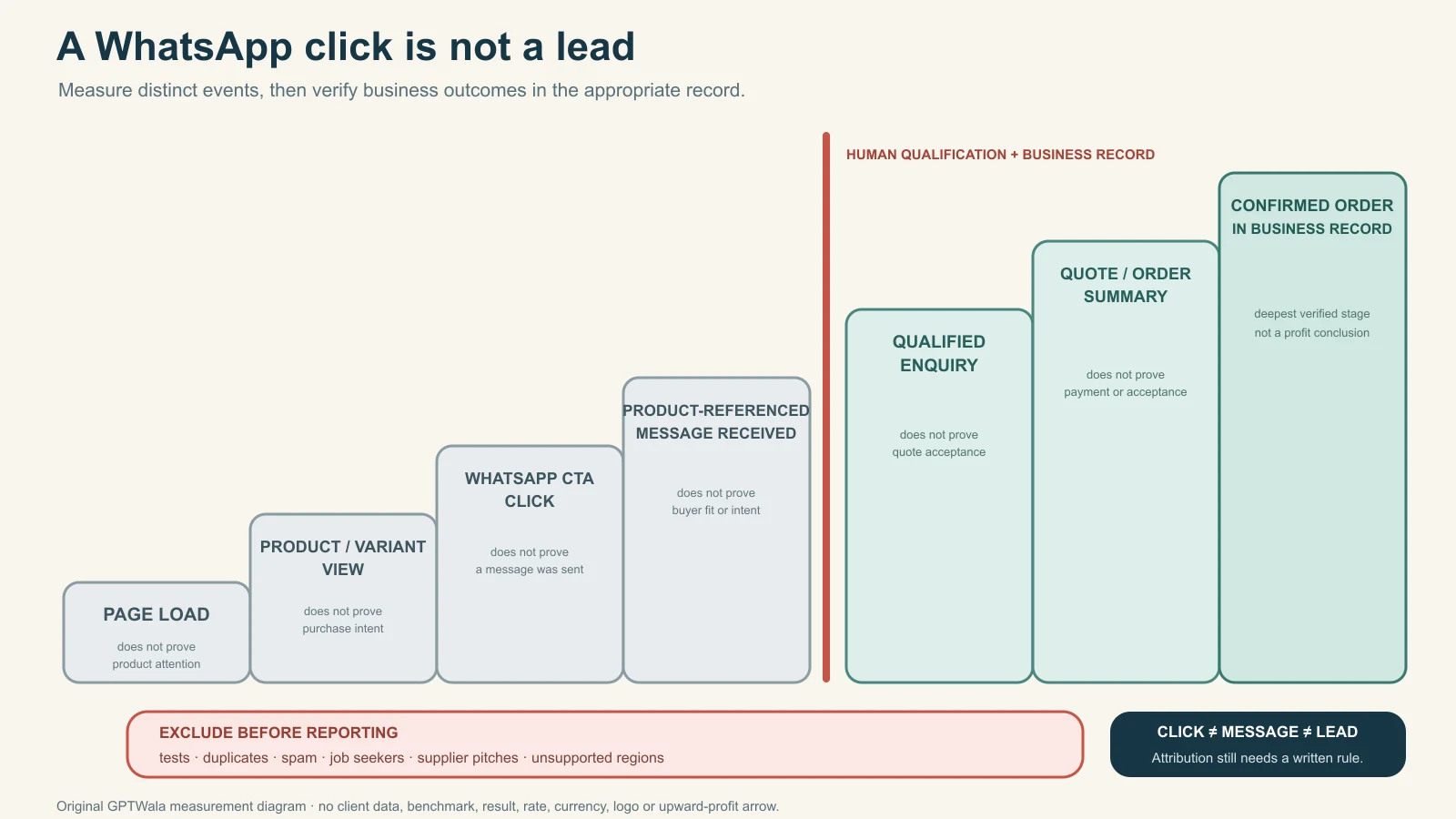
Original GPTWala measurement ladder. Interface events, messages, qualified enquiries, commercial records and confirmed orders are distinct; the diagram contains no client data, rate, benchmark, currency, attribution result or profit claim.
Define a qualified WhatsApp enquiry
Example for a wholesale landing page:
A non-test, non-duplicate message from a retailer or distributor in a serviceable region that names the page’s product/assortment, meets or can meet the disclosed MOQ, provides city and expected quantity, and reaches a real next step.
Exclude spam, tests, jobs, suppliers, accidental clicks, unsupported geographies and unrelated service requests. Adapt the definition to the business; it is not a universal benchmark.
Use non-sensitive source references
Pass a short page/offer/campaign code such as KSA24A-AUG26, not a customer name, phone number, email or detailed personal profile. Reconcile the code in the enquiry record. Do not hide sensitive or manipulative targeting information in the prefilled message.
Choose the least complicated valid measurement route
A small business may begin with:
- page/CTA diagnostics;
- a manual or CRM enquiry source field;
- test-message exclusions; and
- quote/order reconciliation.
Adding a Meta pixel, Conversions API, call-tracking system or customer-data upload introduces technical, access and privacy work. Meta’s Business Tools Terms place requirements around rights, permissions, lawful basis, notice and restricted/sensitive data. Recheck current terms and obtain appropriate advice before implementation. Technical availability is not permission.
Report cautiously
Useful page reports can show:
- working/broken CTA rate from tests;
- CTA clicks by page/offer version;
- product-referenced conversations received;
- qualified enquiry rate using the written rule;
- response ownership/time as an operational measure;
- wrong-product or missing-context rate;
- quotes/orders linked in business records; and
- data/consent or product-truth incidents.
Do not claim that a new headline “increased sales” without a controlled comparison and reliable outcome linkage.
Assemble the page in WordPress or another CMS
The controls below are platform-neutral. Menu names, theme behaviour and plugins change; inspect the actual authorised site before implementation.
Create the page shell
- Use the approved slug and canonical intent.
- Set the page to draft.
- Add one H1 and the buyer-first section order.
- Use native text, headings, lists, tables and buttons rather than one long image.
- Insert only approved, compressed derivative assets with alt text/captions.
- Add policy and business-identity links.
- Configure the correct WhatsApp action and fallback.
- Add only privacy-reviewed measurement.
- Preview on real phone widths before any traffic.
This article does not claim that a particular WordPress block, theme or plugin was tested.
Keep reusable blocks source-controlled
Reusable elements can include:
- business identity and contact block;
- delivery/returns/warranty link block;
- WhatsApp expectation note;
- product-truth disclosure;
- qualified-enquiry fields; and
- final QA footer.
But reuse must not freeze stale facts. A global “ships across India” block can make every page wrong at once. Assign an owner and update trigger to every reusable commercial statement.
Handle variant pages and URLs deliberately
If the page covers several variants:
- preserve the selected variant in the URL or page state when feasible;
- update visible product name, image, facts and CTA context together;
- keep one clear canonical approach;
- avoid indexable thin combinations with no distinct buyer value; and
- test shared links in messaging/social previews.
Google’s current Product variant structured-data guidance says eligible ecommerce implementations should give variants unique identifiers and support direct preselection with the correct image, price and availability information. Treat this as web implementation guidance—not a ranking promise or a reason to generate thin pages.
Use schema only when the visible page qualifies
Google’s Product structured-data documentation distinguishes product snippets from merchant listings and says Search appearances remain discretionary. If the landing page is a genuine product page, an implementer can evaluate current eligible markup and required visible fields.
Do not add a fabricated Offer, review, rating, price, availability or return policy merely for schema. This educational blog article should use Article/BlogPosting plus BreadcrumbList, not Product markup.
Run the pre-launch phone journey
The page is not ready because the builder preview looks correct. Test the public draft or protected staging route as a buyer.
Twelve-step dry run
- Open the source message/ad/post and record its product, offer and audience.
- Tap through on a normal phone and relevant connection.
- Confirm the exact page, HTTPS route and business identity.
- Compare headline, image, variant, offer and material conditions with the approved card.
- Read every specification, inclusion, price/MOQ, availability and policy statement.
- Try every variant, accordion, table, download and secondary link.
- Use keyboard/screen-reader/accessibility checks appropriate to the implementation.
- Tap every WhatsApp CTA and confirm the correct business account/number.
- Verify prefilled product, variant, page version and non-sensitive source code.
- Send a labelled test message during the staffed test window.
- Confirm the right owner receives, logs and excludes the test from leads/sales.
- Retrieve the correct product source and follow the real qualification/handoff path.
Testing must not create a live order, take payment, reserve stock or expose real customer data.
Pre-launch decision table
| Gate | Pass evidence | Hard stop |
|---|---|---|
| Product | Exact SKU/variant, inclusions and assets verified | Similar/unverified item or AI product drift |
| Offer | Price/MOQ/availability/delivery basis current | Contradiction or unsupported urgency |
| Claims | Evidence and owner recorded | Unsupported performance/certification/comparison |
| Page | Mobile route, content and links work | Broken, wrong or inaccessible critical path |
| Correct business identity, context and owner | Personal/retired number or lost variant context | |
| Privacy | Data map, notice, permissions/access reviewed | Unapproved tags, sensitive URL data or missing notice |
| Operations | Stock/quote/fulfilment source and stop owner ready | Nobody can answer or fulfil the advertised route |
| Measurement | Events and exclusions match written definitions | Clicks/tests reported as qualified leads/orders |
Any hard stop keeps the page in draft or traffic paused until the defect is corrected and retested.
Set event-driven rechecks
Reopen the affected gates when:
- product, variant, packaging or included pieces change;
- price, MOQ, stock, delivery or policy changes;
- an image, video, claim or proof asset changes;
- the WhatsApp number, team, hours or access changes;
- a page, plugin, theme, domain or redirect changes;
- a tracking/data tool or privacy position changes;
- the traffic message or target buyer changes; or
- a complaint reveals confusion or misrepresentation.
No fixed review interval replaces those triggers.
Use the workflow for Indian product businesses
These are fictional examples, not case studies or performance claims.
Surat apparel wholesaler: starter assortment page
Page job: help independent retailers decide whether a 24-piece cotton-kurti assortment fits their store.
Show: exact assortment code, fabric composition source, silhouettes, size/colour mix rules, piece count, MOQ, replacement policy as applicable, current trade-terms route and serviceable region.
WhatsApp context: retailer type, city, expected quantity and assortment code.
Truth stop: model imagery must not change print, neckline, sleeve, border, colour, length, size or included mix. Do not promise margin or sell-through.
Rajkot component manufacturer: technical fit page
Page job: help a procurement/maintenance buyer identify whether a component family deserves technical review.
Show: exact series/part references, controlled dimensions/material fields, drawing revision, application boundary, MOQ, sample/document route and lead-time basis.
WhatsApp context: part/drawing reference, application, quantity, city/country and timeline.
Truth stop: a render is not dimensional or performance proof. Do not say “prevents breakdowns” or “fits all models”. Route suitability to a competent human using current documents.
Morbi tile manufacturer: sample-request page
Page job: let dealers or project buyers inspect one design/finish family before requesting sample terms.
Show: exact design codes, size/finish, box quantity/coverage basis, shade/batch caveat, application boundary, sample terms and project-location requirement.
WhatsApp context: design code, finish, project city, approximate area/quantity and sample request.
Truth stop: generated room scenes must not alter tile face, repeat, reflectivity, grout/joint impression, colour or scale. Current physical sample approval may be necessary for colour-critical decisions.
Jaipur jewellery retailer: exact-item appointment page
Page job: help a local buyer ask about one exact necklace or pair before a store/video appointment.
Show: exact SKU, item count, dimensions/weight basis, verified material/stone/enamel description, close-ups, current price/availability basis and appointment/service terms.
WhatsApp context: SKU, city, preferred appointment type and question.
Truth stop: do not change stone count, setting, chain, clasp, hallmark, colour or apparent scale. A generated hallmark-looking mark is not purity evidence.
Local appliance retailer: delivery-area page
Page job: help nearby buyers check one model and delivery/service area before enquiry.
Show: exact model, included accessories, key verified specifications, price basis, pincode/service boundary, installation/warranty route and stock-confirmation language.
WhatsApp context: model, pincode, quantity and installation question.
Truth stop: do not say “free installation” or “same-day delivery” without current conditions and operational capacity. Avoid a family image that shows accessories not included with the model.
Global product exporter: bounded trade-enquiry page
Page job: help a business buyer request a current export quotation for one controlled range.
Show: product/pack specification, MOQ/order multiple, applicable documents, incoterm/freight/price confirmation route, lead-time basis and target-market limits as reviewed.
WhatsApp context: buyer/company type, destination country, quantity, required specification and timeline.
Truth stop: do not imply customs, certification, sanctions, tax, currency, delivery or market eligibility without current specialist review for the actual destination.
Fix common product landing-page mistakes
| Mistake | Why it fails | Safe fix |
|---|---|---|
| One page serves retail, wholesale and procurement | Product, price and qualification messages conflict | Choose one primary buyer or governed views/pages |
| Headline repeats vague “premium quality” | Buyer cannot identify offer or fit | Name exact product/offer, buyer and supported difference |
| Ad/post shows one variant; page shows another | Message match and product truth break | Route to exact variant and preserve selection |
| Hero image includes unlisted props | Buyer may infer extra inclusions | Use exact offer image and list inclusions/exclusions |
| AI fills missing specifications | Plausible facts become misinformation | Apply the no-source stop rule |
| “Starting at” has no real configuration | Price attracts under false conditions | Name purchasable basis and material conditions |
| Wholesale price ignores MOQ/case | Enquiries start with wrong expectation | State unit, MOQ, multiple, case and quote basis |
| Floating WhatsApp icon says only “Chat” | Product and action context are lost | Use specific labels and prefilled product reference |
| CTA opens personal/retired number | Ownership, privacy and continuity fail | Use governed business route and test regularly |
| Prefilled URL contains personal data | Data can leak through logs/shares | Use non-sensitive offer/source codes only |
| Instant-reply promise relies on automation | Human response/stock check cannot meet it | Publish real hours and next-step expectation |
| Page asks 12 fields before giving value | Buyer leaves or gives unreliable data | Ask only decision-changing fields |
| Pixel/tag added by default | Data collection lacks purpose/review | Map event, owner, notice, access and retention first |
| CTA click counted as lead or sale | Reporting inflates business outcomes | Use the event ladder and qualification record |
| Page stays live after offer changes | Old price/stock/claim keeps circulating | Assign owner, version and event-driven pause/update |
Connect the page to the DAA growth system
A truthful landing page is part of Digital Presence. Verified product images, explanations, comparisons and videos support AI Content Creation when AI is constrained by the product/offer source. Paid distribution can then bring suitable people to the page and WhatsApp journey.
GPTWala’s workshop teaches the DAA sequence: Digital Presence → AI Content Creation → ₹100/day WhatsApp ads. The ₹100/day element is a taught test-budget/system concept, not a guarantee of reach, approval, enquiries, sales, earnings, profit or return on ad spend. A landing page cannot fix an unprofitable offer, unavailable product, misleading creative or unstaffed WhatsApp route.
See the GPTWala workshop and decide whether the DAA approach fits your product business.
Frequently asked questions
What is a product landing page for WhatsApp enquiries?
It is a focused page for one product, product group or bounded offer that gives a specific buyer the information needed to start a useful WhatsApp conversation. It should pass exact product and source context into the chat without implying that a click is an order.
Do I need a website before using WhatsApp for product enquiries?
Not for every organic conversation, but a maintained landing page gives ads, posts, QR codes and sales links a controlled place to explain the product, offer, proof, terms and privacy before chat. Choose the destination that the business can truthfully operate.
What should be above the fold on a product landing page?
Show the exact product/offer, intended buyer, supported value, material condition such as MOQ or service area, truthful hero asset and a specific WhatsApp action. Do not hide the only important limitation far below the button.
How long should a WhatsApp landing page be?
Long enough to resolve the buying decision and no longer. A simple local retail item may need a short page; a wholesale assortment or technical product may need comparison, documents and terms. Remove repetition, not buying-critical information.
What should the WhatsApp button say?
Describe the next action: “Ask about this exact set”, “Request current wholesale terms”, “Send my requirement for fit review” or “Check delivery for my pincode”. Avoid “Buy now” when stock, price, fit or terms still require confirmation.
What should the prefilled WhatsApp message contain?
Include a non-sensitive product/offer code, selected variant, page version, buyer type, city/service area and quantity/application prompt where useful. Do not put identity documents, payment data, health information, exact home addresses or other sensitive details in a URL or prefilled message.
Is a WhatsApp button click a lead?
No. It proves only that the visitor attempted the action. A message received proves a conversation; a qualified enquiry must pass the business’s written buyer, product, location, quantity and next-step rule. Keep tests, duplicates and spam separate.
Should I show price on the landing page?
Show it only when the unit, variant, tax/freight/delivery basis and conditions are clear and maintainable. Otherwise state a genuine range, starting configuration or quotation route. Never show the lowest volume slab as though every buyer receives it.
Can I use AI-generated product images on the page?
Only after exact-product review. Reject any output that changes shape, colour, material, pattern, text, quantity, included parts, scale, fit or performance. Use real proof for buying-critical details, operation, safety, certification and performance.
Do I need a form before the WhatsApp button?
Usually not. Ask only the few fields that materially improve the first message. A long form can duplicate the chat and collect unnecessary data. If a form is used, label fields, explain purpose, validate accessibly and review privacy/data handling.
Should I add the Meta pixel or Conversions API?
Not automatically. Start with the business decision and event definition. Add a tool only when a named measurement need, authorised access, privacy review, notices/permissions, technical QA and maintenance route exist. A CTA click should not be labelled a qualified lead.
What schema should a product landing page use?
Evaluate current Product markup only when the page is a genuine eligible product page and visible content meets the requirements. Do not fabricate price, availability, reviews or offers for schema. This educational guide itself should use Article/BlogPosting plus BreadcrumbList.
Sources checked for this guide
- WhatsApp Business Messaging Policy
- WhatsApp Business app features
- Meta for Business: ad review, policy and destination review
- Meta Business Tools Terms
- Department of Consumer Affairs: Consumer Protection (E-Commerce) Rules, 2020
- CCPA: Guidelines for Prevention of Misleading Advertisements and Endorsements, 2022
- India Code: DPDP Act commencement record
- W3C Web Accessibility Initiative: Forms Tutorial
- W3C Web Accessibility Initiative: Images Tutorial
- Google Search Central: Product structured data
- Google Search Central: Product variant structured data
- Google Search Central: Article structured data
- Google Search Central: Changes to HowTo and FAQ rich results
Leave a Reply