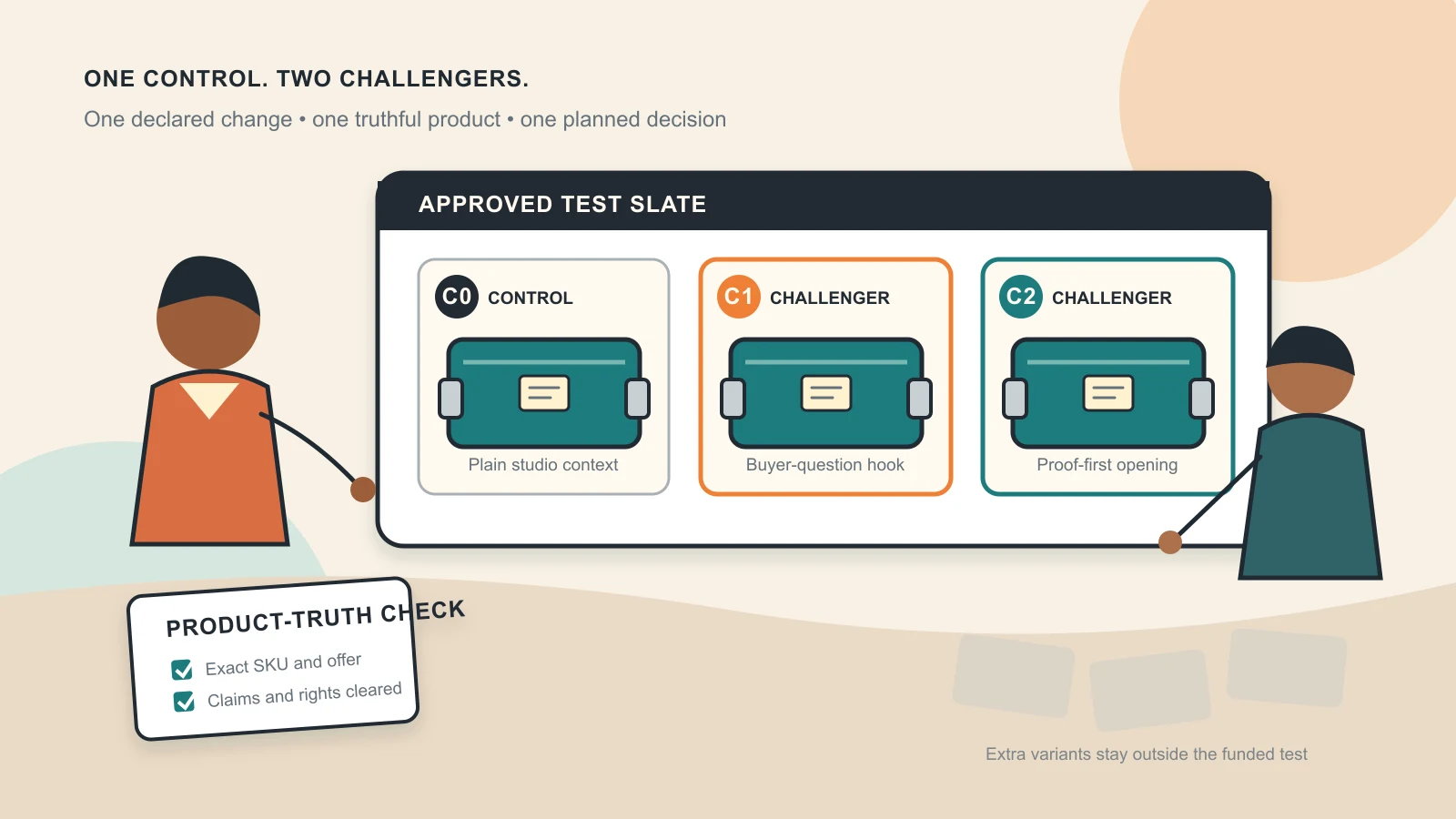
Visual disclosure: Original GPTWala editorial illustration created with AI using one fictional, unbranded product. It is not a real Ads Manager screen, client result or performance claim; the box geometry, two side latches, cream label, colour and size stay identical across C0, C1 and C2.
Reviewed and updated: 12 August 2026
To test AI ad creatives on a small budget, test fewer ideas. Start with one approved control and one or two challengers, change one declared creative factor, keep the audience, offer, destination and measurement logic stable, and write the spend cap and decision rule before launch. Reject inaccurate product images and unsupported claims before they consume media money. Judge the result by a qualified business action—not by whichever ad gets the cheapest click.
The honest result may be accepted, rejected or no decision. A low-volume test that cannot distinguish the creatives is not proof that they are equal, and it is not permission to call the highest click-through rate a winner.
This seed article begins after the AI ad creative system has produced a small set of approved concepts. It owns the testing matrix and the economics of reaching an accepted creative. The future Meta-readiness guide owns what the business must fix before spending; the ₹100/day click-to-WhatsApp guide will own that specific campaign setup and its limits; the product-business unit economics guide will own the full profitability calculation.
Table of contents
- Define what a creative test can prove
- Pass the zero-spend gate
- Choose one outcome and a metric ladder
- Write one testable creative hypothesis
- Build the small-budget testing matrix
- Choose directional screening or a controlled test
- Set budget and duration without fake universal numbers
- Run the test without contaminating it
- Read the result with four decision states
- Calculate accepted-creative economics
- Apply the framework to Indian product businesses
- Protect product truth, rights and disclosure
- Diagnose common testing failures
- Use the one-page test record
- Frequently asked questions
Define what a creative test can prove
An ad creative test is a planned comparison between approved messages or presentations for one declared business job. It is not a contest between everything AI can generate.
Use this sentence:
For [exact product and offer], will changing [one creative factor] improve [one primary outcome] for [one audience and destination], while product truth and downstream quality remain acceptable?
Examples:
- Will a real mechanism close-up produce more qualified dealer enquiries than the current pack shot for the same kitchenware SKU and offer?
- Will a buyer-question opening produce more data-sheet requests than a feature-list opening for the same industrial component?
- Will an approved real-detail jewellery image plus restrained lifestyle context produce more product-page visits than the existing plain-background image?
The conclusion belongs only to the tested context: product, offer, audience, geography, placement mix, destination, optimization goal and period. “Creative C1 was provisionally accepted for this test” is defensible. “AI lifestyle ads always work better” is not.
Screening is different from confirmation
| Test job | Question | Useful outcome | What it cannot prove |
|---|---|---|---|
| Pre-media review | Is this ad accurate, understandable, rights-cleared and technically ready? | Eligible or rejected before spend | Market response |
| Directional screen | Which approved concept deserves a cleaner comparison or more evidence? | Keep, reject or no decision | Causal lift or a universal winner |
| Controlled comparison | Did the declared change cause a credible difference under the test conditions? | Control, treatment or no decision | Future performance in every audience/period |
| Confirmation | Does a provisional result hold when repeated or exposed to the intended operating conditions? | Confirmed accept, reject or no decision | Permanent performance |
AI makes screening cheap only when rejection is cheap. Generating twenty variants and buying too little evidence for each one is not an efficient test.
Pass the zero-spend gate
Do not pay an ad platform to discover an error your product owner could see for free.
Product and offer gate
Confirm for every creative:
- exact SKU, variant, size, colour, finish and packaging generation;
- visible parts, labels, model numbers and included quantity;
- current price, tax/shipping conditions, minimum order quantity and offer dates where stated;
- stock or availability wording that the business can honour;
- destination page or WhatsApp message that matches the ad; and
- no prop, model, background or animation implying an included item or capability that is not supplied.
Use the product-accuracy checklist for AI images and the AI product-video motion-truth guide before an image or clip enters a paid test.
Claim gate
Every objective or implied claim needs a source and approved wording. Check:
- material, dimensions, capacity, compatibility and performance;
- “best”, “number one”, “waterproof”, “safe”, “instant”, “eco-friendly” or similar claims;
- before/after images and demonstrations;
- comparisons with another product;
- warranty, return, free-delivery and discount wording;
- testimonials, ratings, press badges, certifications and expert statements; and
- scarcity, countdown or “only a few left” presentation.
An AI-generated review, customer, test result, award, showroom crowd or product demonstration does not become true because it is labelled as AI.
Rights and cultural-fit gate
Record permission for product images, people, likenesses, voices, testimonials, music, typefaces, locations and supplier assets. Review Indian-language copy, clothing, gestures, household context and regional details with someone who understands the intended audience. Remove stereotypes and any synthetic person who could be mistaken for a real customer, employee, expert or endorser.
Destination and response gate
Click the actual ad destination on a phone. Confirm that:
- the product and offer match;
- the page or chat opens correctly;
- the first WhatsApp message identifies the campaign/creative;
- someone can respond during the test window;
- a qualified enquiry has a written definition; and
- the log can distinguish duplicate, spam, job-seeker, supplier and customer messages.
If the business cannot answer, qualify or record enquiries, the test measures a broken response system as much as the creative. Fix that through the WhatsApp selling system before judging ads.
Choose one outcome and a metric ladder
Start at the deepest action the test can measure reliably. Work upwards only for diagnosis.
| Level | Example measures | What it can tell you | What it cannot tell you |
|---|---|---|---|
| 0. Eligibility | Product/claim/rights/destination pass | Ad deserves media spend | Whether buyers will respond |
| 1. Delivery | Status, spend, impressions, destination errors | Whether the ad actually entered delivery | Whether the message is persuasive |
| 2. Attention | Video hold/plays, click-through rate, outbound clicks | Where people may stop or continue | Lead quality, sale or profit |
| 3. Intent | Landing-page view, catalogue open, conversation start, data-sheet click | A stronger next step than attention alone | Whether the person is a suitable buyer |
| 4. Qualified action | Dealer enquiry, exact-SKU quote request, eligible consumer enquiry, sample request, verified order | Whether the ad attracts the action named in the brief | Incrementality or long-term profitability by itself |
| 5. Economics | Cost per qualified action, contribution-aware order cost, accepted-creative cost | Whether the tested result fits a declared business constraint | That the result will persist when scaled |
Define a qualified enquiry before launch
A conversation start is not automatically a lead. A simple B2B qualification definition might require:
- business name and city;
- buyer type: retailer, dealer, distributor, institutional buyer or end user;
- product/SKU or application requested;
- quantity, minimum-order or buying timeframe; and
- a valid next step such as catalogue, sample, quotation or call.
A B2C retailer might instead require the exact item, serviceable location, purchasing question and non-duplicate contact. Use only information genuinely needed, handle it under the business’s privacy obligations and restrict access to the log.
Pick one primary decision metric
If the job is “generate qualified dealer enquiries,” the primary metric can be cost per qualified dealer enquiry. Conversation starts and clicks are diagnostics. If there are no qualified enquiries, a cheaper click is not enough to accept the creative.
Do not change the primary metric after seeing which column makes a preferred variant look best.
Write one testable creative hypothesis
AI can change hooks, images, video, layouts, models, voices, language and CTAs at once. That creates output, not learning.
Test one factor with two or three levels
| Factor to test | Control | Challenger | Keep fixed |
|---|---|---|---|
| Opening angle | Product/category statement | Buyer problem question | Product, offer, body copy, format, CTA, audience and destination |
| Evidence style | Approved pack shot | Real feature/detail proof | Headline, price/offer, layout, CTA and campaign settings |
| Format | Static image | Short video using the same approved claim sequence | Message, offer, audience, destination and measurement |
| Context | Approved neutral background | Approved lifestyle context with protected product | Product layer, claim, price, CTA and settings |
| Language | Approved English master | Reviewed Hindi or regional-language version | Meaning, product term, offer, layout logic and audience definition |
Testing two completely different ads is allowed, but call it a whole-concept screen. Its conclusion is only that one package earned a stronger signal. You cannot claim the hook caused the result if the format, product view, offer and copy all changed too.
Write a claim ledger beside the hypothesis
| Creative element | Exact statement or implication | Evidence | Allowed variation | Stop condition |
|---|---|---|---|---|
| Product image | Exact SKU and pack | Approved source master | Background/layout only | Shape, label, colour, quantity or part changes |
| Hook | Buyer problem | Recorded sales question | Question versus direct statement | Fear, certainty or outcome is exaggerated |
| Feature proof | Visible mechanism/detail | Real footage/specification | Crop or sequence | Demonstration or timing is invented |
| Offer | Current commercial terms | Approved offer sheet | None during a creative test | Price, MOQ, date, stock or inclusion differs |
| CTA | Named next action | Working page/chat | Same wording in both cells | Destination or response path differs |
Build the small-budget testing matrix
Small budgets need a narrow matrix. Begin with one control and no more challengers than the budget can expose meaningfully.
The test card
| Field | Control C0 | Challenger C1 | Challenger C2, only if supportable |
|---|---|---|---|
| Exact product/offer | Same | Same | Same |
| Audience/geography | Same | Same | Same |
| Objective/performance goal | Same | Same | Same |
| Placement logic | Same | Same | Same |
| Destination and qualification | Same | Same | Same |
| Creative factor | Current approved level | New level 1 | New level 2 |
| Product/claim QA | Pass | Pass | Pass |
| Primary metric | One shared definition | One shared definition | One shared definition |
| Media cap and time window | Pre-authorised | Pre-authorised | Pre-authorised |
| Immediate stop rules | Shared | Shared | Shared |
| Acceptance rule | Written before launch | Written before launch | Written before launch |
Choose a matrix by the decision you need
| Situation | Minimum sensible slate | Appropriate conclusion |
|---|---|---|
| No prior advertising history | One truthful baseline plus one materially different approved concept | Which concept deserves another test; expect “no decision” |
| Existing accepted control | Control plus one challenger | Whether challenger replaces, joins or loses to control in this context |
| Several AI variations of one idea | Human/product QA, then control plus the strongest one or two | Whether the idea level merits confirmation, not which tiny decoration wins |
| Multiple products and offers | Test one representative product/offer first | Workflow lesson for that case; no range-wide claim |
| Multiple languages | One approved language master versus one reviewed translation | Language-version result for that audience; not a translation-quality shortcut |
When the budget cannot support C2, delete C2. Do not reduce each cell until none can answer the question.
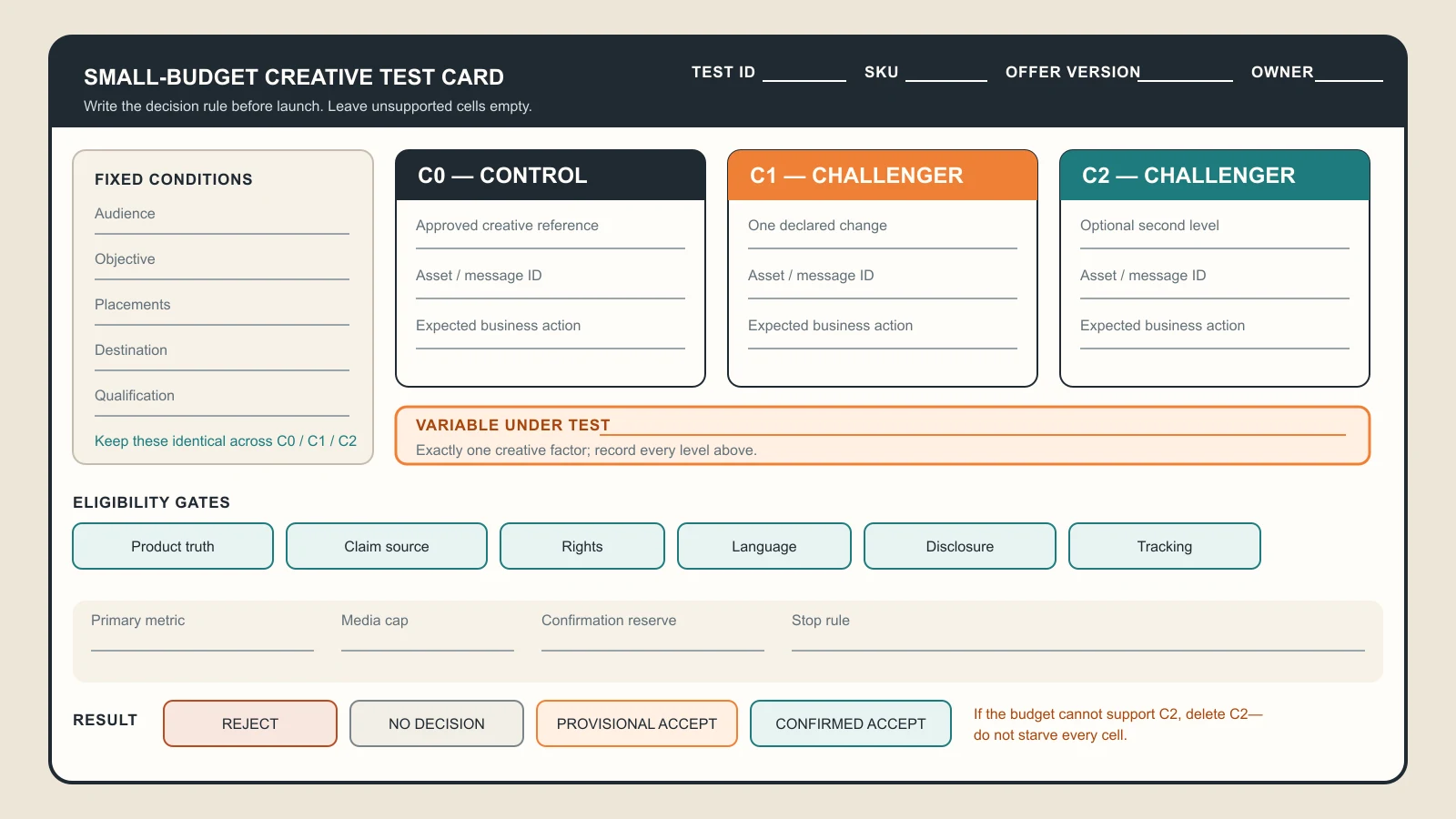
Lock the test question, fixed conditions, eligibility gates, spend cap and decision states before launch. Original GPTWala deterministic planning template; fields are intentionally blank and it shows no platform interface, spend recommendation or result.
Choose directional screening or a controlled test
The platform structure determines what you may conclude.
Mode 1: directional in-campaign screen
Place a small number of eligible ads under the same intended campaign/ad-set context and observe how they deliver. This is useful for operational screening, but do not assume the ads receive equal or random exposure.
Meta explains that its auction uses the advertiser bid, estimated action rate and ad quality, and that its delivery system learns from response data. That means ordinary co-delivery is an optimized allocation system, not automatically a clean randomized experiment. This is an inference from Meta’s explanation of how its ad auction and machine learning work.
Use this mode to decide which creative deserves a controlled comparison or whether an obvious candidate should be rejected. Label the output directional, not causal.
Mode 2: native A/B comparison
Meta’s current Ads Manager instructions include an A/B-test option at campaign setup. Availability and exact controls can depend on the account and campaign choices; check the live interface. See Meta’s current campaign-creation guide.
Use the platform’s native experiment route when the decision matters enough to require separated control/treatment exposure. Keep the declared non-creative settings aligned and do not make mid-test changes that invalidate the comparison.
Random allocation, balance and a single primary factor are core features of a defensible comparison. The US National Institute of Standards and Technology describes completely randomized designs as comparisons of levels of one primary factor randomly assigned to experimental units. See the NIST randomized-design explanation.
Mode 3: sequential screen
Running C0 this week and C1 next week is sometimes the only practical option, but auction conditions, competitors, stock, weather, paydays, festivals and buyer demand can change. Treat a sequential comparison as exploratory. If it guides an important decision, repeat the order, overlap the periods where possible or use a native controlled test.
Do not mix testing with automatic combination discovery
Some automated creative formats can mix images, text, layouts or enhancements and deliver personalized versions. That may be useful for performance, but it answers a different question from “Did C1 beat C0?”
If combinations are allowed:
- record exactly which automations are on;
- inspect generated crops, text, backgrounds and music;
- protect SKU/label/quantity/claim truth in every eligible output;
- do not attribute the result to one asset unless reporting supports it; and
- run a controlled comparison when a specific creative lesson is required.
Set budget and duration without fake universal numbers
There is no defensible rupee amount, number of days or conversion count that makes every creative test valid. Costs and signal rates vary by product, audience, objective, geography, season and auction.
Meta’s public budget guidance says there is no one-size-fits-all answer. It describes a daily budget as an average amount and a lifetime budget as the amount set for the full run, while recommending sufficient budget over at least seven days for the delivery system to learn. See Meta’s current budget and scheduling page.
That does not mean seven days guarantees an answer. Meta also has a “learning limited” delivery status for an ad set that has not generated enough results, and says performance can be less stable during learning. See Meta’s delivery-status definitions.
Build the budget from the decision backwards
Authorise four separate amounts:
- Production and review budget: assets, operator time, product review, language review, rights and corrections.
- Screening media budget: enough to detect delivery/measurement failure and obtain a directional signal.
- Confirmation reserve: money not released unless a challenger earns a cleaner test.
- Contingency: a separately approved amount for a technical rerun—not a silent extension for a preferred creative.
Use a lifetime budget or other current account control when it matches the required scheduled media cap, but monitor actual billing and all campaigns. The platform budget does not include production, review, taxes or staff cost.
Use expected signal—not hope—to size the slate
Before launch, inspect the business’s own recent data:
- typical cost and volume for the selected primary action;
- proportion of conversations that become qualified;
- product stock and response capacity;
- how many eligible audience members can realistically be reached; and
- how much loss the business has authorised for learning.
If qualified dealer enquiries historically arrive rarely, a tiny test cannot reliably rank three ads by that event. Options are:
- test one challenger against one control;
- use a higher-volume intent event only as a screen, then confirm on qualified actions;
- pool time without changing the conditions unnecessarily;
- choose a product/offer with more representative signal; or
- do not run a comparative test yet.
Prewrite stop and continuation rules
Stop immediately when:
- the product, offer, claim, price, language or destination is wrong;
- the ad is rejected or restricted and the reason is not understood;
- the wrong geography/audience or an unintended placement is receiving delivery;
- tracking, campaign tags or WhatsApp routing fail;
- response capacity is unavailable;
- the authorised spend cap is reached; or
- a rights, safety or material disclosure issue appears.
Continue to the planned review point when early differences are small and no critical failure exists. Do not pause C1 after a few expensive clicks while allowing C0 to accumulate a full period.
Record no decision when delivery, action volume or measurement is too weak. The remedy is a better-designed next test, not a stronger adjective in the report.
Run the test without contaminating it
Before launch
- Freeze the test card and give it an ID such as
A18-SKU214-HOOK-01. - Save the exact exported assets, copy, destination, audience/settings record and approval evidence.
- Confirm all cells pass product, claim, rights, language and destination review.
- Record the primary metric, diagnostic metrics, spend cap, period and decision states.
- Take a baseline export or screenshot from the account—not for publication, but for the audit trail.
- Test the enquiry/checkout path with a clearly identified internal test that will be excluded from results.
During the run
- Check delivery and critical errors, not a changing leaderboard every hour.
- Do not edit a creative, offer, audience, budget logic, destination or optimization goal inside the comparison.
- Log stock changes, outages, holidays, competitor events and sales-team gaps.
- Tag or record every inbound enquiry against the correct creative where the setup permits.
- Apply the same qualification definition without knowing which creative the reviewer prefers, where practical.
- Preserve raw platform exports and the downstream enquiry/order log.
Meta says Ads Manager activity history records who changed campaigns, ad sets and ads, what changed and when. Use it to investigate contamination rather than relying on memory. See Meta’s activity-history instructions.
After the planned window
Freeze the export before making changes. Reconcile:
- platform spend with billing;
- delivered ads with the eligible asset register;
- clicks/conversations with destination logs;
- qualified actions with the written definition;
- duplicates, spam and internal tests; and
- any product, offer or operational incident.
Do not delete the losing asset or overwrite its file. A future reviewer must be able to reconstruct what was tested.
Read the result with four decision states
“Winner” is too coarse for a small-budget test. Use four states.
1. Rejected
Reject a creative when it:
- fails product, claim, rights, disclosure or destination truth;
- cannot render safely in required placements;
- triggers unqualified response that violates the declared guardrail;
- reaches the pre-authorised decision cap without meeting the prewritten acceptance rule, and the measurement was usable; or
- loses a sufficiently informative controlled comparison under the declared rule.
Record the reason. “Bad creative” teaches less than “buyer-problem hook generated low-quality consumer chats for a wholesale MOQ offer.”
2. No decision
Use this when:
- one cell barely delivered;
- the primary action did not occur often enough to interpret;
- tracking or destination failed;
- a material setting or offer changed;
- demand conditions were abnormal; or
- diagnostic metrics disagree and the primary outcome has no usable signal.
No decision is not a tie and not a rejection. It protects the next test from false learning.
3. Provisionally accepted
A creative can enter the approved testing library when it:
- passed every zero-spend gate;
- delivered in the intended context;
- met the prewritten outcome and quality rule in a directional or limited test; and
- has no critical product, claim, destination or audience harm signal.
It can receive confirmation budget but should not yet be called universally scalable.
4. Confirmed accepted
Confirm when a stronger comparison or repeat run supports the same decision and the downstream qualified-action/economic guardrail still holds. Record the exact scope and review date.
Acceptance statement: C1 is accepted for SKU 214’s dealer-enquiry campaign, approved offer V3, the tested audience/settings and the 12–19 August window. It is not approval for other SKUs, languages, offers or platforms.
Read diagnostics as a chain
| Pattern | Likely interpretation | Next action |
|---|---|---|
| Low delivery across all cells | Setup, audience, bid/budget, review or demand problem | Do not blame creative; diagnose campaign readiness |
| Strong attention, weak intent | Hook may attract but product/offer/destination does not continue the promise | Review message match and traffic quality |
| Strong chat starts, weak qualification | Creative or routing may invite the wrong people | Tighten audience/message/qualifying path in a new declared test |
| Higher qualified-action rate, limited volume | Promising but uncertain | Reserve for confirmation; do not claim a winner |
| Cheap clicks, wrong SKU questions | Product identity or copy is unclear | Reject/repair for truth, even if CTR is high |
| Good platform result, poor sales follow-up | Creative cannot be isolated from operations | Fix response system, then retest |
Do not use one ad’s absence of spend as evidence that buyers disliked it. In an optimized delivery screen, the platform may simply have allocated fewer opportunities.
Calculate accepted-creative economics
AI reduces the cost of producing variations only when the business can approve, test and reuse them. Count the complete path from idea to accepted creative.
Keep media economics and creative-supply economics separate
Media outcome metrics describe what happened after delivery:
- cost per conversation start = media spend ÷ conversation starts;
- cost per qualified enquiry = media spend ÷ qualified enquiries;
- qualification rate = qualified enquiries ÷ eligible conversation starts; and
- cost per verified order or other deepest reliable action = media spend ÷ that action.
Use the platform’s current metric definitions and attribution settings in the export. Do not mix “all clicks”, “link clicks”, “outbound clicks” or self-calculated numbers without labelling them.
Creative-supply metrics describe what it cost to produce a usable advertising asset:
- eligible rate = creatives passing zero-spend QA ÷ creatives submitted;
- provisional acceptance rate = provisionally accepted creatives ÷ eligible creatives tested;
- confirmation rate = confirmed accepted creatives ÷ provisional accepts tested again;
- rejected media spend = media spend attributed to rejected creatives;
- inconclusive media spend = media spend attributed to no-decision creatives; and
- rework cost = attributable correction/review cost after first submission.
Cost per accepted creative
Use:
Cost per confirmed accepted creative = (attributable production + review + rights + rework + screening media + confirmation media) ÷ confirmed accepted creatives
Include human time at a consistent internal rate. Include the control’s new adaptation cost only when it was incurred for this test. Do not include unrelated brand work or ongoing campaign spend without a documented allocation rule.
If zero creatives are confirmed, do not divide by zero and do not report ₹0. Record no confirmed creative and the full amount as test-and-learning cost.
Illustrative arithmetic, not a benchmark
A fictional seller prepares three eligible ads. Attributable creation, product review and language review total ₹900; screening media totals ₹1,800. One is provisionally accepted. The cost per provisional accepted creative at that point is (₹900 + ₹1,800) ÷ 1 = ₹2,700.
If the seller then spends ₹1,200 to confirm it and the result passes, cost per confirmed accepted creative becomes ₹3,900 ÷ 1 = ₹3,900. If confirmation fails, there are zero confirmed accepts: record ₹3,900 of test-and-learning cost, not a fake cost per winner.
These amounts are deliberately hypothetical. They are not a recommendation for how much an Indian business should spend or evidence of likely performance.
Acceptance still needs an affordability ceiling
A creative may be the best in the test and still be unaffordable. Before testing, obtain a provisional maximum cost for the qualified action or order from the business’s own margins, fulfilment costs, return/cancellation pattern and lead-to-sale rate. The unit-economics guide owns that calculation.
If the ceiling is unknown, the test can rank concepts directionally but cannot prove commercial acceptance.
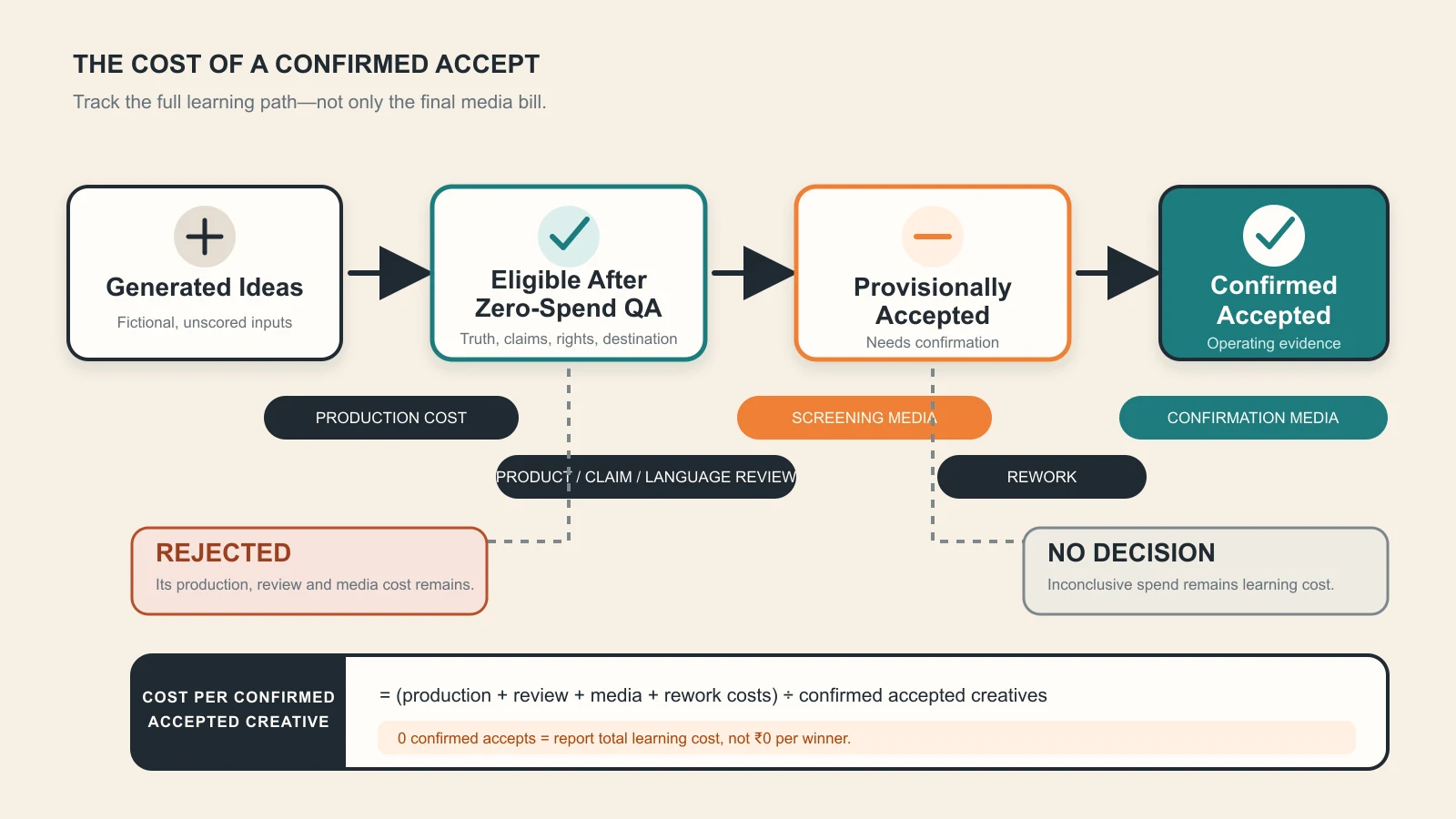
Measure the complete path to a confirmed accepted creative; rejected and inconclusive spend is part of the learning cost. Original GPTWala deterministic flow—not a dashboard, benchmark or claimed campaign result.
Apply the framework to Indian product businesses
The scenarios below are fictional operating examples. They are not GPTWala client results, regional market claims or recommended budgets.
Surat saree wholesaler: qualify dealers, not chat starts
The business has one approved control showing the exact saree, blouse-piece inclusion, colour code and wholesale MOQ. C1 changes only the opening from a generic collection statement to a buyer question about repeatable colour availability. The product images, offer, audience, placements, destination and CTA stay fixed.
Primary outcome: qualified dealer enquiries that provide business city, buyer type, requested quantity and next step. Conversation starts are diagnostic. Reject the ad if AI changes the border, weave, colour, drape or included piece—even if it earns cheaper chats.
Rajkot kitchenware manufacturer: test proof against presentation
C0 uses an approved pack shot. C1 uses real footage of the exact latch or lid mechanism with the same headline, offer and dealer-enquiry path. The hypothesis is that verified feature proof earns more qualified requests than presentation alone.
Do not use generated movement to show closure, heating, pressure, timing or safety. If the creative test changes both the mechanism proof and the commercial offer, it cannot tell the manufacturer what caused the response.
Jaipur jewellery retailer: context may not replace evidence
C0 uses an approved real macro image. C1 keeps the protected real product layer and adds a clearly contextual festive setting. Both show the same SKU, stone arrangement, metal colour, scale logic, price/terms and destination.
A creative cannot be accepted if the scene adds stones, increases sparkle into an implied quality claim, changes the clasp or suggests a real model endorsement without permission. Use the AI jewellery product-truth checklist for source approval.
Coimbatore component manufacturer: measure a buying action
C0 opens with the exact part number and application. C1 opens with a verified buyer problem; the specification block and data-sheet destination remain identical. The primary action is a qualified data-sheet or quotation request for that part—not a video view or general “interested” message.
Technical suitability, compatibility, capacity and certification wording come from current approved documents. A high-click ad that sends buyers to the wrong component fails.
Local homeware retailer: one offer, one service area
The retailer wants to compare a product-only control with an in-home contextual version. Both creatives must show the same current item, pack contents, price conditions, delivery area and WhatsApp path. If C1 uses a generated room, the product’s size and included props must remain unambiguous.
Orders outside the service area are not qualified outcomes. The test should not reward a beautiful creative for demand the business cannot serve.
Protect product truth, rights and disclosure
Paid testing does not relax the truth standard. It increases the cost and reach of a mistake.
India’s advertising baseline
The Central Consumer Protection Authority’s 2022 guidelines address misleading advertisements and endorsements. The ASCI Code says advertisements should not mislead through statements or visual presentation by implication, omission, ambiguity or exaggeration. See the Department of Consumer Affairs’ official CCPA guidelines page and the ASCI Code.
For every test cell:
- show the sellable product and current offer;
- substantiate objective and implied claims;
- do not fabricate results, demonstrations, testimonials or endorsements;
- keep material conditions readable and close to the claim;
- make AI context subordinate to exact product evidence; and
- obtain category-appropriate review for regulated, safety-critical or high-consequence claims.
This is practical editorial guidance, not legal advice.
Current AI-ad transparency needs a freshness check
Meta’s official ads-transparency update, revised 1 June 2026, says “AI info” appears for ads created or significantly edited with its generative-AI creative tools and that Meta is beginning to detect third-party AI creation/editing through industry-standard signals, with regional variation possible. See Meta’s GenAI ads-transparency update.
Do not remove provenance signals to evade a label. Record the source, tool/model, changes, permissions and disclosure decision for each creative. Recheck the current account interface and destination rules on upload day.
ASCI released draft AI advertising guidelines for stakeholder consultation in May 2026. They were still treated as draft material when this guide was reviewed; do not cite them as a final binding code. Check their status before launching or updating a campaign.
Meta reviews more than the picture
Meta says ad review may examine the image/video, text, targeting and destination, and notes an additional thread-level checkpoint for ads that click to message. See Meta’s ad review and policy guide.
Passing review is not proof that the product, claim or economics are correct. An advertiser remains responsible for its creative and destination.
Diagnose common testing failures
| Failure | Why it wastes a small budget | Repair |
|---|---|---|
| Twenty AI variants enter together | Each gets little or uneven evidence; review cost is hidden | QA offline and test one control plus one or two challengers |
| Every element changes | No causal lesson | Name it whole-concept screening or rebuild a single-factor comparison |
| No accepted control | There is no trustworthy baseline | Create a truthful baseline and test destination first |
| CTR becomes the winner rule | Attention is mistaken for qualified demand | Predeclare the deepest reliable outcome and keep CTR diagnostic |
| The “loser” barely spent | Absence of delivery is treated as rejection | Use no decision or a controlled allocation |
| Budgets/settings change mid-run | Treatment and conditions become entangled | Freeze; stop and relaunch with a new test ID if material |
| AI alters the SKU | Performance rewards a product the seller does not supply | Reject before spend; protect exact product layers |
| Sales team changes qualification | Downstream outcome is inconsistent | Use a written rubric and blinded review where practical |
| One festival week becomes evergreen proof | Time/context effect is ignored | Record conditions and repeat before broad rollout |
| Platform review is treated as compliance | Automated acceptance replaces business responsibility | Run product, claim, rights and category review separately |
| No-decision cost is hidden | Testing looks cheaper than it was | Track inconclusive spend and total cost per accepted creative |
| “AI winner” is copied to every SKU | Variant-specific evidence is overgeneralised | Retest representative risk classes; do not clone blindly |
Never change the product to improve the metric
If the inaccurate version earns more clicks, the lesson is not “use more AI”. It may be that buyers prefer a feature, finish or price you do not offer. Feed that insight to product/merchandising; do not advertise the fiction.
Use the one-page test record
Keep one record for every comparison. A spreadsheet is enough if the fields are controlled.
Identity
- test ID, owner and dates;
- exact SKU, variant and offer version;
- campaign/ad set/ad IDs;
- audience, geography, objective, performance goal and placement logic;
- destination and response owner; and
- source-control creative ID.
Hypothesis and method
- buyer problem and intended action;
- one factor and its levels;
- directional, native A/B or sequential mode;
- what remains fixed;
- primary and diagnostic metrics;
- qualification definition;
- media cap, confirmation reserve and review point; and
- immediate stop rules.
Eligibility
- product-truth approval;
- claim sources and approved wording;
- offer/price/stock check;
- rights and release check;
- language/cultural review;
- AI/provenance/disclosure decision;
- destination and tracking test; and
- ad-category or specialist review, if required.
Result
- exported platform data and attribution setting;
- qualified-action log and exclusions;
- spend by cell;
- product, claim, response or tracking incidents;
- result state: reject, no decision, provisional accept or confirmed accept;
- exact acceptance scope;
- total production/review/media/rework cost; and
- next test or stop decision.
A complete small-budget learning loop
- Produce one approved control and one challenger.
- Reject untruthful or weak assets offline.
- Define one primary outcome and qualification rule.
- Choose screening or controlled comparison.
- Authorise media and confirmation separately.
- Run without material mid-test edits.
- Reconcile platform and business records.
- Classify the result honestly.
- Confirm only the promising candidate.
- Add the accepted creative and lesson to the library with its scope/date.
NIST’s experimental-design handbook notes that a planned sequence of small experiments is often better than relying on one large experiment for a complete answer. See its practical DOE steps. For a product business, each loop should buy one useful decision, not a decorative dashboard.
Connect testing to the wider growth system
A tested creative is only one component. It still needs an online presence buyers can trust, accurate product content, a working enquiry path, prompt follow-up and economics that allow paid distribution.
If your manufacturer, wholesale, retail, shop or product-brand business still depends heavily on walk-ins, exhibitions, dealer calls or forwarded catalogues, GPTWala’s workshop explains the DAA path: Digital Presence → AI Content Creation → ₹100/day WhatsApp ads. The workshop connects content to an enquiry system; it does not guarantee leads, sales or return on ad spend.
See the GPTWala workshop and decide whether the DAA approach fits your product business.
Frequently asked questions
How many AI ad creatives should I test on a small budget?
Test only as many as can receive meaningful evidence. For a genuinely small budget, begin with one approved control and one challenger; add a second challenger only when the budget, audience and expected action volume can support it. More generated variants do not create more learning when most barely deliver.
How much should I spend on each creative?
There is no universal amount. Work backwards from your own action volume, provisional affordable cost, loss tolerance and the platform’s current budget controls. Separate production/review, screening media and confirmation reserve. A title or competitor’s fixed rupee/dollar rule is not evidence for your product.
How long should an ad creative test run?
Run through the predeclared window or evidence rule unless a critical stop condition occurs. Meta currently recommends sufficient budget over at least seven days for its delivery system to learn, but seven days does not guarantee an interpretable result. Low action volume may still produce no decision.
Should I test several ads in one Meta ad set?
That can be useful for a directional screen, but do not assume equal or randomized delivery. For a decision that requires a causal comparison, use the current native A/B option when eligible and keep the non-creative conditions aligned.
What should stay fixed in a creative test?
Keep the exact product, offer, audience/geography, objective, optimization goal, placement logic, destination, tracking and qualification rule fixed. Change the declared creative factor. If several elements change, label it whole-concept screening and limit the conclusion.
Is the ad with the highest click-through rate the winner?
Not necessarily. CTR is an attention diagnostic. A product business usually needs a qualified enquiry, data-sheet request, order or another deeper action. A high-CTR ad that attracts the wrong buyer or shows the wrong product should be rejected.
What if one creative receives almost no spend?
Record no decision for that cell in an optimized screen. Lack of delivery is not proof of dislike. Use a controlled test, narrower slate or better-supported next comparison if the decision matters.
Can I use AI-generated product images in a paid test?
Only after exact-SKU, claim, rights, disclosure and destination review. Protect labels, geometry, colour, quantity and included parts. Use real capture when fit, movement, texture, scale, function, safety or performance is material to the buying decision.
What is cost per accepted creative?
It is total attributable production, review, rights, rework, screening media and confirmation media divided by the number of confirmed accepted creatives. If none are accepted, report the total learning cost and zero accepts; do not manufacture a cost-per-winner number.
When should I scale an accepted creative?
Only after it passes product/claim/rights review, meets the predeclared qualified-action and affordability guardrails, and survives appropriate confirmation. “Accepted” applies to the tested context and date. Scaling budget, audience or offer creates a new operating condition that still needs monitoring.
Sources checked for this guide
- Meta Help: Create ad campaigns in Meta Ads Manager
- Meta for Business: Budgets, costs and schedules
- Meta Help: Campaign, ad set and ad delivery status
- Meta Help: How Facebook ads use machine learning
- Meta Help: Ads Manager activity history
- Meta for Business: Ad review, policy and support
- Meta Newsroom: Expanding GenAI transparency for ads, updated 1 June 2026
- NIST/SEMATECH e-Handbook: Completely randomized designs
- NIST/SEMATECH e-Handbook: Steps of design of experiments
- Department of Consumer Affairs: Guidelines for Prevention of Misleading Advertisements and Endorsements for Misleading Advertisements, 2022
- Advertising Standards Council of India: The ASCI Code
- ASCI: Draft Guidelines for Responsible Labelling of Synthetically Generated Content in Advertising, May 2026
Leave a Reply