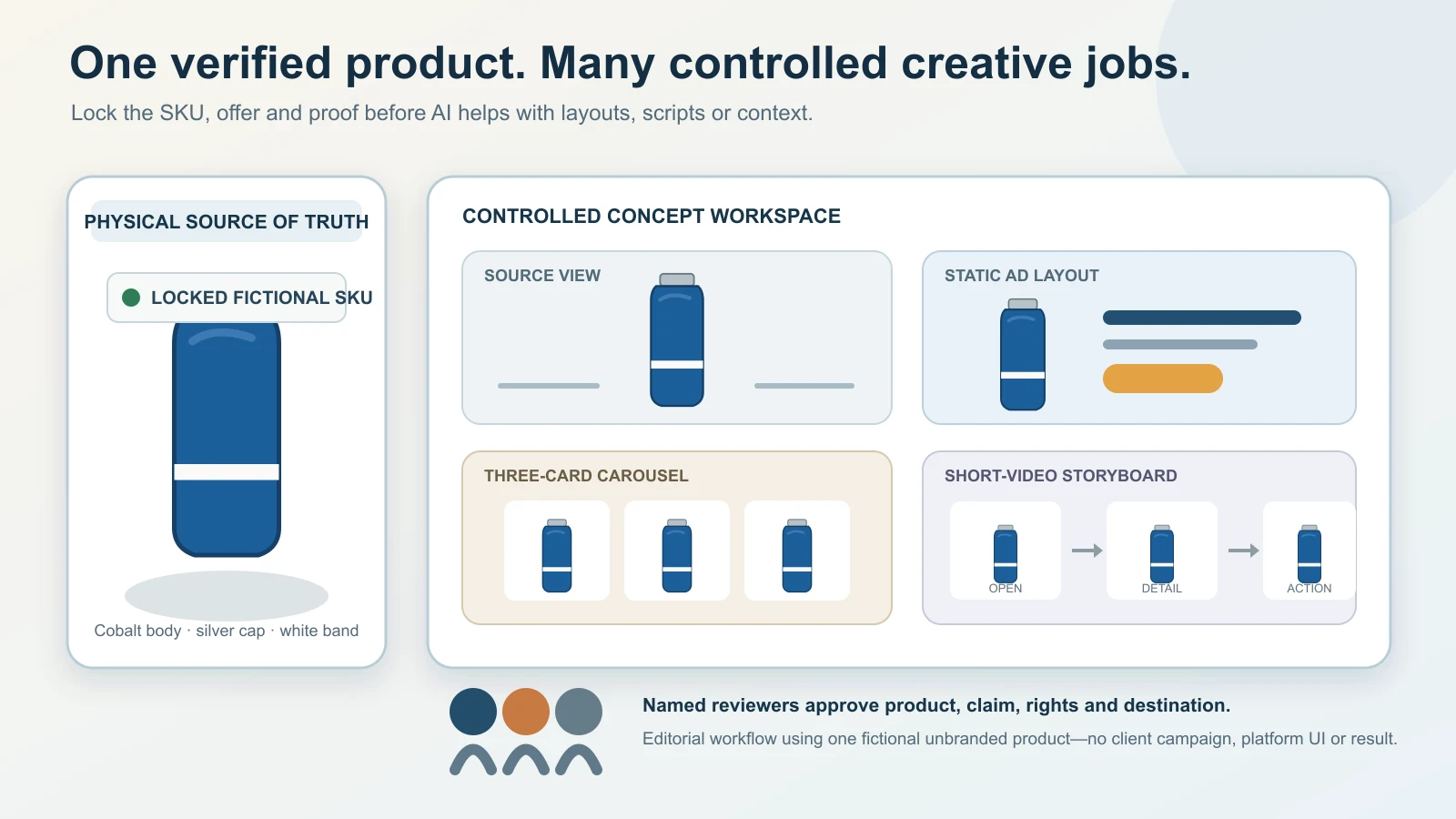
Reviewed and updated: 12 August 2026
Editorial disclosure: no advertisement, AI generator, campaign, seller account or commercial result was tested for this article. The framework, examples and checklists are GPTWala editorial guidance. Current platform and advertising sources support only the factual claims attributed to them.
An effective AI ad creative starts with one exact product, one verified offer and one buyer decision. Use AI to explore angles, layouts, scripts, backgrounds and format versions, but lock the SKU, claims, price, quantity, rights and destination. Give every concept a creative contract, compare every generated asset with approved product evidence, and reject anything that invents proof, customers, performance or urgency. AI can accelerate production; it cannot approve the promise.
Table of contents
- What is an AI ad creative?
- Begin with a creative contract
- Give each creative one buyer job
- Choose the right creative use case
- Build five controlled creative layers
- Choose a format that fits the evidence
- Use AI in green, amber and red lanes
- Create angles without inventing claims
- Run product, offer and claim gates
- Build the creative production system
- Apply it to Indian product businesses
- Prepare the channel-ready release pack
- Know what A17 does not own
- Run the final preflight
- Frequently asked questions
What is an AI ad creative for a product business?
An ad creative is the communication a buyer sees: the product visual or video, headline, supporting copy, proof, offer, brand and call to action. AI may help produce some or all of those elements. That does not make the AI output the strategy, the evidence or the approved advertisement.
For a product business, a useful equation is:
Verified product + buyer problem + supported message + appropriate format + truthful offer + working destination = an ad creative candidate
“Candidate” matters. The file is not ready because it looks professional or because an ad tool exported it. It becomes releasable only after product, claim, rights, channel and destination review.
What AI can contribute
AI can help a small product team:
- turn a structured brief into several concept directions;
- draft headline and script options for human review;
- arrange approved product layers into layouts;
- create controlled contextual backgrounds;
- convert an approved concept into static, carousel and video storyboards;
- create crop and language candidates;
- generate captions or rough voice tracks;
- organise a creative library; and
- identify fields that are missing from a brief.
It should not decide whether a claim is true, whether a price is current, whether a testimonial is genuine, whether an imagined use is safe or whether a generated person has permission to endorse the product.
Meta’s current Business AI terms warn that outputs may be inaccurate, incomplete, misleading or inappropriate and place responsibility for checking commercial outputs on the user. That is a provider-specific term, but the operating principle is universal: human reviewers own the advertisement.
The creative is a promise to the destination
If the ad says “dealer price list,” the click or WhatsApp reply must lead to a current dealer path. If it says “set of six,” the product page and sales team must offer six. If it shows a red variant, that variant must be identifiable and available under the stated terms.
Meta’s current ad-review overview says review can consider the image, video, text, targeting and destination such as a website or landing page. Passing review is not proof that the product or claim is accurate. It is a separate platform decision. Build the creative and destination as one promise even when different people own them.
Begin with a creative contract, not a prompt
Write one contract before generating concepts. A one-page table is enough.
| Field | Question to answer | Acceptable evidence | Stop condition |
|---|---|---|---|
| Exact product | Which SKU, child variant, pack and revision appears? | Physical sample, approved product record and approved visual master | Team cannot identify the exact sale item |
| Buyer | Who is making which decision? | Sales notes, enquiry patterns, interviews, site/search data or an explicit initial hypothesis | Audience is only “everyone” |
| Buyer problem | What question or friction does this ad address? | Real customer/dealer question or clearly labelled hypothesis | Problem is invented to make a dramatic ad |
| Message | What single idea should the viewer remember? | Product record plus approved positioning | Multiple unrelated promises compete |
| Claim | Which factual statement is made or implied? | Dated substantiation and named owner | Evidence is missing, stale or for another variant |
| Proof unit | What visible fact supports the message? | Real demo, detail, measurement, verified record or genuine testimonial | Generated scene is the only “proof” |
| Offer | What exactly can the buyer receive, at what stated terms? | Current price/quantity/availability/eligibility record | Sales team or destination cannot fulfil it |
| Format | Why static, carousel, video, catalogue or presenter? | Evidence and message complexity | Format requires product behaviour not captured |
| Destination | Where does the click or enquiry go? | Working URL, landing page, catalogue or owned WhatsApp route | Path is broken, mismatched or unstaffed |
| Rights/disclosure | Can every asset, person, voice, logo, review and reference be used? | Permission, licence, release and current disclosure review | Rights or identity are unclear |
| Owner/version | Who approves and which file is current? | Named product, marketing and channel owners | No one can revoke or update the creative |
This contract prevents a common failure: generating twenty attractive designs around an offer that was never approved.
Use a claim ledger beside the creative contract
A claim ledger can be one row per factual statement:
| Proposed claim | Claim type | Evidence and date | Qualifier/conditions | Owner | Allowed until |
|---|---|---|---|---|---|
| “Available in three sizes” | Range fact | Current SKU register | List exact current sizes | Catalogue owner | Next range update |
| “Free delivery in Jaipur” | Offer/price term | Written delivery policy | Eligible pincodes, minimum order and end date | Sales owner | Campaign end |
| “Fits Model X” | Compatibility | Approved fit record/test | Exact version and exclusions | Product/engineering owner | Product revision |
| “Handmade” | Process/origin | Supplier/process record | Define relevant component/process | Product owner | Supplier change |
| Customer quotation | Endorsement | Permission and source message | Do not change meaning; identify relationship if required | Marketing/legal owner | Permission expiry |
Leave the row blank if evidence does not exist. Do not ask AI to fill it.
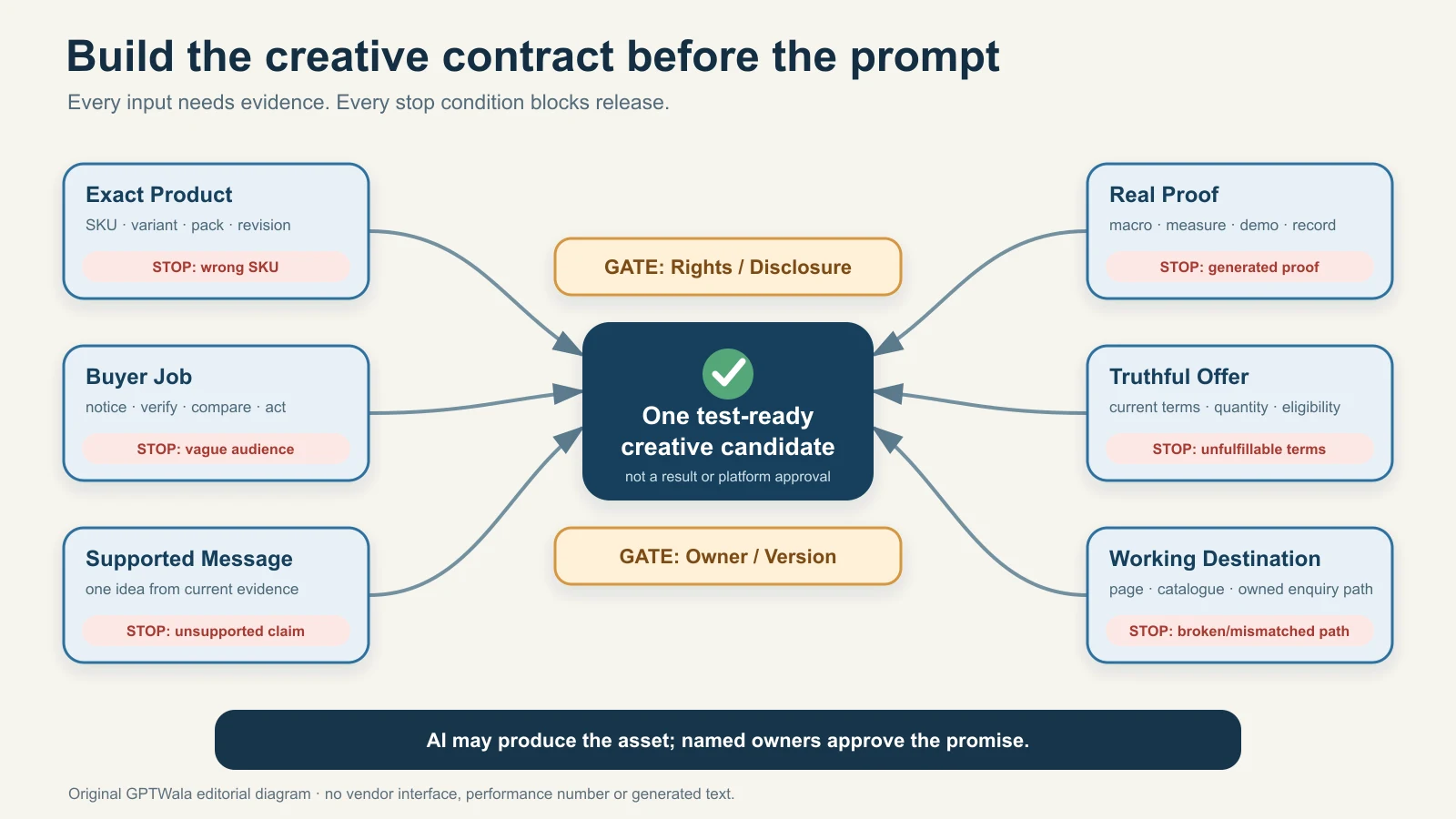
Original GPTWala creative-contract system. Every input has an explicit stop condition; AI may produce the asset, but named owners approve the promise.
Give each creative one buyer job
An ad can make a buyer notice, understand, verify, compare or act. Trying to do all five in one frame usually creates tiny text and an unclear promise.
| Buyer job | Useful creative question | Strong proof unit | Appropriate next action |
|---|---|---|---|
| Notice | Is this relevant to my problem or context? | Recognisable situation plus exact product | Learn more or view range |
| Understand | What is it and what does it do? | Product identity, one feature and a truthful use | View details or watch demo |
| Verify | Is a key concern answered? | Real macro, measurement, process, material or included-parts view | See proof page or ask a precise question |
| Compare | Which verified option fits me? | Same-basis comparison of the seller’s real variants | Choose variant or request specification |
| Enquire/buy | What is offered now and what should I do? | Exact product, terms and clear fulfilment path | Visit product page or start WhatsApp enquiry |
| Return | Why should a known buyer consider another product or repeat order? | Relevant range, refill, compatible accessory or current offer | Reorder, view additions or contact sales |
The job is not the ad-platform objective. It is the communication task. A campaign may have its own objective and optimisation settings; Meta ads readiness is a separate decision.
Write the one-sentence creative proposition
Use this form:
For [specific buyer] who needs [specific outcome or answer], show [exact SKU or range] with [one supported message], prove it using [real evidence], and invite [one next action].
Example:
For small sweet-shop owners comparing takeaway boxes, show the exact 500 ml food-container SKU with its real lid and pack quantity, prove the dimensions and included quantity from approved records, and invite them to request the current wholesale price list.
This is a brief, not a performance promise.
Choose the right AI ad creative use case
The safest concept depends on what the business can prove.
| Use case | Core creative idea | Evidence required | Good AI role | Avoid |
|---|---|---|---|---|
| Product/range introduction | “Here is the exact product or range” | Approved main images and current variants | Layout, background, crops, copy drafts | Invented variants or range count |
| Problem-to-product | “This product is relevant to this situation” | Documented use and accurate constraints | Illustrative context around retained product | Fake failure, unsafe scenario or guaranteed result |
| Feature-to-benefit | “This feature may help with this job” | Exact feature plus substantiated benefit | Diagram, headline options, motion graphics | Turning a feature into unsupported performance |
| Detail/proof | “Inspect this important buying field” | Real macro, measurement, demo or record | Native callouts, sequencing, clean layout | AI-sharpened fake detail |
| Variant comparison | “Choose among these real options” | Same-basis approved images and data | Comparison grid and readable labels | Comparing mismatched angles or omitting conditions |
| Process/origin | “See how it is made or sourced” | Real process footage/records and permissions | Script, captions, edit plan | Synthetic factory or artisan presented as real |
| Offer/availability | “This specific offer is available under these terms” | Current price, stock, dates and eligibility | Native offer card and versions | False scarcity, hidden charges or fake crossed-out price |
| Dealer/B2B enquiry | “Ask for the specification, range or price list” | Product data, MOQ/territory/lead-time owner and response path | Multi-product layout, localisation, lead card | Claiming dealership availability without sales confirmation |
| Customer proof | “A real buyer reports a real experience” | Genuine permission, complete context and current relationship | Transcript cleanup or authorised edit | Invented review, synthetic customer or changed meaning |
| Seasonal/contextual | “Use the product in this relevant occasion” | Accurate product, offer and non-deceptive context | Scene ideation and controlled background | Cultural stereotype, unsupported gifting contents or fake stock urgency |
AI can generate a scene that looks like evidence. That does not make it evidence. A synthetic workshop cannot prove “handcrafted,” and a generated spill cannot prove “leakproof.” Keep proof real and context identifiable as presentation.
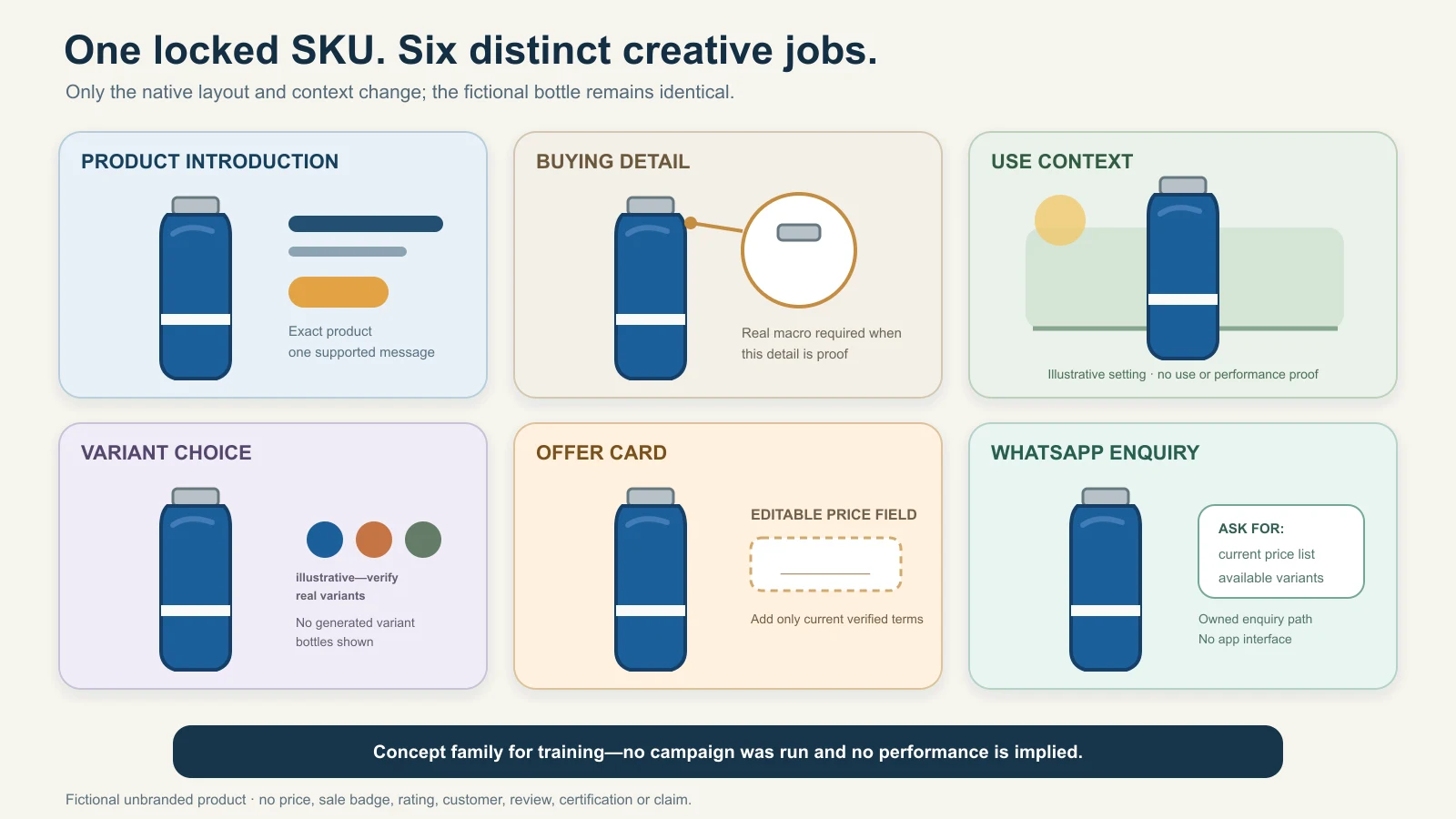
Original GPTWala one-SKU concept family using the same fictional bottle in every panel. The swatches are illustrative, the price field is blank, and no campaign, result, customer, review or platform test is implied.
Build five controlled creative layers
Treat the ad as layers with different freedom.
1. Product layer: locked
Start from an approved exact-SKU image, video or verified 3D asset. Lock:
- silhouette, proportions and functional geometry;
- colour, pattern, material, finish and meaningful reflections;
- labels, logos, marks and printed text;
- variant, pack quantity and included components;
- fit, drape, settings, ports, holes and accessories; and
- scale wherever the scene affects the buying decision.
Use the AI product-image accuracy checklist before an image enters ad production. Use the AI product-video guide before motion becomes proof.
2. Context layer: controlled
AI may help create a room, surface, atmosphere or seasonal setting around the retained product. The context must not imply an unverified use, compatibility, location, ingredient, included prop or scale.
Use the AI product-background guide for the full source-to-composite workflow. For an ad, add one question: What claim does this scene make before anyone reads the copy?
3. Message layer: substantiated
The headline should communicate one supported idea. Avoid words such as “best,” “No. 1,” “guaranteed,” “instant,” “100%,” “eco-friendly,” “chemical-free,” “waterproof,” “clinically proven” or “free” unless current evidence and conditions justify the exact phrase.
ASCI’s current code says objective claims should be capable of substantiation and visual presentation must not mislead through implication, omission, ambiguity or exaggeration. ASCI is a self-regulatory organisation, not a government body; category-specific legal review may still be needed.
4. Proof layer: real or clearly qualified
Proof can be:
- a real product detail;
- measured dimensions;
- a real demonstration under recorded conditions;
- accurate included-parts or quantity view;
- a dated certification or test claim that the product owner is authorised to use;
- a genuine customer/dealer statement with permission; or
- a transparent explanation of material, process or compatibility.
Do not use an AI avatar as a fake customer. Do not generate a star rating. Do not create a “lab” or “expert” scene to borrow authority. If a claim depends on the disclaimer to become true, rewrite the main claim.
The Government of India’s 2022 CCPA guidelines set conditions for non-misleading advertisements and address bait/free claims, duties and endorsements. The Department’s annual report summarises an important disclaimer principle: a disclaimer should not hide material information or try to correct a misleading claim. This guide is operational advice, not legal advice.
5. Action layer: fulfilable
The call to action should match the next step:
- View exact specifications
- See available colours
- Request the current wholesale price list
- Check delivery for your pincode
- Ask about dealer availability
- Open the product page
- Start a WhatsApp enquiry
Avoid “Buy now” if the click opens a generic homepage, “Get quote” if nobody owns replies, or “Limited stock” without current stock evidence. The creative is not complete until the post-click or post-message experience can fulfil the instruction.
Choose a format that fits the evidence
Choose format after the message and proof unit.
| Format | Best when | Evidence burden | AI can help | Main stop rule |
|---|---|---|---|---|
| Static product card | One product, message and action are enough | Approved product layer, accurate copy and offer | Layout, background, native copy variants, crop plan | Product or text becomes too small to verify |
| Detail-led static | One buying concern needs proof | Real macro/measurement and exact caption | Callouts and hierarchy | Generated detail is treated as proof |
| Carousel | Buyer needs a sequence or same-basis variant comparison | One verified role per card and consistent mapping | Storyboard, layout system and captions | Cards mix variants or hide comparison conditions |
| Short demo video | Real action or several proof views explain the product | Approved footage/stills, script and frame review | Edit plan, captions, cutdowns, simple graphics | Generated motion invents function or timing |
| Founder/expert explainer | Trust depends on accountable human explanation | Real speaker, verified script and consent | Outline, captions and edits | Script exceeds speaker evidence or expertise |
| Synthetic spokesperson | Language/format scale is useful and context permits it | Likeness/voice rights, disclosure and line-by-line fact review | Presenter and localisation candidate | Avatar implies a real customer, expert or endorser |
| Customer/creator-style ad | A genuine user perspective is the proof | Real participant, permission and unaltered meaning | Transcript, edit structure and authorised versions | Person or experience is fabricated |
| Range/catalogue card | B2B buyer needs options at a glance | Exact SKU mapping and readable distinctions | Grid generation and derivative layouts | Variants are invented or merged |
For stills-to-video production, use the product demo video tutorial. For synthetic presenters, use the AI spokesperson product-video guide when it is live. A format choice does not lower the evidence standard.
Build for actual placements, not one universal canvas
Create a clean master, then make deliberate derivatives for the placements available in the live account. Meta’s current Ads Manager guidance separates the ad level—format, images/video, text and links—from campaign and ad-set decisions, and notes that available options can vary by objective and setup.
Do not hard-code a 2026 size table into a long-lived operating system. Check the current interface and placement documentation, protect product edges and readable qualifiers, and preview every derivative. Automated crop or enhancement is a candidate, not an approval.
Use AI in green, amber and red lanes
Green: low product-truth freedom
Good early uses include:
- organise the creative contract;
- turn verified facts into headline drafts;
- storyboard approved product stills;
- remove an outside background while retaining real product pixels;
- create native layout alternatives;
- resize and crop from an approved master;
- draft captions and subtitle timing;
- translate for review by a qualified speaker; and
- create non-claiming decorative elements.
Green does not mean automatic approval. Copy, translation, crop and export can still introduce errors.
Amber: plausible but review-heavy
Use extra controls for:
- generated lifestyle or installed scenes;
- synthetic models wearing apparel or jewellery;
- image-to-video movement;
- synthetic presenters and voices;
- customer-style scripts;
- comparative layouts;
- multilingual dubbing;
- product outpainting; and
- automated creative enhancements inside an ad platform.
Amber assets need product, context, rights, disclosure and destination review. Meta currently applies or is rolling out AI information for ads created or significantly edited with its generative creative tools and, in a June 2026 update, described broader detection of third-party AI signals for its “About this ad” surface. The experience may vary by region. Check the live account and current policy; do not guess the required disclosure from this article.
Red: do not generate as commercial evidence
Stop if the workflow asks AI to create:
- a product variant that does not exist;
- an unseen product feature, label, mark or pack quantity;
- a fake customer, review, rating, unboxing or testimonial;
- a synthetic artisan, factory, farm, laboratory or store presented as real;
- a before/after result that was not observed;
- a competitor comparison without evidence and permission review;
- false scarcity, crossed-out price or “free” offer;
- safety, compatibility, certification or performance proof;
- an unauthorised celebrity, creator, employee, customer, logo, voice or style; or
- a photorealistic event presented as something the business actually did.
The red lane is not cured by small text saying “AI generated.” Disclosure does not make a false product or claim true.
Create ad angles without inventing claims
An angle is the lens through which one verified product fact becomes relevant to one buyer. It is not a licence to invent pain, proof or urgency.
Start from six evidence-backed angle families
| Angle family | Starting question | Product-business example | Evidence needed |
|---|---|---|---|
| Buying-detail | Which field blocks the decision? | “See the real clasp and measured drop” | Exact macro and measurement |
| Use-case | In which verified situation is this relevant? | “A compact organiser for this drawer size” | Dimensions and accurate context |
| Choice | Which real variant is right for whom? | “Matte or satin finish?” | Same-basis images and current variants |
| Process | What real making/sourcing step matters? | “Cut and stitched in our recorded unit” | Real footage/records and rights |
| Offer | What can the buyer receive now? | “Pack of 12, request current wholesale price” | Quantity, terms, stock/availability owner |
| Objection | Which honest concern can we answer? | “Will this connector fit Model X?” | Compatibility record and limitations |
Write at least one “do not imply” line for each concept. Example: “Show the organiser in a drawer; do not imply that other objects are included or that it fits every drawer.”
Research competitors without copying them
Meta’s Ad Library lets people search active ads running across Meta products. Use it to observe category language, proof patterns, common formats and gaps. An active ad is not evidence of profitability or quality; that is an inference from the library’s stated scope, which exposes current activity rather than ordinary advertisers’ outcome data.
Record patterns, not assets:
- buyer question addressed;
- format and sequence;
- type of proof shown;
- offer clarity;
- destination promise;
- common omission; and
- opportunity to be more useful or truthful.
Do not clone a competitor’s layout, copy, slogan, music, creator, characters or distinctive visual identity. ASCI’s fair-competition section also warns against advertisements so similar in layout, slogans, visuals, music or sound that they suggest plagiarism.
Separate ideation from production
Ask AI for contrasting concepts, not dozens of finished files. A practical concept card includes:
- buyer and buyer job;
- one message;
- one proof unit;
- format and opening frame;
- exact product asset IDs;
- offer and CTA;
- claim-ledger rows used;
- risk/“do not imply” line; and
- owner decision: produce, revise or reject.
Producing three genuinely different concept cards is more useful than producing thirty near-identical colour changes. A18 owns how to test them with a small budget; A17 stops at approved, testable creative candidates.
Run the product, offer and claim gates
Product gate
Compare every final candidate with the physical SKU, approved master and product record. Check:
- exact variant and revision;
- shape, colour, material, pattern and finish;
- label, logo, mark and product text;
- count, pack and included components;
- size, fit, drape and installed scale;
- function/motion shown; and
- file-to-SKU mapping.
If a candidate fails, use the AI product-photography troubleshooting checklist rather than patching until the defect is hard to see.
Offer gate
Read the ad without the design file open. Ask:
- Is the pictured product the offered product?
- Is the stated price current and does it need conditions?
- Are taxes, delivery, minimum order, geography, end date or eligibility material?
- Does “free” have a real, documented meaning?
- Is stock or scarcity current, owned and updateable?
- Does the destination repeat the same offer?
- Can sales staff answer the enquiry correctly?
Never place an offer inside generated product packaging. Keep price, terms and CTA as editable native text so a change does not require regenerating the SKU.
Claim and visual-impression gate
Check both the copy and what the scene implies:
| Creative element | Possible implied claim | Required check |
|---|---|---|
| Water beads on product | Water resistance/waterproofing | Exact tested claim and conditions, or remove |
| Heavy load/impact | Durability or load capacity | Verified test/product record and safe depiction |
| Sparkle/glow | Material, purity, efficacy or performance | Remove if it changes product meaning |
| Person in uniform/lab | Expert approval or testing | Real identity, permission and substantiated role |
| Factory/farm/artisan | Origin, process or employment | Real authorised evidence; no synthetic documentary claim |
| Many boxes/queues | Popularity, stock, production scale or demand | Do not manufacture social proof through scene volume |
| Timer/instant transition | Speed or immediacy | Recorded conditions and accurate qualifier |
| “Only today” badge | Scarcity or deadline | Current documented end time and update owner |
Keep the main claim honest on its own. A disclaimer can clarify limits; it should not reverse the headline.
Rights, people and authenticity gate
Confirm rights for:
- product photography and uploaded source material;
- logos, fonts, packaging artwork and certification marks;
- music, voice, stock footage and sound effects;
- customer messages, reviews and case material;
- employee, model, creator and influencer likeness;
- synthetic likeness or cloned voice; and
- competitor/reference material.
Do not assume a public post is reusable ad material. Keep the permission and licence record with the creative ID. High-risk categories and cross-border campaigns need appropriate legal/policy review.
Build the AI ad creative production system
Step 1: approve the product and offer pack
Collect approved product images/video, SKU data, current offer terms, claim ledger, brand files, destination copy and rights records. Mark missing evidence before concepting.
Step 2: choose the buyer job and proposition
Write one buyer, one question, one message, one proof unit and one action. If the team cannot agree, create separate concept cards rather than a crowded compromise.
Step 3: choose genuinely distinct angle–format pairs
Examples:
- detail proof as a static macro;
- same-SKU variant choice as a carousel;
- real action as a short demo;
- current dealer range as a product grid; and
- founder explanation as a captioned video.
Changing only background colour is not a new concept.
Step 4: build from approved product layers
Generate or design the background, layout, motion and copy around the locked product. Keep native text, logo and offer layers editable. Save prompts, asset IDs, licences and version names.
Step 5: review in a fixed order
- product truth;
- offer truth;
- claim and visual implication;
- people, rights and disclosure;
- brand/readability;
- destination match;
- placement preview; and
- final export.
Do not begin with “which design looks best?” A beautiful false product should fail before typography review.
Step 6: make deliberate derivatives
For every approved concept, document:
- master creative ID;
- SKU/variant;
- language;
- placement/crop;
- headline and offer version;
- destination;
- approval owner/date; and
- expiry or refresh trigger.
Translation is a new claim surface. A fluent local-language reviewer should check meaning, tone, units, price, terms and CTA—not only spelling.
Step 7: create the test-ready hand-off
Package the approved candidate, hypothesis, version map, destination, restrictions and claim evidence. Then hand it to the small-budget AI ad creative testing guide when live.
Do not label a creative “winner” before real test evidence. Do not create invented benchmarks from views, likes or active-library duration. A18 owns the testing matrix, sample-size limitations, decision rules and accepted-creative economics.
AI ad creative examples for Indian product businesses
These are fictional operating cases. They are not client campaigns, generated outputs, performance forecasts or claims about every business in the named city.
Surat apparel seller: one border detail, one model context
Buyer job: verify the sari border before starting an enquiry.
Creative: card one uses a real macro of the border and weave; card two uses a carefully reviewed model/context image; card three shows the exact available colourways from approved records.
AI role: layout, neutral festive background and caption drafts.
Stop rule: do not let AI reweave the motif, change transparency, invent zari, alter drape or create a colourway. Use the AI model-photo guide for apparel for fit and garment truth.
Jaipur jewellery retailer: proof before sparkle
Buyer job: inspect what is included in the necklace set.
Creative: a clean set view plus real macros of stone map, clasp and included earrings; native copy invites the buyer to view specifications or enquire.
AI role: background, hierarchy and crop versions.
Stop rule: no generated stone, prong, hallmark, reflection, purity, weight, certification or customer. Use the AI jewellery photography checklist for specialist review.
Rajkot component manufacturer: compatibility without guessing
Buyer job: decide whether to request the specification sheet for one valve model.
Creative: a real product image, native callouts for verified ports and a CTA to request the current data sheet.
AI role: draft alternative headlines and create a clear technical layout.
Stop rule: no inferred dimensions, thread, pressure, material grade, certification or compatibility. The product/engineering owner approves every technical line.
Morbi tile wholesaler: show room context and real finish separately
Buyer job: imagine the tile in a room while still inspecting the actual finish.
Creative: one contextual room visual labelled as an illustrative setting plus a real close-up, measured tile dimensions and current colour/finish name.
AI role: generate the surrounding room around a retained, perspective-correct tile texture derived from the exact approved SKU.
Stop rule: do not hide repeats, change gloss, invent slip/scratch/stain performance, misstate tile size or imply that every installation will match the scene.
Local packaged-goods retailer: current offer, exact pack
Buyer job: understand a weekend store offer and check delivery/collection.
Creative: exact current pack, native price/quantity terms, store area and one clear action.
AI role: create a festive but non-claiming background and language candidates.
Stop rule: no changed label, net quantity, ingredient image, MRP, expiry, discount basis, free item or false scarcity. An owner must remove/replace the creative when terms expire.
Ahmedabad B2B textile wholesaler: range enquiry rather than consumer fantasy
Buyer job: help a boutique owner request the current swatch/range list.
Creative: consistent real swatches with exact internal codes, one verified order-context message and a WhatsApp CTA routed to a trained sales owner.
AI role: range-grid layout, headline drafts and language versions.
Stop rule: no invented shade, fibre, weave, origin, MOQ, lead time or exclusivity. Keep trade terms out until the sales owner confirms them.
Export product brand: localisation without creating a new offer
Buyer job: help a distributor understand one verified product advantage in its market.
Creative: same exact SKU and proof unit, with locally reviewed copy, units, permitted claims and destination.
AI role: first-pass translation, alternative layouts and subtitle timing.
Stop rule: local language, currency, legal fields, availability, certification and cultural context require authorised human review. A global master is not automatically a valid local ad.
Prepare the channel-ready release pack
One approved concept may need several derivatives. The release pack should keep them connected.
| Release item | What to store |
|---|---|
| Creative ID | Stable concept identifier, not “final-v7” |
| Product mapping | Exact SKU/variant/range and approved product-source IDs |
| Claim record | Claim-ledger rows, evidence owner/date and required qualifiers |
| Offer record | Price/quantity/eligibility/area/date and expiry owner |
| Asset rights | Source licences, model/voice/customer permissions and usage limits |
| AI/provenance | Tool/process disclosure record and original/exported metadata as applicable |
| Master | Editable layout with locked product, native text and clean product master |
| Derivatives | Placement, crop, language, file type and destination mapping |
| Approval | Product, marketing, rights/legal-risk and channel reviewers |
| Revocation | Trigger and owner for stock, price, packaging, claim or policy changes |
Inspect the actual uploaded or delivered file
Preview every placement available in the live account. Check product crop, text legibility, qualifier placement, audio/captions, destination, AI information and any automated enhancement. Reopen the downloaded/exported derivative where possible.
Meta says generative-AI ad labels and its “About this ad” information are evolving and may vary by region. Keep your own provenance and approval record instead of treating a platform label as the only record.
Policy review is not claim approval
Meta’s current review guidance explains that ads are checked against its Advertising Standards and that rejected ads can be revised or reviewed. An active status does not certify product truth, legal compliance or commercial performance. Similarly, an AI generator’s “ad-ready” template is not platform approval.
Record the actual account message and submitted file if a creative is rejected. Do not diagnose a rejection from a generic web article.
What this guide does not replace
A17 owns the complete creative system and use cases. It hands off four different downstream decisions:
| Decision | Owner | Why it is separate |
|---|---|---|
| How to test distinct approved concepts with limited spend | A18 — How to Test AI Ad Creatives on a Small Budget | Testing design, evidence thresholds and accepted-creative economics need their own method |
| Whether the Meta ads foundation is ready | A19 — Meta Ads for Product Businesses: What to Fix Before You Spend | Account, tracking, destination, fulfilment and readiness extend beyond creative |
| How to configure and measure the ₹100/day click-to-WhatsApp system | A20 — The ₹100/Day Click-to-WhatsApp Ads System | Budget, setup, tracking, chat flow and limitations are implementation decisions |
| How an offline product business connects content, presence and demand | A25 — Take an Offline Product Business Online With DAA | The end-to-end business roadmap is broader than ads |
Until those URLs are live, leave the anchor unlinked rather than publishing broken links.
AI ad creative preflight checklist
Product and offer
- [ ] Exact SKU, variant, pack and current revision match every frame.
- [ ] Colour, material, geometry, label, quantity and included parts are verified.
- [ ] Price, delivery, minimum order, dates, eligibility and stock language are current.
- [ ] Product shown and product offered are the same.
- [ ] Sales and destination can fulfil the CTA.
Message and proof
- [ ] One buyer job and one main proposition are clear.
- [ ] Every factual claim has dated evidence and an owner.
- [ ] Visual implications match the claim ledger.
- [ ] Proof is real or accurately qualified; generated context is not disguised as proof.
- [ ] Disclaimer clarifies instead of reversing the headline.
- [ ] Testimonial, rating, comparison and urgency are genuine and permitted.
People, rights and AI
- [ ] Source images, logos, fonts, music, footage and artwork are licensed or owned.
- [ ] Customer, employee, model, creator, likeness and voice permissions are recorded.
- [ ] No competitor creative, distinctive style or identity was cloned.
- [ ] Current AI disclosure/label requirements were checked for the destination and region.
- [ ] Product-truth review is separate from provenance/disclosure review.
Destination and release
- [ ] Headline, offer, variant and CTA match the landing page, catalogue or WhatsApp path.
- [ ] Every crop/placement preview preserves the product and material qualifier.
- [ ] Native text is readable; captions and translation are reviewed.
- [ ] Actual delivered file matches the approved master.
- [ ] Creative ID, SKU mapping, evidence, approvals and expiry trigger are stored.
- [ ] No one calls the asset a “winner” or “platform-approved” without the relevant evidence.
Release as test-ready, rework, real capture required or rejected. A test-ready creative is not a prediction that it will perform.
Connect AI ad creative to the DAA system
Ad creative is the AI Content Creation layer. It works only when the buyer can find a credible business, understand the product, take a clear action and receive a useful response.
The GPTWala workshop teaches the DAA path: Digital Presence → AI Content Creation → ₹100/day WhatsApp ads. The ₹100/day element is a taught setup/budget concept, not a guarantee of reach, leads, enquiries, sales, earnings or return on ad spend. The actual creative, account, audience, offer, destination, follow-up and economics still need verification.
See the GPTWala workshop and decide whether the DAA framework fits your product business.
Frequently asked questions
What is an AI ad creative?
It is an advertisement asset—such as a static image, carousel, short video, script or layout—created or adapted with AI assistance. For a product business, the exact SKU, offer, claims, rights and destination still require human approval. “AI generated” describes production, not truth or performance.
Can I make an AI ad from one product photo?
You can make a controlled presentation candidate when that one view proves everything the creative shows. It cannot safely invent the back, label, scale, fit, function, included parts or unseen variants. Capture more real evidence or simplify the concept when the brief needs missing information.
Which AI ad creative format should I start with?
Start with the smallest format that can communicate one supported message. A static detail may answer one objection; a carousel can sequence real proof; a short video is useful when real motion matters. Do not choose a synthetic presenter or generated demo merely because it looks more advanced.
How many ad creative variations should I make?
Create a small set of genuinely distinct concepts with different message–proof–format combinations. Background colours and headline synonyms are derivatives, not new strategic ideas. The correct test count depends on budget, traffic, decision rules and economics; A18 owns that testing method.
Can AI write my ad claims and offers?
AI can draft wording from verified inputs, but it cannot create the underlying evidence or confirm current price, stock, delivery, certification or compatibility. Put each factual statement in a claim ledger and have the authorised owner approve it.
Can I use AI-generated customer or UGC-style ads?
Do not present a synthetic person as a real customer or invent an experience, review or endorsement. A fictional presenter can explain verified information only after likeness, voice, disclosure and channel review. Real customer proof requires genuine permission and accurate context.
Do AI ads need a disclosure?
Requirements depend on the platform, region and nature of the edit. Meta’s current approach includes AI information for certain ads created or significantly edited with generative tools and is evolving for third-party AI signals. Check the live destination at release. Disclosure does not excuse a false product or claim.
How do I know whether a competitor’s ad is working?
An ad library can show current creative activity, but ordinary active-ad visibility is not proof of profitability, conversion or quality. Use it to study category patterns and buyer questions, then create original concepts. Use your own properly designed test and business outcomes for decisions.
What should make me reject an AI ad creative?
Reject it when the product, variant, offer, text, quantity, material, scale, function, context or destination is wrong; when a claim lacks evidence; when a person/review/scene is fabricated; when rights are unresolved; or when the final derivative differs materially from the approved master.
Sources and review method
Reviewed 12 August 2026. Primary and official sources were used for Meta’s ad construction/review, Ad Library scope, generative-AI output responsibility and 2026 AI-transparency approach; Indian misleading-advertising and self-regulatory principles; and schema implementation. The creative contract, five-layer model, green/amber/red lanes, use-case system, claim ledger, India examples and preflight are original GPTWala editorial guidance. No creative, tool, advertiser account, audience, test or result was observed. Recheck every platform-, account-, category- and law-sensitive claim within 24 hours of publication.
- Meta: Expanding GenAI Transparency for Meta’s Ads Products — updated June 2026
- Meta for Business: Ad review, policy and support
- Meta Help Center: Create ad campaigns in Ads Manager
- Meta Help Center: What is the Meta Ad Library?
- Meta Business AI terms
- Meta for Business: Advantage+ creative overview
- CCPA Guidelines for Prevention of Misleading Advertisements and Endorsements, 2022
- Department of Consumer Affairs: Consumer Protection source hub
- Department of Consumer Affairs Annual Report 2022–23
- Advertising Standards Council of India: The ASCI Code
- Google Search Central: General structured-data guidelines
- Google Search Central: Changes to FAQ and HowTo rich results
Leave a Reply