GPTWala Business Hub · Practical advertising systems
A small-team blueprint for organising campaign goals, ad sets, ads, budgets, names, tests and reporting around real business decisions.
Updated 23 August 2026 · Guide for Indian product businesses
A useful Meta ads campaign structure makes decisions easier. It does not try to display every audience idea in separate folders. For a product business, structure should connect the business goal, conversion location, audience controls, product or offer, creative test and reporting rule.
Meta’s current Ads Manager creation guide defines three levels: campaign, ad set and ad. The interface changes over time, but the logic remains helpful. Begin with GPTWala’s Meta ads readiness guide before building campaigns around an unready page, message flow or product offer.
Understand the three levels
Level
Main job
Typical decisions
Do not use it to
Campaign
Define the overall result
Objective, special category if applicable, budget approach
Create many nearly identical audiences without a reason
Ad
Define what the person sees and clicks
Identity, format, product proof, copy, destination, tracking
Hide product or landing-page differences in vague names
Structure around decisions, not imagined precision
Each extra campaign or ad set should answer a decision that cannot be answered cleanly inside the existing structure. Separate when the objective, conversion location, geography with real operational differences, budget rule, product economics or required reporting changes. Do not separate only because two interests sound different.
Meta’s current ad-set simplification guidance says similar ad sets running together receive fewer learning opportunities and recommends consolidation. Treat that as a direction, not permission to mix offers with different margins or delivery constraints.
Account rule: simplify delivery, preserve business truth. Two products with very different contribution margins may require separate controls even if the platform could technically combine them.
A practical blueprint for a small product business
Layer
Purpose
Example
Primary report
Prospecting
Reach eligible new buyers for one outcome
Sales to standard product collection
New-customer orders and contribution
Retargeting
Help known visitors or engagers complete a decision
Viewed product but did not buy
Incremental recovery, not only attributed sales
Creative test
Compare controlled proof or message concepts
Mechanism demo versus use-case comparison
Pre-agreed creative test metrics
Messaging/lead
Generate conversations needing qualification
Wholesale quote on WhatsApp
Qualified lead and confirmed-order cost
Existing-customer
Repeat purchase where consent and exclusions are correct
Relevant replenishment offer
Incremental repeat contribution
Not every account needs all five layers. Create only what the business can operate and measure. A low-volume business may begin with one prospecting structure and one controlled creative test.
Campaign-level choices
Choose the objective closest to the real outcome. Meta explains that its auction looks for people more likely to take the action related to the selected objective. A traffic objective should not be a substitute for a purchase outcome merely because link clicks appear cheaper.
Name one business goal and one primary conversion location.
Choose the objective and performance logic that match that goal.
Apply special-ad-category settings when genuinely required.
Decide whether budget control belongs at campaign or ad-set level.
Define the reporting window and source-of-truth order record before launch.
At ad-set level, keep only distinctions the delivery system or business must respect. These may include conversion location, catalogue or product-set logic, geography served, schedule, audience control, placements and optimisation event.
Reason to separate
Usually valid?
Decision test
Different country or delivery promise
Often
Does stock, price, policy or fulfilment change?
Different product margin
Often
Does the allowable acquisition cost differ materially?
Different conversion location
Yes
Website purchase and WhatsApp conversation are different journeys
Small variations of similar interests
Often no
Will the split create a clear business decision?
Device or placement curiosity
Usually no
Is manual control required by creative or economics?
Ad-level choices
An ad needs a truthful product, specific buyer problem, visible proof, readable copy and matching destination. Organise creatives by concept, not only by format. “Video 3” is not a useful learning record. “Latch mechanism demo, 9:16, hook B” is.
Keep the exact product and variant consistent with the destination.
Use approved claims and show proof where possible.
Create placement-ready crops and readable text.
Attach URL parameters or campaign identifiers consistently.
Check identity, destination, price and stock before publishing.
Meta currently supports campaign-level and ad-set-level budget choices in Ads Manager. Campaign budget allows delivery to allocate across eligible ad sets, while ad-set budget creates tighter local control. Use the choice that matches the decision.
Situation
Starting budget approach
Reason
Similar ad sets serving one outcome
Campaign budget may fit
Allows allocation across delivery opportunities
Strict regional, product or test allocations
Ad-set budget may fit
Preserves planned spend boundaries
Controlled audience or creative experiment
Use explicit test design
Delivery allocation should not invalidate the comparison
Very limited total budget
Simplify first
Too many ad sets can starve each decision
Do not treat either approach as universally superior. The Meta ads budget calculator translates margin, conversion assumptions and the number of useful learning decisions into a planning range.
Separate testing from scaling
A test needs a hypothesis, controlled variable, success metric, minimum operating period and stop rule. Scaling needs stable measurement, contribution headroom and operational capacity. Combining both into constant daily edits makes the account impossible to learn from.
Write the buyer and business hypothesis.
Choose one meaningful variable, such as proof style or destination.
Move only a verified winner into the ongoing structure.
Use naming and documentation that survive staff changes
Level
Suggested fields
Example pattern
Campaign
Goal, location, product group, region
SALES_WEB_STORAGE_INDIA
Ad set
Audience rule, optimisation, geography, window
PROSPECT_PURCHASE_WEST_7D
Ad
Concept, format, product, hook, version
MECHANISM_9X16_JAR_HOOKB_V02
Maintain a change log with owner, date, reason and expected effect. A tidy name cannot replace documentation of offer changes, price changes, tracking releases or stock restrictions.
Archive screenshots or exports at major decision points, especially before restructuring. Record the active objective, conversion event, budget owner, exclusions and page version. When performance moves later, this evidence helps the team separate a delivery change from a product, price, stock or measurement change.
Pre-launch account QA
Campaign objective matches the commercial outcome.
Conversion location and event reflect the real journey.
Ad sets are distinct for a documented reason.
Budget is sufficient for the number of live decisions.
Product, price, availability and page/message destination match.
Creative claims are approved and legible in every placement.
Tracking was tested and order records can be reconciled.
Names, URL parameters and reporting fields are consistent.
Team capacity exists for enquiries, fulfilment and recovery.
Frequently asked questions
What are the three levels of a Meta ads campaign?
The three levels are campaign, ad set and ad. The campaign defines the goal, the ad set defines delivery conditions, and the ad contains the creative and destination.
How many ad sets should a campaign have?
Use only as many as are needed for distinct delivery or business decisions. Similar ad sets can fragment learning, so every split should have a documented reason.
Should I use campaign budget or ad-set budget?
Use campaign budget when allocation across similar ad sets is acceptable. Use ad-set control when geography, product economics or a controlled test needs a defined allocation.
Should prospecting and retargeting be in separate campaigns?
Separate them when the audience logic, message, measurement or budget decision differs. Avoid separation that creates tiny, unstable structures with no clear decision.
How should Meta ads be named?
Include the goal, conversion location, product group, audience or region, creative concept, format and version. Keep a separate change log for important edits.
How often should I change a Meta ads campaign structure?
Change it when a documented business, delivery or measurement need changes. Do not rebuild the account merely because daily performance fluctuates.
GPTWala Business Hub · Practical advertising systems
Choose the destination that completes the buyer’s next task, then measure the full path from paid click to confirmed, profitable order.
Updated 23 August 2026 · Guide for Indian product businesses
Click-to-WhatsApp ads and website conversion ads are not interchangeable buttons. They create different buyer journeys. WhatsApp moves a person into a conversation, where a team or automation helps complete the decision. A website asks the page, product data, checkout and measurement setup to carry more of that work.
The better option is the one that matches the buyer’s immediate task and your operating capacity. Start with GPTWala’s Meta ads readiness guide for product businesses. If the offer, margin, product proof or fulfilment process is weak, changing the destination will not solve the underlying problem.
The short answer
Choose click-to-WhatsApp when buyers need qualification, configuration, a quote, stock confirmation or human reassurance before ordering. Choose website conversion when the offer is standardised, the page answers key questions, checkout works smoothly and purchase events are measured reliably.
Do not decide from cost per click alone. A cheap conversation can become expensive if the team spends hours on unqualified enquiries. A higher website click cost can still work if the page converts, order value is healthy and contribution margin remains after ad spend.
What each ad path is designed to do
Meta’s current official click-to-message overview describes ads that open Messenger, Instagram Direct or WhatsApp conversations. Meta’s objective guidance says the ad system uses the chosen objective to look for people more likely to take the related action. Destination and optimisation therefore need to reflect the real business outcome.
Path
Immediate action
Where persuasion happens
Operating dependency
Click-to-WhatsApp
Start a message
Ad plus conversation
Fast, accurate replies and qualification
Website conversion
Visit page, add to cart, enquire or buy
Ad plus landing/product page
Page quality, checkout, tracking and fulfilment
Hybrid
Read first, message when needed
Page plus optional conversation
Clear handoff and consistent product facts
Decision matrix for product businesses
Buyer situation
Likely starting path
Reason
Standard SKU, clear price, simple delivery and trusted checkout
Website conversion
The page can complete the transaction without a human bottleneck
Wholesale quantity, configuration or location-dependent quote
Click-to-WhatsApp
The conversation gathers decision-critical information
High-consideration product with specifications and case-by-case fit
Website then WhatsApp
The page educates; the conversation qualifies
Impulse-friendly low-complexity product
Website conversion
Extra chat steps may add friction
Catalogue selling without dependable website checkout
Click-to-WhatsApp
A managed conversation can be the current order path
Removes greetings, spam and clearly unsuitable enquiries
Conversation-to-order rate
Confirmed orders ÷ qualified conversations
Shows whether sales follow-up turns interest into orders
WhatsApp acquisition cost
Ad spend ÷ confirmed paid orders from conversations
Makes the message path comparable to ecommerce
Website purchase conversion rate
Confirmed website orders ÷ eligible visits
Shows how efficiently the site completes the task
Website acquisition cost
Ad spend ÷ confirmed paid website orders
Connects media spend to transactions
Contribution after ads
Order contribution before ads − acquisition cost
Separates revenue growth from profitable growth
For WhatsApp, also count handling time, missed-response cost and cancellations. For a website, include payment fees, returns, fulfilment and any discount used to create the conversion. Use the same definition of a confirmed order in both paths.
Build comparable measurement
A message is not automatically a lead, and a platform-attributed purchase is not automatically a settled profitable order. Create a shared funnel:
Ad delivered and clicked.
Conversation started or eligible website session.
Qualified enquiry, product view or add-to-cart.
Order placed.
Payment confirmed.
Order delivered and retained after the relevant return window.
Use consistent campaign identifiers in WhatsApp notes or CRM records. On the website, validate events and reconcile platform reporting with store or payment records. The WhatsApp lead-qualification workflow gives the conversation path explicit stages and handoffs.
When WhatsApp is the stronger path
WhatsApp is useful when the conversation itself creates legitimate value. A packaging supplier may need size, material, quantity, print requirement and delivery location. A homeware seller may need to confirm a variant or dispatch date. The ad should preview the information required so the buyer is not surprised.
Use a specific prefilled message or prompt, not “Hi”.
State response hours and expected next step.
Give the team an approved catalogue, price logic and qualification script.
Separate service questions from sales enquiries.
Record source, qualification outcome, order and reason lost.
A website can sell while the team is unavailable and gives buyers a stable place to compare products, policies, delivery and proof. It is usually stronger when price and variants are standard, the page loads quickly on mobile, checkout is trustworthy and the product does not require case-by-case advice.
Before paying for traffic, test the exact page on a real phone. Confirm the ad promise matches the first screen, variants and price are understandable, shipping and return information are visible, payment works, and the thank-you event records once. For enquiry-led pages, use GPTWala’s product landing-page structure for WhatsApp enquiries.
Use a deliberate hybrid, not two competing calls to action
A hybrid can send traffic to a useful page and offer WhatsApp for specification or fit questions. Decide which action is primary. If every section contains competing “Buy”, “Call”, “Message” and “Request quote” buttons, neither the buyer nor the measurement system has a clear journey.
Stage
Website job
WhatsApp job
Discovery
Explain category and use case
Answer a narrow initial question
Evaluation
Show specifications, proof, variants and policy
Check fit, quantity or availability
Decision
Complete checkout or structured enquiry
Confirm quote, payment path and handoff
Recovery
Preserve cart or enquiry context
Follow up with consent and relevance
Run a fair destination test
Use one offer, audience region and decision window.
Create destination-appropriate ads without changing the product promise.
Give each path enough operational capacity and a pre-agreed spending ceiling.
Measure qualified demand, confirmed orders, contribution and team time.
Document lost reasons rather than declaring a winner from clicks.
Keep a control and change one important variable at a time.
Optimising for conversations when the team cannot respond.
Counting every incoming message as a qualified lead.
Sending website traffic to a generic homepage.
Comparing platform ROAS with incomplete WhatsApp order records.
Ignoring cancellations, returns, discounts and fulfilment cost.
Using a cheap click as proof that the destination is profitable.
Frequently asked questions
Are click-to-WhatsApp ads effective for product businesses?
They can be effective when a conversation is genuinely needed, the team replies quickly, qualification is consistent and confirmed profitable orders are tracked. A low message cost alone does not prove effectiveness.
Are website conversion ads better than WhatsApp ads?
Neither is universally better. Website ads suit standardised self-serve purchases; WhatsApp suits decisions that require qualification, quotation, availability or human reassurance.
Should a Meta ad send people to WhatsApp or a landing page?
Send people to the place that can complete their next task. Use a landing page for structured education or checkout and WhatsApp when a managed conversation is part of the sale.
How do I compare WhatsApp and website ad performance?
Compare confirmed acquisition cost, contribution after ads, cancellation or return outcomes and operating time. Use the same order definition and decision window.
Can I use a website and WhatsApp together?
Yes. Let the website handle stable product information and let WhatsApp handle specific fit, quote or availability questions. Keep one primary action per stage.
What should I track for click-to-WhatsApp ads?
Track spend, conversations, qualified enquiries, response time, orders placed, payments, delivered orders, contribution, lost reasons and follow-up outcomes.
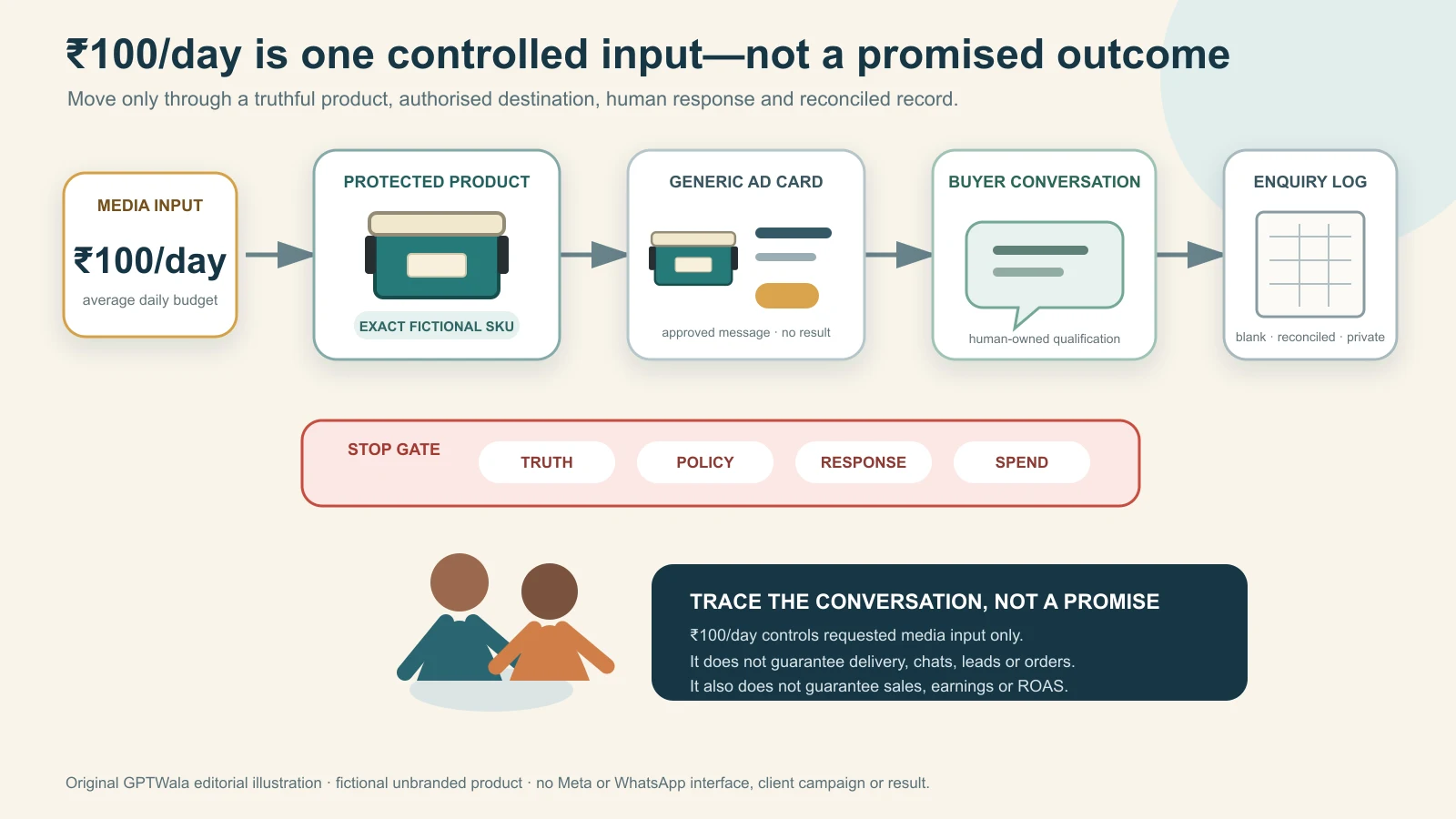
₹100/day is a controlled average media-budget input. The useful output is a traceable, truthful buyer conversation—not a promised lead, order, sale, earning or return.
Reviewed and updated: 12 August 2026
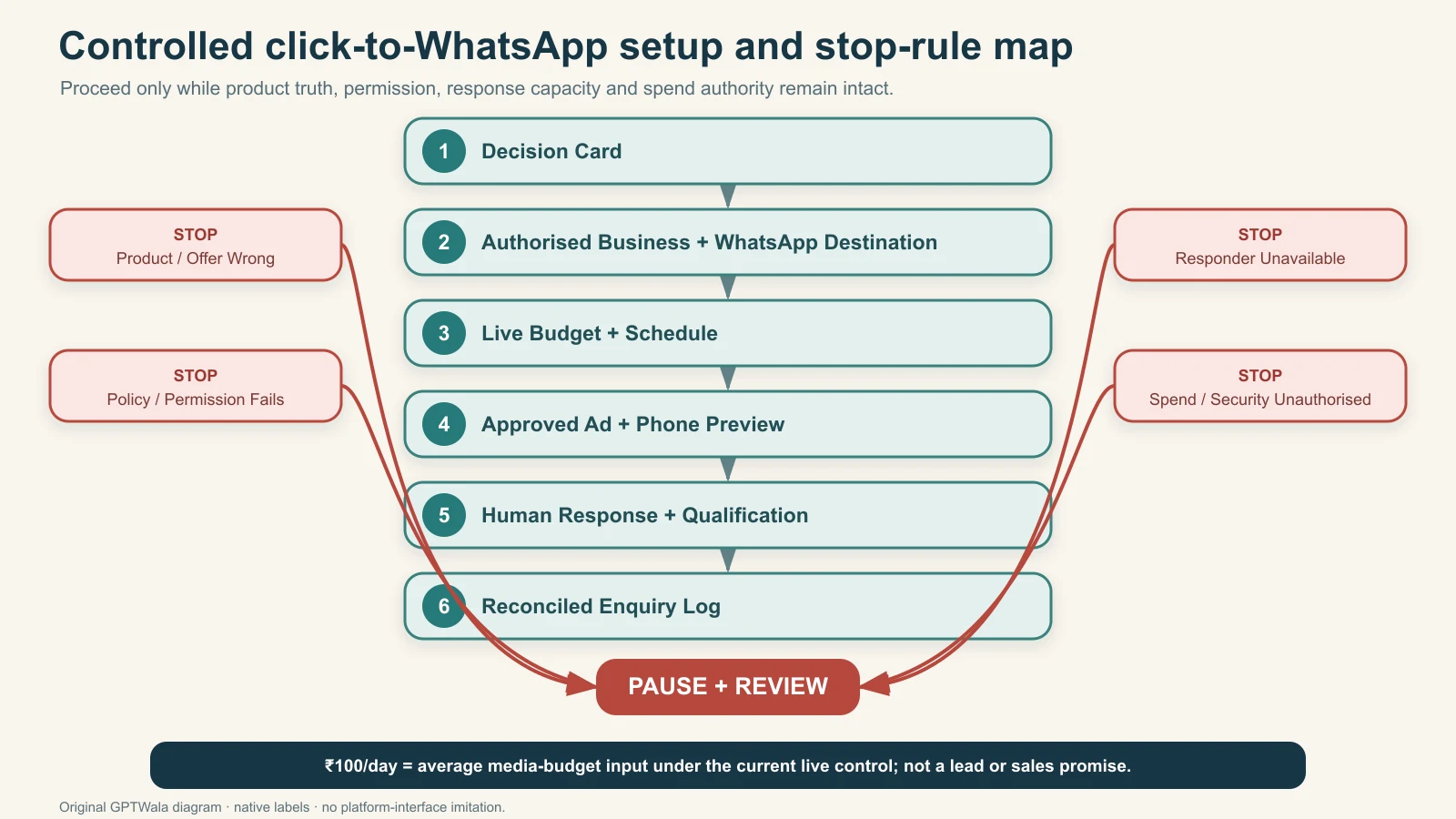
To run a ₹100/day click-to-WhatsApp ad responsibly, use one accurate product offer, one serviceable audience, one approved creative, one authorised WhatsApp destination and one written qualification rule. Set ₹100 as an average daily media budget, not a lead or sales promise. Check the live budget control, preview the complete ad-to-chat journey, have a human ready to respond, log every attributable conversation and stop when product truth, policy, response capacity or spend control fails.
The system can buy a small amount of distribution and evidence. It cannot guarantee delivery, clicks, chats, qualified enquiries, orders, revenue, profit or return on ad spend. At low volume, the correct conclusion may simply be not enough evidence.
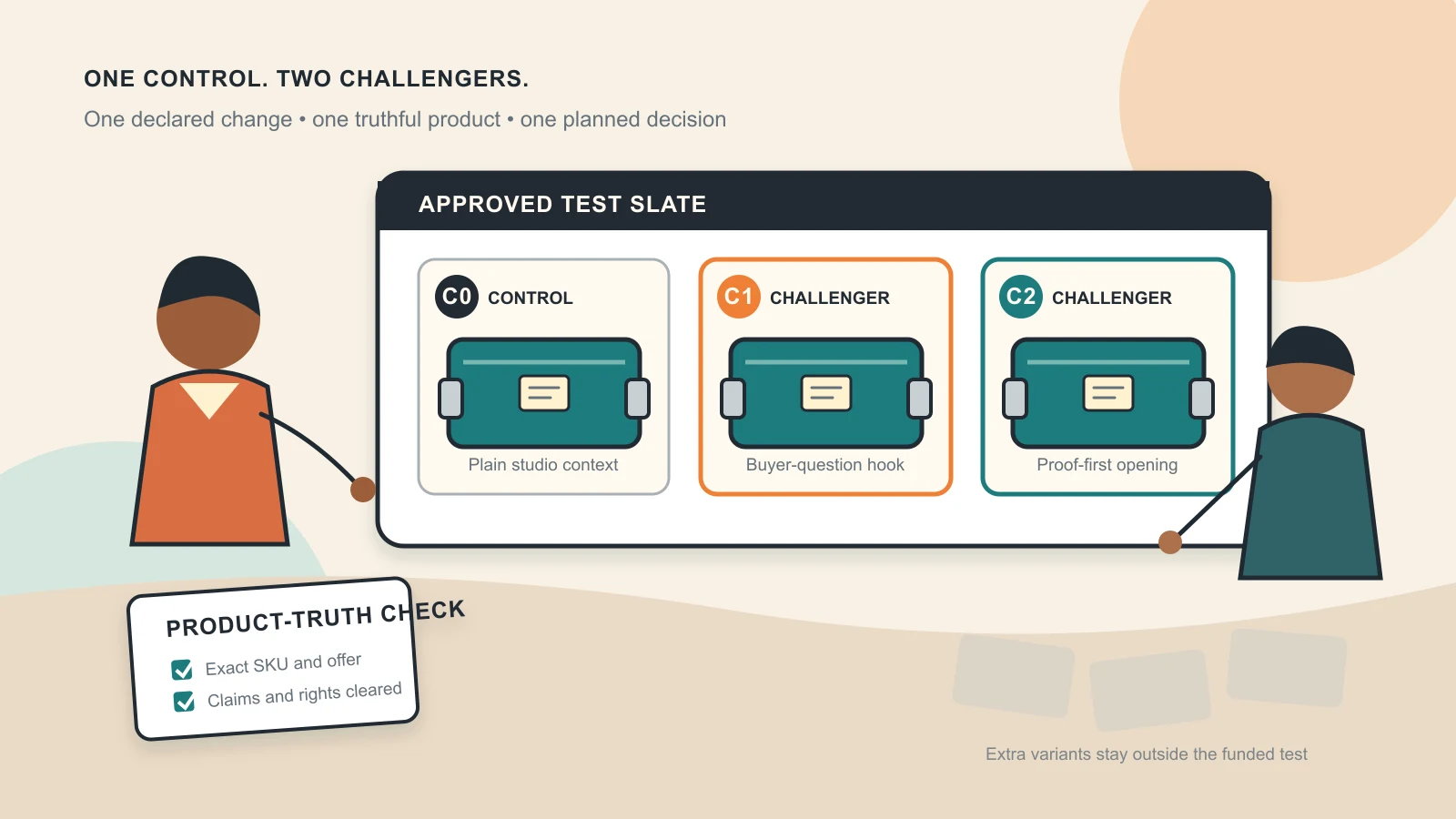
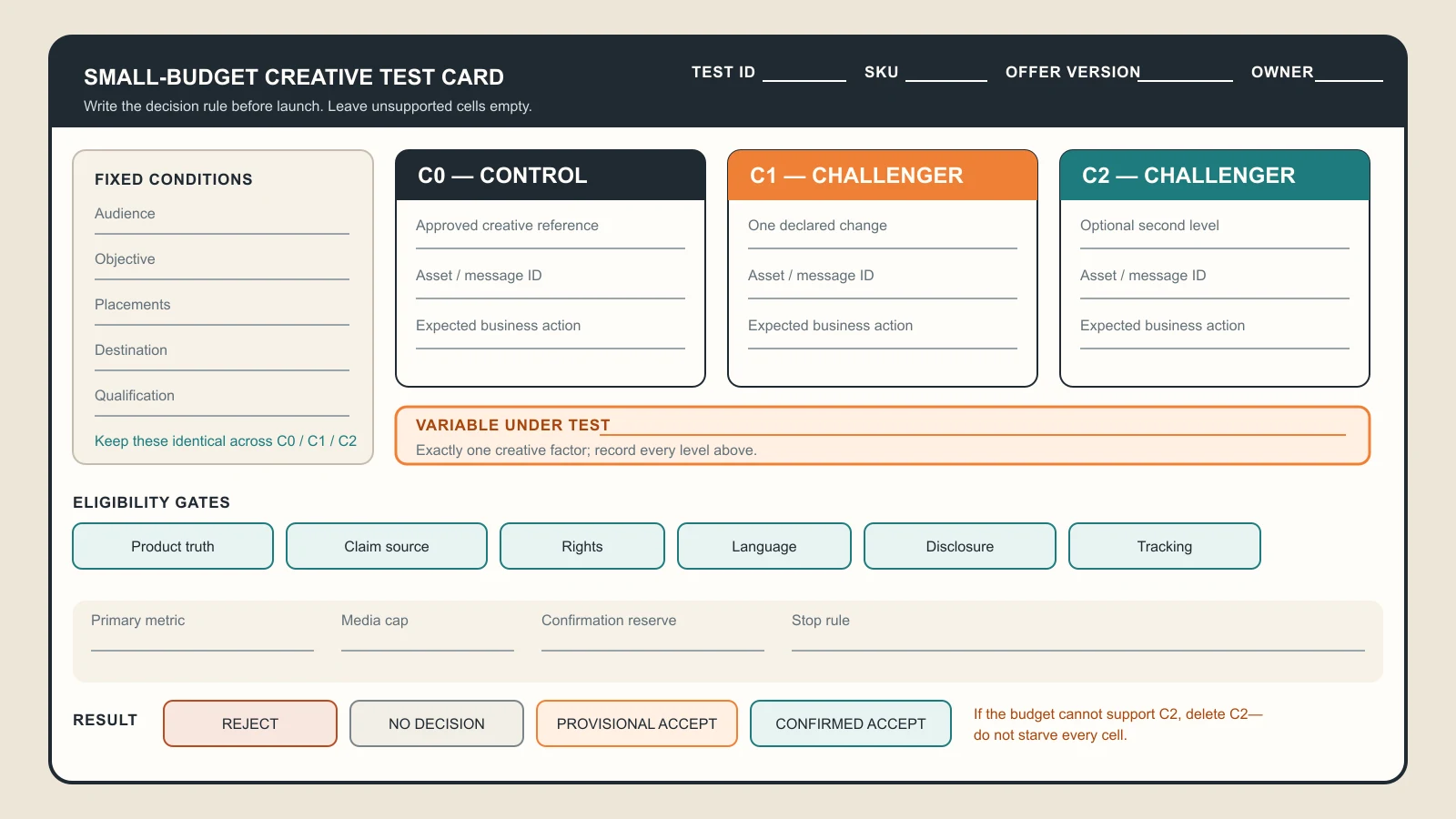
This article owns the specific click-to-WhatsApp setup, tracking loop and limits. The AI ad creative guide owns creative strategy; the small-budget creative testing guide owns control-versus-challenger testing; the Meta-readiness article owns the account, offer and destination gate; and the WhatsApp selling system owns the full enquiry-to-order conversation. Do those jobs separately rather than forcing one ₹100 campaign to solve all of them.
₹100/day controls only the average daily media-budget input you request from the platform. It does not set a price for a lead, reserve a number of impressions or buy a particular business outcome.
Meta’s current public budget guidance defines a daily budget as the average amount an advertiser is willing to spend per day. It says Meta may spend up to 75% over that daily promotional budget on a particular day, while weekly spend should not exceed seven times the daily budget. A lifetime budget works differently: it limits total spend over the selected run while daily spend may fluctuate. Check the current explanation on Meta’s budgets, costs and schedules page and the exact control shown in your live account before approval.
For a continuously scheduled ₹100 average daily budget, the current public definition implies:
one day is not guaranteed to stop at exactly ₹100;
a day could reach ₹175 under the stated 75%-over allowance;
the corresponding seven-day media envelope is up to ₹700; and
actual delivery can be below the available budget.
Those figures are arithmetic illustrations of the current budget definition, not predicted results. Billing currency, taxes, account time zone, changes, pauses and other charges need their own live-account check. If Ads Manager displays a different minimum, limit or control, do not force the article’s number into the account. Re-authorise the amount actually shown or do not launch.
Use ₹100/day as a controlled pilot input
A responsible owner can authorise four things:
Media control: the live daily or lifetime budget and maximum authorised exposure.
Time control: start, end and response hours.
truth control: the exact product, offer, claims and visual evidence allowed.
decision control: what would make the business continue unchanged, review or stop.
The owner cannot authorise the market to respond. That is why “₹100/day ads” must never be presented as “₹100 for guaranteed customers.”
Do not turn a budget label into a benchmark
No universal cost per WhatsApp chat exists for every manufacturer, wholesaler, retailer, apparel seller, jewellery business or product brand. Auction conditions, geography, audience, product, season, offer, creative, destination, response quality and measurement all change the result. Even two campaigns for the same SKU can behave differently at different times.
Use your own attributable records to learn what happened in a defined operating window. Do not borrow a screenshot, agency average or competitor’s claimed cost and treat it as your forecast.
Choose one narrow job for the campaign
Ads that click to WhatsApp can appear on Facebook or Instagram and open a chat with the business, according to the current WhatsApp product overview. That path is useful only when the chat has a clear first job.
Choose one, such as:
ask whether a local retail SKU is available for pickup;
request a wholesale catalogue for one category;
share quantity, city and delivery requirement for a quote;
ask for a technical data sheet for one component family;
request size guidance for one apparel line; or
book a product-viewing conversation for a specific jewellery collection.
Avoid “message us for everything.” A vague ad invites vague chats and makes qualification inconsistent.
Write the campaign’s single sentence
Use this template:
This campaign will show [exact product and truthful offer] to [one serviceable buyer group in one geography] and invite them to [one WhatsApp action], which counts as qualified only when [written conditions] are met.
Example:
This campaign will show the current 25 kg wholesale pack of an unbranded food-safe storage product to verified retailers in serviceable Maharashtra districts and invite them to request a dealer catalogue; a qualified enquiry must include business type, city/PIN and expected order quantity.
This is a planning example, not a real campaign or outcome. Replace every term with facts your business can document.
Keep low-budget structure narrow
Start this operating guide only after one creative—or a deliberately small approved creative set—has passed product, claim and rights review. A ₹100/day campaign fragmented across many audiences, products, offers, placements and generated ads may give each branch too little exposure to interpret.
This article does not decide how many creative variants to test. Use the small-budget AI ad testing matrix for that decision. For the present system, reduce variables so that a chat can be traced back to one clear promise and product.
Pass the zero-spend launch gate
Do not pay the platform to reveal an error that a phone preview, stock check or human reviewer could have caught.
The future Meta-readiness guide should carry the full account audit. This is the minimum campaign gate:
Gate
Evidence required before launch
Stop condition
Business identity
Accurate business name, contact details, authorised ad account and authorised WhatsApp business destination
Wrong owner, impersonation, unclear access or compromised account
Product
Exact current SKU/variant, accurate image, current packaging, stock or fulfilment route
Price/MOQ/discount/dates/tax-shipping conditions documented where mentioned
Business cannot honour the words or material conditions are hidden
Claim
Source for every objective or implied material claim
Unsupported performance, safety, ranking, scarcity, comparison or certification claim
Audience
Geography and buyer type the business can legally and operationally serve
Outside service area, prohibited targeting logic or no fulfilment route
Destination
Correct WhatsApp number selected; test chat opens on a phone
Wrong number, dead destination, personal number used without authorisation
Response
Named human owner and published response hours
Nobody available to answer, qualify or escalate
Measurement
Campaign code, qualification rule and lead log ready
No way to distinguish an ad chat, duplicate or qualified enquiry
Policy
Current Meta advertising and WhatsApp category/messaging rules checked
Product/category is prohibited, restricted without eligibility or messaging plan is non-compliant
Spend
Owner has seen the live budget type, currency, schedule and maximum authorised exposure
Unclear billing, unapproved card/account or no stop authority
Passing this gate means eligible to try, not approved by buyers and not guaranteed to pass platform review. Meta says its ad review can consider the creative, text, targeting and destination, and that click-to-message ads have an additional thread-level checkpoint. Review can recur after an ad is live. See Meta’s current ad review, policy and support guide.
Test the complete phone journey
Use a phone that is not already inside the business workflow where practical. Preview the ad and check:
The crop does not remove a pack size, disclaimer or essential product detail.
The CTA opens the intended WhatsApp business identity.
The first visible message names the same product and offer as the ad.
A buyer can state the minimum qualification facts without sharing sensitive data.
The business reply is available in the stated hours.
The source code or campaign identifier reaches the log.
A human escalation path works.
Screenshots from this preview are evidence of setup, not evidence of delivery or demand. Redact numbers, profiles, payment data and customer content before storing or sharing them.
Write the campaign decision card
One page should tell the owner, responder and reviewer what is running. Complete it before opening Ads Manager.
Field
What to write
Campaign ID
A durable code, for example CTWA-2026-08-BOX-Retail-MH-v1
Business job
One action: availability, catalogue, quote input, data sheet, size help or appointment
Product
Exact SKU/family and version date
Offer
Approved copy plus dates and material conditions
Audience
Buyer type, geography and any lawful eligibility condition
Destination
Authorised WhatsApp business number/account owner
Response window
Days, hours, primary responder and backup
Qualification rule
Exact facts required to count a qualified enquiry
Creative
Asset ID, source-photo ID, reviewer and approval date
Budget
Daily/lifetime type, live amount, schedule, currency and maximum authorised exposure
Tracking
Platform fields, source code, lead-log owner and reconciliation time
Immediate stops
Truth, policy, destination, response, security and spend failures
Review point
Predeclared time, spend cap or evidence condition—not “when we feel like it”
The name records channel, product, audience, offer/action, period and creative ID. It does not include a customer’s phone number or personal data. Use the same campaign and creative codes in the response log.
Do not rename the campaign repeatedly to describe performance. Record decisions in the operating log and preserve the original identity.
Set up the click-to-WhatsApp ad
The current official WhatsApp guide describes this broad Ads Manager path: create a campaign, choose an available objective, name it, select Messaging Apps as the conversion location, choose WhatsApp, set schedule and budget, define the audience, add the ad format and content, customize responses and publish. See How to create ads that click to WhatsApp.
Interfaces, eligibility and labels vary by account, region, objective and product update. Treat the sequence below as a control checklist; follow the live guided flow rather than forcing an outdated screenshot.
Step 1: open the authorised business and verify state
Confirm the selected ad account, Page/business identity, currency, time zone, payment method, permissions and WhatsApp destination. If the intended number does not appear, use the live connection flow and recheck ownership. Do not improvise with an employee’s personal number just to get the campaign live.
Stop if any business asset looks unfamiliar, restricted or compromised.
Step 2: create and name the campaign
Select Create in Ads Manager. Choose the objective currently available and appropriate for a messaging destination. Do not choose an objective because an old tutorial shows it; product labels and eligibility change.
Enter the campaign decision-card ID. Disable or decline optional changes you do not understand until the owner knows what they change, what they may cost and how they will be measured.
Step 3: select messaging and WhatsApp
At the relevant conversion-location or destination step, select Messaging Apps, then the authorised WhatsApp account/number. If the interface offers multiple messaging destinations, keep WhatsApp only for a system intended to measure WhatsApp conversations. Mixing destinations changes the operating and reconciliation job.
Send a preview or test through the live tools where available. Verify the business name and number on the receiving phone.
Step 4: enter the authorised budget and schedule
Choose daily or lifetime budget deliberately:
Daily budget: an average per day under Meta’s current definition; daily spend may vary.
Lifetime budget: total available media spend for the selected run; daily allocation can vary.
If using the article’s ₹100/day system, enter ₹100 only when the live account accepts it and the owner accepts the current daily-budget behaviour. Write the start, intended review point and end/stop authority. Do not leave an open-ended campaign merely because the daily number appears small.
Meta’s page currently recommends enough budget over at least seven days for its system to learn. WhatsApp’s setup page similarly presents at least seven days as a best-practice recommendation. That is platform guidance, not proof that seven days at ₹100 will deliver enough buyer actions for a decision. Use a pre-authorised window and accept “not enough evidence” when volume is weak.
Step 5: define the serviceable audience
Start with real fulfilment and buyer logic:
where the product can be delivered, installed, collected or supported;
whether the buyer is a consumer, retailer, dealer, distributor, procurement team or other business;
language needed for the ad and response;
whether order quantity, category or location changes eligibility; and
whether current policy restricts the product or targeting.
The official WhatsApp setup page currently gives a broad audience-size recommendation. Do not apply that generic number blindly to a local shop, narrow industrial component or high-consideration jewellery product. A wide audience that cannot buy is not useful reach.
Avoid unlawful or discriminatory targeting. If the product or offer belongs to a regulated category, obtain category-specific policy and legal review before any setup.
Step 6: choose placements without creating accidental versions
Review the live placement options and previews. The official ads-that-click-to-WhatsApp overview says the format can appear across Facebook and Instagram, including named feed, Stories and Marketplace surfaces, subject to current availability.
At a ₹100/day input, do not create many manual placement branches without a reason. Whichever placement logic you choose, preview the real crop, text, CTA and material conditions in each eligible format. Reject a placement that hides the product truth or makes the offer misleading.
Step 7: add one approved product message
Upload the approved asset and enter the exact copy from the decision card. The product in the image, headline, main text, CTA and WhatsApp opening must agree.
Check especially:
SKU, model, colour, finish and pack quantity;
price, MOQ, sale period and delivery conditions where stated;
included versus illustrative accessories;
claim qualifiers and readable disclosures;
language and punctuation; and
whether an AI-generated context implies a feature, scale, customer, endorsement or result that is not real.
Never use a fabricated testimonial, star rating, certification, “sold out soon” cue, before/after result or showroom crowd.
Step 8: configure the first-message experience
Use the live response-customisation controls to make the first action easy and attributable. Keep it short.
For example:
I saw BOX-T2 / Catalogue-AUG26. I am a [retailer / consumer / other] in [city or PIN] and need approximately [quantity].
The code is fictional. Do not prefill facts the user did not choose. Do not ask for a full card number, financial-account number, government ID or other sensitive identifier. WhatsApp’s current Business Messaging Policy expressly warns businesses not to request full-length payment-card, financial-account, personal-ID or other sensitive identifiers.
Provide a clear way to reach a human. A bot or quick reply can collect basic routing facts; it should not pretend to be a person or trap the buyer without escalation.
Step 9: preview, record and publish for review
Before selecting Publish:
Compare every surface to the signed decision card.
Capture the final campaign, ad-set and ad IDs/names.
Record the live budget type, amount, schedule and account time zone.
Save the approved creative and copy version.
Run the ad-to-chat phone test.
Confirm the responder is on duty.
Confirm the stop owner knows how to pause delivery.
Publish submits the ad into the platform process; it does not certify the product, claim, economics or likely outcome. Record review/delivery state in the log and do not call an ad “running” until the live status and spend confirm delivery.
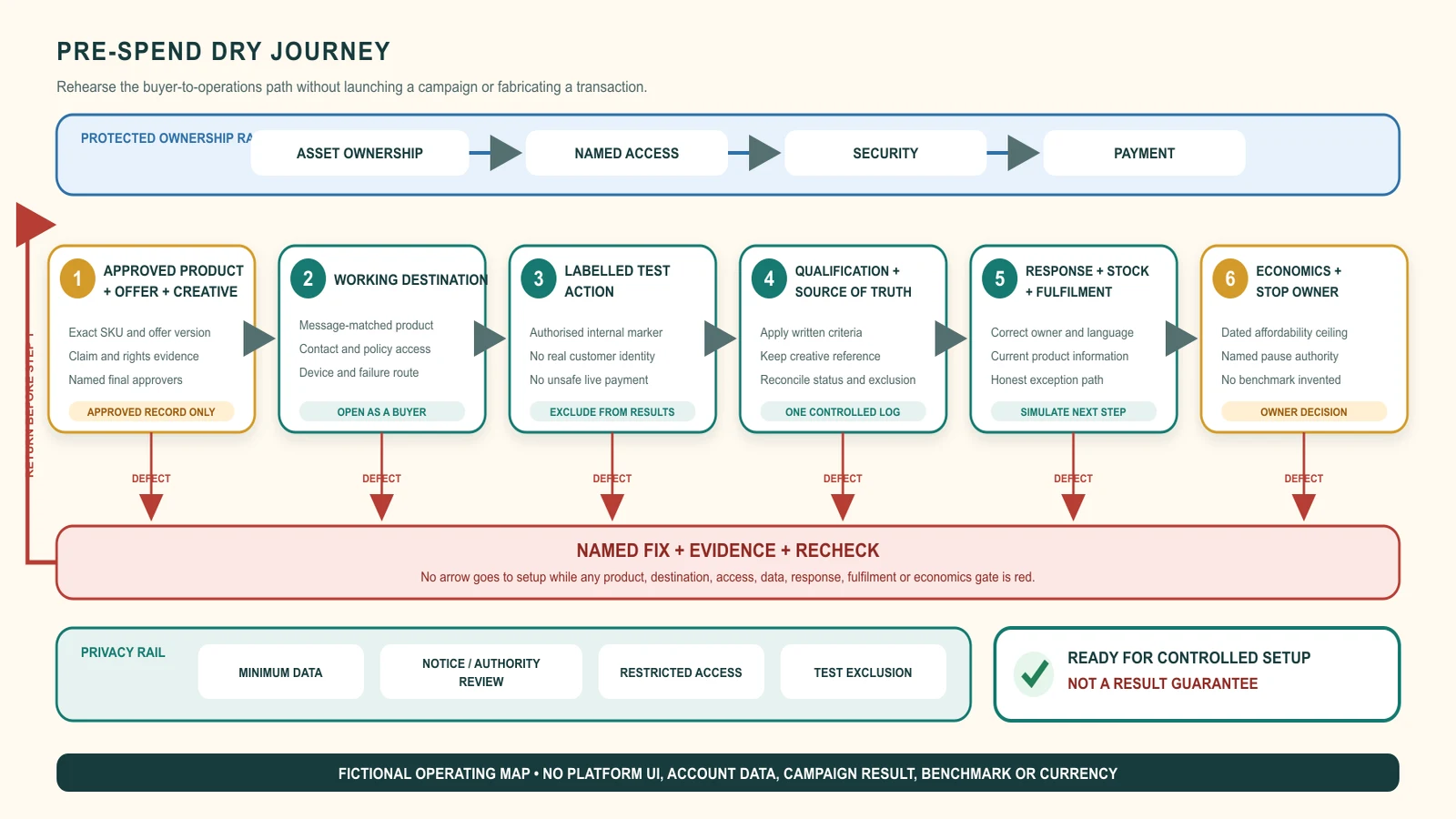
Original GPTWala control flow. Proceed only while product truth, permission, response capacity and spend authority remain intact; the ₹100/day setting is not a lead or sales promise.
Make the ad and first chat agree
The first WhatsApp exchange is where a persuasive ad either becomes a useful enquiry or reveals a mismatch.
Use message continuity
Ad promises
First chat should confirm
Do not do
“Ask if this SKU is available in Lucknow”
SKU, branch/PIN and current availability route
Switch to another model without saying so
“Request the wholesale catalogue”
Business type, city, category and catalogue version
Send an unrelated catalogue or hide MOQ
“Share quantity for a quote”
Exact item, quantity, delivery location and quote conditions
Claim a final price without required inputs
“Get the technical data sheet”
Component family, application and document version
Treat a brochure as proof of suitability
“Ask for size help”
Exact garment, size chart version and buyer’s chosen inputs
Promise fit from a synthetic model image
“Book a jewellery viewing”
Exact collection/item, appointment route and current product details
Imply the AI lifestyle render is the exact stone/finish
Do not bait with one product and open with another. Do not make a low headline price do work that a material MOQ, tax, delivery or variant condition should have done in the ad.
Define qualification before the first chat arrives
A “message” is not automatically a lead. A lead is not automatically qualified. A qualified enquiry is not a sale.
For this campaign, write the minimum observable facts. A B2B wholesale enquiry might require:
relevant business/buyer type;
serviceable city or PIN;
requested product/category;
quantity or credible buying range; and
a next action the business can fulfil.
A retail enquiry may need only product, location and purchase window. A technical manufacturer may need application and specification inputs—but should collect sensitive or safety-critical information through an appropriate secure process, not an improvised chat.
The WhatsApp selling guide for product businesses should own the complete qualification and sales conversation. This campaign needs only a consistent first handoff.
Build a tracking system that survives low volume
Use two records:
Platform delivery record: what the current interface reports about status, spend, delivery and messaging actions.
Business outcome record: what an authorised person verifies in the WhatsApp and order workflow.
Metric names and attribution definitions can change. Export or note the exact label and definition shown in the account; do not silently translate every click or platform event into a buyer conversation.
Use a five-stage measurement ladder
Stage
Operational definition
Source of truth
Typical error
1. Delivered
Ad entered delivery and incurred recorded media spend
Ads Manager/billing record
Assuming approval means delivery
2. Ad-attributed new chat
First observed chat meets the prewritten source-code/time rule
WhatsApp plus lead log
Counting clicks, previews or returning chats as new chats
3. Valid buyer chat
Not a test, duplicate, spam, job seeker, supplier pitch or unrelated request
Human classification
Treating every message as demand
4. Qualified enquiry
Meets the campaign’s written buyer, product, geography and need conditions
Human/CRM record
Changing the definition after seeing results
5. Verified business outcome
Quote, appointment, sample, order or other defined action is reconciled to the enquiry
Order/CRM record
Assuming a chat became revenue
Name the deepest outcome the business can verify. Do not invent an order field if the order system cannot be reconciled.
Create a privacy-minimised enquiry log
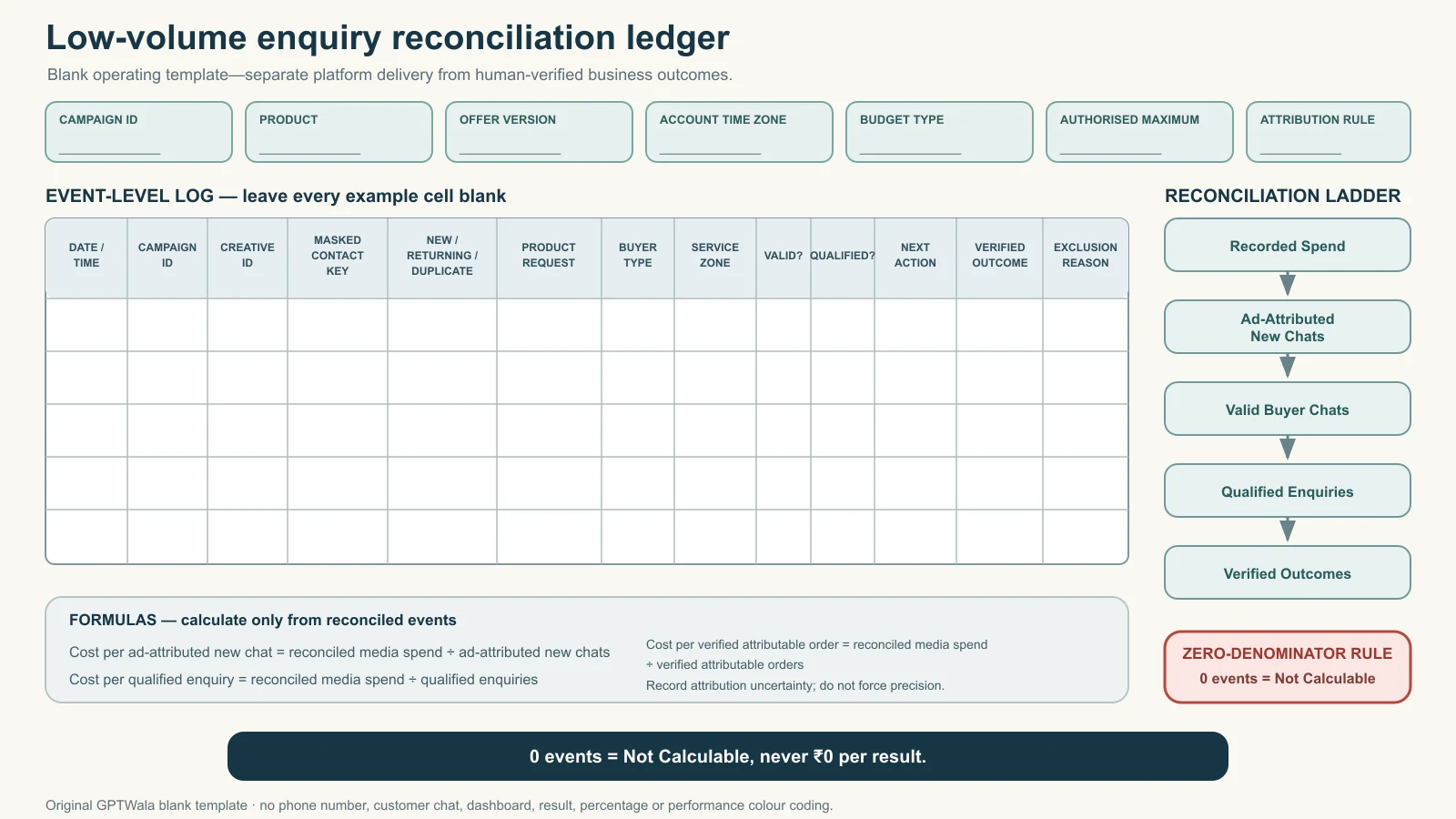
Recommended fields:
Field
Purpose
First-contact date/time
Reconcile with the campaign window and account time zone
Campaign and creative ID
Trace the source without relying on memory
Contact key
Masked phone or internal lead ID; avoid copying full numbers into shared files
New/returning/duplicate
Prevent inflated new-chat counts
Product and request
Confirm message continuity
Buyer type
Retail consumer, retailer, dealer, procurement, other
City/PIN or service zone
Check fulfilment, using only the detail necessary
Quantity/need
Apply the written qualification rule
Classification
Test, spam, unrelated, valid, qualified
Next action and owner
Prevent an enquiry from disappearing
Outcome status
Quote/catalogue/appointment/order/closed-no-fit, only when verified
Exclusion reason
Explain why a chat was not counted
Restrict access, set a retention rule and avoid pasting raw customer chats into public AI tools. The WhatsApp Business Messaging Policy places responsibility on the business for necessary notices, permissions, consents, data protection and a published privacy policy. Obtain India-specific legal guidance for your actual collection and processing; this article is an operating framework, not legal advice.
Write the attribution rule before launch
Example:
Count a new ad-attributed chat when the first incoming message carries campaign code CTWA-BOX-AUG26 or can be matched to the current ad entry within the predeclared window, the contact is not a team test or known duplicate, and a human verifies the product request. Record returning contacts separately.
Choose the window and matching method that your actual tools can support. Campaign codes reduce ambiguity but do not prove causation: a buyer can edit the prefilled message, forward details or contact through another route.
Calculate only what the data supports
Use reconciled media spend, not the budget setting, as the numerator.
Cost per ad-attributed new chat
reconciled media spend ÷ ad-attributed new chats
Valid-chat rate
valid buyer chats ÷ ad-attributed new chats × 100
Qualification rate
qualified enquiries ÷ valid buyer chats × 100
Cost per qualified enquiry
reconciled media spend ÷ qualified enquiries
Cost per verified attributable order
reconciled media spend ÷ verified attributable orders
If the denominator is zero, report not calculable—not ₹0 and not infinity as if it were a useful business result. If attribution is uncertain, report the count and uncertainty rather than forcing precision.
These calculations describe acquisition events, not profitability. They exclude or may exclude creative production, product review, staff time, messaging/technology charges, discounts, returns, fulfilment, tax and contribution margin. Use the product-business unit economics guide before deciding that an observed cost is affordable.
Original GPTWala blank reconciliation template. Keep platform delivery and human-verified outcomes separate, apply a written attribution rule, minimise contact data, and report a zero denominator as “Not Calculable”—never ₹0 per result.
Run the daily operating loop
A low daily media input still needs daily ownership.
Before response hours
confirm the advertised product, offer, stock/fulfilment route and response promise are still true;
check account, campaign, ad-set and ad status;
check spend against the current authorisation and account time zone;
open the destination from a current preview when anything changed;
confirm the primary responder and backup are available; and
check for policy, security, billing or account-quality alerts.
During response hours
answer through the declared business identity;
verify the buyer’s request before sending product facts;
apply the same qualification rule to every chat;
add the campaign/creative ID and classification to the log;
provide a clear human route when automation is used;
honour any stop/opt-out request; and
escalate safety, technical, payment or sensitive-data issues instead of improvising.
Speed helps only when the reply is accurate. A fast wrong specification, price or promise is not good service.
At the end of the operating day
Reconcile:
live status and recorded media spend;
new source-coded chats;
team tests, duplicates, spam and returning contacts;
valid and qualified enquiries;
missing responses or handoffs;
offer/product changes; and
any reason to pause before the next response window.
Do not change audience, offer, creative, destination and qualification together because one day felt quiet. Low-volume noise can look dramatic. Preserve the setup unless a safety/truth/policy/spend stop is triggered or a predeclared review authorises a documented change.
At the predeclared review point
Choose one state:
State
Meaning
Next action
Continue unchanged
Setup is truthful, controllable and producing enough useful operating evidence
Continue only within the next authorised budget/time window
Review one bottleneck
Delivery exists, but a documented mismatch appears in audience, ad-to-chat continuity, qualification or response
Diagnose, change one material component and version the campaign
Stop
Truth, policy, destination, response, security, billing or affordability fails
Pause delivery; fix and re-review before any restart
Not enough evidence
Safe operation, but too few events to infer a result
Report uncertainty; do not name a winner or promise a result
The testing guide owns formal creative comparisons. The unit-economics guide owns the profitability decision. Article 20 owns whether this operating system is controlled and traceable.
Use stop, review and continue rules
Write business-specific thresholds before launch. The table below supplies conditions, not invented universal performance numbers.
Symptom
Likely issue
Diagnostic check
Safe action
Product in ad differs from supplied SKU
Creative/version failure
Compare final ad to the current approved product record
Stop immediately; replace only after fresh product QA
Offer, price, MOQ or availability is no longer true
Stop or update through formal review; do not explain away the mismatch in chat
WhatsApp opens the wrong number or identity
Destination failure
Test from ad preview on a separate phone
Stop immediately and correct ownership/connection
Nobody can reply in promised hours
Capacity failure
Check roster, queue and escalation path
Pause until a trained responder is available
Spend exceeds owner’s understood control
Budget/billing failure
Compare live setting, spend, schedule, currency and current Meta definition
Pause and resolve before reauthorising
Ad is approved but does not deliver
Delivery/eligibility/auction issue
Read live status and diagnostics; inspect schedule and account
Do not diagnose from the title; follow live guidance or support
Many chats are tests, spam or unrelated
Attribution/message mismatch
Reclassify logs; inspect ad wording, audience and source-code flow
Review one cause; never report the raw count as leads
Valid chats are outside service area
Audience/serviceability mismatch
Compare cities/PINs to the fulfilment map
Correct audience/message at a versioned review
Buyers ask for a product/condition not shown
Message-continuity failure
Compare repeated questions with ad and first message
Clarify the truthful offer; do not bait-switch
Chats are valid but rarely qualified
Qualification/offer/audience issue
Apply the unchanged qualification rule and exclusion reasons
Review one bottleneck; do not lower the rule to improve the report
Qualified enquiries receive no next action
Sales-handoff failure
Audit owner, timestamp and open tasks
Pause acquisition if capacity cannot protect buyer experience
No orders appear in a tiny sample
Insufficient or downstream evidence
Check qualified count, follow-up status and order reconciliation
Do not declare failure or success from zero/very low volume
Buyer asks to stop messages
Permission/experience issue
Verify the request and contact record
Stop messaging and honour opt-out promptly
Suspicious login, asset or payment activity appears
Security risk
Check authorised admins and official security/account tools
Pause and secure the account; do not continue spending
An accepted ad and an open chat do not override these stops.
Apply the system to Indian product businesses
The structure stays the same; the qualification facts change by business model.
Rajkot industrial-component manufacturer
Campaign job: request the current data sheet for one pump-component family.
Truth controls: exact drawing revision, material/compatibility wording, no synthetic cutaway that invents an internal feature, and no suitability claim without engineering approval.
First-message fields: component code, application category, city/country and requested quantity range. Route detailed specifications to a trained technical person. The chat does not replace an engineering review.
Qualified enquiry: serviceable geography, relevant application, identifiable component need and plausible next action. A student asking for a project PDF is recorded separately, not mocked and not counted as a buyer.
Surat apparel wholesaler
Campaign job: request the current wholesale catalogue for one garment line.
Truth controls: real colour/print/size chart, current MOQ, dispatch conditions and catalogue version. An AI model must not make the garment look longer, slimmer, differently draped or differently embellished than the supplied item.
First-message fields: retailer/reseller status, city, product line and quantity band. If the seller cannot confirm fit from the information available, say so; link to verified measurements or use real try-on evidence.
Campaign job: request an availability call for one series and delivery region.
Truth controls: exact pattern, finish, tile size, batch/variation explanation and current sample policy. An AI room scene cannot be used as exact proof of colour, scale, reflectivity, joint width or installed result.
First-message fields: series/code, project location, area/quantity estimate and buyer type. Direct the buyer to a real sample or approved physical inspection when finish and batch matter.
Lucknow kitchenware retailer
Campaign job: ask whether one exact SKU is available for branch pickup or serviceable delivery.
Truth controls: current pack quantity, included parts, capacity/model and price conditions. Decorative props must not look included.
First-message fields: SKU, branch/PIN and intended quantity. A qualified retail enquiry can be simpler than a wholesale one, but the store must still separate current buyers from team tests and generic support chats.
Tiruppur apparel brand
Campaign job: get verified size guidance for one product page or collection.
Truth controls: real garment measurements and colour references; no promised fit from a generated body; no fabricated review or “best seller” badge.
First-message fields: exact garment/variant, buyer-selected size inputs and delivery PIN. Collect only what is needed and avoid sensitive body/health data. Escalate ambiguity to a trained human.
Jaipur jewellery business
Campaign job: arrange a product-detail or viewing conversation for a named collection.
Truth controls: real current piece, metal purity/stone/treatment/weight wording as applicable and approved; accurate hallmark/certification statements; no AI enlargement of stones, prongs, finish or included quantity.
First-message fields: item/collection code, city, preferred viewing route and purchase timing if the buyer volunteers it. High-value payment and identity checks belong in a secure, approved process—not the first ad chat.
Bengaluru home-storage product brand
Campaign job: ask for the correct variant for one documented storage need.
Truth controls: exact dimensions, closure, material and included quantity. Do not generate a capacity demonstration or stacking configuration that has not been physically verified.
First-message fields: selected SKU, intended use, variant and serviceable PIN. When load, fit or safety matters, use a real measurement or demonstration.
These examples illustrate routing logic, not campaign forecasts. Each business must replace them with its own records, policy checks and service constraints.
Protect product truth, customer data and messaging permission
Paid distribution increases the cost of a mistake. Use the same product-truth discipline for an ad as for a catalogue or marketplace listing.
Lock a product fact sheet to the creative
Before launch, record:
exact product/SKU and packaging generation;
approved source-photo IDs;
dimensions, material, capacity, quantity and included parts only where verified;
current colour/finish reference and acceptable display caveat;
approved offer, claim and disclaimer copy;
rights/consent for people, locations, voices, testimonials, logos and supplier assets;
whether AI created or materially altered any part; and
product-owner, claim-reviewer and approval date.
Use the AI product-image accuracy checklist when AI assisted the visual. If a buyer-critical feature cannot be locked—such as a jewellery setting, textile print, connector geometry, label, shade, fit, finish, scale, included quantity, safety action or tested performance—use real capture or a deterministic composite. Do not ask a prompt to guess.
Treat generated context as advertising, not decoration
An AI background can imply indoor/outdoor suitability, heat resistance, waterproofing, load capacity, premium material, celebrity use, customer satisfaction or a result. Remove the implication or substantiate it. A tiny disclaimer should not be used to repair a misleading main visual.
Meta’s June 2026 update says its “About this ad” area will carry AI information for ads created or significantly edited with Meta’s generative tools and describes plans/detection for some third-party AI signals. See Meta’s GenAI ad-transparency update. Platform labelling does not prove product accuracy and does not replace advertiser review.
Separate the buyer’s first contact from permission for later marketing
A buyer clicking an ad and starting a chat has asked about that interaction. Do not interpret one enquiry as unlimited permission to broadcast unrelated promotions.
WhatsApp’s current Business Messaging Policy says businesses must maintain accurate profile/contact information, respect block/discontinue/opt-out requests, avoid surprise or spam, and obtain the permissions/notices required for their communications. Its 24-hour customer-service window and approved-template rules are specifically stated for the WhatsApp Business Platform. Do not casually copy those Platform rules onto a Business App workflow, and do not assume the App has no obligations: identify which product you actually use and check its current terms.
If using the Business Platform, the policy says business-initiated conversations use approved message templates; a business may reply without a template within 24 hours of the last user message; and outside that window only approved templates may be used. Pricing applies and can change. The WhatsApp follow-up article should own timed sequences and template use once live.
For either product:
state who the business is;
reply to the request the buyer made;
record any separate permission needed for later categories of messages;
provide a clear opt-out route;
stop when asked; and
provide human escalation when automation is used.
Know the limits before you spend
₹100/day may be too little for the intended job
The campaign may deliver slowly, unevenly or not at all. A narrow industrial audience, expensive auction, weak account eligibility, restrictive placement, low-quality ad, scheduling choice or other conditions may make the budget insufficient. The system cannot infer which cause applies without live diagnostics.
A seven-day window is not a proof threshold
Seven days at a ₹100 average daily budget is an authorised-media example, not a scientific sample size. If only a few valid chats occur, differences between days, creatives or audiences may be noise. Report what happened and the uncertainty.
Platform numbers and WhatsApp records can disagree
Attribution windows, returning contacts, cross-device behaviour, forwarded messages, edited prefills, privacy controls, delayed reporting and team tests can create differences. Preserve both records and the reconciliation method.
Chat quality depends on the whole chain
A truthful ad can still fail operationally because the offer is weak, the audience cannot be served, the first response is late, the catalogue is outdated, the quote is confusing, stock is missing or follow-up is absent. Do not blame the creative alone.
A qualified enquiry is not an order
Orders can cancel, return or produce too little contribution margin. This article stops at traceable acquisition events. A financial decision needs landed margin, fulfilment, staff, returns, production and technology costs—not media spend alone.
Platform approval is not business approval
An approved ad may still be inaccurate, rights-infringing or unaffordable. A rejected ad may need correction or a formal review. Never evade enforcement by disguising the same prohibited or misleading content.
Policies and interfaces change
This guide was reviewed on 12 August 2026. Recheck live objectives, destinations, placements, budget definitions, review status, messaging rules, category eligibility, pricing and AI labels before publication and every launch.
Use the one-page launch record
Copy this into the campaign folder.
Identity and authorisation
Campaign ID:
Business/ad-account owner:
WhatsApp product: Business App / Business Platform / other confirmed setup:
Authorised WhatsApp destination:
Currency and account time zone:
Primary responder / backup / escalation:
Product and offer
Exact SKU/family and version:
Source-photo/product-record IDs:
Approved offer and validity:
Claim sources:
AI use and disclosure decision:
Product/claim/rights approvers and date:
Audience and chat job
Buyer type and service geography:
One campaign action:
Prefilled message/source code:
Qualification rule:
Response hours:
Opt-out and human-escalation path:
Budget and review
Live budget type and amount:
Start/end or review condition:
Maximum authorised media exposure:
Tax/billing check owner:
Immediate stop owner:
Tracking
Platform fields captured:
Attribution rule/window:
Masked lead-log location/owner:
Reconciliation time:
Valid/qualified/outcome definitions:
Final zero-spend sign-off
Product truth passed:
Offer/claim passed:
Rights/consent passed:
Category/policy passed:
Phone preview passed:
Destination and responder passed:
Measurement passed:
Budget authorisation passed:
Do not launch with blank owners or implied approvals.
Connect the campaign to a wider growth system
A click-to-WhatsApp ad cannot compensate for an invisible or untrustworthy business, weak product content, an inaccurate offer or a broken conversation. It works as one distribution layer inside a larger system.
If your manufacturing, wholesale, retail, shop, apparel, jewellery or product-brand business still depends heavily on walk-ins, dealer calls, exhibitions or forwarded catalogues, GPTWala’s workshop explains the DAA path: Digital Presence → AI Content Creation → ₹100/day WhatsApp ads. The ₹100/day phrase is a controlled setup and learning concept. It is not a guarantee of reach, chats, leads, enquiries, orders, sales, earnings, profit or ROAS.
No. ₹100/day is a media-budget input. Auction conditions and the entire ad-to-order chain determine what happens. Delivery itself can be limited, and a low-volume campaign may produce no defensible conclusion. Never sell the number as a guaranteed customer-acquisition package.
Will Meta spend exactly ₹100 every day?
Not under Meta’s current public daily-budget definition. It describes daily budget as an average and says a day may spend up to 75% over while weekly spend does not exceed seven times the daily budget. Recheck the live account and current official page; choose lifetime budget if its total-run control better matches the owner’s authorisation.
Which Meta campaign objective should I choose for click-to-WhatsApp ads?
Choose the currently available objective that supports your intended messaging destination and business job. The current official setup flow says to choose an objective and then select Messaging Apps and WhatsApp in the relevant conversion/destination controls. Labels and eligibility can vary, so do not rely on an old screenshot or a universal objective name.
How many ads should run on ₹100/day?
There is no universal count. Do not fragment the budget across more products, offers, audiences and creative variants than the campaign can meaningfully serve. Begin this setup with one approved creative or the deliberately small set defined by your testing plan. A18 owns formal control-versus-challenger design.
How long should a ₹100/day campaign run?
Authorise a time and maximum exposure that the business can afford, and define stop/review rules first. Meta/WhatsApp currently present at least seven days as a best-practice learning recommendation, but seven days does not guarantee enough delivery, qualified enquiries or statistical evidence. “Not enough evidence” is valid.
Is a click the same as a WhatsApp conversation?
No. A click, a platform messaging event, a new attributable chat, a valid buyer chat, a qualified enquiry and an order are different stages. Keep platform delivery and business outcome records, then reconcile them using a written attribution rule.
What should count as a qualified WhatsApp enquiry?
Define it for the campaign before launch. It normally needs the right buyer type or real consumer need, a serviceable location, the relevant product/request and the minimum quantity/specification/timing facts needed for a next action. Do not lower the rule after seeing weak results.
Can I send promotional follow-ups to everyone who clicks the ad?
No. A click alone is not unlimited marketing permission. Respond to the user’s actual request, identify the WhatsApp product you use, obtain required permissions, honour opt-outs and follow current policy. Business Platform conversations have specific template and 24-hour service-window rules; use the dedicated WhatsApp follow-up system for later sequences.
Can I use AI-generated product images in the ad?
Only after exact product, claim, rights and context review. Lock shape, labels, colour, finish, size, quantity and included parts. Use real capture when a buyer-critical feature, fit, material, scale, safety action or performance cannot be faithfully protected. An AI or platform label does not make an inaccurate ad acceptable.
What should make me stop the campaign immediately?
Stop for a wrong product/offer, misleading claim, broken or wrong destination, unavailable responder, prohibited or ineligible category, unauthorised spend/billing, account compromise, permission/opt-out failure or material customer-data risk. Performance disappointment alone should follow the prewritten review rule, not an impulsive multi-variable edit.
What is the most useful number to track?
Track the deepest event you can verify consistently—often a qualified enquiry rather than a click. Pair its cost with the valid-chat and qualification rates so you can locate the bottleneck. A verified order and contribution margin are deeper still, but only when your records support attribution and the full economics.
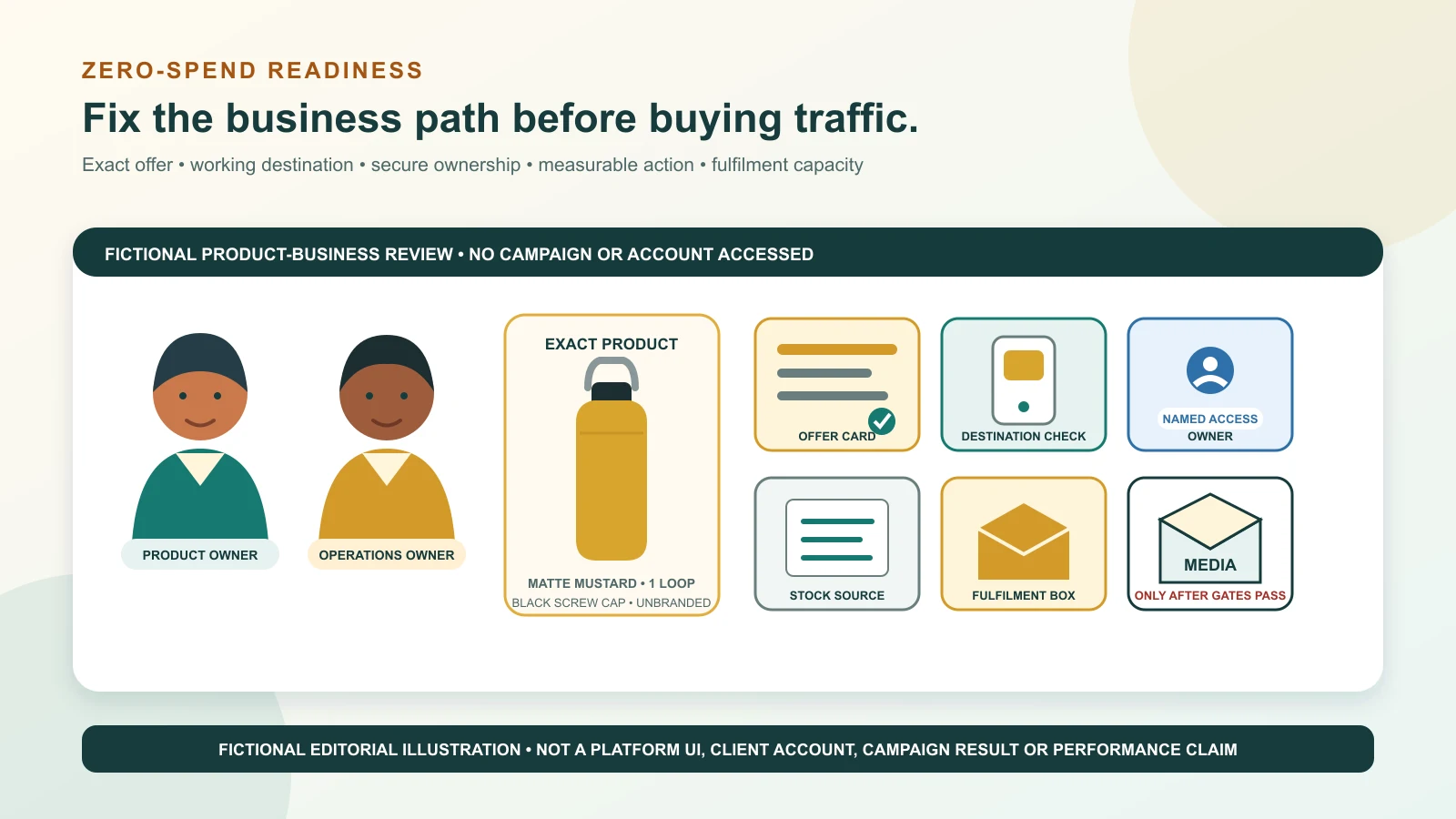
Fix the business path before buying traffic: exact offer, working destination, secure ownership, measurable action and a team that can fulfil it. Original GPTWala editorial illustration using fictional people and one fictional unbranded product; it is not a platform interface, client account, campaign result or performance claim.
Reviewed and updated: 12 August 2026
Before spending on Meta ads, make sure the business can complete the journey the ad promises. Confirm one exact product and offer, a working destination, named owners for every account and payment asset, a truthful creative and claims record, a measurable qualified action, a response-and-fulfilment plan, and an affordable acquisition ceiling. If a critical gate is red, fix it before campaign setup.
This is a zero-spend readiness audit, not an Ads Manager tutorial. No Meta account, payment method, pixel, campaign, destination, customer data or product was accessed or tested for this guide. The examples are fictional and no approval, lead, sale, cost saving or return on ad spend is claimed.
Meta may review an ad’s image, video, text, targeting and destination, and an ad can be reviewed again after it starts running. Platform review is therefore one gate—not proof that the product claim is true, the destination will convert, the business can fulfil demand or the economics work. Meta explains its current review and restriction process here.
Configure the specific ₹100/day click-to-WhatsApp workflow
The ₹100/Day Click-to-WhatsApp Ads System
Hands off only after this audit passes
Calculate contribution margin and affordable acquisition cost
Product-Business Unit Economics for Digital Ads
Requires a dated affordability ceiling, but does not rebuild the calculation
Do not use this checklist to declare that Meta will approve an ad. Do not use it to forecast results. Use it to stop avoidable operational failures from becoming paid failures.
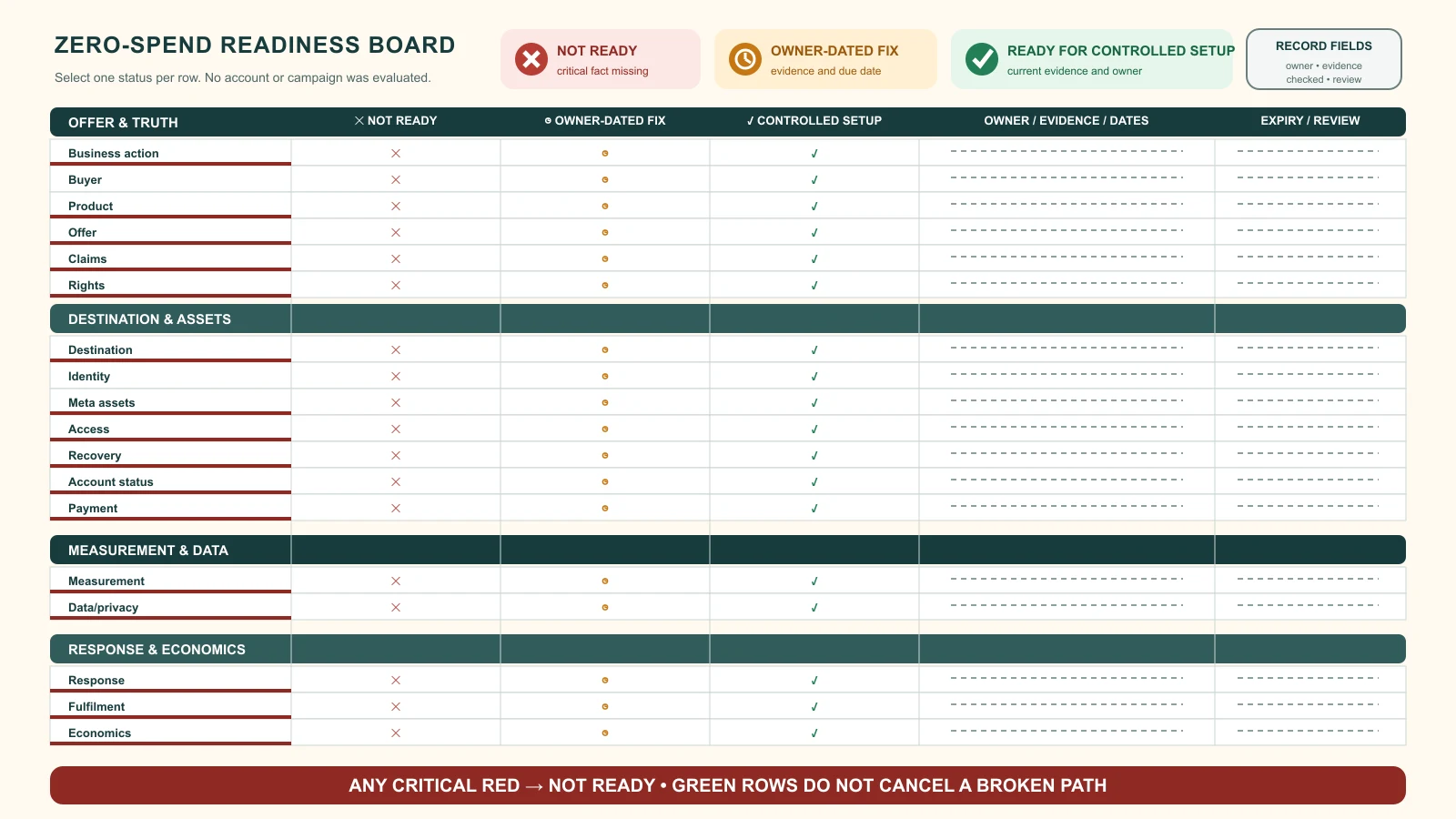
Use three readiness states, not a misleading average
A score of 14 out of 16 can sound impressive. It is useless if one of the missing items is the only person who controls the ad account, the product is not in stock, or the destination does not open.
Use three states for every row:
Not ready: a critical fact, owner, proof or working path is missing.
Ready with an owner-dated fix: the gap is non-critical for today’s audit, and a named person has a dated task that must close before launch.
Ready for controlled setup: the item has current evidence, a named owner and a completed dry check.
Critical gates cannot be averaged away
The following rows are hard gates:
exact product and current offer;
substantiated claims and rights-cleared creative;
working, message-matched destination;
legitimate ownership and recoverable access;
no unresolved compromise or restriction that makes setup unsafe;
authorised payment owner and spend control;
defined qualified action and source of truth;
privacy-reviewed data plan;
response, stock and fulfilment capacity; and
a dated affordability and stop decision owner.
If any one is red, the final state is not ready. A launch date, agency deadline or festival sale does not turn red into green.
Record evidence, not confidence
For each row, record:
status;
named owner;
evidence link, asset ID or dated file;
last checked date and time;
expiry or next review date where relevant;
exact blocker;
fix owner and due date; and
final approver.
“Owner says it is fine” is not evidence. “SKU BT-750-BLK, stock sheet v4, checked by Priya on 12 August at 16:30” is reviewable.
Complete the zero-spend readiness board
Use this board before anyone opens campaign creation. Keep sensitive identifiers and payment information in the business’s restricted system—not in a shared blog template or screenshot.
Gate
Ready evidence
Hard-stop example
Owner
Business outcome
One qualified action and exclusions are written
“Get more sales” with no measurable action
Business owner
Buyer
Named buyer type, geography and eligibility
Retail and wholesale buyers mixed into one undefined audience
Sales owner
Product
Exact SKU, variant, quantity and current stock source
AI visual or ad copy does not match the supplied item
Product owner
Offer
Current price/MOQ/terms/dates/service area
Expired discount or hidden mandatory charge
Commercial owner
Claims
Claim ledger with source, wording and reviewer
“Waterproof”, “best” or performance claim without evidence
Product/compliance owner
Creative rights
Permission/licence for images, people, audio and marks
Supplier or customer asset used without clear rights
Creative owner
Destination
Actual URL/chat/form opens and matches the ad
Broken page, wrong SKU or unavailable WhatsApp number
Destination owner
Business identity
Current name, contact, address/service area and policies
Buyer cannot tell who is selling or how to contact them
Business owner
Meta assets
Page, Instagram, ad account and optional assets mapped
Nobody can identify the owning business or asset IDs
Asset owner
Access
Named people and least-necessary roles reviewed
Shared password, fake profile or former agency access
Security/admin owner
Recovery
Two-factor authentication, trusted recovery route and escalation
Compromised email/phone or no recoverable full-control owner
Security owner
Account status
Business Support Home and known restrictions checked
Unresolved restriction or attempt to evade review
Account owner
Payment
Authorised payer, current method/state and notification route
No admin, unknown card owner or unrecognised charge
Finance owner
Measurement
Qualified action, event/log source, exclusions and QA owner
Clicks called sales; test messages counted as leads
Measurement owner
Data/privacy
Data map, notice, permission/lawful-basis review and access rules
Customer data uploaded because a tool makes it possible
Privacy/data owner
Response
Working hours, language, qualification and escalation
Nobody can answer the promised channel
Sales/support owner
Fulfilment
Stock, dispatch, service geography, returns and exception plan
Offer cannot be honoured at the advertised terms
Operations owner
Economics
Dated affordable-action ceiling and stop authority
Spend allowed without knowing what an acceptable result costs
Finance/business owner
The roles can belong to the same person in a small shop. The important part is that each decision has an accountable human and a traceable record.
One critical red gate keeps the business at “not ready”; green rows do not cancel a broken path. This is an unscored editorial template, not an account assessment or platform interface.
Choose the business action before the campaign objective
Do not begin with “we want Facebook ads.” Begin with the business action a suitable buyer should complete.
Useful examples include:
a retailer requests the current wholesale catalogue and meets the minimum order;
a manufacturer receives a data-sheet or quotation request with a valid application;
a jewellery buyer asks about one exact piece and serviceable location;
a local shop receives an order enquiry for an in-stock item within its delivery area; or
an exporter receives a trade enquiry with destination country, quantity and timeframe.
Define what qualifies—and what does not
A qualified dealer enquiry might require:
business name and city;
buyer type;
exact range or application;
approximate quantity or buying timeframe; and
a valid next step such as catalogue, sample, call or quotation.
Exclude test messages, duplicate enquiries, job seekers, suppliers, spam, messages outside the service area and buyers who do not meet the disclosed MOQ. The definition should match the business model; it is not a universal lead standard.
Name one source of truth
Choose the record that decides whether the action happened:
a website order or verified checkout record;
a CRM stage with a written qualification rule;
a restricted WhatsApp enquiry log maintained by an owner;
a quotation register; or
an order ledger reconciled to the campaign reference.
Clicks, video plays and conversation starts can help diagnose the journey. They are not automatically qualified enquiries or sales.
Bring a preliminary affordability ceiling
Before setup, the business owner needs a dated maximum affordable cost for the chosen action. That figure depends on contribution margin, conversion from enquiry to order, returns/cancellations, fulfilment costs, repeat purchase assumptions and risk tolerance. Use the unit-economics guide for the full calculation.
This article does not prescribe a budget, cost per lead, industry benchmark or acceptable return. If the economics are unknown, the audit remains red.
Write an exact offer card
An offer is more than a headline. It is the commercial promise that the ad, destination, seller and operations team must all recognise.
Complete one card for one promoted offer:
Field
What to record
Offer ID and version
Stable reference and approval date
Exact product
SKU/range, variant, colour, size, finish and packaging generation
Included quantity
One unit, pair, set, pack, case, carton or stated MOQ
Buyer
Consumer, retailer, dealer, distributor, institution or another defined group
Geography
Delivery/service area and exclusions
Price
Current amount plus tax, shipping and other mandatory conditions where applicable
Wholesale terms
MOQ, slab, sample policy, quotation basis or dealer eligibility
Availability
Current stock/source and permitted wording such as “subject to confirmation”
Delivery
Realistic dispatch/delivery basis and exceptions
Returns/warranty
Current terms and destination link
Validity
Start/end date or stock condition for an offer
CTA
The exact next action and destination
Owner
Person who can approve a change or stop the offer
Use one offer version everywhere
The ad, destination, catalogue, saved reply and sales sheet must not tell different stories. If the price changes, create a new offer version. If a colour sells out, update or pause the affected creative and destination. If wholesale price depends on quantity, say so instead of showing the lowest slab as though every buyer receives it.
Do not hide the material condition in tiny text
A disclaimer can clarify a claim; it should not reverse the main promise. ASCI’s current self-regulatory code requires objectively ascertainable claims to be capable of substantiation and says advertising should not mislead by implication or omission. Read the current ASCI Code.
The Central Consumer Protection Authority’s 2022 Guidelines address false or misleading advertisements and conditions for valid advertising. Use the official Department of Consumer Affairs notification and obtain category-specific advice where needed. This guide is operational guidance, not legal advice.
Make the product and ad truthful
Paid distribution raises the cost of a product error because more buyers see it faster.
Lock product identity before creative approval
For the advertised item, record:
SKU/range and packaging generation;
shape, dimensions, material and finish;
colour reference under an agreed viewing condition;
labels, marks and model numbers;
part, stone, pocket, button or accessory count;
included versus illustrative items;
scale reference where size can be misunderstood; and
approved real photographs for comparison.
Use the product-accuracy checklist for AI images before any AI-assisted visual becomes an ad candidate.
Do not create a test result, customer, showroom crowd, award, certification mark, before/after result or expert endorsement with AI. Labelling a false claim “AI-generated” does not make it true.
Use a product-truth stop rule
Require real capture or specialist review when the sale depends on evidence AI cannot safely reconstruct, including:
a jewellery stone count, setting, hallmark location, reflection or scale;
garment texture, construction, fall, transparency or exact colour;
machinery operation, guarding, fit, tolerance or safety behaviour;
food condition, pack quantity or regulated label;
a real before/after comparison;
a certification, lab result or measurable performance claim; or
the actual contents of a sealed pack.
Context may be synthetic. Decisive product evidence should remain real, attributable and reviewable.
Prepare the release pack
The approved creative pack should contain:
creative ID and version;
product and offer IDs;
final asset plus crops/derivatives;
exact copy, CTA and destination;
product-truth comparison;
claim ledger references;
rights/licence evidence;
language approval;
AI/provenance disclosure decision where applicable;
expiry conditions; and
named product, claim, creative and channel approvers.
“Approved” means approved for that product, offer, destination, period and channel—not for permanent reuse.
Test the real destination
The destination is part of the ad promise. Meta says its review may inspect a landing page or website as well as the ad itself. Ads that click to message also have an additional thread-level checkpoint in Meta’s current review description. See Meta’s ad review guide.
Test as a buyer, not as the person who built it
Open the actual destination on a normal phone and connection available to the intended market. Do not rely only on an admin preview.
Check:
the link, button, form or chat opens;
the exact product/offer is immediately recognisable;
business name and contact route are clear;
price, MOQ, tax/shipping conditions and validity do not contradict the ad;
stock/service geography is current;
images show the same item and included quantity;
the CTA leads to the expected next step;
privacy, return, delivery and other necessary policies are accessible;
the page is readable and usable on the tested device;
form validation and confirmation work where applicable; and
a failure route gives the buyer a genuine alternative, not a dead end.
Record the device, browser/app, network, geography, date, tester, result and evidence. One passing test does not guarantee every device or region; define the supported journey and retest after material changes.
Website destination
A website may need product-page, checkout/form, analytics and privacy review. A Meta pixel specifically requires a business website, and current setup routes can vary as Events Manager changes. Meta’s current pixel help page should be reopened during implementation.
Do not install a pixel merely because a checklist mentions it. Decide first what event is useful, who owns the website, what data is collected and whether the business has the necessary notices, rights and permissions.
WhatsApp or messaging destination
Confirm the correct business number, profile identity, working hours, language, opening message, campaign reference, qualification questions, escalation route and human owner. Do not claim a conversation start is a lead.
Use the WhatsApp selling guide for the response system and the ₹100/day click-to-WhatsApp guide for the later campaign setup. This article stops before either implementation.
Instant form, catalogue or other Meta destination
Controls and eligibility can differ by account and change over time. Record the actual destination type, owning asset, displayed product/offer, privacy link, notification owner, export/access route and follow-up process. Do not publish instructions based on an interface the team has not checked in its own authorised account.
Map Meta assets, ownership and access
Not every business needs every Meta asset. The readiness task is to identify the assets this route actually uses and who controls them.
Build an asset register
Possible rows include:
business portfolio, if used;
Facebook Page;
Instagram account;
ad account;
payment profile/method owner;
website/domain;
dataset/pixel, if used;
WhatsApp or other messaging asset, if used;
catalogue, if used; and
agency/partner access, if used.
For each asset record:
Field
Record
Asset name/type
Human-readable name
Asset ID
Store in a restricted operations record
Owning legal/business entity
Who should control it
Current full-control/admin owner
Named human, not “agency”
Working access
Yes/no, checked date
Linked assets
Page, Instagram, domain, dataset, messaging, catalogue as applicable
Currency/time zone/current configuration
Record what the account actually shows; do not assume it is easy to change
Restriction or warning
Status, evidence and owner
Recovery route
Named people and protected contact method
Former staff/partner access
Retain/remove decision and evidence
This is an inventory, not a universal requirement list.
Do not share one person’s login
Meta’s current help page says people added to an ad account receive access according to their assigned role; it also says account sharing or inauthentic profiles managed by multiple people violate its rules. The documented ad-account roles include admin, advertiser and analyst with different permissions. Review Meta’s current role guidance.
Use named access and the least permission needed. Do not send passwords to staff, freelancers or agencies. Do not create a “team profile.” Remove or reduce access when the work ends.
Treat Page full control as sensitive
Meta says Page access can include full or partial Facebook access and task access. Its current guidance warns that a person with full control can manage access and may remove others or delete the Page. Review the current Page-access definitions.
Operationally, keep at least two current, trusted recovery-capable owners where the business structure allows—but label that as a GPTWala continuity recommendation, not a Meta rule. Each must understand the responsibility; adding extra admins without governance increases risk.
Separate agency convenience from business ownership
Before spend, answer:
Does the business know which entity owns the Page, ad account and connected assets?
Can the business see and remove partner access?
Is the payer authorised and known to finance?
Will campaign history, audiences, creative records and measurement remain available if the agency changes?
Is there an exit checklist with asset transfer, access removal and data handling?
If the only person who can answer is an external supplier, the business is not operationally ready.
Secure access, recovery and payment responsibility
Run the access-security check
Before setup:
enable two-factor authentication on relevant accounts using the appropriate current Meta route;
protect the email and phone numbers used for recovery;
review active sessions, alerts and unfamiliar changes;
remove unneeded browser extensions and inspect devices if compromise is suspected;
verify partner requests independently;
use Meta Business Support Home to check account status and support issues; and
keep a named escalation owner.
Meta warns businesses about phishing through malicious partner requests and recommends two-factor authentication, caution with unknown links and Business Support Home for account-status review. Read Meta’s current anti-phishing guidance.
Do not troubleshoot a suspected compromise by adding payment information or granting more access. Stop and use official recovery/support routes.
Check restrictions; never try to evade them
Record the status of the user/profile, Page, business account/portfolio and ad account relevant to the route. Resolve unfamiliar warnings, ownership disputes, payment failures and rejected assets before launch.
Meta says restrictions can consider severe or repeated policy violations, attempts to evade review/enforcement, inauthentic accounts and connections to abusive assets. It points advertisers to Business Support Home when they believe a restriction is incorrect. See Meta’s review and restriction guidance.
Do not create replacement identities or assets to bypass a restriction. A genuine business should document the issue and use the current review route.
Assign a payment owner
The payment gate is green only when:
the authorised payer is named;
the business knows whether the account uses a saved payment route or available/manual funds;
the current country, currency, billing and tax details have been reviewed by the responsible person;
finance knows who can run ads against the method;
spend notifications and invoice/reconciliation ownership are assigned;
unrecognised-charge escalation is documented; and
the person allowed to change payment settings has the correct access.
Meta currently says an ad-account admin is required to add or edit a payment method and distinguishes accounts using available funds/manual payment. It also prompts for payment before the first ad can be published. Read the current payment-method help page.
Do not place card numbers, bank details, one-time passwords, invoices or personal data in a shared readiness sheet or screenshot. This audit records responsibility and status, not secret values.
Choose measurement without collecting data by accident
Measurement readiness begins with a decision, not a tag.
Write the measurement contract
Record:
the primary qualified action;
exact inclusion/exclusion rules;
source of truth;
campaign/creative reference carried through the journey;
event or log owner;
test-data label and exclusion route;
duplicate-handling rule;
reconciliation frequency;
privacy/data owner;
the person who can stop spend; and
the dated affordability ceiling from the economics owner.
For a simple WhatsApp enquiry path, a restricted manual log may be the first source of truth. For a website, a business may consider website events. For a CRM or offline journey, other connections may be relevant.
Meta describes Conversions API as a connection for marketing data from sources such as a server, website platform, app or CRM, including website, offline and messaging events. It also states that Conversions API is not designed to bypass data-sharing policies or privacy rules. Read Meta’s current Conversions API overview.
That description is not a recommendation to implement it for every small business. Choose tools only after the event, data source, ownership, engineering capacity and privacy position are clear.
Build a data map before a customer-data connection
For every proposed event, list:
data field;
source;
purpose;
destination/recipient;
access roles;
retention/deletion route;
notice/consent or other applicable basis reviewed by the responsible person;
sensitive-data check; and
test and incident owner.
Meta’s Business Tools Terms say advertisers using tools such as the pixel and Conversions API must have necessary rights, permissions and a lawful basis for Business Tool Data, and prohibit specified sensitive categories and data about children under 13. The terms also contain notice and website-ownership conditions for pixel use. Review the current Meta Business Tools Terms before implementation.
Terms and applicable law can change. Obtain appropriate privacy/legal advice for the real data flow, particularly for health, financial, children’s, regulated or cross-border contexts. Technical possibility is not permission.
Prepare response, stock and fulfilment
An ad can succeed at generating interest and still fail the business if nobody answers or the offer cannot be supplied.
Write the enquiry-response card
Record:
destination and opening message;
staffed hours and out-of-hours response;
supported languages;
named first responder and backup;
qualification questions;
current catalogue/price/quotation source;
escalation for technical, price, stock, shipping and complaint questions;
expected response target based on actual staffing—not a made-up benchmark;
disposition labels such as qualified, unqualified, duplicate, spam, pending and order; and
log/reconciliation owner.
Do a capacity check. If an existing team can responsibly handle 20 active enquiries in a day, it should not tell the campaign team it can handle 200. Use the business’s actual workflow and measure it; no universal response-time or capacity number is claimed here.
Write the fulfilment card
Confirm:
stock source and refresh frequency;
reserved versus shared inventory;
current pack/case/MOQ rules;
serviceable pincodes, cities, states or countries;
dispatch process and honest delivery basis;
quotation approval;
tax/invoice route;
payment collection ownership;
returns, cancellations, damaged-goods and warranty process;
installation/technical support where applicable; and
overload/stock-out stop rule.
Give operations authority to stop the ad
The person who discovers a stock, quality, pricing, payment, delivery or safety problem needs a clear route to notify the ad owner. Do not leave an invalid offer running while the business waits for a weekly meeting.
The stop record should capture time, affected offer/creative, reason, person notified, action taken and restart approval.
Run a dry journey before spending
Run one controlled internal journey from ad record to operational outcome without launching a campaign.
The dry-journey script
Select the approved record. Name the product ID, offer version, creative ID, destination and intended qualified action.
Check authorised access. Confirm the named people can perform only the tasks they own; do not change live account settings for a checklist exercise.
Open the destination as a buyer. Use a relevant phone/browser/network and compare what appears with the approved offer card.
Submit one labelled test action if authorised. Use an obvious test marker and no real customer’s identity. Do not use a live order/payment route unless the business has a safe, reversible testing procedure.
Verify notification and ownership. Did the correct person receive the event, form or message during staffed hours?
Qualify with the written rule. Make sure the test is excluded from reported leads and sales.
Retrieve the correct product information. The responder should use the current catalogue, data sheet, price, MOQ and stock source.
Simulate the next step. Check quotation, order, delivery or appointment hand-off without fabricating a transaction.
Reconcile the record. Confirm the source of truth keeps the campaign/creative reference, status and exclusion label.
Exercise one failure. Try an out-of-stock or outside-service-area scenario and check that the promise remains honest.
Record evidence. Save a redacted result, date, tester, defects and owners. Do not expose messages, payment or personal data.
Decide readiness. A product, destination, access, security, payment, data, response, fulfilment or economics red returns the audit to not ready.
This is an operational rehearsal, not a platform, pixel, payment or campaign test. If the real system cannot be tested safely without changing external state, assign the authorised specialist and keep the gate red until they complete it.
Rehearse the complete buyer-to-operations path; every failure returns to a named fix before campaign setup. The flow is fictional operating guidance and reports no platform test, transaction or campaign result.
Apply the audit to Indian product businesses
These examples are fictional. They illustrate different readiness failures; they are not client results or promises.
Surat apparel wholesaler: separate the buyer and quantity
The wholesaler wants catalogue enquiries for a kurti range. The attractive AI lifestyle creative passes only if the exact fabric appearance, construction, colour family and included quantity remain honest.
The readiness audit finds:
the ad says “wholesale,” but the opening WhatsApp reply does not ask whether the buyer is a retailer;
the catalogue mixes single-piece and set pricing;
MOQ and shipping are not visible; and
the team answers Hindi and Gujarati but the assigned responder is not named.
Decision: not ready. Fix one B2B offer card, make the MOQ/pack basis explicit, write the qualification questions and assign the language/response owner. Do not solve this by targeting more people.
Rajkot machinery manufacturer: route technical proof to a human
The business wants quotation requests for one component. The destination works, but the ad draft says it “eliminates breakdowns,” and the synthetic animation shows an operating motion that the engineering team has not approved.
The readiness audit requires:
exact model/application and specification sheet;
evidence-approved wording rather than an absolute reliability promise;
real technical imagery or verified diagram for operation/fit;
an application field in the enquiry;
an engineer or trained product owner for technical questions; and
a quotation/lead source of truth.
Decision: real evidence and specialist review required. Media approval cannot repair an unsupported engineering claim.
Jaipur jewellery retailer: make the advertised piece identifiable
The seller wants appointment or WhatsApp enquiries for one necklace. A generic “similar design available” destination cannot substantiate the exact stone pattern shown in a highly polished AI image.
The gate stays red until the business provides:
a real reference for the exact piece or clearly labels a concept rather than an available SKU;
stone count/setting, metal/finish, hallmark location where relevant and scale evidence;
current price or a truthful quotation basis;
current availability and service area; and
a responder who can identify the piece from the campaign reference.
Use the AI jewellery photography guide for the category-specific truth gate. Do not let an AI render become inventory evidence.
Local homeware shop: limit the delivery promise
The shop promotes a fictional matte mustard-yellow insulated bottle with a black cap and one stainless loop. The product and offer are accurate, but the saved reply promises “delivery across India” while the shop currently handles only selected local pincodes.
Decision: not ready. Correct the service area in the ad, destination and saved reply; add a pincode question; confirm stock/pack quantity; assign the responder and delivery exception route. A smaller honest service area is better than a large false promise.
Global product exporter: match geography, currency and ownership
An Indian exporter wants enquiries from overseas distributors. The gate checks:
buyer country and buyer type;
currency/quotation basis and validity;
MOQ, samples and trade terms stated accurately;
shipping/customs language reviewed by the responsible specialist;
permitted geographies and category rules;
response coverage across time zones;
CRM/source-of-truth ownership; and
privacy/data handling for the actual cross-border flow.
Decision depends on evidence. This article does not decide customs, tax, sanctions, product certification, privacy or advertising law for a market. Obtain specialist review before targeting it.
Know the hard stop rules
Do not proceed to campaign setup when any of these is true:
the promoted product, variant, quantity, price, MOQ, availability or validity is unclear;
an AI image/video changes the product or implies unsupported performance;
a material claim lacks current evidence or required review;
creative, person, music, supplier, customer or brand rights are unclear;
the destination is broken, mismatched, misleading or cannot be tested;
business identity/contact/policies are not adequate for the real journey;
nobody can identify who owns the Page, ad account, destination or data connection;
a shared password, fake profile, former staff/agency access or compromised recovery route remains;
an account restriction, suspicious change or unrecognised charge is unresolved;
the payer is not authorised or finance cannot reconcile spend;
no qualified action, exclusion rule or source of truth exists;
the proposed event/customer-data flow has not passed privacy review;
nobody can answer, qualify or escalate enquiries;
stock, service geography, dispatch, return or safety obligations cannot be honoured;
no dated affordability ceiling or stop authority exists; or
the product/category/geography requires specialist review that has not occurred.
When to bring in a specialist
Use the appropriate professional when the risk exceeds the team’s evidence or authority:
Meta asset recovery, compromise or disputed ownership;
payment, tax or billing issues;
pixel, Conversions API, CRM, catalogue or complex event implementation;
privacy, consent, customer-list or cross-border data questions;
regulated, age-restricted, health, finance, safety or high-risk product categories;
comparative, environmental, certification, endorsement or technical performance claims;
jewellery/gemology, textile-colour, machinery/safety or other specialist product proof; and
cross-border advertising, shipping, customs or local-market compliance.
The specialist’s involvement does not turn a red gate green automatically. Record what they reviewed, for which asset/market/version, on what date and under what conditions.
Move from readiness to the right next guide
When every critical gate is green, produce a signed readiness hand-off containing:
readiness record ID and date;
product, offer, creative and destination versions;
intended buyer and qualified action;
asset/access/payment owners;
measurement and privacy owner;
response and fulfilment owners;
affordability ceiling and stop owner;
unresolved non-critical actions with owners/dates; and
configure the specific WhatsApp route through The ₹100/Day Click-to-WhatsApp Ads System; or
repair response and qualification through the WhatsApp selling system.
Passing readiness means the path is fit for controlled setup at a point in time. It does not mean the campaign is approved, profitable or safe to ignore. Reopen the affected gates whenever the product, offer, creative, destination, account, payment, data flow, team, stock, geography, policy or economics changes.
Connect readiness to the DAA growth system
If an offline manufacturer, wholesaler, retailer, shopkeeper, apparel seller, jewellery business or product brand still depends heavily on walk-ins, dealer calls, exhibitions or forwarded catalogues, ads should be the last connected layer—not the first isolated purchase.
GPTWala’s workshop teaches the DAA path: Digital Presence → AI Content Creation → ₹100/day WhatsApp ads. Article 19 protects the joins between those layers: a credible destination, truthful content and a business-ready enquiry path before paid distribution.
What should I fix before running Meta ads for a product business?
Fix one exact product and offer, claim evidence and creative rights, the real destination, asset ownership and named access, security/recovery, restriction and payment responsibility, the qualified-action definition, the privacy-reviewed measurement route, response capacity, stock/fulfilment and the affordable-action ceiling. Any critical red gate means “not ready.”
Do I need a website before running Meta ads?
Not every destination is a website; the appropriate route depends on the campaign and business. A Meta pixel does require a business website, according to Meta’s current help. A messaging route needs its own identity, response, qualification and logging system. Choose the destination first, then apply its actual account, policy, measurement and privacy requirements.
Do I need a Meta pixel or Conversions API before I spend?
There is no universal answer. Define the business action and source of truth first. A website may use pixel and/or Conversions API; a simple enquiry route may initially rely on a controlled manual log. Implement only a data flow the business can govern, test and lawfully operate. Recheck current Meta guidance in the authorised account.
Can my agency own the ad account?
The important issue is deliberate, documented ownership and continuity. The business should know the owning entity, asset IDs, payment owner, access roles, partner permissions, data/creative custody and exit process. If the business cannot operate, recover or transfer the essential assets when the relationship ends, treat that as a readiness risk and obtain appropriate account/contract advice.
Is it safe to share one Facebook login with my team?
No. Meta’s current help says people should be added with roles and that sharing accounts or using inauthentic profiles managed by multiple people violates its rules. Use named access, least-necessary permission, two-factor authentication, protected recovery routes and timely removal of former access.
Does Meta ad approval mean my claims are legally safe?
No. Meta review is a platform-policy process and can include the creative, targeting and destination. It is not legal advice, product verification, a regulator’s approval, a guarantee of continuing delivery or evidence that the offer can be fulfilled. Maintain your own claim, product, rights and category review.
How should a small business define a qualified WhatsApp enquiry?
Use fields that distinguish a suitable buyer from a chat: buyer type, city/service area, exact product/application, quantity or buying timeframe, and a real next step. Exclude tests, duplicates, spam, job seekers, suppliers and ineligible geographies. Collect only information genuinely needed and handle it under the business’s privacy obligations.
What if my product is out of stock after ads start?
Use the prewritten stop route immediately: notify the ad owner, record the affected offer/creative and time, pause or correct the invalid promise through an authorised person, update the destination/saved replies and restart only after stock and offer approval. Do not keep an unavailable offer running merely because the campaign has history.
How much money should I start with?
This readiness guide gives no universal amount. First calculate a dated affordable cost for the chosen action and decide what evidence the proposed setup can reasonably collect. Article 20 owns the specific ₹100/day click-to-WhatsApp implementation; Article 29 owns full unit economics. A budget label is not an outcome guarantee.
How often should I repeat the readiness audit?
Recheck affected gates whenever the product, offer, price, stock, creative, destination, access, payment, data flow, response team, geography, policy or economics changes. Also assign a routine review frequency based on business risk. No universal interval replaces event-triggered checks.
A small budget should test a small, truthful question—not a large pile of unrelated AI variants.
Visual disclosure: Original GPTWala editorial illustration created with AI using one fictional, unbranded product. It is not a real Ads Manager screen, client result or performance claim; the box geometry, two side latches, cream label, colour and size stay identical across C0, C1 and C2.
Reviewed and updated: 12 August 2026
To test AI ad creatives on a small budget, test fewer ideas. Start with one approved control and one or two challengers, change one declared creative factor, keep the audience, offer, destination and measurement logic stable, and write the spend cap and decision rule before launch. Reject inaccurate product images and unsupported claims before they consume media money. Judge the result by a qualified business action—not by whichever ad gets the cheapest click.
The honest result may be accepted, rejected or no decision. A low-volume test that cannot distinguish the creatives is not proof that they are equal, and it is not permission to call the highest click-through rate a winner.
This seed article begins after the AI ad creative system has produced a small set of approved concepts. It owns the testing matrix and the economics of reaching an accepted creative. The future Meta-readiness guide owns what the business must fix before spending; the ₹100/day click-to-WhatsApp guide will own that specific campaign setup and its limits; the product-business unit economics guide will own the full profitability calculation.
An ad creative test is a planned comparison between approved messages or presentations for one declared business job. It is not a contest between everything AI can generate.
Use this sentence:
For [exact product and offer], will changing [one creative factor] improve [one primary outcome] for [one audience and destination], while product truth and downstream quality remain acceptable?
Examples:
Will a real mechanism close-up produce more qualified dealer enquiries than the current pack shot for the same kitchenware SKU and offer?
Will a buyer-question opening produce more data-sheet requests than a feature-list opening for the same industrial component?
Will an approved real-detail jewellery image plus restrained lifestyle context produce more product-page visits than the existing plain-background image?
The conclusion belongs only to the tested context: product, offer, audience, geography, placement mix, destination, optimization goal and period. “Creative C1 was provisionally accepted for this test” is defensible. “AI lifestyle ads always work better” is not.
Screening is different from confirmation
Test job
Question
Useful outcome
What it cannot prove
Pre-media review
Is this ad accurate, understandable, rights-cleared and technically ready?
Eligible or rejected before spend
Market response
Directional screen
Which approved concept deserves a cleaner comparison or more evidence?
Keep, reject or no decision
Causal lift or a universal winner
Controlled comparison
Did the declared change cause a credible difference under the test conditions?
Control, treatment or no decision
Future performance in every audience/period
Confirmation
Does a provisional result hold when repeated or exposed to the intended operating conditions?
Confirmed accept, reject or no decision
Permanent performance
AI makes screening cheap only when rejection is cheap. Generating twenty variants and buying too little evidence for each one is not an efficient test.
Pass the zero-spend gate
Do not pay an ad platform to discover an error your product owner could see for free.
Product and offer gate
Confirm for every creative:
exact SKU, variant, size, colour, finish and packaging generation;
visible parts, labels, model numbers and included quantity;
current price, tax/shipping conditions, minimum order quantity and offer dates where stated;
stock or availability wording that the business can honour;
destination page or WhatsApp message that matches the ad; and
no prop, model, background or animation implying an included item or capability that is not supplied.
Every objective or implied claim needs a source and approved wording. Check:
material, dimensions, capacity, compatibility and performance;
“best”, “number one”, “waterproof”, “safe”, “instant”, “eco-friendly” or similar claims;
before/after images and demonstrations;
comparisons with another product;
warranty, return, free-delivery and discount wording;
testimonials, ratings, press badges, certifications and expert statements; and
scarcity, countdown or “only a few left” presentation.
An AI-generated review, customer, test result, award, showroom crowd or product demonstration does not become true because it is labelled as AI.
Rights and cultural-fit gate
Record permission for product images, people, likenesses, voices, testimonials, music, typefaces, locations and supplier assets. Review Indian-language copy, clothing, gestures, household context and regional details with someone who understands the intended audience. Remove stereotypes and any synthetic person who could be mistaken for a real customer, employee, expert or endorser.
Destination and response gate
Click the actual ad destination on a phone. Confirm that:
the product and offer match;
the page or chat opens correctly;
the first WhatsApp message identifies the campaign/creative;
someone can respond during the test window;
a qualified enquiry has a written definition; and
the log can distinguish duplicate, spam, job-seeker, supplier and customer messages.
If the business cannot answer, qualify or record enquiries, the test measures a broken response system as much as the creative. Fix that through the WhatsApp selling system before judging ads.
Choose one outcome and a metric ladder
Start at the deepest action the test can measure reliably. Work upwards only for diagnosis.
Level
Example measures
What it can tell you
What it cannot tell you
0. Eligibility
Product/claim/rights/destination pass
Ad deserves media spend
Whether buyers will respond
1. Delivery
Status, spend, impressions, destination errors
Whether the ad actually entered delivery
Whether the message is persuasive
2. Attention
Video hold/plays, click-through rate, outbound clicks
Whether the ad attracts the action named in the brief
Incrementality or long-term profitability by itself
5. Economics
Cost per qualified action, contribution-aware order cost, accepted-creative cost
Whether the tested result fits a declared business constraint
That the result will persist when scaled
Define a qualified enquiry before launch
A conversation start is not automatically a lead. A simple B2B qualification definition might require:
business name and city;
buyer type: retailer, dealer, distributor, institutional buyer or end user;
product/SKU or application requested;
quantity, minimum-order or buying timeframe; and
a valid next step such as catalogue, sample, quotation or call.
A B2C retailer might instead require the exact item, serviceable location, purchasing question and non-duplicate contact. Use only information genuinely needed, handle it under the business’s privacy obligations and restrict access to the log.
Pick one primary decision metric
If the job is “generate qualified dealer enquiries,” the primary metric can be cost per qualified dealer enquiry. Conversation starts and clicks are diagnostics. If there are no qualified enquiries, a cheaper click is not enough to accept the creative.
Do not change the primary metric after seeing which column makes a preferred variant look best.
Write one testable creative hypothesis
AI can change hooks, images, video, layouts, models, voices, language and CTAs at once. That creates output, not learning.
Test one factor with two or three levels
Factor to test
Control
Challenger
Keep fixed
Opening angle
Product/category statement
Buyer problem question
Product, offer, body copy, format, CTA, audience and destination
Evidence style
Approved pack shot
Real feature/detail proof
Headline, price/offer, layout, CTA and campaign settings
Format
Static image
Short video using the same approved claim sequence
Message, offer, audience, destination and measurement
Context
Approved neutral background
Approved lifestyle context with protected product
Product layer, claim, price, CTA and settings
Language
Approved English master
Reviewed Hindi or regional-language version
Meaning, product term, offer, layout logic and audience definition
Testing two completely different ads is allowed, but call it a whole-concept screen. Its conclusion is only that one package earned a stronger signal. You cannot claim the hook caused the result if the format, product view, offer and copy all changed too.
Write a claim ledger beside the hypothesis
Creative element
Exact statement or implication
Evidence
Allowed variation
Stop condition
Product image
Exact SKU and pack
Approved source master
Background/layout only
Shape, label, colour, quantity or part changes
Hook
Buyer problem
Recorded sales question
Question versus direct statement
Fear, certainty or outcome is exaggerated
Feature proof
Visible mechanism/detail
Real footage/specification
Crop or sequence
Demonstration or timing is invented
Offer
Current commercial terms
Approved offer sheet
None during a creative test
Price, MOQ, date, stock or inclusion differs
CTA
Named next action
Working page/chat
Same wording in both cells
Destination or response path differs
Build the small-budget testing matrix
Small budgets need a narrow matrix. Begin with one control and no more challengers than the budget can expose meaningfully.
The test card
Field
Control C0
Challenger C1
Challenger C2, only if supportable
Exact product/offer
Same
Same
Same
Audience/geography
Same
Same
Same
Objective/performance goal
Same
Same
Same
Placement logic
Same
Same
Same
Destination and qualification
Same
Same
Same
Creative factor
Current approved level
New level 1
New level 2
Product/claim QA
Pass
Pass
Pass
Primary metric
One shared definition
One shared definition
One shared definition
Media cap and time window
Pre-authorised
Pre-authorised
Pre-authorised
Immediate stop rules
Shared
Shared
Shared
Acceptance rule
Written before launch
Written before launch
Written before launch
Choose a matrix by the decision you need
Situation
Minimum sensible slate
Appropriate conclusion
No prior advertising history
One truthful baseline plus one materially different approved concept
Which concept deserves another test; expect “no decision”
Existing accepted control
Control plus one challenger
Whether challenger replaces, joins or loses to control in this context
Several AI variations of one idea
Human/product QA, then control plus the strongest one or two
Whether the idea level merits confirmation, not which tiny decoration wins
Multiple products and offers
Test one representative product/offer first
Workflow lesson for that case; no range-wide claim
Multiple languages
One approved language master versus one reviewed translation
Language-version result for that audience; not a translation-quality shortcut
When the budget cannot support C2, delete C2. Do not reduce each cell until none can answer the question.
Lock the test question, fixed conditions, eligibility gates, spend cap and decision states before launch. Original GPTWala deterministic planning template; fields are intentionally blank and it shows no platform interface, spend recommendation or result.
Choose directional screening or a controlled test
The platform structure determines what you may conclude.
Mode 1: directional in-campaign screen
Place a small number of eligible ads under the same intended campaign/ad-set context and observe how they deliver. This is useful for operational screening, but do not assume the ads receive equal or random exposure.
Meta explains that its auction uses the advertiser bid, estimated action rate and ad quality, and that its delivery system learns from response data. That means ordinary co-delivery is an optimized allocation system, not automatically a clean randomized experiment. This is an inference from Meta’s explanation of how its ad auction and machine learning work.
Use this mode to decide which creative deserves a controlled comparison or whether an obvious candidate should be rejected. Label the output directional, not causal.
Mode 2: native A/B comparison
Meta’s current Ads Manager instructions include an A/B-test option at campaign setup. Availability and exact controls can depend on the account and campaign choices; check the live interface. See Meta’s current campaign-creation guide.
Use the platform’s native experiment route when the decision matters enough to require separated control/treatment exposure. Keep the declared non-creative settings aligned and do not make mid-test changes that invalidate the comparison.
Random allocation, balance and a single primary factor are core features of a defensible comparison. The US National Institute of Standards and Technology describes completely randomized designs as comparisons of levels of one primary factor randomly assigned to experimental units. See the NIST randomized-design explanation.
Mode 3: sequential screen
Running C0 this week and C1 next week is sometimes the only practical option, but auction conditions, competitors, stock, weather, paydays, festivals and buyer demand can change. Treat a sequential comparison as exploratory. If it guides an important decision, repeat the order, overlap the periods where possible or use a native controlled test.
Do not mix testing with automatic combination discovery
Some automated creative formats can mix images, text, layouts or enhancements and deliver personalized versions. That may be useful for performance, but it answers a different question from “Did C1 beat C0?”
If combinations are allowed:
record exactly which automations are on;
inspect generated crops, text, backgrounds and music;
protect SKU/label/quantity/claim truth in every eligible output;
do not attribute the result to one asset unless reporting supports it; and
run a controlled comparison when a specific creative lesson is required.
Set budget and duration without fake universal numbers
There is no defensible rupee amount, number of days or conversion count that makes every creative test valid. Costs and signal rates vary by product, audience, objective, geography, season and auction.
Meta’s public budget guidance says there is no one-size-fits-all answer. It describes a daily budget as an average amount and a lifetime budget as the amount set for the full run, while recommending sufficient budget over at least seven days for the delivery system to learn. See Meta’s current budget and scheduling page.
That does not mean seven days guarantees an answer. Meta also has a “learning limited” delivery status for an ad set that has not generated enough results, and says performance can be less stable during learning. See Meta’s delivery-status definitions.
Build the budget from the decision backwards
Authorise four separate amounts:
Production and review budget: assets, operator time, product review, language review, rights and corrections.
Screening media budget: enough to detect delivery/measurement failure and obtain a directional signal.
Confirmation reserve: money not released unless a challenger earns a cleaner test.
Contingency: a separately approved amount for a technical rerun—not a silent extension for a preferred creative.
Use a lifetime budget or other current account control when it matches the required scheduled media cap, but monitor actual billing and all campaigns. The platform budget does not include production, review, taxes or staff cost.
Use expected signal—not hope—to size the slate
Before launch, inspect the business’s own recent data:
typical cost and volume for the selected primary action;
proportion of conversations that become qualified;
product stock and response capacity;
how many eligible audience members can realistically be reached; and
how much loss the business has authorised for learning.
If qualified dealer enquiries historically arrive rarely, a tiny test cannot reliably rank three ads by that event. Options are:
test one challenger against one control;
use a higher-volume intent event only as a screen, then confirm on qualified actions;
pool time without changing the conditions unnecessarily;
choose a product/offer with more representative signal; or
do not run a comparative test yet.
Prewrite stop and continuation rules
Stop immediately when:
the product, offer, claim, price, language or destination is wrong;
the ad is rejected or restricted and the reason is not understood;
the wrong geography/audience or an unintended placement is receiving delivery;
tracking, campaign tags or WhatsApp routing fail;
response capacity is unavailable;
the authorised spend cap is reached; or
a rights, safety or material disclosure issue appears.
Continue to the planned review point when early differences are small and no critical failure exists. Do not pause C1 after a few expensive clicks while allowing C0 to accumulate a full period.
Record no decision when delivery, action volume or measurement is too weak. The remedy is a better-designed next test, not a stronger adjective in the report.
Run the test without contaminating it
Before launch
Freeze the test card and give it an ID such as A18-SKU214-HOOK-01.
Save the exact exported assets, copy, destination, audience/settings record and approval evidence.
Confirm all cells pass product, claim, rights, language and destination review.
Record the primary metric, diagnostic metrics, spend cap, period and decision states.
Take a baseline export or screenshot from the account—not for publication, but for the audit trail.
Test the enquiry/checkout path with a clearly identified internal test that will be excluded from results.
During the run
Check delivery and critical errors, not a changing leaderboard every hour.
Do not edit a creative, offer, audience, budget logic, destination or optimization goal inside the comparison.
Log stock changes, outages, holidays, competitor events and sales-team gaps.
Tag or record every inbound enquiry against the correct creative where the setup permits.
Apply the same qualification definition without knowing which creative the reviewer prefers, where practical.
Preserve raw platform exports and the downstream enquiry/order log.
Meta says Ads Manager activity history records who changed campaigns, ad sets and ads, what changed and when. Use it to investigate contamination rather than relying on memory. See Meta’s activity-history instructions.
After the planned window
Freeze the export before making changes. Reconcile:
platform spend with billing;
delivered ads with the eligible asset register;
clicks/conversations with destination logs;
qualified actions with the written definition;
duplicates, spam and internal tests; and
any product, offer or operational incident.
Do not delete the losing asset or overwrite its file. A future reviewer must be able to reconstruct what was tested.
Read the result with four decision states
“Winner” is too coarse for a small-budget test. Use four states.
1. Rejected
Reject a creative when it:
fails product, claim, rights, disclosure or destination truth;
cannot render safely in required placements;
triggers unqualified response that violates the declared guardrail;
reaches the pre-authorised decision cap without meeting the prewritten acceptance rule, and the measurement was usable; or
loses a sufficiently informative controlled comparison under the declared rule.
Record the reason. “Bad creative” teaches less than “buyer-problem hook generated low-quality consumer chats for a wholesale MOQ offer.”
2. No decision
Use this when:
one cell barely delivered;
the primary action did not occur often enough to interpret;
tracking or destination failed;
a material setting or offer changed;
demand conditions were abnormal; or
diagnostic metrics disagree and the primary outcome has no usable signal.
No decision is not a tie and not a rejection. It protects the next test from false learning.
3. Provisionally accepted
A creative can enter the approved testing library when it:
passed every zero-spend gate;
delivered in the intended context;
met the prewritten outcome and quality rule in a directional or limited test; and
has no critical product, claim, destination or audience harm signal.
It can receive confirmation budget but should not yet be called universally scalable.
4. Confirmed accepted
Confirm when a stronger comparison or repeat run supports the same decision and the downstream qualified-action/economic guardrail still holds. Record the exact scope and review date.
Acceptance statement: C1 is accepted for SKU 214’s dealer-enquiry campaign, approved offer V3, the tested audience/settings and the 12–19 August window. It is not approval for other SKUs, languages, offers or platforms.
Read diagnostics as a chain
Pattern
Likely interpretation
Next action
Low delivery across all cells
Setup, audience, bid/budget, review or demand problem
Do not blame creative; diagnose campaign readiness
Strong attention, weak intent
Hook may attract but product/offer/destination does not continue the promise
Review message match and traffic quality
Strong chat starts, weak qualification
Creative or routing may invite the wrong people
Tighten audience/message/qualifying path in a new declared test
Higher qualified-action rate, limited volume
Promising but uncertain
Reserve for confirmation; do not claim a winner
Cheap clicks, wrong SKU questions
Product identity or copy is unclear
Reject/repair for truth, even if CTR is high
Good platform result, poor sales follow-up
Creative cannot be isolated from operations
Fix response system, then retest
Do not use one ad’s absence of spend as evidence that buyers disliked it. In an optimized delivery screen, the platform may simply have allocated fewer opportunities.
Calculate accepted-creative economics
AI reduces the cost of producing variations only when the business can approve, test and reuse them. Count the complete path from idea to accepted creative.
Keep media economics and creative-supply economics separate
Media outcome metrics describe what happened after delivery:
cost per conversation start = media spend ÷ conversation starts;
cost per qualified enquiry = media spend ÷ qualified enquiries;
qualification rate = qualified enquiries ÷ eligible conversation starts; and
cost per verified order or other deepest reliable action = media spend ÷ that action.
Use the platform’s current metric definitions and attribution settings in the export. Do not mix “all clicks”, “link clicks”, “outbound clicks” or self-calculated numbers without labelling them.
Creative-supply metrics describe what it cost to produce a usable advertising asset:
rejected media spend = media spend attributed to rejected creatives;
inconclusive media spend = media spend attributed to no-decision creatives; and
rework cost = attributable correction/review cost after first submission.
Cost per accepted creative
Use:
Cost per confirmed accepted creative = (attributable production + review + rights + rework + screening media + confirmation media) ÷ confirmed accepted creatives
Include human time at a consistent internal rate. Include the control’s new adaptation cost only when it was incurred for this test. Do not include unrelated brand work or ongoing campaign spend without a documented allocation rule.
If zero creatives are confirmed, do not divide by zero and do not report ₹0. Record no confirmed creative and the full amount as test-and-learning cost.
Illustrative arithmetic, not a benchmark
A fictional seller prepares three eligible ads. Attributable creation, product review and language review total ₹900; screening media totals ₹1,800. One is provisionally accepted. The cost per provisional accepted creative at that point is (₹900 + ₹1,800) ÷ 1 = ₹2,700.
If the seller then spends ₹1,200 to confirm it and the result passes, cost per confirmed accepted creative becomes ₹3,900 ÷ 1 = ₹3,900. If confirmation fails, there are zero confirmed accepts: record ₹3,900 of test-and-learning cost, not a fake cost per winner.
These amounts are deliberately hypothetical. They are not a recommendation for how much an Indian business should spend or evidence of likely performance.
Acceptance still needs an affordability ceiling
A creative may be the best in the test and still be unaffordable. Before testing, obtain a provisional maximum cost for the qualified action or order from the business’s own margins, fulfilment costs, return/cancellation pattern and lead-to-sale rate. The unit-economics guide owns that calculation.
If the ceiling is unknown, the test can rank concepts directionally but cannot prove commercial acceptance.
Measure the complete path to a confirmed accepted creative; rejected and inconclusive spend is part of the learning cost. Original GPTWala deterministic flow—not a dashboard, benchmark or claimed campaign result.
Apply the framework to Indian product businesses
The scenarios below are fictional operating examples. They are not GPTWala client results, regional market claims or recommended budgets.
Surat saree wholesaler: qualify dealers, not chat starts
The business has one approved control showing the exact saree, blouse-piece inclusion, colour code and wholesale MOQ. C1 changes only the opening from a generic collection statement to a buyer question about repeatable colour availability. The product images, offer, audience, placements, destination and CTA stay fixed.
Primary outcome: qualified dealer enquiries that provide business city, buyer type, requested quantity and next step. Conversation starts are diagnostic. Reject the ad if AI changes the border, weave, colour, drape or included piece—even if it earns cheaper chats.
Rajkot kitchenware manufacturer: test proof against presentation
C0 uses an approved pack shot. C1 uses real footage of the exact latch or lid mechanism with the same headline, offer and dealer-enquiry path. The hypothesis is that verified feature proof earns more qualified requests than presentation alone.
Do not use generated movement to show closure, heating, pressure, timing or safety. If the creative test changes both the mechanism proof and the commercial offer, it cannot tell the manufacturer what caused the response.
Jaipur jewellery retailer: context may not replace evidence
C0 uses an approved real macro image. C1 keeps the protected real product layer and adds a clearly contextual festive setting. Both show the same SKU, stone arrangement, metal colour, scale logic, price/terms and destination.
A creative cannot be accepted if the scene adds stones, increases sparkle into an implied quality claim, changes the clasp or suggests a real model endorsement without permission. Use the AI jewellery product-truth checklist for source approval.
Coimbatore component manufacturer: measure a buying action
C0 opens with the exact part number and application. C1 opens with a verified buyer problem; the specification block and data-sheet destination remain identical. The primary action is a qualified data-sheet or quotation request for that part—not a video view or general “interested” message.
Technical suitability, compatibility, capacity and certification wording come from current approved documents. A high-click ad that sends buyers to the wrong component fails.
Local homeware retailer: one offer, one service area
The retailer wants to compare a product-only control with an in-home contextual version. Both creatives must show the same current item, pack contents, price conditions, delivery area and WhatsApp path. If C1 uses a generated room, the product’s size and included props must remain unambiguous.
Orders outside the service area are not qualified outcomes. The test should not reward a beautiful creative for demand the business cannot serve.
Protect product truth, rights and disclosure
Paid testing does not relax the truth standard. It increases the cost and reach of a mistake.
India’s advertising baseline
The Central Consumer Protection Authority’s 2022 guidelines address misleading advertisements and endorsements. The ASCI Code says advertisements should not mislead through statements or visual presentation by implication, omission, ambiguity or exaggeration. See the Department of Consumer Affairs’ official CCPA guidelines page and the ASCI Code.
For every test cell:
show the sellable product and current offer;
substantiate objective and implied claims;
do not fabricate results, demonstrations, testimonials or endorsements;
keep material conditions readable and close to the claim;
make AI context subordinate to exact product evidence; and
obtain category-appropriate review for regulated, safety-critical or high-consequence claims.
This is practical editorial guidance, not legal advice.
Current AI-ad transparency needs a freshness check
Meta’s official ads-transparency update, revised 1 June 2026, says “AI info” appears for ads created or significantly edited with its generative-AI creative tools and that Meta is beginning to detect third-party AI creation/editing through industry-standard signals, with regional variation possible. See Meta’s GenAI ads-transparency update.
Do not remove provenance signals to evade a label. Record the source, tool/model, changes, permissions and disclosure decision for each creative. Recheck the current account interface and destination rules on upload day.
ASCI released draft AI advertising guidelines for stakeholder consultation in May 2026. They were still treated as draft material when this guide was reviewed; do not cite them as a final binding code. Check their status before launching or updating a campaign.
Meta reviews more than the picture
Meta says ad review may examine the image/video, text, targeting and destination, and notes an additional thread-level checkpoint for ads that click to message. See Meta’s ad review and policy guide.
Passing review is not proof that the product, claim or economics are correct. An advertiser remains responsible for its creative and destination.
Diagnose common testing failures
Failure
Why it wastes a small budget
Repair
Twenty AI variants enter together
Each gets little or uneven evidence; review cost is hidden
QA offline and test one control plus one or two challengers
Every element changes
No causal lesson
Name it whole-concept screening or rebuild a single-factor comparison
No accepted control
There is no trustworthy baseline
Create a truthful baseline and test destination first
CTR becomes the winner rule
Attention is mistaken for qualified demand
Predeclare the deepest reliable outcome and keep CTR diagnostic
The “loser” barely spent
Absence of delivery is treated as rejection
Use no decision or a controlled allocation
Budgets/settings change mid-run
Treatment and conditions become entangled
Freeze; stop and relaunch with a new test ID if material
AI alters the SKU
Performance rewards a product the seller does not supply
Reject before spend; protect exact product layers
Sales team changes qualification
Downstream outcome is inconsistent
Use a written rubric and blinded review where practical
One festival week becomes evergreen proof
Time/context effect is ignored
Record conditions and repeat before broad rollout
Platform review is treated as compliance
Automated acceptance replaces business responsibility
Run product, claim, rights and category review separately
No-decision cost is hidden
Testing looks cheaper than it was
Track inconclusive spend and total cost per accepted creative
“AI winner” is copied to every SKU
Variant-specific evidence is overgeneralised
Retest representative risk classes; do not clone blindly
Never change the product to improve the metric
If the inaccurate version earns more clicks, the lesson is not “use more AI”. It may be that buyers prefer a feature, finish or price you do not offer. Feed that insight to product/merchandising; do not advertise the fiction.
Use the one-page test record
Keep one record for every comparison. A spreadsheet is enough if the fields are controlled.
Identity
test ID, owner and dates;
exact SKU, variant and offer version;
campaign/ad set/ad IDs;
audience, geography, objective, performance goal and placement logic;
destination and response owner; and
source-control creative ID.
Hypothesis and method
buyer problem and intended action;
one factor and its levels;
directional, native A/B or sequential mode;
what remains fixed;
primary and diagnostic metrics;
qualification definition;
media cap, confirmation reserve and review point; and
immediate stop rules.
Eligibility
product-truth approval;
claim sources and approved wording;
offer/price/stock check;
rights and release check;
language/cultural review;
AI/provenance/disclosure decision;
destination and tracking test; and
ad-category or specialist review, if required.
Result
exported platform data and attribution setting;
qualified-action log and exclusions;
spend by cell;
product, claim, response or tracking incidents;
result state: reject, no decision, provisional accept or confirmed accept;
exact acceptance scope;
total production/review/media/rework cost; and
next test or stop decision.
A complete small-budget learning loop
Produce one approved control and one challenger.
Reject untruthful or weak assets offline.
Define one primary outcome and qualification rule.
Choose screening or controlled comparison.
Authorise media and confirmation separately.
Run without material mid-test edits.
Reconcile platform and business records.
Classify the result honestly.
Confirm only the promising candidate.
Add the accepted creative and lesson to the library with its scope/date.
NIST’s experimental-design handbook notes that a planned sequence of small experiments is often better than relying on one large experiment for a complete answer. See its practical DOE steps. For a product business, each loop should buy one useful decision, not a decorative dashboard.
Connect testing to the wider growth system
A tested creative is only one component. It still needs an online presence buyers can trust, accurate product content, a working enquiry path, prompt follow-up and economics that allow paid distribution.
If your manufacturer, wholesale, retail, shop or product-brand business still depends heavily on walk-ins, exhibitions, dealer calls or forwarded catalogues, GPTWala’s workshop explains the DAA path: Digital Presence → AI Content Creation → ₹100/day WhatsApp ads. The workshop connects content to an enquiry system; it does not guarantee leads, sales or return on ad spend.
How many AI ad creatives should I test on a small budget?
Test only as many as can receive meaningful evidence. For a genuinely small budget, begin with one approved control and one challenger; add a second challenger only when the budget, audience and expected action volume can support it. More generated variants do not create more learning when most barely deliver.
How much should I spend on each creative?
There is no universal amount. Work backwards from your own action volume, provisional affordable cost, loss tolerance and the platform’s current budget controls. Separate production/review, screening media and confirmation reserve. A title or competitor’s fixed rupee/dollar rule is not evidence for your product.
How long should an ad creative test run?
Run through the predeclared window or evidence rule unless a critical stop condition occurs. Meta currently recommends sufficient budget over at least seven days for its delivery system to learn, but seven days does not guarantee an interpretable result. Low action volume may still produce no decision.
Should I test several ads in one Meta ad set?
That can be useful for a directional screen, but do not assume equal or randomized delivery. For a decision that requires a causal comparison, use the current native A/B option when eligible and keep the non-creative conditions aligned.
What should stay fixed in a creative test?
Keep the exact product, offer, audience/geography, objective, optimization goal, placement logic, destination, tracking and qualification rule fixed. Change the declared creative factor. If several elements change, label it whole-concept screening and limit the conclusion.
Is the ad with the highest click-through rate the winner?
Not necessarily. CTR is an attention diagnostic. A product business usually needs a qualified enquiry, data-sheet request, order or another deeper action. A high-CTR ad that attracts the wrong buyer or shows the wrong product should be rejected.
What if one creative receives almost no spend?
Record no decision for that cell in an optimized screen. Lack of delivery is not proof of dislike. Use a controlled test, narrower slate or better-supported next comparison if the decision matters.
Can I use AI-generated product images in a paid test?
Only after exact-SKU, claim, rights, disclosure and destination review. Protect labels, geometry, colour, quantity and included parts. Use real capture when fit, movement, texture, scale, function, safety or performance is material to the buying decision.
What is cost per accepted creative?
It is total attributable production, review, rights, rework, screening media and confirmation media divided by the number of confirmed accepted creatives. If none are accepted, report the total learning cost and zero accepts; do not manufacture a cost-per-winner number.
When should I scale an accepted creative?
Only after it passes product/claim/rights review, meets the predeclared qualified-action and affordability guardrails, and survives appropriate confirmation. “Accepted” applies to the tested context and date. Scaling budget, audience or offer creates a new operating condition that still needs monitoring.
Original GPTWala editorial illustration using one fictional, unbranded cobalt-blue bottle. The workflow shows no client campaign, platform interface, performance result or sales claim.
Reviewed and updated: 12 August 2026
Editorial disclosure: no advertisement, AI generator, campaign, seller account or commercial result was tested for this article. The framework, examples and checklists are GPTWala editorial guidance. Current platform and advertising sources support only the factual claims attributed to them.
An effective AI ad creative starts with one exact product, one verified offer and one buyer decision. Use AI to explore angles, layouts, scripts, backgrounds and format versions, but lock the SKU, claims, price, quantity, rights and destination. Give every concept a creative contract, compare every generated asset with approved product evidence, and reject anything that invents proof, customers, performance or urgency. AI can accelerate production; it cannot approve the promise.
An ad creative is the communication a buyer sees: the product visual or video, headline, supporting copy, proof, offer, brand and call to action. AI may help produce some or all of those elements. That does not make the AI output the strategy, the evidence or the approved advertisement.
For a product business, a useful equation is:
Verified product + buyer problem + supported message + appropriate format + truthful offer + working destination = an ad creative candidate
“Candidate” matters. The file is not ready because it looks professional or because an ad tool exported it. It becomes releasable only after product, claim, rights, channel and destination review.
What AI can contribute
AI can help a small product team:
turn a structured brief into several concept directions;
draft headline and script options for human review;
arrange approved product layers into layouts;
create controlled contextual backgrounds;
convert an approved concept into static, carousel and video storyboards;
create crop and language candidates;
generate captions or rough voice tracks;
organise a creative library; and
identify fields that are missing from a brief.
It should not decide whether a claim is true, whether a price is current, whether a testimonial is genuine, whether an imagined use is safe or whether a generated person has permission to endorse the product.
Meta’s current Business AI terms warn that outputs may be inaccurate, incomplete, misleading or inappropriate and place responsibility for checking commercial outputs on the user. That is a provider-specific term, but the operating principle is universal: human reviewers own the advertisement.
The creative is a promise to the destination
If the ad says “dealer price list,” the click or WhatsApp reply must lead to a current dealer path. If it says “set of six,” the product page and sales team must offer six. If it shows a red variant, that variant must be identifiable and available under the stated terms.
Meta’s current ad-review overview says review can consider the image, video, text, targeting and destination such as a website or landing page. Passing review is not proof that the product or claim is accurate. It is a separate platform decision. Build the creative and destination as one promise even when different people own them.
Begin with a creative contract, not a prompt
Write one contract before generating concepts. A one-page table is enough.
Field
Question to answer
Acceptable evidence
Stop condition
Exact product
Which SKU, child variant, pack and revision appears?
Physical sample, approved product record and approved visual master
Team cannot identify the exact sale item
Buyer
Who is making which decision?
Sales notes, enquiry patterns, interviews, site/search data or an explicit initial hypothesis
Audience is only “everyone”
Buyer problem
What question or friction does this ad address?
Real customer/dealer question or clearly labelled hypothesis
Problem is invented to make a dramatic ad
Message
What single idea should the viewer remember?
Product record plus approved positioning
Multiple unrelated promises compete
Claim
Which factual statement is made or implied?
Dated substantiation and named owner
Evidence is missing, stale or for another variant
Proof unit
What visible fact supports the message?
Real demo, detail, measurement, verified record or genuine testimonial
Generated scene is the only “proof”
Offer
What exactly can the buyer receive, at what stated terms?
Current price/quantity/availability/eligibility record
Sales team or destination cannot fulfil it
Format
Why static, carousel, video, catalogue or presenter?
Evidence and message complexity
Format requires product behaviour not captured
Destination
Where does the click or enquiry go?
Working URL, landing page, catalogue or owned WhatsApp route
Path is broken, mismatched or unstaffed
Rights/disclosure
Can every asset, person, voice, logo, review and reference be used?
Permission, licence, release and current disclosure review
Rights or identity are unclear
Owner/version
Who approves and which file is current?
Named product, marketing and channel owners
No one can revoke or update the creative
This contract prevents a common failure: generating twenty attractive designs around an offer that was never approved.
Use a claim ledger beside the creative contract
A claim ledger can be one row per factual statement:
Proposed claim
Claim type
Evidence and date
Qualifier/conditions
Owner
Allowed until
“Available in three sizes”
Range fact
Current SKU register
List exact current sizes
Catalogue owner
Next range update
“Free delivery in Jaipur”
Offer/price term
Written delivery policy
Eligible pincodes, minimum order and end date
Sales owner
Campaign end
“Fits Model X”
Compatibility
Approved fit record/test
Exact version and exclusions
Product/engineering owner
Product revision
“Handmade”
Process/origin
Supplier/process record
Define relevant component/process
Product owner
Supplier change
Customer quotation
Endorsement
Permission and source message
Do not change meaning; identify relationship if required
Marketing/legal owner
Permission expiry
Leave the row blank if evidence does not exist. Do not ask AI to fill it.
Original GPTWala creative-contract system. Every input has an explicit stop condition; AI may produce the asset, but named owners approve the promise.
Give each creative one buyer job
An ad can make a buyer notice, understand, verify, compare or act. Trying to do all five in one frame usually creates tiny text and an unclear promise.
Buyer job
Useful creative question
Strong proof unit
Appropriate next action
Notice
Is this relevant to my problem or context?
Recognisable situation plus exact product
Learn more or view range
Understand
What is it and what does it do?
Product identity, one feature and a truthful use
View details or watch demo
Verify
Is a key concern answered?
Real macro, measurement, process, material or included-parts view
See proof page or ask a precise question
Compare
Which verified option fits me?
Same-basis comparison of the seller’s real variants
Choose variant or request specification
Enquire/buy
What is offered now and what should I do?
Exact product, terms and clear fulfilment path
Visit product page or start WhatsApp enquiry
Return
Why should a known buyer consider another product or repeat order?
Relevant range, refill, compatible accessory or current offer
Reorder, view additions or contact sales
The job is not the ad-platform objective. It is the communication task. A campaign may have its own objective and optimisation settings; Meta ads readiness is a separate decision.
Write the one-sentence creative proposition
Use this form:
For [specific buyer] who needs [specific outcome or answer], show [exact SKU or range] with [one supported message], prove it using [real evidence], and invite [one next action].
Example:
For small sweet-shop owners comparing takeaway boxes, show the exact 500 ml food-container SKU with its real lid and pack quantity, prove the dimensions and included quantity from approved records, and invite them to request the current wholesale price list.
This is a brief, not a performance promise.
Choose the right AI ad creative use case
The safest concept depends on what the business can prove.
Use case
Core creative idea
Evidence required
Good AI role
Avoid
Product/range introduction
“Here is the exact product or range”
Approved main images and current variants
Layout, background, crops, copy drafts
Invented variants or range count
Problem-to-product
“This product is relevant to this situation”
Documented use and accurate constraints
Illustrative context around retained product
Fake failure, unsafe scenario or guaranteed result
Feature-to-benefit
“This feature may help with this job”
Exact feature plus substantiated benefit
Diagram, headline options, motion graphics
Turning a feature into unsupported performance
Detail/proof
“Inspect this important buying field”
Real macro, measurement, demo or record
Native callouts, sequencing, clean layout
AI-sharpened fake detail
Variant comparison
“Choose among these real options”
Same-basis approved images and data
Comparison grid and readable labels
Comparing mismatched angles or omitting conditions
Process/origin
“See how it is made or sourced”
Real process footage/records and permissions
Script, captions, edit plan
Synthetic factory or artisan presented as real
Offer/availability
“This specific offer is available under these terms”
Current price, stock, dates and eligibility
Native offer card and versions
False scarcity, hidden charges or fake crossed-out price
Dealer/B2B enquiry
“Ask for the specification, range or price list”
Product data, MOQ/territory/lead-time owner and response path
Multi-product layout, localisation, lead card
Claiming dealership availability without sales confirmation
Customer proof
“A real buyer reports a real experience”
Genuine permission, complete context and current relationship
Transcript cleanup or authorised edit
Invented review, synthetic customer or changed meaning
Seasonal/contextual
“Use the product in this relevant occasion”
Accurate product, offer and non-deceptive context
Scene ideation and controlled background
Cultural stereotype, unsupported gifting contents or fake stock urgency
AI can generate a scene that looks like evidence. That does not make it evidence. A synthetic workshop cannot prove “handcrafted,” and a generated spill cannot prove “leakproof.” Keep proof real and context identifiable as presentation.
Original GPTWala one-SKU concept family using the same fictional bottle in every panel. The swatches are illustrative, the price field is blank, and no campaign, result, customer, review or platform test is implied.
Build five controlled creative layers
Treat the ad as layers with different freedom.
1. Product layer: locked
Start from an approved exact-SKU image, video or verified 3D asset. Lock:
silhouette, proportions and functional geometry;
colour, pattern, material, finish and meaningful reflections;
labels, logos, marks and printed text;
variant, pack quantity and included components;
fit, drape, settings, ports, holes and accessories; and
scale wherever the scene affects the buying decision.
Use the AI product-image accuracy checklist before an image enters ad production. Use the AI product-video guide before motion becomes proof.
2. Context layer: controlled
AI may help create a room, surface, atmosphere or seasonal setting around the retained product. The context must not imply an unverified use, compatibility, location, ingredient, included prop or scale.
Use the AI product-background guide for the full source-to-composite workflow. For an ad, add one question: What claim does this scene make before anyone reads the copy?
3. Message layer: substantiated
The headline should communicate one supported idea. Avoid words such as “best,” “No. 1,” “guaranteed,” “instant,” “100%,” “eco-friendly,” “chemical-free,” “waterproof,” “clinically proven” or “free” unless current evidence and conditions justify the exact phrase.
ASCI’s current code says objective claims should be capable of substantiation and visual presentation must not mislead through implication, omission, ambiguity or exaggeration. ASCI is a self-regulatory organisation, not a government body; category-specific legal review may still be needed.
4. Proof layer: real or clearly qualified
Proof can be:
a real product detail;
measured dimensions;
a real demonstration under recorded conditions;
accurate included-parts or quantity view;
a dated certification or test claim that the product owner is authorised to use;
a genuine customer/dealer statement with permission; or
a transparent explanation of material, process or compatibility.
Do not use an AI avatar as a fake customer. Do not generate a star rating. Do not create a “lab” or “expert” scene to borrow authority. If a claim depends on the disclaimer to become true, rewrite the main claim.
The Government of India’s 2022 CCPA guidelines set conditions for non-misleading advertisements and address bait/free claims, duties and endorsements. The Department’s annual report summarises an important disclaimer principle: a disclaimer should not hide material information or try to correct a misleading claim. This guide is operational advice, not legal advice.
5. Action layer: fulfilable
The call to action should match the next step:
View exact specifications
See available colours
Request the current wholesale price list
Check delivery for your pincode
Ask about dealer availability
Open the product page
Start a WhatsApp enquiry
Avoid “Buy now” if the click opens a generic homepage, “Get quote” if nobody owns replies, or “Limited stock” without current stock evidence. The creative is not complete until the post-click or post-message experience can fulfil the instruction.
Choose a format that fits the evidence
Choose format after the message and proof unit.
Format
Best when
Evidence burden
AI can help
Main stop rule
Static product card
One product, message and action are enough
Approved product layer, accurate copy and offer
Layout, background, native copy variants, crop plan
Product or text becomes too small to verify
Detail-led static
One buying concern needs proof
Real macro/measurement and exact caption
Callouts and hierarchy
Generated detail is treated as proof
Carousel
Buyer needs a sequence or same-basis variant comparison
One verified role per card and consistent mapping
Storyboard, layout system and captions
Cards mix variants or hide comparison conditions
Short demo video
Real action or several proof views explain the product
Approved footage/stills, script and frame review
Edit plan, captions, cutdowns, simple graphics
Generated motion invents function or timing
Founder/expert explainer
Trust depends on accountable human explanation
Real speaker, verified script and consent
Outline, captions and edits
Script exceeds speaker evidence or expertise
Synthetic spokesperson
Language/format scale is useful and context permits it
Likeness/voice rights, disclosure and line-by-line fact review
Presenter and localisation candidate
Avatar implies a real customer, expert or endorser
Customer/creator-style ad
A genuine user perspective is the proof
Real participant, permission and unaltered meaning
Transcript, edit structure and authorised versions
Build for actual placements, not one universal canvas
Create a clean master, then make deliberate derivatives for the placements available in the live account. Meta’s current Ads Manager guidance separates the ad level—format, images/video, text and links—from campaign and ad-set decisions, and notes that available options can vary by objective and setup.
Do not hard-code a 2026 size table into a long-lived operating system. Check the current interface and placement documentation, protect product edges and readable qualifiers, and preview every derivative. Automated crop or enhancement is a candidate, not an approval.
Use AI in green, amber and red lanes
Green: low product-truth freedom
Good early uses include:
organise the creative contract;
turn verified facts into headline drafts;
storyboard approved product stills;
remove an outside background while retaining real product pixels;
create native layout alternatives;
resize and crop from an approved master;
draft captions and subtitle timing;
translate for review by a qualified speaker; and
create non-claiming decorative elements.
Green does not mean automatic approval. Copy, translation, crop and export can still introduce errors.
Amber: plausible but review-heavy
Use extra controls for:
generated lifestyle or installed scenes;
synthetic models wearing apparel or jewellery;
image-to-video movement;
synthetic presenters and voices;
customer-style scripts;
comparative layouts;
multilingual dubbing;
product outpainting; and
automated creative enhancements inside an ad platform.
Amber assets need product, context, rights, disclosure and destination review. Meta currently applies or is rolling out AI information for ads created or significantly edited with its generative creative tools and, in a June 2026 update, described broader detection of third-party AI signals for its “About this ad” surface. The experience may vary by region. Check the live account and current policy; do not guess the required disclosure from this article.
Red: do not generate as commercial evidence
Stop if the workflow asks AI to create:
a product variant that does not exist;
an unseen product feature, label, mark or pack quantity;
a fake customer, review, rating, unboxing or testimonial;
a synthetic artisan, factory, farm, laboratory or store presented as real;
a before/after result that was not observed;
a competitor comparison without evidence and permission review;
false scarcity, crossed-out price or “free” offer;
safety, compatibility, certification or performance proof;
an unauthorised celebrity, creator, employee, customer, logo, voice or style; or
a photorealistic event presented as something the business actually did.
The red lane is not cured by small text saying “AI generated.” Disclosure does not make a false product or claim true.
Create ad angles without inventing claims
An angle is the lens through which one verified product fact becomes relevant to one buyer. It is not a licence to invent pain, proof or urgency.
Start from six evidence-backed angle families
Angle family
Starting question
Product-business example
Evidence needed
Buying-detail
Which field blocks the decision?
“See the real clasp and measured drop”
Exact macro and measurement
Use-case
In which verified situation is this relevant?
“A compact organiser for this drawer size”
Dimensions and accurate context
Choice
Which real variant is right for whom?
“Matte or satin finish?”
Same-basis images and current variants
Process
What real making/sourcing step matters?
“Cut and stitched in our recorded unit”
Real footage/records and rights
Offer
What can the buyer receive now?
“Pack of 12, request current wholesale price”
Quantity, terms, stock/availability owner
Objection
Which honest concern can we answer?
“Will this connector fit Model X?”
Compatibility record and limitations
Write at least one “do not imply” line for each concept. Example: “Show the organiser in a drawer; do not imply that other objects are included or that it fits every drawer.”
Research competitors without copying them
Meta’s Ad Library lets people search active ads running across Meta products. Use it to observe category language, proof patterns, common formats and gaps. An active ad is not evidence of profitability or quality; that is an inference from the library’s stated scope, which exposes current activity rather than ordinary advertisers’ outcome data.
Record patterns, not assets:
buyer question addressed;
format and sequence;
type of proof shown;
offer clarity;
destination promise;
common omission; and
opportunity to be more useful or truthful.
Do not clone a competitor’s layout, copy, slogan, music, creator, characters or distinctive visual identity. ASCI’s fair-competition section also warns against advertisements so similar in layout, slogans, visuals, music or sound that they suggest plagiarism.
Separate ideation from production
Ask AI for contrasting concepts, not dozens of finished files. A practical concept card includes:
buyer and buyer job;
one message;
one proof unit;
format and opening frame;
exact product asset IDs;
offer and CTA;
claim-ledger rows used;
risk/“do not imply” line; and
owner decision: produce, revise or reject.
Producing three genuinely different concept cards is more useful than producing thirty near-identical colour changes. A18 owns how to test them with a small budget; A17 stops at approved, testable creative candidates.
Run the product, offer and claim gates
Product gate
Compare every final candidate with the physical SKU, approved master and product record. Check:
Is the stated price current and does it need conditions?
Are taxes, delivery, minimum order, geography, end date or eligibility material?
Does “free” have a real, documented meaning?
Is stock or scarcity current, owned and updateable?
Does the destination repeat the same offer?
Can sales staff answer the enquiry correctly?
Never place an offer inside generated product packaging. Keep price, terms and CTA as editable native text so a change does not require regenerating the SKU.
Claim and visual-impression gate
Check both the copy and what the scene implies:
Creative element
Possible implied claim
Required check
Water beads on product
Water resistance/waterproofing
Exact tested claim and conditions, or remove
Heavy load/impact
Durability or load capacity
Verified test/product record and safe depiction
Sparkle/glow
Material, purity, efficacy or performance
Remove if it changes product meaning
Person in uniform/lab
Expert approval or testing
Real identity, permission and substantiated role
Factory/farm/artisan
Origin, process or employment
Real authorised evidence; no synthetic documentary claim
Many boxes/queues
Popularity, stock, production scale or demand
Do not manufacture social proof through scene volume
Timer/instant transition
Speed or immediacy
Recorded conditions and accurate qualifier
“Only today” badge
Scarcity or deadline
Current documented end time and update owner
Keep the main claim honest on its own. A disclaimer can clarify limits; it should not reverse the headline.
Rights, people and authenticity gate
Confirm rights for:
product photography and uploaded source material;
logos, fonts, packaging artwork and certification marks;
music, voice, stock footage and sound effects;
customer messages, reviews and case material;
employee, model, creator and influencer likeness;
synthetic likeness or cloned voice; and
competitor/reference material.
Do not assume a public post is reusable ad material. Keep the permission and licence record with the creative ID. High-risk categories and cross-border campaigns need appropriate legal/policy review.
Build the AI ad creative production system
Step 1: approve the product and offer pack
Collect approved product images/video, SKU data, current offer terms, claim ledger, brand files, destination copy and rights records. Mark missing evidence before concepting.
Step 2: choose the buyer job and proposition
Write one buyer, one question, one message, one proof unit and one action. If the team cannot agree, create separate concept cards rather than a crowded compromise.
Changing only background colour is not a new concept.
Step 4: build from approved product layers
Generate or design the background, layout, motion and copy around the locked product. Keep native text, logo and offer layers editable. Save prompts, asset IDs, licences and version names.
Step 5: review in a fixed order
product truth;
offer truth;
claim and visual implication;
people, rights and disclosure;
brand/readability;
destination match;
placement preview; and
final export.
Do not begin with “which design looks best?” A beautiful false product should fail before typography review.
Step 6: make deliberate derivatives
For every approved concept, document:
master creative ID;
SKU/variant;
language;
placement/crop;
headline and offer version;
destination;
approval owner/date; and
expiry or refresh trigger.
Translation is a new claim surface. A fluent local-language reviewer should check meaning, tone, units, price, terms and CTA—not only spelling.
Step 7: create the test-ready hand-off
Package the approved candidate, hypothesis, version map, destination, restrictions and claim evidence. Then hand it to the small-budget AI ad creative testing guide when live.
Do not label a creative “winner” before real test evidence. Do not create invented benchmarks from views, likes or active-library duration. A18 owns the testing matrix, sample-size limitations, decision rules and accepted-creative economics.
AI ad creative examples for Indian product businesses
These are fictional operating cases. They are not client campaigns, generated outputs, performance forecasts or claims about every business in the named city.
Surat apparel seller: one border detail, one model context
Buyer job: verify the sari border before starting an enquiry.
Creative: card one uses a real macro of the border and weave; card two uses a carefully reviewed model/context image; card three shows the exact available colourways from approved records.
AI role: layout, neutral festive background and caption drafts.
Stop rule: do not let AI reweave the motif, change transparency, invent zari, alter drape or create a colourway. Use the AI model-photo guide for apparel for fit and garment truth.
Jaipur jewellery retailer: proof before sparkle
Buyer job: inspect what is included in the necklace set.
Creative: a clean set view plus real macros of stone map, clasp and included earrings; native copy invites the buyer to view specifications or enquire.
AI role: background, hierarchy and crop versions.
Stop rule: no generated stone, prong, hallmark, reflection, purity, weight, certification or customer. Use the AI jewellery photography checklist for specialist review.
Rajkot component manufacturer: compatibility without guessing
Buyer job: decide whether to request the specification sheet for one valve model.
Creative: a real product image, native callouts for verified ports and a CTA to request the current data sheet.
AI role: draft alternative headlines and create a clear technical layout.
Stop rule: no inferred dimensions, thread, pressure, material grade, certification or compatibility. The product/engineering owner approves every technical line.
Morbi tile wholesaler: show room context and real finish separately
Buyer job: imagine the tile in a room while still inspecting the actual finish.
Creative: one contextual room visual labelled as an illustrative setting plus a real close-up, measured tile dimensions and current colour/finish name.
AI role: generate the surrounding room around a retained, perspective-correct tile texture derived from the exact approved SKU.
Stop rule: do not hide repeats, change gloss, invent slip/scratch/stain performance, misstate tile size or imply that every installation will match the scene.
Local packaged-goods retailer: current offer, exact pack
Buyer job: understand a weekend store offer and check delivery/collection.
Creative: exact current pack, native price/quantity terms, store area and one clear action.
AI role: create a festive but non-claiming background and language candidates.
Stop rule: no changed label, net quantity, ingredient image, MRP, expiry, discount basis, free item or false scarcity. An owner must remove/replace the creative when terms expire.
Ahmedabad B2B textile wholesaler: range enquiry rather than consumer fantasy
Buyer job: help a boutique owner request the current swatch/range list.
Creative: consistent real swatches with exact internal codes, one verified order-context message and a WhatsApp CTA routed to a trained sales owner.
AI role: range-grid layout, headline drafts and language versions.
Stop rule: no invented shade, fibre, weave, origin, MOQ, lead time or exclusivity. Keep trade terms out until the sales owner confirms them.
Export product brand: localisation without creating a new offer
Buyer job: help a distributor understand one verified product advantage in its market.
Creative: same exact SKU and proof unit, with locally reviewed copy, units, permitted claims and destination.
AI role: first-pass translation, alternative layouts and subtitle timing.
Stop rule: local language, currency, legal fields, availability, certification and cultural context require authorised human review. A global master is not automatically a valid local ad.
Prepare the channel-ready release pack
One approved concept may need several derivatives. The release pack should keep them connected.
Release item
What to store
Creative ID
Stable concept identifier, not “final-v7”
Product mapping
Exact SKU/variant/range and approved product-source IDs
Claim record
Claim-ledger rows, evidence owner/date and required qualifiers
Offer record
Price/quantity/eligibility/area/date and expiry owner
Asset rights
Source licences, model/voice/customer permissions and usage limits
AI/provenance
Tool/process disclosure record and original/exported metadata as applicable
Master
Editable layout with locked product, native text and clean product master
Derivatives
Placement, crop, language, file type and destination mapping
Approval
Product, marketing, rights/legal-risk and channel reviewers
Revocation
Trigger and owner for stock, price, packaging, claim or policy changes
Inspect the actual uploaded or delivered file
Preview every placement available in the live account. Check product crop, text legibility, qualifier placement, audio/captions, destination, AI information and any automated enhancement. Reopen the downloaded/exported derivative where possible.
Meta says generative-AI ad labels and its “About this ad” information are evolving and may vary by region. Keep your own provenance and approval record instead of treating a platform label as the only record.
Policy review is not claim approval
Meta’s current review guidance explains that ads are checked against its Advertising Standards and that rejected ads can be revised or reviewed. An active status does not certify product truth, legal compliance or commercial performance. Similarly, an AI generator’s “ad-ready” template is not platform approval.
Record the actual account message and submitted file if a creative is rejected. Do not diagnose a rejection from a generic web article.
What this guide does not replace
A17 owns the complete creative system and use cases. It hands off four different downstream decisions:
Decision
Owner
Why it is separate
How to test distinct approved concepts with limited spend
A18 — How to Test AI Ad Creatives on a Small Budget
Testing design, evidence thresholds and accepted-creative economics need their own method
Whether the Meta ads foundation is ready
A19 — Meta Ads for Product Businesses: What to Fix Before You Spend
Account, tracking, destination, fulfilment and readiness extend beyond creative
How to configure and measure the ₹100/day click-to-WhatsApp system
A20 — The ₹100/Day Click-to-WhatsApp Ads System
Budget, setup, tracking, chat flow and limitations are implementation decisions
How an offline product business connects content, presence and demand
A25 — Take an Offline Product Business Online With DAA
The end-to-end business roadmap is broader than ads
Until those URLs are live, leave the anchor unlinked rather than publishing broken links.
AI ad creative preflight checklist
Product and offer
[ ] Exact SKU, variant, pack and current revision match every frame.
[ ] Colour, material, geometry, label, quantity and included parts are verified.
[ ] Price, delivery, minimum order, dates, eligibility and stock language are current.
[ ] Product shown and product offered are the same.
[ ] Sales and destination can fulfil the CTA.
Message and proof
[ ] One buyer job and one main proposition are clear.
[ ] Every factual claim has dated evidence and an owner.
[ ] Visual implications match the claim ledger.
[ ] Proof is real or accurately qualified; generated context is not disguised as proof.
[ ] Disclaimer clarifies instead of reversing the headline.
[ ] Testimonial, rating, comparison and urgency are genuine and permitted.
People, rights and AI
[ ] Source images, logos, fonts, music, footage and artwork are licensed or owned.
[ ] Customer, employee, model, creator, likeness and voice permissions are recorded.
[ ] No competitor creative, distinctive style or identity was cloned.
[ ] Current AI disclosure/label requirements were checked for the destination and region.
[ ] Product-truth review is separate from provenance/disclosure review.
Destination and release
[ ] Headline, offer, variant and CTA match the landing page, catalogue or WhatsApp path.
[ ] Every crop/placement preview preserves the product and material qualifier.
[ ] Native text is readable; captions and translation are reviewed.
[ ] Actual delivered file matches the approved master.
[ ] Creative ID, SKU mapping, evidence, approvals and expiry trigger are stored.
[ ] No one calls the asset a “winner” or “platform-approved” without the relevant evidence.
Release as test-ready, rework, real capture required or rejected. A test-ready creative is not a prediction that it will perform.
Connect AI ad creative to the DAA system
Ad creative is the AI Content Creation layer. It works only when the buyer can find a credible business, understand the product, take a clear action and receive a useful response.
The GPTWala workshop teaches the DAA path: Digital Presence → AI Content Creation → ₹100/day WhatsApp ads. The ₹100/day element is a taught setup/budget concept, not a guarantee of reach, leads, enquiries, sales, earnings or return on ad spend. The actual creative, account, audience, offer, destination, follow-up and economics still need verification.
It is an advertisement asset—such as a static image, carousel, short video, script or layout—created or adapted with AI assistance. For a product business, the exact SKU, offer, claims, rights and destination still require human approval. “AI generated” describes production, not truth or performance.
Can I make an AI ad from one product photo?
You can make a controlled presentation candidate when that one view proves everything the creative shows. It cannot safely invent the back, label, scale, fit, function, included parts or unseen variants. Capture more real evidence or simplify the concept when the brief needs missing information.
Which AI ad creative format should I start with?
Start with the smallest format that can communicate one supported message. A static detail may answer one objection; a carousel can sequence real proof; a short video is useful when real motion matters. Do not choose a synthetic presenter or generated demo merely because it looks more advanced.
How many ad creative variations should I make?
Create a small set of genuinely distinct concepts with different message–proof–format combinations. Background colours and headline synonyms are derivatives, not new strategic ideas. The correct test count depends on budget, traffic, decision rules and economics; A18 owns that testing method.
Can AI write my ad claims and offers?
AI can draft wording from verified inputs, but it cannot create the underlying evidence or confirm current price, stock, delivery, certification or compatibility. Put each factual statement in a claim ledger and have the authorised owner approve it.
Can I use AI-generated customer or UGC-style ads?
Do not present a synthetic person as a real customer or invent an experience, review or endorsement. A fictional presenter can explain verified information only after likeness, voice, disclosure and channel review. Real customer proof requires genuine permission and accurate context.
Do AI ads need a disclosure?
Requirements depend on the platform, region and nature of the edit. Meta’s current approach includes AI information for certain ads created or significantly edited with generative tools and is evolving for third-party AI signals. Check the live destination at release. Disclosure does not excuse a false product or claim.
How do I know whether a competitor’s ad is working?
An ad library can show current creative activity, but ordinary active-ad visibility is not proof of profitability, conversion or quality. Use it to study category patterns and buyer questions, then create original concepts. Use your own properly designed test and business outcomes for decisions.
What should make me reject an AI ad creative?
Reject it when the product, variant, offer, text, quantity, material, scale, function, context or destination is wrong; when a claim lacks evidence; when a person/review/scene is fabricated; when rights are unresolved; or when the final derivative differs materially from the approved master.
Sources and review method
Reviewed 12 August 2026. Primary and official sources were used for Meta’s ad construction/review, Ad Library scope, generative-AI output responsibility and 2026 AI-transparency approach; Indian misleading-advertising and self-regulatory principles; and schema implementation. The creative contract, five-layer model, green/amber/red lanes, use-case system, claim ledger, India examples and preflight are original GPTWala editorial guidance. No creative, tool, advertiser account, audience, test or result was observed. Recheck every platform-, account-, category- and law-sensitive claim within 24 hours of publication.