Reviewed and updated: 12 August 2026
Editorial method note: this guide provides a decision model and blank cost worksheet. It does not claim a measured price, time saving, conversion lift or approval rate. The business scenarios are illustrative, not client case studies.
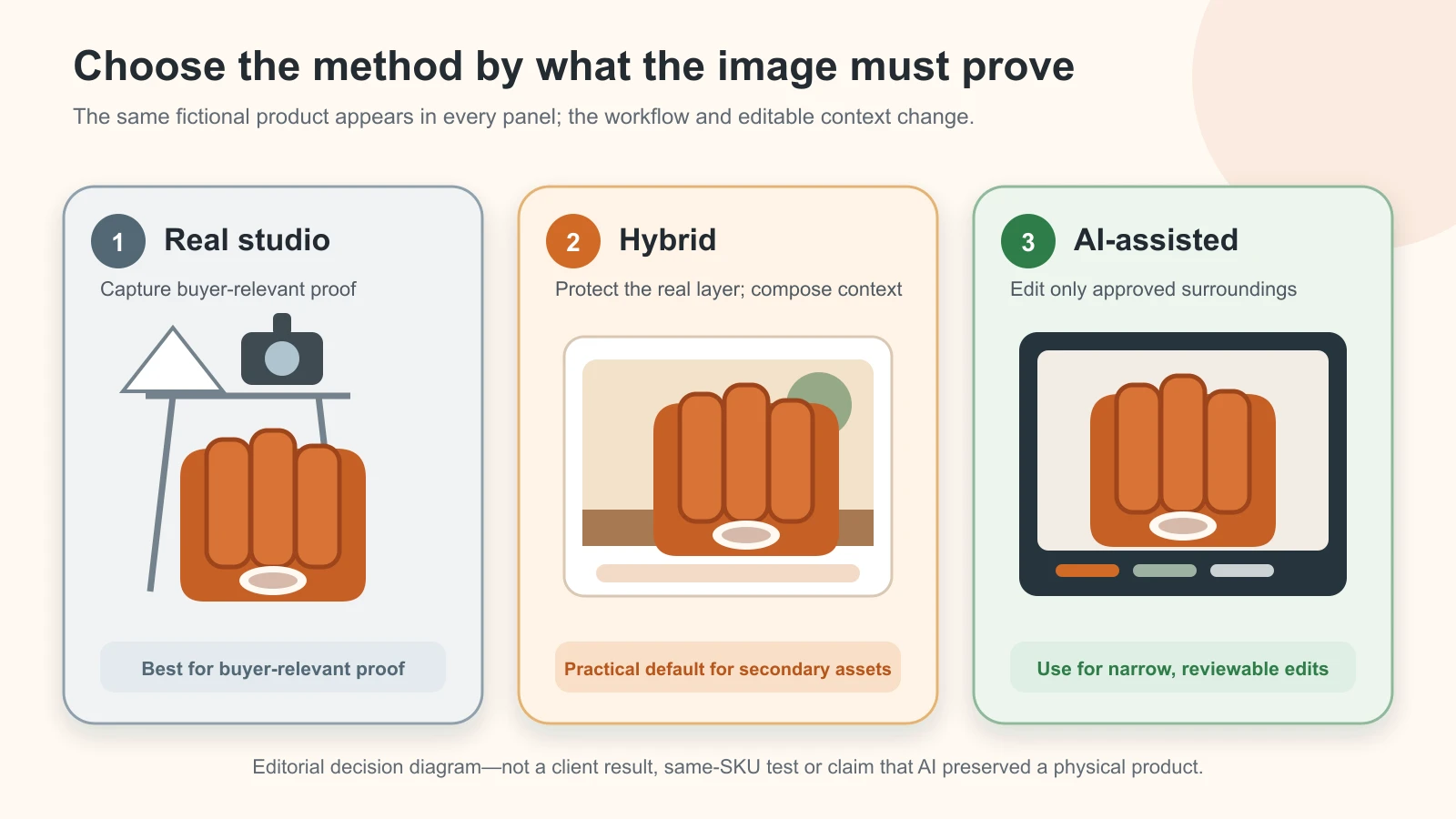
Choose the method asset by asset. Use real photography when the image must prove the exact product, fit, finish, construction, scale or included parts. Use AI for controlled cleanup, crops and secondary context when the product layer can remain truthful. Use a hybrid workflow when you need both: real product evidence plus adaptable backgrounds or campaign scenes. Compare methods by cost per approved asset, not by the price of a shoot or subscription alone.
Table of contents
- The decision in one table
- What AI, a traditional shoot and a hybrid actually mean
- Ask five questions before choosing a method
- Risk-and-fit matrix by image job
- When real capture is mandatory
- When AI is a sensible fit
- Why hybrid is often the practical default
- Compare total cost per approved asset
- Six illustrative product-business decisions
- Check platform rules, rights and advertising truth
- Use this nine-step hybrid SOP
- Run a small decision pilot
- Put the approved method into an online growth system
- Frequently asked questions
The decision in one table
“AI versus photography” is the wrong business-level question. A manufacturer may need a controlled studio capture for a technical component, a hybrid installation scene for a brochure and AI-assisted crops for dealer messages. Those are three asset decisions for one SKU.
Use this first-pass rule:
| If the image must… | Start with | Why | Do not approve until… |
|---|---|---|---|
| Prove the exact item, variant, finish, construction or pack | Real capture | The product itself supplies the evidence | It matches the physical SKU and current offer |
| Show exact fit, drape, scale or use that affects a buying decision | Real capture, usually with a specialist | A plausible reconstruction can still imply the wrong product behaviour | The product expert verifies the visible result |
| Put an already approved product into a new secondary context | Hybrid | A real product layer carries identity while AI changes the scene | Edges, reflections, contact, scale and context remain truthful |
| Remove a background, clean dust, resize or make channel crops | AI-assisted or conventional editing | The task can often preserve the product pixels | The before/after comparison shows no product change |
| Explore a campaign direction before production | AI concept | Fast visual exploration can help a brief | It is labelled concept-only and never presented as product proof |
| Produce a main listing image for an unfamiliar platform or category | Real or hybrid after checking the current rule | The destination controls what may appear and how | The current seller-account/category rule and exact SKU both pass |
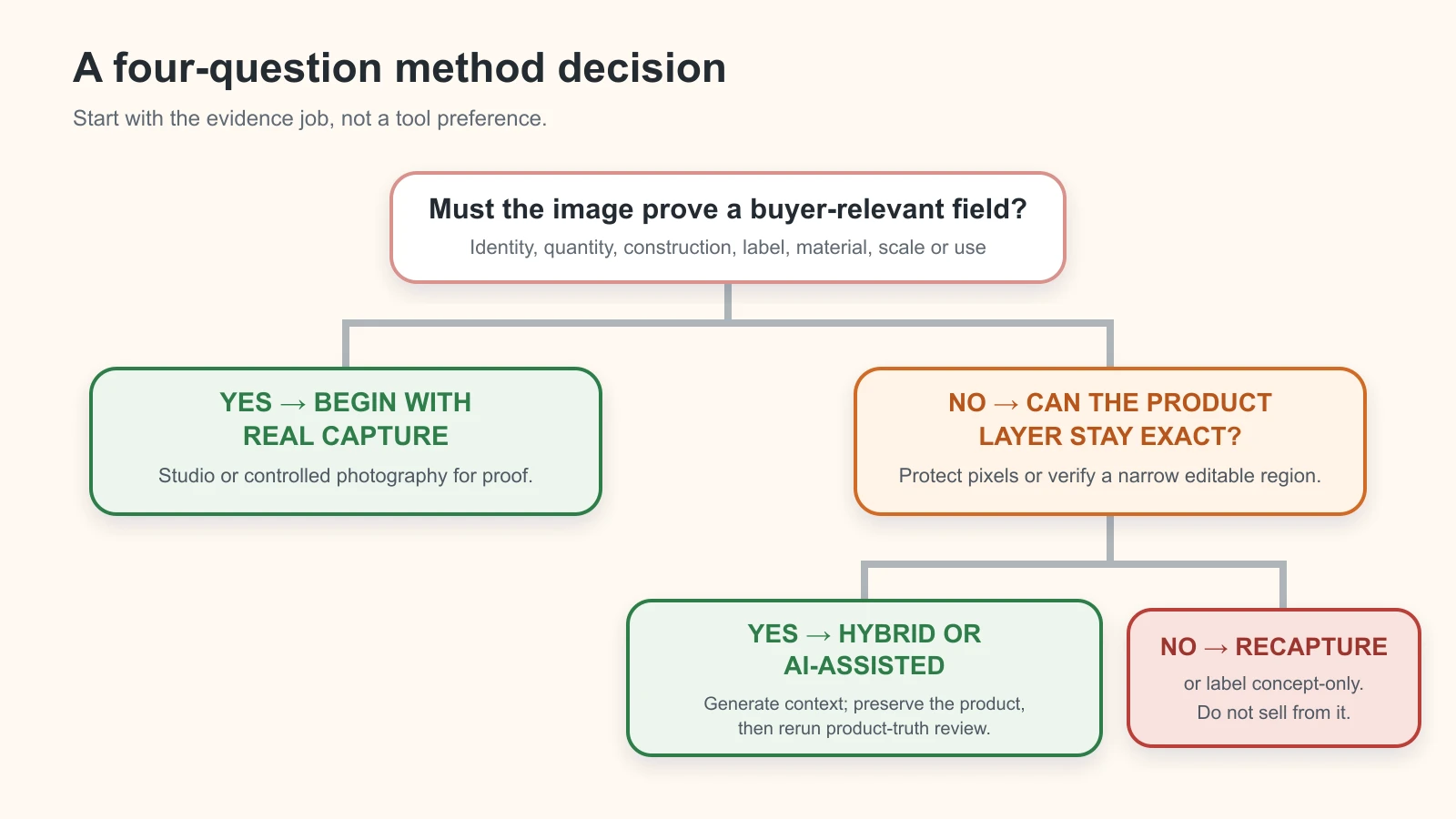
Original GPTWala method-decision diagram. Start with real capture when an image must prove the product; use AI assistance only when the editable scope is narrow and reviewable.
This is a routing table, not a verdict on a profession or tool. A strong photographer can solve lighting, composition and material problems that automation cannot. A disciplined AI-assisted workflow can remove repetitive production work. A hybrid team can use each method where it is strongest.
For the broader terminology and three product-truth risk lanes, read the complete AI product photography guide. This page owns the method-selection and cost decision.
What AI, a traditional shoot and a hybrid actually mean
Fair comparison begins with fair definitions.
AI-assisted product imagery
This can range from low-risk editing to high-risk reconstruction:
- background removal or replacement;
- expansion for a different aspect ratio;
- cleanup, relighting or shadow generation;
- placement of a real cut-out into a generated scene;
- generation of model or lifestyle context around a reference; or
- complete text-to-image generation.
These are not equivalent. Removing dust from a real pack is different from asking a model to reconstruct a necklace. The first may preserve the product; the second can invent it. Judge the actual operation, not the “AI” label.
A traditional or studio photoshoot
This means the sale item, or a verified representative item where that is legitimate, is physically captured. It may involve a product photographer, stylist, model, studio lighting, colour control, focus stacking, specialist rigging and conventional retouching.
“Traditional” does not mean unedited. Real photography still needs a product-truth boundary. Retouching that removes a permanent seam, changes a gemstone setting or alters the pack quantity can mislead just as an AI reconstruction can.
A hybrid workflow
A hybrid starts with verified real captures and uses AI or conventional compositing for a controlled part of the final asset. Common examples include:
- a real product cut-out on an AI-generated room background;
- real apparel and fit reference with a carefully reviewed context extension;
- a studio hero image plus AI-assisted crops for WhatsApp and ads; and
- a real machine-part photograph combined with a clearly illustrative installation setting.
Hybrid does not automatically mean safe. It is safe only when the protected product layer remains exact, the new context does not create false scale or performance implications, and the final file passes human review.
Ask five questions before choosing a method
1. What must this image prove?
Write one sentence:
This image must help the buyer verify the exact blue 750 ml bottle, its current label, cap, quantity and included pourer.
If the sentence contains verify, exact, fits, includes, measured, current pack, finish, setting, connector or safety, begin with real evidence. AI can assist later, but it should not invent the field that the image is supposed to prove.
If the job is “show how this approved bottle could look on a breakfast table,” a hybrid secondary image may be appropriate. The bottle still needs a real source; the table can be contextual.
2. Can the exact product layer remain untouched?
Ask whether the process can preserve the product silhouette, label, colour relationships, construction and reflections while changing only the permitted area.
If the editor must regenerate through the product because the source angle is missing, the mask is poor or the scene demands a new view, risk increases sharply. Return to capture rather than treating the prompt as evidence.
The product-accuracy control guide owns the detailed audit. For this decision, one rule is enough: if you cannot isolate what may change from what must not change, choose real capture or recapture.
3. Is repeatability more important than novelty?
A wholesaler may need the same crop and background treatment across 400 already photographed SKUs. A rule-based AI-assisted edit may be useful if the same acceptance test works across the batch.
A new premium range may instead need one art-directed shoot that establishes lighting, angles and material language. Novelty is not automatically better, and volume does not automatically make full generation sensible. Count repeatable operations, not just SKU volume.
4. Can a qualified reviewer detect a wrong result?
An owner who handles the ceramic every day can often identify a false glaze or rim. A marketplace operator who has never seen the physical product may not. A jewellery image needs someone who can check the stone setting and clasp; an industrial part needs someone who knows the ports and dimensions.
If nobody available can verify the high-risk fields, do not use a method that can reconstruct them. A realistic output is not self-verifying.
5. What happens after approval?
Name the destination before production: website, marketplace main image, additional image, WhatsApp catalogue, dealer PDF, ad or internal concept board.
The same scene can be acceptable as a clearly contextual website image and unsuitable as a marketplace main image. Google Merchant Center, for example, distinguishes the main product image from additional images and currently requires the main image to accurately display the product and correct variant. Its rules also require specified AI-source metadata to remain in generative-AI product images. Check the current destination rather than assuming one “ecommerce-ready” file works everywhere. See Google’s main-image, additional-image and AI-generated content guidance.
Risk-and-fit matrix by image job
“Strong fit” means a sensible starting method, not automatic approval.
| Image job | AI-assisted | Real studio/on-location | Hybrid | Primary failure to control |
|---|---|---|---|---|
| Clean background, dust cleanup or channel crop from a good source | Strong fit | Optional | Useful for difficult edges | Product pixels, thin edges or label are altered |
| Marketplace main image | Conditional | Strong fit | Strong fit when exact product remains real | Wrong variant, crop, staging, overlay or current platform rule |
| Secondary lifestyle image | Useful | Useful | Strong fit | False scale, extra components or invented use |
| Apparel fit and drape proof | Weak as reconstruction | Strong fit | Conditional secondary use | Cut, length, transparency, print or drape changes |
| Jewellery macro/detail proof | Weak as reconstruction | Strong fit | Conditional context use | Stone count, prong, clasp, metal colour or reflection changes |
| Reflective, transparent or translucent product | Risky | Strong fit with specialist control | Useful after a real hero exists | Edges, transparency, highlights or material identity fail |
| Technical part, dimensions or connector proof | Weak as reconstruction | Strong fit | Useful for labelled context diagrams | Hole, thread, port, scale or included part is invented |
| B2B catalogue range with approved SKU cut-outs | Useful for standardisation | Useful for source capture | Strong fit | Variant mapping and batch QA break |
| Seasonal ad background around an approved pack | Useful | Useful | Strong fit | Offer, pack, quantity or context becomes misleading |
| New campaign mood-board | Strong fit as concept | Useful later | Useful | Concept is mistaken for an available product or result |
The matrix deliberately avoids a single winner. It also avoids a separate page for every industry. The product’s buyer-relevant fields and asset role determine the route.
When real capture is mandatory
For this editorial system, real capture is mandatory for the product layer whenever the final image must prove a field that the team cannot otherwise verify. That is an operating stop rule, not a claim that a particular law bans AI.
Start or return to a real shoot when:
- the exact SKU or current variant has not been photographed;
- a reverse side, closure, underside, port or included component is missing;
- fit, drape, transparency or size relationship affects the buying decision;
- colour or surface finish is commercially decisive and the current capture chain cannot be checked;
- stones, prongs, engraving, hallmarks, fine textures or reflective edges must be visible;
- the image communicates dimensions, compatibility, safety, performance or a regulated claim;
- a high-value or one-off item cannot tolerate invented detail;
- a marketplace or category rule requires a presentation the team cannot create and verify from the existing source;
- the AI-assisted result repeatedly changes the same essential field; or
- no competent reviewer can compare the output with the physical item.
“Real capture” can mean an owner’s controlled phone reference for a simple low-risk secondary asset, or a specialist studio for colour, reflections, macro detail, liquids, glass, jewellery, machinery or models. Choose the capture competence that the product demands.
Do not confuse real capture with automatic accuracy. Use the correct sample, clean it, record the variant and approve the retouch. A studio image of the wrong packaging version is still wrong.
When AI is a sensible fit
AI is most useful when it removes repeatable work or creates non-evidentiary context around evidence that already exists.
Good candidates include:
- background removal from a clean source;
- canvas expansion for a banner or vertical ad;
- consistent shadows after the product layer is protected;
- removal of temporary dust, support wires or capture artefacts that are not product features;
- standard crops and exports across approved images;
- multiple secondary room or seasonal contexts around one approved cut-out;
- early campaign concepts that are clearly labelled and not offered for sale; and
- internal visual briefs before a photographer, stylist or designer produces the final asset.
Use a narrower guide for AI background generation or creating a product image from a phone photo when those pages are live. This article does not own their tool steps.
AI is a poor fit when the operation must imagine unseen product surfaces, create another view from inadequate references, reconstruct exact lettering or demonstrate performance. More prompting does not turn missing evidence into evidence.
Why hybrid is often the practical default
A hybrid library separates proof assets from persuasion assets.
Proof assets show what the buyer receives: clean front and back, important details, scale, current packaging, components, fit and construction. Capture these from the real item and preserve them.
Persuasion assets help a buyer imagine context: a sari at an occasion, a planter in a balcony, a fitting in a production line, a gift box in a festive setting. These can use controlled AI assistance when the product remains accurate and the scene does not imply a false inclusion, dimension, use or result.
That separation gives a small business reusable material without asking every image to do every job. It also gives reviewers a fallback: when a contextual image is uncertain, the real proof set remains available.
A practical sequence is:
- capture and approve the exact product once;
- create a protected master cut-out where appropriate;
- build a small number of controlled contexts;
- compare every context with the real proof set;
- export by destination; and
- recapture whenever the requested angle or product state is absent.
For the full phone-to-approved operating trail, use the seven-gate AI product photography workflow. The decision here is simpler: hybrid is valuable only when it keeps the proof layer real.
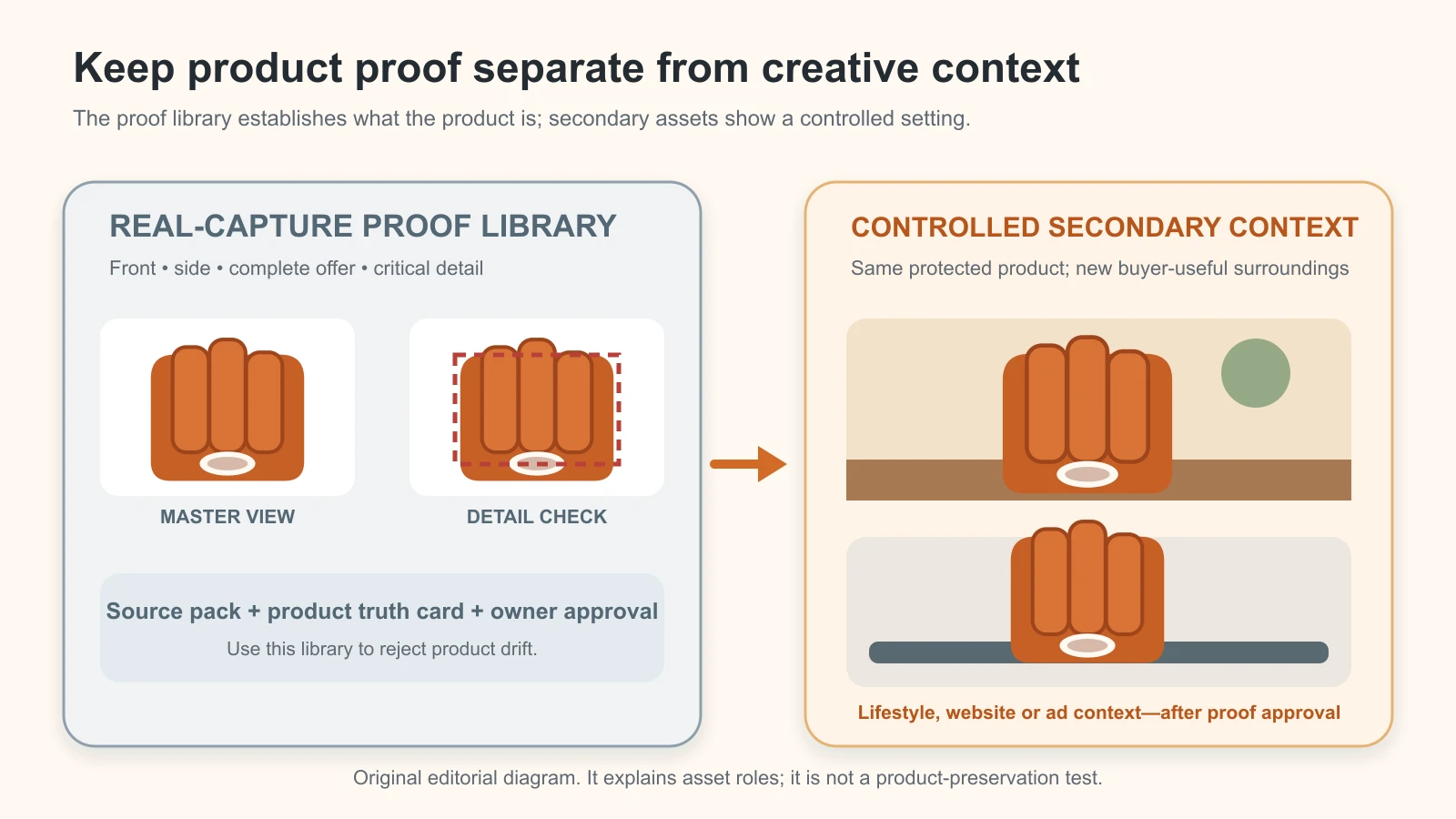
Original GPTWala asset-role diagram. It explains why proof and contextual imagery need different approval jobs; it is not a product-preservation test.
Compare total cost per approved asset
The cheapest generation, subscription or shoot quote can become the most expensive route if it creates unusable files, repeated review or a reshoot. Compare the same job, quantity, destination and quality threshold.
Use the same cost boundary for every method
For each method, record:
- planning and shot-list time;
- sample sourcing, cleaning, transport and returns;
- photographer, studio, model, stylist, operator or agency fees;
- equipment or rental allocated to the job;
- software, credits and storage allocated to the job;
- capture, generation, retouching and compositing time;
- product-expert and channel-review time;
- rejected attempts and revision time;
- export, naming, metadata and hand-off time;
- licensing, releases or rights administration where applicable; and
- reshoot or recapture cost caused by a failed method.
Use the business’s actual loaded hourly cost or an agreed internal rate. Do not copy a universal Indian market rate into the worksheet.
Calculate approved output, not generated output
Use:
Total cost per approved asset = all attributable production and review cost ÷ number of assets that passed product truth and destination review
If an AI tool generates 80 files and only eight pass, the denominator is eight. If a shoot produces 30 captures but the brief required and approved 12 final assets, the denominator is 12. Drafts and rejected variations are work, not inventory.
Add two separate measures:
Lead time per approved set = elapsed time from approved brief to usable hand-off
First-pass approval rate = assets approved without revision ÷ assets submitted for review
These measures reveal different problems. A method can be inexpensive but slow because approval waits for a product owner. Another can have a high shoot fee but deliver a durable proof library for several campaigns.
Use this blank comparison worksheet
| Cost or outcome | AI-assisted route | Real shoot route | Hybrid route |
|---|---|---|---|
| Planning and sample preparation | ₹___ | ₹___ | ₹___ |
| Capture/studio/model/operator | ₹___ | ₹___ | ₹___ |
| Software, equipment and allocated overhead | ₹___ | ₹___ | ₹___ |
| Retouching/compositing | ₹___ | ₹___ | ₹___ |
| Review and revisions | ₹___ | ₹___ | ₹___ |
| Rights, releases and hand-off | ₹___ | ₹___ | ₹___ |
| Recapture/reshoot caused by failure | ₹___ | ₹___ | ₹___ |
| Total attributable cost | ₹___ | ₹___ | ₹___ |
| Assets submitted for review | ___ | ___ | ___ |
| Assets approved | ___ | ___ | ___ |
| Cost per approved asset | ₹___ | ₹___ | ₹___ |
| First-pass approval rate | ___% | ___% | ___% |
| Lead time for approved set | ___ | ___ | ___ |
Do not force depreciation, reusable set design or a source library into one job if they will serve future work. Allocate them consistently and state the rule. Also record the life of the asset: a verified studio master reused for two years is not fairly compared with a one-week campaign background without noting reuse.
The worksheet supports a decision; it does not prove that one method always wins. Keep filled results private until they come from a dated, reviewable production run.
Six illustrative product-business decisions
These scenarios show how the matrix works. They are not claims about real GPTWala clients, costs or outcomes.
Rajkot component manufacturer: real proof, hybrid application context
The manufacturer sells a machined connector to distributors. Hole placement, threading, dimensions and finish affect compatibility.
Decision: commission controlled real front, back, side, macro and measured views for the technical proof set. Use a hybrid image only for a clearly contextual “typical installation” scene, with the real component layer protected and any non-included machinery clearly contextual.
Why not full generation: the image must prove geometry that a model could plausibly but incorrectly reconstruct. A dealer should receive dimensioned technical material, not an attractive approximation.
Surat apparel wholesaler: real garment truth, selective secondary context
The wholesaler needs line-sheet images for many sari designs plus a few campaign scenes. Border, print, weave, transparency and drape distinguish the SKUs.
Decision: capture each exact design and its border/details. Use real model photography when fit or drape is evidence. Consider hybrid or AI-assisted secondary scenes only after the exact garment is preserved and checked.
Stop rule: if the generated view invents pleats, changes the border width, repeats a motif or shows a different transparency, reject it. The dedicated AI model photos for apparel guide should control garment-specific review when live.
Jaipur jewellery retailer: specialist real macro first
The retailer sells a high-value necklace whose stone arrangement, prongs, clasp and scale drive trust.
Decision: use specialist real macro and worn-scale photography for proof. AI may help create a non-product background for a secondary campaign image only if the necklace layer is unchanged and the contact, reflection and scale remain believable.
Stop rule: one changed setting, missing prong, invented hallmark or misleading chain scale stops the asset. Use the AI jewellery photography checklist for category detail when live.
Indore packaged-goods retailer: current pack capture plus seasonal variants
The retailer has a modest catalogue and changes festive messaging through the year. Current label, net quantity, flavour and included count matter.
Decision: photograph the current pack and included units. Keep a clean real main image. Build hybrid secondary festival contexts around the approved pack, but do not add gifts, ingredients, quantities or performance claims that are not part of the offer.
Stop rule: an old pack, unreadable statutory information or an extra product that appears included returns the job to capture or brief.
Morbi ceramics brand: controlled master library, then contextual scale
The brand exports tiles or tableware and needs consistent dealer imagery plus room scenes.
Decision: create real colour/finish and detail masters for every commercially distinct variant. Use hybrid room scenes for inspiration only after checking pattern repeat, scale, edge, grout or set quantity implications. Label a concept if it is not a literal installed result.
Why hybrid: one controlled proof library can support several layouts, while the real master remains the buyer’s reference. Do not let a generated room become the only evidence of finish or size.
Multi-brand wholesaler: rights check before any method
The wholesaler receives mixed supplier images and wants a consistent catalogue quickly.
Decision: first confirm which source files may be edited, uploaded to an AI service and reused in ads. Request missing high-resolution or current-variant files. Then standardise approved sources with controlled backgrounds and crops.
Stop rule: no permission, unclear variant or unknown source means no AI upload and no public reuse until resolved. Speed does not cure an asset-rights gap. The AI catalogue photography guide for manufacturers and wholesalers should own the batch-governance layer when live.
Check platform rules, rights and advertising truth
Method choice is only one gate. A truthful product can still use the wrong crop for a platform; a technically accepted image can still depict the wrong SKU.
Platform rules control the destination
Google Merchant Center’s current main-image page says the image should accurately display the entire product, should not use a generic illustration instead of the actual product except in stated categories, and should show the correct variant, colour, pattern and material. It also requires AI-source metadata to remain in generative-AI images. Google permits AI-generated images in specified image attributes, but that permission is not a promise that any particular output is accurate or will be accepted.
Amazon India’s controlling product-image requirements can require sign-in and category context. Its public seller-staff guidance also tells sellers to check the category Product Page Style Guide. Reopen the current seller account on production day. Do not turn a public forum post, an AI tool’s export label or this article into blanket platform approval.
Use the forthcoming product image rules for Google Shopping, Amazon, Flipkart and websites for the channel-by-channel check. Until then, verify each live seller surface directly.
Put rights and permissions in the brief
In India, the Copyright Act identifies photographs as artistic works and contains specific rules on first ownership of commissioned photographs, subject to its provisions and any agreement to the contrary. It also sets requirements for written assignments, including the work and rights assigned. Those rules can be fact-specific; this article is not legal advice. See the official Copyright Act, 1957, especially Sections 2, 17 and 19, and obtain professional advice where needed.
Operationally, record:
- who created or commissioned each source photograph;
- the agreed media, territory, duration, editing and sublicensing scope;
- whether supplier files may be modified and used in advertising;
- whether the selected AI service may receive the product, logo, model or location files under its current terms;
- model, talent and location permissions where applicable;
- restrictions on confidential prototypes or unreleased designs; and
- who may deliver masters and working files after the job.
Do not assume a subscription gives rights to source material you did not own, or that paying a photographer resolves every model, location, trademark or cross-border use. Put the required commercial uses in writing before production.
Product truth applies to every method
The ASCI Code says advertising claims should be truthful and that visual presentation should not mislead by implication, omission, ambiguity or exaggeration. The Government of India’s Consumer Protection rules and guidelines hub lists the E-Commerce Rules and the 2022 misleading-advertising guidelines.
That is why an AI scene must not imply a component, scale, capability or result that the buyer does not receive—and why a heavily retouched studio image does not get a free pass. Keep claim evidence and product approval separate from aesthetics. Obtain category-specific legal or regulatory advice for medical, food, cosmetic, electrical, safety-related or other controlled claims.
Use this nine-step hybrid SOP
This is a narrow hand-off between real capture and controlled context. It is not a replacement for the complete production workflow.
1. Assign one image role
Name the exact SKU, destination and role: proof, detail, lifestyle, ad or concept. Do not combine “marketplace main image” and “festive ad” in one brief.
2. Lock the product truth fields
List the silhouette, variant, colour relationship, finish, pattern, label, construction, quantity, components, dimensions and approved claims that cannot change.
3. Capture the real proof set
Photograph enough views to verify the locked fields. Keep the untouched originals and the physical product available until the first contextual output passes.
4. Confirm rights and destination
Record source permissions, model/location permissions where applicable, tool upload permission and the current channel/category rule.
5. Build a protected product master
Create a clean cut-out or approved real base without reconstructing missing edges. Thin chains, glass, fibres, shadows and reflective edges may need specialist masking. If the extraction cannot preserve the item, change the source or method.
6. Generate or compose only the permitted context
Mask or otherwise protect the product layer. Specify what may change—background, surface, lighting environment or crop—and what must remain untouched. Avoid prompts that ask for another product angle unless that view has real evidence.
7. Review proof and context separately
First compare product identity, offer, material and geometry against the real item. Then check contact, shadow, reflections, scale, surrounding objects and implied use. Reject a context that makes an unsafe, unsupported or non-included claim.
8. Export for one destination
Apply the current size, crop, format, overlay and provenance rules. Preserve required metadata through compression, content management and delivery. Reopen the delivered file—not only the editor preview.
9. Record the decision and true cost
Mark APPROVED, REVISE or REJECTED with a reason. Record attempts, operator time, reviewer time, external fees and approved output. Feed the result into the cost-per-approved-asset worksheet.
If product truth repeatedly fails at Steps 5–7, do not keep regenerating. Return to the real shoot, change the asset role or use the real image without generated context.
Run a small decision pilot
Before committing a range, choose one representative SKU and three materially different asset jobs:
- a proof or main-listing image;
- a secondary contextual image; and
- a channel crop or campaign variation.
Produce each job with only the methods that are genuinely plausible. Do not force full AI generation into a proof job just to complete a comparison.
Keep the same brief, product, destination check and approval owner. Record:
- source quality and missing views;
- first-pass product-truth result;
- destination result;
- attempts and rejection reasons;
- hands-on and elapsed time;
- all attributable cost;
- approved asset count; and
- whether the method creates a reusable master.
At the end, make a per-job decision:
- Real: proof risk or specialist capture need dominates;
- AI-assisted: the task is repeatable and product preservation is demonstrable;
- Hybrid: real evidence plus adaptable context gives the cleanest control; or
- Stop/change brief: no method can support the requested implication truthfully.
This pilot is a template, not a result. Do not publish a savings percentage or “faster than a studio” claim until a dated comparison with the same acceptance standard exists.
Put the approved method into an online growth system
Choosing the right image method does not create demand by itself. The asset still needs a useful destination, an offer, a way for buyers to ask questions and a follow-up process.
If your product business still depends mostly on walk-ins, referrals or dealer visits, the GPTWala workshop explains the DAA path: Digital Presence → AI Content Creation → ₹100/day WhatsApp ads. Product photos belong in the AI Content Creation layer; the workshop shows how that layer connects to a visible presence and a controlled enquiry process. It does not promise leads, sales or ROI.
See the GPTWala workshop
Choose an image method that supports the business system—not a pile of unused files.
Frequently asked questions
Is AI product photography always cheaper than a traditional photoshoot?
No. Compare total cost per approved asset for the same brief and acceptance standard. Include source capture, subscriptions or credits, operator time, retouching, product-expert review, rejected attempts, exports, rights administration and recapture. AI can be efficient for repeatable context or crops; repeated product errors can erase that advantage. A shoot can cost more upfront while creating a reusable proof library.
Can AI replace a product photographer?
Not as a universal rule. AI can reduce repetitive editing and create controlled secondary context. A photographer remains the stronger starting point when lighting, material, reflections, macro detail, colour, fit, scale or physical product proof must be captured. Many businesses will use both, with the method chosen per asset.
Is a studio photo automatically more accurate than an AI image?
No. A studio can capture the real item, but the wrong sample, poor colour control or excessive retouching can still create a false image. Real capture provides evidence that generation cannot invent; it still needs exact-SKU identification, an approved brief and product-truth review.
What is hybrid product photography?
Hybrid product photography combines verified real product captures with controlled editing, compositing or AI-generated context. A common example is an approved real cut-out placed into a generated lifestyle scene. The product layer, offer and scale still need side-by-side approval, and the final destination rules still apply.
Which method is safest for jewellery?
Begin with specialist real capture for stone settings, prongs, clasps, metal colour, engraving, scale and reflections. Use AI cautiously for secondary backgrounds or campaign context only when the real jewellery layer remains intact. Reject any changed construction or implied hallmark, weight, purity or inclusion.
Which method is best for apparel model images?
Use real garment and fit evidence when cut, length, drape, print, transparency or size presentation matters. AI-assisted model or context images can be secondary assets only after garment-specific review. A plausible garment on a model can still show a different construction.
Can I use an AI image as a marketplace main image?
Only if the current platform, account and category rules allow the final presentation and the image accurately represents the exact product. Google Merchant Center currently allows generative-AI images in specified attributes but also requires the actual product/correct variant standards and AI-source metadata. Other marketplaces control their own current rules. Check on upload day; “marketplace-ready” from a tool is not approval.
How do I calculate cost per approved product image?
Add every attributable production and review cost, then divide by the number of assets that pass both product-truth and destination review. Use approved assets—not generated variations—as the denominator. Record lead time and first-pass approval separately so a low price does not hide long waits or repeated rework.
Who owns commissioned or AI-assisted product images?
Ownership and permitted use depend on the source, contract, applicable law, tool terms and any third-party rights. Indian copyright law has specific rules for commissioned photographs and written assignments, but the facts and agreement matter. Record rights, media, territory, duration, editing, AI upload and model/location permissions in writing, and seek legal advice for uncertain or high-value use.
Sources and review method
Reviewed 11 August 2026. The method matrix, cost worksheet, hybrid SOP and illustrative scenarios are GPTWala editorial tools, not externally validated standards. No real comparative cost pilot was available for this draft. Platform rules and service terms can change; recheck them within 24 hours of publication and on each destination’s upload day.
- Google Merchant Center: image link
- Google Merchant Center: additional image link
- Google Merchant Center: AI-generated content
- Amazon.in Seller Central: Product Image Requirements (sign-in may be required)
- Amazon.in seller-staff public product-image guidance
- Government of India: Consumer Protection rules and guidelines
- ASCI Code for Self-Regulation
- Copyright Office, Government of India: Copyright Act, 1957
- Google Search Central: general structured-data guidelines
- Google Search Central: FAQ and HowTo rich-result changes
- GPTWala workshop
Leave a Reply