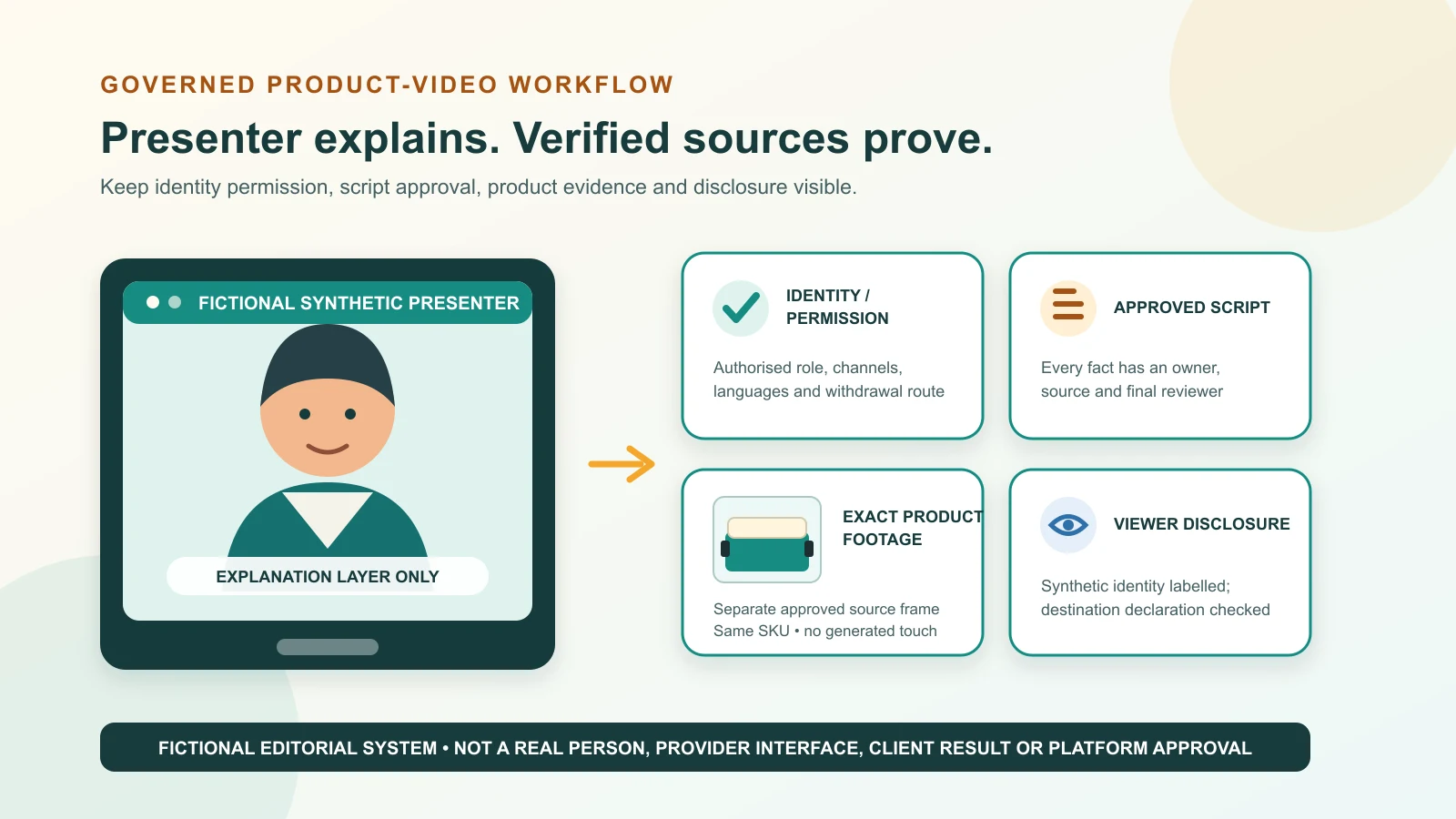
Reviewed and updated: 12 August 2026
Editorial disclosure: no avatar, voice, product, account, advertisement or upload was created or tested for this article. Named controls and policies come from current official sources. The workflow, consent-scope card, claim ledger and review gates are GPTWala editorial guidance; all business examples and planned visuals are fictional.
An AI spokesperson product video can explain a verified product repeatedly and in more than one language, but the presenter must never become a shortcut around consent or truth. Choose an authorised identity, document the permitted uses of the face and voice, approve every claim, show the exact product through real product assets, and disclose synthetic media where the law, provider or destination requires it. If the message depends on personal experience, expertise or a real demonstration, record a real person instead.
Table of contents
- What this guide owns
- Choose the presenter type
- Build real consent
- Check current provider limits
- Create the truth pack
- Write a truthful script
- Keep the product exact
- Use the production workflow
- Review Indian languages
- Disclose the right things
- Run the approval gate
- Indian product-business examples
- Know when to record a human
- Frequently asked questions
What an AI spokesperson product video is
An AI spokesperson product video uses a generated or digitally recreated presenter, voice, or both to deliver a product script. The presenter may be:
- a provider-supplied stock or synthetic avatar;
- a fictional character created for the brand;
- an authorised digital version of a founder, employee or creator;
- a licensed synthetic voice over product footage; or
- a hybrid, with a short synthetic introduction followed by real product shots.
The presenter is the delivery layer. It is not product evidence, a customer, an expert, or a person who has used the item merely because it looks and sounds confident.
This article owns identity choice, face and voice permission, script authority, presenter disclosure, multilingual review and final trust approval. The complete AI product-video guide for Indian product businesses owns video strategy, channel roles and measurement. The still-photo product-demo workflow owns the safe assembly of verified product stills. The future AI ad-creative guide owns paid testing and campaign use.
Four statements that must stay separate
Before production, ask four different questions:
- Who is speaking? A fictional avatar, licensed stock presenter, founder, employee, customer, creator or expert?
- What may that identity say? Brand facts, personal experience, technical advice, a testimonial or an endorsement?
- What proves the product? Real footage, approved stills, current catalogue data, test records or nothing yet?
- What must viewers and platforms be told? Synthetic-media status, commercial relationship, product limitations and current upload declaration?
One “AI-generated” label cannot answer all four. Likewise, a provider accepting an avatar does not verify the product, the script or the final advertising use.
Choose the lowest-risk presenter that can do the job
Use the least identity-dependent format that still communicates clearly.
| Presenter route | Appropriate role | Main risk | Minimum approval condition |
|---|---|---|---|
| Real owner/staff recording | Founder story, expertise, craft, personal message or real demonstration | Ordinary filming, claim and release risks | Real speaker approves the script and final edit; claims are supported |
| Clearly fictional or stock synthetic presenter | Neutral explanation, FAQ, catalogue navigation or dealer-enquiry introduction | Viewer assumes a real person or real experience; provider licence may restrict channels | Current licence allows the intended use; synthetic status and script ownership are clear |
| Authorised founder/employee avatar | Repeatable brand explanation or approved language versions | Likeness/voice scope expands beyond what the person expected | Same person completes provider verification; separate scoped permission and script approval exist |
| External creator or influencer avatar | A contracted campaign where the person’s identity is genuinely relevant | False endorsement, material-connection disclosure, reuse after campaign | Detailed agreement, genuine endorsement, claim due diligence and destination disclosure |
| Customer/testimonial avatar | Rare; only reproducing a genuine, current account with explicit permission | Fabricated experience or altered meaning | Original testimony exists, is current and accurately represented; customer approves every final version |
| Unauthorised real-person or celebrity clone | None | Impersonation, false endorsement and identity harm | Do not create or publish |
A neutral stock avatar is not automatically safe. It can still imply that a real sales representative, technician, doctor, customer or designer is speaking. Wardrobe, background, name caption, script and product category all shape that impression.
Do not manufacture authority through styling
Reject a synthetic presenter designed to look like a professional whose authority the business cannot substantiate. Examples include:
- a person in a doctor’s coat making health claims;
- a hard-hat “engineer” certifying machinery performance;
- a jeweller or assayer guaranteeing purity without verified evidence;
- a chef claiming personal use of cookware never tested by that person;
- a customer describing delivery, fit or durability that never occurred; or
- a founder lookalike presented as the actual founder.
If expertise is necessary, use an appropriately qualified, authorised real person and obtain category-specific review.
Treat provider verification as one control, not the whole consent record
Current avatar providers use identity and consent checks. For example, HeyGen says every video-based Digital Twin requires a short consent video and that a person creating an avatar for someone else must have that person submit their own consent recording. Synthesia currently requires a live consent video of the same person for a photo avatar and separate voice-speaker consent for voice cloning. These are useful safeguards, not a complete contract for your marketing programme. See HeyGen’s consent-video instructions, Synthesia’s personal-avatar guidance and Synthesia’s voice-cloning guidance.
Build a scoped permission record before uploading a face or voice
At minimum, record and review:
| Permission field | Question the record must answer |
|---|---|
| Identity | Who is the real person, and who verified that the source face/voice belongs to them? |
| Source assets | Which photographs, footage and voice samples may be uploaded? |
| Creation purpose | Is permission for a test, internal training, product explainers, organic social, paid advertising or all approved uses? |
| Presenter role | May the avatar appear as founder, employee, creator, neutral narrator or another precisely defined role? |
| Script authority | Must the person approve every script, every final output, or a defined claim library plus every final output? |
| Products and claims | Which categories, SKUs, claims and sensitive topics are permitted or forbidden? |
| Languages and voice | Which languages, accents, translations, cloned voices and pronunciation variants are allowed? |
| Channels and geography | Website, YouTube, Instagram, marketplace, WhatsApp, paid ads, dealer screens, India or other territories? |
| Term and archive | When does permission start/end, and what happens to old public videos and internal files? |
| Access | Which employees, agencies and provider workspaces may generate or edit the avatar? |
| Training and retention | What may the provider retain or use, under the selected account terms and settings? |
| Withdrawal and disputes | How can the person raise an objection, and who pauses new use, access and distribution? |
| Payment and credit | What compensation, attribution or material-connection disclosure applies? |
| Final approval | Who signs off the face, voice, script, product, disclosure, destination and export? |
This is an operational checklist, not a legal release. Likeness, voice, employment, advertising, privacy and data rules vary with the people, category, territory and distribution. Obtain current legal advice where the use is material, sensitive or disputed.
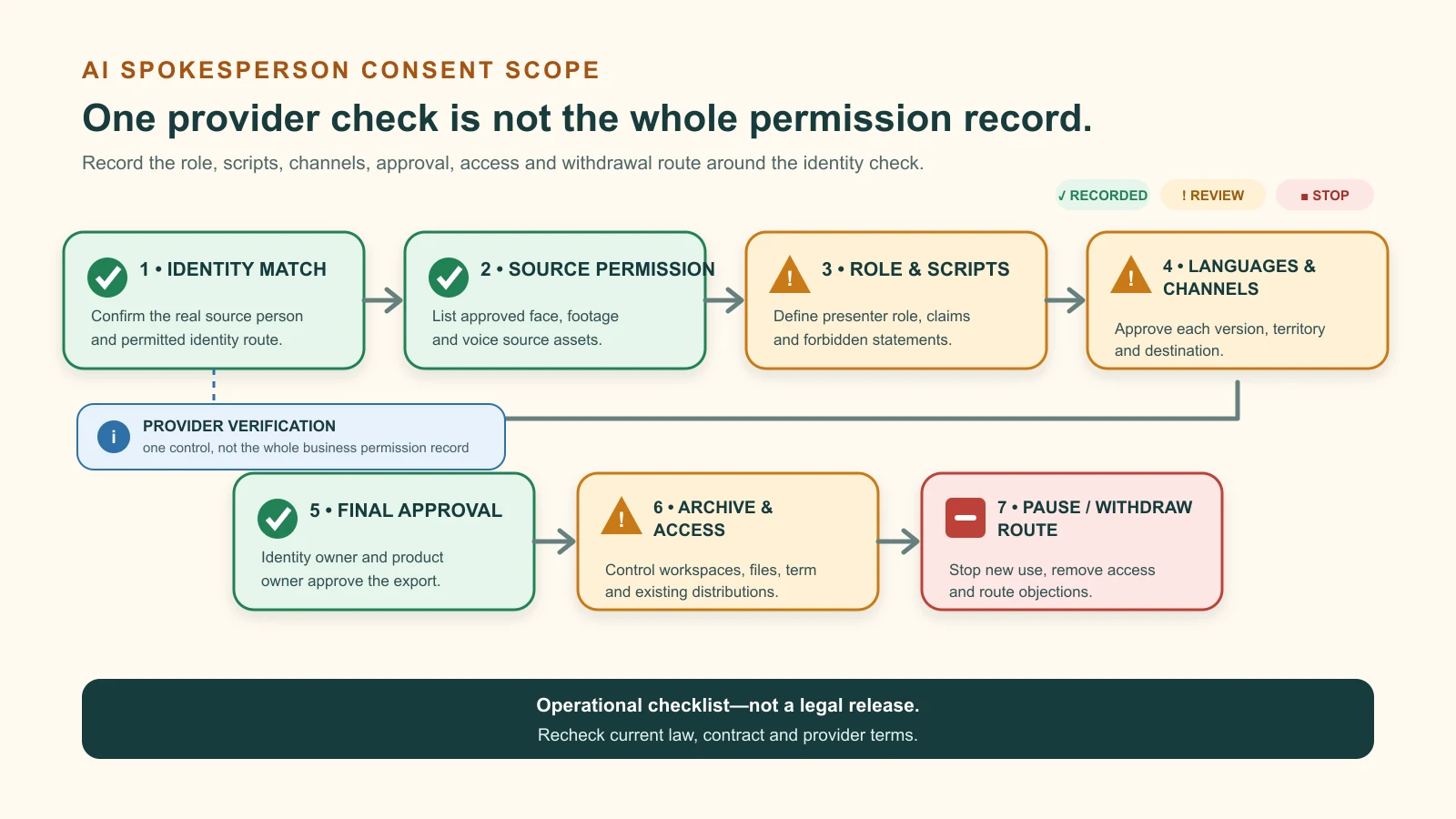
GPTWala consent-scope card. A provider’s live consent check is one gate inside a wider business permission and approval record.
Keep consent specific and reversible in operations
Do not bury avatar permission inside a vague “all media forever” line and then assume the relationship will never change. A practical system should be able to:
- stop new generation immediately;
- remove staff or agency access;
- identify every existing video using the identity;
- distinguish editable project files from already distributed copies;
- record whether withdrawal affects future use, existing use or both after advice; and
- route a complaint to a named owner rather than an unmanaged inbox.
India’s data-protection framework has a phased commencement. The official 13 November 2025 notification schedules many core processing and consent provisions of the Digital Personal Data Protection Act for a later commencement date. That timing is one reason not to copy an old consent template or treat this checklist as legal advice; verify the law and contract position on the actual production date. See the official DPDP commencement record on India Code.
Check the current tool licence and consent route
Provider controls differ by avatar type, voice type, plan and intended channel. Recheck the current source in the account before production; do not rely on a tutorial screenshot.
Three current examples show why the exact route matters
- HeyGen Digital Twin: the person shown must provide the required consent video. That proves a current provider gate exists; it does not approve your claim, contract, destination or product depiction.
- Synthesia personal avatar and voice: current guidance requires same-person live consent for a photo avatar and the voice speaker’s own passcode consent for a clone. Its current licensing page also distinguishes stock/synthetic-avatar use from custom-avatar use and lists paid-promotion restrictions for stock/synthetic avatars. Check the exact licence before turning an organic product explainer into an ad. See Synthesia’s current video-licensing page.
- ElevenLabs Professional Voice Clone: current help says a user can create a Professional Voice Clone only of their own voice. If another speaker wants to share one, that speaker creates and verifies it in their account and can share it privately. ElevenLabs also prohibits unauthorised, deceptive or harmful impersonation. See Professional Voice Clone ownership guidance and the ElevenLabs Prohibited Use Policy.
These examples are not a tool ranking or a promise that a feature is available on your plan or in your location. They establish a working rule: verify the current identity route, licence, data terms and destination for the exact presenter type you intend to use.
A provider approval does not mean platform or ad approval
Keep four approvals separate:
- the avatar/voice provider accepts the source identity and content;
- the identity owner permits the specific business use;
- the destination accepts the media, disclosure and advertising format; and
- the product/category reviewer approves every visible and spoken claim.
Passing one does not imply the others. Do not write “approved for ads” unless the current provider licence and actual advertising destination both say so for that asset and use.
Build the product, identity and claim pack first
Do not generate the presenter and then invent something for it to say. Assemble the evidence first.
Product identity card
For the exact item shown, record:
- product and child SKU/design code;
- current colour, finish, size and pack version;
- quantity and included components;
- dimensions and units from controlled data;
- exact label, logo, model and variant text;
- material and construction claims;
- current price, tax, minimum order, stock and territory where mentioned;
- product warnings, exclusions and compatibility limits;
- source image/video IDs; and
- product owner and approval date.
If the physical item, source footage and product record disagree, stop and reconcile them. The avatar should never be used to smooth over a catalogue error.
Identity card
Record:
- real, fictional, stock or authorised digital-double status;
- provider avatar/voice ID and workspace owner;
- approved public name and role, if any;
- source-person permission record or stock licence;
- permitted/forbidden scripts and destinations;
- required identity and commercial disclosures; and
- approval owner, expiry and withdrawal route.
Do not label a fictional avatar with a plausible employee name, title or professional credential unless the communication makes its fictional status clear and the representation has been reviewed.
Claim ledger
Every factual sentence needs an owner and source.
| Proposed line | What it implies | Evidence needed | Safe treatment |
|---|---|---|---|
| “Model RB-24 is available in blue and grey.” | Current variants and availability | Current SKU/stock record | Allow only for the named date/market; update or remove when stale |
| “The carton contains 24 units.” | Exact sale quantity | Current pack/BOM and real set image | Show the real count or sealed pack; reject if quantity changed |
| “I use this every day.” | Speaker’s personal experience | Genuine, current experience of the identified speaker | Never assign to stock/fictional avatar; use only with the real person’s truthful approval |
| “Our founder designed this.” | Identity, role and authorship | Company record and founder approval | Use founder’s real recording or authorised avatar with exact wording |
| “Customers love the fit.” | Broad testimonial/consumer evidence | Representative, current evidence and compliant claim review | Prefer specific verified feedback; do not put invented consensus in an avatar’s mouth |
| “100% waterproof.” | Measured performance | Relevant controlled test and scope | State the precise supported rating/conditions or remove; use real proof footage where needed |
| “Only five left.” | Real scarcity | Timestamped stock record for that destination | Publish only while true; avoid synthetic urgency |
The CCPA’s Guidelines for Prevention of Misleading Advertisements and Endorsements for Misleading Advertisements, 2022 require truthful, honest representation and address misleading exaggeration. An official March 2026 PIB explanation also states that an endorsement should reflect the genuine, reasonably current opinion of the endorser and be based on adequate information or experience. A synthetic presenter cannot create that experience after the fact.
Write a script the presenter is actually allowed to say
Use brand-language by default, not fake personal experience
For a neutral or fictional avatar, prefer:
- “This model includes…”
- “The product record lists…”
- “The real product footage shows…”
- “For current price and availability, message the seller…”
- “The manufacturer specifies…” followed by accurate qualification.
Avoid:
- “I bought this…”
- “I tested this…”
- “I recommend this…”
- “My patients/customers use this…”
- “We guarantee…” without the exact authorised guarantee; and
- “As an engineer/doctor/jeweller…” when no real qualified speaker is making the statement.
An authorised founder avatar may use first person only where the statement is true, within the permission scope and approved in the final context. “I founded this business in 2018” and “I personally use every product” are different claims; verify each.
Write one language master before translations
The language master should include:
- exact product/SKU name;
- pronunciation and forbidden substitutions;
- approved units, numbers and currency format;
- claim source beside each factual line;
- words that must remain in English or a product-specific term;
- warnings and qualifications that must not be shortened;
- disclosure wording; and
- one current call to action.
Keep sentences short enough to review by ear. Do not let a fluent synthetic voice hide a changed number, model name or guarantee.
Illustrative scene map for a B2B product introduction
This example is a script structure, not a tested duration or performance formula.
| Scene | Picture | Speaker/copy role | Proof rule |
|---|---|---|---|
| 1 | Synthetic presenter beside brand colour panel | Identify the product and buyer problem | Presenter clearly synthetic/authorised; no personal experience |
| 2 | Real approved front and side footage of SKU RB-24 | Name visible construction and variant | Product pixels come from verified source footage |
| 3 | Real set/pack image | State carton quantity and included parts | Quantity must match current BOM and offer |
| 4 | Native text card plus real detail | State verified MOQ, territory or compatibility | Time-sensitive fields have owner/date |
| 5 | Presenter returns with enquiry CTA | Invite catalogue request or WhatsApp enquiry | No false urgency or guaranteed outcome |
| 6 | Disclosure/end card | Identify synthetic presenter and commercial source | Disclosure survives every crop/export |
Do not make the avatar hold, wear, open, pour or operate the product unless the interaction was really captured and composited without changing it. A generated gesture is not a demonstration.
Keep the synthetic presenter and product proof separate
The safest composition uses a presenter to orient the viewer and real product assets to prove the item.
Use a two-layer edit
Presenter layer
- carries explanation, navigation and CTA;
- uses an authorised/stock/fictional identity;
- contains no generated product interaction;
- remains visually distinct from technical or product proof; and
- carries the appropriate synthetic identity disclosure.
Product-evidence layer
- shows real video or approved stills of the exact SKU;
- preserves label, geometry, colour, texture, quantity and included parts;
- adds dimensions, price and claims as verified native text;
- uses real footage for operation, fit, drape, scale, safety or performance; and
- retains source IDs and product approval.
If you only have stills, use the product demo from still photos workflow and keep motion inside the photographed evidence. Use the product-accuracy guide before placing any AI-edited product asset into the video.
Reject “presenter holding product” generations when touch matters
Generated contact can silently change:
- the product’s size relative to a hand or body;
- the number, shape or position of handles, clasps, stones, straps or buttons;
- the way a garment fits or falls;
- a jewellery piece’s length, stone count, setting or hallmark;
- a machine’s controls, guards, cable or moving parts;
- the quantity inside a pack; and
- shadows and reflections that imply false material or scale.
For sale-facing proof, film a real authorised person holding/using the exact item, or show the product separately. Use the synthetic avatar only as a presenter.
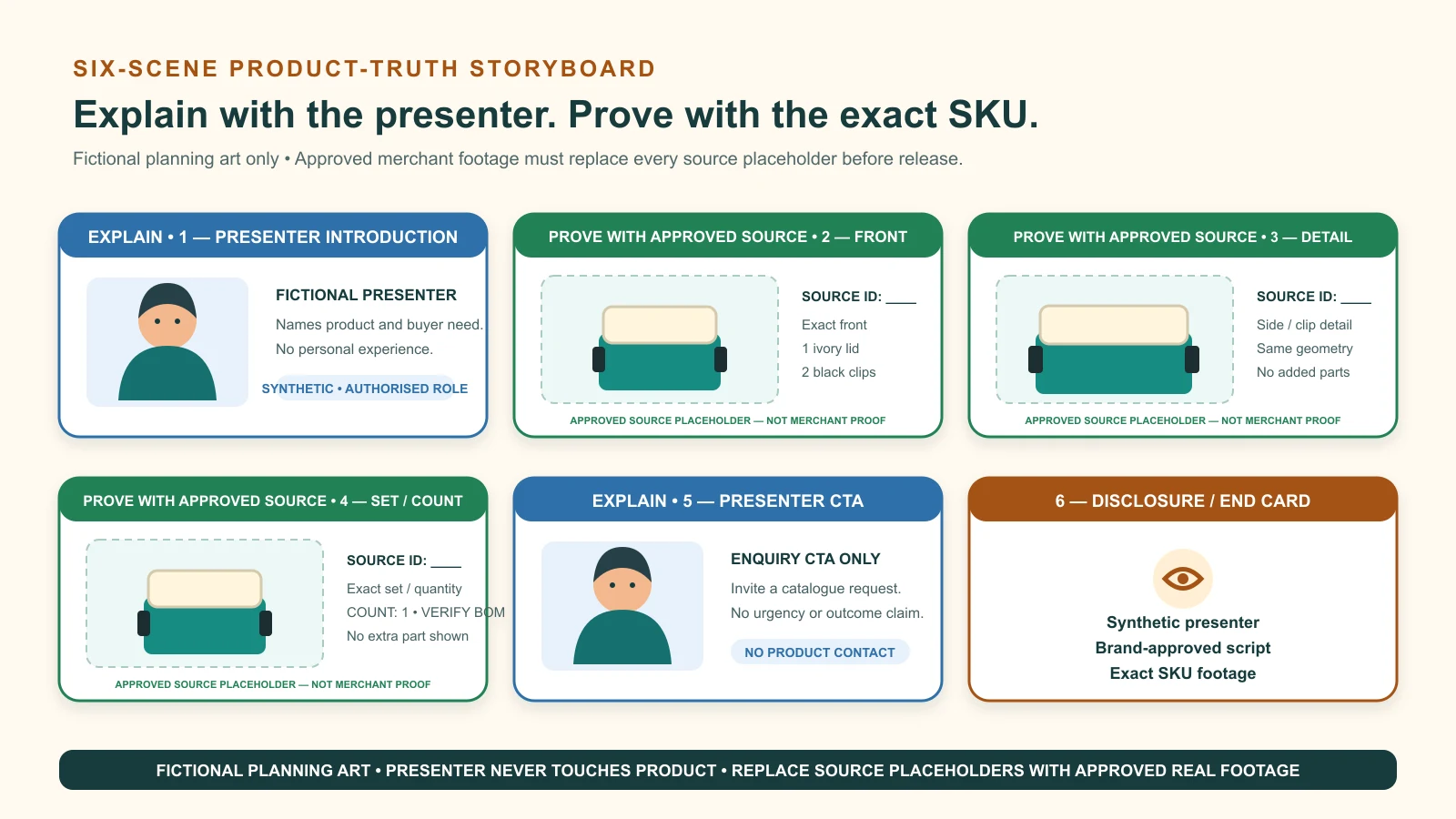
Fictional storyboard. Presenter scenes explain; real-product scenes prove. No generated touch, testimonial or performance claim is shown.
Use a twelve-step spokesperson workflow
1. Define one job and one destination
Choose a bounded job: introduce a dealer catalogue, answer one repeated product question, explain a verified feature or invite an enquiry. Record whether the file is for a website, organic social post, marketplace, WhatsApp, sales screen or paid ad. Rights and disclosures can change by destination.
2. Choose the identity class
Select real recording, stock/fictional avatar, authorised digital double or synthetic voice-only. Write down why that identity is necessary. If a neutral captioned product video can do the job, it may be the simpler option.
3. Verify identity and permission
Complete the provider’s current same-person/voice verification route. Separately complete the business permission record for source upload, role, script, languages, products, term and channels. Do not ask an agency to “make the founder avatar” from public clips.
4. Verify the licence and data route
Check the exact provider, avatar/voice type, account plan, commercial-use terms, paid-promotion restrictions, workspace access, retention and deletion controls. Save the dated source/terms version in the project record. Do not publish a legal conclusion based only on a pricing table.
5. Lock the exact-product pack
Confirm SKU, variation, source footage, claims, quantity, price/offer and product owner. Protect the original media; work on traceable copies.
6. Build and approve the claim ledger
Map every number, feature, comparison, superlative, testimonial, certification and CTA to current evidence. Remove any sentence without an owner and source.
7. Approve the language master
The identity owner, product owner and marketing owner review the exact script. A specialist reviews regulated or technical claims where necessary. Lock the approved version before synthesis.
8. Generate the presenter without product proof
Create a short presenter candidate on a clean background or brand panel. Keep the product out of the avatar’s hands and generated scene. Record provider, avatar/voice ID, settings, project version and output date. No candidate is approved merely because it renders successfully.
9. Review face, voice and role
Compare the output with the authorised identity and intended role. Reject:
- face or voice mismatch;
- strange expressions that change the message;
- wrong name, accent or professional impression;
- lip-sync that changes a number or term;
- emotional delivery that implies a testimonial; or
- an output the real person considers unacceptable.
10. Add exact-product evidence
Cut to real, approved product footage/stills for every product fact. Add copy as native text. Review every crop, composite edge, shadow, reflection, label, component and frame transition. Do not let a transition merge the avatar with the product.
11. Add disclosures and destination data
Assess synthetic-media, commercial-relationship and platform-upload disclosures separately. Preserve provider labels/provenance where required. Add captions and accessible disclosure in the relevant language. Recheck the destination’s current rules on upload day.
12. Run final approval and archive the record
The identity/consent owner approves the person and voice. The product owner approves the SKU and claims. The language reviewer approves every spoken/captioned version. The channel owner approves licence, disclosure and final export. Archive sources, script, permissions, output IDs, approvals and released destinations.
Do not release an “almost approved” file while waiting for one of those gates.
Review every Indian language as a new claim version
Synthetic dubbing can make a script sound fluent while changing its commercial meaning. Review each language against the locked master, not only against the previous translation.
Build a spoken truth sheet
For Hindi, Gujarati, Marathi, Tamil, Telugu, Bengali or another target language, record:
- exact product/brand pronunciation;
- SKU and model-code reading;
- units such as mm, ml, kg, watts, carats and pieces;
- currency, tax, MOQ and offer wording;
- material, purity, safety, warranty and certification terms;
- whether English product terms should remain unchanged;
- required disclosure in the same language or an approved understandable form; and
- named human reviewer and approval date.
Review five tracks, not only the voice
- Meaning: Does the translation preserve every limit and qualification?
- Identity: Does the voice still sound within the authorised role and scope?
- Timing: Does shortened or stretched speech detach a claim from its proof shot?
- Captions: Do captions match the final audio, model code, units and price?
- Disclosure: Is the synthetic/commercial disclosure understandable and visible/audible in the final destination crop?
If no fluent reviewer can verify a language, do not publish it as an approved sales version. Use a simpler real narration, find a qualified reviewer or keep the video in the language you can govern.
Use three different disclosures for three different questions
1. Synthetic-identity disclosure: “Is this a real recorded person?”
For a realistic synthetic presenter or cloned voice, a plain-language on-screen and/or audible statement can clarify the production method. A practical template is:
AI-generated presenter and voice. Script approved by the brand. Product footage shows the exact SKU identified in this video.
Use the last sentence only when it is true and verified. For an authorised real person’s digital double, name the person only with permission and state that an authorised digital avatar/voice is being used. Translate and human-review the disclosure for the audience.
India’s 2026 IT Rules amendment created a current intermediary due-diligence framework for “synthetically generated information” (SGI). MeitY’s official FAQ says the threshold covers realistic synthetic audio/visual media that appears real and depicts a person/event in a way likely to be perceived as indistinguishable from the real. It describes prominent labels/provenance for qualifying permissible SGI and user declarations/labels on significant social-media intermediaries. These are intermediary rules with defined scope, not a substitute for case-specific advice to a merchant. Treat a realistic AI spokesperson or cloned natural-person voice as a high-priority disclosure review, answer platform declarations accurately and do not remove labels or provenance. See the MeitY FAQ on the 2026 SGI amendments.
2. Commercial disclosure: “Is this advertising or an endorsement?”
An AI label does not reveal a paid partnership, employee relationship or other material connection. If a real creator/influencer’s identity is used, handle the commercial disclosure separately.
ASCI’s current influencer guidance says influencer ads with a material connection require an upfront, prominent advertising disclosure. It also says a virtual influencer must additionally tell consumers that they are not interacting with a real human being. Apply that guidance where the presenter/account actually operates as an influencer or virtual influencer; do not casually label every brand-owned support video an influencer post. See ASCI’s influencer advertising guidance.
3. Platform declaration: “What must the uploader select or provide?”
YouTube’s current policy requires creators to disclose AI-generated or meaningfully AI-altered photorealistic content and provides an “AI use” setting during upload. Examples include making a real person appear to say or do something they did not do. YouTube also lets people request review of realistic synthetic content that looks or sounds like them; disclosure and consent are among the factors it considers. See YouTube’s current GenAI disclosure guidance and YouTube’s identity-protection guidance.
Other destinations have their own current rules. Do not assume a disclosure embedded in the video replaces the upload control, or that selecting an upload control replaces a clear viewer-facing disclosure.
Disclosure does not cure deception
“AI-generated” does not make any of these acceptable:
- an unauthorised founder, customer, expert or celebrity clone;
- a fictional testimonial;
- a false price, shortage, certification or guarantee;
- a generated product presented as the exact SKU;
- a voice clone outside its permission or licence; or
- a misleading demonstration or professional claim.
Truth, permission, licence and disclosure are separate gates.
Run the final spokesperson-truth gate
Reject the file when any critical row fails.
| Gate | Reviewer checks | Reject when |
|---|---|---|
| Presenter identity | Stock/fictional/real-person status, public name and role | Identity is ambiguous or falsely presented |
| Likeness permission | Same-person verification plus scoped business record | Permission is missing, expired, disputed or outside use |
| Voice permission | Source, provider route, languages and licence | Voice is unverified, misattributed or outside scope |
| Provider/destination licence | Avatar type, organic/paid use, channel, plan and date | Intended destination is not clearly allowed |
| Script authority | Final approved version and speaker role | Output says something the identity owner did not approve |
| Endorsement truth | Personal opinion/experience, material connection and role | Fictional or altered experience is implied |
| Product identity | SKU, variant, label, geometry, colour and pack | Any critical product field drifts |
| Quantity and included parts | Real pack/BOM/source image | Count or bundle differs from the current offer |
| Claims and offer | Source, scope, date, conditions and qualifications | Claim is unsupported, exaggerated or stale |
| Language | Meaning, pronunciation, units, captions and warnings | Reviewer cannot verify or meaning changed |
| Human-product interaction | Scale, contact, fit, use and physical behaviour | Generated interaction is presented as real proof |
| Synthetic disclosure | India/destination/provider assessment and final label | Required disclosure/metadata is missing or removed |
| Commercial disclosure | Ad/employee/partnership/affiliate status where relevant | Material connection is hidden |
| Export | Audio, captions, crop, safe area, label and metadata | Released file differs from approved master |
| Archive | Sources, consent, script, tool/output IDs and approvals | Team cannot reconstruct what was authorised and released |
Review the actual exported/uploaded derivative, not only the editor timeline. Compression, auto-captions, crop and platform processing can obscure a disclosure or change how the presenter/product appears.
How Indian product businesses can apply the workflow
These are fictional routing examples, not client case studies or performance claims.
Ludhiana fastener manufacturer: neutral dealer explainer
A manufacturer wants to introduce a new dealer catalogue. A licensed neutral synthetic presenter can explain how to request the catalogue, while real macro footage shows the exact fastener head, threading, finish and pack label. Verified native text carries dimensions, grade and MOQ. The avatar does not dress as an engineer, claim to have tested load performance or hold a generated fastener between unstable fingers.
Route the approved product assets through the catalogue photography guide for manufacturers and wholesalers before the presenter edit.
Surat apparel wholesaler: authorised founder language versions
The founder may record a real master and permit an avatar for selected Hindi and Gujarati catalogue introductions. Each translation retains fabric composition, piece count, size range and dispatch terms. Real garment video shows colour, construction and drape. The synthetic founder never claims “I am wearing this” unless that event was actually recorded and the statement is true. Use the AI model-photo guide for apparel when product/model imagery is part of the source pack.
Jaipur jewellery seller: presenter intro, real jewellery proof
A clearly synthetic presenter can introduce a collection and invite a WhatsApp enquiry. Real approved macro footage must show the exact piece, stone count, setting, clasp, hallmark location where relevant, colour and scale reference. The avatar should not hold generated jewellery, state personal ownership or imply purity from appearance. Use the AI jewellery product-photography guide for stone, hallmark, reflection and scale safeguards.
Rajkot kitchenware retailer: current-offer explainer
A fictional presenter can introduce a storage-set offer, but the quantity, sizes, materials, current price and included lids must come from the actual offer record and real set image. “Only today” or “last five sets” requires live evidence and expiry handling. A native end card can invite a WhatsApp catalogue request without promising a response time or discount that operations cannot meet.
Coimbatore machinery supplier: real engineer for technical authority
Use a synthetic neutral narrator for navigation if needed, but record a real authorised technical person and real machine footage for operation, guard placement, safety, capacity and performance statements. Do not dress a fictional avatar as an engineer or animate an unrecorded machine movement. High-risk product claims need category-appropriate technical and legal review.
When a real human or specialist is the better choice
Choose a real recording when the value of the scene comes from the person actually being there.
Use a real human for:
- founder history, emotion, accountability or craft;
- genuine customer experience or testimonial;
- professional expertise, certification or regulated advice;
- product use where hands, body, fit, drape or ergonomics matter;
- live operation, assembly, safety or performance;
- a sensitive apology, complaint response or trust repair;
- employee culture or behind-the-scenes authenticity; and
- any message the identity owner wants to deliver personally.
Stop and obtain specialist advice when:
- a celebrity, public figure, deceased person or minor is involved;
- the source person, employee, creator or customer is unsure or withdraws permission;
- paid media, sublicensing, cross-border use or long-term reuse is not covered clearly;
- a health, financial, safety, legal or other regulated claim appears;
- the avatar or voice provider’s current terms conflict with the intended channel;
- the destination has a new synthetic-media or advertising rule you cannot interpret;
- a complaint alleges impersonation, privacy harm or false endorsement; or
- the team cannot separate product proof from generated presentation.
A clear phone recording from the real founder can be more trustworthy and easier to approve than a highly polished digital double. Use AI when repeatability genuinely helps—not because the real person’s permission, product proof or accountability is inconvenient.
Frequently asked questions
What is an AI spokesperson product video?
It is a product video in which a generated or digitally recreated presenter, synthetic voice, or both deliver a script. The presenter can explain verified facts, but it does not create personal experience, expertise, a testimonial or product proof.
Can I make an AI avatar of my founder?
Only with the founder’s informed, documented permission, the provider’s current same-person verification, a defined script/channel/language scope, final approval and required disclosure. Do not build one from public interviews or social clips without a valid authorised route.
Is the provider’s consent video enough?
No. It is an important platform safeguard, but the business still needs a scoped record covering source upload, presenter role, scripts, products, languages, channels, duration, access, withdrawal, compensation and approvals. Obtain legal advice for the actual use.
Can I clone an employee’s or voice actor’s voice?
Only through a provider route and agreement that allow that specific person, voice and use. Some tools require the speaker to create and verify the voice in their own account. Do not upload recordings merely because the business possesses the file.
Must an AI spokesperson video be disclosed?
It depends on the finished realism, jurisdiction, provider and destination, but a realistic synthetic person or cloned voice requires a high-priority disclosure review. India’s current SGI intermediary framework and YouTube’s current AI-use policy make accurate declarations and prominent labels especially important. Disclosure does not legalise impersonation or false claims.
Can a synthetic presenter give a customer testimonial?
Not as an invented customer. If it reproduces a real customer’s genuine, current experience, the customer must authorise the exact use and approve every final version; the edit must not change meaning. In many cases, a real customer recording is safer and more credible.
Can I use a stock AI avatar in paid advertising?
Do not assume so. Licences can differ by provider, avatar type, plan and destination. Synthesia’s current page, for example, lists paid-promotion restrictions for its stock/synthetic avatars and a different route for custom avatars. Verify the exact current licence and advertising platform before production.
How should I make Hindi or regional-language versions?
Lock one verified language master, then have a fluent human review each version for meaning, product names, units, price, warnings, captions, voice identity and disclosure. If no reviewer can verify the language, do not release it as an approved sales video.
Should the avatar hold the product?
Usually not when scale, fit, components, jewellery details, fabric behaviour or use matters. Generated hands and contact can change the product. Show real approved product footage separately or film a real authorised person handling the exact item.
When is a real spokesperson better than an AI avatar?
Use a real person for personal stories, testimonials, expertise, trust repair and physical demonstrations. Use a synthetic presenter for repeatable, neutral explanation only when permission, licence, script, product evidence, language and disclosure can all be governed.
Build the system beyond one spokesperson video
One approved presenter video is useful; a governed digital growth system is more valuable. In the GPTWala DAA framework, product businesses connect Digital Presence → AI Content Creation → ₹100/day WhatsApp ads. An AI spokesperson belongs in the content layer only after the exact product, claim, identity and destination are controlled.
Explore the GPTWala DAA workshop to learn how an offline manufacturer, wholesaler, retailer, shopkeeper or product brand can connect truthful digital assets to a practical online enquiry path. Verify the current workshop page and offer before publication; this article promises no views, leads, sales or return on ad spend.
Sources and further reading
- MeitY: FAQ on the 2026 IT Rules amendments for synthetically generated information
- MeitY: current IT Rules, amendments and official source collection
- India Code: Digital Personal Data Protection Act, commencement record
- CCPA: Guidelines for Prevention of Misleading Advertisements and Endorsements for Misleading Advertisements, 2022
- Press Information Bureau: March 2026 official explanation of CCPA endorsement due diligence
- ASCI: influencer advertising and virtual-influencer guidance
- HeyGen: recording a Digital Twin consent video
- Synthesia: personal avatar from a photo
- Synthesia: voice-clone consent
- Synthesia: current video licensing by avatar type
- ElevenLabs: Professional Voice Clone ownership and sharing
- ElevenLabs: Prohibited Use Policy
- YouTube: disclosing GenAI content
- YouTube: protecting identity and reporting realistic synthetic likeness
- Google Search Central: Article structured data
- Google Search Central: VideoObject structured data
- Google Search Central: general structured-data guidelines
- Google Search Central: documentation update removing FAQ rich-result guidance
Leave a Reply