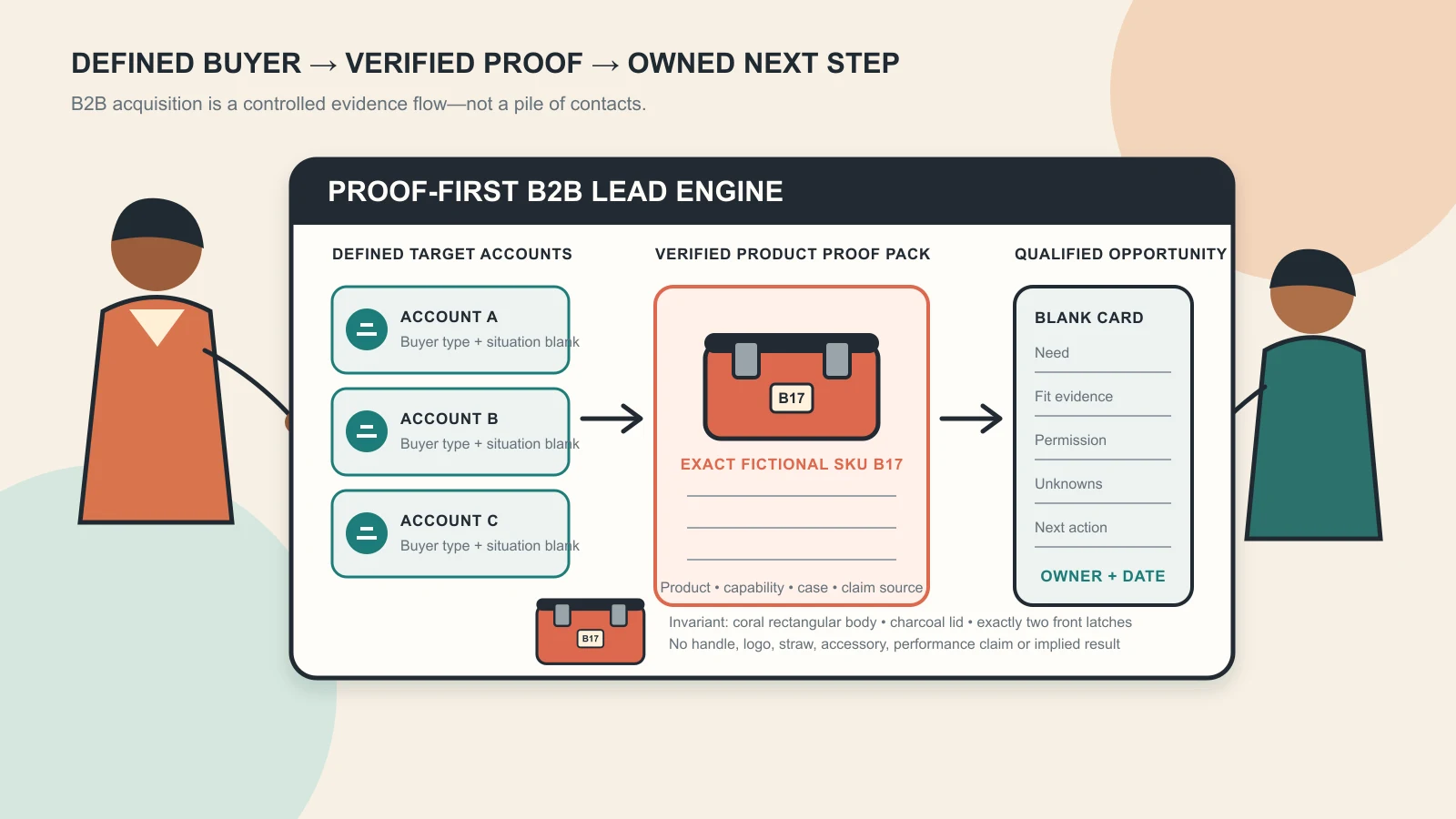
Visual disclosure: Original GPTWala editorial illustration using fictional anonymous accounts, one unbranded B17 product and a blank opportunity card. It is not a lead database, client pipeline or sales result; the lunchbox remains a coral rectangular body with charcoal lid, exactly two front latches, and no handle, logo, straw or accessory.
Reviewed and updated: 12 August 2026
To generate useful B2B leads, define one narrow type of business account and buyer, identify the buying situation your product can genuinely solve, prepare verifiable product and commercial proof, and use a controlled mix of inbound search, named-account outreach, referrals, dealers, events and relevant procurement channels. Route every response to one source-tracked enquiry record, qualify fit and buying intent, and move only a verified next step—sample, specification review, meeting or quote—into the sales pipeline.
Do not buy or scrape a large contact list and call it demand. A company name is an account, a person is a contact, a message is activity, and a reply is not automatically a qualified lead. For a manufacturer or wholesaler, the useful unit is a sales-accepted business opportunity: a serviceable account with a relevant need, a real buyer or buying process, enough product/commercial fit to continue, and a dated next action owned by someone.
This root guide owns dealer and business-buyer acquisition. The digital product catalogue guide owns buyer-ready product information; the product landing-page guide owns page construction; the WhatsApp selling guide owns the enquiry-to-order conversation; and the product-business unit economics guide owns margin and affordable-acquisition decisions.
Table of contents
- Define a B2B lead before choosing a channel
- Choose one ideal business account
- Find a real buying situation
- Build a proof pack before prospecting
- Create a lawful, usable target-account list
- Use a balanced B2B lead-generation channel mix
- Build inbound discovery that answers buyer questions
- Run named-account outbound without spam
- Recruit dealers and distributors deliberately
- Use exhibitions, associations and procurement routes
- Create a conversion destination and next-step offer
- Qualify enquiries into real opportunities
- Hand opportunities to sales without losing context
- Use AI without inventing buyers or proof
- Measure the lead engine without vanity metrics
- Run a controlled first acquisition cycle
- Apply the system to Indian and global product businesses
- Fix common B2B lead-generation failures
- Frequently asked questions
Define a B2B lead before choosing a channel
B2B lead generation is the controlled process of finding organisations that may fit the business, earning a relevant response, checking whether a commercial problem and product match exist, and securing a legitimate next step. It is not the collection of visiting cards, email addresses, group members, social followers or catalogue downloads.
Use a shared stage vocabulary
| Stage | Minimum evidence | What it is not |
|---|---|---|
| Target account | Named organisation fits the written account profile | Proof that anyone there wants to buy |
| Contact | Identifiable person connected to the account through an appropriate source | Permission to contact through every channel forever |
| Engaged account | Relevant person takes a meaningful action or replies in context | A qualified opportunity |
| Business enquiry | Account asks about a product, capability, dealership, sample, specification or quote | A purchase order |
| Qualified opportunity | Need, product fit, serviceability, buyer process and a real next step are sufficiently clear | Guaranteed revenue |
| Sales-accepted opportunity | Sales owner accepts the evidence, next action and responsibility | A forecasted win |
| Quote/sample/technical review | Defined commercial or evaluation step occurred | Buyer confirmation or payment |
| Won order | Authorised order record meets the business’s acceptance rule | Cash received or profit earned unless the records prove it |
Write these definitions into the lead log. If marketing calls every form completion “qualified” while sales accepts only accounts with a specification and quantity, the dashboard will create an argument instead of a pipeline.
Exclude non-leads openly
Record separate reasons for:
- supplier, job, service or collaboration enquiries;
- consumer enquiries outside the B2B offer;
- duplicates;
- spam, fraud or tests;
- unsupported products or geographies;
- accounts below a genuine minimum order or above capability;
- students/researchers with no buying project; and
- existing service cases that belong to customer support.
Exclusion is not failure. It makes the acquisition evidence more truthful.
Choose one ideal business account
“Manufacturers and wholesalers” is too broad for one campaign. A tile manufacturer seeking architects, a food-packaging converter seeking regional brands and an apparel wholesaler seeking multi-brand boutiques need different proof, buyers, channels and commercial gates.
Build an ideal business account card for one acquisition cycle.
| Dimension | Question | Example entry—illustrative only |
|---|---|---|
| Account type | Which organisation can buy or influence the purchase? | Independent homeware retailer with two to ten outlets |
| Geography | Where can the business serve profitably and reliably? | Selected cities reachable by current distributor/freight setup |
| Category/use | What does the account sell, make or use? | Mid-priced kitchen-storage range |
| Scale signal | What observable fact suggests a viable requirement? | Carries adjacent categories and replenishes them |
| Buyer role | Who owns discovery, technical approval, commercials and payment? | Owner/category buyer; accounts team later |
| Buying situation | What event makes the conversation relevant now? | New outlet, supplier replacement, seasonal range or stock gap |
| Product fit | Which exact family or capability can help? | Verified three-SKU starter assortment |
| Commercial boundary | MOQ, pack, credit, territory, lead time or service limits | Case-pack order; no assumed credit/exclusivity |
| Disqualifier | What makes the account unsuitable? | Outside service geography or requires unsupported certification |
| First next step | What small decision can the buyer reasonably take? | Review range card and request current sample/quote |
Separate account fit from buyer intent
A company can match the profile and have no current project. Another can have urgent intent but require a product the business cannot supply. Track both:
- fit: account, geography, use, product family, volume range and serviceability;
- intent: current trigger, active evaluation, requested information and timing; and
- access: relevant role, procurement route and agreed next action.
Do not inflate fit into intent. A new branch opening is a possible trigger, not proof that the buyer wants your catalogue.
Build a negative account profile
List accounts the cycle should not pursue. Examples include buyers requiring prohibited claims, impossible delivery, unsafe credit, exclusive rights the owner has not approved, unsupported customisation, or quantities that disrupt existing customers. This protects sales time and prevents desperate promises.
Find a real buying situation
Product businesses often begin with “we make high-quality products.” A buyer begins with risk, availability, assortment, specification, margin, landed cost, delivery, compliance, service or differentiation.
Translate the product family into a buyer decision, not a slogan.
| Buying situation | Useful first proof | Unsafe claim |
|---|---|---|
| Retailer needs a new range | Current assortment, case pack, price basis, dispatch and reorder process | “Guaranteed fast-moving products” |
| Manufacturer needs a component supplier | Exact specification, tolerance, material evidence, capacity/lead-time basis and sample route | “Zero defects” without substantiation |
| Brand needs contract manufacturing | Capability boundary, MOQ, development process, quality documents and confidentiality route | “Any formulation/design possible” |
| Dealer wants a territory | Range fit, demand-support plan, commercial model and conflict policy | “Exclusive territory” before approval |
| Buyer needs an alternative supplier | Approved equivalent/compatibility evidence and change-control process | “Same as Brand X” without technical and rights review |
| Export distributor evaluates a range | Buyer-market documents, pack/labelling route, logistics assumptions and verification step | “Export-ready worldwide” |
Choose one next-step offer
A B2B offer is often a reduction in buying risk rather than a discount. Useful examples include:
- a range card for one category;
- exact technical data sheet or drawing;
- a sample or sample-kit request with clear conditions;
- a verified MOQ and pack matrix;
- a short capability call with the relevant technical or commercial owner;
- a current quote request for a defined specification and quantity;
- a dealer-fit checklist; or
- an authorised factory/process evidence pack where genuinely relevant.
Do not advertise “free sample” if freight, eligibility, deposit, return or quantity conditions exist. State the conditions before collecting detailed information.
Build a proof pack before prospecting
Acquisition creates scrutiny. Prepare the evidence a serious buyer will need before increasing outreach.
The minimum buyer-ready proof pack
| Proof area | Minimum useful content | Owner |
|---|---|---|
| Business identity | Accurate business/trading identity, location, contacts and role in supply | Business owner/admin |
| Product identity | Exact SKU/family, variant, dimensions/specification, pack and images | Product owner |
| Capability | What is made/stocked/sourced, process boundary and customisation limits | Operations/technical |
| Commercial basis | MOQ, order multiple, price/quote basis, tax/freight assumptions, lead-time basis | Sales/finance |
| Quality/compliance | Current applicable documents mapped to the exact product/site/process | Quality/compliance |
| Availability | How stock or production capacity will be checked before commitment | Operations |
| Evidence assets | Catalogue, product page, data sheet, sample policy and authorised case proof | Marketing/product |
| Next step | Named route for sample, technical review, dealership assessment or quote | Sales owner |
Use the digital product catalogue system to create buyer-specific views from one verified product master. Use the AI catalogue photography workflow for exact-SKU image production at scale.
Apply the product-and-claim truth gate
The CCPA’s Guidelines for Prevention of Misleading Advertisements and Endorsements for Misleading Advertisements, 2022 require truthful, honest representations and guard against misleading exaggeration. The ASCI Code also requires objectively ascertainable claims to be substantiable and advertising not to mislead through statement, omission, ambiguity or exaggeration.
Reject or pause acquisition assets that:
- show a different SKU, pack, finish, component or quantity;
- present a staged factory, machine, warehouse or team as the business’s own when it is not;
- use a certification, registration, test, patent, customer logo or award outside its actual scope or permission;
- claim capacity, stock, lead time, geographic reach or price without a current operational basis;
- turn an AI-generated use scene into evidence of performance;
- imply the wholesaler manufactures the product when it does not;
- present a prototype, sample or custom concept as generally available stock;
- invent a customer quote, order volume, saving, defect reduction or result; or
- use “export quality,” “best,” “number one,” “100%,” “guaranteed” or similar language without a defensible meaning and evidence.
Keep case evidence auditable
A B2B case example should say what was actually supplied, for whom it may be named, over what period, under what conditions and which result the records support. Obtain permission before using a buyer’s name, logo, image, quotation or confidential specification. If no publishable case exists, use a clearly labelled process example—not a fictional success story.
Create a lawful, usable target-account list
A target-account list should explain why this account fits now, where the information came from, what contact route is appropriate and when the record should be reviewed. It should not be a copied database with unknown origin.
Use an account research card
| Field | What to record | Guardrail |
|---|---|---|
| Account name | Accurate public organisation identity | Avoid duplicates and similarly named entities |
| Public source | Official website, event directory, association listing, referral or buyer-provided information | Record source URL/date; do not scrape prohibited/private data |
| Fit evidence | Category, geography, buyer type or observable use | Distinguish observation from inference |
| Possible trigger | Publicly supported change or buyer-stated need | Label as hypothesis until confirmed |
| Relevant role | Function likely to own the decision | Do not guess a private email or personal number |
| Permitted contact route | Public business route, referral, event follow-up or consented channel | Check law, platform rules and source terms |
| Relevance sentence | Why the offer may matter to this account | No fake familiarity or invented pain |
| Status and review date | Research, ready, contacted, replied, qualified, pause or suppress | Honour opt-out and corrections across systems |
| Owner/next action | Named person and dated action | No unowned records |
Prefer source quality over list size
Good sources may include:
- existing customers and lapsed accounts the business may lawfully re-engage;
- customer, supplier or professional referrals;
- the business’s own website enquiries and event registrations;
- official exhibitor, association, procurement or member directories whose terms permit the intended use;
- public company websites and business contact routes;
- authorised marketplace or portal enquiries;
- buyer requests for samples, catalogues or quotes; and
- sales-team territory knowledge recorded with source and date.
Do not collect personal phone numbers from private groups, scrape profiles, buy an unexplained spreadsheet, evade platform limits or upload a contact list to AI merely because it is convenient.
Treat privacy and outreach law as jurisdiction-specific
India’s Digital Personal Data Protection framework has phased commencement. The current India Code commencement record is a freshness warning, not a ready-made outreach permission rule. Email, calling, cookies, profiling and business-contact rules also differ by geography and context.
Before operating a domestic or global campaign, decide with appropriate advice:
- what data is collected and why;
- where it came from and whether the intended use is permitted;
- what notice, consent or other lawful basis is required;
- how correction, deletion, suppression and opt-out are handled;
- who may access or export the data;
- which vendors or AI systems receive it; and
- how long records are kept.
The WhatsApp Business Messaging Policy is explicit for that channel: a business needs the person’s number and opt-in permission for subsequent messages or calls, must respect opt-outs and must not spam or surprise people. A publicly visible number is not unlimited WhatsApp marketing permission.
Use a balanced B2B lead-generation channel mix
Do not choose a channel because it is fashionable. Choose it because the target account uses it during the relevant buying situation and the business can operate it responsibly.
| Channel | Best initial job | Evidence needed | Common failure |
|---|---|---|---|
| Existing customers/referrals | Find adjacent accounts and credible introductions | Customer permission, clear fit and referral context | Asking for “any leads” without a specific profile |
| Website/search | Capture active research around product/use/specification | Buyer-answer page, proof pack, working enquiry route | Generic homepage with no product or buyer decision |
| Named-account outbound | Reach a small, researched set of likely accounts | Relevance sentence, truthful proof and compliant route | Bulk generic pitch or fake personalisation |
| Dealer/distributor recruitment | Build a channel for defined territory/category | Partner model, conflict rule and support capacity | Promising exclusivity or margin before evaluation |
| Exhibitions/associations | Meet concentrated category participants | Pre-event account list, meeting purpose and follow-up owner | Counting badges or cards as leads |
| Marketplaces/directories | Capture category demand or buyer enquiries | Current listing accuracy, response process and source tracking | Renting demand while failing to capture learning/ownership |
| Procurement/tender portals | Respond to structured purchase opportunities | Eligibility, documents, exact specification and commercial review | Chasing every tender regardless of fit |
| Paid acquisition | Create controlled distribution to a ready destination | Offer, proof, tracking, response and unit economics | Spending before the business can qualify or fulfil |
Use two or three complementary routes in the first cycle. A company can build search demand over time while running small named-account outreach and seeking trusted introductions. Ten disconnected channels usually create incomplete records and slow follow-up.
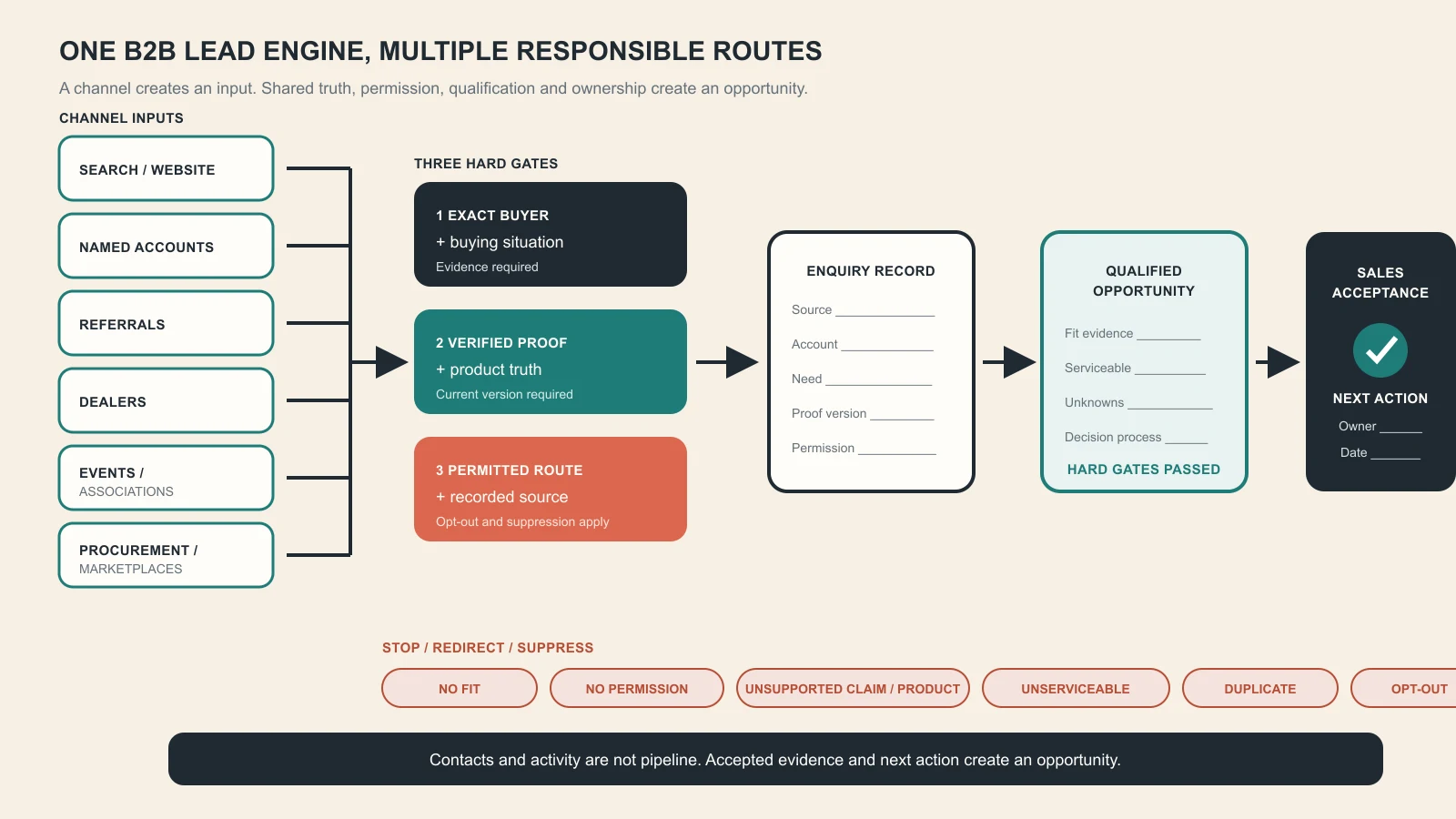
Different channels can feed one lead engine only when they share proof, qualification and ownership. Original GPTWala deterministic system diagram; all account, source and action fields are blank, and it shows no dashboard, benchmark, company record or performance result.
Build inbound discovery that answers buyer questions
An inbound page should answer the question the buyer has before a sales conversation. Examples include:
- manufacturer for an exact component/material/use;
- wholesale supplier for a category and geography;
- MOQ, case pack or private-label capability;
- technical specification, compatibility or sample process;
- distributor/dealer opportunity for a defined range; or
- alternative supplier evaluation for a specific risk.
Google’s Search Essentials and SEO Starter Guide are useful official starting points for crawlable, people-first search pages. They do not promise ranking, leads or commercial fit.
Build pages around buyer decisions, not city-keyword copies
A useful page can include:
- clear product/capability scope;
- who the offer is and is not for;
- exact variants, specifications or range structure;
- MOQ/pack/price basis where responsible;
- service geography and delivery/production boundary;
- evidence and current documents;
- sample, technical review or quote process;
- realistic response expectation set by the business;
- privacy/contact information; and
- one next action.
Do not create near-duplicate “manufacturer in every city” pages without unique operational value. Do not copy competitor specifications or use an unrelated factory photograph. Accurate local or service information matters more than keyword repetition.
Use a Business Profile only where it truthfully applies
If the business is eligible for a Google Business Profile, follow the current guidelines for representing a business on Google. Keep name, category, location/service area, hours, website and contact information accurate. Do not create fake offices, virtual locations, duplicate profiles or keyword-stuffed names to appear closer to buyers.
This manuscript did not test a profile or local ranking. Verify eligibility and current controls in the real account before implementation.
Run named-account outbound without spam
Outbound works best as a researched business conversation, not a volume contest. The goal of the first message is not to close a purchase. It is to establish relevance and ask for a proportionate next step.
Use the six-part relevance note
- Accurate context: why this account/role is being contacted, based on a public or referred fact.
- Buyer situation: the category, use or risk the offer addresses—stated as a possibility, not an invented pain.
- Verifiable capability: one exact product family or process the business can support.
- Proof route: concise product page, data sheet, range card or authorised case evidence.
- Small next step: ask whether the topic is relevant and who owns it, or offer a sample/specification review.
- Respectful exit: make it easy to say no or redirect, and suppress further contact when required.
Illustrative structure:
I’m contacting you because your public range includes [verified category]. We supply [exact product/capability] for [defined use], with [one substantiated differentiator]. If [buying situation] is relevant, I can send the current [range/specification/sample conditions] for review. If another person owns this category, please point me to the appropriate public route; if it is not relevant, I will close the record.
This is an editorial structure, not a legally approved template or proven reply generator. Adapt it to the channel, jurisdiction, relationship and real evidence. Do not insert a false compliment, fabricated trigger or invented competitor problem.
Research before personalising
AI can summarise a supplied official website or group accounts by stated category, but a human should verify every line used in outreach. “I saw you are expanding” must point to a current, reliable public source. If the fact cannot be verified, remove it.
Set contact pressure limits
Define:
- channels permitted for the campaign;
- maximum attempts and review interval;
- rules for referral or role redirection;
- event-follow-up expectations;
- suppression and opt-out handling;
- when a buyer-stated future date overrides the schedule; and
- who can approve another contact after silence.
Article 22’s WhatsApp follow-up templates own timed WhatsApp sequences once the contact and permission conditions are satisfied. This article does not prescribe a universal cadence for email, phone or social platforms.
Recruit dealers and distributors deliberately
Dealer generation is not ordinary lead generation with the word “partner” added. A channel partner may represent the product, hold inventory, extend credit, provide service and affect other accounts in the territory.
Publish the partner fit, not an unlimited opportunity
State the current model clearly:
- product range and target customer;
- geography under evaluation;
- expected category experience or operating capability;
- opening order or stock expectation where approved;
- showroom, warehousing, service or sales capability if genuinely required;
- training, content, sample or demand support the supplier can actually provide;
- enquiry, evaluation and onboarding process; and
- whether territory/exclusivity is unavailable, conditional or separately approved.
Never advertise “exclusive dealership guaranteed” when territory conflict, performance conditions, contract, credit or owner approval remain open.
Use a dealer-fit card
| Dimension | Evidence to collect | Stop/escalate when… |
|---|---|---|
| Business identity | Trading entity and verified business route | Identity or authority is unclear |
| Category fit | Current adjacent products and customer type | The range conflicts materially or has no buyer overlap |
| Territory | Actual operating coverage and location | Territory overlaps without an approved conflict rule |
| Sales/service capability | Team, channel, demonstration or service needs | Product requires unsupported technical service |
| Commercial fit | Order model, payment/credit route and expected economics | Credit or margin promise exceeds authority |
| Reputation/compliance | References and relevant public/contract review | Material concern cannot be resolved |
| Launch plan | First range, training, content and review owner | No named owner or realistic activation step |
| Decision | progress, hold, decline or specialist review | Exclusivity/regulated terms lack approval |
Do not use personal data or unofficial background checks beyond what is relevant, proportionate and lawful. A dealer application is not permission to circulate its financial or identity documents across the sales team.
Use exhibitions, associations and procurement routes
Events and portals can concentrate relevant buyers, but attendance or registration does not create qualified demand.
Before an exhibition
- identify target accounts and buyer roles from permitted official information;
- choose one product family and meeting purpose;
- prepare an exact-SKU proof pack and sample-control log;
- schedule relevant meetings without pretending an appointment exists;
- decide who captures consent, notes and next actions; and
- define how badges/cards will be stored, corrected and suppressed.
At the event
Ask one or two qualification questions before presenting the full range. Record the product/use, buyer role, quantity or scale signal, geography, timing and agreed next action. Do not mark every scanned badge as an opportunity.
After the event
Send only the material agreed in the conversation. Cite the meeting context accurately, correct transcription errors and close irrelevant records. A fast generic blast can erase the trust created face to face.
Procurement and tender portals
Use structured procurement routes when the business can meet the stated eligibility, documentation, specification, delivery and commercial conditions. For Indian public procurement, start at the official Government e-Marketplace portal and current buyer/seller guidance rather than an unverified agent or old tutorial.
Create a bid/no-bid gate:
- exact product/specification fit;
- eligibility and current documents;
- quantity and capacity;
- delivery geography/timeline;
- inspection, warranty and service requirements;
- payment/working-capital implications;
- price and contribution after all obligations;
- responsible bid owner; and
- conflicts, declarations and approval.
This article does not certify GeM/tender eligibility, registration, category fit or bid success. Check the live opportunity and obtain appropriate commercial/legal review.
Create a conversion destination and next-step offer
Every channel should lead to a destination that continues the same promise. A buyer who clicks “request a tile sample” should not land on a generic corporate homepage.
Choose one destination:
- buyer-specific product or capability page;
- controlled digital catalogue view;
- technical data-sheet page;
- dealer application/fit page;
- sample request;
- quote request; or
- direct business conversation with prefilled context where permitted.
The product landing-page guide should own the page build. The acquisition brief should specify what the page must prove and which fields the business genuinely needs.
Ask for the minimum useful information
For an early enquiry, useful fields may be:
- business name and work contact;
- buyer role or department;
- product/category/use;
- specification or variant;
- indicative quantity/order pattern;
- delivery city/country; and
- preferred next step.
Do not ask for bank information, government ID, full company dossiers or unrelated personal data just to unlock a catalogue. Collect tax, credit, export or compliance documents only when the transaction reaches the appropriate stage and the business has a controlled route.
Preserve source context
Pass a campaign/source code, page, product family and requested action into the lead record. Do not rely only on cookies or claim perfect attribution. When a buyer self-reports the source, keep the original technical source and the buyer’s answer separately.
Qualify enquiries into real opportunities
Qualification should protect the buyer and the business from a poor-fit sales process. It should not become an interrogation or a score that hides a critical failure.
Use the qualified-opportunity card
| Field | Question | Evidence/state |
|---|---|---|
| Account and role | Which organisation and who is involved? | |
| Need/use | What is the business trying to source, replace, launch or solve? | |
| Exact product fit | Which SKU/family/specification might fit? | |
| Quantity/cadence | What quantity, frequency or scale is currently indicated? | |
| Geography/serviceability | Can the business supply and support this location? | |
| Timing/trigger | Why now, and what date/event matters? | |
| Decision process | Who evaluates technical, commercial and final approval? | |
| Commercial boundary | MOQ, price basis, credit, freight or customisation issue? | |
| Evidence requested | Catalogue, sample, data sheet, meeting or quote? | |
| Risk/unknown | What must be verified before commitment? | |
| Next action | Exact action, owner and date | |
| Decision | accept, nurture, redirect, hold, decline or suppress |
Keep the public template blank. A filled fictional opportunity can be mistaken for a customer record.
Use hard gates before scoring
Stop or redirect when:
- the product/specification cannot be supplied truthfully;
- geography, legal/category or service conditions cannot be met;
- the requested use is unsafe or unsupported;
- identity or authority is materially unclear;
- the buyer requires a claim/certification the business does not hold;
- commercial terms fall outside approved authority;
- a conflict, fraud or data-security concern is unresolved; or
- the person opts out.
Only after hard gates pass should the team rank attention by fit, intent, value, timing and effort. Do not average a prohibited product or impossible specification into a “72% qualified lead.”
Distinguish nurture from “not now” neglect
If a suitable account has a stated future date, record the reason, requested information, permission/channel and next review date. If no timing or permission exists, close or suppress rather than sending endless “checking in” messages.
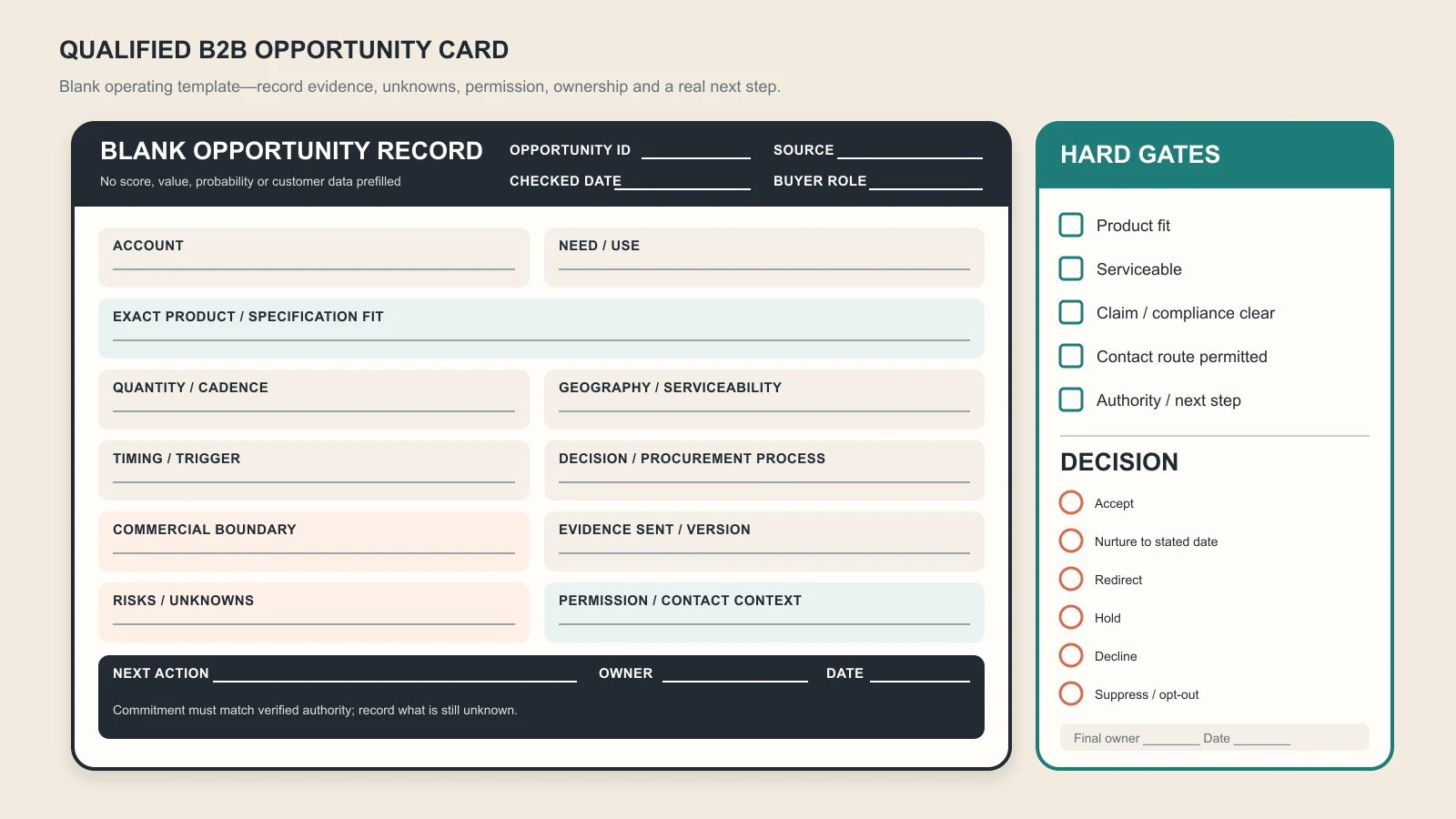
A qualified opportunity records evidence, unknowns, ownership and a real next step—not a lead score alone. Original GPTWala blank operating template; it contains no personal data, customer record, deal value, win probability, prechecked gate, pipeline status or forecast.
Hand opportunities to sales without losing context
The handoff should let the sales owner continue without asking the buyer to repeat everything or trusting an AI summary blindly.
Use a seven-line handoff:
- account and verified business route;
- buyer role and contact permission/context;
- exact need/use and product family;
- quantity/geography/timing stated by the buyer;
- evidence already sent and version/date;
- risks, unknowns and commitments not yet made; and
- next action, owner and due date.
Sales must accept, redirect or reject the opportunity under a written rule. An unaccepted lead is not a sales pipeline item merely because marketing assigned it.
Protect the first sales commitment
Before a sample, quote or technical answer leaves the business, verify:
- exact product/specification and version;
- current price basis, MOQ, tax and freight assumptions;
- stock or production lead-time source;
- sample conditions;
- delivery/service geography;
- claim/certification scope; and
- authority for discount, credit, exclusivity or customisation.
The WhatsApp selling system owns the later conversation, quote confirmation, payment verification and fulfilment path.
Use AI without inventing buyers or proof
AI can reduce manual work around a controlled evidence set. It should not become the source of truth.
Appropriate assistance
- classify supplied accounts against a written profile;
- summarise public pages with source links for human verification;
- detect duplicate names and inconsistent fields;
- draft role-specific page outlines or outreach options from approved facts;
- translate a draft for review by a fluent, product-aware person;
- extract enquiry fields into a draft opportunity card;
- suggest questions for missing qualification fields; and
- flag unsupported superlatives, claims or missing sources.
Prohibited shortcuts
- inventing a person, title, email address, phone number or buying trigger;
- inferring protected or sensitive personal traits;
- generating fake factory/customer/product evidence;
- filling missing capacity, price, stock, specification or certification;
- fabricating personalisation such as “loved your recent expansion”;
- scraping or uploading data against source terms or law;
- sending autonomous follow-up without approved logic, access and suppression; or
- scoring an account as “high intent” from weak behavioural guesses.
Keep prompt/input, sources, output, reviewer and final decision where AI materially affects a lead record. If the source cannot be shown, the statement does not belong in outreach.
Measure the lead engine without vanity metrics
Count the stages the business can define and audit. Use unique accounts where account-level decisions matter; do not let ten contacts at one company become ten opportunities.
Core measures
| Measure | Definition | What it does not prove |
|---|---|---|
| Researched target accounts | Unique accounts passing the research-ready rule | Contact permission or buyer intent |
| Accounts reached | Unique accounts receiving an authorised first contact | Message read or relevance |
| Engaged accounts | Unique accounts taking the predefined meaningful action | Qualification |
| Business enquiries | Unique relevant inbound/reply records after exclusions | Commercial fit |
| Qualified opportunities | Enquiries passing the written qualification gate | Sales acceptance or revenue |
| Sales-accepted opportunities | Qualified records accepted with owner/next action | Win probability |
| Samples/technical reviews/quotes | Verified next-step records | Order confirmation |
| Won orders | Orders meeting the authorised acceptance definition | Collected cash, gross margin or repeat value |
| Truth/compliance defects | Material wrong claim, product, permission, routing or data event | A minor copy preference |
Useful formulas
Enquiry qualification rate
= qualified opportunities ÷ business enquiries reviewed
Sales acceptance rate
= sales-accepted opportunities ÷ qualified opportunities handed off
Cost per sales-accepted opportunity
= attributable channel operating and media cost ÷ sales-accepted opportunities
Quote-to-order rate
= won orders from comparable quotes ÷ comparable quotes issued in the defined cohort/window
Write the denominator, time window, source and exclusions beside every rate. A zero denominator is “not calculable,” not 0%. A small cohort may support no reliable conclusion.
Separate pipeline from revenue and profit
An open opportunity is not revenue. A purchase order may not be invoiced, paid or profitable. Use the authorised accounting/order record for revenue and the unit-economics guide for contribution, working capital, returns, freight and affordable acquisition.
Diagnose quality before volume
If activity increases while sales-accepted opportunities do not, inspect:
- wrong account segment;
- weak or unverified proof;
- irrelevant first offer;
- poor destination/message match;
- unclear qualification;
- slow or unowned response;
- product/commercial mismatch;
- invalid contact source/permission; or
- fulfilment/economic boundaries.
Do not solve a broken qualification path by buying more data.
Run a controlled first acquisition cycle
Use a short operating cycle to learn, not to promise a sales-cycle result. Four weeks is an editorial starting structure for team discipline; it is not a universal time-to-lead or time-to-order benchmark.
Week 1: lock the segment and proof
- approve one ideal business account card and negative profile;
- choose one product family and buying situation;
- complete the proof pack and truth review;
- define qualification, exclusions and handoff;
- confirm data/outreach rules for chosen channels; and
- test the destination and lead record.
Week 2: start small-channel execution
- research a manageable named-account batch;
- ask selected customers/partners for specific introductions;
- publish or improve one buyer-answer page;
- begin authorised one-to-one outreach; and
- schedule event/procurement actions only where fit is proven.
“Manageable” depends on research and response capacity. It is not a hidden recommendation to contact a fixed number of accounts.
Week 3: review conversations and proof gaps
- classify every reply and exclusion;
- verify whether the buyer role and situation were correct;
- inspect repeated specification, MOQ, price or document questions;
- correct public proof before increasing activity; and
- hand accepted opportunities to a named sales owner.
Week 4: decide continue, change or stop
Continue only when the process is safe and the evidence supports the same segment/channel/offer. Change one material variable when diagnosis points to it. Stop or pause when truth, permission, serviceability, response capacity or economics fails.
Record insufficient evidence when activity is too low or the buying cycle is longer than the observation window. Do not manufacture a success conclusion at month end.
Apply the system to Indian and global product businesses
These are illustrative operating scenarios, not GPTWala client results.
Morbi tile manufacturer seeking regional dealers
Define the account as an established building-material dealer in serviceable cities, not “any architect or contractor.” Prepare exact series, dimensions, finish, packing, shade/batch guidance, sample process, freight assumptions and current territory policy. The first offer can be a dealer range review, not an exclusivity promise.
Rajkot component manufacturer seeking OEM buyers
Target one application and buyer role. Lead with drawing/specification review, material/process evidence, tolerance capability and sample route. Never claim compatibility, capacity or zero defects from a generic machine image. Technical rejection should happen before a commercial quote.
Surat apparel wholesaler seeking multi-brand retailers
Segment by store type, price band, geography and order model. Use exact current styles, size/colour mapping, case or assortment rules, dispatch basis and reorder process. AI model images must not change print, neckline, border, colour or drape; use the apparel product-truth checklist.
Jaipur jewellery supplier seeking boutiques
Choose costume/fashion/fine product boundaries accurately and use design codes. Verify stone count, setting, dimensions, metal/finish claim, pair/set quantity, hallmark/purity statements and packaging. Do not use sparkle or a model scene as evidence of composition. Route fine-detail imagery through the jewellery photography checks.
Packaging manufacturer seeking regional product brands
Segment by pack type and material/process fit. Offer a specification/capability review using dimensions, print/process boundary, MOQ, development steps and sample conditions. Do not promise migration, barrier performance, sustainability or compliance without the exact substantiation and test scope.
Indian manufacturer seeking an overseas distributor
Choose one target market and distributor profile. Verify product/pack/document readiness, language, service, landed-cost assumptions and the roles of importer/distributor before outreach. “Exported before” does not prove eligibility in a new market. Obtain current market, customs, tax, labelling, sector and contract advice before commitment.
Wholesaler expanding to an adjacent state
Start with accounts whose category, order pattern and service expectations fit the real warehouse/freight model. Confirm tax/invoice, delivery, damage/return, credit and salesperson ownership. A list of retailers is not a territory strategy; map who will respond, fulfil and support them.
Fix common B2B lead-generation failures
| Failure | Why it happens | Safe correction |
|---|---|---|
| “We need more leads” with no segment | Volume is used to avoid a positioning decision | Approve one account card, buying situation and next step |
| Purchased/scraped contact blast | List size looks measurable | Stop, review source/permission/law, suppress invalid records and rebuild from authorised sources |
| Generic “best quality, best price” pitch | Proof pack is missing | Replace slogans with exact product/capability evidence and boundaries |
| Every reply becomes qualified | Stage definitions are absent | Apply hard gates and a shared opportunity card |
| Sales rejects marketing leads | Handoff lacks evidence or acceptance rule | Define sales acceptance, exclusions, owner and feedback reason |
| Many catalogue requests, few next steps | Catalogue is sent without qualification | Ask buyer type/use/quantity/geography and share a relevant view |
| Dealer enquiries create channel conflict | Territory and authority were not defined | Pause promises; evaluate fit, overlap, contract and owner approval |
| Exhibition produces a bag of cards | No meeting context or next action was captured | Record product, role, need and agreed follow-up at the event |
| AI personalisation contains false facts | Generated text was not source-checked | Require source links and human approval for every account-specific line |
| Tender effort consumes the team | Bid/no-bid gate is missing | Check eligibility, product fit, capacity, cash and contribution first |
| Pipeline value rises but orders do not | Stages/probabilities are inflated | Reconcile to accepted actions and authorised order/accounting records |
| Ads generate chats the team cannot answer | Destination/response path was not ready | Pass the Meta ads readiness gate before spending |
Connect B2B acquisition to the DAA system
A manufacturer or wholesaler that relies mainly on dealer calls, exhibitions, referrals and forwarded PDFs needs a connected online path, not a replacement for every existing relationship.
The GPTWala DAA sequence is Digital Presence → AI Content Creation → ₹100/day WhatsApp ads. For B2B acquisition:
- Digital Presence makes the business, product range and next step discoverable;
- AI Content Creation can help produce accurate buyer-specific assets under human control; and
- controlled distribution can be tested only after proof, qualification, response and economics are ready.
The GPTWala workshop is educational. It does not guarantee leads, dealer appointments, quotes, orders, revenue, profit or return on ad spend.
Frequently asked questions
What is the best B2B lead-generation method for manufacturers?
There is no universal best channel. Choose according to the buyer’s research and purchasing process. A strong first mix often combines buyer-answer search content, small named-account outreach and trusted referrals, but the right mix depends on product, geography, sales cycle, evidence, permission and team capacity. Measure qualified and sales-accepted opportunities, not contact volume.
How do I find wholesale buyers for my products?
Define the account type, buyer role, category, geography, order model and disqualifiers first. Research accounts through authorised public, referral, event, association, marketplace, procurement and first-party sources. Contact only through an appropriate lawful route with a relevant proof offer. Do not buy an unexplained list or guess private contact details.
Is a catalogue download a B2B lead?
It is an engagement signal only if the download can be tied to a legitimate account/context. Qualification needs enough evidence of business fit, need, serviceability and a real next step. Anonymous downloads may guide content decisions but should not be reported as qualified pipeline.
What should I offer a B2B prospect first?
Offer the smallest useful proof for the buying situation: a range card, exact specification, MOQ/pack matrix, sample conditions, technical review, dealer-fit checklist or current quote request. Do not force a meeting before the buyer can see basic fit, and do not offer a “free” sample with hidden conditions.
How many follow-ups should I send?
No fixed number applies across email, phone, platforms, events and buyer-stated timing. Define channel rules, permission, maximum attempts, suppression and a respectful close. A buyer’s requested date and the current law/platform policy override a generic cadence. Stop when the person opts out or the account is no longer relevant.
How should I qualify a dealer or distributor enquiry?
Verify business identity, category/customer fit, territory, sales/service capability, commercial model, reputation/compliance concerns and a realistic launch plan. Do not promise margin, credit, exclusivity or territory before authorised evaluation and contract review.
Can AI generate and contact B2B leads automatically?
AI can classify supplied accounts, summarise authorised public information, draft from approved facts and help extract enquiry fields. It must not invent contacts, triggers, proof or intent, scrape prohibited data, send uncontrolled messages or make commercial commitments. Human owners must verify sources, permission, product truth and every next action.
How do I measure B2B lead generation?
Track unique researched accounts, accounts reached, engaged accounts, business enquiries, qualified opportunities, sales-accepted opportunities, samples/technical reviews/quotes, won orders and truth/compliance defects. Add costs by channel. Define every stage, denominator, cohort and time window; pipeline is not revenue and revenue is not profit.
Should a small manufacturer use paid ads for B2B leads?
Only after the offer, buyer, proof, destination, tracking, response, fulfilment and economics are ready. Paid distribution can test reach and conversations; it cannot guarantee a qualified opportunity or order. Start with the Meta readiness and unit-economics guides before authorising spend.
How long does B2B lead generation take?
No reliable universal period exists. Product complexity, buyer process, specification, sample testing, budget, procurement, credit, geography and timing all affect the cycle. Use a short operating cycle to test process quality, but do not treat four weeks or any content-marketing timeline as a promised order date.
Sources checked for this guide
- Google Search Essentials
- Google Search SEO Starter Guide
- Google Business Profile: Guidelines for representing your business on Google
- WhatsApp Business Messaging Policy
- WhatsApp Messaging Guidelines
- India Code: Digital Personal Data Protection Act commencement record
- CCPA: Guidelines for Prevention of Misleading Advertisements and Endorsements for Misleading Advertisements, 2022
- Advertising Standards Council of India: The ASCI Code
- Government e-Marketplace
- Google Search: General structured data guidelines
- Google Search documentation update: Removing FAQ rich-result support
Leave a Reply