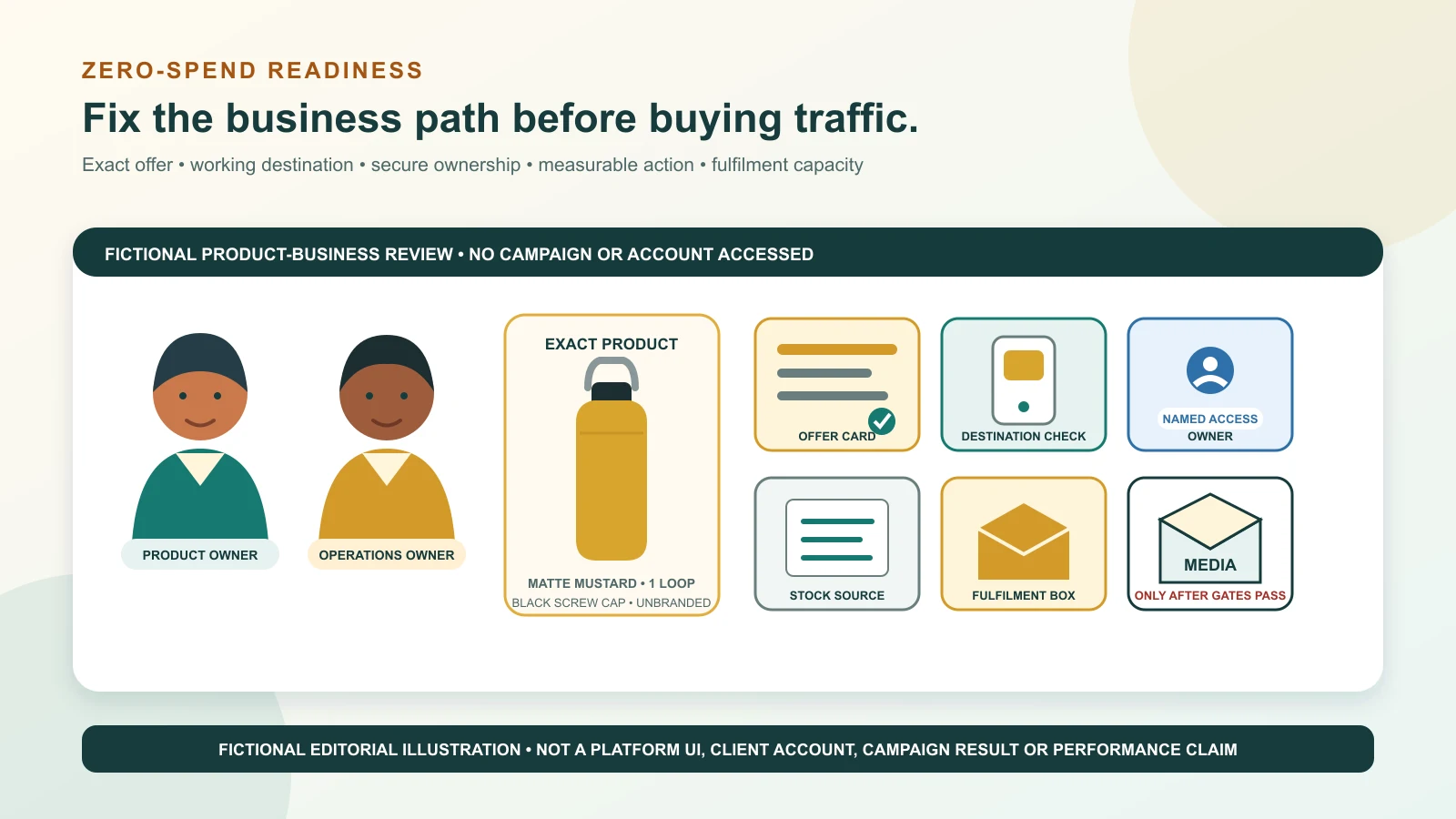
Reviewed and updated: 12 August 2026
Before spending on Meta ads, make sure the business can complete the journey the ad promises. Confirm one exact product and offer, a working destination, named owners for every account and payment asset, a truthful creative and claims record, a measurable qualified action, a response-and-fulfilment plan, and an affordable acquisition ceiling. If a critical gate is red, fix it before campaign setup.
This is a zero-spend readiness audit, not an Ads Manager tutorial. No Meta account, payment method, pixel, campaign, destination, customer data or product was accessed or tested for this guide. The examples are fictional and no approval, lead, sale, cost saving or return on ad spend is claimed.
Meta may review an ad’s image, video, text, targeting and destination, and an ad can be reviewed again after it starts running. Platform review is therefore one gate—not proof that the product claim is true, the destination will convert, the business can fulfil demand or the economics work. Meta explains its current review and restriction process here.
Table of contents
- Understand what this readiness guide owns
- Use three readiness states, not a misleading average
- Complete the zero-spend readiness board
- Choose the business action before the campaign objective
- Write an exact offer card
- Make the product and ad truthful
- Test the real destination
- Map Meta assets, ownership and access
- Secure access, recovery and payment responsibility
- Choose measurement without collecting data by accident
- Prepare response, stock and fulfilment
- Run a dry journey before spending
- Apply the audit to Indian product businesses
- Know the hard stop rules
- Move from readiness to the right next guide
- Frequently asked questions
Understand what this readiness guide owns
Meta ads amplify a path. They do not repair the path while people are travelling through it.
A product business may have attractive creative and still be unready because:
- the promoted colour is unavailable;
- the ad says “single piece” while the destination shows a wholesale carton;
- an old agency still controls the Page or ad account;
- nobody owns the payment method or billing review;
- the WhatsApp number opens, but the shop answers three days later;
- the business counts every chat—including spam and duplicate messages—as a lead;
- the product margin cannot support the cost of acquiring an order; or
- an AI image has changed the product that buyers will actually receive.
Article 19 owns those pre-spend conditions. It deliberately leaves adjacent decisions to their own guides:
| Decision | Where it belongs | What this article does |
|---|---|---|
| Build truthful AI-assisted ad concepts and formats | AI Ad Creatives for Product Businesses | Requires an approved creative-and-evidence pack |
| Compare a control with a small number of challengers | How to Test AI Ad Creatives on a Small Budget | Requires readiness before media testing |
| Configure the specific ₹100/day click-to-WhatsApp workflow | The ₹100/Day Click-to-WhatsApp Ads System | Hands off only after this audit passes |
| Calculate contribution margin and affordable acquisition cost | Product-Business Unit Economics for Digital Ads | Requires a dated affordability ceiling, but does not rebuild the calculation |
Do not use this checklist to declare that Meta will approve an ad. Do not use it to forecast results. Use it to stop avoidable operational failures from becoming paid failures.
Use three readiness states, not a misleading average
A score of 14 out of 16 can sound impressive. It is useless if one of the missing items is the only person who controls the ad account, the product is not in stock, or the destination does not open.
Use three states for every row:
- Not ready: a critical fact, owner, proof or working path is missing.
- Ready with an owner-dated fix: the gap is non-critical for today’s audit, and a named person has a dated task that must close before launch.
- Ready for controlled setup: the item has current evidence, a named owner and a completed dry check.
Critical gates cannot be averaged away
The following rows are hard gates:
- exact product and current offer;
- substantiated claims and rights-cleared creative;
- working, message-matched destination;
- legitimate ownership and recoverable access;
- no unresolved compromise or restriction that makes setup unsafe;
- authorised payment owner and spend control;
- defined qualified action and source of truth;
- privacy-reviewed data plan;
- response, stock and fulfilment capacity; and
- a dated affordability and stop decision owner.
If any one is red, the final state is not ready. A launch date, agency deadline or festival sale does not turn red into green.
Record evidence, not confidence
For each row, record:
- status;
- named owner;
- evidence link, asset ID or dated file;
- last checked date and time;
- expiry or next review date where relevant;
- exact blocker;
- fix owner and due date; and
- final approver.
“Owner says it is fine” is not evidence. “SKU BT-750-BLK, stock sheet v4, checked by Priya on 12 August at 16:30” is reviewable.
Complete the zero-spend readiness board
Use this board before anyone opens campaign creation. Keep sensitive identifiers and payment information in the business’s restricted system—not in a shared blog template or screenshot.
| Gate | Ready evidence | Hard-stop example | Owner |
|---|---|---|---|
| Business outcome | One qualified action and exclusions are written | “Get more sales” with no measurable action | Business owner |
| Buyer | Named buyer type, geography and eligibility | Retail and wholesale buyers mixed into one undefined audience | Sales owner |
| Product | Exact SKU, variant, quantity and current stock source | AI visual or ad copy does not match the supplied item | Product owner |
| Offer | Current price/MOQ/terms/dates/service area | Expired discount or hidden mandatory charge | Commercial owner |
| Claims | Claim ledger with source, wording and reviewer | “Waterproof”, “best” or performance claim without evidence | Product/compliance owner |
| Creative rights | Permission/licence for images, people, audio and marks | Supplier or customer asset used without clear rights | Creative owner |
| Destination | Actual URL/chat/form opens and matches the ad | Broken page, wrong SKU or unavailable WhatsApp number | Destination owner |
| Business identity | Current name, contact, address/service area and policies | Buyer cannot tell who is selling or how to contact them | Business owner |
| Meta assets | Page, Instagram, ad account and optional assets mapped | Nobody can identify the owning business or asset IDs | Asset owner |
| Access | Named people and least-necessary roles reviewed | Shared password, fake profile or former agency access | Security/admin owner |
| Recovery | Two-factor authentication, trusted recovery route and escalation | Compromised email/phone or no recoverable full-control owner | Security owner |
| Account status | Business Support Home and known restrictions checked | Unresolved restriction or attempt to evade review | Account owner |
| Payment | Authorised payer, current method/state and notification route | No admin, unknown card owner or unrecognised charge | Finance owner |
| Measurement | Qualified action, event/log source, exclusions and QA owner | Clicks called sales; test messages counted as leads | Measurement owner |
| Data/privacy | Data map, notice, permission/lawful-basis review and access rules | Customer data uploaded because a tool makes it possible | Privacy/data owner |
| Response | Working hours, language, qualification and escalation | Nobody can answer the promised channel | Sales/support owner |
| Fulfilment | Stock, dispatch, service geography, returns and exception plan | Offer cannot be honoured at the advertised terms | Operations owner |
| Economics | Dated affordable-action ceiling and stop authority | Spend allowed without knowing what an acceptable result costs | Finance/business owner |
The roles can belong to the same person in a small shop. The important part is that each decision has an accountable human and a traceable record.
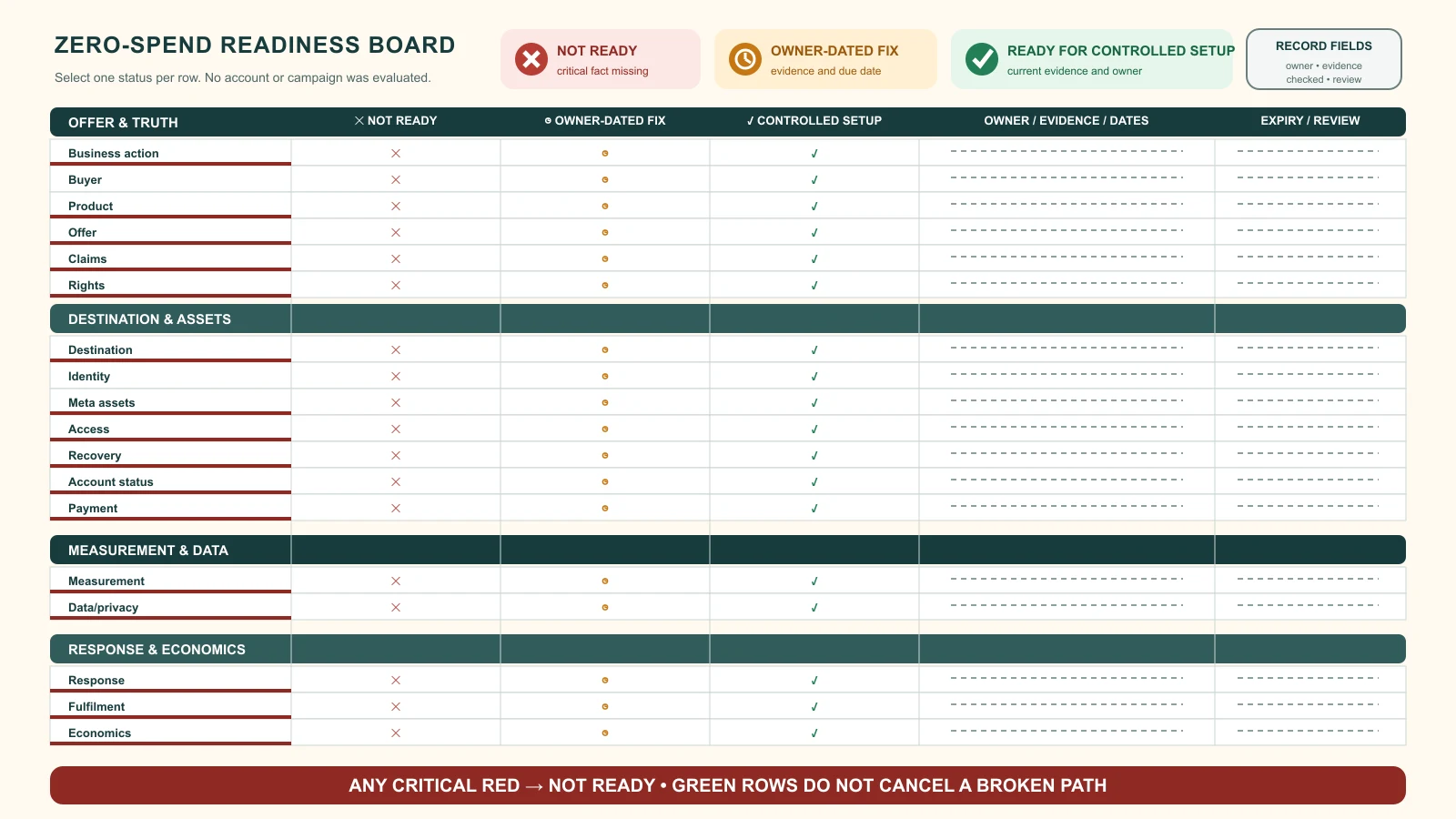
One critical red gate keeps the business at “not ready”; green rows do not cancel a broken path. This is an unscored editorial template, not an account assessment or platform interface.
Choose the business action before the campaign objective
Do not begin with “we want Facebook ads.” Begin with the business action a suitable buyer should complete.
Useful examples include:
- a retailer requests the current wholesale catalogue and meets the minimum order;
- a manufacturer receives a data-sheet or quotation request with a valid application;
- a jewellery buyer asks about one exact piece and serviceable location;
- a local shop receives an order enquiry for an in-stock item within its delivery area; or
- an exporter receives a trade enquiry with destination country, quantity and timeframe.
Define what qualifies—and what does not
A qualified dealer enquiry might require:
- business name and city;
- buyer type;
- exact range or application;
- approximate quantity or buying timeframe; and
- a valid next step such as catalogue, sample, call or quotation.
Exclude test messages, duplicate enquiries, job seekers, suppliers, spam, messages outside the service area and buyers who do not meet the disclosed MOQ. The definition should match the business model; it is not a universal lead standard.
Name one source of truth
Choose the record that decides whether the action happened:
- a website order or verified checkout record;
- a CRM stage with a written qualification rule;
- a restricted WhatsApp enquiry log maintained by an owner;
- a quotation register; or
- an order ledger reconciled to the campaign reference.
Clicks, video plays and conversation starts can help diagnose the journey. They are not automatically qualified enquiries or sales.
Bring a preliminary affordability ceiling
Before setup, the business owner needs a dated maximum affordable cost for the chosen action. That figure depends on contribution margin, conversion from enquiry to order, returns/cancellations, fulfilment costs, repeat purchase assumptions and risk tolerance. Use the unit-economics guide for the full calculation.
This article does not prescribe a budget, cost per lead, industry benchmark or acceptable return. If the economics are unknown, the audit remains red.
Write an exact offer card
An offer is more than a headline. It is the commercial promise that the ad, destination, seller and operations team must all recognise.
Complete one card for one promoted offer:
| Field | What to record |
|---|---|
| Offer ID and version | Stable reference and approval date |
| Exact product | SKU/range, variant, colour, size, finish and packaging generation |
| Included quantity | One unit, pair, set, pack, case, carton or stated MOQ |
| Buyer | Consumer, retailer, dealer, distributor, institution or another defined group |
| Geography | Delivery/service area and exclusions |
| Price | Current amount plus tax, shipping and other mandatory conditions where applicable |
| Wholesale terms | MOQ, slab, sample policy, quotation basis or dealer eligibility |
| Availability | Current stock/source and permitted wording such as “subject to confirmation” |
| Delivery | Realistic dispatch/delivery basis and exceptions |
| Returns/warranty | Current terms and destination link |
| Validity | Start/end date or stock condition for an offer |
| CTA | The exact next action and destination |
| Owner | Person who can approve a change or stop the offer |
Use one offer version everywhere
The ad, destination, catalogue, saved reply and sales sheet must not tell different stories. If the price changes, create a new offer version. If a colour sells out, update or pause the affected creative and destination. If wholesale price depends on quantity, say so instead of showing the lowest slab as though every buyer receives it.
Do not hide the material condition in tiny text
A disclaimer can clarify a claim; it should not reverse the main promise. ASCI’s current self-regulatory code requires objectively ascertainable claims to be capable of substantiation and says advertising should not mislead by implication or omission. Read the current ASCI Code.
The Central Consumer Protection Authority’s 2022 Guidelines address false or misleading advertisements and conditions for valid advertising. Use the official Department of Consumer Affairs notification and obtain category-specific advice where needed. This guide is operational guidance, not legal advice.
Make the product and ad truthful
Paid distribution raises the cost of a product error because more buyers see it faster.
Lock product identity before creative approval
For the advertised item, record:
- SKU/range and packaging generation;
- shape, dimensions, material and finish;
- colour reference under an agreed viewing condition;
- labels, marks and model numbers;
- part, stone, pocket, button or accessory count;
- included versus illustrative items;
- scale reference where size can be misunderstood; and
- approved real photographs for comparison.
Use the product-accuracy checklist for AI images before any AI-assisted visual becomes an ad candidate.
Separate fact, evidence and wording
Maintain a claim ledger:
| Claim ID | Public wording | What a buyer may infer | Evidence/source | Conditions | Reviewer | Status |
|---|---|---|---|---|---|---|
| C-01 | Exact proposed sentence | Literal and implied meaning | Dated product/test/certification source | Model, method, market, expiry | Named reviewer | Approve/rewrite/reject |
Treat material, capacity, compatibility, performance, safety, waterproofing, durability, certification, environmental benefit, comparison, scarcity, discount, delivery, warranty, testimonial and rating claims as review items.
Do not create a test result, customer, showroom crowd, award, certification mark, before/after result or expert endorsement with AI. Labelling a false claim “AI-generated” does not make it true.
Use a product-truth stop rule
Require real capture or specialist review when the sale depends on evidence AI cannot safely reconstruct, including:
- a jewellery stone count, setting, hallmark location, reflection or scale;
- garment texture, construction, fall, transparency or exact colour;
- machinery operation, guarding, fit, tolerance or safety behaviour;
- food condition, pack quantity or regulated label;
- a real before/after comparison;
- a certification, lab result or measurable performance claim; or
- the actual contents of a sealed pack.
Context may be synthetic. Decisive product evidence should remain real, attributable and reviewable.
Prepare the release pack
The approved creative pack should contain:
- creative ID and version;
- product and offer IDs;
- final asset plus crops/derivatives;
- exact copy, CTA and destination;
- product-truth comparison;
- claim ledger references;
- rights/licence evidence;
- language approval;
- AI/provenance disclosure decision where applicable;
- expiry conditions; and
- named product, claim, creative and channel approvers.
“Approved” means approved for that product, offer, destination, period and channel—not for permanent reuse.
Test the real destination
The destination is part of the ad promise. Meta says its review may inspect a landing page or website as well as the ad itself. Ads that click to message also have an additional thread-level checkpoint in Meta’s current review description. See Meta’s ad review guide.
Test as a buyer, not as the person who built it
Open the actual destination on a normal phone and connection available to the intended market. Do not rely only on an admin preview.
Check:
- the link, button, form or chat opens;
- the exact product/offer is immediately recognisable;
- business name and contact route are clear;
- price, MOQ, tax/shipping conditions and validity do not contradict the ad;
- stock/service geography is current;
- images show the same item and included quantity;
- the CTA leads to the expected next step;
- privacy, return, delivery and other necessary policies are accessible;
- the page is readable and usable on the tested device;
- form validation and confirmation work where applicable; and
- a failure route gives the buyer a genuine alternative, not a dead end.
Record the device, browser/app, network, geography, date, tester, result and evidence. One passing test does not guarantee every device or region; define the supported journey and retest after material changes.
Website destination
A website may need product-page, checkout/form, analytics and privacy review. A Meta pixel specifically requires a business website, and current setup routes can vary as Events Manager changes. Meta’s current pixel help page should be reopened during implementation.
Do not install a pixel merely because a checklist mentions it. Decide first what event is useful, who owns the website, what data is collected and whether the business has the necessary notices, rights and permissions.
WhatsApp or messaging destination
Confirm the correct business number, profile identity, working hours, language, opening message, campaign reference, qualification questions, escalation route and human owner. Do not claim a conversation start is a lead.
Use the WhatsApp selling guide for the response system and the ₹100/day click-to-WhatsApp guide for the later campaign setup. This article stops before either implementation.
Instant form, catalogue or other Meta destination
Controls and eligibility can differ by account and change over time. Record the actual destination type, owning asset, displayed product/offer, privacy link, notification owner, export/access route and follow-up process. Do not publish instructions based on an interface the team has not checked in its own authorised account.
Map Meta assets, ownership and access
Not every business needs every Meta asset. The readiness task is to identify the assets this route actually uses and who controls them.
Build an asset register
Possible rows include:
- business portfolio, if used;
- Facebook Page;
- Instagram account;
- ad account;
- payment profile/method owner;
- website/domain;
- dataset/pixel, if used;
- WhatsApp or other messaging asset, if used;
- catalogue, if used; and
- agency/partner access, if used.
For each asset record:
| Field | Record |
|---|---|
| Asset name/type | Human-readable name |
| Asset ID | Store in a restricted operations record |
| Owning legal/business entity | Who should control it |
| Current full-control/admin owner | Named human, not “agency” |
| Working access | Yes/no, checked date |
| Linked assets | Page, Instagram, domain, dataset, messaging, catalogue as applicable |
| Currency/time zone/current configuration | Record what the account actually shows; do not assume it is easy to change |
| Restriction or warning | Status, evidence and owner |
| Recovery route | Named people and protected contact method |
| Former staff/partner access | Retain/remove decision and evidence |
This is an inventory, not a universal requirement list.
Do not share one person’s login
Meta’s current help page says people added to an ad account receive access according to their assigned role; it also says account sharing or inauthentic profiles managed by multiple people violate its rules. The documented ad-account roles include admin, advertiser and analyst with different permissions. Review Meta’s current role guidance.
Use named access and the least permission needed. Do not send passwords to staff, freelancers or agencies. Do not create a “team profile.” Remove or reduce access when the work ends.
Treat Page full control as sensitive
Meta says Page access can include full or partial Facebook access and task access. Its current guidance warns that a person with full control can manage access and may remove others or delete the Page. Review the current Page-access definitions.
Operationally, keep at least two current, trusted recovery-capable owners where the business structure allows—but label that as a GPTWala continuity recommendation, not a Meta rule. Each must understand the responsibility; adding extra admins without governance increases risk.
Separate agency convenience from business ownership
Before spend, answer:
- Does the business know which entity owns the Page, ad account and connected assets?
- Can the business see and remove partner access?
- Is the payer authorised and known to finance?
- Will campaign history, audiences, creative records and measurement remain available if the agency changes?
- Is there an exit checklist with asset transfer, access removal and data handling?
If the only person who can answer is an external supplier, the business is not operationally ready.
Secure access, recovery and payment responsibility
Run the access-security check
Before setup:
- enable two-factor authentication on relevant accounts using the appropriate current Meta route;
- protect the email and phone numbers used for recovery;
- review active sessions, alerts and unfamiliar changes;
- remove unneeded browser extensions and inspect devices if compromise is suspected;
- verify partner requests independently;
- use Meta Business Support Home to check account status and support issues; and
- keep a named escalation owner.
Meta warns businesses about phishing through malicious partner requests and recommends two-factor authentication, caution with unknown links and Business Support Home for account-status review. Read Meta’s current anti-phishing guidance.
Do not troubleshoot a suspected compromise by adding payment information or granting more access. Stop and use official recovery/support routes.
Check restrictions; never try to evade them
Record the status of the user/profile, Page, business account/portfolio and ad account relevant to the route. Resolve unfamiliar warnings, ownership disputes, payment failures and rejected assets before launch.
Meta says restrictions can consider severe or repeated policy violations, attempts to evade review/enforcement, inauthentic accounts and connections to abusive assets. It points advertisers to Business Support Home when they believe a restriction is incorrect. See Meta’s review and restriction guidance.
Do not create replacement identities or assets to bypass a restriction. A genuine business should document the issue and use the current review route.
Assign a payment owner
The payment gate is green only when:
- the authorised payer is named;
- the business knows whether the account uses a saved payment route or available/manual funds;
- the current country, currency, billing and tax details have been reviewed by the responsible person;
- finance knows who can run ads against the method;
- spend notifications and invoice/reconciliation ownership are assigned;
- unrecognised-charge escalation is documented; and
- the person allowed to change payment settings has the correct access.
Meta currently says an ad-account admin is required to add or edit a payment method and distinguishes accounts using available funds/manual payment. It also prompts for payment before the first ad can be published. Read the current payment-method help page.
Do not place card numbers, bank details, one-time passwords, invoices or personal data in a shared readiness sheet or screenshot. This audit records responsibility and status, not secret values.
Choose measurement without collecting data by accident
Measurement readiness begins with a decision, not a tag.
Write the measurement contract
Record:
- the primary qualified action;
- exact inclusion/exclusion rules;
- source of truth;
- campaign/creative reference carried through the journey;
- event or log owner;
- test-data label and exclusion route;
- duplicate-handling rule;
- reconciliation frequency;
- privacy/data owner;
- the person who can stop spend; and
- the dated affordability ceiling from the economics owner.
Use a metric ladder for diagnosis
| Level | Examples | Use before/after launch | Do not infer |
|---|---|---|---|
| Eligibility | product, claim, rights, destination pass | Whether the ad deserves setup | Buyer response |
| Delivery | status, spend, impressions, destination error | Whether delivery occurred | Persuasion or lead quality |
| Intent | outbound visit, product-page view, conversation/form start | Where people continue | A qualified buyer or sale |
| Qualified action | eligible enquiry, catalogue/quote/sample request, verified order | Primary business decision where measurable | Incrementality by itself |
| Economics | cost per qualified action/order against the dated ceiling | Whether the result fits the business constraint | Future or scaled performance |
Article 18 owns the small-budget creative-testing method. Article 19 only ensures the business has something truthful and useful to measure.
Pick the least complicated valid route
For a simple WhatsApp enquiry path, a restricted manual log may be the first source of truth. For a website, a business may consider website events. For a CRM or offline journey, other connections may be relevant.
Meta describes Conversions API as a connection for marketing data from sources such as a server, website platform, app or CRM, including website, offline and messaging events. It also states that Conversions API is not designed to bypass data-sharing policies or privacy rules. Read Meta’s current Conversions API overview.
That description is not a recommendation to implement it for every small business. Choose tools only after the event, data source, ownership, engineering capacity and privacy position are clear.
Build a data map before a customer-data connection
For every proposed event, list:
- data field;
- source;
- purpose;
- destination/recipient;
- access roles;
- retention/deletion route;
- notice/consent or other applicable basis reviewed by the responsible person;
- sensitive-data check; and
- test and incident owner.
Meta’s Business Tools Terms say advertisers using tools such as the pixel and Conversions API must have necessary rights, permissions and a lawful basis for Business Tool Data, and prohibit specified sensitive categories and data about children under 13. The terms also contain notice and website-ownership conditions for pixel use. Review the current Meta Business Tools Terms before implementation.
Terms and applicable law can change. Obtain appropriate privacy/legal advice for the real data flow, particularly for health, financial, children’s, regulated or cross-border contexts. Technical possibility is not permission.
Prepare response, stock and fulfilment
An ad can succeed at generating interest and still fail the business if nobody answers or the offer cannot be supplied.
Write the enquiry-response card
Record:
- destination and opening message;
- staffed hours and out-of-hours response;
- supported languages;
- named first responder and backup;
- qualification questions;
- current catalogue/price/quotation source;
- escalation for technical, price, stock, shipping and complaint questions;
- expected response target based on actual staffing—not a made-up benchmark;
- disposition labels such as qualified, unqualified, duplicate, spam, pending and order; and
- log/reconciliation owner.
Do a capacity check. If an existing team can responsibly handle 20 active enquiries in a day, it should not tell the campaign team it can handle 200. Use the business’s actual workflow and measure it; no universal response-time or capacity number is claimed here.
Write the fulfilment card
Confirm:
- stock source and refresh frequency;
- reserved versus shared inventory;
- current pack/case/MOQ rules;
- serviceable pincodes, cities, states or countries;
- dispatch process and honest delivery basis;
- quotation approval;
- tax/invoice route;
- payment collection ownership;
- returns, cancellations, damaged-goods and warranty process;
- installation/technical support where applicable; and
- overload/stock-out stop rule.
Give operations authority to stop the ad
The person who discovers a stock, quality, pricing, payment, delivery or safety problem needs a clear route to notify the ad owner. Do not leave an invalid offer running while the business waits for a weekly meeting.
The stop record should capture time, affected offer/creative, reason, person notified, action taken and restart approval.
Run a dry journey before spending
Run one controlled internal journey from ad record to operational outcome without launching a campaign.
The dry-journey script
- Select the approved record. Name the product ID, offer version, creative ID, destination and intended qualified action.
- Check authorised access. Confirm the named people can perform only the tasks they own; do not change live account settings for a checklist exercise.
- Open the destination as a buyer. Use a relevant phone/browser/network and compare what appears with the approved offer card.
- Submit one labelled test action if authorised. Use an obvious test marker and no real customer’s identity. Do not use a live order/payment route unless the business has a safe, reversible testing procedure.
- Verify notification and ownership. Did the correct person receive the event, form or message during staffed hours?
- Qualify with the written rule. Make sure the test is excluded from reported leads and sales.
- Retrieve the correct product information. The responder should use the current catalogue, data sheet, price, MOQ and stock source.
- Simulate the next step. Check quotation, order, delivery or appointment hand-off without fabricating a transaction.
- Reconcile the record. Confirm the source of truth keeps the campaign/creative reference, status and exclusion label.
- Exercise one failure. Try an out-of-stock or outside-service-area scenario and check that the promise remains honest.
- Record evidence. Save a redacted result, date, tester, defects and owners. Do not expose messages, payment or personal data.
- Decide readiness. A product, destination, access, security, payment, data, response, fulfilment or economics red returns the audit to not ready.
This is an operational rehearsal, not a platform, pixel, payment or campaign test. If the real system cannot be tested safely without changing external state, assign the authorised specialist and keep the gate red until they complete it.
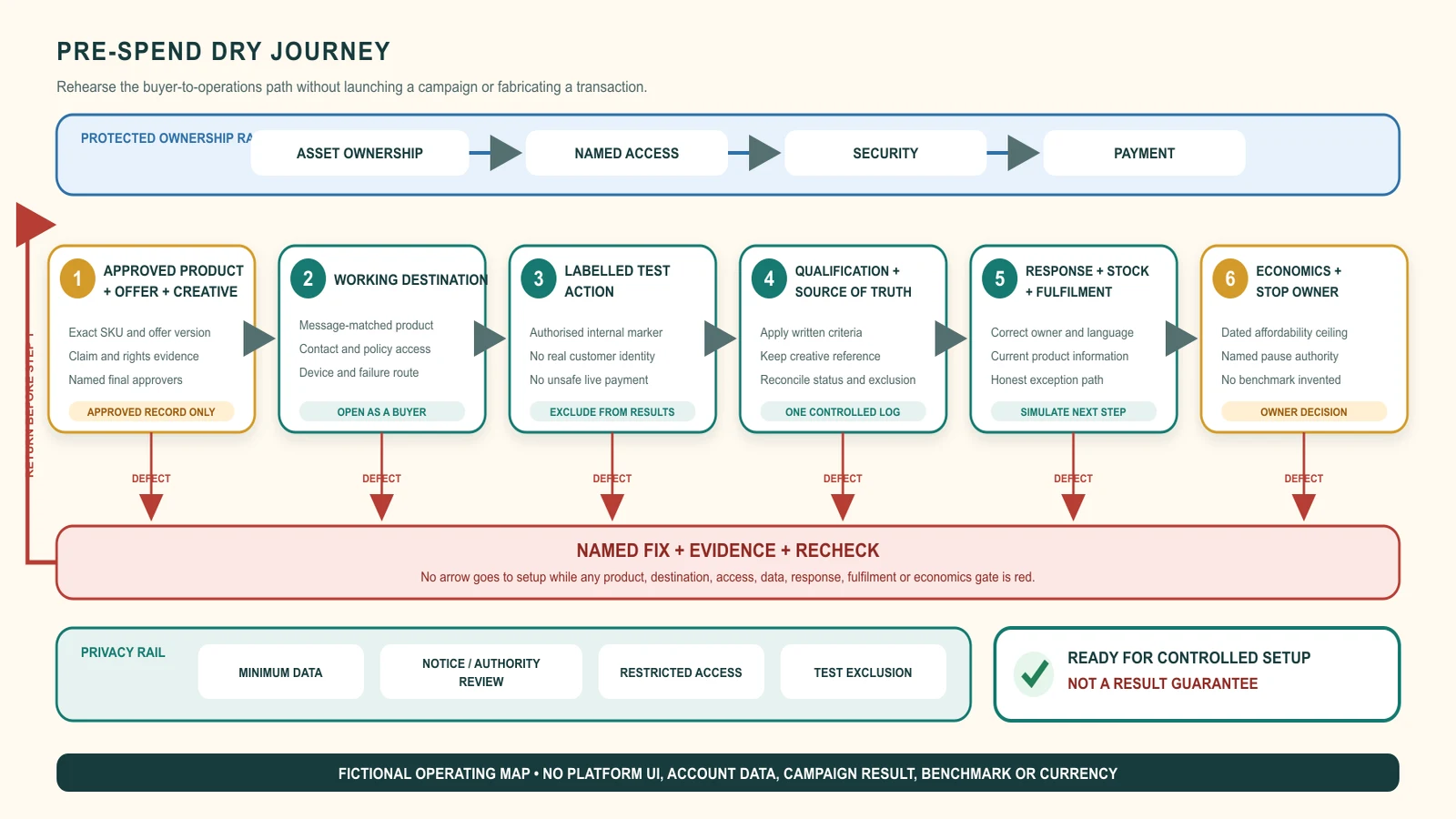
Rehearse the complete buyer-to-operations path; every failure returns to a named fix before campaign setup. The flow is fictional operating guidance and reports no platform test, transaction or campaign result.
Apply the audit to Indian product businesses
These examples are fictional. They illustrate different readiness failures; they are not client results or promises.
Surat apparel wholesaler: separate the buyer and quantity
The wholesaler wants catalogue enquiries for a kurti range. The attractive AI lifestyle creative passes only if the exact fabric appearance, construction, colour family and included quantity remain honest.
The readiness audit finds:
- the ad says “wholesale,” but the opening WhatsApp reply does not ask whether the buyer is a retailer;
- the catalogue mixes single-piece and set pricing;
- MOQ and shipping are not visible; and
- the team answers Hindi and Gujarati but the assigned responder is not named.
Decision: not ready. Fix one B2B offer card, make the MOQ/pack basis explicit, write the qualification questions and assign the language/response owner. Do not solve this by targeting more people.
Rajkot machinery manufacturer: route technical proof to a human
The business wants quotation requests for one component. The destination works, but the ad draft says it “eliminates breakdowns,” and the synthetic animation shows an operating motion that the engineering team has not approved.
The readiness audit requires:
- exact model/application and specification sheet;
- evidence-approved wording rather than an absolute reliability promise;
- real technical imagery or verified diagram for operation/fit;
- an application field in the enquiry;
- an engineer or trained product owner for technical questions; and
- a quotation/lead source of truth.
Decision: real evidence and specialist review required. Media approval cannot repair an unsupported engineering claim.
Jaipur jewellery retailer: make the advertised piece identifiable
The seller wants appointment or WhatsApp enquiries for one necklace. A generic “similar design available” destination cannot substantiate the exact stone pattern shown in a highly polished AI image.
The gate stays red until the business provides:
- a real reference for the exact piece or clearly labels a concept rather than an available SKU;
- stone count/setting, metal/finish, hallmark location where relevant and scale evidence;
- current price or a truthful quotation basis;
- current availability and service area; and
- a responder who can identify the piece from the campaign reference.
Use the AI jewellery photography guide for the category-specific truth gate. Do not let an AI render become inventory evidence.
Local homeware shop: limit the delivery promise
The shop promotes a fictional matte mustard-yellow insulated bottle with a black cap and one stainless loop. The product and offer are accurate, but the saved reply promises “delivery across India” while the shop currently handles only selected local pincodes.
Decision: not ready. Correct the service area in the ad, destination and saved reply; add a pincode question; confirm stock/pack quantity; assign the responder and delivery exception route. A smaller honest service area is better than a large false promise.
Global product exporter: match geography, currency and ownership
An Indian exporter wants enquiries from overseas distributors. The gate checks:
- buyer country and buyer type;
- currency/quotation basis and validity;
- MOQ, samples and trade terms stated accurately;
- shipping/customs language reviewed by the responsible specialist;
- permitted geographies and category rules;
- response coverage across time zones;
- CRM/source-of-truth ownership; and
- privacy/data handling for the actual cross-border flow.
Decision depends on evidence. This article does not decide customs, tax, sanctions, product certification, privacy or advertising law for a market. Obtain specialist review before targeting it.
Know the hard stop rules
Do not proceed to campaign setup when any of these is true:
- the promoted product, variant, quantity, price, MOQ, availability or validity is unclear;
- an AI image/video changes the product or implies unsupported performance;
- a material claim lacks current evidence or required review;
- creative, person, music, supplier, customer or brand rights are unclear;
- the destination is broken, mismatched, misleading or cannot be tested;
- business identity/contact/policies are not adequate for the real journey;
- nobody can identify who owns the Page, ad account, destination or data connection;
- a shared password, fake profile, former staff/agency access or compromised recovery route remains;
- an account restriction, suspicious change or unrecognised charge is unresolved;
- the payer is not authorised or finance cannot reconcile spend;
- no qualified action, exclusion rule or source of truth exists;
- the proposed event/customer-data flow has not passed privacy review;
- nobody can answer, qualify or escalate enquiries;
- stock, service geography, dispatch, return or safety obligations cannot be honoured;
- no dated affordability ceiling or stop authority exists; or
- the product/category/geography requires specialist review that has not occurred.
When to bring in a specialist
Use the appropriate professional when the risk exceeds the team’s evidence or authority:
- Meta asset recovery, compromise or disputed ownership;
- payment, tax or billing issues;
- pixel, Conversions API, CRM, catalogue or complex event implementation;
- privacy, consent, customer-list or cross-border data questions;
- regulated, age-restricted, health, finance, safety or high-risk product categories;
- comparative, environmental, certification, endorsement or technical performance claims;
- jewellery/gemology, textile-colour, machinery/safety or other specialist product proof; and
- cross-border advertising, shipping, customs or local-market compliance.
The specialist’s involvement does not turn a red gate green automatically. Record what they reviewed, for which asset/market/version, on what date and under what conditions.
Move from readiness to the right next guide
When every critical gate is green, produce a signed readiness hand-off containing:
- readiness record ID and date;
- product, offer, creative and destination versions;
- intended buyer and qualified action;
- asset/access/payment owners;
- measurement and privacy owner;
- response and fulfilment owners;
- affordability ceiling and stop owner;
- unresolved non-critical actions with owners/dates; and
- final launch-setup approver.
Then choose the next guide:
- build or revise creative through the AI ad creative system;
- compare approved concepts through the small-budget testing method;
- configure the specific WhatsApp route through The ₹100/Day Click-to-WhatsApp Ads System; or
- repair response and qualification through the WhatsApp selling system.
Passing readiness means the path is fit for controlled setup at a point in time. It does not mean the campaign is approved, profitable or safe to ignore. Reopen the affected gates whenever the product, offer, creative, destination, account, payment, data flow, team, stock, geography, policy or economics changes.
Connect readiness to the DAA growth system
If an offline manufacturer, wholesaler, retailer, shopkeeper, apparel seller, jewellery business or product brand still depends heavily on walk-ins, dealer calls, exhibitions or forwarded catalogues, ads should be the last connected layer—not the first isolated purchase.
GPTWala’s workshop teaches the DAA path: Digital Presence → AI Content Creation → ₹100/day WhatsApp ads. Article 19 protects the joins between those layers: a credible destination, truthful content and a business-ready enquiry path before paid distribution.
See the GPTWala workshop and decide whether the DAA framework fits your product business. The ₹100/day element is a taught setup/budget concept, not a guarantee of reach, approval, leads, enquiries, sales, earnings, profit or return on ad spend. Verify the current workshop page and offer before publication.
Frequently asked questions
What should I fix before running Meta ads for a product business?
Fix one exact product and offer, claim evidence and creative rights, the real destination, asset ownership and named access, security/recovery, restriction and payment responsibility, the qualified-action definition, the privacy-reviewed measurement route, response capacity, stock/fulfilment and the affordable-action ceiling. Any critical red gate means “not ready.”
Do I need a website before running Meta ads?
Not every destination is a website; the appropriate route depends on the campaign and business. A Meta pixel does require a business website, according to Meta’s current help. A messaging route needs its own identity, response, qualification and logging system. Choose the destination first, then apply its actual account, policy, measurement and privacy requirements.
Do I need a Meta pixel or Conversions API before I spend?
There is no universal answer. Define the business action and source of truth first. A website may use pixel and/or Conversions API; a simple enquiry route may initially rely on a controlled manual log. Implement only a data flow the business can govern, test and lawfully operate. Recheck current Meta guidance in the authorised account.
Can my agency own the ad account?
The important issue is deliberate, documented ownership and continuity. The business should know the owning entity, asset IDs, payment owner, access roles, partner permissions, data/creative custody and exit process. If the business cannot operate, recover or transfer the essential assets when the relationship ends, treat that as a readiness risk and obtain appropriate account/contract advice.
Is it safe to share one Facebook login with my team?
No. Meta’s current help says people should be added with roles and that sharing accounts or using inauthentic profiles managed by multiple people violates its rules. Use named access, least-necessary permission, two-factor authentication, protected recovery routes and timely removal of former access.
Does Meta ad approval mean my claims are legally safe?
No. Meta review is a platform-policy process and can include the creative, targeting and destination. It is not legal advice, product verification, a regulator’s approval, a guarantee of continuing delivery or evidence that the offer can be fulfilled. Maintain your own claim, product, rights and category review.
How should a small business define a qualified WhatsApp enquiry?
Use fields that distinguish a suitable buyer from a chat: buyer type, city/service area, exact product/application, quantity or buying timeframe, and a real next step. Exclude tests, duplicates, spam, job seekers, suppliers and ineligible geographies. Collect only information genuinely needed and handle it under the business’s privacy obligations.
What if my product is out of stock after ads start?
Use the prewritten stop route immediately: notify the ad owner, record the affected offer/creative and time, pause or correct the invalid promise through an authorised person, update the destination/saved replies and restart only after stock and offer approval. Do not keep an unavailable offer running merely because the campaign has history.
How much money should I start with?
This readiness guide gives no universal amount. First calculate a dated affordable cost for the chosen action and decide what evidence the proposed setup can reasonably collect. Article 20 owns the specific ₹100/day click-to-WhatsApp implementation; Article 29 owns full unit economics. A budget label is not an outcome guarantee.
How often should I repeat the readiness audit?
Recheck affected gates whenever the product, offer, price, stock, creative, destination, access, payment, data flow, response team, geography, policy or economics changes. Also assign a routine review frequency based on business risk. No universal interval replaces event-triggered checks.
Sources checked for this guide
- Meta for Business: Ad review, policy and support
- Meta Advertising Standards: current policy entry point
- Meta Help: How to add people to an ad account
- Meta Help: About Facebook Page access
- Meta Help: Give, edit or remove Page access
- Meta Help: Protect yourself from phishing
- Meta Help: Add a payment method to an existing ad account
- Meta Help: Set up and install the Meta pixel
- Meta Business Help: About Conversions API
- Meta: Business Tools Terms
- Department of Consumer Affairs: Guidelines for Prevention of Misleading Advertisements and Endorsements for Misleading Advertisements, 2022
- Advertising Standards Council of India: The ASCI Code
Leave a Reply