Break-even ROAS is the revenue return at which advertising contributes no profit after the costs included in the model. This guide builds the number from order economics, not guesswork.
Updated 24 August 2026 · Practical guide for Indian product businesses
Understand what break-even ROAS does and does not mean
Google defines ROAS as total conversion value divided by total ad spend. Break-even ROAS adds business economics: it asks how much attributed sales value is required for the pre-ad contribution from those sales to pay for the advertising. It is a planning boundary, not proof that advertising caused every reported order.
Build the order-level inputs first with the product-business unit economics guide. Keep the calculator focused on costs that change with the order. Fixed salaries and rent can be handled in the operating target or a separate profit model, but the choice must be documented.
Metric
Formula
Meaning
ROAS
Attributed conversion value ÷ ad spend
Revenue efficiency reported against spend
Pre-ad contribution margin
Contribution before ads ÷ net revenue
Share of revenue available to fund ads
Break-even ROAS
1 ÷ pre-ad contribution margin
ROAS at zero contribution after ad spend
Operating ROAS target
Break-even plus safety and profit requirement
Decision threshold for real campaigns
Build net revenue and variable cost correctly
Begin with net product revenue on the same basis used for conversion value. Then subtract product cost, packaging, outbound fulfilment, payment cost, channel commissions, expected return and replacement cost, and any sales-linked discount. Do not subtract ad spend yet because the result is contribution before advertising.
Input
Include
Common error
Net revenue
Realised selling price after discounts and relevant taxes
Using MRP or tax-inclusive value without reconciliation
Product cost
Landed unit cost
Using supplier price but omitting inbound cost
Fulfilment
Packaging, pick, ship and sales-linked handling
Using only headline courier rate
Payment and channel cost
Gateway, COD or commission linked to sale
Treating all channels as identical
Expected returns
Probability-weighted reverse and value loss
Ignoring returns until month-end
The contribution margin calculator should be the source of these inputs. Reconcile monthly with actual settlements rather than letting an old spreadsheet become policy.
Calculate break-even ROAS from contribution margin
Suppose an order produces ₹1,000 of net revenue and ₹400 of contribution before ads. The pre-ad contribution margin is 40 percent. Break-even ROAS is 1 ÷ 0.40, which equals 2.5x. At ₹100 of ad spend, 2.5x ROAS reports ₹250 of revenue and approximately ₹100 of pre-ad contribution, so ad spend consumes the contribution.
Break-even ROAS = 1 ÷ pre-ad contribution margin. When margin is shown as a percentage, convert it to a decimal first. This relationship is valid only when the margin rate reasonably represents the product mix attributed to the campaign.
Pre-ad contribution margin
Break-even ROAS
Revenue needed for ₹10,000 ad spend
20%
5.00x
₹50,000
30%
3.33x
About ₹33,333
40%
2.50x
₹25,000
50%
2.00x
₹20,000
Use a calculator sequence that exposes assumptions
Choose a revenue basis and period that matches ad reporting.
Enter average net revenue per attributed order.
Enter each variable cost separately, including expected returns.
Calculate contribution before ads and divide by net revenue.
Divide one by the contribution margin decimal.
Add an explicit uncertainty and profit buffer for the operating target.
Calculator line
Example only
Result
Net revenue per order
₹1,500
Starting value
Variable costs before ads
₹990
Product, fulfilment, payment and expected returns
Contribution before ads
₹510
₹1,500 − ₹990
Contribution margin
34%
₹510 ÷ ₹1,500
Break-even ROAS
2.94x
1 ÷ 0.34
The example is instructional, not a benchmark. Replace every input with the campaign’s product and channel mix.
Use product-level or weighted margins for mixed campaigns
A campaign selling products with different margins should not use a simple average of margin percentages. Weight each product by its share of net attributed revenue or calculate total contribution divided by total net revenue for the mix. A shift toward a low-margin bestseller can raise the real break-even ROAS even when platform ROAS is stable.
Product group
Revenue share
Contribution margin
Weighted contribution
A
50%
45%
22.5 percentage points
B
30%
30%
9 percentage points
C
20%
20%
4 percentage points
Total mix
100%
35.5%
Break-even about 2.82x
Recalculate after major price, discount or shipping changes. The margin-safe discount guide explains why a promotion can change break-even even if unit volume increases.
Adjust for returns, cancellations and cash outcomes
Ad platforms may report conversion value before returns or cancellations are fully known. Build an expected adjustment using product and channel history, then reconcile the realised cohort later. Keep return probability, lost value, reverse shipping and non-refundable payment cost separate so the model can be audited.
Scenario
Model treatment
Review
Prepaid cancellation
Remove revenue and include non-recoverable costs
Order and payment record
COD refusal
No realised revenue plus shipping and handling loss
Carrier settlement
Return to stock
Remove sale, include reverse cost and any value loss
Inspection grade
Partial refund
Reduce realised revenue and keep applicable costs
Refund transaction
A campaign near break-even is especially sensitive to these outcomes. Use realised contribution, not only platform revenue, for the final decision.
Set an operating target above break-even
Break-even leaves no room for model error, overhead or profit. Create a target contribution after ads and solve for the required ROAS, or apply a documented buffer. The buffer should be larger when attribution is uncertain, returns are volatile, cash is tight or creative fatigue is likely.
If you require 10 percent of revenue as contribution after ads and pre-ad contribution is 40 percent, only 30 percent is available for advertising. The corresponding ROAS target is 1 ÷ 0.30, or 3.33x. This is more transparent than adding an arbitrary 20 percent to break-even.
Objective
Available share for ads
Target logic
Zero post-ad contribution
Full pre-ad contribution margin
Break-even only
Positive order contribution
Pre-ad margin minus desired contribution rate
Sustainable operating target
New-customer investment
May allow lower first-order result
Requires credible repeat-value model
Cash protection
Lower allowable ad share
Higher target and spend controls
Reconcile platform ROAS with business ROAS
Google Ads explains that conversion values can represent sales revenue or profit-related values. Whatever value is used, document it. Compare platform conversion value with paid orders, realised net revenue and contribution for the same cohort. Differences can come from attribution windows, duplicate tags, cancellations, cross-device journeys and channel overlap.
View
Numerator
Use
Platform ROAS
Reported conversion value
Optimisation signal
Realised revenue ROAS
Settled net revenue
Commercial reconciliation
Contribution after ads
Realised contribution minus ad spend
Profitability decision
Incremental ROAS
Estimated additional value caused by ads
Causal evaluation when testable
Before scaling, complete the readiness checks in the Meta ads guide and apply the same measurement discipline to any channel.
Use break-even ROAS as a boundary, not an automatic switch
A campaign below target may need a price, offer, landing-page, product-mix or measurement fix. A campaign above target may still be capacity-constrained or overly dependent on one product. Review contribution, order quality, cash timing and customer fit before changing spend.
Recalculate the model after fee, tax, fulfilment or return changes. Keep dated assumptions next to each decision so a future team member can understand why 3.2x was acceptable in one month and not another.
Frequently asked questions
What is break-even ROAS?
Break-even ROAS is the revenue-to-ad-spend ratio at which the contribution generated by attributed sales equals ad spend after the costs included in the model. Profit is zero at that boundary.
How do I calculate break-even ROAS?
If contribution margin before advertising is expressed as a decimal, break-even ROAS equals 1 divided by that margin. A 40 percent contribution margin gives a 2.5x break-even ROAS before safety allowances.
Is a higher break-even ROAS better?
No. A higher break-even ROAS means the business needs more attributed revenue for each rupee of ad spend to avoid loss, usually because pre-ad contribution margin is lower.
Should GST be included in a ROAS calculator?
Use the revenue basis that matches the advertising platform and your management accounts. Do not treat collected tax as spendable revenue. Have an accountant confirm the treatment for your business.
Why can an ad campaign beat break-even ROAS and still lose money?
The model may omit returns, fulfilment, discounts, marketplace charges, payment fees, agency costs or unattributed orders. Measurement and cash timing can also differ from the simplified calculator.
What ROAS target should a product business use?
Use a target above break-even to create room for uncertainty, overhead and profit. Set the buffer from data quality, return variability, cash constraints and the business objective.
A win-back campaign should solve a reason for inactivity, not simply send a bigger coupon to every old customer. This playbook defines the audience, sequence, economics and stopping rules.
Updated 24 August 2026 · Practical guide for Indian product businesses
Define inactivity relative to the buying cycle
A customer is not lapsed simply because a calendar says 90 days. A replacement part, a seasonal item and a monthly consumable have different normal intervals. Estimate the expected repeat window by product or segment, then define inactivity as a meaningful delay beyond that window.
WooCommerce’s example uses minimum and maximum days since purchase to identify inactive customers. That is a useful starting mechanism, but the values must come from your data. This campaign sits inside the broader customer-retention system and should not overlap with a normal replenishment reminder or a recent abandoned-cart recovery.
Customer state
Example rule
Best treatment
Within normal cycle
Not yet due to repurchase
Education or service only
Approaching expected repeat
Near usual interval
Replenishment reminder
Meaningfully late
Past segment threshold
Win-back candidate
Inactive beyond useful contact
Very old or invalid context
Preference check or suppression
Diagnose why customers may not have returned
A generic “we miss you” message assumes the customer forgot. Inactivity may instead come from excess product life, poor fit, out-of-stock items, service failure, changed need, price pressure or channel migration. Use order history, support reasons, returns and feedback to create a small set of plausible causes.
One-time or gift buyers may never have had a repeat need.
Customers who complained need resolution, not a promotion.
Buyers of a discontinued SKU need a truthful replacement path.
Heavy discounters may be inactive only because the previous offer ended.
Customers who moved to another channel may still be active but invisible in one dataset.
Segment by relationship, not just last-purchase date
Start with a few actionable groups. One-time buyers need reassurance and education. Former repeat buyers may respond to convenience, availability or recognition. High-return customers require a different decision from high-contribution customers. Segment only when the message or offer will genuinely change.
Segment
Likely question
Message angle
Exclusion check
One-time buyer
Was the first purchase useful?
Usage help and relevant next product
Return or complaint unresolved
Former repeat buyer
What changed?
Availability, convenience or improvement
Already reordered elsewhere in system
High-value inactive
Is the relationship still relevant?
Personal service and preference check
Sensitive issue needs human owner
Offer-only buyer
Would they buy without a deep discount?
Value and product fit before incentive
Unprofitable historical contribution
The customer segmentation guide provides a wider framework, but the win-back audience should stay small enough to explain and audit.
Build a short sequence with a different job for each message
A useful sequence progresses from relevance to a reason to return and then to a respectful close. Repeating the same coupon three times is not a sequence. Each message should add information or choice, and all later messages must be suppressed after purchase, reply or opt-out.
Touch
Job
Example angle
Stop condition
1: Relevance
Reconnect purchase context
How to get more value from the product
Purchase, reply or opt-out
2: Reason to return
Present a meaningful change
Restock, improvement or complementary item
Purchase, reply or opt-out
3: Preference or close
Ask what is useful
Choose frequency, give feedback or pause
Any response or sequence end
Use a direct product or category link, not a busy home page. A customer who needs help should be routed to a person rather than forced through promotional automation.
Set the win-back offer from incremental contribution
An incentive is a cost of reactivation. Calculate whether the incremental order contribution can fund the discount, message cost and likely returns. Do not compare the offer only with the customer’s lifetime revenue; the next order must still make commercial sense.
Incremental win-back contribution = reactivated order contribution − incentive − campaign cost − expected return cost. Compare this with a holdout group or historical baseline to estimate how many orders would have happened anyway. Use the unit economics guide before approving a broad discount.
Offer
Potential benefit
Primary risk
Best control
No discount
Tests true relevance
Lower initial response
Strong product-specific reason
Fixed credit
Easy customer value
Consumes margin on small baskets
Minimum contribution threshold
Percentage discount
Scales with order
Large cost on high-value carts
Discount cap
Service benefit
Protects price integrity
Operational workload
Capacity and eligibility rule
Use the right channel and respect customer choice
A historic order is not universal permission to contact a person forever. Check current channel consent, message purpose and opt-out state. WhatsApp policy requires the customer’s number and opt-in permission, compliance with applicable law and prompt respect for requests to stop.
Link WhatsApp execution to the WhatsApp selling guide. Keep email, SMS and WhatsApp permissions separate where required. The final message can offer a preference choice, but it should not pressure a customer to remain subscribed.
Control
Required decision
Evidence
Eligibility
Why this person is a win-back candidate
Segment and last qualifying order
Permission
Which channel and purpose are allowed
Consent record
Frequency
How many touches are permitted
Sequence rule
Suppression
What stops all later sends
Purchase, reply, opt-out or complaint
Automate the rule and keep exceptions human
The automation should identify the audience, apply exclusions, schedule touches and record outcomes. Humans should own complaints, product suitability, sensitive customer history and manual credits. Every branch needs an owner and a maximum response time.
Calculate the lapsed threshold by product or segment.
Build the eligible audience and remove exclusions.
Assign the approved sequence and channel permission.
Suppress immediately after purchase, response or opt-out.
Route service issues to a human queue.
Record reactivation window, contribution and reason codes.
Apply the controls from the marketing automation guide. Never upload an old contact list to a new tool without reconciling consent and opt-outs.
Use a reactivation window and a credible baseline
Choose the conversion event and time window before launch. A purchase within 14 or 30 days may be appropriate depending on the buying cycle. Count revenue and contribution separately. A high response rate can still be unprofitable if the incentive, returns or service effort is heavy.
Metric
Definition
Interpretation
Eligible audience
Customers after all exclusions
True denominator
Reactivation rate
Eligible customers who buy in window ÷ eligible customers
Observed response
Incremental lift
Campaign reactivation minus baseline or holdout
Likely campaign effect
Contribution per eligible customer
Net campaign contribution ÷ eligible customers
Economic efficiency
Opt-out and complaint rate
Negative outcomes ÷ delivered messages
Trust and targeting quality
Review by segment. One group may justify expansion while another should be suppressed or served differently.
Run a controlled win-back pilot
Choose one segment with a clear lapsed definition and a known reason to return. Manually inspect a sample of records, approve the sequence and hold back a comparable group when the audience is large enough. Launch in a volume the support team can handle.
At the end of the window, classify results as purchase, reply, service issue, opt-out, no response or bad data. Carry customers who need ongoing follow-up into a normal service or retention path. Do not keep them in a permanent win-back loop. The objective is a renewed useful relationship, not repeated pressure.
Frequently asked questions
What is a customer win-back campaign?
A customer win-back campaign is a short sequence designed to re-engage a previous buyer who has not purchased within the expected cycle. It should address a plausible reason for inactivity and use clear stopping rules.
When is a customer considered lapsed?
The right threshold depends on the normal repurchase interval for the product and customer segment. A useful rule is based on a multiple of the observed cycle rather than one fixed number of days for the entire catalogue.
How many messages should a win-back campaign include?
A small product business can start with two or three purposeful messages: relevance or education, a reason to return, and a final preference or feedback request. Stop after purchase, opt-out or the sequence limit.
Should every win-back campaign use a discount?
No. Product improvement, availability, education, service recovery or a relevant new option may be stronger reasons to return. Use an incentive only when the expected incremental contribution can fund it.
Which customers should be excluded from win-back campaigns?
Exclude recent purchasers, people who opted out, customers with unresolved complaints, refunded or fraudulent orders, invalid contacts and segments for which the message is not relevant.
How do I measure a win-back campaign?
Use an eligible audience, holdout where practical, reactivation window, contribution after incentive, opt-out rate and complaint rate. Do not attribute every later purchase to the campaign.
GPTWala Business Hub · Practical ecommerce systems
Make the homepage a useful route into products, categories, proof and help instead of a crowded poster that asks every visitor to do everything.
Updated 23 August 2026 · Guide for Indian product businesses
An ecommerce homepage should help a visitor answer four questions quickly: what this business sells, who it is for, why it is credible and where to go next. It is not required to explain every SKU. Its job is orientation, priority and routing.
Choose one dominant retail or lead-generation path. Secondary audiences can have clear routes without competing equally in the hero.
Above-the-fold checklist
Business/category meaning is clear without reading the logo.
Headline names the product area or buyer outcome without hype.
Supporting line adds a truthful differentiator, use case or service boundary.
Primary CTA goes to a useful category, collection or enquiry step.
Hero image shows a real product, use or range and remains legible on mobile.
Price, delivery or location cues appear only when current and important.
No autoplay, popup or banner blocks orientation.
Hero test: hide the logo and ask a new person what the business sells, who it serves and what the main button will do.
Navigation and product discovery
Google’s current ecommerce site-structure guidance explains that links from menus to categories, subcategories and products help it understand and find the site. The same hierarchy helps buyers.
Element
Checklist
Avoid
Primary menu
Buyer-friendly categories and essential help
Internal department names
Search
Visible where catalogue size justifies it; handles SKU and common terms
Empty results with no recovery
Category links
Real crawlable links with descriptive labels
Only image tiles or JavaScript events
Breadcrumb/wayfinding
Preserve location after click
Dead-end landing pages
Support
Policies, order help and contact are findable
WhatsApp as the only unexplained option
Homepage merchandising
Feature products for a documented reason: best fit for a new buyer, seasonal relevance, current availability, high repeat demand or strategic range. Label the reason honestly. “Best seller” needs evidence; “Featured” is safer when the choice is editorial.
Module
Buyer job
Required data
Shop by category
Understand the range
Stable category name and representative image
Shop by use
Solve a situation
Clear eligibility and product fit
Featured products
Begin comparison
Price, variant/stock state and destination
New arrivals
See genuinely new items
Launch date and expiry rule for badge
Wholesale route
Request a qualified quote
MOQ/process proof and form/message path
Product cards should use the same names, images and prices as the product page. Use GPTWala’s product-page copy template for the destination.
Trust and policy cues
Show the business name and a monitored contact route.
Link shipping, return/refund, privacy and terms before checkout.
Use reviews only with a real source and moderation policy.
Explain COD, payment or delivery limitations accurately.
Keep awards, certifications and logos current and permissioned.
Do not display fake countdowns, stock or visitor counters.
Trust is distributed across accurate product data, working pages and predictable service. A badge cannot repair contradictory price or delivery information.
Helpful content and proof
Use concise proof that helps a decision: material/process evidence, category comparison, buyer guide, care/compatibility information, customer use with permission or an operations snapshot. Link to deeper pages rather than pasting long generic brand copy.
Proof type
Good homepage use
Evidence
Product range
Representative category cards
Current catalogue
Manufacturing/process
One verified capability plus detail link
Own facility/process record
Review
Short attributed excerpt
Real review and permission where needed
Delivery/service
Clear service area/window
Current operations policy
Guide
Answer a common pre-purchase question
Maintained editorial page
Mobile, accessibility and performance
Test on a real narrow device and a slower connection. The current Core Web Vitals are LCP, INP and CLS; web.dev’s official overview explains their recommended thresholds and field measurement. Do not optimise only a laboratory score.
Keep tap targets separated and text zoomable.
Reserve image dimensions to prevent layout shifts.
Compress responsive images and avoid an oversized hero video.
Make keyboard focus and visible labels work.
Keep sticky bars from covering content and checkout routes.
Test menus, search, filters and popups without a mouse.
Homepage SEO and internal linking
Use one descriptive H1 that represents the business/category, a unique title and a useful meta description. Link to priority categories with normal <a href> links, not only a site search. Keep organisation/contact facts consistent and add structured data only when it matches visible content and Google’s current guidelines.
Do not make the homepage target every product keyword. Product pages are owned by the product-page SEO system; category pages have their own intent and architecture.
Measurement plan
Question
Metric/event
Warning
Can visitors choose a route?
Category/search/help progression
Clicks alone do not show success
Do priority cards work?
Eligible card-to-product sessions
Position affects exposure
Does homepage traffic buy?
Confirmed orders/contribution by landing cohort
Reconcile returns
Is discovery failing?
Search exit/zero-result terms
Review query quality
Is mobile experience healthy?
Field vitals and task completion
Lab tests are not field data
Homepage launch QA
All buttons and category links open the promised page.
Prices, stock badges, dates and policies are current.
Hero and cards work across common screen sizes.
Menu, search and keyboard navigation work.
Images have useful alt text where appropriate and fixed dimensions.
No horizontal overflow or blocked content exists.
Analytics records one accurate event per action.
Homepage does not cannibalise category or product-page intent.
Support and order routes are monitored.
Assign homepage ownership and a maintenance cadence
A homepage audit is only useful when each module has an owner. Merchandising should own promoted collections and stock status, marketing should own campaign promises, operations should own delivery and return claims, and the website owner should own navigation, technical health and measurement. Put the owner and the last-reviewed date in a simple module register. This prevents an expired sale, unavailable product or old shipping promise from remaining visible long after a campaign ends.
Use a predictable review rhythm: check inventory-linked modules and offers weekly, proof and policy claims monthly, and the full mobile-to-checkout journey quarterly. Review again after every major catalogue, pricing, theme or analytics change. A smaller homepage that is current and measurable is usually safer than a crowded homepage that nobody maintains.
Homepage change
Before publishing
After publishing
Hero or offer
Confirm dates, eligibility, stock and destination
Test the main click on phone and desktop
Featured collection
Check product availability, price and sort order
Verify products are crawlable and purchasable
Trust or policy claim
Match the wording to the current policy page
Check the policy link and mobile readability
Navigation update
Protect high-demand paths and naming consistency
Review search, menu and analytics events
Keep a dated screenshot of important homepage versions and annotate major launches in analytics. That record helps the team explain conversion changes without guessing and makes rollback easier when a redesign underperforms.
Include a clear category promise, primary route, navigation, search where useful, category/product modules, truthful proof, policies, support, mobile performance and measurement.
How many products should appear on an ecommerce homepage?
Show only enough products to support priority discovery decisions. The right number depends on catalogue size, page speed, screen size and the routes buyers need.
Should an ecommerce homepage link to products or categories?
Usually both, with categories providing durable discovery and selected products supporting clear merchandising reasons. Keep all links useful and crawlable.
What should be above the fold on an ecommerce homepage?
Show what the business sells, who it serves, one truthful differentiator and a primary action that leads to a useful destination.
How do I improve ecommerce homepage conversion?
Improve message clarity, routing, product-card accuracy, trust, mobile speed and destination quality, then measure confirmed outcomes rather than only hero clicks.
Is homepage SEO different from product-page SEO?
Yes. The homepage normally represents the business and main category, while category and product pages own narrower shopping and item-level queries.
GPTWala Business Hub · Practical advertising systems
A small-team blueprint for organising campaign goals, ad sets, ads, budgets, names, tests and reporting around real business decisions.
Updated 23 August 2026 · Guide for Indian product businesses
A useful Meta ads campaign structure makes decisions easier. It does not try to display every audience idea in separate folders. For a product business, structure should connect the business goal, conversion location, audience controls, product or offer, creative test and reporting rule.
Meta’s current Ads Manager creation guide defines three levels: campaign, ad set and ad. The interface changes over time, but the logic remains helpful. Begin with GPTWala’s Meta ads readiness guide before building campaigns around an unready page, message flow or product offer.
Understand the three levels
Level
Main job
Typical decisions
Do not use it to
Campaign
Define the overall result
Objective, special category if applicable, budget approach
Create many nearly identical audiences without a reason
Ad
Define what the person sees and clicks
Identity, format, product proof, copy, destination, tracking
Hide product or landing-page differences in vague names
Structure around decisions, not imagined precision
Each extra campaign or ad set should answer a decision that cannot be answered cleanly inside the existing structure. Separate when the objective, conversion location, geography with real operational differences, budget rule, product economics or required reporting changes. Do not separate only because two interests sound different.
Meta’s current ad-set simplification guidance says similar ad sets running together receive fewer learning opportunities and recommends consolidation. Treat that as a direction, not permission to mix offers with different margins or delivery constraints.
Account rule: simplify delivery, preserve business truth. Two products with very different contribution margins may require separate controls even if the platform could technically combine them.
A practical blueprint for a small product business
Layer
Purpose
Example
Primary report
Prospecting
Reach eligible new buyers for one outcome
Sales to standard product collection
New-customer orders and contribution
Retargeting
Help known visitors or engagers complete a decision
Viewed product but did not buy
Incremental recovery, not only attributed sales
Creative test
Compare controlled proof or message concepts
Mechanism demo versus use-case comparison
Pre-agreed creative test metrics
Messaging/lead
Generate conversations needing qualification
Wholesale quote on WhatsApp
Qualified lead and confirmed-order cost
Existing-customer
Repeat purchase where consent and exclusions are correct
Relevant replenishment offer
Incremental repeat contribution
Not every account needs all five layers. Create only what the business can operate and measure. A low-volume business may begin with one prospecting structure and one controlled creative test.
Campaign-level choices
Choose the objective closest to the real outcome. Meta explains that its auction looks for people more likely to take the action related to the selected objective. A traffic objective should not be a substitute for a purchase outcome merely because link clicks appear cheaper.
Name one business goal and one primary conversion location.
Choose the objective and performance logic that match that goal.
Apply special-ad-category settings when genuinely required.
Decide whether budget control belongs at campaign or ad-set level.
Define the reporting window and source-of-truth order record before launch.
At ad-set level, keep only distinctions the delivery system or business must respect. These may include conversion location, catalogue or product-set logic, geography served, schedule, audience control, placements and optimisation event.
Reason to separate
Usually valid?
Decision test
Different country or delivery promise
Often
Does stock, price, policy or fulfilment change?
Different product margin
Often
Does the allowable acquisition cost differ materially?
Different conversion location
Yes
Website purchase and WhatsApp conversation are different journeys
Small variations of similar interests
Often no
Will the split create a clear business decision?
Device or placement curiosity
Usually no
Is manual control required by creative or economics?
Ad-level choices
An ad needs a truthful product, specific buyer problem, visible proof, readable copy and matching destination. Organise creatives by concept, not only by format. “Video 3” is not a useful learning record. “Latch mechanism demo, 9:16, hook B” is.
Keep the exact product and variant consistent with the destination.
Use approved claims and show proof where possible.
Create placement-ready crops and readable text.
Attach URL parameters or campaign identifiers consistently.
Check identity, destination, price and stock before publishing.
Meta currently supports campaign-level and ad-set-level budget choices in Ads Manager. Campaign budget allows delivery to allocate across eligible ad sets, while ad-set budget creates tighter local control. Use the choice that matches the decision.
Situation
Starting budget approach
Reason
Similar ad sets serving one outcome
Campaign budget may fit
Allows allocation across delivery opportunities
Strict regional, product or test allocations
Ad-set budget may fit
Preserves planned spend boundaries
Controlled audience or creative experiment
Use explicit test design
Delivery allocation should not invalidate the comparison
Very limited total budget
Simplify first
Too many ad sets can starve each decision
Do not treat either approach as universally superior. The Meta ads budget calculator translates margin, conversion assumptions and the number of useful learning decisions into a planning range.
Separate testing from scaling
A test needs a hypothesis, controlled variable, success metric, minimum operating period and stop rule. Scaling needs stable measurement, contribution headroom and operational capacity. Combining both into constant daily edits makes the account impossible to learn from.
Write the buyer and business hypothesis.
Choose one meaningful variable, such as proof style or destination.
Move only a verified winner into the ongoing structure.
Use naming and documentation that survive staff changes
Level
Suggested fields
Example pattern
Campaign
Goal, location, product group, region
SALES_WEB_STORAGE_INDIA
Ad set
Audience rule, optimisation, geography, window
PROSPECT_PURCHASE_WEST_7D
Ad
Concept, format, product, hook, version
MECHANISM_9X16_JAR_HOOKB_V02
Maintain a change log with owner, date, reason and expected effect. A tidy name cannot replace documentation of offer changes, price changes, tracking releases or stock restrictions.
Archive screenshots or exports at major decision points, especially before restructuring. Record the active objective, conversion event, budget owner, exclusions and page version. When performance moves later, this evidence helps the team separate a delivery change from a product, price, stock or measurement change.
Pre-launch account QA
Campaign objective matches the commercial outcome.
Conversion location and event reflect the real journey.
Ad sets are distinct for a documented reason.
Budget is sufficient for the number of live decisions.
Product, price, availability and page/message destination match.
Creative claims are approved and legible in every placement.
Tracking was tested and order records can be reconciled.
Names, URL parameters and reporting fields are consistent.
Team capacity exists for enquiries, fulfilment and recovery.
Frequently asked questions
What are the three levels of a Meta ads campaign?
The three levels are campaign, ad set and ad. The campaign defines the goal, the ad set defines delivery conditions, and the ad contains the creative and destination.
How many ad sets should a campaign have?
Use only as many as are needed for distinct delivery or business decisions. Similar ad sets can fragment learning, so every split should have a documented reason.
Should I use campaign budget or ad-set budget?
Use campaign budget when allocation across similar ad sets is acceptable. Use ad-set control when geography, product economics or a controlled test needs a defined allocation.
Should prospecting and retargeting be in separate campaigns?
Separate them when the audience logic, message, measurement or budget decision differs. Avoid separation that creates tiny, unstable structures with no clear decision.
How should Meta ads be named?
Include the goal, conversion location, product group, audience or region, creative concept, format and version. Keep a separate change log for important edits.
How often should I change a Meta ads campaign structure?
Change it when a documented business, delivery or measurement need changes. Do not rebuild the account merely because daily performance fluctuates.
GPTWala Business Hub · Practical advertising systems
Choose the destination that completes the buyer’s next task, then measure the full path from paid click to confirmed, profitable order.
Updated 23 August 2026 · Guide for Indian product businesses
Click-to-WhatsApp ads and website conversion ads are not interchangeable buttons. They create different buyer journeys. WhatsApp moves a person into a conversation, where a team or automation helps complete the decision. A website asks the page, product data, checkout and measurement setup to carry more of that work.
The better option is the one that matches the buyer’s immediate task and your operating capacity. Start with GPTWala’s Meta ads readiness guide for product businesses. If the offer, margin, product proof or fulfilment process is weak, changing the destination will not solve the underlying problem.
The short answer
Choose click-to-WhatsApp when buyers need qualification, configuration, a quote, stock confirmation or human reassurance before ordering. Choose website conversion when the offer is standardised, the page answers key questions, checkout works smoothly and purchase events are measured reliably.
Do not decide from cost per click alone. A cheap conversation can become expensive if the team spends hours on unqualified enquiries. A higher website click cost can still work if the page converts, order value is healthy and contribution margin remains after ad spend.
What each ad path is designed to do
Meta’s current official click-to-message overview describes ads that open Messenger, Instagram Direct or WhatsApp conversations. Meta’s objective guidance says the ad system uses the chosen objective to look for people more likely to take the related action. Destination and optimisation therefore need to reflect the real business outcome.
Path
Immediate action
Where persuasion happens
Operating dependency
Click-to-WhatsApp
Start a message
Ad plus conversation
Fast, accurate replies and qualification
Website conversion
Visit page, add to cart, enquire or buy
Ad plus landing/product page
Page quality, checkout, tracking and fulfilment
Hybrid
Read first, message when needed
Page plus optional conversation
Clear handoff and consistent product facts
Decision matrix for product businesses
Buyer situation
Likely starting path
Reason
Standard SKU, clear price, simple delivery and trusted checkout
Website conversion
The page can complete the transaction without a human bottleneck
Wholesale quantity, configuration or location-dependent quote
Click-to-WhatsApp
The conversation gathers decision-critical information
High-consideration product with specifications and case-by-case fit
Website then WhatsApp
The page educates; the conversation qualifies
Impulse-friendly low-complexity product
Website conversion
Extra chat steps may add friction
Catalogue selling without dependable website checkout
Click-to-WhatsApp
A managed conversation can be the current order path
Removes greetings, spam and clearly unsuitable enquiries
Conversation-to-order rate
Confirmed orders ÷ qualified conversations
Shows whether sales follow-up turns interest into orders
WhatsApp acquisition cost
Ad spend ÷ confirmed paid orders from conversations
Makes the message path comparable to ecommerce
Website purchase conversion rate
Confirmed website orders ÷ eligible visits
Shows how efficiently the site completes the task
Website acquisition cost
Ad spend ÷ confirmed paid website orders
Connects media spend to transactions
Contribution after ads
Order contribution before ads − acquisition cost
Separates revenue growth from profitable growth
For WhatsApp, also count handling time, missed-response cost and cancellations. For a website, include payment fees, returns, fulfilment and any discount used to create the conversion. Use the same definition of a confirmed order in both paths.
Build comparable measurement
A message is not automatically a lead, and a platform-attributed purchase is not automatically a settled profitable order. Create a shared funnel:
Ad delivered and clicked.
Conversation started or eligible website session.
Qualified enquiry, product view or add-to-cart.
Order placed.
Payment confirmed.
Order delivered and retained after the relevant return window.
Use consistent campaign identifiers in WhatsApp notes or CRM records. On the website, validate events and reconcile platform reporting with store or payment records. The WhatsApp lead-qualification workflow gives the conversation path explicit stages and handoffs.
When WhatsApp is the stronger path
WhatsApp is useful when the conversation itself creates legitimate value. A packaging supplier may need size, material, quantity, print requirement and delivery location. A homeware seller may need to confirm a variant or dispatch date. The ad should preview the information required so the buyer is not surprised.
Use a specific prefilled message or prompt, not “Hi”.
State response hours and expected next step.
Give the team an approved catalogue, price logic and qualification script.
Separate service questions from sales enquiries.
Record source, qualification outcome, order and reason lost.
A website can sell while the team is unavailable and gives buyers a stable place to compare products, policies, delivery and proof. It is usually stronger when price and variants are standard, the page loads quickly on mobile, checkout is trustworthy and the product does not require case-by-case advice.
Before paying for traffic, test the exact page on a real phone. Confirm the ad promise matches the first screen, variants and price are understandable, shipping and return information are visible, payment works, and the thank-you event records once. For enquiry-led pages, use GPTWala’s product landing-page structure for WhatsApp enquiries.
Use a deliberate hybrid, not two competing calls to action
A hybrid can send traffic to a useful page and offer WhatsApp for specification or fit questions. Decide which action is primary. If every section contains competing “Buy”, “Call”, “Message” and “Request quote” buttons, neither the buyer nor the measurement system has a clear journey.
Stage
Website job
WhatsApp job
Discovery
Explain category and use case
Answer a narrow initial question
Evaluation
Show specifications, proof, variants and policy
Check fit, quantity or availability
Decision
Complete checkout or structured enquiry
Confirm quote, payment path and handoff
Recovery
Preserve cart or enquiry context
Follow up with consent and relevance
Run a fair destination test
Use one offer, audience region and decision window.
Create destination-appropriate ads without changing the product promise.
Give each path enough operational capacity and a pre-agreed spending ceiling.
Measure qualified demand, confirmed orders, contribution and team time.
Document lost reasons rather than declaring a winner from clicks.
Keep a control and change one important variable at a time.
Optimising for conversations when the team cannot respond.
Counting every incoming message as a qualified lead.
Sending website traffic to a generic homepage.
Comparing platform ROAS with incomplete WhatsApp order records.
Ignoring cancellations, returns, discounts and fulfilment cost.
Using a cheap click as proof that the destination is profitable.
Frequently asked questions
Are click-to-WhatsApp ads effective for product businesses?
They can be effective when a conversation is genuinely needed, the team replies quickly, qualification is consistent and confirmed profitable orders are tracked. A low message cost alone does not prove effectiveness.
Are website conversion ads better than WhatsApp ads?
Neither is universally better. Website ads suit standardised self-serve purchases; WhatsApp suits decisions that require qualification, quotation, availability or human reassurance.
Should a Meta ad send people to WhatsApp or a landing page?
Send people to the place that can complete their next task. Use a landing page for structured education or checkout and WhatsApp when a managed conversation is part of the sale.
How do I compare WhatsApp and website ad performance?
Compare confirmed acquisition cost, contribution after ads, cancellation or return outcomes and operating time. Use the same order definition and decision window.
Can I use a website and WhatsApp together?
Yes. Let the website handle stable product information and let WhatsApp handle specific fit, quote or availability questions. Keep one primary action per stage.
What should I track for click-to-WhatsApp ads?
Track spend, conversations, qualified enquiries, response time, orders placed, payments, delivered orders, contribution, lost reasons and follow-up outcomes.
GPTWala Business Hub visual guide for brand strategy local product business.
Reviewed and updated: 12 August 2026
A local product-business brand is the consistent expectation created by its products, promise, proof, identity and behaviour across store, packaging, website, WhatsApp and service. Start with positioning and operational truth, then define voice and visual rules. A logo redesign cannot repair an unreliable promise.
This root guide owns the practical brand system, not trademark or legal clearance advice. This guide gives you an operating method, not a promise of rankings, enquiries, sales or profit. Platform policies, fees, eligibility and laws can change, so verify the linked primary sources and your own commercial records before implementation.
The real question is not whether a local product brand sounds useful. The question is whether it solves a defined buyer or operating problem for one product, audience and channel without breaking product truth, margin, consent or delivery capacity.
Use these diagnostic questions before spending money or assigning work:
What should the right customer reliably expect?
Which product and service facts support that expectation?
What must remain consistent across store and digital channels?
Which claims, symbols or experiences would be misleading?
Write the answers in one decision note. If a critical answer is unknown, make discovery the next task. Do not let an attractive tool, template or competitor example silently become the strategy.
Build the source-of-truth sheet first
Every execution step should pull facts from an approved record. A source-of-truth sheet prevents a copywriter, agency, AI tool or busy salesperson from filling a gap with a plausible but wrong product promise.
Truth item
Authoritative source
Owner
Stop condition
Product and offer facts
Approved SKU, catalogue and offer master
Product or merchandising owner
A buying-critical field is missing or inconsistent
Buyer need and language
Recorded enquiries, interviews and sales notes
Sales or customer owner
The audience is assumed rather than evidenced
Price, margin and fulfilment
Current finance, stock and delivery records
Finance or operations owner
The promise cannot be fulfilled profitably or reliably
Channel and permission rules
Current platform policy and consent record
Channel owner
Permission, eligibility or policy is unclear
Add a version date to the sheet. When price, stock, specification, channel rule, audience permission or fulfilment promise changes, pause affected assets until their owner approves the update.
A practical implementation workflow
Step 1: Define the brand promise
Translate positioning into a bounded expectation the business can deliver.
Evidence before moving on: A promise with proof and exclusions.
Step 2: Create the identity core
Document name usage, logo, colour, typography, imagery, tone and product naming.
Evidence before moving on: A small usable guide, not a moodboard only.
Evidence before moving on: Each touchpoint has an owner and required behaviour.
Step 4: Build proof patterns
Use product details, process, people, policies and genuine customer evidence appropriately.
Evidence before moving on: Claims register and permission record.
Step 5: Run consistency reviews
Sample real touchpoints and correct the highest-risk mismatch first.
Evidence before moving on: Quarterly brand and promise audit.
Do not combine all steps into one launch. A small controlled version creates evidence that can be reviewed. A large rollout creates more places for the same unnoticed error to spread.
Use the decision table
Situation
Recommended action
Avoid
Identity looks inconsistent
Fix rules and production templates
Redesigning everything without a system
Promise exceeds operations
Narrow the promise or improve delivery
Adding a disclaimer to exaggeration
Different audiences need different tone
Adapt examples while preserving the core
Creating contradictory brands
Customer proof lacks permission
Do not publish it
Assuming a message is a testimonial licence
Treat this table as a starting policy. Your product risk, average order value, buying cycle, staff coverage, cash cycle and after-sales burden may require stricter gates.
Apply it to Indian product businesses
Local jewellery store
Trust comes from exact product records and service. Identity supports, but does not replace, material disclosure, pricing and after-sales terms.
Proof to keep: Claim and service audits.
Regional food brand
Packaging and retailer display must communicate the same product identity. The brand guide controls pack hierarchy, approved claims and current contact information.
Proof to keep: Artwork approval and complaint record.
Homeware manufacturer
B2B catalogues and consumer pages need different detail. Both use one core promise and product truth while adapting decision information.
Proof to keep: Cross-channel content audit.
These examples are intentionally operational rather than aspirational. Replace every placeholder with current records from the actual business. Do not present a fictional example as a client result or an industry benchmark.
Use AI without losing business truth
AI can help organise approved facts, draft alternatives, summarise interviews, classify enquiries, produce controlled content variants and flag missing fields. It must not invent specifications, materials, prices, discounts, stock, delivery dates, certifications, customer consent, testimonials or commercial results.
Use a four-part control:
Bound the input: provide only permitted, current source material.
Constrain the output: state what may change and what must remain exact.
Review by role: the product or commercial owner checks buying-critical facts.
Record release evidence: keep the source version, prompt or brief, reviewer, corrections and approval date.
For customer data, use approved accounts and collect only what the workflow genuinely needs. Do not paste private buyer lists, confidential price sheets or unreleased product files into an unapproved tool. India’s data-protection requirements and implementation timelines should be checked against current official MeitY material and qualified advice for the business.
Avoid the common failure patterns
Logo-first branding: Start with positioning, promise and experience.
Copied brand voice: Use language the business can sustain.
Inconsistent product names: Create a naming and SKU hierarchy.
Testimonials without controls: Verify customer, permission, scope and wording.
The most expensive failure is usually not weak wording. It is a mismatch between the public promise and the business that must fulfil it.
Measure progress with operating evidence
Do not use reach, clicks or message volume as proof of business value by themselves. Connect upstream activity to a verified downstream event.
Measure
Definition
Decision it supports
Promise consistency
Sampled touchpoints matching approved promise and facts
Whether the brand system is controlled
Recognition accuracy
Target customers identifying the intended category and difference
Whether identity communicates clearly
Brand-caused defects
Confusion or complaints tied to names, claims or experience
What needs correction
Template adoption
Teams using current approved assets and rules
Whether governance works
Record the denominator, time window, product or offer, channel, source and owner for every rate. Keep observed results separate from forecasts. A short test can show a problem, but it may not support a broad conclusion.
A 30-day implementation plan
Days 1 to 5: define
Choose one product, audience, channel and business outcome. Complete the source-of-truth sheet, baseline and stop rules. Name the owner who can approve or stop the work.
Days 6 to 12: build
Create the smallest usable version. Test links, mobile reading, forms or message routing, exact product facts, price basis, permissions and team handoffs. Use internal testers before real buyers.
Days 13 to 20: run a bounded pilot
Release to a limited, relevant audience or product set. Log every material exception. Do not expand merely because the asset looks polished or early engagement is positive.
Days 21 to 26: reconcile
Connect platform events to enquiry, order, delivery, return and finance records as relevant. Review complaints, mismatches, duplicate handling, response delays and workload.
Days 27 to 30: decide
Choose one outcome: keep, fix, stop or expand one variable. Record why, what changes next and when the next review occurs. Expansion should preserve the same truth, consent and approval controls.
Connect this work to the GPTWala DAA framework
DAA works best when digital presence, AI content and ads express one operationally true brand promise. If your product business still depends mainly on walk-ins, dealer calls, exhibitions or forwarded catalogues, GPTWala’s free DAA workshop explains how digital presence, AI-assisted content and controlled WhatsApp-led demand generation can work as one system. The workshop is educational and does not guarantee traffic, leads, orders, sales, earnings or profit.
Frequently asked questions
What is the difference between a brand and a logo?
A logo is one identity asset. The brand is the expectation created by product, promise, proof, design, communication and behaviour across the entire customer experience.
Does a local store need a brand strategy?
Yes, when it needs consistent decisions across signage, product selection, packaging, website, WhatsApp and service. The strategy can be short, but it should define the promise, audience, proof, identity and boundaries.
Can AI create my brand identity?
AI can explore directions and produce controlled drafts, but the business must own positioning, rights, originality checks, product truth and final identity. Do not assume generated names, logos or images are clear to use.
Can a small Indian product business start a local product brand without a large budget?
Yes, if it starts with one product, one audience, one owner and one measurable buyer action. A small budget does not remove the need for accurate product facts, realistic fulfilment, permission and a stop rule. Expand only after the first bounded version produces trustworthy operating evidence.
Can AI automate a local product brand?
AI can assist with research organisation, drafting, classification and controlled variants. It should not invent product specifications, prices, stock, delivery promises, customer permission, testimonials or results. A named human owner must verify buying-critical facts and approve release.
How long should I test a local product brand before deciding?
Use a test window long enough for the relevant outcome to mature. A product-page test may need enough qualified visits; a B2B workflow may need the full enquiry-to-decision cycle; retention work may need a repeat-purchase window. Define the event, denominator and review date before launch instead of choosing a universal number of days.
GPTWala Business Hub visual guide for ideal customer profile product business.
Reviewed and updated: 12 August 2026
Segment customers by meaningful differences in buying situation, required product or service, order economics, decision process and support burden, not demographics alone. An ideal customer profile describes the type of customer the business can serve repeatedly and profitably with the current offer and capabilities. It must include disqualifiers.
This guide owns evidence-based segments, ICP fields and fit scoring. This guide gives you an operating method, not a promise of rankings, enquiries, sales or profit. Platform policies, fees, eligibility and laws can change, so verify the linked primary sources and your own commercial records before implementation.
The real question is not whether customer segmentation sounds useful. The question is whether it solves a defined buyer or operating problem for one product, audience and channel without breaking product truth, margin, consent or delivery capacity.
Use these diagnostic questions before spending money or assigning work:
Which needs or constraints change the product decision?
Which customer types produce acceptable retained contribution and service load?
Who decides, influences, pays and uses the product?
Which conditions make the business a poor fit?
Write the answers in one decision note. If a critical answer is unknown, make discovery the next task. Do not let an attractive tool, template or competitor example silently become the strategy.
Build the source-of-truth sheet first
Every execution step should pull facts from an approved record. A source-of-truth sheet prevents a copywriter, agency, AI tool or busy salesperson from filling a gap with a plausible but wrong product promise.
Truth item
Authoritative source
Owner
Stop condition
Product and offer facts
Approved SKU, catalogue and offer master
Product or merchandising owner
A buying-critical field is missing or inconsistent
Buyer need and language
Recorded enquiries, interviews and sales notes
Sales or customer owner
The audience is assumed rather than evidenced
Price, margin and fulfilment
Current finance, stock and delivery records
Finance or operations owner
The promise cannot be fulfilled profitably or reliably
Channel and permission rules
Current platform policy and consent record
Channel owner
Permission, eligibility or policy is unclear
Add a version date to the sheet. When price, stock, specification, channel rule, audience permission or fulfilment promise changes, pause affected assets until their owner approves the update.
A practical implementation workflow
Step 1: Collect behaviour and outcome evidence
Combine enquiry reasons, orders, returns, support, interviews and contribution by cohort.
Evidence before moving on: Segments are grounded in records, not stereotypes.
Step 2: Create need-based groups
Group customers by job, trigger, risk, channel, order pattern and service requirement.
Evidence before moving on: Each segment implies a different decision or workflow.
Step 3: Evaluate business fit
Score product fit, contribution, repeat potential, capacity, credit/cash and support burden.
Evidence before moving on: A fit rule with disqualifiers.
Step 4: Write the ICP card
Record context, need, firm/customer attributes only when relevant, buying process, proof needs, economics and exclusions.
Evidence before moving on: Sales, content and operations interpret it consistently.
Step 5: Test one segment
Align offer, page, qualification and follow-up; compare mature outcomes.
Evidence before moving on: Keep/fix/stop decision with evidence.
Do not combine all steps into one launch. A small controlled version creates evidence that can be reviewed. A large rollout creates more places for the same unnoticed error to spread.
Use the decision table
Situation
Recommended action
Avoid
Groups differ only by age or city
Merge unless those factors change need or service
Decorative segments
High revenue but poor collection/support
Downgrade fit using full economics
Calling them ideal from topline
Small segment has strong repeat and fit
Protect it even if reach is lower
Chasing volume alone
Sensitive personal data is unnecessary
Do not collect or infer it
Over-segmentation
Treat this table as a starting policy. Your product risk, average order value, buying cycle, staff coverage, cash cycle and after-sales burden may require stricter gates.
Apply it to Indian product businesses
Retailer
A homeware store separates gift buyers, home organisers and trade decorators by job and service need. Each group receives different navigation and proof, while product facts stay the same.
Proof to keep: Conversion, returns and questions by segment.
Wholesaler
Retail buyers differ by store type, quantity, assortment and credit needs. The ICP includes order fit and payment behaviour, not only business size.
Proof to keep: Collected contribution and reorder cycle.
Manufacturer
An ideal OEM buyer has compatible specs, viable volume and a workable approval process. Qualification excludes projects outside capability or unsafe timelines.
Proof to keep: RFQ-to-feasibility and estimate-to-actual records.
These examples are intentionally operational rather than aspirational. Replace every placeholder with current records from the actual business. Do not present a fictional example as a client result or an industry benchmark.
Use AI without losing business truth
AI can help organise approved facts, draft alternatives, summarise interviews, classify enquiries, produce controlled content variants and flag missing fields. It must not invent specifications, materials, prices, discounts, stock, delivery dates, certifications, customer consent, testimonials or commercial results.
Use a four-part control:
Bound the input: provide only permitted, current source material.
Constrain the output: state what may change and what must remain exact.
Review by role: the product or commercial owner checks buying-critical facts.
Record release evidence: keep the source version, prompt or brief, reviewer, corrections and approval date.
For customer data, use approved accounts and collect only what the workflow genuinely needs. Do not paste private buyer lists, confidential price sheets or unreleased product files into an unapproved tool. India’s data-protection requirements and implementation timelines should be checked against current official MeitY material and qualified advice for the business.
Avoid the common failure patterns
Persona fiction: Use observed decisions and outcomes.
Revenue-only ICP: Include contribution, cash and service burden.
No disqualifiers: State when the offer or customer is not a fit.
Sensitive inference: Collect only necessary lawful data.
The most expensive failure is usually not weak wording. It is a mismatch between the public promise and the business that must fulfil it.
Measure progress with operating evidence
Do not use reach, clicks or message volume as proof of business value by themselves. Connect upstream activity to a verified downstream event.
Measure
Definition
Decision it supports
Segment coverage
Known customers mapped to a usable segment
Whether segmentation is operational
Qualified-fit rate
Enquiries meeting ICP and offer criteria
Whether targeting works
Retained contribution by segment
Mature contribution under consistent scope
Which segment is sustainable
Exception burden
Support, return, credit or fulfilment issues by segment
Where fit rules need change
Record the denominator, time window, product or offer, channel, source and owner for every rate. Keep observed results separate from forecasts. A short test can show a problem, but it may not support a broad conclusion.
A 30-day implementation plan
Days 1 to 5: define
Choose one product, audience, channel and business outcome. Complete the source-of-truth sheet, baseline and stop rules. Name the owner who can approve or stop the work.
Days 6 to 12: build
Create the smallest usable version. Test links, mobile reading, forms or message routing, exact product facts, price basis, permissions and team handoffs. Use internal testers before real buyers.
Days 13 to 20: run a bounded pilot
Release to a limited, relevant audience or product set. Log every material exception. Do not expand merely because the asset looks polished or early engagement is positive.
Days 21 to 26: reconcile
Connect platform events to enquiry, order, delivery, return and finance records as relevant. Review complaints, mismatches, duplicate handling, response delays and workload.
Days 27 to 30: decide
Choose one outcome: keep, fix, stop or expand one variable. Record why, what changes next and when the next review occurs. Expansion should preserve the same truth, consent and approval controls.
Connect this work to the GPTWala DAA framework
DAA content and ads work better when the business chooses one evidence-backed customer context instead of targeting everyone. If your product business still depends mainly on walk-ins, dealer calls, exhibitions or forwarded catalogues, GPTWala’s free DAA workshop explains how digital presence, AI-assisted content and controlled WhatsApp-led demand generation can work as one system. The workshop is educational and does not guarantee traffic, leads, orders, sales, earnings or profit.
Frequently asked questions
What is the difference between an ICP and a buyer persona?
An ICP defines the type of customer or account the business can serve well and profitably. A buyer persona describes a person’s role, questions and decision behaviour. B2B work often needs both account fit and human buying roles.
Should customer segments be based on demographics?
Only when a demographic factor genuinely affects need, eligibility, communication or service and its use is lawful and appropriate. Behaviour, buying context, product fit and economics are often more actionable.
How many customer segments should a small business have?
Use the fewest segments that change a real product, message, channel, qualification or service decision. If two labels receive the same treatment, they may not need separate segments.
Can a small Indian product business start customer segmentation without a large budget?
Yes, if it starts with one product, one audience, one owner and one measurable buyer action. A small budget does not remove the need for accurate product facts, realistic fulfilment, permission and a stop rule. Expand only after the first bounded version produces trustworthy operating evidence.
Can AI automate customer segmentation?
AI can assist with research organisation, drafting, classification and controlled variants. It should not invent product specifications, prices, stock, delivery promises, customer permission, testimonials or results. A named human owner must verify buying-critical facts and approve release.
How long should I test customer segmentation before deciding?
Use a test window long enough for the relevant outcome to mature. A product-page test may need enough qualified visits; a B2B workflow may need the full enquiry-to-decision cycle; retention work may need a repeat-purchase window. Define the event, denominator and review date before launch instead of choosing a universal number of days.
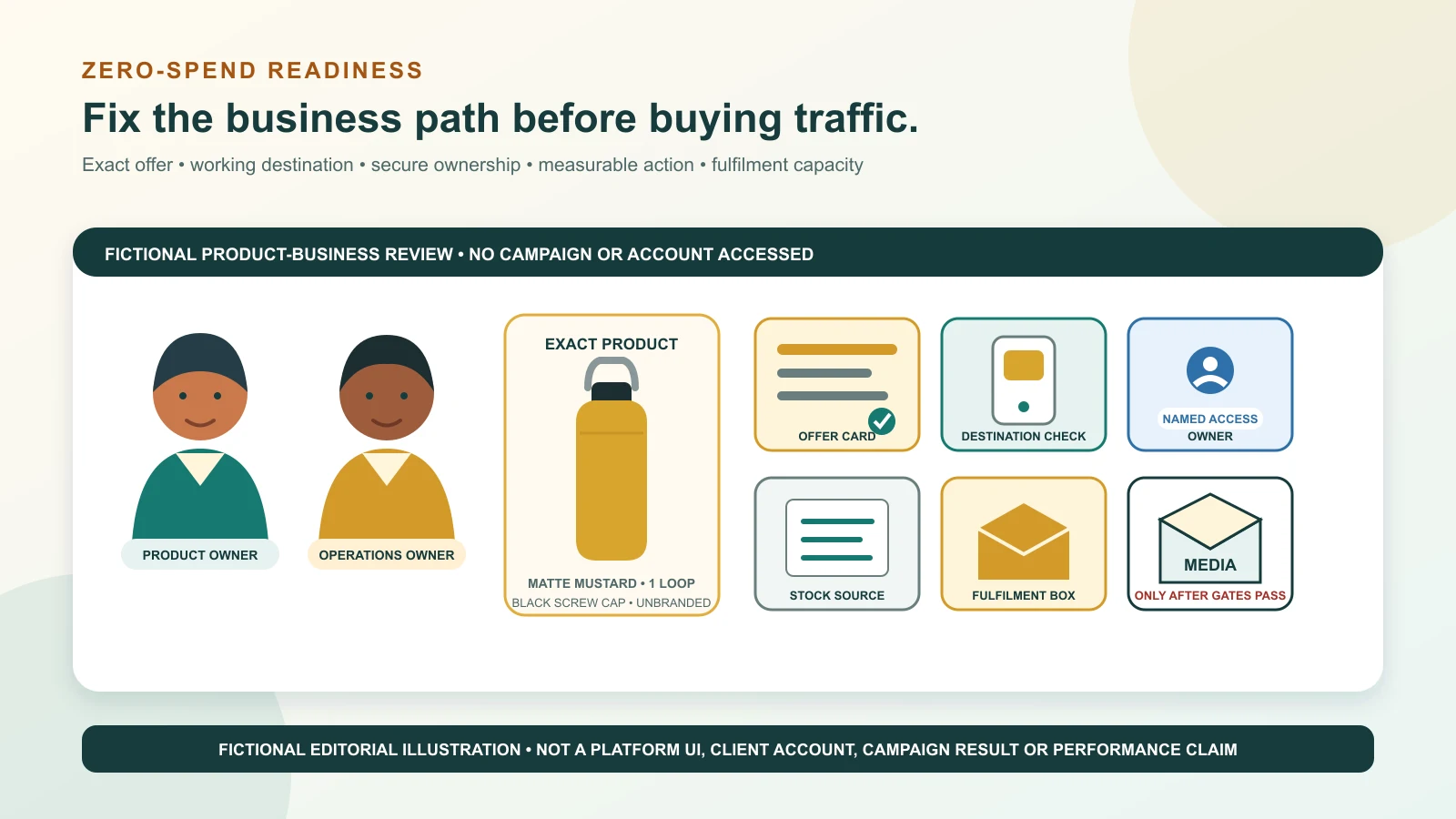
Fix the business path before buying traffic: exact offer, working destination, secure ownership, measurable action and a team that can fulfil it. Original GPTWala editorial illustration using fictional people and one fictional unbranded product; it is not a platform interface, client account, campaign result or performance claim.
Reviewed and updated: 12 August 2026
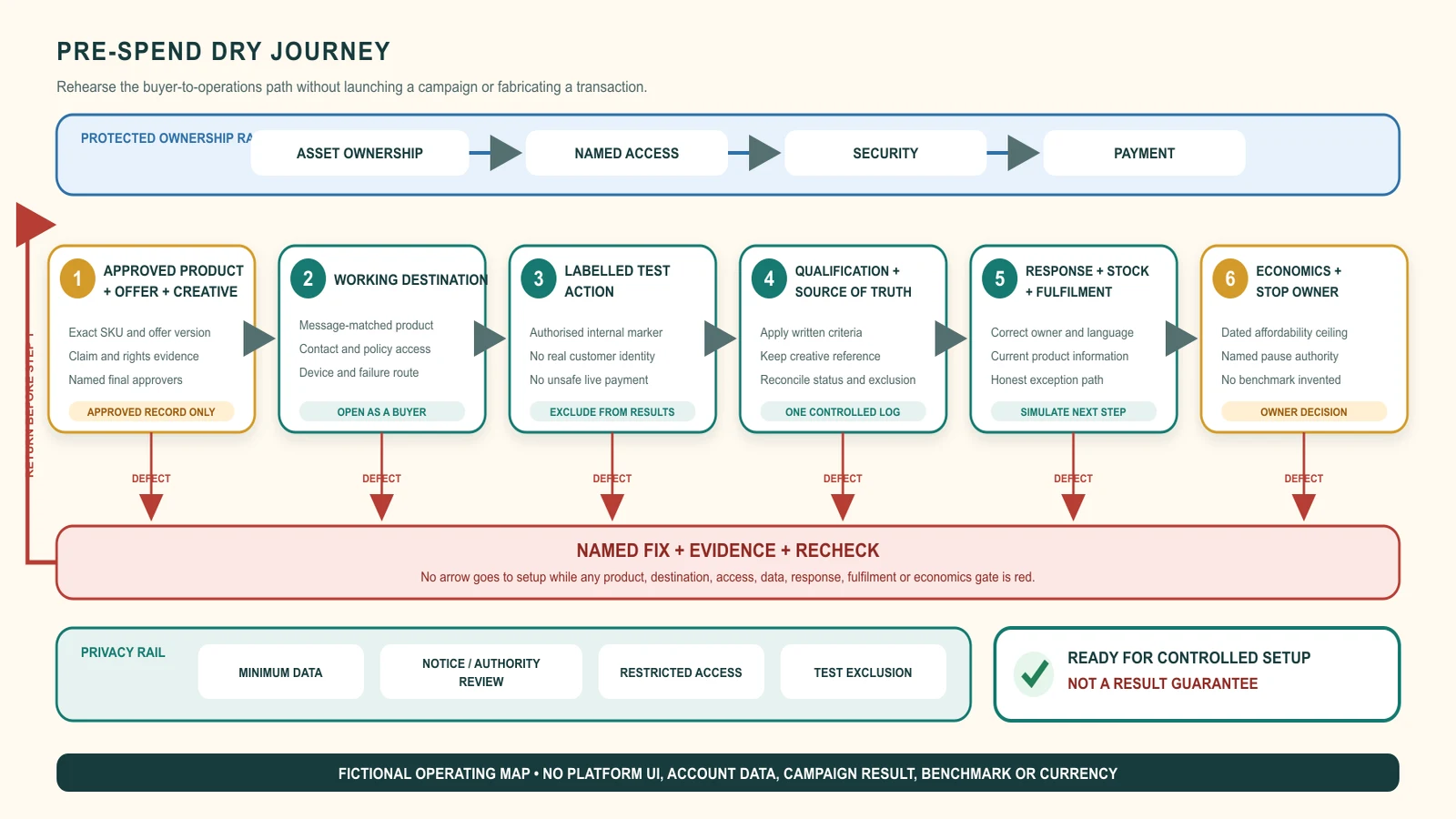
Before spending on Meta ads, make sure the business can complete the journey the ad promises. Confirm one exact product and offer, a working destination, named owners for every account and payment asset, a truthful creative and claims record, a measurable qualified action, a response-and-fulfilment plan, and an affordable acquisition ceiling. If a critical gate is red, fix it before campaign setup.
This is a zero-spend readiness audit, not an Ads Manager tutorial. No Meta account, payment method, pixel, campaign, destination, customer data or product was accessed or tested for this guide. The examples are fictional and no approval, lead, sale, cost saving or return on ad spend is claimed.
Meta may review an ad’s image, video, text, targeting and destination, and an ad can be reviewed again after it starts running. Platform review is therefore one gate—not proof that the product claim is true, the destination will convert, the business can fulfil demand or the economics work. Meta explains its current review and restriction process here.
Configure the specific ₹100/day click-to-WhatsApp workflow
The ₹100/Day Click-to-WhatsApp Ads System
Hands off only after this audit passes
Calculate contribution margin and affordable acquisition cost
Product-Business Unit Economics for Digital Ads
Requires a dated affordability ceiling, but does not rebuild the calculation
Do not use this checklist to declare that Meta will approve an ad. Do not use it to forecast results. Use it to stop avoidable operational failures from becoming paid failures.
Use three readiness states, not a misleading average
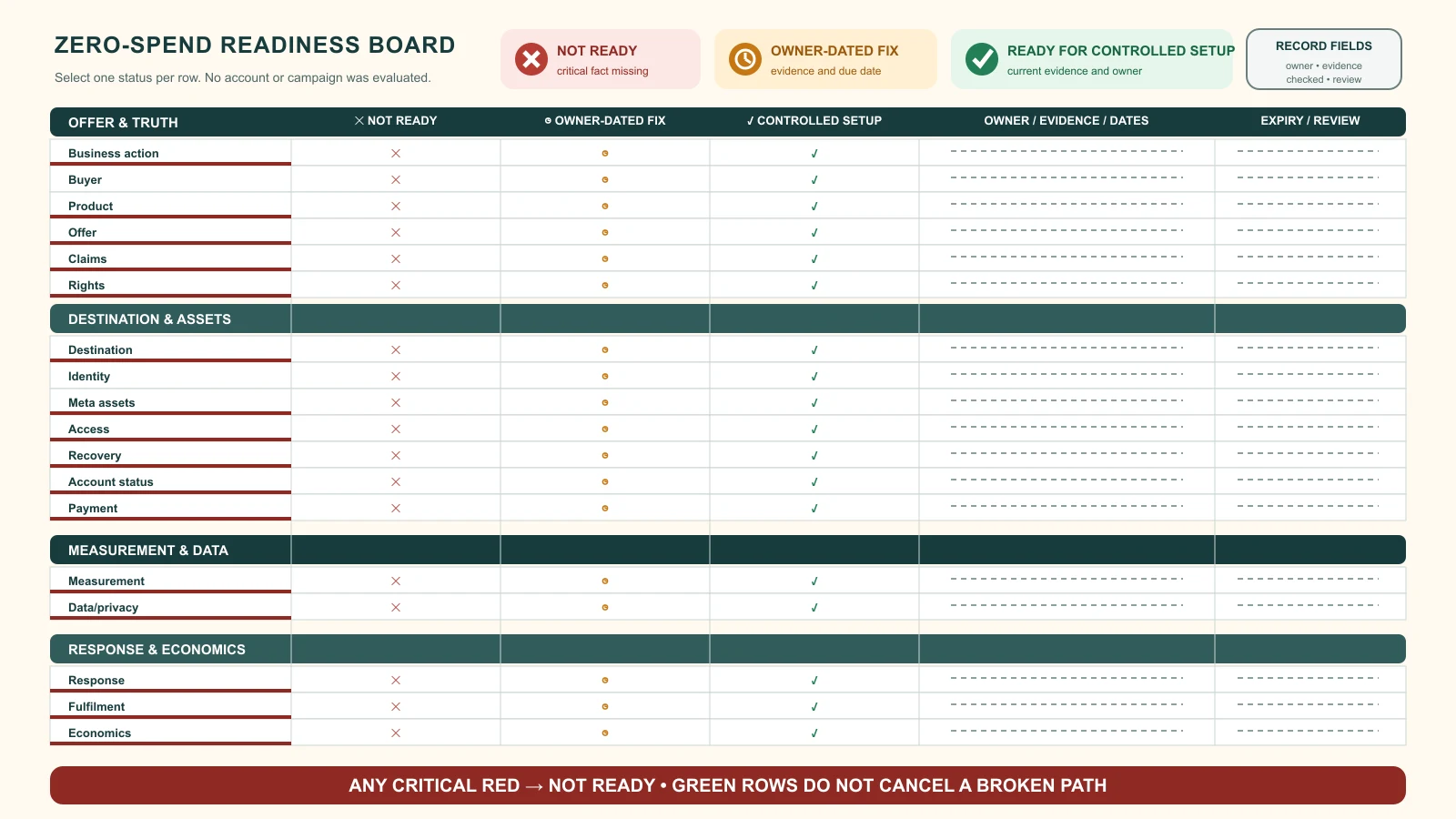
A score of 14 out of 16 can sound impressive. It is useless if one of the missing items is the only person who controls the ad account, the product is not in stock, or the destination does not open.
Use three states for every row:
Not ready: a critical fact, owner, proof or working path is missing.
Ready with an owner-dated fix: the gap is non-critical for today’s audit, and a named person has a dated task that must close before launch.
Ready for controlled setup: the item has current evidence, a named owner and a completed dry check.
Critical gates cannot be averaged away
The following rows are hard gates:
exact product and current offer;
substantiated claims and rights-cleared creative;
working, message-matched destination;
legitimate ownership and recoverable access;
no unresolved compromise or restriction that makes setup unsafe;
authorised payment owner and spend control;
defined qualified action and source of truth;
privacy-reviewed data plan;
response, stock and fulfilment capacity; and
a dated affordability and stop decision owner.
If any one is red, the final state is not ready. A launch date, agency deadline or festival sale does not turn red into green.
Record evidence, not confidence
For each row, record:
status;
named owner;
evidence link, asset ID or dated file;
last checked date and time;
expiry or next review date where relevant;
exact blocker;
fix owner and due date; and
final approver.
“Owner says it is fine” is not evidence. “SKU BT-750-BLK, stock sheet v4, checked by Priya on 12 August at 16:30” is reviewable.
Complete the zero-spend readiness board
Use this board before anyone opens campaign creation. Keep sensitive identifiers and payment information in the business’s restricted system—not in a shared blog template or screenshot.
Gate
Ready evidence
Hard-stop example
Owner
Business outcome
One qualified action and exclusions are written
“Get more sales” with no measurable action
Business owner
Buyer
Named buyer type, geography and eligibility
Retail and wholesale buyers mixed into one undefined audience
Sales owner
Product
Exact SKU, variant, quantity and current stock source
AI visual or ad copy does not match the supplied item
Product owner
Offer
Current price/MOQ/terms/dates/service area
Expired discount or hidden mandatory charge
Commercial owner
Claims
Claim ledger with source, wording and reviewer
“Waterproof”, “best” or performance claim without evidence
Product/compliance owner
Creative rights
Permission/licence for images, people, audio and marks
Supplier or customer asset used without clear rights
Creative owner
Destination
Actual URL/chat/form opens and matches the ad
Broken page, wrong SKU or unavailable WhatsApp number
Destination owner
Business identity
Current name, contact, address/service area and policies
Buyer cannot tell who is selling or how to contact them
Business owner
Meta assets
Page, Instagram, ad account and optional assets mapped
Nobody can identify the owning business or asset IDs
Asset owner
Access
Named people and least-necessary roles reviewed
Shared password, fake profile or former agency access
Security/admin owner
Recovery
Two-factor authentication, trusted recovery route and escalation
Compromised email/phone or no recoverable full-control owner
Security owner
Account status
Business Support Home and known restrictions checked
Unresolved restriction or attempt to evade review
Account owner
Payment
Authorised payer, current method/state and notification route
No admin, unknown card owner or unrecognised charge
Finance owner
Measurement
Qualified action, event/log source, exclusions and QA owner
Clicks called sales; test messages counted as leads
Measurement owner
Data/privacy
Data map, notice, permission/lawful-basis review and access rules
Customer data uploaded because a tool makes it possible
Privacy/data owner
Response
Working hours, language, qualification and escalation
Nobody can answer the promised channel
Sales/support owner
Fulfilment
Stock, dispatch, service geography, returns and exception plan
Offer cannot be honoured at the advertised terms
Operations owner
Economics
Dated affordable-action ceiling and stop authority
Spend allowed without knowing what an acceptable result costs
Finance/business owner
The roles can belong to the same person in a small shop. The important part is that each decision has an accountable human and a traceable record.
One critical red gate keeps the business at “not ready”; green rows do not cancel a broken path. This is an unscored editorial template, not an account assessment or platform interface.
Choose the business action before the campaign objective
Do not begin with “we want Facebook ads.” Begin with the business action a suitable buyer should complete.
Useful examples include:
a retailer requests the current wholesale catalogue and meets the minimum order;
a manufacturer receives a data-sheet or quotation request with a valid application;
a jewellery buyer asks about one exact piece and serviceable location;
a local shop receives an order enquiry for an in-stock item within its delivery area; or
an exporter receives a trade enquiry with destination country, quantity and timeframe.
Define what qualifies—and what does not
A qualified dealer enquiry might require:
business name and city;
buyer type;
exact range or application;
approximate quantity or buying timeframe; and
a valid next step such as catalogue, sample, call or quotation.
Exclude test messages, duplicate enquiries, job seekers, suppliers, spam, messages outside the service area and buyers who do not meet the disclosed MOQ. The definition should match the business model; it is not a universal lead standard.
Name one source of truth
Choose the record that decides whether the action happened:
a website order or verified checkout record;
a CRM stage with a written qualification rule;
a restricted WhatsApp enquiry log maintained by an owner;
a quotation register; or
an order ledger reconciled to the campaign reference.
Clicks, video plays and conversation starts can help diagnose the journey. They are not automatically qualified enquiries or sales.
Bring a preliminary affordability ceiling
Before setup, the business owner needs a dated maximum affordable cost for the chosen action. That figure depends on contribution margin, conversion from enquiry to order, returns/cancellations, fulfilment costs, repeat purchase assumptions and risk tolerance. Use the unit-economics guide for the full calculation.
This article does not prescribe a budget, cost per lead, industry benchmark or acceptable return. If the economics are unknown, the audit remains red.
Write an exact offer card
An offer is more than a headline. It is the commercial promise that the ad, destination, seller and operations team must all recognise.
Complete one card for one promoted offer:
Field
What to record
Offer ID and version
Stable reference and approval date
Exact product
SKU/range, variant, colour, size, finish and packaging generation
Included quantity
One unit, pair, set, pack, case, carton or stated MOQ
Buyer
Consumer, retailer, dealer, distributor, institution or another defined group
Geography
Delivery/service area and exclusions
Price
Current amount plus tax, shipping and other mandatory conditions where applicable
Wholesale terms
MOQ, slab, sample policy, quotation basis or dealer eligibility
Availability
Current stock/source and permitted wording such as “subject to confirmation”
Delivery
Realistic dispatch/delivery basis and exceptions
Returns/warranty
Current terms and destination link
Validity
Start/end date or stock condition for an offer
CTA
The exact next action and destination
Owner
Person who can approve a change or stop the offer
Use one offer version everywhere
The ad, destination, catalogue, saved reply and sales sheet must not tell different stories. If the price changes, create a new offer version. If a colour sells out, update or pause the affected creative and destination. If wholesale price depends on quantity, say so instead of showing the lowest slab as though every buyer receives it.
Do not hide the material condition in tiny text
A disclaimer can clarify a claim; it should not reverse the main promise. ASCI’s current self-regulatory code requires objectively ascertainable claims to be capable of substantiation and says advertising should not mislead by implication or omission. Read the current ASCI Code.
The Central Consumer Protection Authority’s 2022 Guidelines address false or misleading advertisements and conditions for valid advertising. Use the official Department of Consumer Affairs notification and obtain category-specific advice where needed. This guide is operational guidance, not legal advice.
Make the product and ad truthful
Paid distribution raises the cost of a product error because more buyers see it faster.
Lock product identity before creative approval
For the advertised item, record:
SKU/range and packaging generation;
shape, dimensions, material and finish;
colour reference under an agreed viewing condition;
labels, marks and model numbers;
part, stone, pocket, button or accessory count;
included versus illustrative items;
scale reference where size can be misunderstood; and
approved real photographs for comparison.
Use the product-accuracy checklist for AI images before any AI-assisted visual becomes an ad candidate.
Do not create a test result, customer, showroom crowd, award, certification mark, before/after result or expert endorsement with AI. Labelling a false claim “AI-generated” does not make it true.
Use a product-truth stop rule
Require real capture or specialist review when the sale depends on evidence AI cannot safely reconstruct, including:
a jewellery stone count, setting, hallmark location, reflection or scale;
garment texture, construction, fall, transparency or exact colour;
machinery operation, guarding, fit, tolerance or safety behaviour;
food condition, pack quantity or regulated label;
a real before/after comparison;
a certification, lab result or measurable performance claim; or
the actual contents of a sealed pack.
Context may be synthetic. Decisive product evidence should remain real, attributable and reviewable.
Prepare the release pack
The approved creative pack should contain:
creative ID and version;
product and offer IDs;
final asset plus crops/derivatives;
exact copy, CTA and destination;
product-truth comparison;
claim ledger references;
rights/licence evidence;
language approval;
AI/provenance disclosure decision where applicable;
expiry conditions; and
named product, claim, creative and channel approvers.
“Approved” means approved for that product, offer, destination, period and channel—not for permanent reuse.
Test the real destination
The destination is part of the ad promise. Meta says its review may inspect a landing page or website as well as the ad itself. Ads that click to message also have an additional thread-level checkpoint in Meta’s current review description. See Meta’s ad review guide.
Test as a buyer, not as the person who built it
Open the actual destination on a normal phone and connection available to the intended market. Do not rely only on an admin preview.
Check:
the link, button, form or chat opens;
the exact product/offer is immediately recognisable;
business name and contact route are clear;
price, MOQ, tax/shipping conditions and validity do not contradict the ad;
stock/service geography is current;
images show the same item and included quantity;
the CTA leads to the expected next step;
privacy, return, delivery and other necessary policies are accessible;
the page is readable and usable on the tested device;
form validation and confirmation work where applicable; and
a failure route gives the buyer a genuine alternative, not a dead end.
Record the device, browser/app, network, geography, date, tester, result and evidence. One passing test does not guarantee every device or region; define the supported journey and retest after material changes.
Website destination
A website may need product-page, checkout/form, analytics and privacy review. A Meta pixel specifically requires a business website, and current setup routes can vary as Events Manager changes. Meta’s current pixel help page should be reopened during implementation.
Do not install a pixel merely because a checklist mentions it. Decide first what event is useful, who owns the website, what data is collected and whether the business has the necessary notices, rights and permissions.
WhatsApp or messaging destination
Confirm the correct business number, profile identity, working hours, language, opening message, campaign reference, qualification questions, escalation route and human owner. Do not claim a conversation start is a lead.
Use the WhatsApp selling guide for the response system and the ₹100/day click-to-WhatsApp guide for the later campaign setup. This article stops before either implementation.
Instant form, catalogue or other Meta destination
Controls and eligibility can differ by account and change over time. Record the actual destination type, owning asset, displayed product/offer, privacy link, notification owner, export/access route and follow-up process. Do not publish instructions based on an interface the team has not checked in its own authorised account.
Map Meta assets, ownership and access
Not every business needs every Meta asset. The readiness task is to identify the assets this route actually uses and who controls them.
Build an asset register
Possible rows include:
business portfolio, if used;
Facebook Page;
Instagram account;
ad account;
payment profile/method owner;
website/domain;
dataset/pixel, if used;
WhatsApp or other messaging asset, if used;
catalogue, if used; and
agency/partner access, if used.
For each asset record:
Field
Record
Asset name/type
Human-readable name
Asset ID
Store in a restricted operations record
Owning legal/business entity
Who should control it
Current full-control/admin owner
Named human, not “agency”
Working access
Yes/no, checked date
Linked assets
Page, Instagram, domain, dataset, messaging, catalogue as applicable
Currency/time zone/current configuration
Record what the account actually shows; do not assume it is easy to change
Restriction or warning
Status, evidence and owner
Recovery route
Named people and protected contact method
Former staff/partner access
Retain/remove decision and evidence
This is an inventory, not a universal requirement list.
Do not share one person’s login
Meta’s current help page says people added to an ad account receive access according to their assigned role; it also says account sharing or inauthentic profiles managed by multiple people violate its rules. The documented ad-account roles include admin, advertiser and analyst with different permissions. Review Meta’s current role guidance.
Use named access and the least permission needed. Do not send passwords to staff, freelancers or agencies. Do not create a “team profile.” Remove or reduce access when the work ends.
Treat Page full control as sensitive
Meta says Page access can include full or partial Facebook access and task access. Its current guidance warns that a person with full control can manage access and may remove others or delete the Page. Review the current Page-access definitions.
Operationally, keep at least two current, trusted recovery-capable owners where the business structure allows—but label that as a GPTWala continuity recommendation, not a Meta rule. Each must understand the responsibility; adding extra admins without governance increases risk.
Separate agency convenience from business ownership
Before spend, answer:
Does the business know which entity owns the Page, ad account and connected assets?
Can the business see and remove partner access?
Is the payer authorised and known to finance?
Will campaign history, audiences, creative records and measurement remain available if the agency changes?
Is there an exit checklist with asset transfer, access removal and data handling?
If the only person who can answer is an external supplier, the business is not operationally ready.
Secure access, recovery and payment responsibility
Run the access-security check
Before setup:
enable two-factor authentication on relevant accounts using the appropriate current Meta route;
protect the email and phone numbers used for recovery;
review active sessions, alerts and unfamiliar changes;
remove unneeded browser extensions and inspect devices if compromise is suspected;
verify partner requests independently;
use Meta Business Support Home to check account status and support issues; and
keep a named escalation owner.
Meta warns businesses about phishing through malicious partner requests and recommends two-factor authentication, caution with unknown links and Business Support Home for account-status review. Read Meta’s current anti-phishing guidance.
Do not troubleshoot a suspected compromise by adding payment information or granting more access. Stop and use official recovery/support routes.
Check restrictions; never try to evade them
Record the status of the user/profile, Page, business account/portfolio and ad account relevant to the route. Resolve unfamiliar warnings, ownership disputes, payment failures and rejected assets before launch.
Meta says restrictions can consider severe or repeated policy violations, attempts to evade review/enforcement, inauthentic accounts and connections to abusive assets. It points advertisers to Business Support Home when they believe a restriction is incorrect. See Meta’s review and restriction guidance.
Do not create replacement identities or assets to bypass a restriction. A genuine business should document the issue and use the current review route.
Assign a payment owner
The payment gate is green only when:
the authorised payer is named;
the business knows whether the account uses a saved payment route or available/manual funds;
the current country, currency, billing and tax details have been reviewed by the responsible person;
finance knows who can run ads against the method;
spend notifications and invoice/reconciliation ownership are assigned;
unrecognised-charge escalation is documented; and
the person allowed to change payment settings has the correct access.
Meta currently says an ad-account admin is required to add or edit a payment method and distinguishes accounts using available funds/manual payment. It also prompts for payment before the first ad can be published. Read the current payment-method help page.
Do not place card numbers, bank details, one-time passwords, invoices or personal data in a shared readiness sheet or screenshot. This audit records responsibility and status, not secret values.
Choose measurement without collecting data by accident
Measurement readiness begins with a decision, not a tag.
Write the measurement contract
Record:
the primary qualified action;
exact inclusion/exclusion rules;
source of truth;
campaign/creative reference carried through the journey;
event or log owner;
test-data label and exclusion route;
duplicate-handling rule;
reconciliation frequency;
privacy/data owner;
the person who can stop spend; and
the dated affordability ceiling from the economics owner.
For a simple WhatsApp enquiry path, a restricted manual log may be the first source of truth. For a website, a business may consider website events. For a CRM or offline journey, other connections may be relevant.
Meta describes Conversions API as a connection for marketing data from sources such as a server, website platform, app or CRM, including website, offline and messaging events. It also states that Conversions API is not designed to bypass data-sharing policies or privacy rules. Read Meta’s current Conversions API overview.
That description is not a recommendation to implement it for every small business. Choose tools only after the event, data source, ownership, engineering capacity and privacy position are clear.
Build a data map before a customer-data connection
For every proposed event, list:
data field;
source;
purpose;
destination/recipient;
access roles;
retention/deletion route;
notice/consent or other applicable basis reviewed by the responsible person;
sensitive-data check; and
test and incident owner.
Meta’s Business Tools Terms say advertisers using tools such as the pixel and Conversions API must have necessary rights, permissions and a lawful basis for Business Tool Data, and prohibit specified sensitive categories and data about children under 13. The terms also contain notice and website-ownership conditions for pixel use. Review the current Meta Business Tools Terms before implementation.
Terms and applicable law can change. Obtain appropriate privacy/legal advice for the real data flow, particularly for health, financial, children’s, regulated or cross-border contexts. Technical possibility is not permission.
Prepare response, stock and fulfilment
An ad can succeed at generating interest and still fail the business if nobody answers or the offer cannot be supplied.
Write the enquiry-response card
Record:
destination and opening message;
staffed hours and out-of-hours response;
supported languages;
named first responder and backup;
qualification questions;
current catalogue/price/quotation source;
escalation for technical, price, stock, shipping and complaint questions;
expected response target based on actual staffing—not a made-up benchmark;
disposition labels such as qualified, unqualified, duplicate, spam, pending and order; and
log/reconciliation owner.
Do a capacity check. If an existing team can responsibly handle 20 active enquiries in a day, it should not tell the campaign team it can handle 200. Use the business’s actual workflow and measure it; no universal response-time or capacity number is claimed here.
Write the fulfilment card
Confirm:
stock source and refresh frequency;
reserved versus shared inventory;
current pack/case/MOQ rules;
serviceable pincodes, cities, states or countries;
dispatch process and honest delivery basis;
quotation approval;
tax/invoice route;
payment collection ownership;
returns, cancellations, damaged-goods and warranty process;
installation/technical support where applicable; and
overload/stock-out stop rule.
Give operations authority to stop the ad
The person who discovers a stock, quality, pricing, payment, delivery or safety problem needs a clear route to notify the ad owner. Do not leave an invalid offer running while the business waits for a weekly meeting.
The stop record should capture time, affected offer/creative, reason, person notified, action taken and restart approval.
Run a dry journey before spending
Run one controlled internal journey from ad record to operational outcome without launching a campaign.
The dry-journey script
Select the approved record. Name the product ID, offer version, creative ID, destination and intended qualified action.
Check authorised access. Confirm the named people can perform only the tasks they own; do not change live account settings for a checklist exercise.
Open the destination as a buyer. Use a relevant phone/browser/network and compare what appears with the approved offer card.
Submit one labelled test action if authorised. Use an obvious test marker and no real customer’s identity. Do not use a live order/payment route unless the business has a safe, reversible testing procedure.
Verify notification and ownership. Did the correct person receive the event, form or message during staffed hours?
Qualify with the written rule. Make sure the test is excluded from reported leads and sales.
Retrieve the correct product information. The responder should use the current catalogue, data sheet, price, MOQ and stock source.
Simulate the next step. Check quotation, order, delivery or appointment hand-off without fabricating a transaction.
Reconcile the record. Confirm the source of truth keeps the campaign/creative reference, status and exclusion label.
Exercise one failure. Try an out-of-stock or outside-service-area scenario and check that the promise remains honest.
Record evidence. Save a redacted result, date, tester, defects and owners. Do not expose messages, payment or personal data.
Decide readiness. A product, destination, access, security, payment, data, response, fulfilment or economics red returns the audit to not ready.
This is an operational rehearsal, not a platform, pixel, payment or campaign test. If the real system cannot be tested safely without changing external state, assign the authorised specialist and keep the gate red until they complete it.
Rehearse the complete buyer-to-operations path; every failure returns to a named fix before campaign setup. The flow is fictional operating guidance and reports no platform test, transaction or campaign result.
Apply the audit to Indian product businesses
These examples are fictional. They illustrate different readiness failures; they are not client results or promises.
Surat apparel wholesaler: separate the buyer and quantity
The wholesaler wants catalogue enquiries for a kurti range. The attractive AI lifestyle creative passes only if the exact fabric appearance, construction, colour family and included quantity remain honest.
The readiness audit finds:
the ad says “wholesale,” but the opening WhatsApp reply does not ask whether the buyer is a retailer;
the catalogue mixes single-piece and set pricing;
MOQ and shipping are not visible; and
the team answers Hindi and Gujarati but the assigned responder is not named.
Decision: not ready. Fix one B2B offer card, make the MOQ/pack basis explicit, write the qualification questions and assign the language/response owner. Do not solve this by targeting more people.
Rajkot machinery manufacturer: route technical proof to a human
The business wants quotation requests for one component. The destination works, but the ad draft says it “eliminates breakdowns,” and the synthetic animation shows an operating motion that the engineering team has not approved.
The readiness audit requires:
exact model/application and specification sheet;
evidence-approved wording rather than an absolute reliability promise;
real technical imagery or verified diagram for operation/fit;
an application field in the enquiry;
an engineer or trained product owner for technical questions; and
a quotation/lead source of truth.
Decision: real evidence and specialist review required. Media approval cannot repair an unsupported engineering claim.
Jaipur jewellery retailer: make the advertised piece identifiable
The seller wants appointment or WhatsApp enquiries for one necklace. A generic “similar design available” destination cannot substantiate the exact stone pattern shown in a highly polished AI image.
The gate stays red until the business provides:
a real reference for the exact piece or clearly labels a concept rather than an available SKU;
stone count/setting, metal/finish, hallmark location where relevant and scale evidence;
current price or a truthful quotation basis;
current availability and service area; and
a responder who can identify the piece from the campaign reference.
Use the AI jewellery photography guide for the category-specific truth gate. Do not let an AI render become inventory evidence.
Local homeware shop: limit the delivery promise
The shop promotes a fictional matte mustard-yellow insulated bottle with a black cap and one stainless loop. The product and offer are accurate, but the saved reply promises “delivery across India” while the shop currently handles only selected local pincodes.
Decision: not ready. Correct the service area in the ad, destination and saved reply; add a pincode question; confirm stock/pack quantity; assign the responder and delivery exception route. A smaller honest service area is better than a large false promise.
Global product exporter: match geography, currency and ownership
An Indian exporter wants enquiries from overseas distributors. The gate checks:
buyer country and buyer type;
currency/quotation basis and validity;
MOQ, samples and trade terms stated accurately;
shipping/customs language reviewed by the responsible specialist;
permitted geographies and category rules;
response coverage across time zones;
CRM/source-of-truth ownership; and
privacy/data handling for the actual cross-border flow.
Decision depends on evidence. This article does not decide customs, tax, sanctions, product certification, privacy or advertising law for a market. Obtain specialist review before targeting it.
Know the hard stop rules
Do not proceed to campaign setup when any of these is true:
the promoted product, variant, quantity, price, MOQ, availability or validity is unclear;
an AI image/video changes the product or implies unsupported performance;
a material claim lacks current evidence or required review;
creative, person, music, supplier, customer or brand rights are unclear;
the destination is broken, mismatched, misleading or cannot be tested;
business identity/contact/policies are not adequate for the real journey;
nobody can identify who owns the Page, ad account, destination or data connection;
a shared password, fake profile, former staff/agency access or compromised recovery route remains;
an account restriction, suspicious change or unrecognised charge is unresolved;
the payer is not authorised or finance cannot reconcile spend;
no qualified action, exclusion rule or source of truth exists;
the proposed event/customer-data flow has not passed privacy review;
nobody can answer, qualify or escalate enquiries;
stock, service geography, dispatch, return or safety obligations cannot be honoured;
no dated affordability ceiling or stop authority exists; or
the product/category/geography requires specialist review that has not occurred.
When to bring in a specialist
Use the appropriate professional when the risk exceeds the team’s evidence or authority:
Meta asset recovery, compromise or disputed ownership;
payment, tax or billing issues;
pixel, Conversions API, CRM, catalogue or complex event implementation;
privacy, consent, customer-list or cross-border data questions;
regulated, age-restricted, health, finance, safety or high-risk product categories;
comparative, environmental, certification, endorsement or technical performance claims;
jewellery/gemology, textile-colour, machinery/safety or other specialist product proof; and
cross-border advertising, shipping, customs or local-market compliance.
The specialist’s involvement does not turn a red gate green automatically. Record what they reviewed, for which asset/market/version, on what date and under what conditions.
Move from readiness to the right next guide
When every critical gate is green, produce a signed readiness hand-off containing:
readiness record ID and date;
product, offer, creative and destination versions;
intended buyer and qualified action;
asset/access/payment owners;
measurement and privacy owner;
response and fulfilment owners;
affordability ceiling and stop owner;
unresolved non-critical actions with owners/dates; and
configure the specific WhatsApp route through The ₹100/Day Click-to-WhatsApp Ads System; or
repair response and qualification through the WhatsApp selling system.
Passing readiness means the path is fit for controlled setup at a point in time. It does not mean the campaign is approved, profitable or safe to ignore. Reopen the affected gates whenever the product, offer, creative, destination, account, payment, data flow, team, stock, geography, policy or economics changes.
Connect readiness to the DAA growth system
If an offline manufacturer, wholesaler, retailer, shopkeeper, apparel seller, jewellery business or product brand still depends heavily on walk-ins, dealer calls, exhibitions or forwarded catalogues, ads should be the last connected layer—not the first isolated purchase.
GPTWala’s workshop teaches the DAA path: Digital Presence → AI Content Creation → ₹100/day WhatsApp ads. Article 19 protects the joins between those layers: a credible destination, truthful content and a business-ready enquiry path before paid distribution.
What should I fix before running Meta ads for a product business?
Fix one exact product and offer, claim evidence and creative rights, the real destination, asset ownership and named access, security/recovery, restriction and payment responsibility, the qualified-action definition, the privacy-reviewed measurement route, response capacity, stock/fulfilment and the affordable-action ceiling. Any critical red gate means “not ready.”
Do I need a website before running Meta ads?
Not every destination is a website; the appropriate route depends on the campaign and business. A Meta pixel does require a business website, according to Meta’s current help. A messaging route needs its own identity, response, qualification and logging system. Choose the destination first, then apply its actual account, policy, measurement and privacy requirements.
Do I need a Meta pixel or Conversions API before I spend?
There is no universal answer. Define the business action and source of truth first. A website may use pixel and/or Conversions API; a simple enquiry route may initially rely on a controlled manual log. Implement only a data flow the business can govern, test and lawfully operate. Recheck current Meta guidance in the authorised account.
Can my agency own the ad account?
The important issue is deliberate, documented ownership and continuity. The business should know the owning entity, asset IDs, payment owner, access roles, partner permissions, data/creative custody and exit process. If the business cannot operate, recover or transfer the essential assets when the relationship ends, treat that as a readiness risk and obtain appropriate account/contract advice.
Is it safe to share one Facebook login with my team?
No. Meta’s current help says people should be added with roles and that sharing accounts or using inauthentic profiles managed by multiple people violates its rules. Use named access, least-necessary permission, two-factor authentication, protected recovery routes and timely removal of former access.
Does Meta ad approval mean my claims are legally safe?
No. Meta review is a platform-policy process and can include the creative, targeting and destination. It is not legal advice, product verification, a regulator’s approval, a guarantee of continuing delivery or evidence that the offer can be fulfilled. Maintain your own claim, product, rights and category review.
How should a small business define a qualified WhatsApp enquiry?
Use fields that distinguish a suitable buyer from a chat: buyer type, city/service area, exact product/application, quantity or buying timeframe, and a real next step. Exclude tests, duplicates, spam, job seekers, suppliers and ineligible geographies. Collect only information genuinely needed and handle it under the business’s privacy obligations.
What if my product is out of stock after ads start?
Use the prewritten stop route immediately: notify the ad owner, record the affected offer/creative and time, pause or correct the invalid promise through an authorised person, update the destination/saved replies and restart only after stock and offer approval. Do not keep an unavailable offer running merely because the campaign has history.
How much money should I start with?
This readiness guide gives no universal amount. First calculate a dated affordable cost for the chosen action and decide what evidence the proposed setup can reasonably collect. Article 20 owns the specific ₹100/day click-to-WhatsApp implementation; Article 29 owns full unit economics. A budget label is not an outcome guarantee.
How often should I repeat the readiness audit?
Recheck affected gates whenever the product, offer, price, stock, creative, destination, access, payment, data flow, response team, geography, policy or economics changes. Also assign a routine review frequency based on business risk. No universal interval replaces event-triggered checks.