A crop-first production system for vertical, square and horizontal product videos, with current official references and safe-area controls.
Updated 23 August 2026 · Guide for Indian product businesses
Product video sizing is not solved by exporting one horizontal file and letting every platform crop it. The product, label, hand action, captions and CTA must remain clear after the destination adds its own interface. A small team needs a three-orientation master plan and a habit of checking current platform specifications before delivery. Start with GPTWala’s AI product video guide for the factual production workflow.
This guide is dated 23 August 2026. Platform rules change, so the linked official help pages are the final authority at upload time.
Aspect ratio versus resolution versus safe area
Term
Meaning
Example
Aspect ratio
Relationship between width and height
9:16 vertical, 1:1 square, 16:9 horizontal
Resolution
Pixel dimensions of the exported frame
1080 × 1920 for a vertical HD file
Safe area
Zone kept clear of platform controls, captions and crops
Product and claim stay away from overlay regions
Orientation
How the frame is held
Vertical, square or horizontal
Delivery spec
Platform/placement requirements
Format, duration, file size, codec and ratio
Use a three-master orientation system
For a reusable paid and organic video library, plan three deliberate versions:
9:16 vertical: short-form feeds and Stories/Reels-style placements.
1:1 square: flexible feed and catalogue-style placement.
16:9 horizontal: YouTube watch/in-stream, website players, presentations and wider screens.
Google Ads’ current creative guidance recommends providing horizontal 16:9, vertical 9:16 and square 1:1 orientations for video ad coverage. See the official Google Ads creative guidance.
Do not merely pad: a horizontal video placed inside a vertical canvas often leaves the product too small. Recompose the edit or capture a vertical-native take.
Current page lists recommended/max dimensions and caption requirements
Own product page
Choose for player/layout and buyer task
Your site implementation
Prioritise mobile width, performance and visible controls
WhatsApp send/catalogue support
Simple mobile-first crop
Current app behaviour and file limits
Keep product and message legible on a small screen
Specifications in this table are planning references, not a permanent upload guarantee. Check the exact campaign type and placement at export.
Design safe compositions before editing
Platforms can place profile names, captions, buttons and CTAs over different parts of a video. Google Ads publishes safe-zone guidance for its video formats. Use platform templates where available and inspect every placement preview.
Element
Safe-area rule
Common failure
Product
Keep the decision-critical area away from edges and overlays
CTA covers clasp, label or price
Logo
Use a clear but non-obstructive locked position
Platform crop removes half the mark
Headline
Short lines with high contrast and breathing room
Tiny multi-line paragraph
Captions
Reserve a consistent readable region
Burned captions collide with platform captions
CTA
Place message where the platform button will not contradict or cover it
Two competing calls to action
Capture footage that can survive reframing
Frame important actions with extra clean space in selected takes.
Capture separate vertical takes for hand/product movement that crosses a wide frame.
Keep camera originals at sufficient quality for the planned crops.
Record clean product, detail and CTA plates for recomposition.
Start with approved footage and script, then build each orientation as a real edit:
Create timelines for vertical, square and horizontal.
Reframe each shot manually; do not trust auto-reframe without review.
Resize or reposition on-screen text for each layout.
Change opening duration and CTA only where the placement requires it.
Compare the product to the approved master after crop, scale and AI expansion.
Export with a clear orientation/version filename.
If generative expansion is used to fill a canvas, lock the real product area and inspect new background details. Do not let the tool invent parts or alter scale.
Text, captions, audio and platform UI
Use on-screen text to support meaning, not to replace the product. Keep contrast high and line length short. Captions should match spoken words and preserve product names, units and Indian-language terms correctly. Review sound-off and sound-on versions.
LinkedIn’s current ad specifications, for example, describe SRT captions for its video ads, while other platforms may support uploaded or automatic captions differently. Keep a clean caption file and a reviewed transcript in the asset package.
Compression and final quality QA
QA area
Check
Dimensions/ratio
Export matches the exact placement specification
Product truth
Label, colour, shape, components and action remain correct
Crop
No decision-critical part is clipped
Text
Readable on a phone and not covered by UI
Compression
No blockiness, banding or destroyed texture around the product
Audio/captions
Synced, intelligible and correctly named
Preview
Checked in the destination’s current preview and on a real mobile device
Keep specifications current without rewriting the system
Maintain a dated delivery matrix with official links, owner and last-verified date. Recheck before a new campaign, when a platform rejects an upload or when a placement changes. Keep the three-orientation production logic stable, but treat exact duration, file size, format and safe-zone rules as changeable.
The story and proof still begin with an approved product video script; the format matrix should not dictate weak content.
Website and WhatsApp delivery need their own checks
For an own website, choose a player and file strategy that does not block reading or make the product page unnecessarily heavy. Provide a poster frame, accessible controls, captions/transcript where useful and a fallback when autoplay is disabled. Test on the actual mobile page, not only inside the editor.
For WhatsApp, buyers may view on slower networks and forward the file outside its original context. Keep the opening product identification clear, make text readable, include a trustworthy next step and avoid compressing the only master. Test the delivered file in the app and keep the higher-quality approved export in the archive. Connect recurring vertical assets to the 30-day short-form video content system.
Name versions so the team sends the right file
Filename part
Example
Reason
Product/campaign
jar-a750-demo
Identifies the factual asset
Orientation
9x16, 1x1, 16x9
Prevents wrong-placement uploads
Language
en, hi
Separates reviewed copy/captions
Version/status
v03-approved
Avoids publishing an unapproved draft
Example: jar-a750-demo-9x16-hi-v03-approved.mp4. Keep approval status in the register as well; a filename alone is not access control. Archive the corresponding script, captions, source project and platform-spec verification date with the master so a future editor can rebuild the deliverable safely.
Frequently asked questions
What is the best aspect ratio for product videos?
There is no single universal ratio. Plan 9:16 vertical, 1:1 square and 16:9 horizontal masters when you need broad paid and organic coverage.
Is 9:16 or 1:1 better for ecommerce video?
Use 9:16 for vertical short-form placements and 1:1 where a square feed asset is useful. Choose by placement and preview, not a generic winner.
Can I crop one horizontal product video for every platform?
Sometimes, but important actions, labels and text often become too small or are clipped. Capture reframing-safe footage and create deliberate orientation-specific edits.
What resolution should I use for product video ads?
Check the current destination specification. Google Ads currently recommends HD examples of 1920×1080 horizontal, 1080×1920 vertical and 1080×1080 square.
What is a video safe area?
It is the part of the frame reserved for critical product and message elements so platform controls, captions, CTAs or crops do not cover them.
How often should video specifications be checked?
Check before each new campaign or major upload and whenever the platform changes placement behaviour. Keep a dated matrix linked to official help pages.
A decision framework for choosing whether the viewer needs attention, understanding or proof, with production and measurement rules for each format.
Updated 23 August 2026 · Guide for Indian product businesses
A product demo, explainer video and video ad can all contain the same product, but they are not interchangeable. A demo proves how the product behaves. An explainer builds understanding around a problem, method or system. An ad earns attention and moves the right viewer to a next step. Choosing the format by length alone leads to weak briefs and misleading measurement.
Three formats, three primary jobs
Format
Primary viewer job
Core evidence
Typical next step
Product demo
Verify how a specific product works
Real interface, mechanism, assembly or use
Choose, enquire, buy or implement
Explainer
Understand a problem, process, category or solution
Clear model, sequence, example and boundaries
Learn more, compare or request guidance
Video ad
Notice relevance and act
Fast product/audience signal plus credible proof
Click, message, visit or watch
Fast choice: if the viewer asks “Does it work and how?”, make a demo. If they ask “What is this and why does it matter?”, make an explainer. If they are not yet paying attention, make an ad that leads to the right proof.
When to make a product demo
Choose a demo when purchase or adoption depends on seeing the product perform a task. This is common for tools, appliances, closures, assembly, software interfaces and B2B components.
Demo structure
Name the exact product and starting condition.
Show setup without hiding a critical step.
Record the complete core action.
Show the result and relevant limitation.
Direct the viewer to specifications, compatibility or the next step.
A demo is not a promise that every customer will get the same outcome. State test conditions where they matter. Use the still-photo demo method only when motion is not essential to proving the mechanism.
When to make an explainer video
Choose an explainer when the buyer needs a mental model before evaluating a SKU. It can clarify how a wholesale ordering process works, why a packaging material behaves differently, how a product family is organised or what steps a service includes.
Explainer structure
Define the audience and situation.
Name the problem without exaggerating fear.
Explain the process or principle in a few stages.
Use one concrete product or customer scenario.
Clarify fit, non-fit and next question.
Animation is optional. A presenter, diagrams, product footage or screen recording can all work if the explanation remains accurate.
When to make a video ad
Choose an ad when distribution is paid and the creative must create relevance before the viewer has asked for an explanation or demo. The ad should not carry every detail. Its job is to signal the audience/problem/product, provide enough proof to earn the next action, and match the destination.
Ad structure
Show or state who/what the message is for.
Present one tension, opportunity or product difference.
Give one credible proof moment.
Use a CTA that matches the landing page or WhatsApp flow.
Qualified click/message plus post-click conversion and cost
Cheap clicks that do not convert
Keep product truth, complaints and expectation-related returns as guardrails. A higher click rate is not a win if the ad and destination disagree.
Three product-business examples
Local apparel brand
A short ad can signal the audience and fabric/occasion, an explainer can clarify the size and fit system, and a demo can show drape, closure and movement on the exact garment. Do not let a mood-led ad replace accurate fit views.
Packaging manufacturer
An ad can reach procurement teams with one relevant application, an explainer can show the material/ordering decision path, and a demo can record assembly, seal or load handling under defined conditions. The quotation page should carry the current specification.
Retail appliance seller
An ad can introduce the use case, an explainer can compare model families and a demo can show controls, included accessories and cleaning. Compatibility, electrical and safety information must remain in the product documentation.
These examples also show why one “brand film” is rarely enough. Reuse approved product footage, but create the opening, narrative depth and CTA for the viewer’s current task. When the sales team requests “one video for everything”, return to the buyer question and destination. A focused asset is easier to approve, place and measure.
Repurpose without confusing the format
A complete demo may supply a six-second proof moment for an ad. An explainer diagram may become a sales follow-up clip. Reuse is efficient when the team keeps the original context and does not turn a conditional result into a universal claim. Store source footage by product and proof type, then link every derivative to the approved script and destination.
Frequently asked questions
What is the difference between a product demo and an explainer video?
A demo proves how a specific product performs a task. An explainer builds understanding of a problem, process, category or solution, sometimes using a product as one example.
What is the difference between a product video and a video ad?
A product video may serve education, proof or support. A video ad is built for paid distribution, fast audience qualification and a campaign-specific next action.
When should I use a product demo video?
Use one when the buying decision depends on seeing setup, operation, fit, assembly, compatibility or result for the exact product.
Can an explainer video also be an ad?
It can be edited into an ad, but the opening, pace, proof and CTA should be redesigned for the placement. Do not assume the full explainer works unchanged.
Which format is best for WhatsApp enquiries?
Use an ad or short relevance clip to start the conversation, then send the demo or explainer that answers the buyer’s specific question.
How should I measure demo, explainer and ad videos?
Measure each against its job: product understanding and decision support for demos, qualified comprehension for explainers, and post-click or post-message outcomes for ads.
A production-ready worksheet that turns a script into exact shots, product actions, crops, audio cues and approval checks.
Updated 23 August 2026 · Guide for Indian product businesses
A product video shot list converts the approved script into a capture plan. It tells the team exactly what to record, in which product state, from which framing, for which crop and with which factual check. Without it, small teams often discover missing close-ups, mismatched variants or unusable vertical crops during editing.
How will approved shots become each final version?
Editor
Timeline and deliverable
Adobe describes a shot list as the detailed plan of what needs to be captured, including framing and production information. Its shot-list overview is a useful general production reference. A product-business list adds SKU, variant and product-truth controls.
Required fields for every product-video shot
Field
Purpose
Example
Shot ID
Unique handoff reference
JAR-A750-07
Script line / viewer question
Connects shot to the communication job
Show how the seal is removed
Exact product state
Prevents continuity errors
Amber 750 ml jar, lid open, seal fitted
Action
Defines what happens
Hand removes seal slowly and replaces it
Framing and camera
Makes coverage predictable
Top close-up, locked camera
Light/background/props
Controls look and factual context
Neutral table, soft side light, no extra accessories
Duration / handles
Gives editor usable time
Action plus two seconds before and after
Target crops
Protects vertical, square or horizontal delivery
9:16 primary; 1:1 safe
Audio
Plans dialogue, natural sound or silence
Capture latch click separately
Truth/approval check
Defines acceptance
Seal colour and lid construction match approved SKU
Reusable scene-by-scene shot-list template
Shot ID
Scene job
Product/action
Frame/movement
Crop/audio
QA
01
Identify problem
Old container leaks during tilt
Medium close-up; fixed
9:16 safe; natural sound
Do not imply competitor brand
02
Identify exact solution
Approved jar enters frame
Clean hero; slow push only if stable
All crops; text space above
Correct 750 ml variant
03
Prove mechanism
Four latches close in sequence
Top close-up; locked
9:16/1:1; capture clicks
All latches visible and functional
04
Show scale
Measured contents placed inside
Three-quarter view
Horizontal secondary
No unverified capacity implication
05
CTA
500 ml and 1 litre variants beside labels
Wide locked shot
All crops; clean voice-over
Correct names and destination
Core product-video coverage modules
Identification module
Capture a stable hero, label/name, front/back/important sides and the exact variant. This footage supports openings, transitions and thumbnails.
Mechanism or use module
Record the complete action in a clear master shot, then details from angles that explain contact points, controls or sequence. Do not use only fast cutaways that hide whether the product works.
Scale, fit or installation module
Use a familiar and truthful reference, dimension overlay or on-body/in-space view. Lock perspective so the product is not exaggerated.
Contents and compatibility module
Show every included item separately from props. Capture model numbers, connectors or fit points where they help the buyer verify compatibility.
Texture and finish module
Use controlled light and movement to reveal material. For reflective products, plan the environment using GPTWala’s reflection-control workflow.
Choose an efficient shoot order
The published story order is rarely the fastest capture order. Group shots by product state, setup, lens, background and talent. Capture the clean, unopened item before it is assembled, filled, worn or marked. Record destructive or messy demonstrations last.
Shoot order
Why
Continuity record
Clean hero and all sides
Product is untouched
Reference photos of labels and orientation
Detail and macro
Setup remains clean and controlled
Lens, distance and product state
Assembly/use
Product may change state
Step photos and included parts
Lifestyle/talent
Needs separate blocking and releases
Wardrobe, hand, location and consent
Messy/destructive tests
Cannot easily reset
Test conditions and result
Plan multiple aspect ratios at capture
Mark the primary composition and the safe secondary crops. A wide product held near the edge may fail in vertical delivery. Capture selected wide, medium and detail versions rather than expecting automatic reframing to solve every scene.
Keep critical product detail and labels inside the planned safe area.
Leave room for captions, platform controls and CTA overlays.
Capture clean plates when approved composites may be needed.
Record a vertical-native take for hand actions that feel awkward when cropped.
Clean the lens, stabilise the phone, disable beauty/scene filters, lock exposure and focus where possible, and record with consistent light. Put the shot list where the operator can check it without touching the set. Capture one reference clip and review it at full size before completing the batch.
When using stills instead of motion, the still-photo demo workflow helps plan pans, crops and truthful sequence.
Continuity and product-truth controls
Use a physical SKU card at the beginning of each take, then remove it before the usable action.
Photograph the product state after each approved setup.
Track fill level, cap position, cable routing, hand orientation and included parts.
Never substitute a convenient variant when colour, size, finish or mechanism differs.
Label AI-generated or composited elements in the production register.
Editor handoff and shot-list QA
Rename clips with shot ID and take number, keep camera originals, and mark approved takes without deleting alternatives. The editor should receive the script, shot list, claims sheet, product reference, logo/fonts, music and talent rights, crop matrix and final delivery list.
Every script line has at least one usable proof shot.
Shot IDs, filenames and product variant agree.
Core actions are complete, not hidden by cuts.
Audio, releases and licensed assets are documented.
Primary and secondary crops keep critical elements safe.
Product-truth notes survive the edit handoff.
Add a take log so the editor does not guess
The shot list says what to capture; the take log records what actually happened. During production, mark the best take, technical problem, product-state change and any approved deviation. A 20-second note can save an editor from reviewing several almost-identical clips or choosing a take with the wrong variant.
Shot/take
Status
Production note
Editor instruction
03/T1
Reject
Second latch did not fully close
Do not use, even as a cutaway
03/T2
Approved
Complete action; clean sound
Primary demo master
03/T3
Approved detail
Tighter crop; no beginning handle
Use only after T2 establishes action
Record reshoots as new takes rather than overwriting files. Keep a copy of the final shot list and take log inside the project archive with the product reference and claims sheet. That makes future versions, translations and corrections easier to audit.
Frequently asked questions
What is a product video shot list?
It is a capture plan that turns each script line or buyer question into a defined product state, action, frame, crop, audio need and approval check.
What should be included in a video shot list?
Include shot ID, scene job, exact SKU/variant, action, framing, movement, light, background, props, duration, crop, audio and product-truth QA.
How do I create a shot list for a product video?
Break the approved script into proof needs, choose the clearest master and detail shots, record product state and crop requirements, then group capture by setup.
Should the shot list follow the final edit order?
Not necessarily. Capture in the safest efficient order, such as clean product first and messy demonstrations last, while using shot IDs to restore story order in editing.
How do I plan one shoot for vertical and horizontal video?
Mark a primary crop, protect critical elements in shared safe areas, and capture separate vertical-native or wider takes where reframing would weaken the action.
Can AI generate missing shots after production?
It should not invent an unseen product side, action, accessory or result. Recapture missing factual evidence; use AI only for approved non-product elements under review.
Seven fill-in frameworks that connect buyer questions, truthful product proof, scenes, words and calls to action before production begins.
Updated 23 August 2026 · Guide for Indian product businesses
A product video script is not only a voice-over. It is a decision document that says what the buyer needs to understand, what must appear on screen, which words are safe to use and what action follows. A strong script keeps the product truthful before filming, editing or AI generation begins.
Use this guide with GPTWala’s complete AI product video guide. Choose one format for one job rather than combining a demo, testimonial, explainer and sale announcement into a crowded 20-second video.
Start with a one-line video brief
Complete this sentence before writing scenes: After watching, [specific audience] should understand/believe/do [one outcome] because they saw [specific proof].
Brief field
Weak answer
Useful answer
Audience
Everyone
Retail buyers comparing 500 ml and 1 litre food-storage jars
Outcome
Know our product
Understand how the lid locks and choose the right capacity
Proof
Looks premium
Close-up of hinge, seal, open/close action and measured capacity label
Destination
Online
Product page or WhatsApp enquiry for the exact SKU
Guardrail
Make it viral
No invented claim, accessory, result, size or testimonial
Write the script in four production columns
Separating the plan prevents the editor from guessing what a line means visually. Adobe’s current video script guidance and templates also emphasise defining purpose and organising the script before production.
Time
Picture/action
Spoken words or sound
On-screen text
0–2 sec
Lid slipping from an overfilled container
“Still fighting this every morning?”
Lunch-box leak?
2–6 sec
Exact product opened; seal and latch shown
“This model uses a four-side latch and removable seal.”
Show the real closure
6–11 sec
Measured quantity placed inside
“Choose 500 ml or 1 litre for your routine.”
500 ml / 1 litre
11–15 sec
Two SKUs beside their labels
“Check dimensions and order the right size.”
View sizes
Write only what the shot can prove or what approved product data supports. The visual and words should agree.
Seven product video script templates
1. Buyer problem to product mechanism
Hook: Name a specific, recognisable friction. Proof: Show the product feature operating. Meaning: Explain the practical difference without guaranteeing a universal outcome. CTA: Invite the next verifiable step.
Template: “If [specific situation] keeps happening, look at [feature]. Here is how it [visible action]. Check [specification/fit condition], then [CTA].”
2. Three-step product demo
Template: “Step one: [prepare]. Step two: [use]. Step three: [finish/check]. The important detail is [limitation or care point].” Pair each sentence with the real action. For a still-image method, see how to make a demo video from still photos.
3. Product comparison without attacking a competitor
Template: “Choose [variant A] when [use condition]. Choose [variant B] when [different condition]. Both include [shared fact]. Compare [dimensions/material/pack] before ordering.”
4. Objection or FAQ answer
Template: “Does [product] work with [condition]? It works when [verified compatibility], and it does not include/support [important limit]. Here is the detail to check before buying.”
5. Unboxing and what-is-included video
Template: “Inside this [exact pack/SKU], you receive [item one], [item two] and [item three]. [Visible prop] is for demonstration and is not included. Here is how the parts fit.”
6. Launch or new-variant announcement
Template: “New: [exact variant] joins [product family]. It changes [verified visible attribute] while keeping [verified shared feature]. Available from [truthful availability point].”
7. Click-to-WhatsApp enquiry script
Template: “Need [product outcome/category] for [use]? See [one proof]. Message ‘[short keyword]’ with your [quantity/size/location] and we will share the relevant option.” Connect this to GPTWala’s click-to-WhatsApp system.
Match every claim to product proof
Line type
Evidence before approval
Safer writing approach
Specification
Approved data sheet or packaging
State the exact value and condition
Compatibility
Tested model/list and documented exclusions
Tell buyers what to check
Performance
Defined test method and result
Describe the observed result, not a universal promise
Customer quote
Real consented source and exact context
Do not generate or polish into a different claim
Comparison
Like-for-like criteria
Compare use cases or verified attributes
Scarcity
Actual stock or deadline
Remove false countdowns and invented urgency
Plan timing without rushing the buyer
Duration should follow the decision, not a fashionable number. A single hook and proof may fit a short placement. Assembly, compatibility or safety may require a longer product-page video. Read the script aloud and time the actual product action. A lid cannot be understood if the cut hides the mechanism.
Give the opening one idea, not three claims.
Let important label or dimension text stay long enough to read.
Use cutaways to clarify, not to hide product behaviour.
Create separate edits for different placements instead of squeezing one timeline everywhere.
Design for sound-off and sound-on viewing
The main meaning should survive muted viewing where the platform or user starts without sound. Use concise on-screen text and readable captions. Do not paste the full voice-over as tiny text. Sound can add rhythm, human tone and explanation, but the product and CTA must remain identifiable visually.
Adapt language, presenter and voice
Use the words buyers already use in calls and WhatsApp chats. Explain technical terms once. For multilingual versions, translate meaning and units carefully rather than replacing words mechanically. Keep one approved claims sheet across languages.
An AI presenter can be useful for consistent delivery, but disclose synthetic presentation where required and never use a fake expert or customer identity. GPTWala’s AI spokesperson workflow covers consent, trust and disclosure.
Use AI to draft, not to invent the product story
Give an AI tool approved facts, audience, goal, proof shots, tone and prohibited claims. Ask for alternative structures, then verify every line. Do not ask it to “make claims stronger”. Keep the product data and approval owner outside the model.
Safe prompt frame: “Use only the facts below. If a proof or specification is missing, mark the line for removal. Write four columns: time, picture, spoken words and on-screen text.”
Pre-production script QA
One audience, one video job and one destination are named.
Every factual line has approved evidence.
Every important line has a feasible proof shot.
The exact SKU, variant and included items are correct.
On-screen text is readable in the target crop.
CTA matches what happens after the click or message.
Music, voice, presenter, location and stock media rights are documented.
AI output has been reviewed for invented product details.
Worked example: from buyer question to approved script
Suppose a wholesaler repeatedly receives the question, “Will this 25 kg packaging bag work for sharp-edged metal parts?” The script should not answer yes unless the product team has an approved use condition and test. A safe video can show the material layers, seam construction and available specification, then ask the buyer for part dimensions and handling conditions.
Draft line
Problem
Approved rewrite
“The strongest bag for any metal part.”
Absolute, unsupported comparison and universal use
“This model uses [verified material and seam]. Share part shape, weight and handling method so the team can check fit.”
“It never tears.”
Impossible guarantee
Show the approved test/condition, or remove the claim
“Buy now.”
CTA ignores qualification
“Send part dimensions, quantity and delivery location for the relevant option.”
This version may sound less dramatic, but it does a better sales job. It qualifies the enquiry, preserves the role of technical data and gives the production team specific evidence to film. Keep rejected lines in the approval record so they do not return during editing or translation.
Frequently asked questions
How do you write a script for a product video?
Define one audience, outcome and proof, then write time, picture, spoken words and on-screen text in separate columns. Verify every claim before production.
What should a product video script include?
Include the exact SKU, buyer question, visible proof, approved claim, scene/action, audio or voice, on-screen text, timing, destination and call to action.
How long should a product video script be?
Long enough to complete one viewer task without rushing. A simple hook and proof can be short; setup, compatibility or detailed demos may need longer edits.
Can I use the same script for Reels, ads and a product page?
Use one approved factual core, but create placement-specific openings, crops, timing and calls to action. The viewer context differs.
Can AI write product video scripts?
Yes for options and structure, provided it receives approved facts and a prohibited-claims list. A human owner must verify every product detail and claim.
What is the best call to action for a product video?
The CTA should match the next real step, such as checking dimensions, viewing variants, requesting a quote or sending specific enquiry information on WhatsApp.
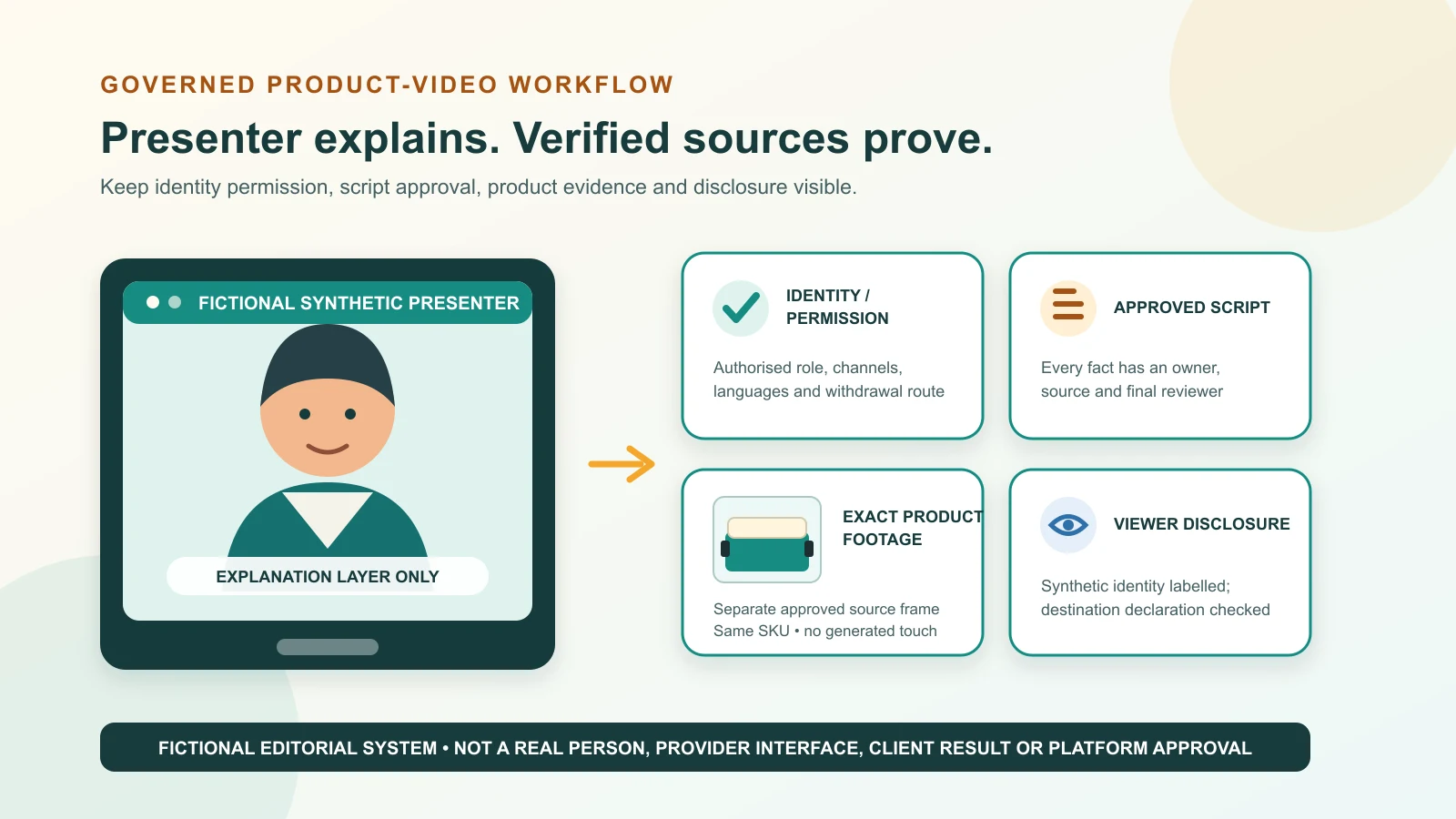
Editorial illustration of a fictional synthetic presenter and a fictional, unbranded product. It is not a client result, a real person, a provider interface or proof of platform acceptance.
Reviewed and updated: 12 August 2026
Editorial disclosure: no avatar, voice, product, account, advertisement or upload was created or tested for this article. Named controls and policies come from current official sources. The workflow, consent-scope card, claim ledger and review gates are GPTWala editorial guidance; all business examples and planned visuals are fictional.
An AI spokesperson product video can explain a verified product repeatedly and in more than one language, but the presenter must never become a shortcut around consent or truth. Choose an authorised identity, document the permitted uses of the face and voice, approve every claim, show the exact product through real product assets, and disclose synthetic media where the law, provider or destination requires it. If the message depends on personal experience, expertise or a real demonstration, record a real person instead.
An AI spokesperson product video uses a generated or digitally recreated presenter, voice, or both to deliver a product script. The presenter may be:
a provider-supplied stock or synthetic avatar;
a fictional character created for the brand;
an authorised digital version of a founder, employee or creator;
a licensed synthetic voice over product footage; or
a hybrid, with a short synthetic introduction followed by real product shots.
The presenter is the delivery layer. It is not product evidence, a customer, an expert, or a person who has used the item merely because it looks and sounds confident.
This article owns identity choice, face and voice permission, script authority, presenter disclosure, multilingual review and final trust approval. The complete AI product-video guide for Indian product businesses owns video strategy, channel roles and measurement. The still-photo product-demo workflow owns the safe assembly of verified product stills. The future AI ad-creative guide owns paid testing and campaign use.
Four statements that must stay separate
Before production, ask four different questions:
Who is speaking? A fictional avatar, licensed stock presenter, founder, employee, customer, creator or expert?
What may that identity say? Brand facts, personal experience, technical advice, a testimonial or an endorsement?
What proves the product? Real footage, approved stills, current catalogue data, test records or nothing yet?
What must viewers and platforms be told? Synthetic-media status, commercial relationship, product limitations and current upload declaration?
One “AI-generated” label cannot answer all four. Likewise, a provider accepting an avatar does not verify the product, the script or the final advertising use.
Choose the lowest-risk presenter that can do the job
Use the least identity-dependent format that still communicates clearly.
Presenter route
Appropriate role
Main risk
Minimum approval condition
Real owner/staff recording
Founder story, expertise, craft, personal message or real demonstration
Ordinary filming, claim and release risks
Real speaker approves the script and final edit; claims are supported
Clearly fictional or stock synthetic presenter
Neutral explanation, FAQ, catalogue navigation or dealer-enquiry introduction
Viewer assumes a real person or real experience; provider licence may restrict channels
Current licence allows the intended use; synthetic status and script ownership are clear
Authorised founder/employee avatar
Repeatable brand explanation or approved language versions
Likeness/voice scope expands beyond what the person expected
Same person completes provider verification; separate scoped permission and script approval exist
External creator or influencer avatar
A contracted campaign where the person’s identity is genuinely relevant
False endorsement, material-connection disclosure, reuse after campaign
Detailed agreement, genuine endorsement, claim due diligence and destination disclosure
Customer/testimonial avatar
Rare; only reproducing a genuine, current account with explicit permission
Fabricated experience or altered meaning
Original testimony exists, is current and accurately represented; customer approves every final version
Unauthorised real-person or celebrity clone
None
Impersonation, false endorsement and identity harm
Do not create or publish
A neutral stock avatar is not automatically safe. It can still imply that a real sales representative, technician, doctor, customer or designer is speaking. Wardrobe, background, name caption, script and product category all shape that impression.
Do not manufacture authority through styling
Reject a synthetic presenter designed to look like a professional whose authority the business cannot substantiate. Examples include:
a person in a doctor’s coat making health claims;
a hard-hat “engineer” certifying machinery performance;
a jeweller or assayer guaranteeing purity without verified evidence;
a chef claiming personal use of cookware never tested by that person;
a customer describing delivery, fit or durability that never occurred; or
a founder lookalike presented as the actual founder.
If expertise is necessary, use an appropriately qualified, authorised real person and obtain category-specific review.
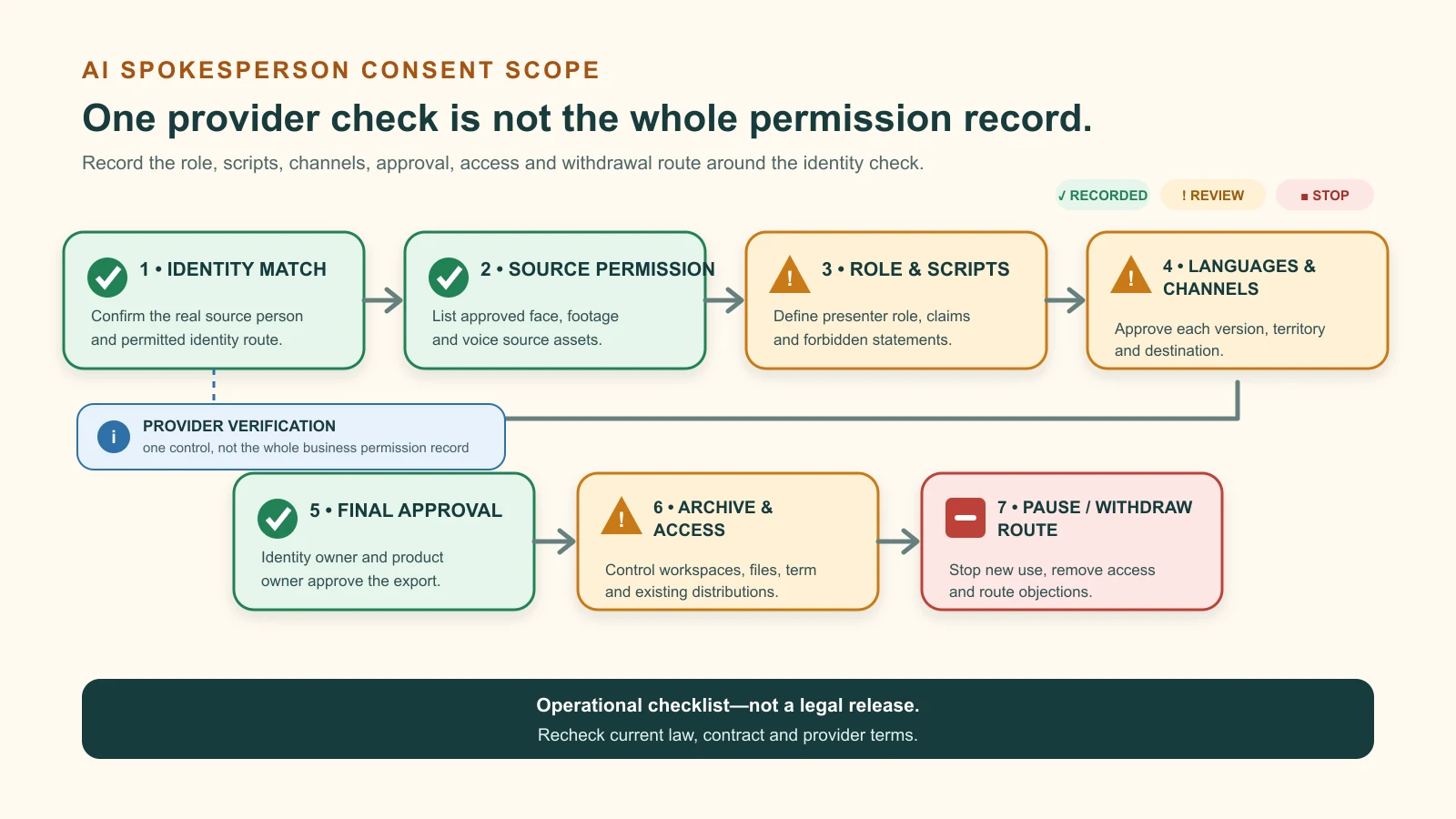
Treat provider verification as one control, not the whole consent record
Current avatar providers use identity and consent checks. For example, HeyGen says every video-based Digital Twin requires a short consent video and that a person creating an avatar for someone else must have that person submit their own consent recording. Synthesia currently requires a live consent video of the same person for a photo avatar and separate voice-speaker consent for voice cloning. These are useful safeguards, not a complete contract for your marketing programme. See HeyGen’s consent-video instructions, Synthesia’s personal-avatar guidance and Synthesia’s voice-cloning guidance.
Build a scoped permission record before uploading a face or voice
At minimum, record and review:
Permission field
Question the record must answer
Identity
Who is the real person, and who verified that the source face/voice belongs to them?
Source assets
Which photographs, footage and voice samples may be uploaded?
Creation purpose
Is permission for a test, internal training, product explainers, organic social, paid advertising or all approved uses?
Presenter role
May the avatar appear as founder, employee, creator, neutral narrator or another precisely defined role?
Script authority
Must the person approve every script, every final output, or a defined claim library plus every final output?
Products and claims
Which categories, SKUs, claims and sensitive topics are permitted or forbidden?
Languages and voice
Which languages, accents, translations, cloned voices and pronunciation variants are allowed?
Channels and geography
Website, YouTube, Instagram, marketplace, WhatsApp, paid ads, dealer screens, India or other territories?
Term and archive
When does permission start/end, and what happens to old public videos and internal files?
Access
Which employees, agencies and provider workspaces may generate or edit the avatar?
Training and retention
What may the provider retain or use, under the selected account terms and settings?
Withdrawal and disputes
How can the person raise an objection, and who pauses new use, access and distribution?
Payment and credit
What compensation, attribution or material-connection disclosure applies?
Final approval
Who signs off the face, voice, script, product, disclosure, destination and export?
This is an operational checklist, not a legal release. Likeness, voice, employment, advertising, privacy and data rules vary with the people, category, territory and distribution. Obtain current legal advice where the use is material, sensitive or disputed.
GPTWala consent-scope card. A provider’s live consent check is one gate inside a wider business permission and approval record.
Keep consent specific and reversible in operations
Do not bury avatar permission inside a vague “all media forever” line and then assume the relationship will never change. A practical system should be able to:
stop new generation immediately;
remove staff or agency access;
identify every existing video using the identity;
distinguish editable project files from already distributed copies;
record whether withdrawal affects future use, existing use or both after advice; and
route a complaint to a named owner rather than an unmanaged inbox.
India’s data-protection framework has a phased commencement. The official 13 November 2025 notification schedules many core processing and consent provisions of the Digital Personal Data Protection Act for a later commencement date. That timing is one reason not to copy an old consent template or treat this checklist as legal advice; verify the law and contract position on the actual production date. See the official DPDP commencement record on India Code.
Check the current tool licence and consent route
Provider controls differ by avatar type, voice type, plan and intended channel. Recheck the current source in the account before production; do not rely on a tutorial screenshot.
Three current examples show why the exact route matters
HeyGen Digital Twin: the person shown must provide the required consent video. That proves a current provider gate exists; it does not approve your claim, contract, destination or product depiction.
Synthesia personal avatar and voice: current guidance requires same-person live consent for a photo avatar and the voice speaker’s own passcode consent for a clone. Its current licensing page also distinguishes stock/synthetic-avatar use from custom-avatar use and lists paid-promotion restrictions for stock/synthetic avatars. Check the exact licence before turning an organic product explainer into an ad. See Synthesia’s current video-licensing page.
ElevenLabs Professional Voice Clone: current help says a user can create a Professional Voice Clone only of their own voice. If another speaker wants to share one, that speaker creates and verifies it in their account and can share it privately. ElevenLabs also prohibits unauthorised, deceptive or harmful impersonation. See Professional Voice Clone ownership guidance and the ElevenLabs Prohibited Use Policy.
These examples are not a tool ranking or a promise that a feature is available on your plan or in your location. They establish a working rule: verify the current identity route, licence, data terms and destination for the exact presenter type you intend to use.
A provider approval does not mean platform or ad approval
Keep four approvals separate:
the avatar/voice provider accepts the source identity and content;
the identity owner permits the specific business use;
the destination accepts the media, disclosure and advertising format; and
the product/category reviewer approves every visible and spoken claim.
Passing one does not imply the others. Do not write “approved for ads” unless the current provider licence and actual advertising destination both say so for that asset and use.
Build the product, identity and claim pack first
Do not generate the presenter and then invent something for it to say. Assemble the evidence first.
Product identity card
For the exact item shown, record:
product and child SKU/design code;
current colour, finish, size and pack version;
quantity and included components;
dimensions and units from controlled data;
exact label, logo, model and variant text;
material and construction claims;
current price, tax, minimum order, stock and territory where mentioned;
product warnings, exclusions and compatibility limits;
source image/video IDs; and
product owner and approval date.
If the physical item, source footage and product record disagree, stop and reconcile them. The avatar should never be used to smooth over a catalogue error.
Identity card
Record:
real, fictional, stock or authorised digital-double status;
provider avatar/voice ID and workspace owner;
approved public name and role, if any;
source-person permission record or stock licence;
permitted/forbidden scripts and destinations;
required identity and commercial disclosures; and
approval owner, expiry and withdrawal route.
Do not label a fictional avatar with a plausible employee name, title or professional credential unless the communication makes its fictional status clear and the representation has been reviewed.
Claim ledger
Every factual sentence needs an owner and source.
Proposed line
What it implies
Evidence needed
Safe treatment
“Model RB-24 is available in blue and grey.”
Current variants and availability
Current SKU/stock record
Allow only for the named date/market; update or remove when stale
“The carton contains 24 units.”
Exact sale quantity
Current pack/BOM and real set image
Show the real count or sealed pack; reject if quantity changed
“I use this every day.”
Speaker’s personal experience
Genuine, current experience of the identified speaker
Never assign to stock/fictional avatar; use only with the real person’s truthful approval
“Our founder designed this.”
Identity, role and authorship
Company record and founder approval
Use founder’s real recording or authorised avatar with exact wording
“Customers love the fit.”
Broad testimonial/consumer evidence
Representative, current evidence and compliant claim review
Prefer specific verified feedback; do not put invented consensus in an avatar’s mouth
“100% waterproof.”
Measured performance
Relevant controlled test and scope
State the precise supported rating/conditions or remove; use real proof footage where needed
Write a script the presenter is actually allowed to say
Use brand-language by default, not fake personal experience
For a neutral or fictional avatar, prefer:
“This model includes…”
“The product record lists…”
“The real product footage shows…”
“For current price and availability, message the seller…”
“The manufacturer specifies…” followed by accurate qualification.
Avoid:
“I bought this…”
“I tested this…”
“I recommend this…”
“My patients/customers use this…”
“We guarantee…” without the exact authorised guarantee; and
“As an engineer/doctor/jeweller…” when no real qualified speaker is making the statement.
An authorised founder avatar may use first person only where the statement is true, within the permission scope and approved in the final context. “I founded this business in 2018” and “I personally use every product” are different claims; verify each.
Write one language master before translations
The language master should include:
exact product/SKU name;
pronunciation and forbidden substitutions;
approved units, numbers and currency format;
claim source beside each factual line;
words that must remain in English or a product-specific term;
warnings and qualifications that must not be shortened;
disclosure wording; and
one current call to action.
Keep sentences short enough to review by ear. Do not let a fluent synthetic voice hide a changed number, model name or guarantee.
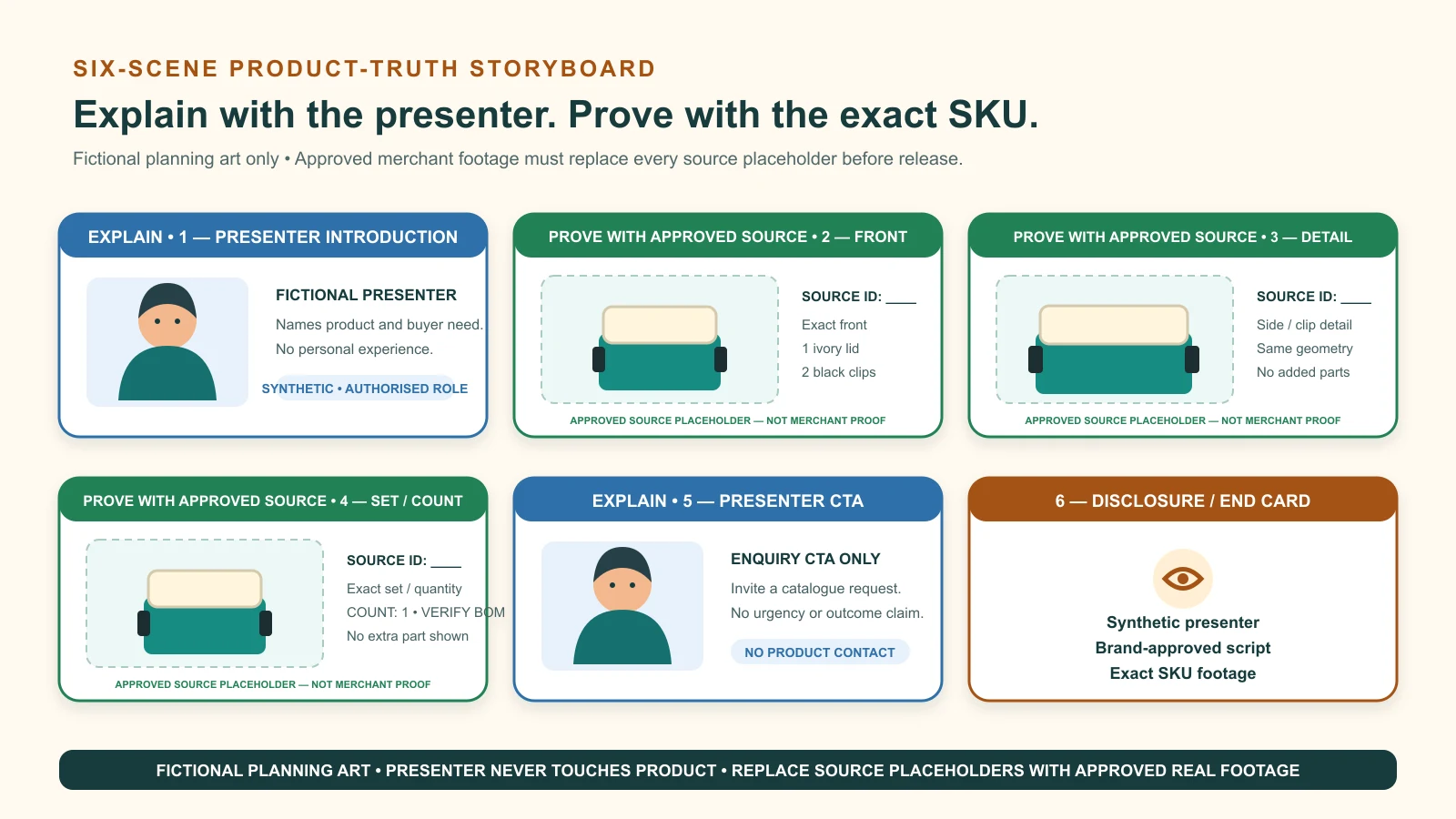
Illustrative scene map for a B2B product introduction
This example is a script structure, not a tested duration or performance formula.
Scene
Picture
Speaker/copy role
Proof rule
1
Synthetic presenter beside brand colour panel
Identify the product and buyer problem
Presenter clearly synthetic/authorised; no personal experience
2
Real approved front and side footage of SKU RB-24
Name visible construction and variant
Product pixels come from verified source footage
3
Real set/pack image
State carton quantity and included parts
Quantity must match current BOM and offer
4
Native text card plus real detail
State verified MOQ, territory or compatibility
Time-sensitive fields have owner/date
5
Presenter returns with enquiry CTA
Invite catalogue request or WhatsApp enquiry
No false urgency or guaranteed outcome
6
Disclosure/end card
Identify synthetic presenter and commercial source
Disclosure survives every crop/export
Do not make the avatar hold, wear, open, pour or operate the product unless the interaction was really captured and composited without changing it. A generated gesture is not a demonstration.
Keep the synthetic presenter and product proof separate
The safest composition uses a presenter to orient the viewer and real product assets to prove the item.
Use a two-layer edit
Presenter layer
carries explanation, navigation and CTA;
uses an authorised/stock/fictional identity;
contains no generated product interaction;
remains visually distinct from technical or product proof; and
carries the appropriate synthetic identity disclosure.
Product-evidence layer
shows real video or approved stills of the exact SKU;
preserves label, geometry, colour, texture, quantity and included parts;
adds dimensions, price and claims as verified native text;
uses real footage for operation, fit, drape, scale, safety or performance; and
retains source IDs and product approval.
If you only have stills, use the product demo from still photos workflow and keep motion inside the photographed evidence. Use the product-accuracy guide before placing any AI-edited product asset into the video.
Reject “presenter holding product” generations when touch matters
Generated contact can silently change:
the product’s size relative to a hand or body;
the number, shape or position of handles, clasps, stones, straps or buttons;
the way a garment fits or falls;
a jewellery piece’s length, stone count, setting or hallmark;
a machine’s controls, guards, cable or moving parts;
the quantity inside a pack; and
shadows and reflections that imply false material or scale.
For sale-facing proof, film a real authorised person holding/using the exact item, or show the product separately. Use the synthetic avatar only as a presenter.
Fictional storyboard. Presenter scenes explain; real-product scenes prove. No generated touch, testimonial or performance claim is shown.
Use a twelve-step spokesperson workflow
1. Define one job and one destination
Choose a bounded job: introduce a dealer catalogue, answer one repeated product question, explain a verified feature or invite an enquiry. Record whether the file is for a website, organic social post, marketplace, WhatsApp, sales screen or paid ad. Rights and disclosures can change by destination.
2. Choose the identity class
Select real recording, stock/fictional avatar, authorised digital double or synthetic voice-only. Write down why that identity is necessary. If a neutral captioned product video can do the job, it may be the simpler option.
3. Verify identity and permission
Complete the provider’s current same-person/voice verification route. Separately complete the business permission record for source upload, role, script, languages, products, term and channels. Do not ask an agency to “make the founder avatar” from public clips.
4. Verify the licence and data route
Check the exact provider, avatar/voice type, account plan, commercial-use terms, paid-promotion restrictions, workspace access, retention and deletion controls. Save the dated source/terms version in the project record. Do not publish a legal conclusion based only on a pricing table.
5. Lock the exact-product pack
Confirm SKU, variation, source footage, claims, quantity, price/offer and product owner. Protect the original media; work on traceable copies.
6. Build and approve the claim ledger
Map every number, feature, comparison, superlative, testimonial, certification and CTA to current evidence. Remove any sentence without an owner and source.
7. Approve the language master
The identity owner, product owner and marketing owner review the exact script. A specialist reviews regulated or technical claims where necessary. Lock the approved version before synthesis.
8. Generate the presenter without product proof
Create a short presenter candidate on a clean background or brand panel. Keep the product out of the avatar’s hands and generated scene. Record provider, avatar/voice ID, settings, project version and output date. No candidate is approved merely because it renders successfully.
9. Review face, voice and role
Compare the output with the authorised identity and intended role. Reject:
face or voice mismatch;
strange expressions that change the message;
wrong name, accent or professional impression;
lip-sync that changes a number or term;
emotional delivery that implies a testimonial; or
an output the real person considers unacceptable.
10. Add exact-product evidence
Cut to real, approved product footage/stills for every product fact. Add copy as native text. Review every crop, composite edge, shadow, reflection, label, component and frame transition. Do not let a transition merge the avatar with the product.
11. Add disclosures and destination data
Assess synthetic-media, commercial-relationship and platform-upload disclosures separately. Preserve provider labels/provenance where required. Add captions and accessible disclosure in the relevant language. Recheck the destination’s current rules on upload day.
12. Run final approval and archive the record
The identity/consent owner approves the person and voice. The product owner approves the SKU and claims. The language reviewer approves every spoken/captioned version. The channel owner approves licence, disclosure and final export. Archive sources, script, permissions, output IDs, approvals and released destinations.
Do not release an “almost approved” file while waiting for one of those gates.
Review every Indian language as a new claim version
Synthetic dubbing can make a script sound fluent while changing its commercial meaning. Review each language against the locked master, not only against the previous translation.
Build a spoken truth sheet
For Hindi, Gujarati, Marathi, Tamil, Telugu, Bengali or another target language, record:
exact product/brand pronunciation;
SKU and model-code reading;
units such as mm, ml, kg, watts, carats and pieces;
currency, tax, MOQ and offer wording;
material, purity, safety, warranty and certification terms;
whether English product terms should remain unchanged;
required disclosure in the same language or an approved understandable form; and
named human reviewer and approval date.
Review five tracks, not only the voice
Meaning: Does the translation preserve every limit and qualification?
Identity: Does the voice still sound within the authorised role and scope?
Timing: Does shortened or stretched speech detach a claim from its proof shot?
Captions: Do captions match the final audio, model code, units and price?
Disclosure: Is the synthetic/commercial disclosure understandable and visible/audible in the final destination crop?
If no fluent reviewer can verify a language, do not publish it as an approved sales version. Use a simpler real narration, find a qualified reviewer or keep the video in the language you can govern.
Use three different disclosures for three different questions
1. Synthetic-identity disclosure: “Is this a real recorded person?”
For a realistic synthetic presenter or cloned voice, a plain-language on-screen and/or audible statement can clarify the production method. A practical template is:
AI-generated presenter and voice. Script approved by the brand. Product footage shows the exact SKU identified in this video.
Use the last sentence only when it is true and verified. For an authorised real person’s digital double, name the person only with permission and state that an authorised digital avatar/voice is being used. Translate and human-review the disclosure for the audience.
India’s 2026 IT Rules amendment created a current intermediary due-diligence framework for “synthetically generated information” (SGI). MeitY’s official FAQ says the threshold covers realistic synthetic audio/visual media that appears real and depicts a person/event in a way likely to be perceived as indistinguishable from the real. It describes prominent labels/provenance for qualifying permissible SGI and user declarations/labels on significant social-media intermediaries. These are intermediary rules with defined scope, not a substitute for case-specific advice to a merchant. Treat a realistic AI spokesperson or cloned natural-person voice as a high-priority disclosure review, answer platform declarations accurately and do not remove labels or provenance. See the MeitY FAQ on the 2026 SGI amendments.
2. Commercial disclosure: “Is this advertising or an endorsement?”
An AI label does not reveal a paid partnership, employee relationship or other material connection. If a real creator/influencer’s identity is used, handle the commercial disclosure separately.
ASCI’s current influencer guidance says influencer ads with a material connection require an upfront, prominent advertising disclosure. It also says a virtual influencer must additionally tell consumers that they are not interacting with a real human being. Apply that guidance where the presenter/account actually operates as an influencer or virtual influencer; do not casually label every brand-owned support video an influencer post. See ASCI’s influencer advertising guidance.
3. Platform declaration: “What must the uploader select or provide?”
YouTube’s current policy requires creators to disclose AI-generated or meaningfully AI-altered photorealistic content and provides an “AI use” setting during upload. Examples include making a real person appear to say or do something they did not do. YouTube also lets people request review of realistic synthetic content that looks or sounds like them; disclosure and consent are among the factors it considers. See YouTube’s current GenAI disclosure guidance and YouTube’s identity-protection guidance.
Other destinations have their own current rules. Do not assume a disclosure embedded in the video replaces the upload control, or that selecting an upload control replaces a clear viewer-facing disclosure.
Disclosure does not cure deception
“AI-generated” does not make any of these acceptable:
an unauthorised founder, customer, expert or celebrity clone;
a fictional testimonial;
a false price, shortage, certification or guarantee;
a generated product presented as the exact SKU;
a voice clone outside its permission or licence; or
a misleading demonstration or professional claim.
Truth, permission, licence and disclosure are separate gates.
Run the final spokesperson-truth gate
Reject the file when any critical row fails.
Gate
Reviewer checks
Reject when
Presenter identity
Stock/fictional/real-person status, public name and role
Identity is ambiguous or falsely presented
Likeness permission
Same-person verification plus scoped business record
Permission is missing, expired, disputed or outside use
Voice permission
Source, provider route, languages and licence
Voice is unverified, misattributed or outside scope
Provider/destination licence
Avatar type, organic/paid use, channel, plan and date
Intended destination is not clearly allowed
Script authority
Final approved version and speaker role
Output says something the identity owner did not approve
Endorsement truth
Personal opinion/experience, material connection and role
Fictional or altered experience is implied
Product identity
SKU, variant, label, geometry, colour and pack
Any critical product field drifts
Quantity and included parts
Real pack/BOM/source image
Count or bundle differs from the current offer
Claims and offer
Source, scope, date, conditions and qualifications
Claim is unsupported, exaggerated or stale
Language
Meaning, pronunciation, units, captions and warnings
Reviewer cannot verify or meaning changed
Human-product interaction
Scale, contact, fit, use and physical behaviour
Generated interaction is presented as real proof
Synthetic disclosure
India/destination/provider assessment and final label
Required disclosure/metadata is missing or removed
Commercial disclosure
Ad/employee/partnership/affiliate status where relevant
Material connection is hidden
Export
Audio, captions, crop, safe area, label and metadata
Released file differs from approved master
Archive
Sources, consent, script, tool/output IDs and approvals
Team cannot reconstruct what was authorised and released
Review the actual exported/uploaded derivative, not only the editor timeline. Compression, auto-captions, crop and platform processing can obscure a disclosure or change how the presenter/product appears.
How Indian product businesses can apply the workflow
These are fictional routing examples, not client case studies or performance claims.
A manufacturer wants to introduce a new dealer catalogue. A licensed neutral synthetic presenter can explain how to request the catalogue, while real macro footage shows the exact fastener head, threading, finish and pack label. Verified native text carries dimensions, grade and MOQ. The avatar does not dress as an engineer, claim to have tested load performance or hold a generated fastener between unstable fingers.
Surat apparel wholesaler: authorised founder language versions
The founder may record a real master and permit an avatar for selected Hindi and Gujarati catalogue introductions. Each translation retains fabric composition, piece count, size range and dispatch terms. Real garment video shows colour, construction and drape. The synthetic founder never claims “I am wearing this” unless that event was actually recorded and the statement is true. Use the AI model-photo guide for apparel when product/model imagery is part of the source pack.
Jaipur jewellery seller: presenter intro, real jewellery proof
A clearly synthetic presenter can introduce a collection and invite a WhatsApp enquiry. Real approved macro footage must show the exact piece, stone count, setting, clasp, hallmark location where relevant, colour and scale reference. The avatar should not hold generated jewellery, state personal ownership or imply purity from appearance. Use the AI jewellery product-photography guide for stone, hallmark, reflection and scale safeguards.
A fictional presenter can introduce a storage-set offer, but the quantity, sizes, materials, current price and included lids must come from the actual offer record and real set image. “Only today” or “last five sets” requires live evidence and expiry handling. A native end card can invite a WhatsApp catalogue request without promising a response time or discount that operations cannot meet.
Coimbatore machinery supplier: real engineer for technical authority
Use a synthetic neutral narrator for navigation if needed, but record a real authorised technical person and real machine footage for operation, guard placement, safety, capacity and performance statements. Do not dress a fictional avatar as an engineer or animate an unrecorded machine movement. High-risk product claims need category-appropriate technical and legal review.
When a real human or specialist is the better choice
Choose a real recording when the value of the scene comes from the person actually being there.
Use a real human for:
founder history, emotion, accountability or craft;
genuine customer experience or testimonial;
professional expertise, certification or regulated advice;
product use where hands, body, fit, drape or ergonomics matter;
live operation, assembly, safety or performance;
a sensitive apology, complaint response or trust repair;
employee culture or behind-the-scenes authenticity; and
any message the identity owner wants to deliver personally.
Stop and obtain specialist advice when:
a celebrity, public figure, deceased person or minor is involved;
the source person, employee, creator or customer is unsure or withdraws permission;
paid media, sublicensing, cross-border use or long-term reuse is not covered clearly;
a health, financial, safety, legal or other regulated claim appears;
the avatar or voice provider’s current terms conflict with the intended channel;
the destination has a new synthetic-media or advertising rule you cannot interpret;
a complaint alleges impersonation, privacy harm or false endorsement; or
the team cannot separate product proof from generated presentation.
A clear phone recording from the real founder can be more trustworthy and easier to approve than a highly polished digital double. Use AI when repeatability genuinely helps—not because the real person’s permission, product proof or accountability is inconvenient.
Frequently asked questions
What is an AI spokesperson product video?
It is a product video in which a generated or digitally recreated presenter, synthetic voice, or both deliver a script. The presenter can explain verified facts, but it does not create personal experience, expertise, a testimonial or product proof.
Can I make an AI avatar of my founder?
Only with the founder’s informed, documented permission, the provider’s current same-person verification, a defined script/channel/language scope, final approval and required disclosure. Do not build one from public interviews or social clips without a valid authorised route.
Is the provider’s consent video enough?
No. It is an important platform safeguard, but the business still needs a scoped record covering source upload, presenter role, scripts, products, languages, channels, duration, access, withdrawal, compensation and approvals. Obtain legal advice for the actual use.
Can I clone an employee’s or voice actor’s voice?
Only through a provider route and agreement that allow that specific person, voice and use. Some tools require the speaker to create and verify the voice in their own account. Do not upload recordings merely because the business possesses the file.
Must an AI spokesperson video be disclosed?
It depends on the finished realism, jurisdiction, provider and destination, but a realistic synthetic person or cloned voice requires a high-priority disclosure review. India’s current SGI intermediary framework and YouTube’s current AI-use policy make accurate declarations and prominent labels especially important. Disclosure does not legalise impersonation or false claims.
Can a synthetic presenter give a customer testimonial?
Not as an invented customer. If it reproduces a real customer’s genuine, current experience, the customer must authorise the exact use and approve every final version; the edit must not change meaning. In many cases, a real customer recording is safer and more credible.
Can I use a stock AI avatar in paid advertising?
Do not assume so. Licences can differ by provider, avatar type, plan and destination. Synthesia’s current page, for example, lists paid-promotion restrictions for its stock/synthetic avatars and a different route for custom avatars. Verify the exact current licence and advertising platform before production.
How should I make Hindi or regional-language versions?
Lock one verified language master, then have a fluent human review each version for meaning, product names, units, price, warnings, captions, voice identity and disclosure. If no reviewer can verify the language, do not release it as an approved sales video.
Should the avatar hold the product?
Usually not when scale, fit, components, jewellery details, fabric behaviour or use matters. Generated hands and contact can change the product. Show real approved product footage separately or film a real authorised person handling the exact item.
When is a real spokesperson better than an AI avatar?
Use a real person for personal stories, testimonials, expertise, trust repair and physical demonstrations. Use a synthetic presenter for repeatable, neutral explanation only when permission, licence, script, product evidence, language and disclosure can all be governed.
Build the system beyond one spokesperson video
One approved presenter video is useful; a governed digital growth system is more valuable. In the GPTWala DAA framework, product businesses connect Digital Presence → AI Content Creation → ₹100/day WhatsApp ads. An AI spokesperson belongs in the content layer only after the exact product, claim, identity and destination are controlled.
Explore the GPTWala DAA workshop to learn how an offline manufacturer, wholesaler, retailer, shopkeeper or product brand can connect truthful digital assets to a practical online enquiry path. Verify the current workshop page and offer before publication; this article promises no views, leads, sales or return on ad spend.
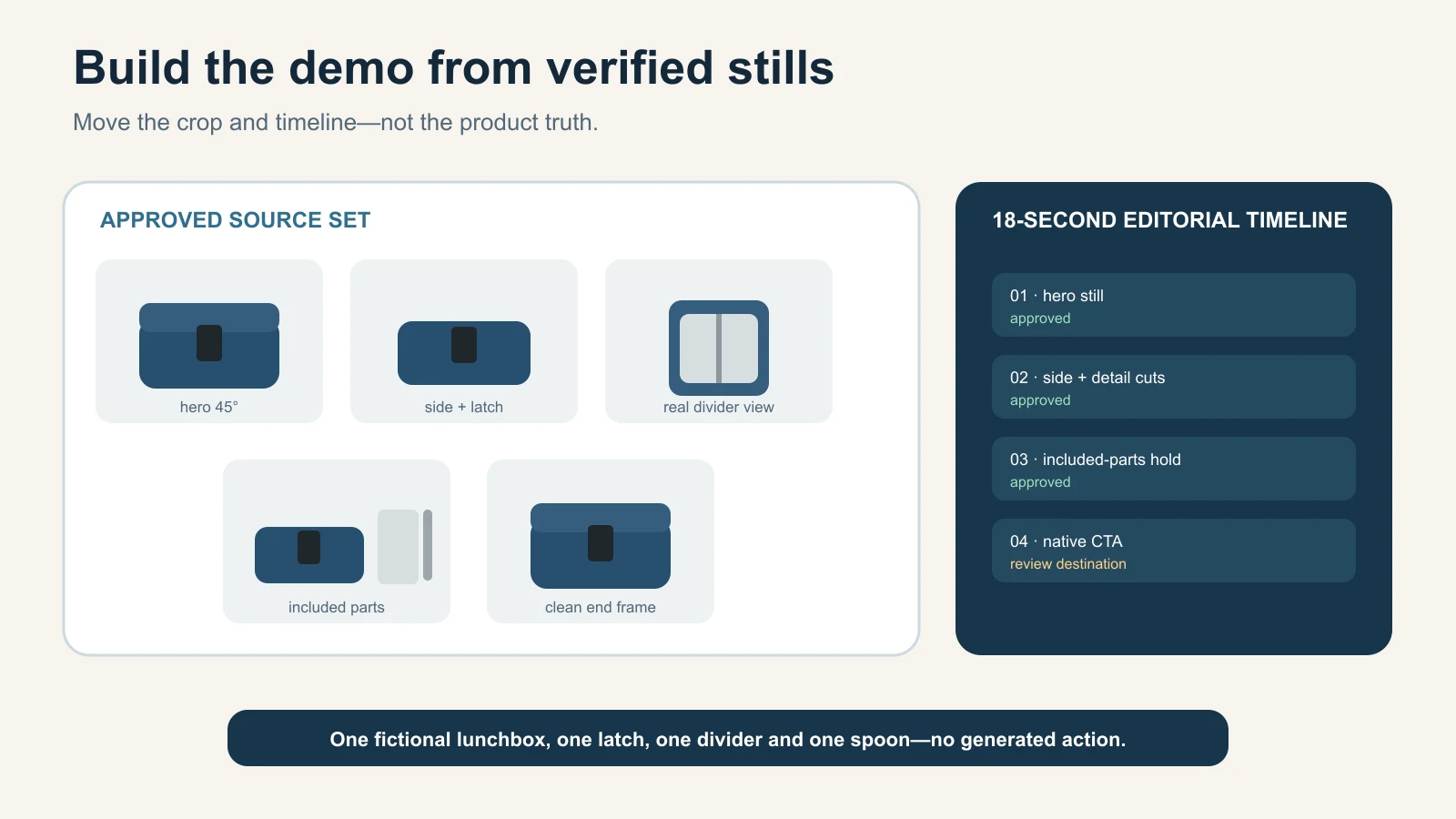
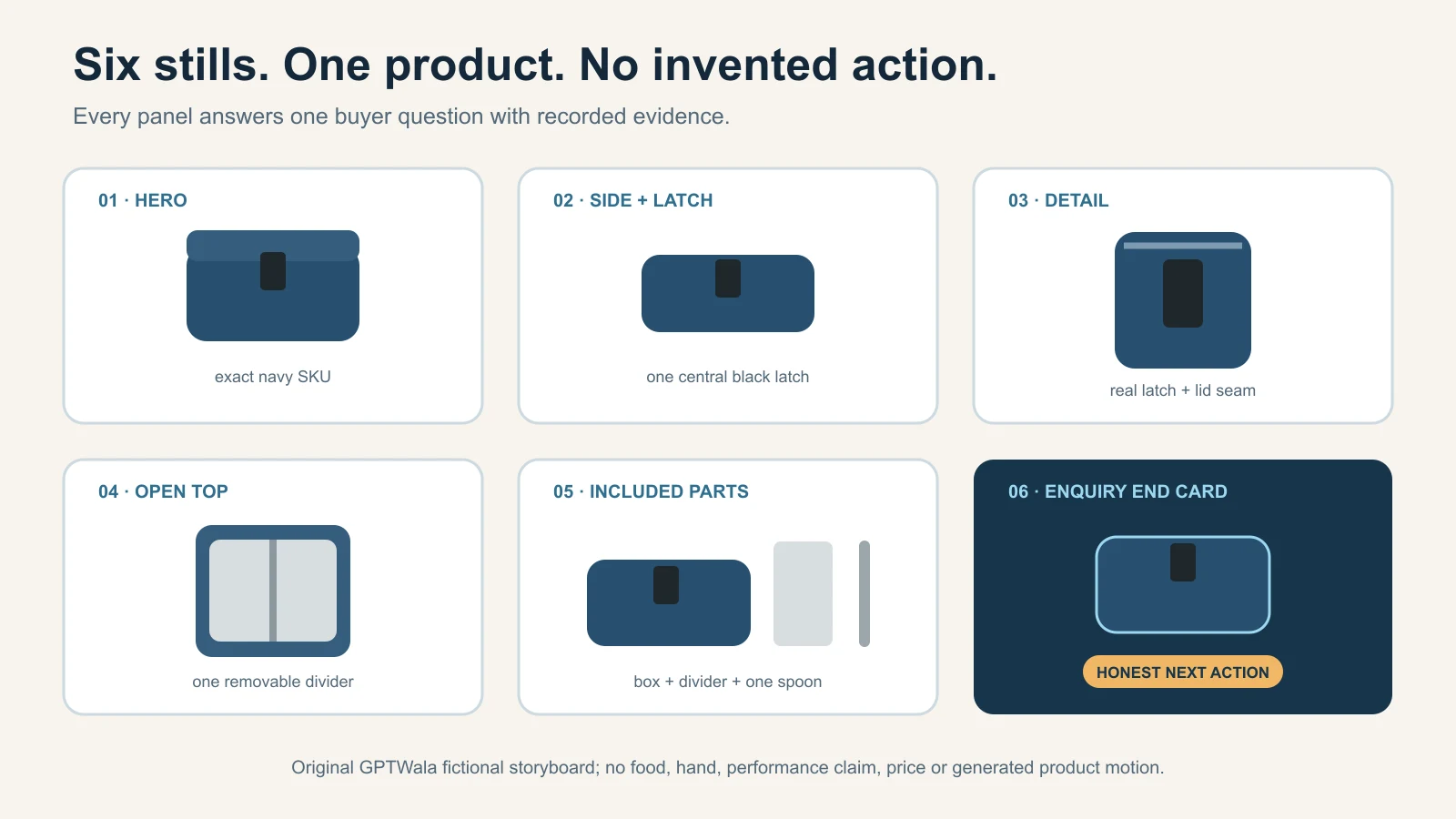
Editorial illustration of a stills-to-demo workflow using a fictional, unbranded lunchbox. It is not a client result, tool test or proof that generated motion preserved a real product.
Reviewed and updated: 12 August 2026
Editorial disclosure: no video tool, product or publishing account was tested for this article. Named capabilities come from current official documentation. The workflow, storyboard and checks are GPTWala editorial guidance; all examples and planned visuals are fictional.
To make a product demo video from still photos, start with verified images of the exact SKU, write one truthful message, and place the photos on a simple timeline. Use cuts, native text and slow camera movement over the stills before trying generated product motion. A single photo cannot prove an unseen side, opening action, fit or performance. If the video must show the product doing something, record that action with the real product.
This page creates a short product-explainer video from real, approved photographs. It is useful when the buyer needs a quick overview of the product, its visible details, included parts and next action.
It does not create evidence of real movement from a still image. It also does not create an AI presenter. The complete AI product-video guide for Indian product businesses owns video strategy, formats, channel roles and measurement. The AI spokesperson product-video guide owns synthetic presenters, consent, voice and disclosure. This article owns the smaller production task: verified product stills → honest timeline → reviewed demo file.
What a still-based demo can show safely
the exact product from photographed angles;
visible material, finish, pattern, label and construction captured in those images;
the quantity and included components shown in a real set photo;
verified dimensions presented as native text;
a sequence such as front → detail → back → contents → offer;
a controlled zoom, pan or crop inside a real photograph; and
a background or graphic transition that does not change the product.
What it cannot establish on its own
how a hinge, lid, pump, zip, wheel, mechanism or machine moves;
how fabric falls, stretches or fits on a person;
how a liquid pours, foam forms or a product performs under use;
the unseen back, inside or underside of a product not photographed;
a genuine 360-degree rotation from one view;
real speed, strength, capacity, waterproofing, heat resistance or other performance;
human handling, scale or ergonomics from a generated hand; or
real results, customer response or return on ad spend.
If your intended “demo” depends on one of those facts, the correct input is real video footage—not a longer prompt.
Choose the safest motion level that can do the job
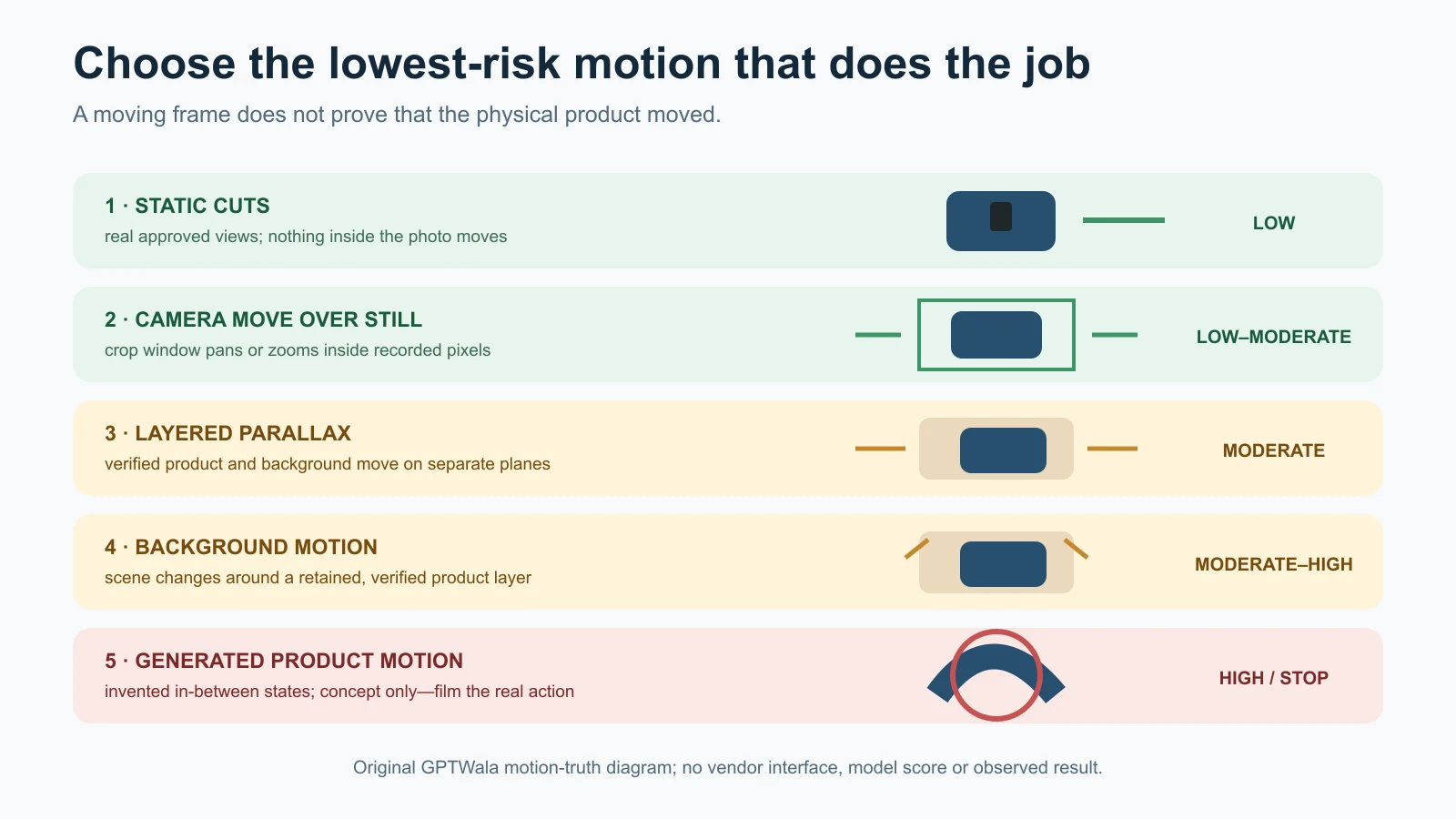
Motion can come from the camera, the edit or the product. Those are not equivalent.
Level
What moves
Suitable use
Truth risk
Approval rule
1. Static timeline — safest
Nothing inside the photo; the edit cuts between real images
Catalogue overview, product features, set contents
Low
Every still already approved; transitions add no product pixels
2. Camera move over a still
Crop window slowly pans or zooms across a real photo
Reveal detail, create pace, fit a vertical frame
Low to moderate
Product remains within source pixels; no edge is invented
3. Layered/parallax scene
Verified product layer and background move at different speeds
Controlled depth, banner-style motion
Moderate
Masks must not expose hidden product areas or bend geometry
4. Generated background motion
Scene changes around a retained product
Secondary lifestyle or ad context
Moderate to high
Product, scale, shadow and reflections remain true in every frame
5. Generated product motion — highest
Tool invents in-between product states
Internal concept or shoot planning
High
Not commerce proof; record the real action before publishing a claim
Start at Level 1 or 2. Move higher only when the buyer benefit is clear and a reviewer can still verify the exact product frame by frame.
GPTWala motion-truth lanes. Moving the frame is not the same as proving that the physical product moved.
Build a truthful still-photo pack
The video is only as trustworthy as its source images. Keep the physical product, exact child SKU and approved product data together until review is complete.
Start with one exact SKU and offer
Record:
SKU/design code and child variant;
colour, finish, size and current pack version;
quantity and every included component;
dimensions and weight only from controlled product data;
visible label/logo text;
material and performance claims supported by current records;
intended video destination; and
one buyer question the video must answer.
Do not mix a blue product front, a black product back and an old package detail into one smooth-looking video. Do not show a single unit while the caption claims a set unless the offer and visuals explain the quantity clearly.
Capture the views the video will actually use
For a simple rigid product, a useful source pack may include:
clean front or 45-degree hero view;
back and side views;
top, inside or underside only when actually photographed;
detail images of texture, label, joint, closure or control;
all included parts in one truthful set image;
measured scale reference for internal review; and
packaging only if it is part of the offer.
The list is not universal. A flat notebook may need fewer views. A jewellery set, reflective vessel, printed garment, machine component or transparent bottle may need more. The phone-to-approved product-image workflow covers the full capture and approval SOP.
Protect the untouched files
Keep source images separate from crops, background edits and video exports. Use filenames that preserve SKU, view, version and status:
If an input image has already changed the label, colour, geometry or included parts, animation will multiply the error across many frames.
Write a one-message demo brief
A product demo from stills needs one clear job. “Make a viral video” is not a brief.
Use this format:
Create a short vertical product overview for exact SKU RJK-LBX-900-MB. Show the real exterior, latch, interior divider and included spoon using approved stills. Use slow camera moves and native captions only. Do not animate the lid, hand, food, insulation effect or leakproof performance. End with “Ask for current price and stock on WhatsApp.”
The product code is fictional. The important parts are the locked SKU, visible proof, prohibited motion and honest next action.
Choose one buyer question
Buyer question
Still-photo answer
Do not imply
What does it look like?
Real front, back, side and detail cuts
A hidden angle that was not captured
What is included?
Real set layout plus native item list
An extra prop or alternative colour is included
How big is it?
Verified dimensions in text and measured reference graphic
Scale from a generated hand or room
What detail makes it useful?
Close-up of a real latch, texture, pocket or connector
That it operates successfully if no real action is shown
How do variants differ?
Separate approved stills and labels for each child SKU
Morphing one colour/design into another as if it is the sale item
How do I enquire?
Native CTA to current WhatsApp/landing page
Scarcity, discount or delivery claim not verified
Keep benefit wording tied to visible fact. “Two removable dividers included” can be shown with a real components photo. “Keeps food hot for 8 hours” requires evidence beyond a still photo and should not appear because the video looks warm.
Build a short scene-by-scene storyboard
Plan before opening an animation tool. Each scene should have one approved visual, one factual caption and one transition.
Illustrative 18-second storyboard
This timing is a copyable example, not a universal platform rule or tested “best length.” Adjust it after checking the real destination and viewer job.
Time
Visual
Native caption
Motion
Truth check
0–2 s
Approved hero still
Exact product name/variant
Gentle scale-in within source frame
Whole product remains visible
2–5 s
Front and side stills
One verified visible feature
Straight cut or dissolve
No morph between angles
5–8 s
Detail macro
Verified material/construction label
Slow pan across real detail
Crop never leaves recorded pixels
8–11 s
Included-parts still
Exact quantity and contents
Static hold with native pointers
Every listed part is visible and sold
11–14 s
Measured/product-data card
Verified dimensions or variant
Native graphic transition
Numbers match current SKU data
14–18 s
Approved hero or pack shot
Honest WhatsApp/website CTA
Simple fade
No fake urgency or outcome claim
Use captions outside the product pixels
Build titles, measurements, arrows and CTA as native video text or graphics. Do not ask a video generator to draw package labels, dimensions or price inside the product image. Generated lettering may look convincing while being wrong.
Keep text readable against a high-contrast background, leave safe margins for the actual destination and provide captions when narration carries meaning.
Use cuts when interpolation would invent
A cut from a real front image to a real back image is truthful. A morph that “rotates” the product between them can invent the sides, thickness, handle and label transition. If the in-between states were not recorded, use the cut.
Original GPTWala fictional storyboard. It shows one lunchbox, one latch, one divider and one spoon; it is not a tool result or proof of product motion or performance.
Assemble the first version without generating product motion
A conventional timeline editor is the safest first tool because it can move the crop window without rebuilding the product.
1. Set the destination canvas
Choose the aspect ratio and resolution from the current destination requirements, not from a universal template. A vertical social video, landscape website embed and square catalogue preview have different crops. Keep one high-quality edit master and make reviewed channel copies rather than stretching one export everywhere.
2. Place only approved stills
Put the images in storyboard order. Match each file to the exact SKU record. Do not use an attractive draft, neighbouring variant or an AI scene that has not passed product truth.
3. Add controlled camera movement
For each still, set a start crop and end crop that remain inside the recorded image. Use a slow push toward a label or detail, a side-to-side pan across a wide set, or a small pull-back to reveal included parts.
Avoid aggressive zoom that exposes blur, turns a thumbnail into a macro or crops away a component. Do not pan beyond the original edge and fill the gap with generated pixels unless that new area is background-only and reviewed.
4. Use simple transitions
Straight cuts, short fades and restrained slides are easier to understand and audit than liquid morphs or object transformations. A transition should connect scenes, not turn one product state into another.
5. Add native information
Insert product name, variant, dimensions, components and CTA from the current SKU record. Keep a source for every claim. Spell-check Hindi, English and regional-language copy with a human reviewer; do not trust text rendered inside generated frames.
6. Export a review file
Name it REVIEW, not FINAL. Reopen the exported file and watch it once at normal speed, once frame by frame around every transition, and once in the destination crop.
Use generative image-to-video only inside a motion-truth lane
Generative image-to-video creates new frames. That is exactly what makes it useful and risky.
What current official tools document
Google’s current Product Studio documentation describes an Animate images route from an uploaded image or Merchant Center product, with an editable generated prompt and multiple output candidates. It also states that the broader Generate Video feature is currently available to merchants in India and selected other countries, and warns that experimental features may produce unexpected results.
Google’s separate Product Studio video guide documents choosing products and arranging product images, optional text and AI-asset labelling guidance. Availability, account access and label controls can change; verify them in the real account.
Adobe’s current Firefly image-to-video documentation describes a first image, optional last image, text-guided transition and camera-motion choices. It also warns that availability can vary by geography, user type and regulatory requirements.
This article did not test either tool. Documentation proves that the controls exist on the checked date; it does not prove product fidelity, cost, speed or suitability for a SKU.
Old tutorials are especially risky. OpenAI currently says the Sora web and app experiences were discontinued on 26 April 2026, with the API scheduled for discontinuation on 24 September 2026. Do not build a production SOP around an old interface video without checking the current provider page.
Safer generated motion
Use generative video only for a narrow instruction such as:
Use the supplied approved photo as the exact first frame. Keep the product completely static and unchanged. Apply only a slow virtual camera push toward the product while the plain background light shifts subtly. Preserve exact geometry, colour, finish, label text, logo, component count, included parts, scale, crop and contact shadow. Do not rotate, open, bend, deform, relight, touch or animate the product. Do not add hands, props, text, particles, liquid, food, steam or extra products. Return one candidate for frame-by-frame human review.
A prompt is not a lock. If the tool cannot keep the product still, return to Level 1 or 2.
Unsafe generated motion from stills
Do not publish these as product demonstrations without real footage:
rotating the item to reveal an unseen side;
opening a lid, hinge, clasp, zip or package;
pouring from a bottle or operating a pump;
flexing fabric, footwear, cable or material;
spinning a wheel, fan, mixer, tool or machine part;
putting apparel or jewellery on a generated person;
showing food, cosmetics or a chemical taking effect;
adding steam, water, fire, impact or load to imply performance; or
generating a customer, worker or expert using the product.
These actions can be useful as a storyboard for a real shoot. Label them concept-only and keep them out of commerce until recreated and verified.
Add text, voice and music without adding false claims
Keep copy tied to evidence
Create a claim ledger before recording voiceover:
Script line
Evidence
Safe status
“Includes two dividers and one spoon”
Real contents photo and current SKU record
Use if the exact offer matches
“Matte blue exterior”
Approved colour/finish source plus physical review
Use with normal colour-display caveat
“Leakproof”
A still of a closed lid
Do not use; a still does not prove performance
“Fits every lunch bag”
No dimensional comparison
Do not use; universal claim unsupported
“Made in India”
Current product/supplier records
Use only when verified for this SKU
“Best-selling”
No current sales evidence and scope
Do not use
The CCPA’s Guidelines for Prevention of Misleading Advertisements, 2022 require truthful and honest representation and prohibit misleading exaggeration of product capability or performance. This is general compliance context, not legal advice for one video.
Use a real or authorised voice
A simple owner/staff narration can work if the speaker approves the recording and the script. If you use a synthetic or cloned voice, verify the speaker’s rights/consent, destination rules and disclosure requirements. A voice sounding confident does not make a product claim true.
AI presenter and cloned-voice decisions belong in the AI spokesperson product-video guide. This still-photo workflow can work without any presenter: captions plus product images are enough.
Treat music as licensed material
Use music you created, licensed or are otherwise authorised to use for the destination. Record the source and licence. Do not assume a tool’s library, “royalty-free” label or subscription automatically permits every organic, paid, client or cross-platform use; check the current terms.
Run the frame-by-frame motion-truth review
Video review must inspect time, not only a thumbnail. Compare the source stills and exact SKU against the start, middle, end and every transition of each shot.
Product bends, rotates into invented geometry or changes silhouette
Colour/finish
Buying-relevant colour, pattern, material cues
Variant drifts or material changes with generated light
Text/marks
Label, logo, quantity, model code and orientation
Text swims, sharpens falsely, changes or disappears
Quantity
Units, components, accessories and props
Extra/missing item or prop appears included
Scale
Dimensions, hand/model/room relationship and crop
Product grows, shrinks or floats
Physical behaviour
Hinges, liquid, fabric, mechanism, shadow and gravity
Unrecorded function or impossible movement is shown
Background/contact
Surface, reflection, shadow, occlusion and edge
Product detaches, intersects a prop or reveals a missing side
Captions/voice
Spelling, timing, language and evidence
Unsupported claim, wrong variant or misleading urgency
Disclosure/rights
AI label, people/voice consent, music and source records
Required disclosure/permission is missing
Destination file
Aspect, crop, resolution, captions, metadata and CTA
Final export differs from approved review file
Watch at normal speed after the frame review. A transition may pass frame-by-frame but still create a misleading impression when seen quickly.
Use an approval record
Field
Entry
SKU / child variant
Video purpose and destination
Source still IDs
Storyboard/script version
Tool/editor and model/version if relevant
Generated segments and prompts
Claims and evidence record
Music/voice/people rights
Disclosure decision
Product reviewer
Channel reviewer
Decision
APPROVE / REVISE / REJECT
Final filename/checksum or version
Keep the form blank until a real video is reviewed. Do not turn the illustrative storyboard into a fake approval record.
Export and disclose for the real destination
Verify format and crop at publication time
Aspect ratios, duration limits, file-size limits, safe areas, caption behaviour and ad rules change. Check the actual destination account before export. Use the product-image and creative rules guide for the broader verification habit, then confirm the current video-specific page for the channel.
Create a master with sufficient quality for planned versions, but review every crop. A vertical crop can remove a handle, included part or measurement card even when the landscape version passed.
Disclose realistic synthetic content where required
YouTube’s current altered or synthetic content guidance requires disclosure when content is meaningfully altered or synthetically generated and appears realistic; the upload flow includes an Altered content setting. Minor aesthetic edits may not require the same disclosure, but the examples and rules must be checked for the actual video.
Do not use disclosure as permission to misrepresent the product. “AI-generated” does not cure a false lid movement or invented feature.
Add video structured data only for a real embedded video
If the finished demo is watchable on a product or article page, Google’s current VideoObject documentation describes properties such as name, description, thumbnail URL, upload date, duration and content/embed URL. Use markup that matches the visible, accessible video. Do not add VideoObject to this article until an actual video exists, and do not expect markup to guarantee a rich result.
How Indian product businesses can use the workflow
These are fictional operating examples, not client results or promises.
Morbi tile manufacturer
Use real stills of the tile face, edge/thickness, finish, back and verified dimensions. Cut between them with native specification text. Do not animate the tile bending, resisting water, preventing slips or supporting a load unless those claims and actions are captured and supported.
Rajkot kitchenware seller
Show the real vessel, lid, handle/joint, included parts and measured capacity from verified data. A slow pan across a real finish is safer than generated rotation. Film the actual opening, pouring, steam, heat or induction use if those behaviours matter.
Surat apparel wholesaler
Sequence real front, back, fabric, print/border, stitching and size-chart stills. Do not make a flat garment appear to drape, stretch or fit a generated model. Use real model footage when fall, fit and movement drive the purchase decision.
Jaipur jewellery retailer
Cut between real main, back, setting, clasp, measured-scale and applicable hallmark views. Do not generate sparkle, rotation or a wearing view from one photo. One changed stone, prong, chain link, hallmark or scale rejects the segment. The AI jewellery photography checklist is the category authority.
B2B machine-part manufacturer
Use verified front/side/back/port and dimension drawings as native graphics. Do not animate a shaft, valve, switch, load path or safety function from stills. Record the real mechanism under appropriate safety conditions and technical review.
Local packaged-goods retailer
Show the current pack front, back/label, seal, size and real included quantity. Keep ingredients, declarations, net quantity and expiry/batch information readable only from current real sources. Do not make particles, ingredients or outcomes swirl out of the pack as if they prove contents or performance.
Common still-to-video failures and safe fixes
Failure
Why it happens
Safe fix
Product “breathes” or changes shape
Generative interpolation redraws each frame
Use a static still with camera crop movement
Label letters swim
Tool rebuilds fine text over time
Keep label static; add verified native text outside product
Fake 360 rotation
One/two views cannot define hidden geometry
Use cuts between real views or record a real turntable
Extra part appears mid-shot
Model invents context/occlusion
Remove generated segment; simplify background
Colour pulses
Generated lighting changes material/variant
Use approved stills and restrained global transitions
Product floats
Shadow/contact changes across frames
Keep real contact; use static background or controlled composite
Hand changes size or grip
Generated human/product interaction is unstable
Film a real authorised hand with measured product
Transition morphs variants
Tool blends child SKUs
Separate variants with a cut and native label
Zoom reveals blur
Source lacks detail
Recapture macro; do not upscale into false detail
Caption claims more than still shows
Script written for persuasion, not evidence
Use claim ledger; delete or verify the line
CTA covers product/quantity
Destination crop/safe area ignored
Reposition native CTA and preview in actual surface
Export loses captions/audio/metadata
Preset or platform processing changes file
Reopen final upload/derivative and compare with approved master
reflective/transparent material changing with angle;
machine, tool, wheel, valve, switch or safety operation;
setup time, speed, load, temperature, sound or performance;
a person using the product;
an unboxing, seal, pack contents or condition sequence; or
a one-off, high-value or regulated item where invented motion is unacceptable.
Still-photo video is a presentation method. Real video is evidence of real motion. A hybrid can use real action clips plus still macros and native data cards, with every part tied to the exact SKU.
Turn the demo into an online-growth asset
An approved video can support a product landing page, digital product catalogue, WhatsApp follow-up or an AI ad-creative testing plan after the relevant channel review. Do not call it successful until you measure the real business outcome separately.
The GPTWala workshop connects this AI Content Creation step to the DAA path: Digital Presence → AI Content Creation → ₹100/day WhatsApp ads. It teaches a practical system, not guaranteed views, enquiries, sales or return on ad spend.
See the GPTWala workshop
Learn how truthful product content can connect to a wider online-growth process.
Frequently asked questions
Can I make a product video using only photos?
Yes. Use a timeline of real approved stills with cuts, native captions and slow pan/zoom movement. This can explain appearance, details, dimensions and included parts. It cannot prove an unrecorded action, hidden side, fit or performance.
How many product photos do I need?
There is no universal number. Capture enough approved views to support every scene without invention: hero, side/back, details, included parts and measured evidence as the product requires. If the storyboard asks for a view you do not have, recapture it or delete that scene.
Can AI turn one product photo into a 360-degree video?
It can generate a plausible rotation, but the unseen geometry is inferred. Do not present that as an exact-product demo. Use a real turntable video, a verified 3D model created from sufficient product data, or cuts between real views.
What motion is safest for a still-photo product demo?
A slow crop-window pan or zoom within a real photograph, plus simple cuts and fades. The product pixels do not need to be regenerated. Check that the crop stays inside the source and that no important component or text is lost.
Can I animate a lid, pump, zip or machine part from a still?
Not as evidence of real function. A generated action may invent hinges, seals, hands, intermediate positions or performance. Film the actual movement with the exact product and appropriate safety review.
How do I stop text and logos changing in AI video?
Keep the product/label static where possible and place captions as native video text. Frame-by-frame review is still required. If a generated segment makes label text swim, sharpen, vanish or change, reject it.
Do I need to disclose that a product video used AI?
It depends on the destination and the nature of the edit. YouTube currently requires disclosure for meaningfully altered or synthetic content that appears realistic. Other platforms and advertising systems have their own rules. Check the actual destination and local obligations; disclosure does not permit product misrepresentation.
Should I use an AI spokesperson in a photo-based demo?
It is optional and adds consent, voice, likeness, script and disclosure risks. A clear product-only video with native captions can be enough. Use the separate AI spokesperson guide before adding a synthetic presenter.
What should make me reject a generated product-video segment?
Reject it if identity, geometry, colour, label, quantity, scale, shadow, included parts or physical behaviour changes; if it shows an unverified claim; or if rights/disclosure evidence is missing. One serious error outweighs attractive motion.
Sources and review method
Reviewed 12 August 2026. Named tool capabilities, platform disclosure and schema facts were checked against current official documentation. The storyboards, motion levels, checks and examples are editorial recommendations. No tool output, merchant account, Indian checkout, upload, VideoObject implementation or performance result was tested.