
Reviewed and updated: 12 August 2026
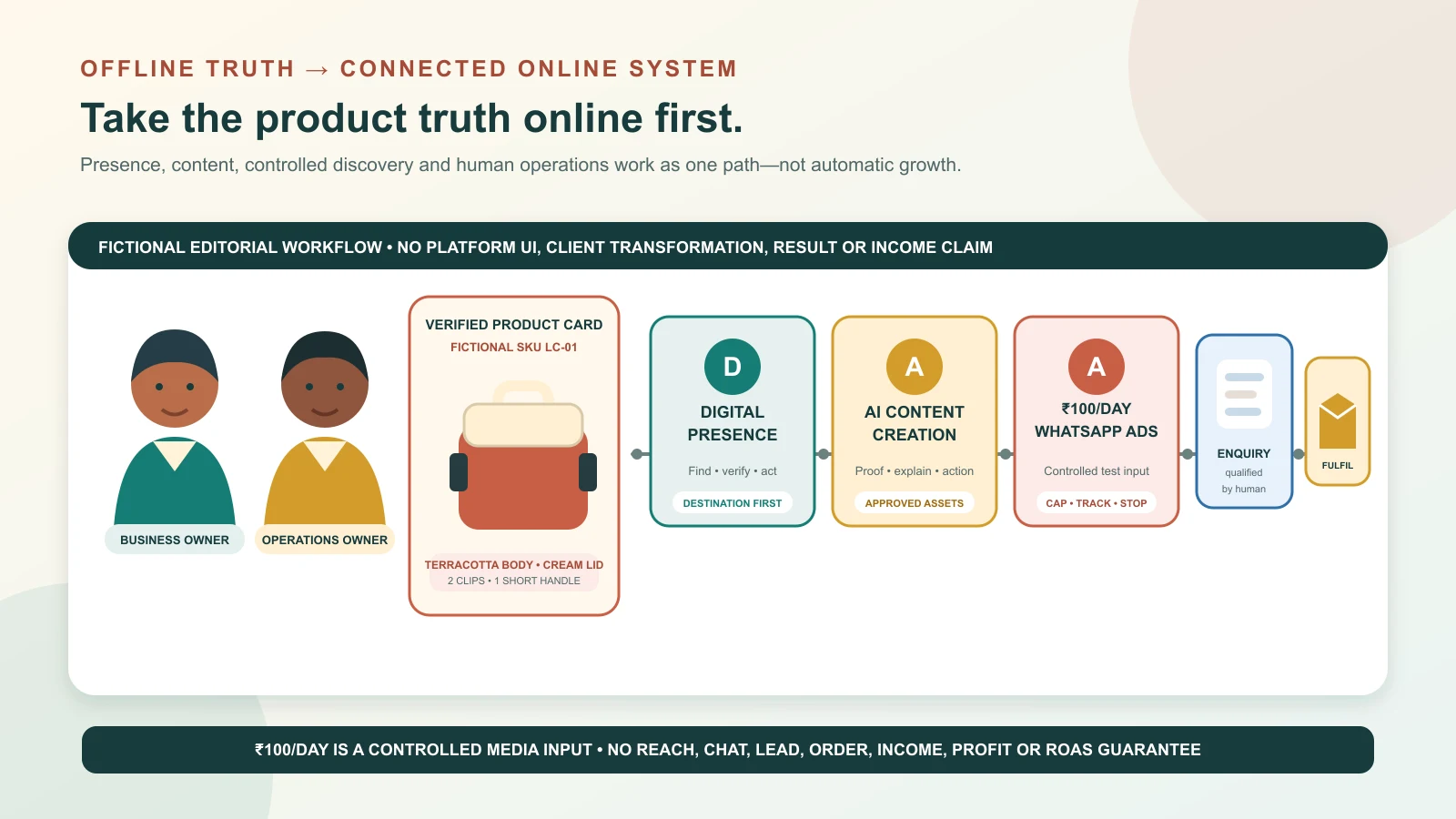
To take an offline product business online, do not begin with random social posts, a large website or paid traffic. Begin with one buyer group, one manageable product range, verified product and commercial facts, one useful digital destination and one owned enquiry process. Then apply GPTWala’s DAA sequence: Digital Presence → AI Content Creation → ₹100/day WhatsApp ads. Each layer should work before the next receives more time or money.
The ₹100/day layer is a controlled starting-budget and learning system, not a promise of reach, chats, leads, orders, revenue, profit or return on ad spend. Online growth still depends on the product, demand, offer, market, content, account, destination, response, stock, fulfilment and unit economics. A business is “online” only when a relevant buyer can find it, understand an exact product, trust the evidence, take a clear action and receive a reliable response.
This root guide owns the end-to-end offline-to-online roadmap and the joins between DAA layers. The AI product-photography guide owns image production, the AI product-video guide owns video, the AI ad-creative guide owns creative strategy, the ₹100/day click-to-WhatsApp guide owns campaign implementation, and the WhatsApp selling guide owns the complete enquiry-to-order system.
Table of contents
- Understand what taking a business online means
- Choose a narrow online pilot
- Map the complete DAA system
- Gate 1: build the offline truth pack
- Gate 2: create a useful digital presence
- Choose the right destination
- Gate 3: build an AI content system
- Turn content into a repeatable operating rhythm
- Gate 4: rehearse the buyer journey organically
- Gate 5: run a controlled ₹100/day WhatsApp ads test
- Connect enquiries to reliable human follow-up
- Gate 6: measure, fix, stop or expand
- Use the roadmap in different product businesses
- Assign roles in a small team
- Avoid common offline-to-online mistakes
- Follow the milestone launch plan
- Frequently asked questions
Understand what taking a business online means
Creating an Instagram account, uploading a PDF catalogue or adding a WhatsApp button is not the complete transformation. Those are assets or channels. The business needs a connected operating path.
The five tests of a useful online presence
A relevant buyer should be able to:
- Find the real business. The name, category, location or service area and contact route are accurate.
- Understand the exact product. Images, specifications, variant, pack, price basis and availability language match the product being sold.
- Trust the evidence. Claims, reviews, credentials, policies and contact details are genuine and current.
- Take one clear action. The buyer can enquire, request a quote, visit, call, order or find a dealer without guessing.
- Receive an operational response. A named person can qualify the request, verify stock/terms, record the order and hand it to fulfilment.
If any one fails, more traffic can expose the defect faster without fixing it.
Online should extend the business, not create a fictional one
The digital layer must represent what the business can actually supply and support. It should not turn:
- a prototype into available stock;
- a styled scene into proof of included accessories;
- a render into proof of manufactured finish or performance;
- a sample into a guarantee for every production batch;
- a reseller into an authorised manufacturer;
- an enquiry into a confirmed order; or
- ad spend into promised sales.
The strongest offline assets—product knowledge, supplier relationships, samples, customer questions, service experience and fulfilment discipline—should become the source material for the online system.
Choose a narrow online pilot
Do not upload the entire shop or factory range before the team can maintain one coherent journey.
Select one pilot buyer
Examples:
- women buying office-wear sarees within a serviceable city;
- multi-brand apparel retailers buying one seasonal wholesale collection;
- jewellery shoppers looking for one verified price band and occasion;
- dealers sourcing one component family;
- architects requesting one tile series and sample route;
- local customers buying one appliance category; or
- overseas distributors evaluating one export-ready product line.
“Everyone” is not a usable pilot audience. The buyer changes the information, proof, language, pack, price basis, logistics and response process.
Select one manageable product range
Choose products for which the business can maintain:
- exact SKU/variant records;
- truthful current images;
- specifications and approved claims;
- stable enough price/quote logic;
- stock or production visibility;
- serviceable delivery or dealer route;
- return, warranty or after-sales scope; and
- a named product owner.
A high-margin product is not automatically the best pilot if its variants, safety claims, customisation or fulfilment cannot be controlled.
Define the pilot action
Pick one action that matches how the business sells:
- request current price and availability;
- ask for a dealer catalogue;
- request a formal B2B quote;
- book a store visit or product demonstration;
- check delivery/service area;
- request a sample or specification sheet; or
- start a qualified WhatsApp conversation.
Do not make “go viral”, “get followers” or “increase awareness” the only operational objective. They do not tell the team what a useful buyer should do next.
Set a no-go line before building
Do not launch the pilot when the exact product, rights, offer, destination, response owner, stock/fulfilment route or affordable acquisition logic is unknown. Use the Meta ads readiness guide before any paid setup and the future unit-economics guide before treating acquisition as scalable.
Map the complete DAA system
DAA is a sequence with feedback, not three disconnected purchases.
| Layer | Core question | Minimum output | Failure if skipped |
|---|---|---|---|
| D — Digital Presence | Where can the right buyer verify us and the product? | Accurate identity, useful destination, exact product information and clear enquiry route | Content has nowhere credible to send interest |
| A — AI Content Creation | What truthful assets help the buyer notice, understand and decide? | Approved product photos, videos, explanations, comparisons and ad-ready variants | Presence stays empty, inconsistent or expensive to maintain |
| A — ₹100/day WhatsApp ads | Can a small controlled paid test bring relevant people into a measurable conversation? | One approved ad path, budget control, source tracking, stop rules and response capacity | Spend buys unqualified or untraceable chats |
| Operating spine | Can the business qualify, quote, fulfil and learn? | WhatsApp stages, owner, source of truth, order record and outcome log | Attention does not become a reliable business process |
The operating spine is not an extra letter in the framework. It is what stops the three letters becoming a presentation.
A simple system map
Verified product and offer → useful destination → approved content → controlled distribution → qualified conversation → verified order/fulfilment → learning
Every arrow needs an owner and a test. For example, an ad can work while the destination fails; the destination can work while WhatsApp response fails; enquiries can be valid while unit economics remain unattractive.
The gates prevent premature scale
Progress only when the previous layer can be demonstrated:
- Gate 1: product and commercial truth exist;
- Gate 2: a buyer can complete the destination journey;
- Gate 3: content passes product, claim, rights and channel review;
- Gate 4: the team handles realistic organic enquiries correctly;
- Gate 5: the paid test has budget, tracking and stop controls; and
- Gate 6: evidence supports fixing, stopping or cautiously expanding.
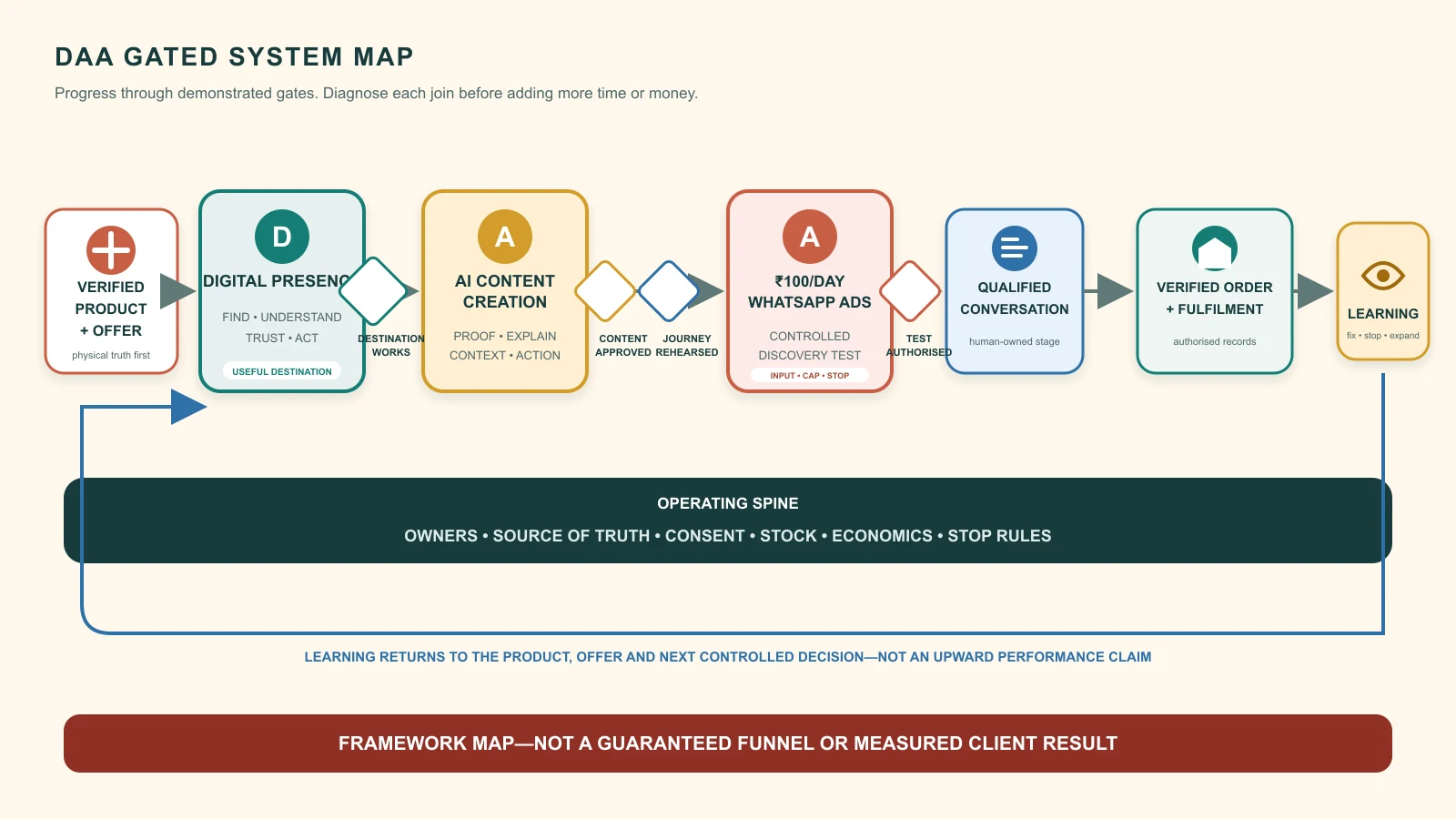
DAA works as a gated loop: product truth supports presence, presence supports content, content supports controlled distribution, and operational outcomes return learning. This is an editorial operating model, not a guaranteed funnel or measured client result.
Gate 1: build the offline truth pack
Before designing, photograph the operating truth.
Product master
For each pilot SKU or configuration, record:
- approved product name and internal/public code;
- current variant, size, colour, finish, pack and included items;
- materials, dimensions and buyer-critical specifications;
- real reference images from required angles;
- claims and the evidence/owner/expiry for each;
- usage, compatibility, safety or care limitations;
- stock/production source and last-checked time; and
- discontinued or restricted variants.
When an item is custom, distinguish a configurable capability from a confirmed specification. “Can manufacture” is not the same as “approved for this application”.
Commercial master
Record the current basis for:
- retail, wholesale, dealer or export pricing;
- minimum order and pack/case multiples;
- tax, freight, installation or sample charges;
- quote validity and who can approve exceptions;
- payment methods and authorised payee identity;
- delivery zones and lead-time confirmation;
- returns, exchanges, warranty and service; and
- offers, limits and expiry ownership.
Do not publish a delivered price when destination-dependent freight is unknown. Do not hide a meaningful mandatory charge behind a headline price.
Business identity and proof
Prepare only proof the business is authorised to use:
- consistent public business name and description;
- current address or service area;
- working phone, email and business hours;
- genuine store/factory/team images where useful and permitted;
- verified registrations, certifications or authorisations only where relevant;
- policies and customer-support route; and
- documented permission for customer images, reviews or endorsements.
The current ASCI Code says objectively ascertainable advertising claims should be capable of substantiation and that statements or visual presentation should not mislead through implication, omission, ambiguity or exaggeration. India’s official 2022 misleading-advertisement guidelines are another publication-day check. General guidance cannot replace category-specific legal review.
Rights and access register
Name the owner and permitted use for:
- logos and trademarks;
- photos, videos, music, fonts and templates;
- customer/dealer data;
- website domain and hosting;
- social, advertising and analytics assets;
- WhatsApp number and linked devices;
- payment profiles; and
- agency/freelancer source files.
The business should be able to recover and continue its essential assets when a person, phone or vendor changes.
Gate 1 pass condition
An independent team member should be able to answer: “What exact product, to which buyer, under what current terms, with what proof, through which owner?” without searching old chats or asking several people for conflicting versions.
Gate 2: create a useful digital presence
Digital presence is the place where product truth becomes findable and actionable.
Establish one consistent business identity
Use the same real business name, category, contact details, location/service area and core description across controlled destinations. If a local storefront or service-area Business Profile is eligible, follow the current Google Business Profile representation guidelines and the actual eligibility rules. Do not create misleading locations, keyword-stuffed names or profiles for businesses that are not eligible.
Build a minimum useful destination
A focused website/landing page, digital catalogue or appropriate marketplace/storefront page should answer:
- Who is the business and who is this product for?
- What exact product/range is being offered?
- What are the buying-critical facts?
- Which images are proof and which are illustrative context?
- What is included and excluded?
- What price basis, MOQ or quote route applies?
- Where can the business deliver, supply or serve?
- What should the buyer do next?
- How does the buyer contact support and understand key terms?
The digital product catalogue guide owns catalogue architecture. The future product landing-page guide owns page conversion detail.
Make the destination discoverable
Use language real buyers understand: product type, application, material, location/service area and buyer question. Write unique, useful page titles, headings, descriptions and body copy for distinct intents. Do not create dozens of near-duplicate city or industry pages with only a word changed.
Google’s current Search Essentials and SEO Starter Guide are the primary starting points for how Google describes technical, spam and content practices. Search visibility is not guaranteed by a keyword, plugin, word count or schema block.
Connect a controlled enquiry route
The CTA should carry useful context into the conversation:
“Ask current price and availability for SKU T42”
is better than:
“Contact us”
Use a product code, page/source marker or prefilled context where appropriate. Keep sensitive personal data out of URLs. Test the route from an ordinary phone, not only the owner’s logged-in device.
Gate 2 pass condition
Give the destination to someone unfamiliar with the project. They should be able to identify the business, exact product, key terms and next action, then successfully start the correct enquiry without assistance.
Choose the right destination
The destination depends on the buying task.
| Destination | Strong when | Weak when | Minimum control |
|---|---|---|---|
| Focused website/landing page | One offer needs explanation, proof, search visibility and measurement | The page is a generic brochure with no owner or action | Domain ownership, mobile QA, clear CTA, policy/contact details |
| Digital catalogue/PDF/web catalogue | B2B or range buyers need structured comparison and product codes | It becomes a static image dump with stale terms | Version, SKU structure, owner and current quote route |
| WhatsApp Business catalogue | A small team sells conversationally from a manageable current range | It is treated as live inventory or formal quotation | Exact items, maintenance rhythm and separate stock/terms check |
| Marketplace/channel listing | The buyer already shops/searches there and rules fit the product | Seller assumes platform traffic replaces brand truth/operations | Current channel compliance, exact listing, fulfilment and margin |
| Google Business Profile | Eligible local/store/service discovery matters | It is used as a substitute for complete product information | Accurate real-world representation and ongoing updates |
| Social profile | Content and conversation support discovery | The business depends on an algorithm and buried old posts | Owned access, consistent identity and link to durable information |
Use the smallest destination that answers the buyer’s real questions. A five-page focused site can be more useful than 100 thin pages. A catalogue can be better than a complex store when every order needs a quote. Conversely, a WhatsApp-only route may be inefficient when buyers repeatedly need specifications the business could publish once.
Gate 3: build an AI content system
AI can reduce the cost and time of producing variations. It cannot supply missing product truth.
Build the source pack first
For each pilot product, collect:
- approved real product photos;
- exact product/variant data;
- buyer questions and objections;
- claim evidence and forbidden claims;
- brand vocabulary and visual rules;
- channel/destination requirements;
- approved CTA and offer terms; and
- rights/consent status for every source asset.
Use the phone-to-approved-image workflow and the product-accuracy checklist when AI assists product visuals.
Give every asset one communication job
Build a small, distinct set:
- Proof: real front, back, detail, scale, pack and included-parts views.
- Explanation: feature, comparison, care, use or selection guidance.
- Context: an illustrative scene that helps the buyer imagine use without becoming product proof.
- Trust: real business, process, policy or expertise evidence.
- Action: one truthful offer, enquiry question or catalogue/landing CTA.
Do not make every post a product-on-a-background image with a different colour. That is format variation, not a content system.
Set red, amber and green AI lanes
| Lane | AI freedom | Examples | Approval rule |
|---|---|---|---|
| Green | Layout, crop, cleanup, background and copy variations with locked facts | social crops, neutral background, headline layout | Content owner plus product check |
| Amber | Context or people may change product meaning | lifestyle scene, apparel model, jewellery styling, demonstration | Product/claim/rights specialist review |
| Red | Error could create safety, legal, technical or material deception | compatibility, certification, before/after, medical/safety performance, precision engineering | Real evidence and authorised specialist; use real capture or do not publish |
AI disclosure and product truth are separate. A label that says “AI-generated” does not correct the wrong colour, stone, dimension, accessory, quantity or claim.
Protect exact product truth
Before release, compare the asset against the source product for:
- silhouette and proportions;
- colour, finish, texture and transparency;
- labels, logos and readable packaging;
- parts, closures, seams, settings and connectors;
- size/scale relationships;
- quantity and included/excluded items;
- model fit or drape where relevant;
- claims implied by the setting, person or action; and
- destination-specific image rules.
Reject a beautiful image when the product becomes a different SKU.
Create a release pack
Every approved asset should have:
- asset ID and version;
- source product/SKU;
- purpose and channel;
- final copy and CTA;
- product/claim/rights approval;
- date and expiry/review trigger;
- alt text and caption where used; and
- source/editable file location.
Gate 3 pass condition
Another reviewer can identify the exact SKU, what is real versus illustrative, what the content claims, where it may be used and who approved it.
Turn content into a repeatable operating rhythm
The aim is not to post every day. It is to answer buyer questions consistently without losing product truth.
Start with four recurring content jobs
- Show: What does the exact product look like?
- Explain: Which buyer problem, use or selection question does it address?
- Prove: What real detail, specification, process or policy supports the statement?
- Invite: What is the next relevant action?
One product can support several distinct assets when each job is different.
Use a simple production board
| Field | Example without invented result |
|---|---|
| Buyer question | “Does this dealer case contain mixed sizes?” |
| Exact source | Collection A, case spec version 3 |
| Content job | Explain pack mix |
| Format | Native comparison card plus short video |
| CTA | Ask current case availability with product code |
| Reviewer | Product owner and sales owner |
| Destination | Catalogue page and approved social profile |
| Next review | When case configuration or price logic changes |
Reuse structure, not stale facts
Templates may preserve layout, tone and review order. Recheck stock, price, offer, dates, claims, compatibility and destination on every release. Do not let an old festival post or dealer rate become an evergreen saved reply.
Connect content to pages, not only feeds
When a post answers an important question, its durable version should live on a product page, catalogue, FAQ, guide or sales resource the business controls. Social content can distribute the answer; it should not be the only place the answer exists.
Gate 4: rehearse the buyer journey organically
Before paid traffic, test the path with zero media spend.
Run ten realistic scenarios
Use team members or authorised testers, not fabricated customer testimonials:
- exact SKU and price question;
- vague “send catalogue” request;
- out-of-stock item;
- wrong service area;
- B2B MOQ mismatch;
- technical or compatibility question;
- buyer asks for a discount outside authority;
- payment screenshot without settlement;
- complaint or return request; and
- opt-out.
Test the complete path
For each scenario, verify:
- source can be identified;
- destination opens and matches the message;
- product code/context reaches the operator;
- the owner responds within the stated business promise;
- qualification asks only useful questions;
- product and commercial facts come from the current master;
- exceptions reach a human owner;
- an order/quote can be recorded outside the chat;
- opt-out is actioned; and
- the final outcome is logged honestly.
Use organic traffic to find defects, not declare demand
Existing customers, store visitors or dealer contacts can reveal broken links, confusing copy and missing information. Their behaviour is not necessarily representative of a new paid audience. Do not call a handful of friendly tests “market validation”.
Gate 4 pass condition
The team can complete the ten scenarios without wrong products, invented facts, duplicate owners, missing records or unhandled stop conditions.
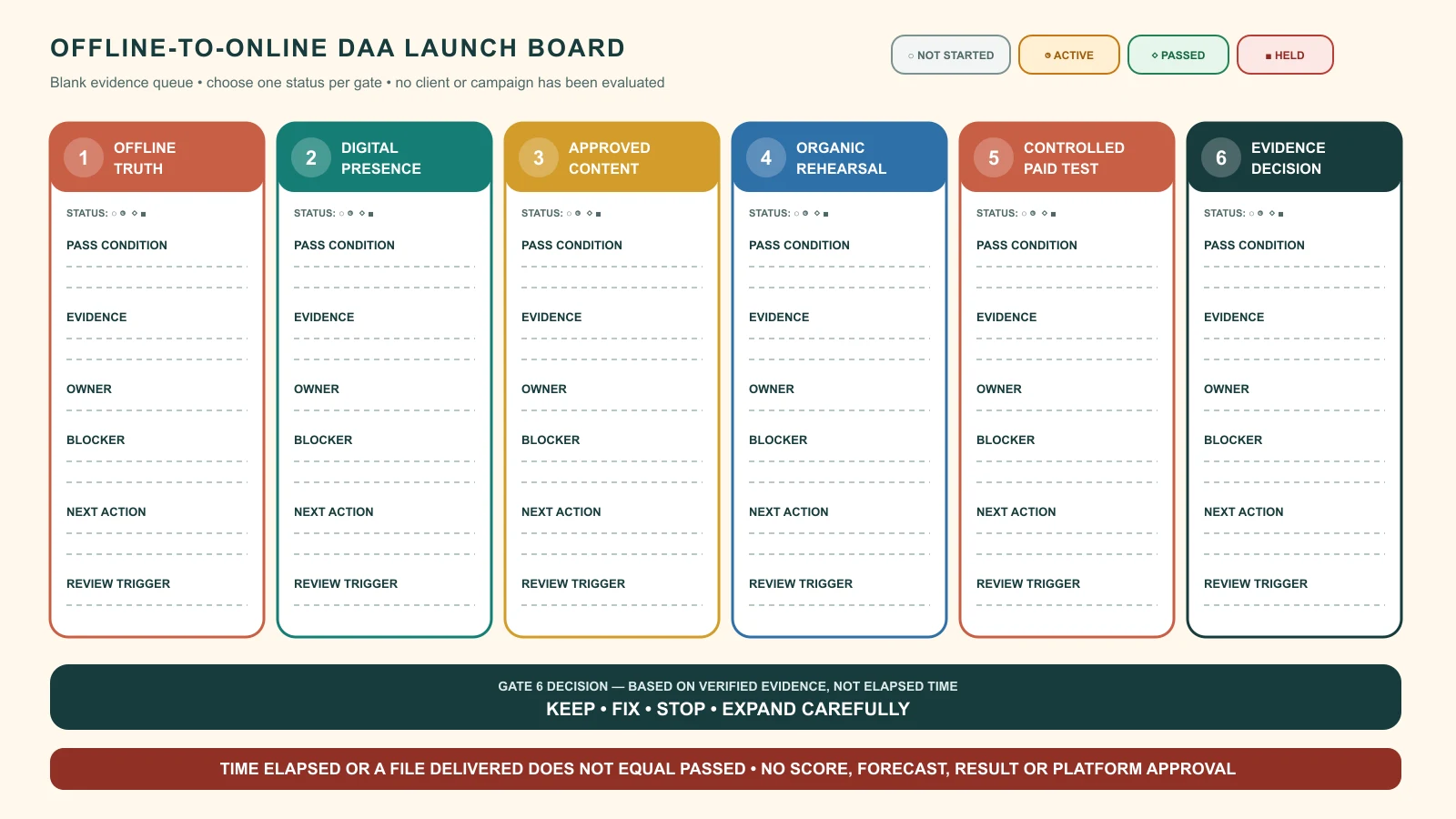
Each gate requires evidence; elapsed time, a new tool or a finished design does not automatically move the business forward. This blank board contains no client data, score, approval, campaign result or financial forecast.
Gate 5: run a controlled ₹100/day WhatsApp ads test
Paid distribution comes after the route works without paid traffic.
Understand what ₹100/day means here
It is a small daily media input used to practise setup, message match, tracking, response and stop decisions. It is not a universal minimum, enough budget for every market, or evidence that Meta will deliver a particular result. Meta’s official budget, cost and schedule guidance explains that ad costs depend on the setup and auction; inspect the current authorised account before launch.
The dedicated ₹100/day click-to-WhatsApp system owns implementation. This roadmap defines the handoff into that system.
Use one controlled campaign question
Example:
Can approved creative C03 bring serviceable apparel retailers interested in collection S24 into a traceable WhatsApp conversation at a cost the business can evaluate?
That question names the creative, buyer, product, route and evidence. “Can Meta grow my business?” is too broad to test.
Prepare the launch card
- business/ad asset owner and access;
- exact product and offer version;
- approved creative ID;
- destination and prefilled context;
- buyer/geography hypothesis;
- daily/lifetime budget and authorised cap;
- test start/review/stop owner;
- valid-chat and qualified-enquiry definition;
- exclusion rules for spam, duplicates and tests;
- response staffing and business hours;
- stock/fulfilment check; and
- affordable-action or unit-economics boundary.
Keep the ad, destination and reply aligned
If the ad says “dealer catalogue for collection S24”, the first destination and operator should recognise S24 and dealer intent. Do not send the buyer to a home page, generic “Hi”, outdated PDF or operator who has not seen the offer.
WhatsApp’s official click-to-WhatsApp ads overview and creation guide are current first-party starting points. Actual objectives, account interfaces and eligibility can change; verify them in the authorised account.
Prewrite stop rules
Stop or hold for:
- wrong or drifting product/offer;
- broken or mismatched destination;
- unavailable stock or response owner;
- misleading claim or rights issue;
- prohibited/restricted or ineligible category;
- unauthorised spend, billing or access problem;
- permission/opt-out failure;
- material data/privacy risk; or
- inability to fulfil a valid enquiry.
Performance disappointment should trigger the planned review, not an impulsive change to budget, audience, creative and offer at the same time.
Gate 5 pass condition
The campaign is authorised, traceable and reversible; the team knows what counts, who responds, when to review and who can stop spend.
Connect enquiries to reliable human follow-up
The first message after an ad or page visit is the beginning of sales operations, not the campaign result.
Classify the conversation
Separate:
- valid product enquiry;
- support/return request;
- dealer or wholesale request;
- supplier/job/collaboration contact;
- duplicate/test;
- wrong geography or product;
- spam/fraud; and
- unclear greeting that needs context.
Do not count every “Hi” as a lead.
Qualify only what changes the next decision
Depending on the business, ask for buyer type, exact product/use, quantity, location/serviceability and timing. Collect the minimum information needed at that stage.
Follow current messaging controls
The WhatsApp Business Messaging Policy currently requires the person’s number plus opt-in permission for subsequent messages/calls and requires opt-outs to be honoured. It also has Business Platform-specific approved-template and 24-hour customer-service-window rules. A person starting one product enquiry should receive a relevant response; that does not silently become unlimited promotional permission.
Use the WhatsApp lead follow-up templates for the active sequence and closure rules.
Create an order record outside the conversation
Before fulfilment, confirm:
- exact SKU/variant and quantity;
- price, tax, freight and total basis;
- delivery/pickup and buyer details needed for the order;
- accepted terms or quote version;
- verified payment or approved credit status; and
- fulfilment owner and next update.
Do not dispatch from a screenshot or an ambiguous voice note.
Gate 6: measure, fix, stop or expand
Measure the path as stages. Do not combine everything into “online sales”.
| Stage | Useful measure | Source of truth | What a problem may mean |
|---|---|---|---|
| Presence | eligible destination sessions/views and product-route actions | Destination/analytics record | Discovery or message mismatch |
| Content | approved assets used and buyer actions by asset | Release pack plus destination/ad record | Content job or product-truth gap |
| Paid distribution | spend, delivery and valid conversation starts | Authorised ad account plus enquiry log | Audience, creative, route or tracking issue |
| Qualification | qualified enquiries ÷ valid enquiries | Controlled sales log | Wrong buyer, weak message or qualification friction |
| Quote/order | quotes, confirmed orders and reasons lost | Quote/order system | Offer, trust, terms or response problem |
| Fulfilment | authorised orders fulfilled correctly/on time | Operations record | Stock, handoff or promise failure |
| Economics | contribution and affordable acquisition decision | Accounting/unit-economics model | Sales can grow while profit deteriorates |
| Trust/control | product/claim defects, complaints and opt-outs | QA/support/consent records | Truth, expectation or frequency failure |
Use denominators
“Ten qualified enquiries” means little without knowing valid enquiries, spend, source, time period, product and qualification definition. Record the denominator before comparing.
Diagnose the broken join
- People see content but do not act: message, proof, offer or CTA may be weak.
- People click but the destination loses them: message match, speed, clarity or trust may be weak.
- Chats start but are invalid: audience, creative promise or source definition may be wrong.
- Valid enquiries do not qualify: product, price, location, MOQ or response may not fit.
- Quotes do not become orders: terms, trust, timing, competition or follow-up may be the issue.
- Orders create complaints/returns: product truth, expectation or fulfilment may be broken.
- Sales occur but cash/profit is weak: margin, freight, returns, labour or acquisition cost may be unsustainable.
Do not blame “the algorithm” before checking the full path.
Decide with four actions
- Keep: the evidence supports continuing the same controlled version.
- Fix: one diagnosed defect has an owner and a new version.
- Stop: the offer, route, policy, economics or capacity does not support continuation.
- Expand carefully: the business can support a larger range, geography, content cadence or budget without losing truth or service.
Expansion is a new test. A result from one product, season, city, buyer type or campaign does not automatically transfer.
Use the roadmap in different product businesses
These are fictional operating examples, not GPTWala client cases, typical industry results or promises.
Apparel wholesaler: from forwarded photos to a dealer pilot
A Surat wholesaler selects one collection and one retailer profile. Gate 1 locks style codes, fabric, size ratio, colourways, case pack, MOQ and current quote basis. Gate 2 creates a dealer catalogue page with three clear collection routes. Gate 3 produces exact garment proof plus controlled model context; model imagery cannot change drape, length, transparency, pattern or included pieces. Gate 4 tests vague “send rate” and 24-piece voice-note scenarios. Gate 5 tests one dealer-catalogue message. The useful outcome is a traceable, qualified dealer conversation—not a message count.
Jewellery retailer: connect styling to exact-item proof
A Jaipur retailer pilots one occasion category. Real front, back, clasp, setting and scale views remain the decision evidence; AI may create labelled context only after product review. The page states exact item code, material/finish, size, inclusions, current price basis and documented hallmark/certification facts where applicable. Ads never imply purity, stone identity, weight, certification or availability from appearance.
Component manufacturer: turn application questions into technical handoffs
A Rajkot manufacturer pilots one component family for one distributor/application segment. The destination provides controlled drawings/specifications and an RFQ route. Content explains selection without inferring compatibility. WhatsApp gathers quantity, application and drawing/version, then hands technical approval to the authorised product/engineering owner. The chat is not the engineering record.
Tile business: separate room inspiration from product evidence
A Morbi tile seller uses real macro, edge, dimensions and current sample/batch information as proof. AI room scenes are labelled illustrative and cannot prove shade, finish, slip performance, installation result or batch uniformity. The destination routes buyers to sample, specification or quote actions by product code and destination.
Local appliance shop: connect local discovery to serviceability
The shop pilots one appliance category, confirms eligible Business Profile information, publishes exact models and service-area terms, and uses content to explain selection. The WhatsApp route checks model, pincode, stock, delivery and installation responsibility. Paid testing begins only when someone can answer during stated hours and operations can verify promises.
Export product brand: localise the buying path, not only the headline
The brand chooses one market and distributor profile. It reviews language, units, currency/quote basis, claims, availability, trade/logistics information, cultural context and local legal/platform requirements. A translated ad leading to an India-only price list or unsupported delivery promise is not localisation.
Assign roles in a small team
One person may hold several roles, but each decision needs an owner.
| Role | Owns | Cannot self-approve when |
|---|---|---|
| Business owner | pilot goal, budget, access and stop authority | financial/product facts are outside their verified record |
| Product owner | SKU, specification, claim and variant truth | regulated/technical approval needs a specialist |
| Commercial owner | price, MOQ, tax/freight basis and offers | exception exceeds authority |
| Content owner | brief, asset version, channel and publishing | product/claim/rights review is pending |
| Ads owner | authorised setup, spend, version and stop control | destination/response gate has failed |
| WhatsApp/sales owner | qualification, quote and next action | technical, finance or complaint escalation is needed |
| Finance/operations | payment, stock, fulfilment and contribution records | the chat conflicts with the authoritative system |
Solo owner version
Use checklists and separate review moments even when one person does everything:
- verify product/commercial facts;
- draft the page/content;
- step away, then review product and claims against sources;
- test the journey as a buyer;
- authorise the budget and stop line; and
- reconcile enquiries/orders with operational records.
Separation in time is weaker than independent review but better than approving while creating.
When to add tools or automation
Add a tool only for a named bottleneck:
- product information is inconsistent;
- asset versions are lost;
- enquiries remain unowned;
- follow-ups are missed;
- attribution cannot be reconciled; or
- a controlled repetitive task consumes avoidable time.
Article 30 will own the wider AI adoption roadmap, roles and risk control. This page uses only the minimum governance needed to run DAA safely.
Avoid common offline-to-online mistakes
Buying a large website before defining the buyer journey
A website cannot decide the product, proof, offer, action or response owner. Build the content model and pilot path first.
Uploading the full catalogue once and forgetting it
Stale variants, prices, images and policies damage trust. Every catalogue needs an owner, version and update trigger.
Treating followers as business outcomes
Followers can support distribution, but the operating system needs qualified actions, quotes, orders, fulfilment and economics.
Using AI to invent what the business has not documented
AI can make missing truth look polished. It cannot verify stock, certifications, materials, performance, warranty, price or compatibility unless connected to an authoritative current source—and the business still owns review.
Running ads before response capacity exists
A fast acknowledgement with no useful answer is not readiness. Operators need product sources, qualification, quote authority, handoffs and closure rules.
Changing everything after weak early data
Simultaneous changes to product, offer, creative, audience, page and budget destroy diagnosis. Change one relevant layer after identifying the likely failure.
Calling every conversation a lead and every order an ad result
Define valid and qualified enquiries in advance. Reconcile orders with source records and acknowledge that store visits, referrals, dealer relationships and repeat buyers may influence the outcome.
Scaling a profitable-looking campaign without full costs
Product margin can disappear after freight, packaging, payment fees, returns, discounts, labour and acquisition cost. Use the future unit-economics guide before scale decisions.
Follow the milestone launch plan
This is a completion sequence, not a guaranteed 30-, 60- or 90-day result. A small stable range may move quickly; a regulated, custom or export business may need much longer.
Milestone 1: pilot is defined
Complete when one buyer, product range, action, owner, no-go line and measurement definition are written.
Milestone 2: truth pack is approved
Complete when product, commercial, identity, rights, access and fulfilment facts have current sources and owners.
Milestone 3: digital destination works
Complete when an unfamiliar tester can find, understand and enquire about the exact product on mobile.
Milestone 4: content release pack exists
Complete when a small set of proof, explanation, context and action assets passes product, claim, rights and channel review.
Milestone 5: organic rehearsal passes
Complete when the team handles ten realistic journeys, including exceptions and opt-out, without a truth or ownership defect.
Milestone 6: paid-test card is authorised
Complete when budget, campaign question, version, source tracking, response staffing, stock, stop rules and economic boundary are documented.
Milestone 7: first evidence review is complete
Complete when the team can reconcile spend, valid/qualified enquiries, quotes/orders, fulfilment, defects and economics, then choose keep, fix, stop or cautiously expand.
Keep a visible operating board
| Milestone | Status | Evidence | Owner | Blocker | Next action |
|---|---|---|---|---|---|
| Pilot | Not started / Active / Passed / Held | Brief link/version | Name/role | Exact issue | One dated action |
| Truth | Not started / Active / Passed / Held | Product/commercial masters | Name/role | Missing source | One dated action |
| Presence | Not started / Active / Passed / Held | Tested destination | Name/role | Journey defect | One dated action |
| Content | Not started / Active / Passed / Held | Release pack | Name/role | Approval gap | One dated action |
| Rehearsal | Not started / Active / Passed / Held | Scenario log | Name/role | Process defect | One dated action |
| Paid test | Not started / Active / Passed / Held | Launch card/account record | Name/role | Readiness/economics | One dated action |
| Review | Not started / Active / Passed / Held | Outcome decision record | Name/role | Data gap | Keep/fix/stop/expand |
Do not mark a milestone passed because a vendor delivered a file. Pass it when the business can demonstrate the required buyer/operating behaviour.
Learn the DAA system with GPTWala
This guide gives the roadmap; implementation still requires choices around your products, team, accounts and market. GPTWala’s workshop teaches the DAA path for product-business owners: Digital Presence → AI Content Creation → ₹100/day WhatsApp ads.
Use the workshop to understand how the layers connect, then apply the gates and truth controls in this guide. The workshop and framework are educational; they do not guarantee reach, enquiries, orders, sales, earnings, profit or return on ad spend.
Frequently asked questions
What is the first step in taking an offline product business online?
Choose one buyer group, a manageable product range and one useful next action. Then build the verified product/commercial truth pack and a working destination. Do not begin by buying traffic or uploading the complete range.
What does DAA stand for in the GPTWala framework?
DAA stands for Digital Presence, AI Content Creation and a ₹100/day WhatsApp ads system. The sequence connects a credible destination to truthful content and then to a small controlled paid-discovery test. WhatsApp sales operations and fulfilment form the operating spine.
Do I need a website to take my product business online?
Not always. The right destination may be a focused landing page, digital catalogue, WhatsApp Business catalogue, eligible Business Profile, marketplace listing or a combination. It must answer the buyer’s questions, be controlled by the business and lead to a reliable action. A website becomes valuable when durable explanation, search visibility, ownership and measurement justify it.
Should I upload all my products at once?
Usually not for a first pilot. Begin with a range whose variants, images, specifications, terms, stock and fulfilment can be maintained. Expand only after the team proves the update and enquiry process.
Can AI create all my product photos and videos?
AI can assist production, context and variations, but the exact physical product and approved records remain the source of truth. Use real capture for buyer-critical detail, scale, fit, material, safety, certification or performance that AI cannot preserve faithfully. Reject product drift.
Is ₹100/day enough to get WhatsApp leads?
There is no guaranteed answer. ₹100/day is the workshop’s controlled starting-budget/system concept. Auction, audience, product, offer, creative, destination, response and market conditions affect delivery and outcomes. Treat it as a bounded learning input and set authorised caps and stop rules.
When is my business ready to run WhatsApp ads?
When the exact product/offer is approved, the destination works, account ownership and payment are controlled, content is truthful, response staff can qualify enquiries, stock/fulfilment can support the promise, tracking is defined and the economic/stop boundary is documented.
What should I measure first?
Measure the deepest stage you can verify consistently: valid conversations, qualified enquiries, quotes, confirmed orders, fulfilment and contribution. Pair every count with its denominator, source, product, time period and definition.
Can a digital agency or freelancer own the whole setup?
They can help build and operate it, but the business should deliberately control or document ownership, named access, payment, data, domain, ad assets, WhatsApp number, source files and exit/recovery. Never depend on a shared personal login or an unknown asset owner.
How long does it take to move an offline business online?
There is no universal duration. A small retailer with a stable range may pass the gates faster than a custom manufacturer, regulated seller or exporter. Use evidence-based milestones rather than a promised number of days.
What if online enquiries arrive but do not become orders?
Locate the broken join: wrong audience, weak message, confusing destination, slow response, missing product fit, price/MOQ/freight mismatch, trust gap, poor follow-up or fulfilment limits. Fix one diagnosed layer at a time instead of only increasing spend.
How is this different from an AI adoption roadmap?
This page is the customer-growth operating path from offline truth to online presence, content, paid discovery and enquiries. Article 30 will own wider AI adoption across teams, tools, permissions, governance and staged organisational rollout.
Sources checked for this guide
- GPTWala DAA Framework Workshop
- Google Search Essentials
- Google SEO Starter Guide
- Google Business Profile guidelines for representing a business
- WhatsApp for Business: Ads that click to WhatsApp
- WhatsApp for Business: How to create ads that click to WhatsApp
- Meta for Business: Ad budgets, costs and schedules
- Meta for Business: Ad review, policy and support
- WhatsApp Business Messaging Policy
- WhatsApp Messaging Guidelines
- Department of Consumer Affairs: Guidelines for Prevention of Misleading Advertisements and Endorsements for Misleading Advertisements, 2022
- Advertising Standards Council of India: The ASCI Code