Tag: WhatsApp Business

  • How to Build and Use a WhatsApp Business Catalogue

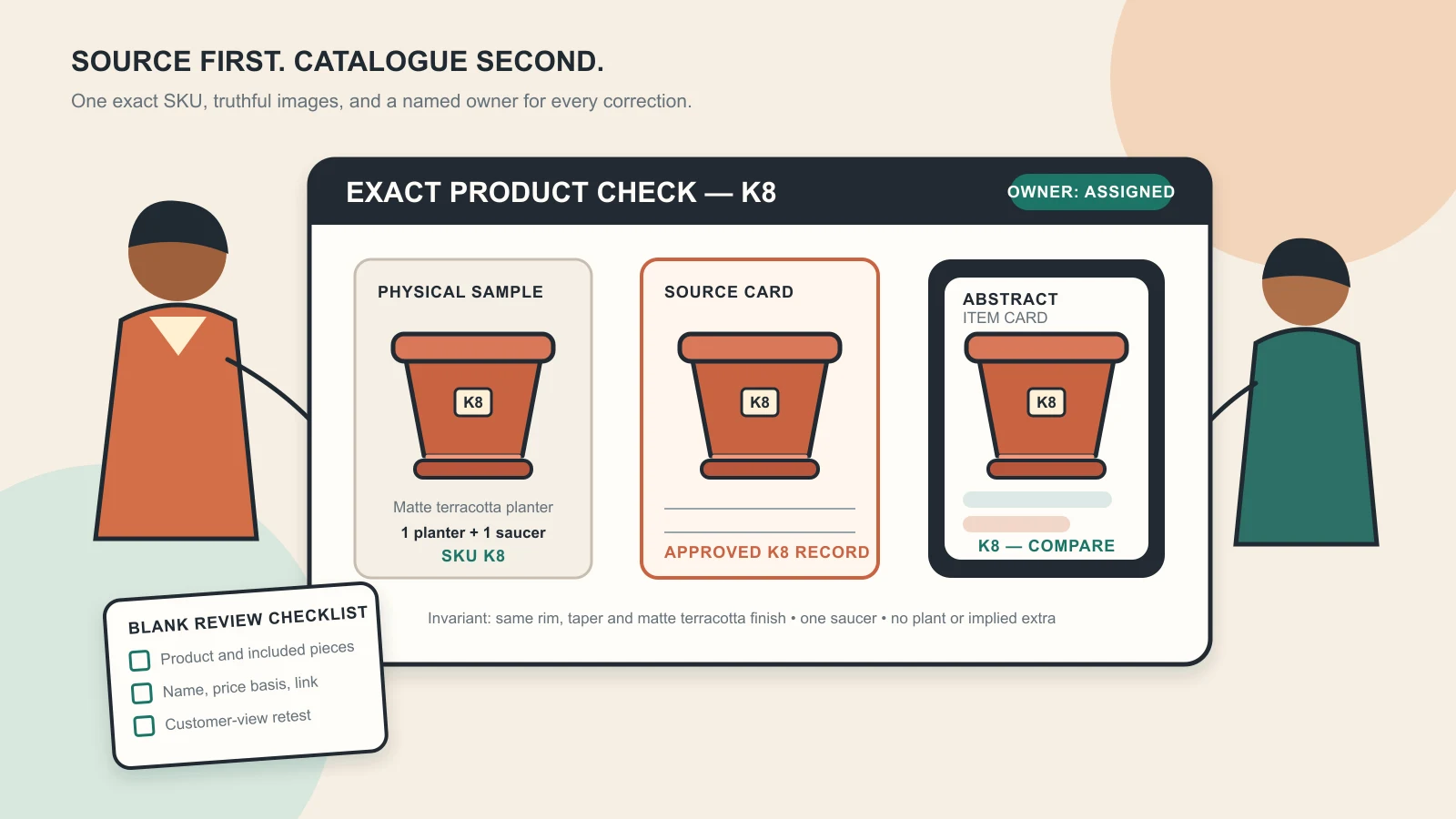
    Indian product-business owner checking one exact product card before adding it to a WhatsApp Business catalogue
    A useful WhatsApp Business catalogue begins with an exact SKU, truthful images and a named person responsible for updates.

    Visual disclosure: Original GPTWala editorial illustration using one fictional, unbranded matte terracotta K8 planter with one matching saucer and abstract catalogue shapes. It is not a WhatsApp interface, platform approval, client result or sales claim; the planter’s rim, taper, colour, finish, K8 label and saucer count remain identical in every representation.

    Reviewed and updated: 12 August 2026

    To build a useful WhatsApp Business catalogue, start with a small approved set of products, prepare one accurate record for each SKU, add truthful images and buyer-relevant details in the WhatsApp Business app, group related items into collections where the feature is available, and inspect the public result from a customer’s phone. Then use the catalogue as a discovery and conversation tool—not as proof of stock, a final quotation, a payment record or a guarantee of sales.

    For each enquiry, share the most relevant item or collection, confirm the exact variant, quantity, current price, availability, delivery conditions and included parts, and move the confirmed order into the business’s authorised order system. Assign one person to correct outdated catalogue entries and keep a dated update log.

    This guide owns the current WhatsApp Business app catalogue setup and practical usage workflow. The WhatsApp selling guide owns the full enquiry-to-order process; the WhatsApp follow-up template guide owns timed message sequences and permission; and the digital product catalogue guide owns range architecture, dealer information and larger B2B catalogues.

    Table of contents

    1. Understand what a WhatsApp Business catalogue does
    2. Choose the correct WhatsApp product
    3. Prepare the catalogue source of truth
    4. Build the first launch set
    5. Add products in the WhatsApp Business app
    6. Organise items into useful collections
    7. Verify the customer view before sharing
    8. Use the catalogue in real buyer conversations
    9. Handle prices, stock, variants and B2B terms
    10. Protect product truth in images and descriptions
    11. Follow commerce, messaging and privacy rules
    12. Maintain the catalogue with a weekly control loop
    13. Measure usefulness without inventing sales attribution
    14. Troubleshoot common catalogue problems
    15. Apply the workflow to Indian product businesses
    16. Use the launch checklist
    17. Frequently asked questions

    Understand what a WhatsApp Business catalogue does

    WhatsApp describes the Business app catalogue as a mobile storefront for products and services. Its current Business app feature page says businesses can group similar items into collections, share the complete catalogue or specific item links, and let customers select catalogue items into a cart that is sent as one message. See the official WhatsApp Business app features.

    That makes the catalogue useful for three jobs:

    • discovery: a buyer can see what the business offers without requesting photos one by one;
    • identification: a shared item can give both sides a clearer product reference; and
    • conversation: a buyer can select an item and ask a specific question or send a cart message.

    The catalogue does not automatically become the business’s inventory, accounting, quotation, tax, payment, shipping or warranty system. WhatsApp’s current policy says the business remains responsible for its transactions, sales terms, privacy terms, taxes, fees and fulfilment. A customer selecting an item or sending a cart is therefore an enquiry or order request until the business verifies and confirms it.

    Catalogue, product database and quote are different records

    Record Primary job What it should control What it must not pretend to prove
    Product source of truth Authoritative product facts SKU, variant, specifications, approved images, current pack and claims Buyer intent or confirmed stock allocation
    WhatsApp catalogue Mobile discovery and product reference Approved public item cards and collections Real-time inventory, final freight, credit or tax treatment
    Quote or order summary Commercial commitment for one buyer Exact item, quantity, price, charges, delivery and terms Payment settlement or dispatch
    Accounting/order system Transaction and fulfilment control Payment/credit status, invoice, allocation, dispatch and reconciliation A substitute for clear customer communication

    The safest design is a chain: source of truth → catalogue item → buyer conversation → confirmed order record. When one link changes, update the downstream records or temporarily hide the affected item.

    Choose the correct WhatsApp product

    This article is for a small business or a manageable team using the WhatsApp Business app. WhatsApp currently positions that app as the small-business product and the Business Platform as the programmatic route for larger-scale messaging. The two products have different setup, management, pricing and messaging controls.

    Use the Business app workflow when:

    • one owner or a small team can review every catalogue change;
    • the launch range is manageable manually;
    • current stock and price can be verified before confirmation;
    • individual customer conversations are handled by people; and
    • no ERP, CRM or automated catalogue integration is required.

    Evaluate the Business Platform or a qualified implementation partner when:

    • several agents need controlled access and routing;
    • the product range or availability changes too quickly for manual maintenance;
    • catalogue data must come from an ERP, ecommerce platform or inventory service;
    • the business needs programmatic single- or multi-product messages; or
    • governance, reporting and integrations exceed what the app can reliably handle.

    Do not follow Business Platform instructions inside the Business app or copy the Platform’s 24-hour/template rules into an app setup without checking which product you use. This page does not teach Commerce Manager, API integration or provider selection.

    Complete the business profile first

    Before adding catalogue items, make the business identity clear. WhatsApp’s current policy requires an accurate Business profile with customer-support contact information and at least one of an email address, website address or telephone number. The current Business app page also describes profile fields such as business description, hours and website.

    Check:

    • legal or trading name used with customers;
    • recognisable logo that the business owns or may use;
    • plain-language description of what the business sells;
    • current address or service area where appropriate;
    • customer-support contact route;
    • correct working hours; and
    • website or verified landing page if one exists.

    A complete profile cannot prove trustworthiness, but an inaccurate one creates avoidable doubt and can breach policy. Do not use another brand’s name, logo or dealer status without authority.

    Prepare the catalogue source of truth

    Do not type the catalogue from memory while holding the phone. Prepare an approved product sheet first. One row should represent one saleable SKU or clearly defined product configuration.

    Use a catalogue source row

    Field What to record Reject or pause when…
    Internal SKU Stable code used by staff The code maps to more than one item or variant
    Public item name Product type plus the buyer’s key differentiator The name depends on vague words such as “premium” or “best”
    Variant Colour, size, material, pack or model The images show a different variant
    Current image set Approved filenames and review date A label, pattern, stone, part or pack version is uncertain
    Short description Material, dimensions, use and included quantity that can be substantiated A benefit, certification or compatibility claim lacks evidence
    Display price decision Exact public price, “contact for current quote,” or another live-app-supported choice Tax, MOQ, unit basis or variant price would make the displayed figure misleading
    Product code Customer-safe code if useful It exposes confidential data or differs from the sales system
    Product/website link Canonical landing page for the exact item, if available in the current app The page is broken, mismatched or outdated
    Stock/availability note Internal status and last check time Staff cannot verify it before confirming an order
    Owner Person responsible for catalogue accuracy Nobody has authority to edit or hide the item

    Meta’s original catalogue announcement documented price, description and product code as item information. The current app may show additional, fewer or differently labelled fields by operating system, version, account and market. Use the controls actually visible in the current app and do not invent a value merely to fill a field.

    Write names that survive chat

    The item name should help a customer and salesperson identify the same product after the image is separated from its collection. A useful pattern is:

    Product type + model/range + key variant

    Examples:

    • Stainless Steel Tiffin R3 — 3 Tier, 900 ml Total
    • Cotton Kurti S17 — Indigo, Size M
    • Gold-Plated Brass Earrings J42 — Green Stone Pair
    • Ceramic Planter K8 — Matte Terracotta, 18 cm
    • Tile Sample Box M12 — Stone Finish, 300 × 600 mm Range

    These are fictional examples, not claims about real products. Match the unit, material and variant to the business’s evidence. Do not cram offers, emojis, urgency or unverifiable superlatives into the name.

    Treat price as a controlled field

    Display a price only when a buyer can understand what that figure covers. Record:

    • unit basis: piece, pair, set, metre, kilogram, carton or another exact unit;
    • whether the figure includes applicable taxes;
    • minimum order quantity where relevant;
    • pack size and included parts;
    • variant dependency;
    • whether freight, installation or customisation is separate; and
    • the date or event that should trigger revalidation.

    If a wholesale, made-to-order or commodity-linked price cannot remain accurate, use the current app’s supported presentation carefully and direct the buyer to request a current written quote. Never place a placeholder number such as ₹1 merely to make the card look complete.

    Build the first launch set

    Start with a small set that the team can keep accurate. “Small” is an operating recommendation, not a claimed WhatsApp limit. Ten well-maintained items are more useful than a large catalogue containing wrong variants, discontinued stock and mixed price bases.

    Choose launch items that are:

    • frequently requested;
    • currently saleable;
    • easy to identify from approved images;
    • supported by complete product facts;
    • permitted by current WhatsApp and Meta commerce policy; and
    • manageable by the person responsible for updates.

    Exclude an item for now if:

    • the product or pack is changing;
    • a buying-critical detail is not photographed clearly;
    • price, tax, MOQ or delivery wording is unresolved;
    • a certification, composition or performance claim is unverified;
    • the item falls into a prohibited or restricted category; or
    • the business cannot fulfil enquiries for it reliably.

    Select the image set by job

    Use the first image to identify the exact sale item. Additional images should answer buyer questions rather than repeat the same angle.

    Image role Useful content Product-truth guardrail
    Main item image Complete product, simple background, recognisable variant No extra accessory, offer badge or different pack
    Alternate angle Back, side, opening, closure or construction Same exact SKU and current version
    Detail Texture, label, clasp, seam, fitting or surface Never “enhance” unreadable detail into invented evidence
    Scale/dimension Verified measurement diagram or honest reference Do not distort the product or imply an unverified capacity
    In-use/context Realistic use without hiding the item Props must not look included; performance must not be staged as proof
    Pack/set Every included piece and quantity Do not show optional items as part of the offer

    For a deeper image workflow, use the AI product photography guide for Indian businesses and the product-accuracy audit. A catalogue card inherits every error in its source image.

    Add products in the WhatsApp Business app

    Interface labels change. On many current app versions, the catalogue is reached through Settings or the main menu → Business tools → Catalogue. Treat that path as orientation, not a permanent promise. Update the app from an official store, open the Business tools visible in the account and follow the current on-screen route.

    Step 1: Open the catalogue manager

    Confirm that you are in the correct business account and phone number before editing. If the catalogue control is absent, do not install unofficial WhatsApp builds or give a third party remote access to the phone. Work through the troubleshooting gate later in this guide.

    Step 2: Add one pilot item

    Do not upload the whole range first. Add one low-risk, fully documented item. Use the source row—not memory—to enter the visible fields.

    In the current item form:

    1. add the approved images in the intended order;
    2. enter the exact public item name;
    3. enter a price only if its unit and conditions remain truthful;
    4. add a concise description with material, size, pack and relevant buying detail;
    5. add the customer-safe product code if the field exists and helps identification;
    6. add the exact product link if offered and verified; and
    7. save the item as the app permits.

    Field availability and labels can vary. If the app marks an item as pending, hidden, rejected or under review, record the displayed state and follow the current in-app guidance. Do not promise an approval time and do not repeatedly recreate the item to bypass a policy decision.

    Step 3: Compare the saved card with the source row

    Check the saved item line by line:

    • correct SKU and variant;
    • image order and crop;
    • complete product and included parts;
    • name, spelling and units;
    • price basis and currency;
    • description and product code;
    • link destination; and
    • visible availability or review state.

    Correct the source or the catalogue; do not tolerate a mismatch because “customers will ask anyway.”

    Step 4: Add the remaining approved launch items

    Use a second person for a spot check when the catalogue contains high-value, regulated, technical or variant-heavy goods. Add in short batches so a repeated mistake can be caught before it affects the full range.
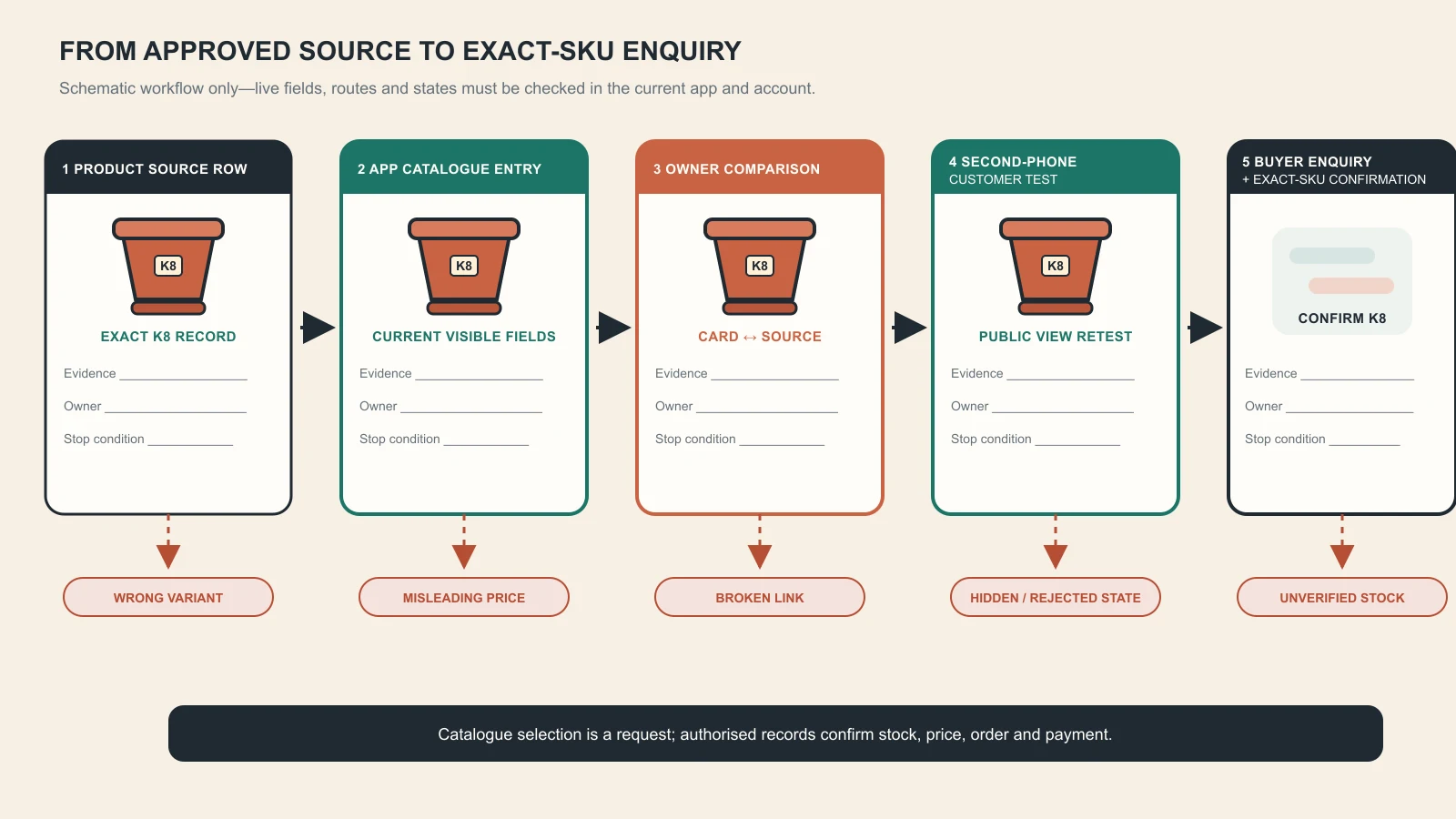
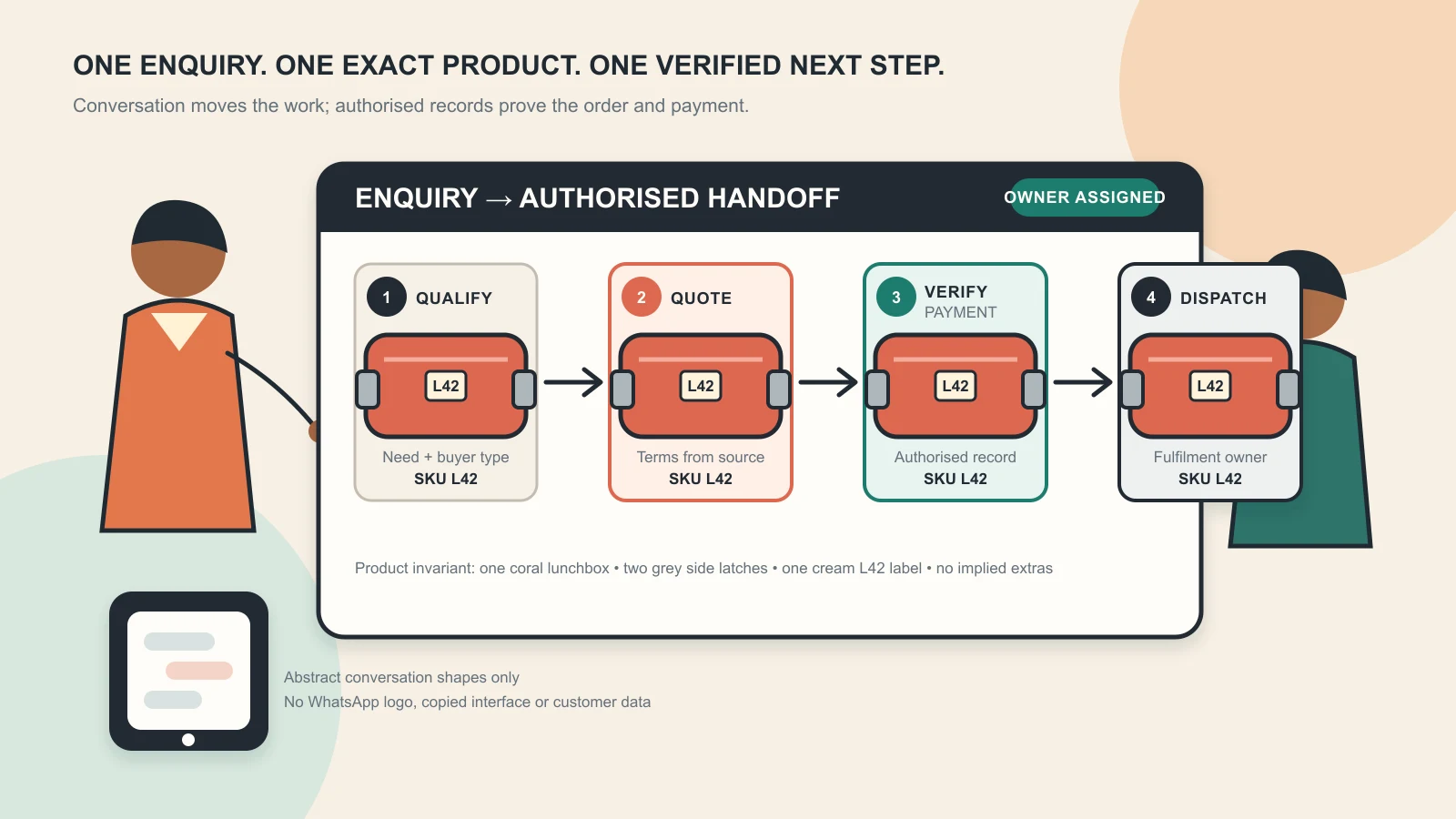
    Product source row moving through catalogue entry, second-phone customer verification and an enquiry with exact SKU confirmation

    The catalogue is a controlled publishing layer between the product source of truth and the buyer conversation. Original GPTWala deterministic workflow: it is not a WhatsApp interface, and every field, route, state and customer view still requires a live-app/account check before publication or use.

    Organise items into useful collections

    WhatsApp’s current Business app feature page says catalogue items can be grouped into collections. Use collections to reduce buyer effort, not to reproduce every internal department or supplier folder.

    Good collection logic reflects how a customer begins a decision:

    • product type: planters, earrings, kurtis, storage boxes;
    • buyer type: retail packs, wholesale-ready range, dealer samples;
    • use: gifting, kitchen storage, festive wear, office accessories;
    • material: cotton, brass, ceramic, stainless steel; or
    • confirmed availability: ready to dispatch, made to order—only if the status is actively maintained.

    Avoid overlapping names such as “New,” “Latest,” “Trending” and “Featured” unless the team has a written rule for membership and expiry. A product can appear exciting and still be impossible to locate.

    Give each collection one clear job

    Buyer question Better collection Weak alternative
    “Which planters can ship this week?” Ready-to-dispatch planters, with an update owner Best planters
    “What do you supply to boutiques?” Boutique wholesale starter range Business products
    “Show me your cotton kurtis” Cotton kurtis Fashion collection
    “Which earrings are under my current budget?” Use a current, maintained price band only Cheap jewellery
    “Do you have sample packs for dealers?” Dealer sample packs Special

    Do not create a “ready stock” or price-band collection unless its owner can remove items when the status changes. If the app/account does not offer collections, keep item names consistent and share specific item links rather than inventing a workaround that misleads buyers.

    Verify the customer view before sharing

    The editor’s view is not the customer’s proof. Test from a separate, ordinary customer account that is not an administrator of the business.

    Run the second-phone test

    Ask a colleague to open the business profile and catalogue as a customer would. Test both Wi-Fi and mobile data if access problems are reported. Check:

    1. Can the customer find the catalogue from the business profile?
    2. Are the intended items and collections visible?
    3. Does the main crop show the complete product?
    4. Are name, variant, units, price conditions and code readable?
    5. Does each link open the exact working page?
    6. Can a specific item or full catalogue be shared through the controls currently shown?
    7. If cart is available, does the selected item arrive in the business chat clearly?
    8. Does the salesperson know that this message is not yet a confirmed order?

    Capture the date, device type, app version if accessible, tester and result in the launch log. Do not publish a filled fictional log as though it were a real test.

    Use a blank catalogue verification record

    Check Result Evidence or issue Owner Retest date
    Business profile accurate
    Catalogue visible to second account
    Collections understandable
    Exact item image and crop correct
    Name, variant and unit correct
    Displayed price not misleading
    Product link resolves correctly
    Cart/item message identifies SKU
    Policy-sensitive items checked
    Final decision: launch, revise or pause

    Use the catalogue in real buyer conversations

    WhatsApp’s feature page says a business can share the whole catalogue or specific item links on WhatsApp, Facebook and Instagram from within the app. It also describes carts as a way for customers to choose catalogue items and send them as one message.

    Use the smallest relevant share:

    • one item link when the buyer asks about a specific product;
    • one collection when the buyer has named a category or use;
    • the full catalogue when the range is genuinely small or the buyer asks to browse; and
    • a separate B2B catalogue or landing page when specifications, tiers and many variants cannot fit clearly in the app.

    Sending the full catalogue to every “Hi” makes the buyer do the qualification work. First ask one useful question such as product category, use, size, quantity, budget range or delivery city—whichever materially changes the answer.

    Use a catalogue-to-confirmation micro-flow

    1. Clarify the need. “Is this for retail use or a wholesale requirement?”
    2. Share the narrowest relevant item or collection. Include the public item name or code in native text.
    3. Invite a specific response. “Please send the item code, colour and quantity you want checked.”
    4. Verify current facts. Check stock, current price, MOQ, tax, freight and dispatch promise in the authorised records.
    5. Summarise the order or quote. Write the exact SKU, variant, quantity, price and conditions.
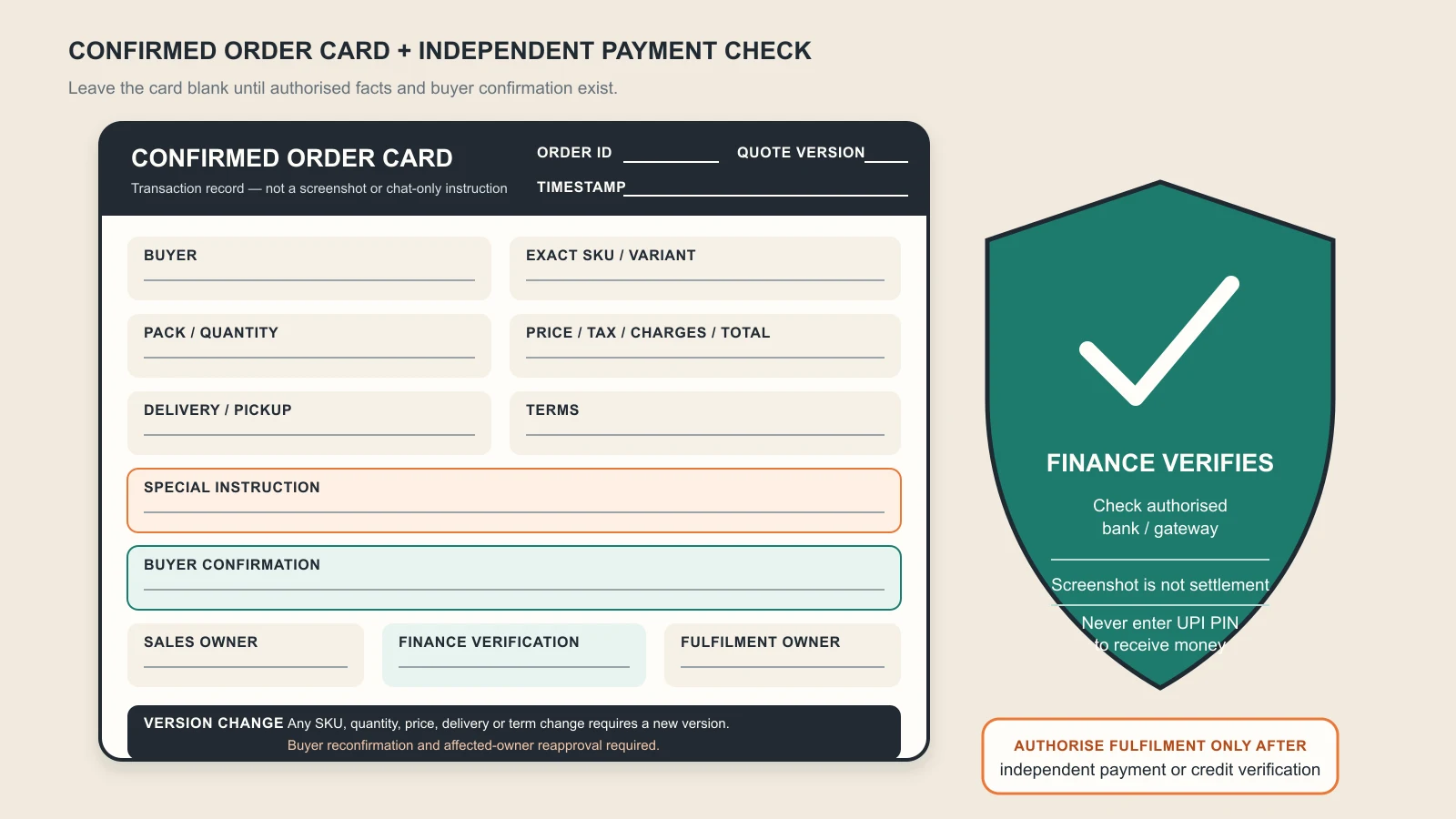
    6. Get explicit confirmation. Correct changes before taking payment or allocating stock.
    7. Verify payment or approved credit separately. A screenshot or cart message is not settlement.

    The message examples are operating templates, not platform requirements or tested conversion claims. Adapt them to the business’s voice and current terms. The WhatsApp selling system owns the complete process after the catalogue share.

    Do not count a cart as a paid order

    A cart message can be a useful structured request, but the business must still confirm:

    • exact variant and quantity;
    • availability or production lead time;
    • current price, tax, discount and freight;
    • delivery or pickup details;
    • return, cancellation and warranty terms where applicable;
    • buyer confirmation; and
    • authorised payment/credit status.

    Only then should fulfilment receive an order record.

    Handle prices, stock, variants and B2B terms

    Most catalogue failures are data-governance failures, not design failures.

    Keep one variant per unambiguous card

    If colour, size, material, pack or model changes the item, the card must not make the buyer guess which variant the image and price represent. Use separate items when that is the clearest supported setup, or state the available choice without implying that every photographed variant has the displayed price or stock.

    For apparel, a card named “Cotton Kurti — all sizes” is risky if the image shows one print, the price applies only to one size, or some sizes are unavailable. For jewellery, one pair cannot silently represent different stone counts or metal finishes. For industrial components, a family image cannot prove the dimensions of every part number.

    Never use catalogue availability as the final stock promise

    Before committing, check the live source controlled by the business. If stock is manual, state the last checked time internally and assign a person to reconcile reservations, store sales and damaged units.

    Use honest phrases such as “Please confirm current availability” only where they do not contradict a stronger displayed claim. Do not label a collection “Ready stock” while keeping sold-out items visible for convenience.

    Separate B2B discovery from quotation

    A manufacturer or wholesaler can use WhatsApp catalogue cards for representative products, ranges or sample packs. The final quote may still depend on:

    • grade, specification or tolerance;
    • minimum order and pack multiple;
    • quantity tier;
    • tax registration and invoice needs;
    • branding or customisation;
    • production lead time;
    • freight, insurance and destination; and
    • approved credit terms.

    Put stable discovery information in the catalogue. Put buyer-specific commercial terms in a versioned quote. Use the digital product catalogue guide for richer B2B range structure.

    Protect product truth in images and descriptions

    A catalogue image is a product representation. The CCPA’s Guidelines for Prevention of Misleading Advertisements and Endorsements for Misleading Advertisements, 2022 apply across forms and media and require truthful, honest representation without misleading exaggeration. A disclosure that an image was AI-assisted does not make an invented feature acceptable.

    Use the exact-SKU image gate

    Before approving any real or AI-assisted image, compare it with the physical item and controlled source photos.

    Reject when the output changes or invents:

    • silhouette, proportions, openings, handles, lids or parts;
    • colour, finish, material or transparency;
    • printed text, logo, label, hallmark or certification mark;
    • pattern, weave, seam, stone count, setting or construction;
    • included quantity or accessory;
    • scale or dimension; or
    • a use, result or performance that has not been substantiated.

    Use AI for a background or controlled context only when the product layer remains verifiably true. If the source does not show a detail, recapture it instead of prompting the tool to guess.

    Keep claims tied to evidence

    Claim type Evidence needed before publishing Unsafe shortcut
    Material Supplier/specification record and exact SKU mapping Inferring from appearance
    Dimensions/capacity Current technical or measurement record Estimating from a photo
    Certification/compliance Valid document covering the exact product and claim Using a badge from another SKU
    Performance Applicable test or defensible substantiation Treating a styled scene as proof
    “Handmade,” “organic,” “waterproof” or similar Defined, documented basis appropriate to the claim Repeating supplier marketing without review
    Included quantity Current pack/BOM and complete image Showing props that look included

    When a claim is not ready, remove it from the catalogue; do not soften it with an asterisk that leads nowhere.

    Follow commerce, messaging and privacy rules

    Catalogue setup does not create permission to market to everyone whose number the business has.

    WhatsApp’s current Business Messaging Policy requires businesses to maintain accurate profile information, contact only people who have provided their number and opt-in permission for subsequent messages or calls, respect block/discontinue/opt-out requests, and avoid spam, deception or surprise. It also makes the business responsible for required privacy notices, permissions and legal compliance. See the WhatsApp Business Messaging Policy.

    Check product eligibility before listing

    The same policy says businesses using catalogue or other commerce experiences must comply with Meta Commerce Policy and applicable terms, laws and regulations. It also lists prohibited or restricted activities and products, with surface- and country-specific exceptions in limited cases.

    Do not rely on a short blog checklist for a policy-sensitive business. Before listing, open the current policy and determine:

    • whether the product, service or business model is allowed;
    • whether the rule differs between the Business app and Business Platform;
    • whether India is an allowed market for any stated exception;
    • what age, geography, licence or other conditions apply; and
    • whether separate Indian product, advertising or sector rules apply.

    If uncertain, pause the item and obtain appropriate compliance advice. “Another seller has it in their catalogue” is not evidence of permission.

    Minimise personal data in catalogue conversations

    Do not ask for full payment-card numbers, financial-account numbers, government ID numbers or unrelated sensitive data in chat. Collect only what the specific transaction needs, at the stage it is needed, and control who can access it. Use authorised payment routes and verify settlement in the bank, gateway or accounting record—not from a screenshot.

    Respect the boundary between service and promotion

    Sharing the exact item a customer requested is different from repeatedly sending unrelated offers. Record how the person opted in, what category of messages they expect and how they can stop them. Honour an opt-out across the team.

    The WhatsApp follow-up templates should own timed follow-up and permission language when live. Do not turn this setup article into a broadcast playbook.

    Maintain the catalogue with a weekly control loop

    Assign a catalogue owner and a backup. The owner does not need to create every image, but must have authority to correct, hide or escalate an inaccurate item.

    Run this loop at a frequency matched to the business. Weekly is a practical starting recommendation, not a platform rule.

    1. Review changes: new SKU, new pack, discontinued item, price change, stock risk, policy change or broken link.
    2. Compare: catalogue card against the current product source row.
    3. Correct or hide: do not leave a known error live while waiting for a redesign.
    4. Retest: inspect the changed item from a customer account.
    5. Record: date, item, change, reason, editor, reviewer and final state.
    6. Notify sales: tell staff when an item code, price basis or availability message changed.
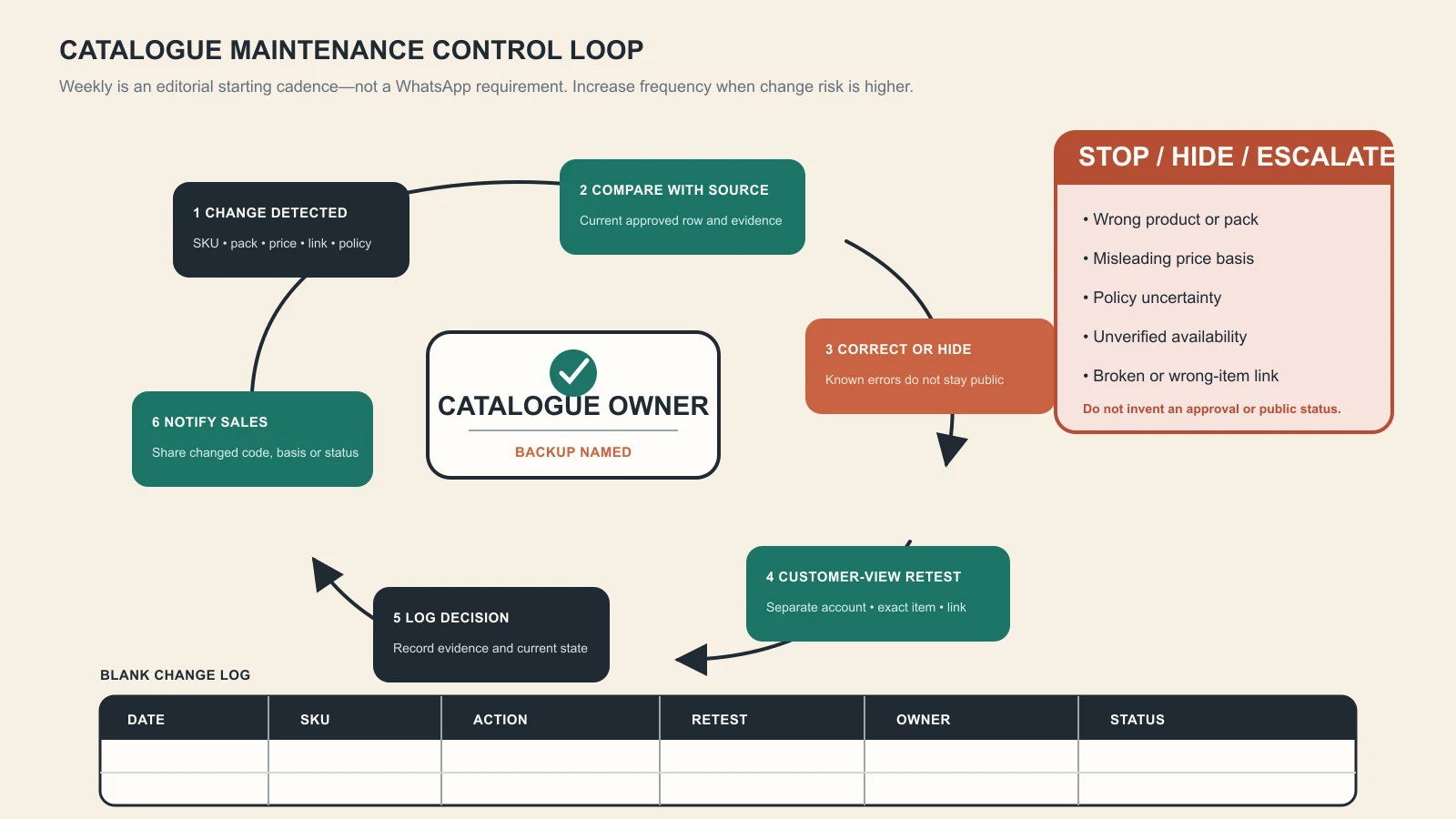
    Six-step WhatsApp Business catalogue maintenance loop from source change to correction, customer-view retest and sales-team notification

    A catalogue remains useful only when source changes trigger correction, retesting and team notification. Original GPTWala deterministic operating diagram; the blank log contains no client data or fabricated status, and the weekly cadence is an editorial starting recommendation—not a WhatsApp requirement.

    Keep a blank change log

    Date SKU/item Change trigger Catalogue action Customer-view retest Owner/reviewer Status

    Useful statuses are draft, pending/current app state, visible, hidden, revise, retired. Use the exact platform status in a separate field if it differs. Never fill the public template with fictional approvals.

    Use stop rules

    Hide or pause an item when:

    • the current product or pack no longer matches the image;
    • the displayed price or unit basis can mislead;
    • stock or fulfilment cannot be verified;
    • a key link is broken or opens the wrong item;
    • an item is rejected or restricted and the reason is unresolved;
    • a material, certification or performance claim is challenged;
    • the catalogue owner cannot maintain it; or
    • customers repeatedly confuse variants or included parts.

    The correct response to a known catalogue error is not “explain it later in chat.” Fix or remove the public card.

    Measure usefulness without inventing sales attribution

    Do not assume every catalogue view caused a sale or every order came from the most recently shared link. Use measurements the business can actually observe and define.

    Record a catalogue-assisted enquiry

    Add these fields to the enquiry or order log where useful:

    • enquiry source;
    • catalogue, collection or item shared;
    • item code named by the buyer;
    • qualified or not, under a written rule;
    • current availability confirmed;
    • quote sent;
    • order confirmed;
    • payment/credit verified;
    • fulfilment status;
    • mismatch or correction needed; and
    • opt-out or complaint.

    Then ask operational questions:

    • Which items attract qualified questions rather than repeated confusion?
    • Which cards create variant, unit or price misunderstandings?
    • How often is an item shared while unavailable?
    • Which broken links or wrong images recur?
    • How long do known errors remain visible?
    • Which catalogue-assisted enquiries become confirmed orders in the authorised records?

    Do not publish a conversion benchmark until the business has a defined denominator, attribution rule, time window and enough reliable data. A small sample may support no conclusion.

    Use an issue rate as a guardrail

    One simple internal guardrail is:

    catalogue mismatch rate = catalogue-assisted enquiries with a material item error ÷ catalogue-assisted enquiries reviewed

    Define “material item error” before counting—for example wrong variant, misleading price basis, unavailable promised stock, broken product link or incorrect included quantity. This is an editorial measurement recommendation, not an industry standard. The goal is to find preventable harm, not manufacture an impressive dashboard.

    Troubleshoot common catalogue problems

    Symptom Likely checks Safe next action
    Catalogue control is missing Correct app, current official version, business account, device/account availability Update through the official store, restart, check current Help Center/in-app support; do not sideload unofficial builds
    Item is pending, hidden or rejected In-app status, product category, image/text, current commerce policy Record the exact state, correct substantiated errors, use official appeal/support route where offered; do not promise review time
    Customer cannot see an item Customer-view test, app version, item state, collection membership, connection Retest from a second account and network; share only after visibility is confirmed
    Main image crops badly Image aspect, subject margins, current preview Re-export around the complete product; do not stretch or regenerate the SKU
    Wrong product opens from a link Copied item, link destination, duplicate or retired SKU Stop sharing, correct the mapping and retest the exact link
    Price in chat differs from catalogue Source date, unit, tax, MOQ, variant or old item Pause the item, correct the public card and issue a clear current quote
    Customers confuse variants Card naming, image-to-variant match, collection overlap Separate ambiguous cards and use exact product codes in chat
    Buyer sends a cart but staff cannot fulfil Stock/lead-time check missing Treat cart as a request, confirm availability and terms, then create an order record
    Catalogue gets views but few useful enquiries Unclear range, weak names, wrong share, insufficient buyer detail Share a narrower item/collection and improve information; do not claim the platform “doesn’t work” from an undefined sample
    Team keeps reintroducing old errors No source row, owner or change log Lock the source, assign an owner and require a customer-view retest

    Escalate to a Platform/integration evaluation when manual synchronisation repeatedly creates customer harm or the team cannot keep the app catalogue aligned with its authorised product and inventory records.

    Apply the workflow to Indian product businesses

    These examples are illustrative operating scenarios, not GPTWala client results.

    Surat apparel seller

    Build collections by stable buyer logic such as cotton kurtis, co-ord sets and wholesale starter packs. Give each print/colour/size combination an unambiguous mapping. Do not use an AI model image to prove fit or drape unless the exact garment has passed the apparel product-truth checklist. Confirm current size stock and pack quantity before quoting.

    Jaipur jewellery business

    Use exact pair/set images and a customer-safe design code. Check stone count, setting, metal colour, clasp, pair symmetry, dimensions and included quantity. Do not infer purity, hallmarking or gemstone identity from an image. High-value or fine-detail products need the jewellery photography truth checks before catalogue approval.

    Rajkot kitchenware manufacturer

    One tiffin family may contain different tier counts, capacities, latch designs and steel grades. A family card is useful for discovery only if it does not imply that the pictured configuration and displayed price cover every model. Send the relevant technical sheet and a current quantity-based quote after qualification.

    Morbi tile wholesaler

    Use collections for finish or application where that matches buyer search. Treat catalogue images as colour/texture guidance, not a guarantee that every screen shows exact colour. Map sample codes to current batches and send specification, packing, quantity and freight terms in the quote. Do not compress a whole tile series into one card when variations materially affect the purchase.

    Local gift or homeware retailer

    Create a manageable ready-to-check range rather than photographing every shop shelf. The catalogue can help a buyer shortlist, but a “ready today” label needs same-day maintenance. Remove sold one-off pieces or clearly reverify availability before accepting payment.

    B2B wholesaler with many SKUs

    Use WhatsApp for a curated entry range and conversation, not as the only database. Ask buyer type, category, quantity and location, then send the relevant digital product catalogue or landing page. Maintain one shared product master so the WhatsApp card, PDF and quote do not contradict one another.

    Use the launch checklist

    Before setup

    • [ ] The account is the official WhatsApp Business app account intended for customers.
    • [ ] Business identity and support details are accurate.
    • [ ] Each launch item has one approved source row and owner.
    • [ ] Product eligibility has been checked against current policy.
    • [ ] Images show the exact SKU, variant and included quantity.
    • [ ] Price, unit, tax/MOQ/freight wording cannot mislead.

    During setup

    • [ ] One pilot item is entered from the source row.
    • [ ] Saved fields, image order and links match the approved record.
    • [ ] Collections follow buyer logic and have an update rule.
    • [ ] Any pending/rejected state is recorded without invented approval timing.
    • [ ] Remaining items are added in reviewable batches.

    Before sharing

    • [ ] A second customer account can find the intended catalogue and items.
    • [ ] Main crops show the complete product.
    • [ ] Item and catalogue links open the correct destination.
    • [ ] Cart/item messages identify the product clearly where available.
    • [ ] Sales staff know that a selection is not a confirmed or paid order.
    • [ ] Stock, price, MOQ, freight and delivery are rechecked before commitment.

    After launch

    • [ ] A catalogue owner and backup are named.
    • [ ] Source changes trigger a public-card review.
    • [ ] Errors are corrected or hidden promptly.
    • [ ] Customer-view retests and changes are logged.
    • [ ] Catalogue-assisted enquiries are measured with defined fields.
    • [ ] Opt-in, privacy and opt-out controls apply to later messaging.

    Turn the catalogue into one part of an online-growth system

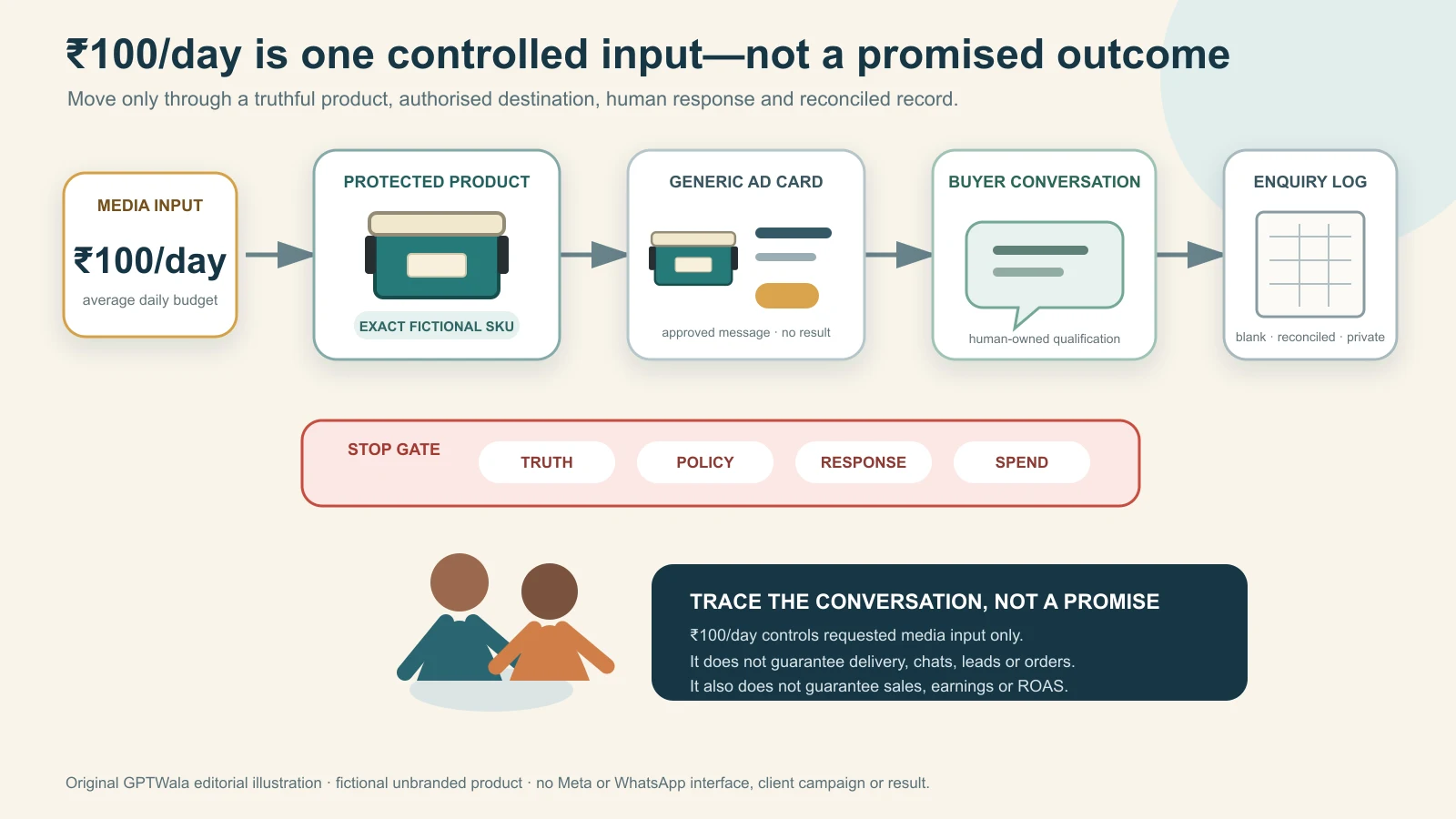
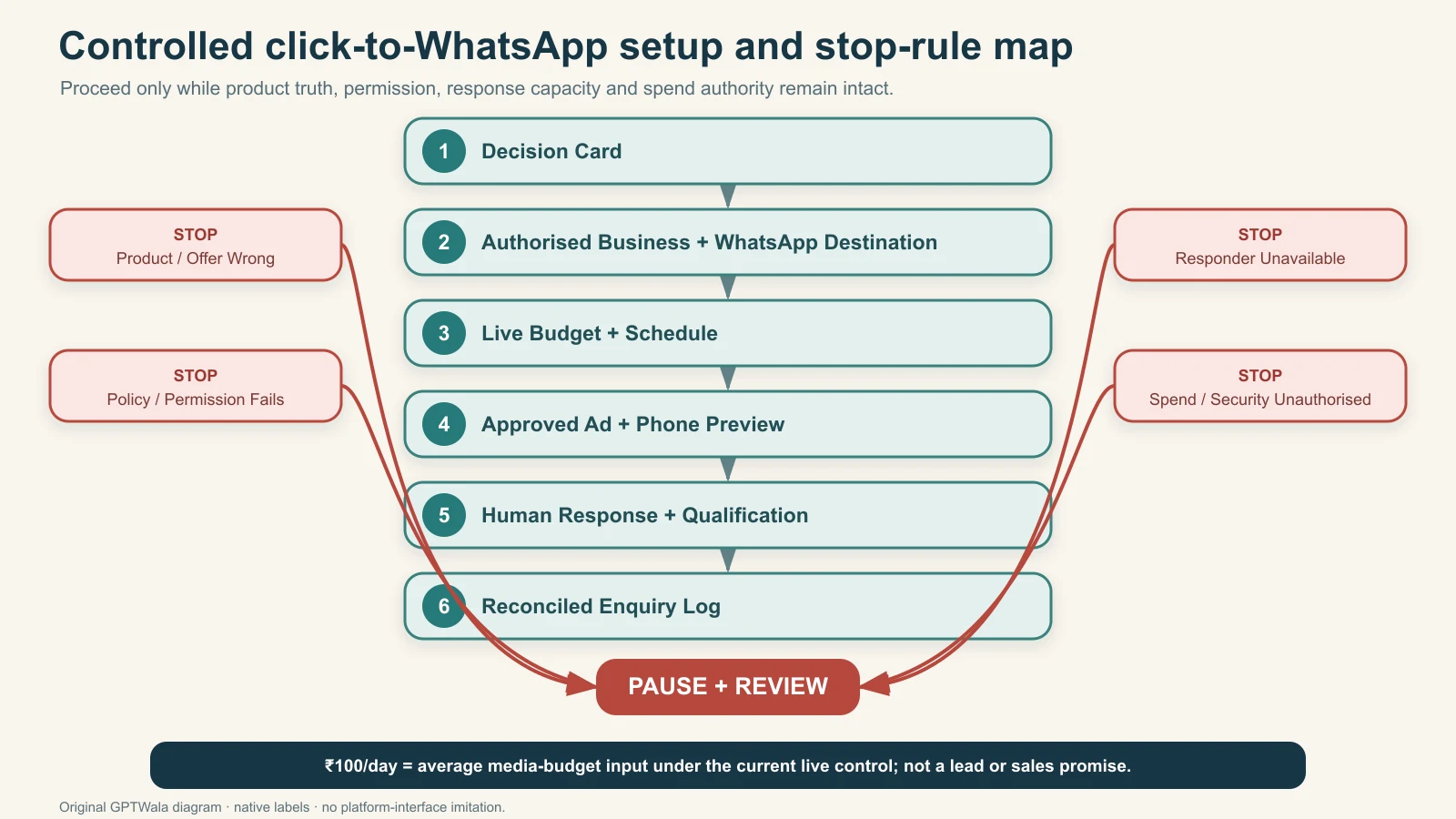
    A truthful WhatsApp Business catalogue gives an offline product business a useful Digital Presence inside a familiar conversation channel. Accurate product images and descriptions are the AI Content Creation layer. Once the catalogue, enquiry handling and tracking are ready, a controlled ₹100/day click-to-WhatsApp test can be evaluated without treating spend as a sales promise.

    That is the GPTWala DAA sequence: Digital Presence → AI Content Creation → ₹100/day WhatsApp ads. The workshop is educational and does not guarantee enquiries, orders, revenue, profit or return on ad spend.

    See the GPTWala workshop
    Learn how a verified catalogue fits into the wider DAA path for taking an offline product business online.

    Frequently asked questions

    Is WhatsApp Business catalogue free?

    WhatsApp currently describes the Business app as free to download and includes catalogue capabilities among its business tools, while also noting that the app has a mix of free and paid features. Costs can still arise from data, devices, staff, ads, third-party tools or other services. Check the current official Business app resource and the controls visible in the account; do not assume every business feature or connected service is free.

    How many products can I add to a WhatsApp Business catalogue?

    This guide does not publish a product limit because no current first-party limit was verified for this manuscript and limits can change by product or implementation. Check the live Business app and current WhatsApp Help Center before planning capacity. Operationally, launch only the number the team can keep accurate.

    What information should a catalogue item include?

    Use the exact product name, variant, truthful images, buyer-relevant description and customer-safe product code. Display price only when unit, pack, tax, MOQ and variant conditions cannot mislead. Add an exact landing-page link if the current app offers the field and the destination is maintained.

    Can I use one card for all sizes or colours?

    Only when the card makes the available variants and the pictured/priced choice unambiguous. If size, colour, material, pack or model changes the product, price or stock, separate cards or a controlled follow-up may be safer. Never let one image silently stand for a different variant.

    Does a WhatsApp cart message confirm an order?

    No. Treat it as a structured request. Confirm the exact item, variant, quantity, availability, price, charges, delivery and terms; obtain buyer confirmation; then verify payment or approved credit in the authorised system before fulfilment.

    Can manufacturers and wholesalers use a WhatsApp catalogue?

    Yes, as a curated discovery and conversation layer. It should not replace specifications, quantity tiers, MOQ, tax, freight, lead time, credit terms or a versioned quote. Large or dynamic ranges need a controlled product master and may require a richer digital catalogue or Platform/integration route.

    Can AI-generated product images go into the catalogue?

    Only after a human verifies that the image truthfully represents the exact SKU. Reject changed shape, colour, material, text, pattern, part count, included accessories, scale or performance. If the AI cannot preserve a buying-critical detail, use the real photograph or a specialist workflow.

    Why is my catalogue item not visible?

    Check the exact status shown in the app, current product/commerce policy, correct business account, item fields, customer-view test, app version and connection. Follow official in-app or Help Center guidance. Do not promise a review time, repeatedly recreate a rejected item or install unofficial software.

    Can I send my catalogue to every phone number I have?

    No. A catalogue link does not remove messaging-permission requirements. WhatsApp’s policy requires the appropriate opt-in and says businesses must respect opt-outs and avoid spam or surprise. Respond to the buyer’s request and keep later promotional messaging within the permission they gave.

    Sources checked for this guide

  • WhatsApp Lead Follow-Up Templates for Product Enquiries

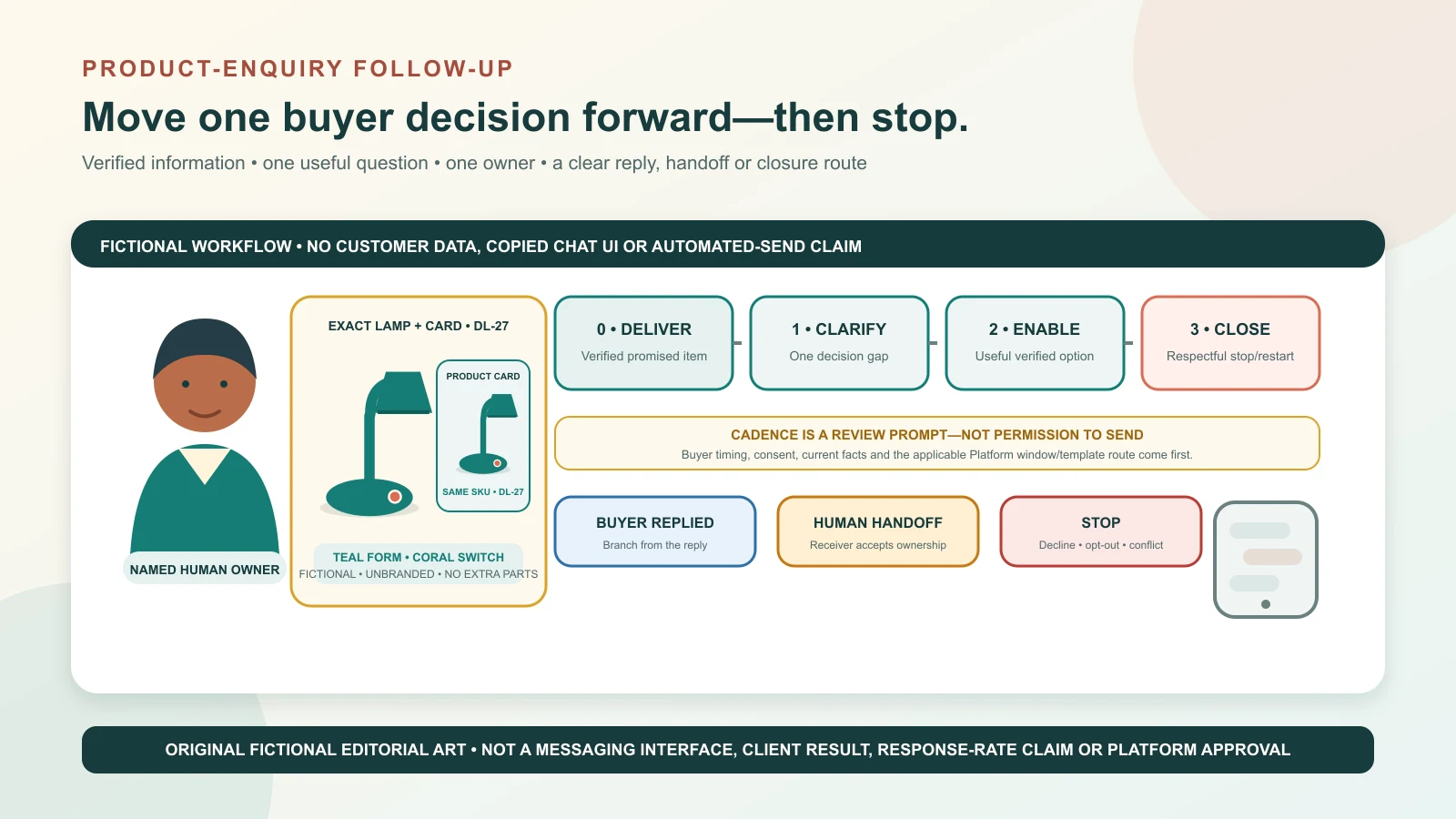
    Indian product-business salesperson moving one exact product enquiry through useful follow-up, decision and respectful closure
    A useful follow-up advances one real buyer decision; it does not repeat “just checking” until the person replies. Original GPTWala editorial illustration using a fictional unbranded lamp and abstract message cards; it is not a messaging-platform interface, client result, response-rate claim or platform approval.

    Reviewed and updated: 12 August 2026

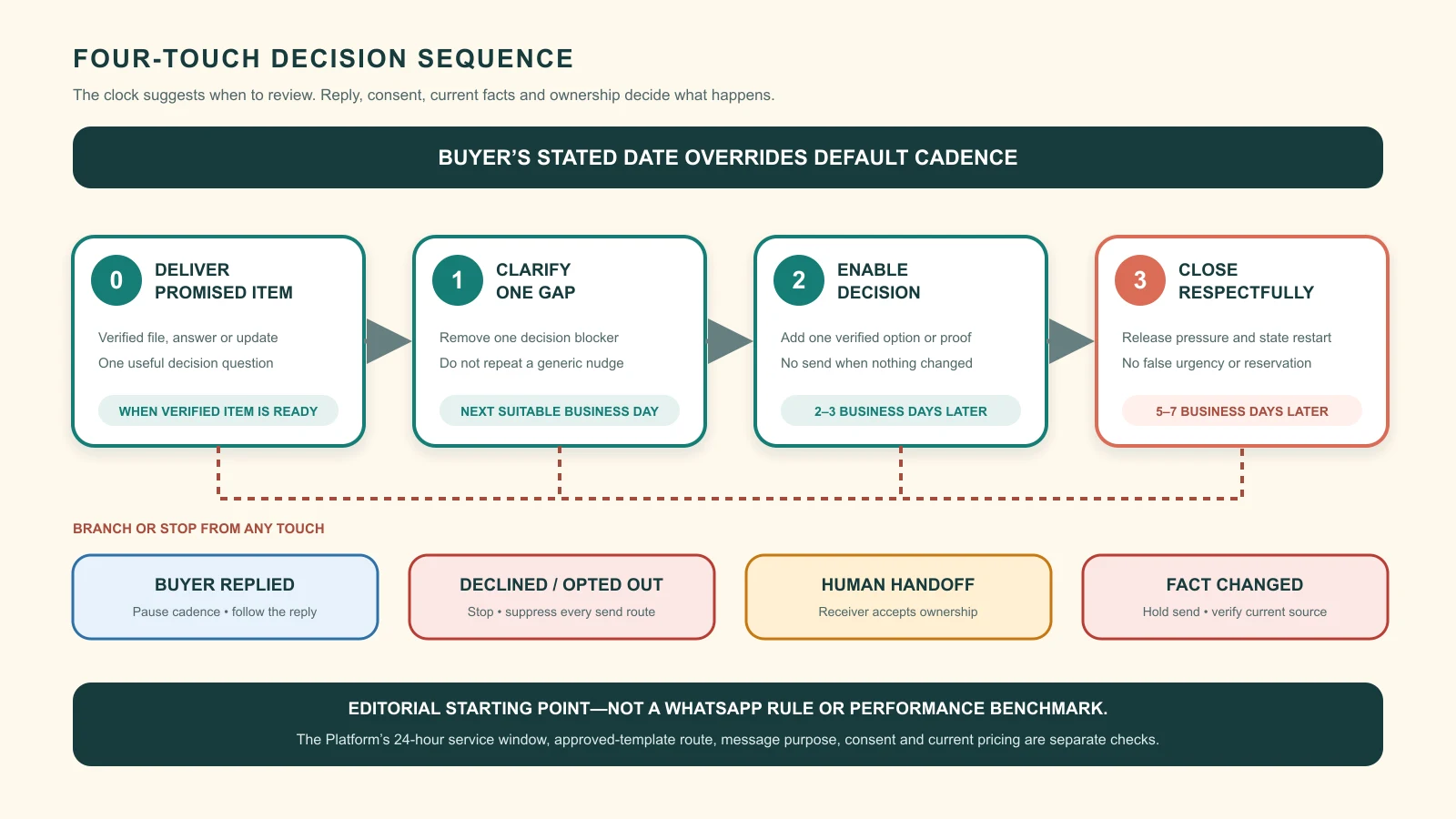
    The best WhatsApp follow-up for a product enquiry gives the buyer one verified piece of decision information, asks one easy question and records one next action. It should not simply repeat “Any update?” A practical starting sequence is: send promised information as soon as it is verified, make one relevant nudge on the next suitable business day, send one decision-enabling follow-up two to three business days later, then close the enquiry politely after another five to seven business days if there is still no response. Change that timing when the buyer gave a date, the requirement is urgent, the quote has a genuine expiry or the category needs a different service rhythm.

    Those intervals are GPTWala operating recommendations to test, not WhatsApp rules, legal advice or universal conversion benchmarks. On the WhatsApp Business Platform, the current policy has a separate 24-hour customer-service window and approved Message Template requirements. Permission, message purpose, current template/category rules and an opt-out must govern what can actually be sent.

    This guide owns the timed product-enquiry sequence, copy templates, branch rules and human handoffs. The complete WhatsApp selling guide owns the wider enquiry-to-order pipeline. The digital product catalogue guide owns catalogue structure, and the WhatsApp Business catalogue guide owns in-app catalogue setup.

    Table of contents

    1. Use a follow-up sequence, not a message pile
    2. Separate service follow-up from marketing
    3. Build a verified follow-up card
    4. Use the four-touch baseline
    5. Copy the enquiry and qualification templates
    6. Follow up after a recommendation or catalogue share
    7. Follow up after a quote
    8. Handle stock, MOQ, sample and custom requirements
    9. Branch when the buyer replies
    10. Use customer-facing and internal handoffs
    11. Close silent enquiries respectfully
    12. Adapt templates for Indian product businesses
    13. Use AI without inventing commercial facts
    14. Set up the workflow in the Business app or Platform
    15. Measure the sequence without fake benchmarks
    16. Frequently asked questions

    Use a follow-up sequence, not a message pile

    A sequence is a controlled set of decisions. Every touch should answer five questions:

    1. Why is this person receiving a message?
    2. What exact product or requirement is in context?
    3. What new verified value does this message add?
    4. What single action can the buyer take next?
    5. When should the business stop, wait or hand off?

    If the operator cannot answer those questions, the next message is probably noise.

    Follow up on the open decision

    Product buyers usually go silent around a specific uncertainty:

    • the exact variant is not clear;
    • the price does not include tax, freight or installation;
    • the buyer needs a smaller quantity or different pack;
    • a shopkeeper needs margin, case-mix or delivery information;
    • a manufacturer needs a drawing, sample, specification or compatibility answer;
    • the buyer is waiting for another decision-maker;
    • the desired item is out of stock; or
    • the seller has not made the next action obvious.

    Follow up on that uncertainty. “Would a front-and-back view of SKU J42 help you confirm the clasp?” is more useful than “Did you see my message?”

    A message is not a stage change

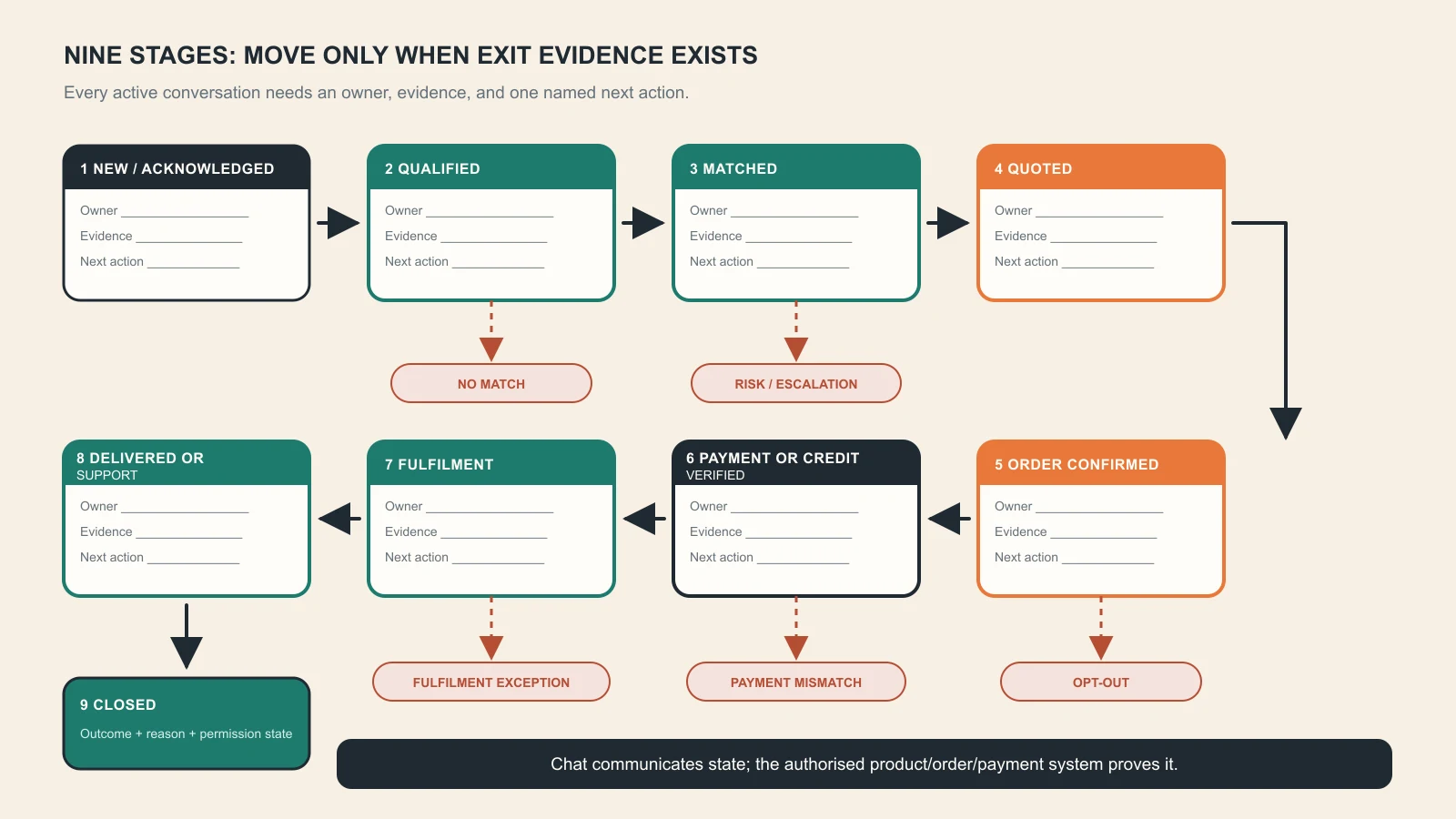
    Do not mark an enquiry “qualified”, “quoted”, “confirmed” or “won” merely because a template was sent. Change the stage only when the required evidence exists. A buyer opening a message is not a product decision; a payment screenshot is not bank settlement; and “looks good” is not a complete order confirmation.

    Stop sequences when reality changes

    Pause automation and route to a person when:

    • the customer replies, even if the reply does not match an expected keyword;
    • the product, price, stock, quote or delivery fact has changed;
    • the buyer asks a technical, safety, legal, warranty or regulated-category question;
    • the chat becomes a complaint, refund, payment or fraud issue;
    • the buyer asks to stop, says they are not interested or chooses another supplier;
    • two team members appear to be handling the same enquiry; or
    • the business cannot verify the next message from its source records.

    Separate service follow-up from marketing

    “Follow-up” is an operating label, not a WhatsApp message category. The purpose and content matter.

    Service or task-continuation follow-up

    This continues something the buyer requested or a transaction already in progress, for example:

    • sending the specification the buyer asked for;
    • asking for one missing field needed to prepare a quote;
    • confirming an agreed sample, pickup or dispatch update;
    • answering an open product question; or
    • routing the buyer to a product specialist.

    Keep it limited to the stated task. Do not attach an unrelated festival offer to an order update.

    Promotional or re-engagement follow-up

    An offer, product recommendation, cross-sell, abandoned-cart reminder or attempt to revive a dormant prospect can be marketing. WhatsApp’s official marketing-message page includes offers, product suggestions, cart reminders and re-engagement among marketing uses. The current WhatsApp Business Messaging Policy requires a business to have the person’s number and opt-in permission for subsequent messages or calls, and to honour opt-outs. Its best-practice section recommends setting expectations by message category.

    Therefore, do not treat an old enquiry, an invoice, an exhibition visitor list, a business card, a group membership or a saved phone number as permanent permission to promote.

    The Platform’s 24-hour control is different from this cadence

    For the WhatsApp Business Platform, current policy says a business may reply without a Message Template within 24 hours of the user’s last message. Outside that customer-service window, only approved Message Templates may be sent. Business-initiated conversations must use approved templates, and automation during the service window must offer a clear path to human escalation.

    The 24-hour window does not mean “send a reminder every 24 hours”. Nor does this article’s next-business-day suggestion override Platform policy. Before implementation, verify:

    • whether the business uses the Business app or Business Platform;
    • whether the service window is open;
    • the purpose and current category of the proposed message;
    • whether an approved template is required and available;
    • whether consent covers the message; and
    • current pricing and account/country eligibility.

    The official Platform pricing page currently describes marketing, utility, authentication and service categories, with charges and conditions that vary by market and category. Do not hard-code an old price or assume a message will be free.

    Build a verified follow-up card

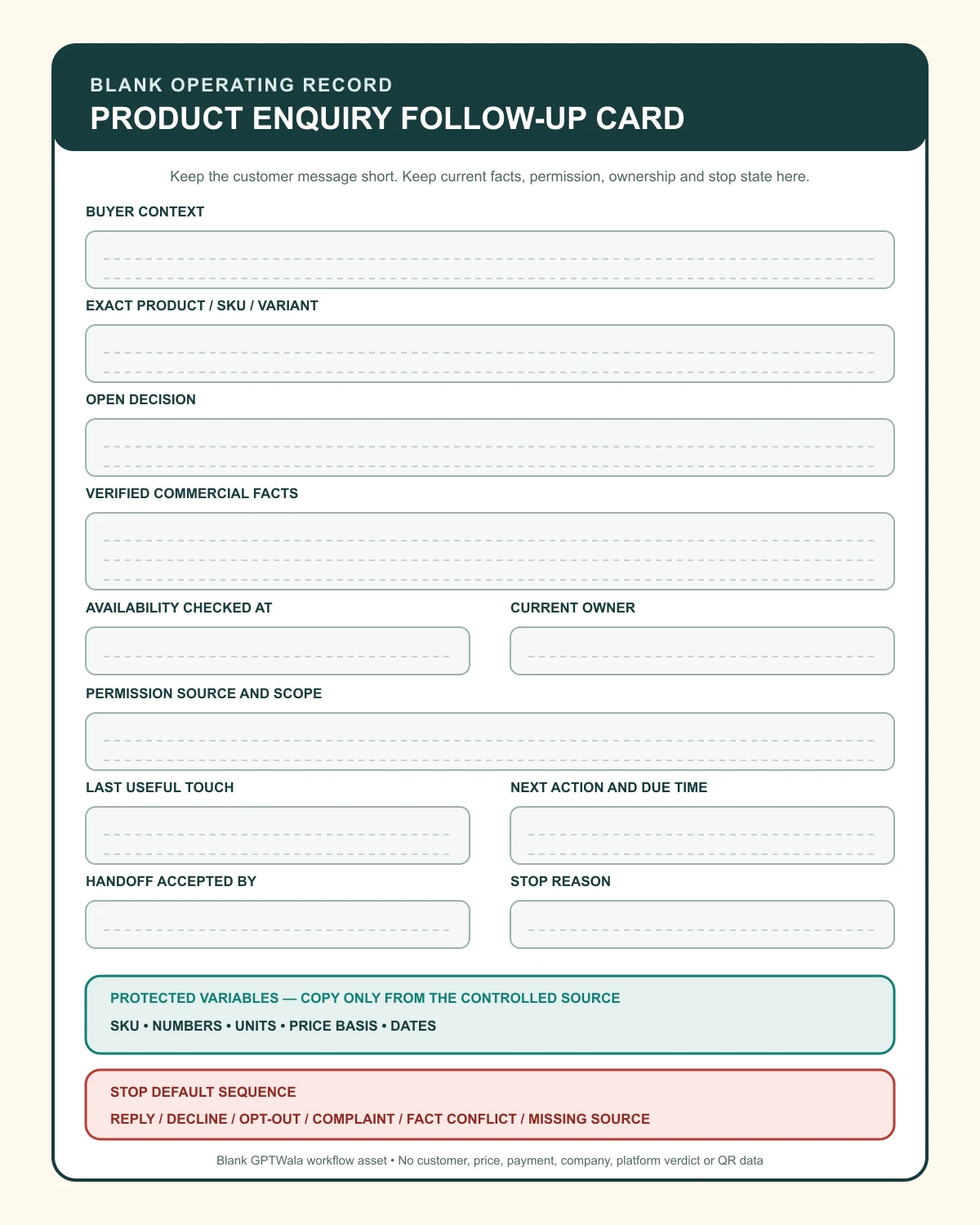
    Templates are safe only when their variables are safe. Create one follow-up card for every active enquiry.

    Field What to record Truth source
    Buyer context buyer type, stated use and location if relevant Buyer’s own message
    Exact product approved name, SKU, variant, size, finish, pack Product master/catalogue
    Open decision the one answer or action still needed Conversation plus stage record
    Commercial facts price, tax, freight, MOQ, quote validity Current price/quote master
    Availability stock or production status and when checked Inventory/production owner
    Promised item image, drawing, quote, sample update or call Named internal owner
    Permission source, scope and opt-out state Consent/customer record
    Sequence state last useful touch, next action and due time Inbox/CRM/controlled log
    Owner one named person or queue Team roster
    Stop reason replied, declined, opted out, duplicate, invalid or closed Recorded event

    Lock the buying-critical variables

    Use placeholders such as:

    • [BUYER_NAME]
    • [BUSINESS_NAME]
    • [PRODUCT_NAME]
    • [SKU]
    • [VARIANT_SIZE_FINISH]
    • [PACK_OR_MOQ]
    • [PRICE_AND_TAX_BASIS]
    • [FREIGHT_OR_DELIVERY_BASIS]
    • [STOCK_STATUS_AS_OF_TIME]
    • [QUOTE_ID_AND_VERSION]
    • [VALID_UNTIL]
    • [ONE_NEXT_ACTION]
    • [HUMAN_CONTACT_OR_ROUTE]

    Do not allow AI or a bulk tool to fill these from a similar product. Pull them from the approved record, or leave the message unsent.

    Use a five-part message anatomy

    A useful product follow-up can usually be built from:

    1. Identity: who is writing.
    2. Context: the exact enquiry, SKU or quote.
    3. Verified value: one new fact, view, option or resolved question.
    4. One question: the smallest decision the buyer can make now.
    5. Exit or handoff: how to pause, decline or reach a person.

    Example anatomy:

    Hello [BUYER_NAME], this is [OWNER] from [BUSINESS_NAME]. You asked about [SKU / EXACT PRODUCT]. I have now verified [ONE FACT] as of [TIME]. Would you like [OPTION A] or [OPTION B]? If this requirement is on hold, tell me and I will close the enquiry for now.

    This is a structure, not a claim that a certain wording increases replies.

    Use the four-touch baseline

    Start with this sequence, then adjust it using your own response, qualification and closure data.

    Touch Suggested trigger and timing Job Do not send when
    0. Deliver As soon as the promised verified item is ready, within stated business hours Fulfil the promise and ask one decision question The item is unverified or another owner is already replying
    1. Clarify Next suitable business day after no response Remove one likely decision gap Buyer gave a later decision date or asked not to be contacted
    2. Enable Two to three business days later Add a real comparison, term, proof view or alternate route Nothing new can be added
    3. Close Five to seven business days later Release pressure, keep the record clean and state how to restart There is an active order, service issue or promised internal action

    These are not mandatory gaps. Use the buyer’s stated date instead of your default. A dealer who says “call Friday after my partner returns” should not receive Tuesday and Wednesday nudges. A buyer asking for same-day stock should receive a verified answer as soon as it exists, not wait for a cadence.

    Event-driven messages outrank timed nudges

    Send a verified event update when:

    • the requested quote is ready;
    • the correct product image or drawing is approved;
    • production confirms feasibility;
    • stock changes materially;
    • a sample is dispatched; or
    • the buyer’s requested follow-up date arrives.

    Do not send both the event update and the scheduled nudge. Cancel or reset the scheduled step.

    Set a response promise you can keep

    If the answer needs work, acknowledge the enquiry and state a realistic next update:

    Thanks for the enquiry about [SKU]. [OWNER] from [BUSINESS_NAME] is checking [STOCK / SPECIFICATION / FREIGHT]. We will update you by [DATE AND TIME]. If your requirement is urgent, reply with the needed quantity and delivery location.

    Do not promise “in 10 minutes” merely to sound responsive. The response promise should match staff coverage and source availability.

    Four-touch WhatsApp product-enquiry sequence with deliver, clarify, enable and close stages plus reply, stop and human-handoff exits

    The clock suggests when to review an enquiry; the buyer’s reply, consent state and verified facts decide what happens next. The intervals are editorial starting points, not messaging-platform rules, approved templates or performance benchmarks.

    Copy the enquiry and qualification templates

    Replace every bracket with verified information. Remove unused clauses. Never send visible placeholder text.

    Template 1: acknowledgement when the answer needs checking

    Hello [BUYER_NAME], this is [OWNER] from [BUSINESS_NAME]. I received your enquiry for [PRODUCT / SKU]. I’m verifying [SPECIFIC FACT] and will update you by [DATE / TIME]. To check the right option, is this for [PERSONAL USE / RETAIL RESALE / WHOLESALE / MANUFACTURING APPLICATION]?

    Use when a useful answer cannot be given immediately. The deadline must be owned.

    Template 2: one missing qualification field

    I can prepare the right option for [PRODUCT]. Please confirm one detail: do you need [QUANTITY / SIZE / MODEL / DELIVERY PINCODE / APPLICATION]? I will use that only to check the suitable product and terms.

    Ask one question, not a form disguised as a message.

    Template 3: vague “price?” enquiry

    The price depends on [VERIFIED VARIABLE, such as pack size or finish]. For the exact quote, should I check [OPTION A] or [OPTION B]? I will include [TAX / FREIGHT BASIS] clearly.

    Do not send a misleading “starting from” figure if the buyer’s likely configuration cannot receive it.

    Template 4: first no-response clarification

    Hello [BUYER_NAME], following up on [PRODUCT / SKU]. To avoid sending an irrelevant list, I only need [ONE FIELD]. You can reply with [SHORT RESPONSE OPTIONS], or say “not now” and I will pause the enquiry.

    Template 5: move from voice note to exact requirement

    I noted [QUANTITY] and [PRODUCT FAMILY] from your voice message. Before I quote, please confirm: does [QUANTITY] mean [PIECES / SETS / CASES], and is the required variant [VARIANT]? I will send the written summary for your check.

    Never infer units, colours or models from unclear audio.

    Follow up after a recommendation or catalogue share

    A catalogue link is not the follow-up. Help the buyer compare a small, relevant set.

    Template 6: exact recommendation plus trade-off

    Based on [BUYER’S STATED NEED], the current match is [PRODUCT / SKU / VARIANT]. Compared with [ALTERNATIVE], the main trade-off is [VERIFIED DIFFERENCE]. Would you like the [DETAIL VIEW / SPECIFICATION / PACK AND PRICE] for this exact SKU?

    Template 7: after sharing product images

    The images I sent are for [EXACT SKU / VARIANT]. The [PROP / MODEL / ROOM SETTING] is context and is not included. Would a close-up of [BUYING-CRITICAL DETAIL] help you decide?

    If an image is AI-assisted, it must still preserve the exact item. Use the product-accuracy checklist before a visual supports a purchase decision.

    Template 8: two-option comparison

    You shortlisted [SKU A] and [SKU B]. The verified differences are: [DIMENSION 1] and [DIMENSION 2]. [SKU A] suits [SUPPORTED USE]; [SKU B] suits [SUPPORTED USE]. Which difference matters more for your order?

    Do not claim one is “best” unless the recommendation follows the buyer’s criteria and approved evidence.

    Template 9: catalogue-share follow-up

    I shared the [COLLECTION / CATEGORY] catalogue for your [USE / STORE TYPE]. To narrow it down, send me up to three product codes and your approximate quantity. I will check the current variant, pack, stock and quote basis for those exact items.

    The digital product catalogue guide explains what buyer information belongs in the catalogue; this message only moves the conversation forward.

    Follow up after a quote

    Do not ask “Did you check the quotation?” without making the decision easier.

    Template 10: quote receipt and one decision

    Hello [BUYER_NAME], I sent quote [QUOTE ID / VERSION] for [EXACT PRODUCT AND QUANTITY] on [DATE]. It includes [TAX / FREIGHT / DELIVERY BASIS]. Is the open question the product, quantity, timing or commercial terms? Reply with one and I will route it correctly.

    Template 11: buyer is comparing suppliers

    Understood. When comparing, please check that both quotes cover the same [SKU / MATERIAL / SIZE / PACK / TAX / FREIGHT / WARRANTY SCOPE]. If you want, send the comparison fields without the other supplier’s confidential document and I will clarify our quote.

    Do not invent a competitor weakness or pressure the buyer to disclose confidential pricing.

    Template 12: genuine quote validity

    Quote [ID / VERSION] is valid until [DATE] because [VERIFIED REASON, if useful]. Current availability is [STATUS AS OF TIME], not a reservation. Would you like us to recheck availability, revise the quantity or close this version?

    Never add a fake midnight deadline, “last piece” line or countdown. The ASCI Code requires factual claims to be substantiated and says advertising should not mislead through implication, omission, ambiguity or exaggeration. A promotional WhatsApp message should follow the same truth discipline.

    Template 13: revised quote

    I have prepared quote [NEW ID / VERSION] with the agreed change from [OLD FACT] to [NEW FACT]. Please ignore version [OLD VERSION]. Before we proceed, confirm [SKU / VARIANT / QUANTITY / TOTAL / DELIVERY BASIS] in the new written summary.

    Never allow two live versions to compete inside a long chat.

    Template 14: decision delayed to a stated date

    Thanks, I have noted that you will review this on [BUYER’S DATE]. I will pause messages until then. If price, stock or lead time changes before that date, should I update you only if it affects quote [ID]?

    Record the answer; do not assume permission.

    Handle stock, MOQ, sample and custom requirements

    Template 15: stock is unverified

    I do not want to confirm availability from an old message. I am checking [SKU / VARIANT / QUANTITY] with [INVENTORY OWNER] and will update you by [TIME]. Please do not treat it as reserved until we confirm in writing.

    Template 16: product is out of stock

    [SKU / VARIANT] is currently [OUT OF STOCK / UNAVAILABLE] as verified at [TIME]. I can check [EXACT ALTERNATIVE] or notify you if you have opted in for a restock update. The alternative differs in [VERIFIED DIFFERENCE]. Which route do you prefer?

    Do not silently substitute a similar colour, size, material or model.

    Template 17: wholesale MOQ or case multiple

    For [SKU], the current wholesale term is [MOQ / CASE MULTIPLE], with [PACK MIX RULE] and [PRICE BASIS]. You asked for [BUYER QUANTITY]. Would you like the nearest valid pack, a different SKU with a lower minimum, or no further follow-up?

    Template 18: sample request

    For the [SKU / MATERIAL] sample, the verified process is [CHARGE / CREDIT / COURIER / LEAD TIME]. A sample confirms only [DEFINED PURPOSE]; final production follows [APPROVED SPECIFICATION / TOLERANCE]. Shall I prepare the sample request with your company and delivery details?

    Do not claim that one sample guarantees the appearance or performance of every production unit.

    Template 19: custom or technical requirement

    Your requirement for [CUSTOM DIMENSION / APPLICATION] needs review by [PRODUCT / ENGINEERING OWNER]. I have recorded [KNOWN FACTS]. The open point is [ONE TECHNICAL QUESTION]. May I hand this to [ROLE], who will respond by [TIME]?

    Do not let a salesperson or AI infer compatibility, load, safety, certification or manufacturing feasibility.

    Template 20: location or freight is missing

    The product price is verified, but the delivered total is not complete without [PINCODE / DESTINATION / UNLOADING CONDITION]. Please share [MINIMUM NECESSARY LOCATION FIELD], or I can quote ex-[WORKS / STORE] without claiming a delivered total.

    Collect only what is needed at the current stage. The WhatsApp Business policy says businesses are responsible for necessary notices, permissions and lawful data handling, and prohibits requesting full payment-card, financial-account and other sensitive identifiers.

    Branch when the buyer replies

    The first reply should cancel every pending automated follow-up. Then route by intent.

    Buyer response Next action Safe reply structure
    “Yes / proceed” Build and verify an order summary Confirm exact SKU, variant, quantity, total, delivery and terms; ask for explicit confirmation
    “Send details” Identify which detail changes the decision Offer specification, exact view, terms or human call—not a 20-file dump
    “Too expensive” Diagnose comparison basis Ask whether the gap is budget, quantity, pack, delivered total or specification
    “Need later” Ask for a buyer-chosen date and permission Pause until that date; do not continue the default cadence
    “No” Record reason if volunteered and close Thank the buyer; do not argue or trigger a discount automatically
    “Stop / remove me” Suppress further sends Confirm the opt-out action without adding a promotion
    Complaint or payment issue Exit sales sequence Route to support/finance with one owner and verified record
    Unclear reply or language issue Ask one clarification or use a human Do not force it through keyword automation

    Price objection template

    Thanks for saying that. To compare fairly, is the issue the total budget, minimum quantity, delivered cost or required specification? I can check one approved alternative; I will not change the specification or terms without showing the difference.

    “Not now” template

    Understood. I will pause this enquiry. If you want a follow-up, choose a date or month; otherwise you can message us again with [SKU / QUOTE ID]. This does not add you to promotional updates.

    Opt-out confirmation

    Understood. We have recorded your request not to receive further [CATEGORY] messages from [BUSINESS_NAME]. You may contact us if you need service for an existing order.

    The exact suppression action must occur in every sending list or system, not only as a label in the chat.

    Use customer-facing and internal handoffs

    A handoff is complete only when the receiver accepts ownership and the customer knows what will happen next.

    Customer-facing product-specialist handoff

    Your question about [TECHNICAL POINT] needs [ROLE]. I have shared only the relevant enquiry details with [NAME / TEAM]. [THEY / WE] will respond by [TIME] in this chat / through [APPROVED ROUTE]. I remain the owner until they accept the handoff.

    Customer-facing shift handoff

    I am handing your enquiry for [SKU / QUOTE ID] to [NEW OWNER] because [REASON]. They have the confirmed details: [ONE-LINE SUMMARY]. The next update is due by [TIME]; you do not need to repeat the full enquiry.

    Internal five-line handoff

    1. Buyer and requested outcome
    2. Exact product, SKU, quantity and quote/order version
    3. Verified facts and their sources
    4. Open question, risk or consent limitation
    5. New owner, required action and due time

    Finance handoff

    Internal: Buyer says payment was made for order [ID]. Do not mark paid from the chat or screenshot. Finance owner [NAME / QUEUE] must verify [AMOUNT / REFERENCE] in the authorised bank, gateway or merchant record and return status [VERIFIED / PENDING / MISMATCH] by [TIME].

    Never ask a buyer for a UPI PIN, OTP, full card number, password or account credential. Payment and refund status must come from the authorised financial record.

    Fulfilment handoff

    Internal: Confirmed order [ID / VERSION] for [SKU / VARIANT / QUANTITY]. Buyer-confirmed delivery/pickup basis: [TERM]. Payment/credit status from finance: [VERIFIED STATUS]. Operations owner: [NAME]. Next verified update due: [TIME]. Exceptions: [NONE / LIST].

    Blank product-enquiry follow-up and handoff card with exact SKU, open decision, verified facts, consent, owner, due time and stop reason fields

    The message stays short because the operational record carries the facts, owner, permission state and next action. This blank asset contains no customer, company, price, payment, result or platform-verdict data.

    Close silent enquiries respectfully

    Closure is part of good follow-up. It prevents an inbox full of false “active leads” and stops repeated unwanted contact.

    Template 21: final close-the-loop message

    Hello [BUYER_NAME], I have not heard back about [PRODUCT / QUOTE ID], so I will close this enquiry for now and stop the follow-up sequence. If you want to restart, reply with [SKU / QUOTE ID]; we will recheck price, stock and terms then. No product or quantity has been reserved.

    Template 22: close when the promised information is no longer current

    The [PRICE / STOCK / LEAD TIME] shared on [DATE] is no longer safe to rely on without a fresh check. I am closing this version rather than leaving an old offer open. Message us with [SKU] if you want a current quote.

    Do not manufacture urgency before closure

    Avoid:

    • “Final chance” when the offer remains available;
    • “You will lose this price tonight” without an approved, genuine expiry;
    • “Only one left” without current inventory evidence;
    • “Your competitors are buying” without authorised evidence and relevance;
    • repeated punctuation, guilt or fear; and
    • a surprise discount immediately after every silence.

    WhatsApp’s Messaging Guidelines prohibit spam and repeated unwanted contact. Its business policy also tells businesses not to confuse, deceive, mislead, spam or surprise people. A short, truthful closure is safer than an endless sequence.

    Record a useful close reason

    • no response after the allowed sequence;
    • no product match;
    • price, MOQ, pack or freight mismatch;
    • timing or service-area mismatch;
    • buyer chose another option;
    • duplicate or invalid enquiry;
    • buyer deferred to a known date;
    • opt-out; or
    • complaint/support route opened.

    Do not invent a reason when the buyer did not provide one. Use “no response after sequence”, not “price too high”.

    Adapt templates for Indian product businesses

    The following are fictional workflow examples, not client results or claims about an industry’s typical conversion rate.

    Surat apparel wholesaler

    A retailer asks for “24 blue sets”. The follow-up must resolve whether 24 means pieces or sets, the size ratio, fabric/collection code, case multiple, tax/freight basis and delivery city. It should not send a model image from a similar garment as proof of fit or colour. If AI-assisted apparel imagery is used, apply the garment-truth checklist and keep the exact SKU beside the order decision.

    Useful next question:

    For collection [CODE], should the 24-unit requirement use [APPROVED SIZE RATIO A] or [RATIO B]? I will then verify the blue variant, case and delivered quote basis.

    Jaipur jewellery retailer

    The buyer wants the piece shown in a styled image. The operator should send exact front, back, clasp, setting and scale views for the actual SKU, then clarify material, finish, size, inclusions and documented hallmark/certification facts where applicable. Do not imply stone identity, purity, weight or certification from appearance.

    Rajkot component manufacturer

    A purchasing team asks whether a component fits an application. The sales sequence pauses for engineering or product-owner review. The handoff carries drawing/version, material, dimension, quantity, application and open technical question. A catalogue similarity is not a compatibility approval.

    Morbi tile manufacturer

    The buyer has a room render and wants an export quote. The follow-up should identify exact tile code, nominal size, finish, batch/variation disclosure, pack, quantity, destination, incoterm/freight assumption and required documents. A room visual is context, not proof of shade, slip performance, installation result or batch uniformity.

    Local appliance retailer

    The buyer asks whether a model can be delivered and installed. Verify the exact model, stock, pincode/service area, included accessories, installation responsibility, warranty terms and delivery basis. Do not turn “delivery available” into a same-day promise without operations acceptance.

    Use regional languages without changing commercial facts

    Translate the conversational layer, but lock:

    • SKU and model code;
    • numbers, units and pack multiples;
    • material and specification terms;
    • price, tax and freight basis;
    • date and time;
    • warranty/return language; and
    • the opt-out meaning.

    Ask a fluent reviewer to check high-stakes or ambiguous translations. Do not transliterate a technical term if it changes what the buyer may understand.

    Use AI without inventing commercial facts

    AI can help draft and organise; it cannot become the source of truth.

    Safe assistance

    • suggest a shorter version of an approved message;
    • identify the one unanswered buyer question;
    • classify a proposed follow-up for human review;
    • translate approved copy while locking protected variables;
    • summarise a chat into the five-line handoff;
    • flag missing fields, repeated messages or an approaching due time; and
    • propose two question phrasings for the human owner.

    Human approval required

    • stock, price, discount, quote validity and delivery commitment;
    • product fit, performance, compatibility, certification or safety;
    • custom feasibility, technical tolerances and regulated claims;
    • payment, refund, dispatch and return status;
    • consent scope, opt-out exceptions and message-category decisions;
    • complaint, warranty, legal or vulnerable-customer messages; and
    • any text built without an approved product/policy source.

    Prompt pattern for an internal draft

    Draft one concise follow-up using only the approved fields below. Preserve SKU, numbers, units, price basis, dates and policy wording exactly. Add no scarcity, guarantee, compatibility, stock, delivery, payment or performance claim. Ask one question. If any required fact is missing or contradictory, output HUMAN CHECK — [missing field] instead of a customer message. Approved fields: [CONTROLLED DATA].

    Never paste customer addresses, IDs, private dealer pricing, invoices, payment details or confidential drawings into an external AI service unless the provider terms, business policy, permissions and applicable law allow that use.

    Set up the workflow in the Business app or Platform

    Small team using the Business app

    WhatsApp’s current Business app feature page lists greeting and away messages, quick replies and labels among its tools. It also notes that some newer broadcast capabilities are limited to eligible users in selected countries. Check the actual account rather than assuming a feature is available.

    A simple operating setup is:

    1. Create labels for new, qualification, match pending, quote sent, buyer decision, handoff, closed and opted out.
    2. Save message structures, not stale prices or stock statements, as quick replies.
    3. Keep the follow-up card in a controlled sheet/CRM/order system appropriate to the business.
    4. Assign one owner and next-action time to every active enquiry.
    5. Review due follow-ups at opening and before closing each business day.
    6. Cancel pending steps immediately on reply, handoff, decline or opt-out.
    7. Audit a small sample weekly for product truth, duplicate sends and closure quality.

    Team using the Business Platform

    Add Platform-specific controls:

    • store the last user-message time;
    • distinguish the open service window from business-initiated sending;
    • map each proposed template to its current approved purpose/category;
    • maintain consent evidence and suppression centrally;
    • expose a clear human escalation route;
    • prevent overlapping campaigns and service sequences;
    • record template version and variables actually sent;
    • monitor delivery and quality signals without treating delivery as a sale; and
    • recheck official policies, pricing and templates before rollout.

    Do not use unofficial automation, scraping or harmful bulk messaging. The current WhatsApp Messaging Guidelines explicitly prohibit scraping and bulk/auto-messaging or automation used to harm WhatsApp or users.

    Pre-send checklist

    • Is the buyer and enquiry correctly identified?
    • Is the message expected and permitted for this purpose?
    • Is the Platform service window open, or is the correct approved template route being used?
    • Is every product, price, stock, quote and date field current?
    • Does the message add one useful fact or action?
    • Is there only one question?
    • Is another owner or automation already contacting the buyer?
    • Is the stop/opt-out state clear?
    • Is there a human route for exceptions?

    If any answer is no or unknown, hold the send.

    Measure the sequence without fake benchmarks

    Do not claim a universal WhatsApp open rate, reply rate, conversion rate or ideal number of touches. Define and compare your own stages.

    Metric Definition What it diagnoses
    Due follow-up completion due follow-ups completed or correctly paused ÷ due follow-ups Operating discipline
    Useful-touch rate follow-ups adding verified information/action ÷ follow-ups reviewed Message quality
    Duplicate-send rate enquiries receiving overlapping/duplicate sends ÷ enquiries followed up Ownership and automation failure
    Response by touch enquiries receiving a buyer response after each touch ÷ enquiries receiving that touch Where conversations restart, not causation
    Qualification completion enquiries reaching required qualification ÷ valid product enquiries Question and routing quality
    Quote clarification rate quotes needing correction/clarification ÷ quotes followed up Quote clarity and product-data gaps
    Handoff acceptance on time accepted handoffs by due time ÷ handoffs due Team continuity
    Opt-out suppression completeness opt-outs suppressed across all send systems ÷ opt-out requests Consent control
    Truth-defect rate reviewed sends with wrong SKU/price/stock/term/claim ÷ sends reviewed Commercial risk
    Closed-with-reason rate closed enquiries with evidenced or honest reason ÷ closed enquiries Pipeline hygiene

    Segment results by source, product group, buyer type, owner and sequence version. A click-to-WhatsApp ad, a store visit, an exhibition relationship and an existing dealer enquiry are not equivalent. The ₹100/day click-to-WhatsApp guide owns the small-budget acquisition workflow; this page starts after the enquiry exists.

    Run a controlled improvement loop

    1. Choose one enquiry type, such as retail product-price enquiries.
    2. Use one approved sequence version for a defined period or sufficient operational sample.
    3. Record stage outcomes and truth defects—not just replies.
    4. Review silent conversations to identify missing decision information.
    5. Change one element: timing, question, proof item or handoff rule.
    6. Keep consent, product truth and closure controls unchanged.
    7. Document the new version and compare like with like.

    Do not declare a winning script from a few conversations or a seasonally distorted week.

    Turn follow-up into a wider online growth system

    Better follow-up prevents avoidable leakage after an enquiry, but it does not create a complete online growth system. The business still needs a trustworthy digital presence, accurate product content and a controlled way to create demand.

    If your manufacturer, wholesale, retail or product brand still depends mainly on walk-ins, dealer calls, exhibitions or forwarded catalogues, GPTWala’s DAA workshop explains the path: Digital Presence → AI Content Creation → ₹100/day WhatsApp ads. It connects discovery, content and conversation into a practical operating model. It does not guarantee leads, sales, reply rates or return on ad spend.

    Frequently asked questions

    How many times should I follow up on a WhatsApp product enquiry?

    There is no universal number. A useful starting point is the promised-information touch, one clarification, one decision-enabling follow-up and one respectful closure. Stop sooner when the person declines, opts out, gives a later date or the enquiry moves to support/order handling. Test your own sequence by buyer type and stage.

    How long should I wait before the first WhatsApp follow-up?

    Send promised information as soon as it is verified. If the buyer does not respond, the next suitable business day is a reasonable operating baseline for many ordinary enquiries. Use the buyer’s stated timing, urgency and business hours instead of following the clock blindly. This suggestion is not a WhatsApp rule.

    What should I write instead of “just checking”?

    Reference the exact product or quote, add one verified fact or useful option, and ask one small question. For example: “For quote Q14, would clarifying the case quantity or delivered total help you decide?”

    Can I follow up after 24 hours on WhatsApp?

    It depends on the product route and permission. On the Business Platform, current policy says free-form replies are allowed within 24 hours of the user’s last message; outside that window, approved Message Templates are required. Business-initiated messages also use approved templates. Verify current category, consent, template and pricing rules before sending. Do not interpret this as permission to send an unwanted message.

    Is a product-enquiry follow-up a service or marketing message?

    The label “follow-up” does not decide the category. A response that fulfils the buyer’s open request differs from an offer, recommendation or attempt to re-engage a dormant prospect. Review the message’s actual purpose against current WhatsApp guidance; do not automatically label every quote reminder as utility or service.

    Can I copy these messages directly into WhatsApp?

    Use them as editable structures. Replace every bracket with verified facts, remove irrelevant text, check permission and current Platform rules, and have a human approve high-risk messages. Never send an unresolved placeholder.

    Should I offer a discount when a buyer does not reply?

    Not automatically. Silence may mean missing information, internal approval, wrong timing or no interest. Diagnose the open decision. Use only an authorised, truthful discount with clear terms; do not manufacture scarcity or train every buyer to wait for a lower price.

    How do I follow up with a wholesale or manufacturing buyer?

    Reference the exact requirement, quote/drawing version, quantity, MOQ/pack, commercial basis and one open decision. Give the buyer’s internal review time. Route technical fit, custom feasibility, credit, export and production commitments to the authorised owner.

    What should happen when a customer says “not now”?

    Pause the default sequence. Ask whether they want a follow-up on a date they choose; if not, close the enquiry and let them restart. “Not now” is not permission for indefinite promotional messages.

    Can AI automate the entire follow-up sequence?

    AI can draft, classify, summarise and flag missing fields, but a controlled source must provide product, price, stock, quote, consent, payment and fulfilment facts. Human review is required for exceptions and high-risk claims. Automation must stop on reply, decline, opt-out, complaint, conflict or missing source.

    How do I know whether the sequence is working?

    Measure stage progress, useful information, truth defects, duplicate sends, accepted handoffs, opt-out action and qualified commercial outcomes by source and product. A delivered message or reply alone does not prove a sale or profitable acquisition.

    Sources checked for this guide

  • WhatsApp Selling for Product Businesses: Complete Guide

    Indian product-business team moving one exact enquiry through qualification, quote, payment verification and dispatch
    WhatsApp selling works when every conversation has an owner, an exact product and one verified next step.

    Visual disclosure: Original GPTWala editorial illustration created with AI using one fictional, unbranded coral lunchbox (SKU L42) and abstract conversation shapes. It is not a WhatsApp interface, client result or sales claim; the lunchbox geometry, two grey side latches, cream label, colour and included pieces remain identical at every stage.

    Reviewed and updated: 12 August 2026

    WhatsApp selling is a controlled enquiry-to-sale process, not simply replying fast or sending a catalogue. A product business should identify the buyer’s need, match an exact SKU, confirm stock and terms, send a written quote/order summary, receive explicit confirmation, verify payment or approved credit in its own system, hand the order to fulfilment and keep one owner until delivery or closure. Automation can assist; it must not invent a product, price, promise or payment status.

    For an Indian manufacturer, wholesaler, retailer, shopkeeper or product brand, the key record is the confirmed order card, not the chat thread. The card connects what the buyer requested to what the business can actually supply.

    This root guide owns the complete enquiry-to-sale operating system. The future WhatsApp follow-up template guide will own timed scripts and handoff messages. The digital product catalogue guide will own catalogue information architecture, while the WhatsApp Business catalogue guide will own the current app setup. The ₹100/day click-to-WhatsApp system owns that particular ad workflow.

    Table of contents

    1. Understand what WhatsApp selling is
    2. Choose the Business app or Platform
    3. Build a product and policy source of truth
    4. Control entry points and permission
    5. Use the nine-stage enquiry-to-sale pipeline
    6. Qualify without interrogating the buyer
    7. Match and present the exact product
    8. Quote and confirm the order in writing
    9. Verify payment and hand off fulfilment
    10. Organise the inbox and team handoffs
    11. Use AI and automation with a human stop rule
    12. Handle follow-up, marketing and opt-out correctly
    13. Apply India product, ad and payment safeguards
    14. Use the system in different product businesses
    15. Measure the pipeline without invented benchmarks
    16. Know when chat should not be the system of record
    17. Frequently asked questions

    Understand what WhatsApp selling is

    WhatsApp can be the conversational layer of a sale. The customer can ask, compare, clarify, confirm and receive updates in one familiar thread. But the business still needs accurate product data, inventory, quotation, payment, fulfilment, service and consent controls outside the conversation.

    A conversation is not automatically a lead

    An inbound message can be:

    • a genuine product enquiry;
    • an existing customer seeking support;
    • a dealer asking for a range or price list;
    • a duplicate from another source;
    • an enquiry outside the service area or minimum order;
    • a supplier, job seeker or collaboration request;
    • spam or fraud; or
    • a person who has not yet said what they need.

    Classify first. Do not report every “Hi” as a lead.

    A “yes” is not automatically an order

    “Send this”, “book it”, a screenshot or a voice note can omit the exact variant, quantity, delivery conditions or total. An actionable order needs a written summary that the buyer confirms and the business can fulfil.

    A catalogue is not inventory or a quotation

    A catalogue helps discovery. It may not reflect real-time stock, buyer-specific pricing, freight, tax, minimum quantity or a custom configuration. Confirm those separately. The platform itself says businesses are responsible for transactions, sales terms, taxes and fulfilment; WhatsApp is not the seller or fulfiller. See the WhatsApp Business Messaging Policy.

    A sent message is not a sale

    Track the pipeline through qualified enquiry, product match, quote, confirmation, verified payment/credit, dispatch and delivery. Revenue should come from the accounting/order record—not a salesperson’s count of chats.

    Choose the Business app or Platform

    WhatsApp currently positions the Business app for small businesses that personally manage conversations and the Business Platform for medium-to-large businesses using programmatic access at scale. See the official WhatsApp Business product overview and Business Platform overview.

    Choose based on operating complexity, not status.

    Need Business app is usually the simpler start Platform/API route deserves evaluation
    Conversation ownership One owner or a small manageable team Multiple agents, queues, routing or specialist handoffs
    Volume Human review of every active conversation remains reliable Inbox volume causes missed, duplicate or unowned work
    Product data Small range, controlled catalogue and manual stock check Large/dynamic range connected to catalogue, CRM, ERP or order system
    Messaging Inbound, personal replies and simple business tools Approved templates, programmatic notifications or governed automation
    Reporting A label/list plus a small order log is enough Auditable events, integrations and role-based reporting are needed
    Exceptions Owner can handle custom terms Rules need escalation across sales, finance, fulfilment and support

    The Business app’s current official feature page lists business profiles, greetings, away messages, quick replies, labels, catalogues, carts, catalogue links and entry points such as QR codes and short links. Some features, broadcasts, payments and commerce options vary by country, eligibility or account. Check the actual app before designing a process around them. See WhatsApp Business app features.

    The Business Platform has different messaging, template, pricing and automation rules. Its current pricing page uses message categories and market/category-dependent pricing; do not copy an old rate into a business plan. Verify the live WhatsApp Business Platform pricing.

    Use one official business identity

    Whichever route you choose:

    • use an accurate business name, category and contact information;
    • state service hours and expected response time;
    • separate business and personal conversations;
    • identify the human/business when an automated message opens the chat;
    • control who can access the number, linked devices and customer data; and
    • document an exit/backup plan if the primary phone, person or provider is unavailable.

    WhatsApp’s policy requires a Business profile with customer-support contact information and accurate, up-to-date details, and prohibits impersonation or misleading people about the nature of the business.

    Build a product and policy source of truth

    Do this before driving more enquiries.

    Product master

    For every sellable item or configuration, store:

    • SKU/product code and approved name;
    • current variant, size, colour, finish and packaging;
    • exact product images and buying-critical detail views;
    • specifications, material and dimensions;
    • included pieces and excluded/contextual props;
    • minimum order, pack/case quantity and multiples;
    • current stock source and last-checked time;
    • approved claim wording and evidence;
    • safe-use or compatibility limitations; and
    • owner for product questions.

    Use the AI product-photography guide and product-accuracy checklist before an AI-assisted visual is shared beside an order action.

    Commercial master

    Keep controlled versions of:

    • retail/wholesale/dealer price logic;
    • applicable tax and invoice process;
    • shipping, delivery zone, freight and pickup terms;
    • offer dates, coupon/discount conditions and stock limits;
    • payment methods and official payee identity;
    • credit approval authority for B2B orders;
    • cancellation, return, exchange and refund process;
    • warranty/after-sales scope; and
    • quote validity.

    Communication master

    Approve:

    • product names and words that must not be translated;
    • English and regional-language terminology;
    • greeting/away message and response-time promise;
    • qualification questions by buyer type;
    • quote and order-confirmation structure;
    • payment-safety note;
    • escalation messages; and
    • opt-in/opt-out wording by message category.

    Saved replies should pull from these masters. They are controlled shortcuts, not permanent truths; review them whenever price, stock, policy or product changes.

    System-of-record map

    Name the authoritative record for each fact:

    Fact Authoritative source WhatsApp’s role
    Product/specification Approved product/PIM/catalogue record Explain and link/share the exact item
    Stock Inventory/owner-confirmed stock record Communicate last verified availability
    Price/offer Current price/offer master Send a dated quote
    Customer and consent Approved CRM/consent log where required Capture the conversation and preference
    Order Order/accounting/ERP record or controlled order sheet Obtain confirmation and send updates
    Payment Bank, payment gateway or authorised merchant record Share official method; never self-certify from a screenshot
    Dispatch Fulfilment/courier record Communicate verified status/tracking
    Return/refund Service/accounting record Collect issue, confirm decision and update customer

    When these sources disagree, pause the sale and resolve the fact. Do not choose whichever answer closes fastest.

    Control entry points and permission

    Make it easy for a buyer to start the right conversation and hard for the business to send an unexpected one.

    Useful customer-initiated entry points

    • a short link beside the exact product/page;
    • a QR code in the store, on an authorised catalogue, invoice, booth or package insert;
    • a “message us” action on a controlled social profile;
    • a product landing page with a prefilled product code;
    • an existing customer’s support/order-update link; or
    • an approved click-to-WhatsApp ad.

    Use a source code or prefilled line such as SAREE-S214 / dealer catalogue so the operator knows what caused the conversation. Do not make the buyer re-explain the product shown beside the link.

    The future product landing-page guide will own that page workflow. A20 owns paid click-to-WhatsApp acquisition.

    Permission is not a purchased contact list

    WhatsApp’s current Business Messaging Policy says a business may contact people only when it has their mobile number and opt-in permission confirming they want subsequent messages or calls. It also requires businesses to respect requests to stop or opt out and says communications must not confuse, deceive, spam or surprise people. See the current policy.

    Therefore:

    • record where, when and for what category a person opted in;
    • do not scrape numbers or message an exhibition list simply because the number is visible;
    • do not treat group membership, an old invoice or a one-time support chat as blanket permission for promotions;
    • make the sending business and purpose clear;
    • give a simple opt-out route and action it across the operating list; and
    • keep order/service updates separate from promotional permission.

    A customer who starts a product enquiry has asked for a response to that enquiry. Do not silently turn it into indefinite marketing permission.

    Platform-specific 24-hour rule

    For the WhatsApp Business Platform, the policy says a business may respond without a Message Template within 24 hours of the user’s last message; outside that customer-service window it may send only approved Message Templates. It also requires a clear human escalation route when automation is used. These are Platform-specific controls, not a generic instruction for every Business-app reply.

    Check current templates, message categories, pricing and account eligibility before implementation. A22 will own the detailed follow-up sequence.

    Use the nine-stage enquiry-to-sale pipeline

    Every active chat needs a stage, an owner and a next action time.

    Stage Required output Exit condition Stop/escalate when
    1. New/acknowledged Source, time, owner and response expectation Buyer/product context identified Spam, abuse or wrong business
    2. Qualified Buyer type, need, quantity/application, location and timing Enough information to recommend Regulated/high-risk need or unclear authority
    3. Matched Exact SKU(s) or an honest “no match” Buyer sees verified option/evidence Product cannot meet stated need
    4. Quoted Dated price/terms/validity from approved master Buyer asks to proceed or declines Stock, freight, tax, credit or claim unresolved
    5. Order summary sent Complete written order card Buyer explicitly confirms or corrects Variant/quantity/address/terms ambiguous
    6. Payment/credit verified Bank/gateway confirmation or approved B2B credit/PO status Order authorised for fulfilment Screenshot only, mismatch or suspicious request
    7. Fulfilment Order ID, picking/production/dispatch owner and due date Dispatched/ready for pickup Stock variance, damage or delay
    8. Delivered/support Verified delivery/pickup and issue route Customer accepts or issue is opened Wrong/damaged/missing item or safety concern
    9. Closed Won/lost reason, final record and permission state Record complete Open refund, complaint, warranty or payment issue

    Do not move a chat because time passed. Move it only when the exit condition is evidenced.

    Stage 1: acknowledge and set the next expectation

    An acknowledgement should do four things:

    1. name the business/operator;
    2. recognise the item or request if known;
    3. state when a useful answer will arrive; and
    4. ask one easy next question.

    Example structure:

    “Hello, this is Meera from [Business]. I can help with product code S214. I’m checking today’s colour and case availability now. Are you buying for a retail shop or for personal use?”

    This is an anatomy example, not a claim that instant replies guarantee sales.

    Stage 2: qualify only what changes the recommendation

    Ask the fewest questions needed to avoid a wrong match. Do not collect identity or sensitive information because it might be useful later.

    Stage 3: match or say no honestly

    Recommend only products supported by the product master. If there is no safe/exact match, state that and route to a product specialist. “No match” protects trust and prevents returns.

    Stages 4 and 5: separate quotation from order confirmation

    A quote is an offer under stated conditions. An order summary is the exact configuration the buyer asks you to fulfil. Keep separate IDs/versions if terms change.

    Stages 6–9: finance and operations take ownership

    Sales should not mark “paid”, “dispatched”, “delivered” or “refunded” from an assumption. The authoritative team/system supplies those states and the chat communicates them.

    Nine-stage WhatsApp enquiry-to-sale pipeline from new enquiry to qualification, product match, quote, order confirmation, payment verification, fulfilment, delivery and closure

    Move a conversation only when the stage’s exit evidence exists—not because time passed. Original GPTWala deterministic pipeline; it contains blank owner/evidence/next-action fields and exception exits, not customer data, platform UI or claimed results.

    Qualify without interrogating the buyer

    B2C qualification card

    Ask only what affects serviceability and product fit:

    • exact item/use case;
    • size, colour, variant or compatibility need;
    • serviceable city/pincode or pickup preference;
    • timing/occasion if stock or customisation depends on it; and
    • one decision question or constraint.

    Do not ask for a complete address, ID document or payment information before it is needed.

    B2B qualification card

    For a dealer, retailer, wholesaler, institutional or industrial buyer, record:

    • business/buyer type and city;
    • product family, application or exact code;
    • quantity, case/pack requirement or expected repeat pattern;
    • specification/quality/packaging requirement;
    • delivery location and requested timeline;
    • catalogue, sample, data sheet or quotation next step; and
    • purchase order, tax invoice or approved-credit process where applicable.

    Do not treat every “price?” as an opportunity that sales must chase forever. If minimum order or service area does not match, answer respectfully and close with a coded reason.

    Qualification should work in Indian languages

    Ask the buyer’s preferred language. Preserve:

    • SKU/model names;
    • units, decimals and pack counts;
    • technical terms that should remain in English;
    • price, tax, shipping and payment meaning;
    • warranty/return limitations; and
    • delivery dates and addresses.

    If a buyer sends a voice note, summarise the order-critical facts in writing and ask them to confirm. Voice recognition or AI translation is not the order record.

    Match and present the exact product

    Use a three-part recommendation

    1. Exact match: SKU, variant and one line explaining why it fits the stated need.
    2. Evidence: approved product view, data sheet, dimensions, pack contents or real demonstration.
    3. Boundary: what is not included, not verified or not suitable.

    Example:

    “Based on 24 pieces for resale, the current match is SKU J42-G, gold-tone, 12-pair dealer case. The attached real front/back/clasp views are for J42-G. Display tray and model styling are not included.”

    Send fewer, better options

    Do not flood a buyer with 40 unrelated images. Share one recommended option and, if useful, two meaningfully different alternatives. Explain the trade-off: material, size, pack, finish, price band, lead time or use case.

    Product-image truth rules

    • label every image with SKU/variant internally;
    • do not mix old and current packaging;
    • show required sides/details before payment;
    • do not let an AI background change size, colour, texture, label, components or quantity;
    • state when a lifestyle scene is illustrative and props are not included;
    • use real capture for fit, drape, reflection, mechanism, scale, texture, safety and performance proof; and
    • withdraw an image when the sellable product changes.

    An attractive but inaccurate image is not a conversion asset. It is an order-error risk.

    Quote and confirm the order in writing

    The quote card

    Include:

    • quote ID, date and validity;
    • buyer/business name where appropriate;
    • exact SKU/variant and description;
    • quantity, unit/pack/case logic and included pieces;
    • unit price, applicable taxes/charges and discount conditions;
    • shipping/freight/pickup and destination assumptions;
    • dispatch or production estimate stated accurately;
    • payment/credit terms;
    • return, exchange, cancellation and warranty reference;
    • total payable or clearly marked items still to be calculated; and
    • salesperson/approver.

    Do not hide a mandatory charge until the final message. If freight is unknown, say “freight pending for pincode confirmation”, not “free delivery”.

    The confirmed order card

    After the buyer agrees, send a new summary:

    Field Required entry
    Order/quote reference Unique ID and version
    Buyer Name/business and contact
    Item Exact SKU, variant, pack and quantity
    Price Unit/line total, tax/charges, discount and final total
    Delivery Full address/pincode or pickup point; promised estimate
    Terms Payment/credit, cancellation, return/exchange and warranty reference
    Special instruction Only approved, operationally feasible instruction
    Confirmation Buyer’s explicit confirmation and timestamp
    Internal owner Sales plus fulfilment/finance owner

    Ask the buyer to correct any line and explicitly confirm. Do not interpret an emoji or payment screenshot as confirmation of all terms.

    Changes create a new version

    If SKU, quantity, price, address or terms change, issue an updated summary and ask for confirmation again. Do not edit the old message silently and hope operations notices.

    Confirmed order card with exact SKU, quantity, price, delivery, terms, buyer confirmation, payment verification and fulfilment owners

    Convert chat into a versioned order card, then verify payment independently before fulfilment. Original GPTWala blank template: it contains no personal data, QR code, bank or WhatsApp logo, transaction status, filled amount or fabricated order result.

    Verify payment and hand off fulfilment

    Share only approved payment routes

    Use the business’s authorised merchant/acquirer, payment link, bank account, UPI ID or other approved method. The payee name the customer sees should be expected and explainable. Never request a full card number, bank account credentials, UPI PIN, OTP or sensitive identity number in chat; WhatsApp’s Business policy also prohibits asking people to share full card/account numbers or other sensitive identifiers.

    A screenshot is not settlement evidence

    Verify payment in the business’s own bank, gateway or authorised merchant record and reconcile amount, payer/reference, order ID and status. If status is pending or mismatched, mark it pending—not paid.

    NPCI’s UPI FAQ says a merchant receives money after the customer confirms payment into the merchant’s bank/pool account under the merchant arrangement. NPCI’s fraud-awareness page also warns that scanning a QR code and entering a UPI PIN is for making a payment, not receiving one. See NPCI’s UPI FAQ and NPCI Fraud Awareness.

    For a seller:

    • never enter a UPI PIN to “receive” a customer payment;
    • never approve a collect request just because the sender says it is a refund or verification;
    • train staff to verify the credit in the authorised record;
    • use the official bank/acquirer complaint route for a disputed status; and
    • separate payment access from casual shared-phone access.

    B2B credit and purchase orders

    If the buyer uses an approved credit line or purchase order, finance—not chat—authorises fulfilment. Record PO/reference, credit approval, due terms and responsible owner. “Old customer” is not a credit decision.

    Fulfilment handoff

    Finance/operations receives the confirmed order card, not a forwarded conversation dump. The handoff must identify:

    • order ID and confirmed version;
    • exact picking/production instruction;
    • verified payment/credit state;
    • dispatch/pickup commitment and owner;
    • packing/label/customisation instruction;
    • buyer delivery/contact information restricted to those who need it; and
    • exception/escalation route.

    Send verified updates for acceptance, dispatch, tracking, pickup readiness, delay and delivery. Do not fabricate a tracking number or promise a date operations has not accepted.

    Organise the inbox and team handoffs

    The Business app currently provides tools such as labels/lists, quick replies, greeting and away messages. Use the actual labels available in the current app, but keep the stage logic stable.

    Minimum stage labels

    • New/unowned
    • Needs qualification
    • Product match pending
    • Quote pending
    • Buyer decision
    • Confirmation/payment pending
    • Fulfilment
    • Support/exception
    • Won/closed
    • Lost/closed
    • Opted out/do not market

    A label is not the result. A conversation can be labelled “Payment pending” only when the order summary is confirmed and finance knows what to verify.

    Ownership rule

    At any moment, one named person or queue owns the next action. The record should show:

    • current stage;
    • owner;
    • next action;
    • due time/date;
    • blocker;
    • last verified product/offer/order version; and
    • escalation owner.

    Avoid the shared-inbox phrase “someone please reply”. Assign the conversation.

    Daily operating rhythm

    At opening:

    • triage new/unowned messages;
    • check time-sensitive quotes, payments and fulfilment exceptions;
    • verify availability changes; and
    • confirm who covers the inbox.

    During the day:

    • update the stage when exit evidence appears;
    • create order/quote records immediately;
    • escalate product, finance or complaint exceptions; and
    • keep replies tied to the correct source master.

    At close:

    • no active conversation remains unowned;
    • every next action has a due time;
    • payment/dispatch exceptions are handed over; and
    • lost/no-decision reasons are recorded.

    Team handoff note

    Use five lines:

    1. Buyer and requested outcome
    2. Exact product/order version
    3. Facts already confirmed
    4. Open question/risk
    5. Named next action and deadline

    Do not ask the customer to repeat the full conversation because internal ownership changed.

    Use AI and automation with a human stop rule

    AI can help a team handle repetition, but the business owns every answer and commitment.

    Safe assistance tasks

    • classify a conversation into a proposed stage;
    • draft a reply from approved product and policy sources;
    • summarise long chats or voice-note facts for human verification;
    • translate an approved message while locking SKU, units and commercial terms;
    • identify missing fields in the quote/order card;
    • suggest a relevant catalogue item from a controlled set;
    • flag an angry customer, payment-risk phrase or safety question; and
    • prepare internal daily summaries with access controls.

    Human approval or direct handling required

    • product fit, compatibility, safety or regulated-category advice;
    • non-standard discount, credit, refund or compensation;
    • warranty, legal or liability language;
    • stock, dispatch and custom-production commitments;
    • payment/refund verification;
    • complaint, threat, vulnerable customer or serious incident;
    • high-value/custom B2B negotiation; and
    • any answer without an approved source.

    The no-source rule

    If the assistant cannot retrieve the exact product/policy/transaction source, it should say what is missing and route to a person. It must never invent:

    • a SKU or compatible model;
    • stock, price, discount or delivery date;
    • product performance or certification;
    • order, payment, refund or tracking status;
    • return/warranty permission; or
    • a customer’s consent.

    Protect customer and business data

    Do not copy customer chats, invoices, addresses, IDs, unpublished pricing, dealer lists or confidential drawings into an external AI tool until the provider’s current terms, the business’s policy and applicable law permit the intended use. Limit access, retain only what is needed and keep customer data out of public prompt libraries.

    For Platform automation, WhatsApp’s policy says businesses using automation within the customer-service window must provide prompt, clear and direct escalation paths, such as a human-agent transfer, phone, email, web support, store/branch or support form.

    Handle follow-up, marketing and opt-out correctly

    This root page defines the controls; A22 will provide the timed message sequence and reusable templates.

    Service follow-up

    Service messages should continue the buyer’s stated task:

    • answer an open product question;
    • confirm a promised quote/sample/data sheet;
    • request one missing order field;
    • give an authorised payment or fulfilment update; or
    • resolve support/return/warranty.

    Do not disguise a promotion as an order update.

    Marketing follow-up

    Before sending offers, launches, restock notices or recommendations:

    • confirm opt-in covers that message category;
    • identify the business and why the message is relevant;
    • use current product/offer facts;
    • choose a frequency consistent with the expectation set;
    • include and honour a clear opt-out; and
    • apply Platform template/category rules where applicable.

    WhatsApp’s Messaging Guidelines prohibit fraud/spam and repeated unwanted contact, and prohibit unauthorised bulk messaging, auto-messaging or automation that harms WhatsApp or users. See the WhatsApp Messaging Guidelines.

    Closed-lost is not “message forever”

    Record why the enquiry closed:

    • no product match;
    • MOQ/price/timing/service area mismatch;
    • no response after an allowed, expected follow-up sequence;
    • buyer chose another option;
    • duplicate/spam; or
    • opt-out.

    That reason guides product and process decisions. It does not create permission for repeated promotions.

    Apply India product, ad and payment safeguards

    Product and advertising truth

    The Central Consumer Protection Authority’s 2022 guidelines address misleading advertisements and endorsements. The ASCI Code says advertisements should not mislead through statements or visual presentation by implication, omission, ambiguity or exaggeration. See the Department of Consumer Affairs’ official guidelines page and the ASCI Code.

    The same truth discipline should govern an ad, catalogue card, status update, saved reply, product photo, quote and chat:

    • exact item and pack;
    • substantiated feature/performance claims;
    • genuine current price/offer;
    • visible material conditions;
    • no fake testimonial, urgency, certification or demonstration; and
    • no disclaimer that contradicts the main message.

    This is operational guidance, not legal advice.

    Consumer/e-commerce obligations do not disappear in chat

    The Department of Consumer Affairs maintains the Consumer Protection (E-Commerce) Rules, 2020 and amendments in its official consumer-protection rules index. Applicability and exact disclosures depend on the seller’s role and model. Obtain appropriate advice and ensure the buyer receives the business/product/price/terms, grievance and transaction information required for the sale.

    WhatsApp also says businesses using commerce features must comply with the Meta Commerce Policy, applicable terms/laws, and remain responsible for sales terms, privacy terms, taxes, payment and fulfilment.

    Restricted and regulated products

    WhatsApp’s current Business policy restricts or prohibits messaging/commerce for various illegal, regulated or restricted goods and services and contains product-, country- and surface-specific exceptions. Do not assume a licence automatically makes the Business app, Platform messaging, catalogue or payment feature permissible.

    Before using WhatsApp for a regulated product:

    1. check the current Business Messaging and Commerce policies;
    2. check the specific country and Business app/Platform surface;
    3. confirm age, licence and geographic controls;
    4. obtain category-specific legal/compliance approval; and
    5. build enforcement and audit evidence before outreach.

    Do not publish a static “allowed products” list from memory; the policy can change.

    Use the system in different product businesses

    The scenarios below are fictional operating examples. They are not client results, regional-market claims or promises that WhatsApp is the best channel for every business.

    Surat apparel wholesaler: convert the voice note into an exact case order

    A retailer sends a voice note asking for “the blue set, 24 pieces”. The seller should not forward it to packing. The operator identifies the collection/SKU, verifies whether “24” means pieces or sets, confirms size/colour assortment, case multiple, wholesale price, tax/freight, destination and buyer timeline, then sends the written order card.

    Real garment images must preserve colour, construction, included pieces and pack logic. Use the AI model-photo garment-truth guide when styled visuals are shared, but keep product-only/detail evidence available.

    Rajkot component manufacturer: route technical fit to a product owner

    A buyer names an application but not the exact part. The operator records operating condition, required specification, existing model/connection and quantity, then routes the match to an authorised technical person. The quote links the verified data sheet and identifies assumptions.

    The chatbot must not infer compatibility from a similar product name. If the application carries safety or performance consequences, WhatsApp is the handoff layer—not the engineering approval record.

    Jaipur jewellery retailer: keep the exact item beside the payment decision

    The customer enters from a festive lifestyle image. The operator confirms the exact SKU, real front/back/clasp views, dimensions/weight information as approved, metal/stone description, included box, price conditions, availability and return/warranty terms before sending a payment route.

    AI sparkle, altered stone count or a synthetic model must not replace real product evidence. The AI jewellery photography checklist owns the detailed visual review.

    Local appliance retailer: verify model and service area

    A customer sends a screenshot without the model number. The operator requests the exact code, explains what is included, checks current stock and serviceable delivery/installation area, and issues a dated quote. The confirmed order card names the exact model; finance independently verifies payment.

    If installation is performed by another party, state who is responsible and what is/is not included. Do not imply installation, warranty or same-day delivery from an attractive creative.

    Morbi tile exporter: WhatsApp is the conversation, not the complete contract

    The buyer asks for an export quotation. WhatsApp can capture size, finish, quantity, destination, sample/data requirement and timeline, but the formal quote/order system should hold packing, quality/specification, commercial terms, freight assumptions, documents and approvals. A showroom/rendered room is context, not shade, finish, slip, variation or installation evidence.

    When terms are complex or high-value, move the validated requirements into the authorised commercial documents and use the chat to coordinate—not to replace them.

    Measure the pipeline without invented benchmarks

    Do not claim WhatsApp “converts at” a fixed rate or that messages have a universal open rate. Measure your own process with defined denominators.

    Volume and ownership

    Metric Formula Decision use
    New enquiries eligible first-time enquiry records in period Workload by source/product
    Unowned-active rate active conversations without an owner ÷ active conversations Inbox control failure
    Acknowledgement within promise enquiries acknowledged inside stated response window ÷ eligible enquiries Whether the promise is operationally honest
    Next-action completeness active conversations with owner + next action + due time ÷ active conversations Whether follow-up can be managed

    Qualification and commercial flow

    Metric Formula Decision use
    Qualification rate qualified enquiries ÷ eligible enquiries Source/message fit; do not assume higher is always better
    Product-match rate enquiries with a verified match ÷ qualified enquiries Range/knowledge gap
    Quote-ready rate quotes issued from approved facts ÷ qualified enquiries Sales operations readiness
    Quote-to-confirmed-order rate confirmed order cards ÷ valid quotes Commercial fit; analyse by product/source
    Confirmation-to-authorised-fulfilment rate payment-verified or credit-approved orders ÷ confirmed orders Payment/credit friction or risk

    Truth and operations

    Metric Formula Decision use
    Wrong-SKU/order correction rate confirmed orders corrected for product/variant/quantity error ÷ confirmed orders Product/confirmation failure
    Price/stock exception rate quotes changed for unverified price/stock ÷ quotes Source-master freshness
    Payment verification exception rate attempted handoffs with screenshot-only/mismatch/pending status ÷ payment-stage orders Finance/safety control
    On-time fulfilment handoff authorised orders handed to operations by agreed internal time ÷ authorised orders Sales-to-operations control
    Post-order issue rate delivered orders with wrong/missing/damaged/term-related issue ÷ delivered orders Product/fulfilment quality; classify cause
    Opt-out action completeness opt-outs removed/suppressed across sending records ÷ opt-out requests Messaging-policy control

    Business outcome

    Track:

    • qualified enquiries and orders by source, product, region and buyer type;
    • contribution-aware order or customer-acquisition cost where attribution is credible;
    • cancellation, return and refund impact;
    • repeat orders from appropriately permissioned customers; and
    • lost reasons that product, price, service area or process can actually address.

    Do not credit WhatsApp alone when an ad, store visit, distributor relationship, price change or salesperson created the demand. The small-budget AI ad-testing guide uses qualified WhatsApp outcomes instead of chat starts; the unit-economics guide should govern profitability decisions.

    Know when chat should not be the system of record

    WhatsApp may remain the buyer-facing conversation while another system controls the transaction.

    Escalate beyond a chat-led record when:

    • SKU count, stock or buyer-specific price changes faster than humans can verify;
    • multiple agents create duplicate, missed or conflicting replies;
    • manufacturing/configuration requires technical approval;
    • the order needs formal quotation, PO, credit, export, tax or compliance documents;
    • customer/payment data needs role-based access and retention controls;
    • delivery, returns or warranty need case management;
    • messages must connect to inventory, CRM, accounting or ERP;
    • regulated products require age, country, licence or audit controls;
    • one phone/person is a business-continuity risk; or
    • management cannot reconcile chats with orders and money.

    Do not buy automation merely because it exists. First define the pipeline, sources, roles, consent and exception logic. Automation will scale a contradiction as efficiently as it scales a good process.

    A practical first rollout

    1. Choose one representative product family and one enquiry source.
    2. Build its product, commercial and communication masters.
    3. Define stages, exit evidence, owners and escalation paths.
    4. Create the quote and confirmed-order cards.
    5. Test ten fictional scenarios: exact request, vague request, wrong product, out of stock, wholesale, custom, payment mismatch, change after confirmation, complaint and opt-out.
    6. Train the operator and finance/fulfilment owners on the handoff.
    7. Start with one controlled entry point and inspect every conversation.
    8. Measure errors and stage leakage before adding ads, broadcasts or automation.
    9. Add a Platform/CRM/integration only when a named operating limitation justifies it.

    The goal is not “zero manual work”. It is zero unowned commitments and fewer preventable order errors.

    Turn conversations into a wider online growth system

    WhatsApp can convert and serve demand, but it does not create a complete digital presence by itself. Buyers may still need a trusted website/page, accurate product content, discovery, advertising and consistent follow-up.

    If your product business still depends mainly on walk-ins, exhibitions, dealer calls or forwarded catalogues, GPTWala’s workshop explains the DAA path: Digital Presence → AI Content Creation → ₹100/day WhatsApp ads. The workshop connects these pieces into an online enquiry system without guaranteeing leads, sales or return on ad spend.

    See the GPTWala workshop and decide whether the DAA approach fits your product business.

    Frequently asked questions

    Can I sell products directly through WhatsApp?

    WhatsApp can support discovery, conversation, order capture and updates, and some commerce/payment features may be available by country/account. The business remains responsible for product truth, terms, payment, taxes, fulfilment, returns and applicable law. Use a confirmed order record outside or alongside the chat.

    Should I use WhatsApp Business app or the Business Platform?

    Start with the Business app when a small team can personally own every conversation and maintain the order record. Evaluate the Platform when you need multiple agents, routing, programmatic messages, governed automation or CRM/ERP integration. Do not choose by a fixed message number; choose by control failure and process needs.

    Do customers need to opt in before I message them?

    WhatsApp’s current Business Messaging Policy requires the number plus opt-in permission for subsequent business messages/calls and requires opt-out requests to be honoured. A customer-initiated enquiry permits a relevant response to that task; it should not be treated as unlimited promotional consent.

    What is the 24-hour WhatsApp customer-service window?

    It is a Business Platform rule: after a user’s message, a business can respond without a Message Template within the 24-hour service window. Outside it, business-initiated messages require approved templates under current policy. Recheck the live policy, category and pricing before implementing follow-up.

    How should I organise WhatsApp sales leads?

    Give every active chat a stage, owner, next action and due time. A practical flow is new, qualified, matched, quoted, order confirmed, payment/credit verified, fulfilment, delivered/support and closed. Labels help navigation; a controlled order/CRM/accounting record holds the transaction.

    What information should I collect before confirming an order?

    Collect only what the sale needs: exact SKU/variant, quantity/pack, price and charges, delivery/pickup details, applicable terms, special instruction and buyer confirmation. For B2B, add business/buyer type, PO/credit and invoice requirements as applicable. Delay sensitive data until genuinely required.

    Is a UPI payment screenshot enough to dispatch an order?

    No. Verify the credit and status in the business’s authorised bank, gateway or merchant record, then reconcile it to the order. Never enter a UPI PIN to receive money or approve an unexpected collect request as “verification”.

    Can AI answer customers and close orders automatically?

    AI may classify, draft, translate, summarise and retrieve approved facts. A human or authoritative system must control product suitability, stock, price, discounts, credit, payment/refund, delivery, warranty, safety and exceptions. If the exact source is unavailable, AI should stop and escalate.

    Can I send promotions to everyone in my contacts?

    No. A saved number is not automatically current, category-specific marketing permission. Record opt-in, set a clear expectation, send relevant truthful messages, provide opt-out and honour it. Do not use scraped lists or repeated unwanted contact.

    What should I measure in WhatsApp selling?

    Measure qualified enquiries, ownership, product match, quotes, confirmed orders, verified payment/credit, fulfilment, errors, issues, opt-outs and business outcomes by source/product. Avoid counting “Hi”, sent messages or catalogue shares as sales.

    Sources checked for this guide

  • The ₹100/Day Click-to-WhatsApp Ads System: Setup, Tracking and Limits

    Indian product-business owner following a controlled path from a truthful product ad to a WhatsApp enquiry log
    ₹100/day is a controlled average media-budget input. The useful output is a traceable, truthful buyer conversation—not a promised lead, order, sale, earning or return.

    Reviewed and updated: 12 August 2026

    To run a ₹100/day click-to-WhatsApp ad responsibly, use one accurate product offer, one serviceable audience, one approved creative, one authorised WhatsApp destination and one written qualification rule. Set ₹100 as an average daily media budget, not a lead or sales promise. Check the live budget control, preview the complete ad-to-chat journey, have a human ready to respond, log every attributable conversation and stop when product truth, policy, response capacity or spend control fails.

    The system can buy a small amount of distribution and evidence. It cannot guarantee delivery, clicks, chats, qualified enquiries, orders, revenue, profit or return on ad spend. At low volume, the correct conclusion may simply be not enough evidence.

    This article owns the specific click-to-WhatsApp setup, tracking loop and limits. The AI ad creative guide owns creative strategy; the small-budget creative testing guide owns control-versus-challenger testing; the Meta-readiness article owns the account, offer and destination gate; and the WhatsApp selling system owns the full enquiry-to-order conversation. Do those jobs separately rather than forcing one ₹100 campaign to solve all of them.

    Table of contents

    1. Understand what ₹100/day actually controls
    2. Choose one narrow job for the campaign
    3. Pass the zero-spend launch gate
    4. Write the campaign decision card
    5. Set up the click-to-WhatsApp ad
    6. Make the ad and first chat agree
    7. Build a tracking system that survives low volume
    8. Run the daily operating loop
    9. Use stop, review and continue rules
    10. Apply the system to Indian product businesses
    11. Protect product truth, customer data and messaging permission
    12. Know the limits before you spend
    13. Use the one-page launch record
    14. Frequently asked questions

    Understand what ₹100/day actually controls

    ₹100/day controls only the average daily media-budget input you request from the platform. It does not set a price for a lead, reserve a number of impressions or buy a particular business outcome.

    Meta’s current public budget guidance defines a daily budget as the average amount an advertiser is willing to spend per day. It says Meta may spend up to 75% over that daily promotional budget on a particular day, while weekly spend should not exceed seven times the daily budget. A lifetime budget works differently: it limits total spend over the selected run while daily spend may fluctuate. Check the current explanation on Meta’s budgets, costs and schedules page and the exact control shown in your live account before approval.

    For a continuously scheduled ₹100 average daily budget, the current public definition implies:

    • one day is not guaranteed to stop at exactly ₹100;
    • a day could reach ₹175 under the stated 75%-over allowance;
    • the corresponding seven-day media envelope is up to ₹700; and
    • actual delivery can be below the available budget.

    Those figures are arithmetic illustrations of the current budget definition, not predicted results. Billing currency, taxes, account time zone, changes, pauses and other charges need their own live-account check. If Ads Manager displays a different minimum, limit or control, do not force the article’s number into the account. Re-authorise the amount actually shown or do not launch.

    Use ₹100/day as a controlled pilot input

    A responsible owner can authorise four things:

    1. Media control: the live daily or lifetime budget and maximum authorised exposure.
    2. Time control: start, end and response hours.
    3. truth control: the exact product, offer, claims and visual evidence allowed.
    4. decision control: what would make the business continue unchanged, review or stop.

    The owner cannot authorise the market to respond. That is why “₹100/day ads” must never be presented as “₹100 for guaranteed customers.”

    Do not turn a budget label into a benchmark

    No universal cost per WhatsApp chat exists for every manufacturer, wholesaler, retailer, apparel seller, jewellery business or product brand. Auction conditions, geography, audience, product, season, offer, creative, destination, response quality and measurement all change the result. Even two campaigns for the same SKU can behave differently at different times.

    Use your own attributable records to learn what happened in a defined operating window. Do not borrow a screenshot, agency average or competitor’s claimed cost and treat it as your forecast.

    Choose one narrow job for the campaign

    Ads that click to WhatsApp can appear on Facebook or Instagram and open a chat with the business, according to the current WhatsApp product overview. That path is useful only when the chat has a clear first job.

    Choose one, such as:

    • ask whether a local retail SKU is available for pickup;
    • request a wholesale catalogue for one category;
    • share quantity, city and delivery requirement for a quote;
    • ask for a technical data sheet for one component family;
    • request size guidance for one apparel line; or
    • book a product-viewing conversation for a specific jewellery collection.

    Avoid “message us for everything.” A vague ad invites vague chats and makes qualification inconsistent.

    Write the campaign’s single sentence

    Use this template:

    This campaign will show [exact product and truthful offer] to [one serviceable buyer group in one geography] and invite them to [one WhatsApp action], which counts as qualified only when [written conditions] are met.

    Example:

    This campaign will show the current 25 kg wholesale pack of an unbranded food-safe storage product to verified retailers in serviceable Maharashtra districts and invite them to request a dealer catalogue; a qualified enquiry must include business type, city/PIN and expected order quantity.

    This is a planning example, not a real campaign or outcome. Replace every term with facts your business can document.

    Keep low-budget structure narrow

    Start this operating guide only after one creative—or a deliberately small approved creative set—has passed product, claim and rights review. A ₹100/day campaign fragmented across many audiences, products, offers, placements and generated ads may give each branch too little exposure to interpret.

    This article does not decide how many creative variants to test. Use the small-budget AI ad testing matrix for that decision. For the present system, reduce variables so that a chat can be traced back to one clear promise and product.

    Pass the zero-spend launch gate

    Do not pay the platform to reveal an error that a phone preview, stock check or human reviewer could have caught.

    The future Meta-readiness guide should carry the full account audit. This is the minimum campaign gate:

    Gate Evidence required before launch Stop condition
    Business identity Accurate business name, contact details, authorised ad account and authorised WhatsApp business destination Wrong owner, impersonation, unclear access or compromised account
    Product Exact current SKU/variant, accurate image, current packaging, stock or fulfilment route Changed label, false colour, missing part, unavailable offer or uncertain variant
    Offer Price/MOQ/discount/dates/tax-shipping conditions documented where mentioned Business cannot honour the words or material conditions are hidden
    Claim Source for every objective or implied material claim Unsupported performance, safety, ranking, scarcity, comparison or certification claim
    Audience Geography and buyer type the business can legally and operationally serve Outside service area, prohibited targeting logic or no fulfilment route
    Destination Correct WhatsApp number selected; test chat opens on a phone Wrong number, dead destination, personal number used without authorisation
    Response Named human owner and published response hours Nobody available to answer, qualify or escalate
    Measurement Campaign code, qualification rule and lead log ready No way to distinguish an ad chat, duplicate or qualified enquiry
    Policy Current Meta advertising and WhatsApp category/messaging rules checked Product/category is prohibited, restricted without eligibility or messaging plan is non-compliant
    Spend Owner has seen the live budget type, currency, schedule and maximum authorised exposure Unclear billing, unapproved card/account or no stop authority

    Passing this gate means eligible to try, not approved by buyers and not guaranteed to pass platform review. Meta says its ad review can consider the creative, text, targeting and destination, and that click-to-message ads have an additional thread-level checkpoint. Review can recur after an ad is live. See Meta’s current ad review, policy and support guide.

    Test the complete phone journey

    Use a phone that is not already inside the business workflow where practical. Preview the ad and check:

    1. The crop does not remove a pack size, disclaimer or essential product detail.
    2. The CTA opens the intended WhatsApp business identity.
    3. The first visible message names the same product and offer as the ad.
    4. A buyer can state the minimum qualification facts without sharing sensitive data.
    5. The business reply is available in the stated hours.
    6. The source code or campaign identifier reaches the log.
    7. A human escalation path works.

    Screenshots from this preview are evidence of setup, not evidence of delivery or demand. Redact numbers, profiles, payment data and customer content before storing or sharing them.

    Write the campaign decision card

    One page should tell the owner, responder and reviewer what is running. Complete it before opening Ads Manager.

    Field What to write
    Campaign ID A durable code, for example CTWA-2026-08-BOX-Retail-MH-v1
    Business job One action: availability, catalogue, quote input, data sheet, size help or appointment
    Product Exact SKU/family and version date
    Offer Approved copy plus dates and material conditions
    Audience Buyer type, geography and any lawful eligibility condition
    Destination Authorised WhatsApp business number/account owner
    Response window Days, hours, primary responder and backup
    Qualification rule Exact facts required to count a qualified enquiry
    Creative Asset ID, source-photo ID, reviewer and approval date
    Budget Daily/lifetime type, live amount, schedule, currency and maximum authorised exposure
    Tracking Platform fields, source code, lead-log owner and reconciliation time
    Immediate stops Truth, policy, destination, response, security and spend failures
    Review point Predeclared time, spend cap or evidence condition—not “when we feel like it”

    Name assets so humans can reconcile them

    Use a readable naming system. For example:

    CTWA | BOX-T2 | RETAILER-MH | CATALOGUE | AUG26 | C1

    The name records channel, product, audience, offer/action, period and creative ID. It does not include a customer’s phone number or personal data. Use the same campaign and creative codes in the response log.

    Do not rename the campaign repeatedly to describe performance. Record decisions in the operating log and preserve the original identity.

    Set up the click-to-WhatsApp ad

    The current official WhatsApp guide describes this broad Ads Manager path: create a campaign, choose an available objective, name it, select Messaging Apps as the conversion location, choose WhatsApp, set schedule and budget, define the audience, add the ad format and content, customize responses and publish. See How to create ads that click to WhatsApp.

    Interfaces, eligibility and labels vary by account, region, objective and product update. Treat the sequence below as a control checklist; follow the live guided flow rather than forcing an outdated screenshot.

    Step 1: open the authorised business and verify state

    Confirm the selected ad account, Page/business identity, currency, time zone, payment method, permissions and WhatsApp destination. If the intended number does not appear, use the live connection flow and recheck ownership. Do not improvise with an employee’s personal number just to get the campaign live.

    Stop if any business asset looks unfamiliar, restricted or compromised.

    Step 2: create and name the campaign

    Select Create in Ads Manager. Choose the objective currently available and appropriate for a messaging destination. Do not choose an objective because an old tutorial shows it; product labels and eligibility change.

    Enter the campaign decision-card ID. Disable or decline optional changes you do not understand until the owner knows what they change, what they may cost and how they will be measured.

    Step 3: select messaging and WhatsApp

    At the relevant conversion-location or destination step, select Messaging Apps, then the authorised WhatsApp account/number. If the interface offers multiple messaging destinations, keep WhatsApp only for a system intended to measure WhatsApp conversations. Mixing destinations changes the operating and reconciliation job.

    Send a preview or test through the live tools where available. Verify the business name and number on the receiving phone.

    Step 4: enter the authorised budget and schedule

    Choose daily or lifetime budget deliberately:

    • Daily budget: an average per day under Meta’s current definition; daily spend may vary.
    • Lifetime budget: total available media spend for the selected run; daily allocation can vary.

    If using the article’s ₹100/day system, enter ₹100 only when the live account accepts it and the owner accepts the current daily-budget behaviour. Write the start, intended review point and end/stop authority. Do not leave an open-ended campaign merely because the daily number appears small.

    Meta’s page currently recommends enough budget over at least seven days for its system to learn. WhatsApp’s setup page similarly presents at least seven days as a best-practice recommendation. That is platform guidance, not proof that seven days at ₹100 will deliver enough buyer actions for a decision. Use a pre-authorised window and accept “not enough evidence” when volume is weak.

    Step 5: define the serviceable audience

    Start with real fulfilment and buyer logic:

    • where the product can be delivered, installed, collected or supported;
    • whether the buyer is a consumer, retailer, dealer, distributor, procurement team or other business;
    • language needed for the ad and response;
    • whether order quantity, category or location changes eligibility; and
    • whether current policy restricts the product or targeting.

    The official WhatsApp setup page currently gives a broad audience-size recommendation. Do not apply that generic number blindly to a local shop, narrow industrial component or high-consideration jewellery product. A wide audience that cannot buy is not useful reach.

    Avoid unlawful or discriminatory targeting. If the product or offer belongs to a regulated category, obtain category-specific policy and legal review before any setup.

    Step 6: choose placements without creating accidental versions

    Review the live placement options and previews. The official ads-that-click-to-WhatsApp overview says the format can appear across Facebook and Instagram, including named feed, Stories and Marketplace surfaces, subject to current availability.

    At a ₹100/day input, do not create many manual placement branches without a reason. Whichever placement logic you choose, preview the real crop, text, CTA and material conditions in each eligible format. Reject a placement that hides the product truth or makes the offer misleading.

    Step 7: add one approved product message

    Upload the approved asset and enter the exact copy from the decision card. The product in the image, headline, main text, CTA and WhatsApp opening must agree.

    Check especially:

    • SKU, model, colour, finish and pack quantity;
    • price, MOQ, sale period and delivery conditions where stated;
    • included versus illustrative accessories;
    • claim qualifiers and readable disclosures;
    • language and punctuation; and
    • whether an AI-generated context implies a feature, scale, customer, endorsement or result that is not real.

    Never use a fabricated testimonial, star rating, certification, “sold out soon” cue, before/after result or showroom crowd.

    Step 8: configure the first-message experience

    Use the live response-customisation controls to make the first action easy and attributable. Keep it short.

    For example:

    I saw BOX-T2 / Catalogue-AUG26. I am a [retailer / consumer / other] in [city or PIN] and need approximately [quantity].

    The code is fictional. Do not prefill facts the user did not choose. Do not ask for a full card number, financial-account number, government ID or other sensitive identifier. WhatsApp’s current Business Messaging Policy expressly warns businesses not to request full-length payment-card, financial-account, personal-ID or other sensitive identifiers.

    Provide a clear way to reach a human. A bot or quick reply can collect basic routing facts; it should not pretend to be a person or trap the buyer without escalation.

    Step 9: preview, record and publish for review

    Before selecting Publish:

    1. Compare every surface to the signed decision card.
    2. Capture the final campaign, ad-set and ad IDs/names.
    3. Record the live budget type, amount, schedule and account time zone.
    4. Save the approved creative and copy version.
    5. Run the ad-to-chat phone test.
    6. Confirm the responder is on duty.
    7. Confirm the stop owner knows how to pause delivery.

    Publish submits the ad into the platform process; it does not certify the product, claim, economics or likely outcome. Record review/delivery state in the log and do not call an ad “running” until the live status and spend confirm delivery.

    Flow from a campaign decision card through an authorised WhatsApp destination to a human responder and reconciled enquiry log with stop gates

    Original GPTWala control flow. Proceed only while product truth, permission, response capacity and spend authority remain intact; the ₹100/day setting is not a lead or sales promise.

    Make the ad and first chat agree

    The first WhatsApp exchange is where a persuasive ad either becomes a useful enquiry or reveals a mismatch.

    Use message continuity

    Ad promises First chat should confirm Do not do
    “Ask if this SKU is available in Lucknow” SKU, branch/PIN and current availability route Switch to another model without saying so
    “Request the wholesale catalogue” Business type, city, category and catalogue version Send an unrelated catalogue or hide MOQ
    “Share quantity for a quote” Exact item, quantity, delivery location and quote conditions Claim a final price without required inputs
    “Get the technical data sheet” Component family, application and document version Treat a brochure as proof of suitability
    “Ask for size help” Exact garment, size chart version and buyer’s chosen inputs Promise fit from a synthetic model image
    “Book a jewellery viewing” Exact collection/item, appointment route and current product details Imply the AI lifestyle render is the exact stone/finish

    Do not bait with one product and open with another. Do not make a low headline price do work that a material MOQ, tax, delivery or variant condition should have done in the ad.

    Define qualification before the first chat arrives

    A “message” is not automatically a lead. A lead is not automatically qualified. A qualified enquiry is not a sale.

    For this campaign, write the minimum observable facts. A B2B wholesale enquiry might require:

    • relevant business/buyer type;
    • serviceable city or PIN;
    • requested product/category;
    • quantity or credible buying range; and
    • a next action the business can fulfil.

    A retail enquiry may need only product, location and purchase window. A technical manufacturer may need application and specification inputs—but should collect sensitive or safety-critical information through an appropriate secure process, not an improvised chat.

    The WhatsApp selling guide for product businesses should own the complete qualification and sales conversation. This campaign needs only a consistent first handoff.

    Build a tracking system that survives low volume

    Use two records:

    1. Platform delivery record: what the current interface reports about status, spend, delivery and messaging actions.
    2. Business outcome record: what an authorised person verifies in the WhatsApp and order workflow.

    Metric names and attribution definitions can change. Export or note the exact label and definition shown in the account; do not silently translate every click or platform event into a buyer conversation.

    Use a five-stage measurement ladder

    Stage Operational definition Source of truth Typical error
    1. Delivered Ad entered delivery and incurred recorded media spend Ads Manager/billing record Assuming approval means delivery
    2. Ad-attributed new chat First observed chat meets the prewritten source-code/time rule WhatsApp plus lead log Counting clicks, previews or returning chats as new chats
    3. Valid buyer chat Not a test, duplicate, spam, job seeker, supplier pitch or unrelated request Human classification Treating every message as demand
    4. Qualified enquiry Meets the campaign’s written buyer, product, geography and need conditions Human/CRM record Changing the definition after seeing results
    5. Verified business outcome Quote, appointment, sample, order or other defined action is reconciled to the enquiry Order/CRM record Assuming a chat became revenue

    Name the deepest outcome the business can verify. Do not invent an order field if the order system cannot be reconciled.

    Create a privacy-minimised enquiry log

    Recommended fields:

    Field Purpose
    First-contact date/time Reconcile with the campaign window and account time zone
    Campaign and creative ID Trace the source without relying on memory
    Contact key Masked phone or internal lead ID; avoid copying full numbers into shared files
    New/returning/duplicate Prevent inflated new-chat counts
    Product and request Confirm message continuity
    Buyer type Retail consumer, retailer, dealer, procurement, other
    City/PIN or service zone Check fulfilment, using only the detail necessary
    Quantity/need Apply the written qualification rule
    Classification Test, spam, unrelated, valid, qualified
    Next action and owner Prevent an enquiry from disappearing
    Outcome status Quote/catalogue/appointment/order/closed-no-fit, only when verified
    Exclusion reason Explain why a chat was not counted

    Restrict access, set a retention rule and avoid pasting raw customer chats into public AI tools. The WhatsApp Business Messaging Policy places responsibility on the business for necessary notices, permissions, consents, data protection and a published privacy policy. Obtain India-specific legal guidance for your actual collection and processing; this article is an operating framework, not legal advice.

    Write the attribution rule before launch

    Example:

    Count a new ad-attributed chat when the first incoming message carries campaign code CTWA-BOX-AUG26 or can be matched to the current ad entry within the predeclared window, the contact is not a team test or known duplicate, and a human verifies the product request. Record returning contacts separately.

    Choose the window and matching method that your actual tools can support. Campaign codes reduce ambiguity but do not prove causation: a buyer can edit the prefilled message, forward details or contact through another route.

    Calculate only what the data supports

    Use reconciled media spend, not the budget setting, as the numerator.

    Cost per ad-attributed new chat

    reconciled media spend ÷ ad-attributed new chats

    Valid-chat rate

    valid buyer chats ÷ ad-attributed new chats × 100

    Qualification rate

    qualified enquiries ÷ valid buyer chats × 100

    Cost per qualified enquiry

    reconciled media spend ÷ qualified enquiries

    Cost per verified attributable order

    reconciled media spend ÷ verified attributable orders

    If the denominator is zero, report not calculable—not ₹0 and not infinity as if it were a useful business result. If attribution is uncertain, report the count and uncertainty rather than forcing precision.

    These calculations describe acquisition events, not profitability. They exclude or may exclude creative production, product review, staff time, messaging/technology charges, discounts, returns, fulfilment, tax and contribution margin. Use the product-business unit economics guide before deciding that an observed cost is affordable.

    Blank ledger reconciling ad spend, new WhatsApp chats, valid buyer chats, qualified enquiries and verified outcomes

    Original GPTWala blank reconciliation template. Keep platform delivery and human-verified outcomes separate, apply a written attribution rule, minimise contact data, and report a zero denominator as “Not Calculable”—never ₹0 per result.

    Run the daily operating loop

    A low daily media input still needs daily ownership.

    Before response hours

    • confirm the advertised product, offer, stock/fulfilment route and response promise are still true;
    • check account, campaign, ad-set and ad status;
    • check spend against the current authorisation and account time zone;
    • open the destination from a current preview when anything changed;
    • confirm the primary responder and backup are available; and
    • check for policy, security, billing or account-quality alerts.

    During response hours

    • answer through the declared business identity;
    • verify the buyer’s request before sending product facts;
    • apply the same qualification rule to every chat;
    • add the campaign/creative ID and classification to the log;
    • provide a clear human route when automation is used;
    • honour any stop/opt-out request; and
    • escalate safety, technical, payment or sensitive-data issues instead of improvising.

    Speed helps only when the reply is accurate. A fast wrong specification, price or promise is not good service.

    At the end of the operating day

    Reconcile:

    1. live status and recorded media spend;
    2. new source-coded chats;
    3. team tests, duplicates, spam and returning contacts;
    4. valid and qualified enquiries;
    5. missing responses or handoffs;
    6. offer/product changes; and
    7. any reason to pause before the next response window.

    Do not change audience, offer, creative, destination and qualification together because one day felt quiet. Low-volume noise can look dramatic. Preserve the setup unless a safety/truth/policy/spend stop is triggered or a predeclared review authorises a documented change.

    At the predeclared review point

    Choose one state:

    State Meaning Next action
    Continue unchanged Setup is truthful, controllable and producing enough useful operating evidence Continue only within the next authorised budget/time window
    Review one bottleneck Delivery exists, but a documented mismatch appears in audience, ad-to-chat continuity, qualification or response Diagnose, change one material component and version the campaign
    Stop Truth, policy, destination, response, security, billing or affordability fails Pause delivery; fix and re-review before any restart
    Not enough evidence Safe operation, but too few events to infer a result Report uncertainty; do not name a winner or promise a result

    The testing guide owns formal creative comparisons. The unit-economics guide owns the profitability decision. Article 20 owns whether this operating system is controlled and traceable.

    Use stop, review and continue rules

    Write business-specific thresholds before launch. The table below supplies conditions, not invented universal performance numbers.

    Symptom Likely issue Diagnostic check Safe action
    Product in ad differs from supplied SKU Creative/version failure Compare final ad to the current approved product record Stop immediately; replace only after fresh product QA
    Offer, price, MOQ or availability is no longer true Offer-control failure Ask product/operations owner; check dated approval Stop or update through formal review; do not explain away the mismatch in chat
    WhatsApp opens the wrong number or identity Destination failure Test from ad preview on a separate phone Stop immediately and correct ownership/connection
    Nobody can reply in promised hours Capacity failure Check roster, queue and escalation path Pause until a trained responder is available
    Spend exceeds owner’s understood control Budget/billing failure Compare live setting, spend, schedule, currency and current Meta definition Pause and resolve before reauthorising
    Ad is approved but does not deliver Delivery/eligibility/auction issue Read live status and diagnostics; inspect schedule and account Do not diagnose from the title; follow live guidance or support
    Many chats are tests, spam or unrelated Attribution/message mismatch Reclassify logs; inspect ad wording, audience and source-code flow Review one cause; never report the raw count as leads
    Valid chats are outside service area Audience/serviceability mismatch Compare cities/PINs to the fulfilment map Correct audience/message at a versioned review
    Buyers ask for a product/condition not shown Message-continuity failure Compare repeated questions with ad and first message Clarify the truthful offer; do not bait-switch
    Chats are valid but rarely qualified Qualification/offer/audience issue Apply the unchanged qualification rule and exclusion reasons Review one bottleneck; do not lower the rule to improve the report
    Qualified enquiries receive no next action Sales-handoff failure Audit owner, timestamp and open tasks Pause acquisition if capacity cannot protect buyer experience
    No orders appear in a tiny sample Insufficient or downstream evidence Check qualified count, follow-up status and order reconciliation Do not declare failure or success from zero/very low volume
    Buyer asks to stop messages Permission/experience issue Verify the request and contact record Stop messaging and honour opt-out promptly
    Suspicious login, asset or payment activity appears Security risk Check authorised admins and official security/account tools Pause and secure the account; do not continue spending

    An accepted ad and an open chat do not override these stops.

    Apply the system to Indian product businesses

    The structure stays the same; the qualification facts change by business model.

    Rajkot industrial-component manufacturer

    Campaign job: request the current data sheet for one pump-component family.

    Truth controls: exact drawing revision, material/compatibility wording, no synthetic cutaway that invents an internal feature, and no suitability claim without engineering approval.

    First-message fields: component code, application category, city/country and requested quantity range. Route detailed specifications to a trained technical person. The chat does not replace an engineering review.

    Qualified enquiry: serviceable geography, relevant application, identifiable component need and plausible next action. A student asking for a project PDF is recorded separately, not mocked and not counted as a buyer.

    Surat apparel wholesaler

    Campaign job: request the current wholesale catalogue for one garment line.

    Truth controls: real colour/print/size chart, current MOQ, dispatch conditions and catalogue version. An AI model must not make the garment look longer, slimmer, differently draped or differently embellished than the supplied item.

    First-message fields: retailer/reseller status, city, product line and quantity band. If the seller cannot confirm fit from the information available, say so; link to verified measurements or use real try-on evidence.

    Qualified enquiry: appropriate buyer type, serviceable location, catalogue-relevant category and MOQ-compatible need.

    Morbi tile or home-surface distributor

    Campaign job: request an availability call for one series and delivery region.

    Truth controls: exact pattern, finish, tile size, batch/variation explanation and current sample policy. An AI room scene cannot be used as exact proof of colour, scale, reflectivity, joint width or installed result.

    First-message fields: series/code, project location, area/quantity estimate and buyer type. Direct the buyer to a real sample or approved physical inspection when finish and batch matter.

    Lucknow kitchenware retailer

    Campaign job: ask whether one exact SKU is available for branch pickup or serviceable delivery.

    Truth controls: current pack quantity, included parts, capacity/model and price conditions. Decorative props must not look included.

    First-message fields: SKU, branch/PIN and intended quantity. A qualified retail enquiry can be simpler than a wholesale one, but the store must still separate current buyers from team tests and generic support chats.

    Tiruppur apparel brand

    Campaign job: get verified size guidance for one product page or collection.

    Truth controls: real garment measurements and colour references; no promised fit from a generated body; no fabricated review or “best seller” badge.

    First-message fields: exact garment/variant, buyer-selected size inputs and delivery PIN. Collect only what is needed and avoid sensitive body/health data. Escalate ambiguity to a trained human.

    Jaipur jewellery business

    Campaign job: arrange a product-detail or viewing conversation for a named collection.

    Truth controls: real current piece, metal purity/stone/treatment/weight wording as applicable and approved; accurate hallmark/certification statements; no AI enlargement of stones, prongs, finish or included quantity.

    First-message fields: item/collection code, city, preferred viewing route and purchase timing if the buyer volunteers it. High-value payment and identity checks belong in a secure, approved process—not the first ad chat.

    Bengaluru home-storage product brand

    Campaign job: ask for the correct variant for one documented storage need.

    Truth controls: exact dimensions, closure, material and included quantity. Do not generate a capacity demonstration or stacking configuration that has not been physically verified.

    First-message fields: selected SKU, intended use, variant and serviceable PIN. When load, fit or safety matters, use a real measurement or demonstration.

    These examples illustrate routing logic, not campaign forecasts. Each business must replace them with its own records, policy checks and service constraints.

    Protect product truth, customer data and messaging permission

    Paid distribution increases the cost of a mistake. Use the same product-truth discipline for an ad as for a catalogue or marketplace listing.

    Lock a product fact sheet to the creative

    Before launch, record:

    • exact product/SKU and packaging generation;
    • approved source-photo IDs;
    • dimensions, material, capacity, quantity and included parts only where verified;
    • current colour/finish reference and acceptable display caveat;
    • approved offer, claim and disclaimer copy;
    • rights/consent for people, locations, voices, testimonials, logos and supplier assets;
    • whether AI created or materially altered any part; and
    • product-owner, claim-reviewer and approval date.

    Use the AI product-image accuracy checklist when AI assisted the visual. If a buyer-critical feature cannot be locked—such as a jewellery setting, textile print, connector geometry, label, shade, fit, finish, scale, included quantity, safety action or tested performance—use real capture or a deterministic composite. Do not ask a prompt to guess.

    Treat generated context as advertising, not decoration

    An AI background can imply indoor/outdoor suitability, heat resistance, waterproofing, load capacity, premium material, celebrity use, customer satisfaction or a result. Remove the implication or substantiate it. A tiny disclaimer should not be used to repair a misleading main visual.

    India’s Department of Consumer Affairs publishes the Guidelines for Prevention of Misleading Advertisements and Endorsements for Misleading Advertisements, 2022. The ASCI Code similarly requires objective claims to be substantiable and visual presentation not to mislead by implication, omission, ambiguity or exaggeration. Obtain qualified legal/category review where needed; ASCI is an industry self-regulatory body, not a government authority.

    Meta’s June 2026 update says its “About this ad” area will carry AI information for ads created or significantly edited with Meta’s generative tools and describes plans/detection for some third-party AI signals. See Meta’s GenAI ad-transparency update. Platform labelling does not prove product accuracy and does not replace advertiser review.

    Separate the buyer’s first contact from permission for later marketing

    A buyer clicking an ad and starting a chat has asked about that interaction. Do not interpret one enquiry as unlimited permission to broadcast unrelated promotions.

    WhatsApp’s current Business Messaging Policy says businesses must maintain accurate profile/contact information, respect block/discontinue/opt-out requests, avoid surprise or spam, and obtain the permissions/notices required for their communications. Its 24-hour customer-service window and approved-template rules are specifically stated for the WhatsApp Business Platform. Do not casually copy those Platform rules onto a Business App workflow, and do not assume the App has no obligations: identify which product you actually use and check its current terms.

    If using the Business Platform, the policy says business-initiated conversations use approved message templates; a business may reply without a template within 24 hours of the last user message; and outside that window only approved templates may be used. Pricing applies and can change. The WhatsApp follow-up article should own timed sequences and template use once live.

    For either product:

    • state who the business is;
    • reply to the request the buyer made;
    • record any separate permission needed for later categories of messages;
    • provide a clear opt-out route;
    • stop when asked; and
    • provide human escalation when automation is used.

    Know the limits before you spend

    ₹100/day may be too little for the intended job

    The campaign may deliver slowly, unevenly or not at all. A narrow industrial audience, expensive auction, weak account eligibility, restrictive placement, low-quality ad, scheduling choice or other conditions may make the budget insufficient. The system cannot infer which cause applies without live diagnostics.

    A seven-day window is not a proof threshold

    Seven days at a ₹100 average daily budget is an authorised-media example, not a scientific sample size. If only a few valid chats occur, differences between days, creatives or audiences may be noise. Report what happened and the uncertainty.

    Platform numbers and WhatsApp records can disagree

    Attribution windows, returning contacts, cross-device behaviour, forwarded messages, edited prefills, privacy controls, delayed reporting and team tests can create differences. Preserve both records and the reconciliation method.

    Chat quality depends on the whole chain

    A truthful ad can still fail operationally because the offer is weak, the audience cannot be served, the first response is late, the catalogue is outdated, the quote is confusing, stock is missing or follow-up is absent. Do not blame the creative alone.

    A qualified enquiry is not an order

    Orders can cancel, return or produce too little contribution margin. This article stops at traceable acquisition events. A financial decision needs landed margin, fulfilment, staff, returns, production and technology costs—not media spend alone.

    Platform approval is not business approval

    An approved ad may still be inaccurate, rights-infringing or unaffordable. A rejected ad may need correction or a formal review. Never evade enforcement by disguising the same prohibited or misleading content.

    Policies and interfaces change

    This guide was reviewed on 12 August 2026. Recheck live objectives, destinations, placements, budget definitions, review status, messaging rules, category eligibility, pricing and AI labels before publication and every launch.

    Use the one-page launch record

    Copy this into the campaign folder.

    Identity and authorisation

    • Campaign ID:
    • Business/ad-account owner:
    • WhatsApp product: Business App / Business Platform / other confirmed setup:
    • Authorised WhatsApp destination:
    • Currency and account time zone:
    • Primary responder / backup / escalation:

    Product and offer

    • Exact SKU/family and version:
    • Source-photo/product-record IDs:
    • Approved offer and validity:
    • Claim sources:
    • AI use and disclosure decision:
    • Product/claim/rights approvers and date:

    Audience and chat job

    • Buyer type and service geography:
    • One campaign action:
    • Prefilled message/source code:
    • Qualification rule:
    • Response hours:
    • Opt-out and human-escalation path:

    Budget and review

    • Live budget type and amount:
    • Start/end or review condition:
    • Maximum authorised media exposure:
    • Tax/billing check owner:
    • Immediate stop owner:

    Tracking

    • Platform fields captured:
    • Attribution rule/window:
    • Masked lead-log location/owner:
    • Reconciliation time:
    • Valid/qualified/outcome definitions:

    Final zero-spend sign-off

    • Product truth passed:
    • Offer/claim passed:
    • Rights/consent passed:
    • Category/policy passed:
    • Phone preview passed:
    • Destination and responder passed:
    • Measurement passed:
    • Budget authorisation passed:

    Do not launch with blank owners or implied approvals.

    Connect the campaign to a wider growth system

    A click-to-WhatsApp ad cannot compensate for an invisible or untrustworthy business, weak product content, an inaccurate offer or a broken conversation. It works as one distribution layer inside a larger system.

    If your manufacturing, wholesale, retail, shop, apparel, jewellery or product-brand business still depends heavily on walk-ins, dealer calls, exhibitions or forwarded catalogues, GPTWala’s workshop explains the DAA path: Digital Presence → AI Content Creation → ₹100/day WhatsApp ads. The ₹100/day phrase is a controlled setup and learning concept. It is not a guarantee of reach, chats, leads, enquiries, orders, sales, earnings, profit or ROAS.

    See the GPTWala workshop and decide whether the DAA approach fits your product business.

    Frequently asked questions

    Can ₹100/day guarantee WhatsApp leads or sales?

    No. ₹100/day is a media-budget input. Auction conditions and the entire ad-to-order chain determine what happens. Delivery itself can be limited, and a low-volume campaign may produce no defensible conclusion. Never sell the number as a guaranteed customer-acquisition package.

    Will Meta spend exactly ₹100 every day?

    Not under Meta’s current public daily-budget definition. It describes daily budget as an average and says a day may spend up to 75% over while weekly spend does not exceed seven times the daily budget. Recheck the live account and current official page; choose lifetime budget if its total-run control better matches the owner’s authorisation.

    Which Meta campaign objective should I choose for click-to-WhatsApp ads?

    Choose the currently available objective that supports your intended messaging destination and business job. The current official setup flow says to choose an objective and then select Messaging Apps and WhatsApp in the relevant conversion/destination controls. Labels and eligibility can vary, so do not rely on an old screenshot or a universal objective name.

    How many ads should run on ₹100/day?

    There is no universal count. Do not fragment the budget across more products, offers, audiences and creative variants than the campaign can meaningfully serve. Begin this setup with one approved creative or the deliberately small set defined by your testing plan. A18 owns formal control-versus-challenger design.

    How long should a ₹100/day campaign run?

    Authorise a time and maximum exposure that the business can afford, and define stop/review rules first. Meta/WhatsApp currently present at least seven days as a best-practice learning recommendation, but seven days does not guarantee enough delivery, qualified enquiries or statistical evidence. “Not enough evidence” is valid.

    Is a click the same as a WhatsApp conversation?

    No. A click, a platform messaging event, a new attributable chat, a valid buyer chat, a qualified enquiry and an order are different stages. Keep platform delivery and business outcome records, then reconcile them using a written attribution rule.

    What should count as a qualified WhatsApp enquiry?

    Define it for the campaign before launch. It normally needs the right buyer type or real consumer need, a serviceable location, the relevant product/request and the minimum quantity/specification/timing facts needed for a next action. Do not lower the rule after seeing weak results.

    Can I send promotional follow-ups to everyone who clicks the ad?

    No. A click alone is not unlimited marketing permission. Respond to the user’s actual request, identify the WhatsApp product you use, obtain required permissions, honour opt-outs and follow current policy. Business Platform conversations have specific template and 24-hour service-window rules; use the dedicated WhatsApp follow-up system for later sequences.

    Can I use AI-generated product images in the ad?

    Only after exact product, claim, rights and context review. Lock shape, labels, colour, finish, size, quantity and included parts. Use real capture when a buyer-critical feature, fit, material, scale, safety action or performance cannot be faithfully protected. An AI or platform label does not make an inaccurate ad acceptable.

    What should make me stop the campaign immediately?

    Stop for a wrong product/offer, misleading claim, broken or wrong destination, unavailable responder, prohibited or ineligible category, unauthorised spend/billing, account compromise, permission/opt-out failure or material customer-data risk. Performance disappointment alone should follow the prewritten review rule, not an impulsive multi-variable edit.

    What is the most useful number to track?

    Track the deepest event you can verify consistently—often a qualified enquiry rather than a click. Pair its cost with the valid-chat and qualification rates so you can locate the bottleneck. A verified order and contribution margin are deeper still, but only when your records support attribution and the full economics.

    Sources checked for this guide