AI can help structure, question and edit a standard operating procedure, but it cannot observe your real process unless people provide reliable evidence. The safest use is as a documentation assistant: it organises approved facts, identifies ambiguity, produces testable wording and supports revision. The process owner still decides what is true, safe and authorised.
This guide owns the SOP-creation workflow under GPTWala’s AI adoption roadmap. It is designed for retail, manufacturing, sales and marketing operations where undocumented knowledge creates delay and inconsistency.
Choose a process that is stable enough to document
Start with a process that repeats, has a clear trigger and finish, and can be observed. Avoid documenting an unstable workaround as if it were policy. If the process changes by product, site or customer type, define those variants before drafting.
Name the SOP’s purpose, audience, boundaries, owner and related systems. Separate an SOP from a policy, checklist and work instruction: a policy sets rules, an SOP describes an end-to-end method, a work instruction explains a specific task, and a checklist confirms critical items.
Document
Primary job
Example
Policy
Set a rule and authority
Approved AI tools
SOP
Define an end-to-end repeatable process
Handle a product return
Work instruction
Explain one technical task
Create a return label
Checklist
Confirm critical completion points
Pack and dispatch review
Capture evidence from the real work
Observe the task, interview the operator and reviewer, collect approved forms or screenshots, and trace a recent normal case. Ask where judgement enters, what exceptions occur, which records are authoritative and what failure looks like. Do not ask AI to invent missing steps.
Create a source pack with only current, approved material. Remove personal, customer, pricing, contract and technical information that the selected tool is not authorised to process. Use synthetic examples for structure. India’s current data-protection materials and contracts may affect how personal data is handled; obtain qualified advice for the actual process.
Evidence
Question
Validation
Operator walkthrough
What actually happens?
Observe one case
System record
Which field or status matters?
Check current configuration
Policy or contract
What rule constrains the task?
Confirm owner and current version
Exception log
Where does the normal path fail?
Review recent examples
Output sample
What does acceptable completion look like?
Reviewer approves example
Map the process before prompting
Write the trigger, inputs, roles, decision points, actions, records, exceptions and finish. A simple swim-lane map exposes handoffs that prose hides. Mark which steps require human judgement and which may be automated. If roles are unclear, fix ownership before polishing language.
Map field
Definition
SOP consequence
Trigger
Event that starts work
Prevents premature action
Input
Information or material required
Creates readiness check
Action
Observable task
Becomes numbered step
Decision
Condition that changes route
Becomes if-then branch
Record
Evidence created or updated
Supports audit and handoff
Finish
Accepted end state
Defines completion
Connect customer and lead procedures to the CRM pipeline so the SOP names one source of truth rather than parallel spreadsheets.
Give AI a controlled documentation brief
Provide the approved process map, audience, terminology, document type, required sections, safety boundaries and style. Tell the tool to flag missing information instead of completing gaps. Ask for numbered, observable actions, explicit decision conditions and the record created at each critical step.
A safe prompt structure
State the role as documentation assistant, list only approved sources, define the output schema, prohibit invention, require uncertainty labels, and ask for questions before drafting when the source is incomplete. Do not include passwords, customer records, private staff data, confidential drawings or licensed material outside its permitted use.
If the SOP covers AI-supported product content, link it to the fact-safe AI description workflow and keep approved product data outside the model response.
Draft for action, not decoration
Use a concise header followed by prerequisites, roles, numbered procedure, decision branches, exceptions, records, escalation, controls and revision information. Begin each step with a verb. Name the system field, status or document where relevant. Explain safety warnings before the risky action, not several pages later.
SOP section
Required content
Quality test
Header
Title, ID, owner, scope and status
Reader has the correct document
Prerequisites
Access, material and knowledge
Work can start safely
Procedure
Ordered actions and decisions
Another trained person can perform it
Exceptions
Known alternate routes and escalation
Failures do not become guesses
Records
What is saved and where
Completion is traceable
Revision
Approval and change summary
Old instructions can be retired
Use screenshots only when they add meaning and can be maintained. Include descriptive captions and hide personal or sensitive information. Interface labels change, so write the business decision as well as the button name.
Run fact, control and language verification
Have the process owner compare every step with the source pack. A technical or safety owner should review controls within their competence. Check product facts, amounts, permissions, system names, sequence, decision thresholds and escalation contacts. AI output is not a source.
NIST’s Generative AI Profile describes confabulation as a risk. Treat any precise fact without a traceable source as unverified. The UK Home Office AI engineering standard also stresses meaningful human oversight and avoiding single points of failure.
Review lens
Reviewer question
Failure response
Accuracy
Is every fact supported?
Correct from source, not memory
Completeness
Can the normal and known exception paths finish?
Add verified branch
Authority
May this role perform the action?
Correct access or ownership
Safety
Can an error cause harm?
Add control and escalation
Clarity
Can the audience follow the wording?
Rewrite and test
Test the SOP with representative users
Ask a trained person who did not write the document to perform a normal case in a safe environment. Observe without coaching. Then test one known exception and one recovery path. Record where the person hesitates, interprets differently or cannot find a required input.
Measure successful completion, critical errors, questions, time and record quality. Do not optimise only for speed. A shorter SOP that hides a safety decision is not better. Revise the source content and retest affected steps.
Automation boundary
When the SOP triggers marketing or operational automation, define what the system may do, what a person must approve, how errors are logged and how the process returns to manual operation.
Approve, publish and control the live version
Use one canonical location with read access for users and controlled edit rights for owners. Show title, identifier, effective status, owner, approver and revision summary. Remove or clearly archive superseded copies from shared folders, print stations and message threads.
Change trigger
Required review
Communication
System or field change
Process owner and administrator
Notify affected users
Policy or legal change
Qualified owner
Reapprove affected controls
Incident or defect
Owner and risk specialist
Issue corrective guidance
New product or site variant
Operational owner
Train relevant team
Scheduled review
Owner confirms current state
Record no-change review
Publish a lightweight companion checklist where speed matters, but keep it linked to the controlled SOP. Surface relevant procedures through the AI-ready business website or knowledge architecture only when access and confidentiality are appropriate.
Use AI for maintenance without losing control
AI can compare two approved versions, summarise requested changes, flag inconsistent terminology and propose training questions. It should not decide that a safety, legal or commercial control is obsolete. Give it the current version and authorised change request, then require a human to approve each material edit.
Review usage questions, exceptions, audit findings and defect records. Frequent workarounds may show that the process or system needs repair, not that the SOP needs more pages. Keep the document usable on the devices and locations where work occurs.
Maintenance input
AI-assisted task
Human decision
Approved change request
Draft affected wording
Accept exact procedure
Two controlled versions
Summarise differences
Determine materiality
Support questions
Group recurring confusion
Change training or SOP
Incident finding
Locate related controls
Approve corrective action
Frequently asked questions
Can AI create a standard operating procedure?
AI can organise approved evidence, draft structured steps and support revisions. A process owner must verify the real workflow, controls, exceptions and authority.
What information should you give AI to write an SOP?
Provide a verified process map, audience, roles, inputs, actions, decisions, records, exceptions, controls and output structure, using only data approved for the tool.
How do you verify an AI-generated SOP?
Trace every fact to approved evidence, review controls with qualified owners, test normal and exception cases with representative users, then reapprove affected revisions.
What should a good SOP include?
Include purpose, scope, roles, prerequisites, ordered procedure, decision branches, exceptions, records, escalation, controls, approval and revision information.
How do you keep confidential data out of an AI-written SOP?
Use redacted or synthetic examples, minimise the source pack, avoid protected records and use only an approved tool and account for the allowed data class.
Who should approve and update an SOP?
The accountable process owner approves operational truth, with technical, safety, legal or data specialists reviewing relevant controls. A named document owner manages revisions.
Operational guidance is general information, not legal, security or professional advice. Verify current requirements and obtain qualified advice for your circumstances.
An AI vendor demo proves that a tool can produce an impressive result under controlled conditions. It does not prove that the tool fits your workflow, protects your information, performs reliably on your cases or remains affordable at scale. A small business needs a right-sized evaluation that connects business value, risk, contract terms and an exit path.
This checklist is the vendor-decision branch of GPTWala’s AI adoption roadmap. It does not award points for fashionable features. It asks whether the vendor can support a defined outcome with evidence your team can inspect.
Define the business need before speaking to vendors
Write a one-page requirement that names the user, current task, problem, desired outcome, constraints and unacceptable failure. State what information the tool would access and what downstream action depends on its output. Without this brief, teams compare demos rather than solutions.
Frame requirements as capabilities and outcomes, not as a demand for a particular model or buzzword. The UK Government’s AI procurement guidance recommends early market engagement and attention to data, impact, skills and vendor lock-in. A small business can apply that principle with a shortlist and a controlled pilot.
Requirement
Useful question
Evidence
Workflow
Which step changes?
Current process map
Outcome
What improves for whom?
Baseline measure
Data
What must enter or connect?
Data classification
Failure
What harm must be prevented?
Risk scenario
Owner
Who adopts and operates it?
Named role
Run a fast first-screen before a full review
Remove vendors that cannot meet non-negotiable requirements. Confirm company identity, product scope, supported regions, account administration, data terms, required integrations, export options and realistic total cost. Ask whether essential capabilities are generally available or only promised on a roadmap.
Screening gate
Pass condition
Warning sign
Purpose fit
Tool supports the defined workflow
Generic demo avoids your case
Data boundary
Vendor explains collection and use
Answers rely on vague “enterprise security”
Administration
Access and deletion can be managed
Only personal accounts are supported
Commercial fit
Costs and limits are understandable
Critical charges appear after pilot
Exit
Data and work can be exported
No usable export or deletion process
Do not send confidential examples during screening. Use synthetic or public test cases until the vendor, account and agreement have been approved for the relevant data.
Investigate data handling and model relationships
Ask what prompt, file, account, telemetry and output data the vendor collects; where it is processed; how long it is retained; whether it is used to train or improve models; which subprocessors receive it; and how deletion is verified. If the vendor uses third-party models, clarify which party controls settings, incidents and contractual promises.
Map data by workflow
A statement such as “we do not train on your data” is not a complete data map. Authentication logs, safety review, backups, connected applications and support tickets may follow different rules. Review the current DPDP materials for Indian personal-data obligations and obtain qualified advice for the specific use.
Data moment
Question
Required control
Input
What enters the tool?
Approved fields and minimisation
Processing
Which services receive it?
Documented subprocessors
Output
Who can view and reuse it?
Access and ownership rule
Retention
How long do copies remain?
Deletion and backup terms
Exit
What can be exported or erased?
Tested procedure
Review security, access and incident readiness
Request proportionate evidence: security policy, independent assessment where available, encryption approach, access control, multi-factor authentication, audit logs, vulnerability handling, business continuity and incident notification terms. A certificate can support the review but does not replace questions about your configured account and data path.
CISA provides vendor supply-chain questions tailored for small and medium businesses. Use the relevant subset rather than sending a massive questionnaire nobody can assess. Check whether administrators can remove users, restrict integrations, export logs and separate customer workspaces.
Control area
Vendor evidence
Customer test
Identity
SSO or MFA and role model
Remove a test user
Logging
Admin and activity records
Find a sample event
Vulnerability
Disclosure and remediation process
Review current policy
Incident
Notification and support route
Confirm contacts and timeline
Resilience
Backup and recovery description
Test export and fallback
Evaluate output quality on a representative test set
Create cases from real work without using protected information. Include normal, difficult, ambiguous and adversarial examples. Define the answer key or review method before running the test. Measure task completion, factual accuracy, consistency, correction effort, latency and unsafe behaviour. For images, inspect product truth and rights; for code, test in a controlled environment; for customer text, verify every claim.
NIST’s Generative AI Profile emphasises risks such as confabulation, harmful bias, privacy and information security. A vendor should explain known limitations, evaluation methods and controls without implying that guardrails make the tool infallible.
Test case
Success measure
Failure threshold
Routine task
Correct output with less effort
Frequent manual reconstruction
Edge case
Uncertainty is handled honestly
Confident invented answer
Adversarial input
Control remains effective
Instruction bypass or data exposure
Repeat run
Acceptable consistency
Material unexplained variation
Read commercial and contractual terms as operating controls
Confirm service scope, usage limits, renewal, price changes, support, uptime commitments, data use, confidentiality, intellectual property, warranties, liability, termination, deletion and governing terms. Record which promises live in the signed agreement rather than the sales presentation.
Calculate total cost using expected users, volume, storage, model usage, premium features, integrations, implementation, training and human review. Include the cost of correction and fallback. A low subscription price can be expensive if output review consumes skilled time.
Cost layer
Question
Decision record
Licence
Per user, workspace or tier?
Expected active users
Usage
Which actions consume credits?
Normal and peak volume
Integration
API or connector charges?
Required systems
Operation
Who administers and reviews?
Monthly owner hours
Exit
Export or migration cost?
Fallback estimate
Test integration and workflow ownership
Check permissions, field mapping, rate limits, error handling, version changes, logs and rollback before connecting production systems. Never allow a vendor tool to publish, send, delete or change records merely because it generated a plausible action. Human confirmation and transaction limits should reflect the consequence.
Document how the business continues if the service is unavailable, changes quality, removes a feature or ends the contract. Export key configurations and controlled outputs in usable formats.
Use a time-boxed pilot with a decision gate
Give the pilot one owner, a small user group, approved data, a start and end, a test set, support expectations and stop conditions. Train users on the intended workflow and collect both performance and review effort. Compare against the baseline, not against doing nothing.
Pilot decision
Evidence
Outcome
Adopt
Value and controls pass
Move to managed rollout
Revise
Value exists but workflow is weak
Fix and rerun focused test
Restrict
Only low-risk cases pass
Limit purpose and data
Reject
Risk, quality or cost fails
Record reason and exit
Update the approved-tool register and AI-ready system architecture only after the decision. Do not let a successful demo become an undocumented permanent deployment.
Use a weighted scorecard without hiding judgement
Weight business fit, data, security, quality, usability, integration, commercial terms and exit based on the use case. Set mandatory gates that cannot be averaged away. For example, a tool with excellent output cannot compensate for prohibited data use.
Dimension
Illustrative weight
Mandatory gate
Business and user fit
20%
Defined owner and outcome
Data and privacy
20%
Acceptable data path
Security and resilience
15%
Account and incident controls
Quality and safety
20%
Representative test passes
Operations and integration
15%
Manageable workflow and fallback
Commercial and exit
10%
Affordable terms and usable export
The buying group should include the process owner, data or security contact, finance and an affected user. High-impact use cases need specialist review. Link the final decision to the business’s wider lead and sales system when the tool affects customers or channel partners.
Frequently asked questions
How do you evaluate an AI vendor?
Define the use case, screen non-negotiables, map data, review security and contracts, test representative cases, calculate total cost, run a controlled pilot and record an exit plan.
What questions should you ask an AI software vendor?
Ask about data collection and training, subprocessors, security, limitations, evaluation, administration, integrations, incidents, pricing, support, export, deletion and contract ownership.
How do you test an AI tool before buying it?
Use a small approved test set with normal, edge and adversarial cases, predefined success measures, qualified reviewers and no protected production data.
What security documents should an AI vendor provide?
Request evidence proportionate to risk, such as security policies, assessment reports, access controls, logging, vulnerability handling, resilience and incident-notification procedures.
How can a small business avoid AI vendor lock-in?
Prefer usable exports, documented integrations, portable data and prompts, contract exit rights, a fallback process and records that another supplier can understand.
Who should approve an AI tool purchase?
The process owner, finance, data or security contact and an affected user should participate, with specialist legal or technical review for higher-impact uses.
Operational guidance is general information, not legal, security or professional advice. Verify current requirements and obtain qualified advice for your circumstances.
An AI acceptable-use policy tells a team which AI tools may be used, for what work, with which data and under whose review. It is not a blanket ban and it is not a promise that an AI system is accurate. A useful policy converts risk into daily decisions: an employee can tell whether a task is allowed, what information must stay out, what must be checked, and how to report a mistake.
This guide owns the policy-template intent within GPTWala’s AI adoption roadmap for manufacturers and retailers. It is an operational starting point, not legal advice. Adapt it to contracts, sector rules, employment practices and the current commencement position of India’s data-protection framework.
Write the policy for people who will use it during real work. State that it covers employees, contractors, interns and external partners using AI for company tasks, whether the tool is free or paid. Include text, image, audio, code, analytics, translation, automation and agent-like systems. Define the policy owner, the approving manager and the contact for security or privacy incidents.
NIST’s AI Risk Management Framework organises work around Govern, Map, Measure and Manage. A small business does not need a large committee, but it does need accountable decisions. The owner should maintain an AI-tool register, classify use cases, approve exceptions and schedule reviews. Functional managers remain responsible for the quality and consequences of work produced by their teams.
Policy item
Minimum decision
Owner
Purpose
Enable useful AI work without bypassing duties
Business owner
Scope
People, tools, data and work channels covered
Policy owner
Exceptions
Who may approve and for how long
Named approver
Review
When the policy and tool list are checked
Policy owner
Create an approved-tool and account rule
Employees should use only tools listed in a simple register. For each tool, record the business purpose, plan or account type, administrator, sign-in method, data settings, permitted teams, renewal date and exit method. A familiar brand name does not answer whether prompts are retained, used for improvement, visible to administrators or sent to another processor.
Free accounts and browser extensions
Do not treat a free account as automatically suitable for company work. The employee should request approval before connecting a mailbox, drive, customer platform or browser extension. The review should consider permissions, data handling, support, export and deletion. Where available, use company-managed accounts, multi-factor authentication and restricted integrations. Link the chosen tool to a defined workflow in the marketing automation guide, rather than allowing unowned experiments to become production systems.
Tool status
Team action
Example control
Approved
Use only for listed purposes
Managed account and documented settings
Pilot
Use with test or low-risk data
Named owner and end date
Restricted
Use only with specialist approval
Contract or technical safeguard
Not approved
Do not use for company work
Report accidental use promptly
Set a clear input-data rule
The fastest policy test is: would the employee be comfortable sending this information to an unapproved outside party? If not, it does not belong in a public or unreviewed AI tool. Prohibit passwords, authentication tokens, payment data, government identifiers, private employee information, confidential contracts, unreleased financials, customer lists, health information, protected technical files and any data a contract forbids sharing.
Even apparently harmless text may reveal identity when combined with order details, locations or complaints. Prefer synthetic examples, redacted records and the minimum fields needed for the task. The DPDP Act and notified Rules should be read for the business’s actual obligations and timeline; do not turn this policy into unsupported legal claims.
Data class
Default AI rule
Safer method
Public approved material
Allowed for approved purpose
Link the public source
Internal routine information
Use only in approved company tool
Minimise and remove names
Confidential business information
Restricted unless specifically approved
Use controlled environment or summary
Personal or regulated data
Do not enter by default
Use authorised process with qualified review
Separate allowed, review-required and prohibited uses
Use three practical tiers. Allowed uses may include brainstorming non-confidential ideas, improving grammar, summarising approved public material or creating a first draft from verified facts. Review-required uses include customer communication, product claims, code, pricing analysis, translations, decisions about people and public images. Prohibited uses include impersonation, deceptive reviews, discrimination, bypassing access controls, fabricating evidence, unlawful surveillance, hiding AI use when disclosure is required, or making a consequential decision without authorised human judgement.
A task may move between tiers when its context changes. Drafting a generic checklist is different from using the same tool to score employees. The NIST Generative AI Profile highlights risks such as confabulation, privacy, information security and harmful bias. Policy language should therefore follow the use case, not merely the product name.
Product and marketing truth
Require staff to follow GPTWala’s fact-safe AI product-description workflow. AI must not invent materials, dimensions, certifications, performance, prices, stock, delivery promises, customers or testimonials.
Define human review by consequence
“Human in the loop” is too vague. Name what the reviewer checks and what evidence they need. The author should verify factual statements against an approved source, check calculations independently, inspect images for product accuracy, test code safely and ensure the output fits the intended audience. The reviewer should have authority to reject the work and enough subject knowledge to recognise errors.
Output
Required reviewer
Evidence before release
Internal brainstorm
Task owner
No confidential input and clear draft label
Customer message
Sales or service owner
Order record, policy and tone check
Product content
Product-data owner
Approved specification and current commercial facts
Code or automation
Technical owner
Test result, access review and rollback
People-related recommendation
Authorised manager and specialist
Lawful process and independent evidence
Record review inside the normal system of work, such as a content approval, ticket, CRM activity or controlled file. Do not create a separate bureaucracy where an existing approval trail is sufficient.
Address prompt injection, integrations and incidents
AI tools can be influenced by text inside websites, documents, emails and connected data. OWASP describes prompt injection and sensitive information disclosure among important risks for large-language-model applications. Employees should treat external content as untrusted, avoid granting broad permissions, verify actions before execution and never allow an assistant to send, delete, purchase or publish merely because a message instructs it to.
Require immediate reporting when protected information is entered, an account is compromised, an output is sent to the wrong person, a tool performs an unexpected action or a harmful public claim is published. The report should state the tool, account, time, data type, action and known recipients without copying the sensitive data again. Follow the existing incident plan. CERT-In’s current blueprint also stresses governance, exposure reduction, supply-chain security, response and workforce readiness.
Protect ownership, records and intellectual property
Specify that company work remains subject to contracts, confidentiality, records rules and intellectual-property review regardless of the tool used. An AI response may resemble third-party material or carry unclear usage rights. Staff should not request imitation of a living creator, paste licensed material outside its permitted use, or claim exclusive ownership without review.
Keep the source brief, material approvals, important prompts, output version and reviewer where the record matters to a customer, audit or production process. Do not retain every casual experiment. Use a proportionate retention rule tied to the underlying business record. Approved public content should enter the same content marketing system as human-written material, including fact checks, source links and version ownership.
Roll out the policy through examples and reinforcement
Introduce the policy in a short live session using tasks the team recognises. Ask people to classify examples, redact a risky prompt, review a flawed answer and report a simulated incident. Give managers a one-page decision route and publish the approved-tool register where it is easy to find.
Rollout step
Evidence of adoption
Correction if weak
Brief managers
Managers can explain the tiers
Use role-specific examples
Train the team
Staff complete scenario exercise
Repeat unsafe-data practice
Enable requests
Tool and exception path is visible
Remove informal approval channels
Review after launch
Incidents and questions are logged
Clarify recurring ambiguous rules
Measure useful adoption, not only policy signatures. Watch for repeated questions, unapproved tools, preventable fact errors, delayed approvals and high-risk use cases. Connect approved tools to the AI-ready website and data architecture so governance supports real delivery.
Frequently asked questions
What is an AI acceptable-use policy?
It is a practical rule set defining approved AI tools, permitted purposes, restricted data, required review, prohibited conduct, incident reporting and ownership.
What should an AI use policy include?
Include scope, owners, an approved-tool register, data classes, use tiers, human-review rules, security controls, records, incident response, training and review cadence.
What data should employees never enter into an AI tool?
By default, keep out passwords, payment data, protected identifiers, confidential contracts, customer lists, private staff data and any information that law or contract restricts.
Can employees use free AI tools for work?
Only if the business has reviewed and approved the specific tool, account type, settings, permissions, purpose and data involved. Free access is not evidence of business suitability.
Who should approve AI-generated work?
The reviewer should match the consequence: a product-data owner for specifications, a sales owner for customer messages, and a technical owner for code or automation.
How often should a small business review its AI policy?
Review it on a fixed cadence and whenever a tool, integration, law, contract, incident or material use case changes. High-risk tools need more frequent review.
Operational guidance is general information, not legal, security or professional advice. Verify current requirements and obtain qualified advice for your circumstances.
A vendor-neutral evaluation method that tests real product work, rights, accuracy, editability and total effort before a team commits.
Updated 23 August 2026 · Guide for Indian product businesses
The “best AI video generator” is not a stable category. Tools change quickly, and the strongest text-to-video demo may be the wrong choice for a team that needs exact product labels, controllable edits, multilingual voice, predictable rights or repeatable catalogue production. Choose with a same-brief test, not a feature list.
This framework extends GPTWala’s AI product video guide and avoids ranking vendors that have not been tested on your actual products.
Avoid the best-tool trap
Marketing claim
Operational question
Evidence to collect
“One-click videos”
How much correction is needed before approval?
Hands-on edit time and rejected outputs
“Brand consistent”
Can the team lock logo, colours, fonts and product assets?
Exported variants against brand QA
“Commercial use”
Which plan, inputs, outputs and regions are covered?
Current terms and written clarification
“Product accurate”
Does the exact SKU survive motion and relighting?
Frame-by-frame comparison with approved master
“Fast”
Fast to first output or fast to approved deliverable?
Total elapsed and labour time
Define the use case before opening tools
Write the asset, input and approval need. “Make AI videos” is not a use case. Examples:
Animate approved still photos into a 15-second product demo without changing the item.
Create presenter-led FAQ versions in Hindi and English using an authorised avatar.
Generate non-product background clips for a campaign while compositing a locked real product layer.
Resize and caption approved footage into vertical, square and horizontal edits.
Separate generation, editing, avatar/voice, translation and versioning. One tool does not have to perform every stage.
Build a same-brief evaluation test
Give each shortlisted tool the same source assets, script, duration, crops, brand rules and prohibited changes. Include one easy scene and one high-risk detail scene. Record settings and attempts.
Test input
Requirement
Why
Approved product master
Exact label, shape, colour and components
Tests preservation, not imagination
Script and shot list
Same words and scene jobs
Keeps the comparison fair
Brand kit
Orange/black/white, logo and type rules
Tests repeatable brand control
Delivery matrix
9:16, 1:1 and 16:9 versions where needed
Tests reframing and safe areas
Prohibited changes
No invented label, accessory, claim or testimonial
Creates an objective rejection gate
Rights scenario
Real input types and intended commercial destination
Tests plan/terms fit
Score output quality and workflow quality separately
Criterion
Weight example
Measure
Product truth
Gate, not average
Any material SKU, label, colour, size or function error fails
Scene and motion quality
15%
Usable continuity, perspective, hands and contact
Editability
15%
Can correct timing, text, layers, captions and crop?
Brand control
10%
Repeatable logo, colour, type and template behaviour
Audio/language
10%
Pronunciation, timing, consent and replaceability
Workflow fit
15%
Review, versions, collaboration, export and archive
Rights/privacy/security
Gate
Terms, retention, training use, access and deletion fit
Total cost/time
15%
Approved deliverable, not generation credit alone
Adjust weights before seeing outputs. Otherwise a visually impressive result can make the team quietly change the criteria.
Make product truth a non-negotiable gate
Inspect the video frame by frame where the product moves, rotates, becomes occluded or interacts with a hand. Reject if the tool changes:
logo, label, spelling or regulatory text;
colour, pattern, material or finish;
shape, dimensions or proportions;
ports, clasps, controls, stones, stitching or included parts;
Review rights, privacy and governance before uploading real assets
Terms and settings change. Read the current vendor documentation for the exact plan and intended use. Record, at minimum, input ownership, output usage rights, training use, retention/deletion, human/face/voice consent, sub-processors, confidentiality options, watermark/disclosure and account export/deletion.
Do not upload confidential product launches, customer data, identifiable people or licensed assets until the responsible owner has approved the handling. The NIST AI Risk Management Framework provides a vendor-neutral way to think about governance, mapping, measurement and management.
Not legal advice: commercial-use labels do not replace reviewing the exact terms, source-asset rights and consent obligations for your business and region.
Measure total cost to an approved deliverable
Track subscription/credits, failed generations, waiting time, operator time, manual retouching, caption/voice fixes, exports and review cycles. A cheaper tool can cost more if every output requires reconstruction.
Cost line
Record
Decision metric
Generation
Credits/attempts per approved scene
Cost per usable scene
Labour
Prompting, editing and QA minutes
Hours per approved deliverable
Rework
Reasons and number of revisions
First-pass approval rate
Tool chain
Extra editor, caption, voice or storage costs
End-to-end cost
Risk
Blocked use cases or required manual controls
Fit/non-fit by workflow
Run a controlled pilot
Choose two representative SKUs and one difficult variant.
Test no more tools than the team can evaluate consistently.
Blind-review outputs against the pre-set scorecard where practical.
Complete rights/privacy review before expanding inputs.
Run one real delivery through review, export and archive.
Decide approved use cases, prohibited use cases and fallback workflow.
Keep a decision record, not a permanent winner
Record date, plan, tested version, sources, prompts/settings, results, costs, risks, owner and review date. Approve tools for specific use cases, such as “caption and resize approved footage”, rather than “all product video”. Re-evaluate when pricing, models, terms or business inputs change.
Testing different briefs: one tool receives a polished prompt while another gets a vague sentence, so the comparison measures operator effort rather than tool fit.
Scoring only the first frame: product errors often appear during rotation, hand contact, occlusion or transitions.
Ignoring rejected attempts: only counting the final output hides cost and unpredictability.
Assuming a paid plan solves rights: plan names are not a substitute for current terms and source-asset permissions.
Choosing for one expert operator: test whether the actual team can repeat, review and hand off the workflow.
No exit path: keep originals, scripts, captions and editable assets so a vendor change does not erase the production system.
Interpret the scorecard with gates
Do not average a serious product-truth or rights failure into an otherwise attractive score. Mark those as gates. Among tools that pass, compare the weighted operational criteria and note uncertainty. If two tools are close, choose the simpler controlled pilot rather than forcing a winner from small samples.
A tool may be approved for background ideation but blocked for product animation, or approved for captions but blocked for customer voice cloning. Use-case-specific approval reduces risk and prevents a broad purchase decision from overruling evidence.
Document human review time as part of the control, not as an invisible cost. If the workflow requires a specialist to catch subtle label or motion errors, assign that reviewer and include the time in the pilot decision. Repeat the hardest test before final approval.
Frequently asked questions
How do I choose the best AI video generator for product marketing?
Define the exact use case, test shortlisted tools with the same approved brief and assets, gate on product truth and rights, then compare editability, workflow fit and total cost.
Should I choose an AI video tool from online rankings?
Use rankings only for discovery. Tool capabilities, plans and terms change, and a reviewer may not test your SKU accuracy, rights or approval workflow.
What should I test in an AI product video?
Test labels, shape, colour, components, motion, hands/contact, editability, aspect ratios, captions, brand controls, rights, privacy and cost to approval.
Can I use a free AI video generator commercially?
Do not assume so. Review the exact plan’s current terms, watermarks, source-asset rights, output rights, retention and usage restrictions before commercial use.
How many AI video tools should a small team test?
Test only a manageable shortlist against the same brief. A deep comparison of a few realistic candidates is more useful than shallow trials of many tools.
How often should we re-evaluate an AI video tool?
Set a review date and reassess when the model, plan, price, terms, data handling or required business use changes.
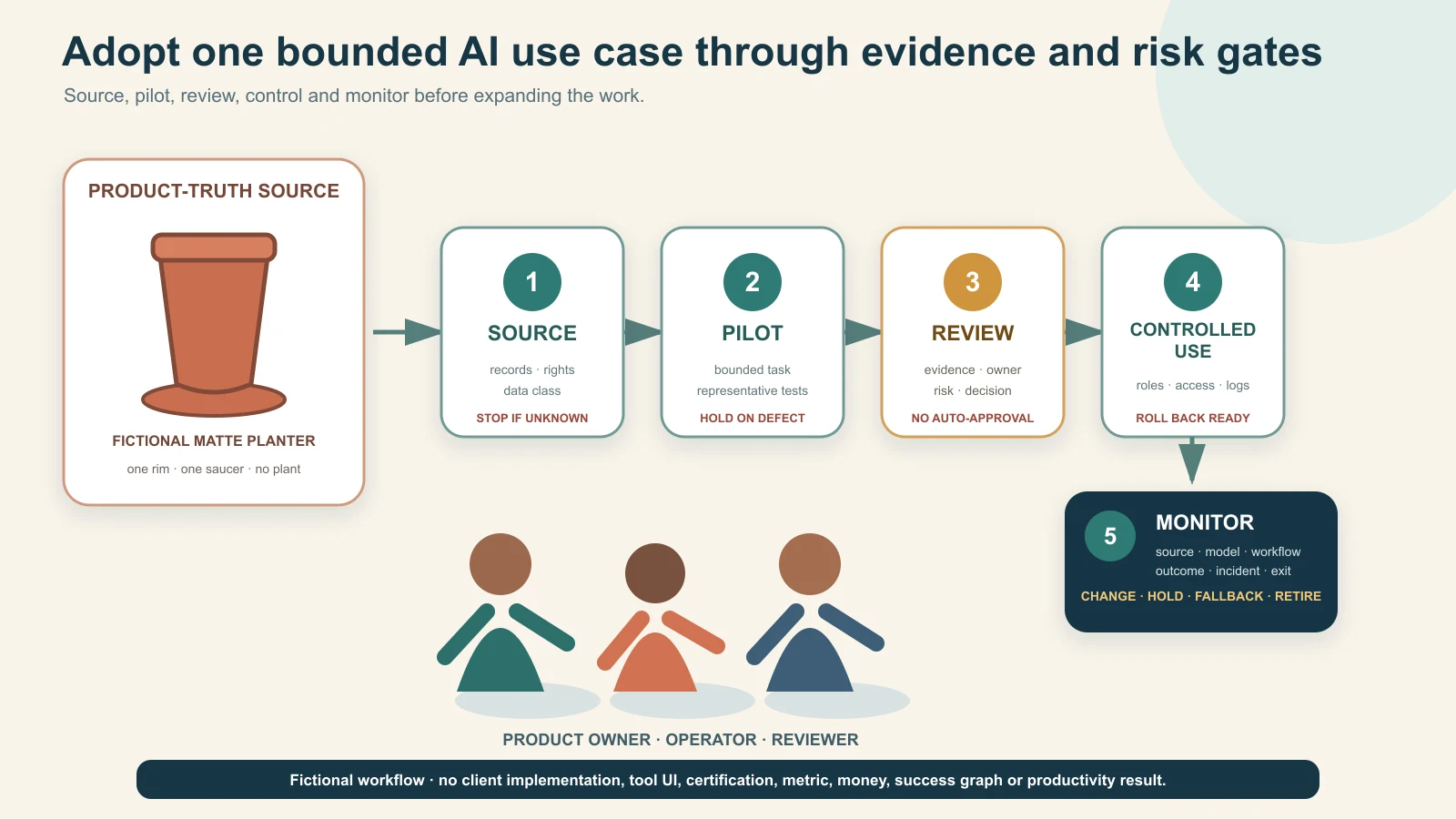
Original GPTWala editorial illustration using fictional people, one unbranded terracotta planter and native workflow cards. It shows no client implementation, software interface, external approval, certification, metric or productivity result.
Reviewed and updated: 12 August 2026
To adopt AI responsibly, map the work before selecting tools, classify use cases by decision and data risk, choose one bounded task with a trustworthy source and human reviewer, measure it against the current process, and release it only through a written approval gate. Turn a successful pilot into a controlled workflow with named owners, access, records, monitoring, incident response and an exit plan. Scale only after the same controls work across a wider product range, team or channel.
Do not begin with “give everyone an AI account” or “automate the whole business.” A polished demo can hide wrong products, leaked data, invented claims, unsafe decisions, unclear rights, unpredictable costs and dependency on a tool the team cannot audit or leave. The useful unit is an approved AI-assisted use case: one defined job, permitted inputs, bounded outputs, responsible owners, pass/fail evidence and a decision to keep, fix, stop or scale.
AI adoption is not a tool purchase or a training session. It changes how work is sourced, produced, reviewed, approved, released, measured and corrected. The business remains responsible for the product, customer promise, transaction, employee action and regulatory obligation even when a model assists.
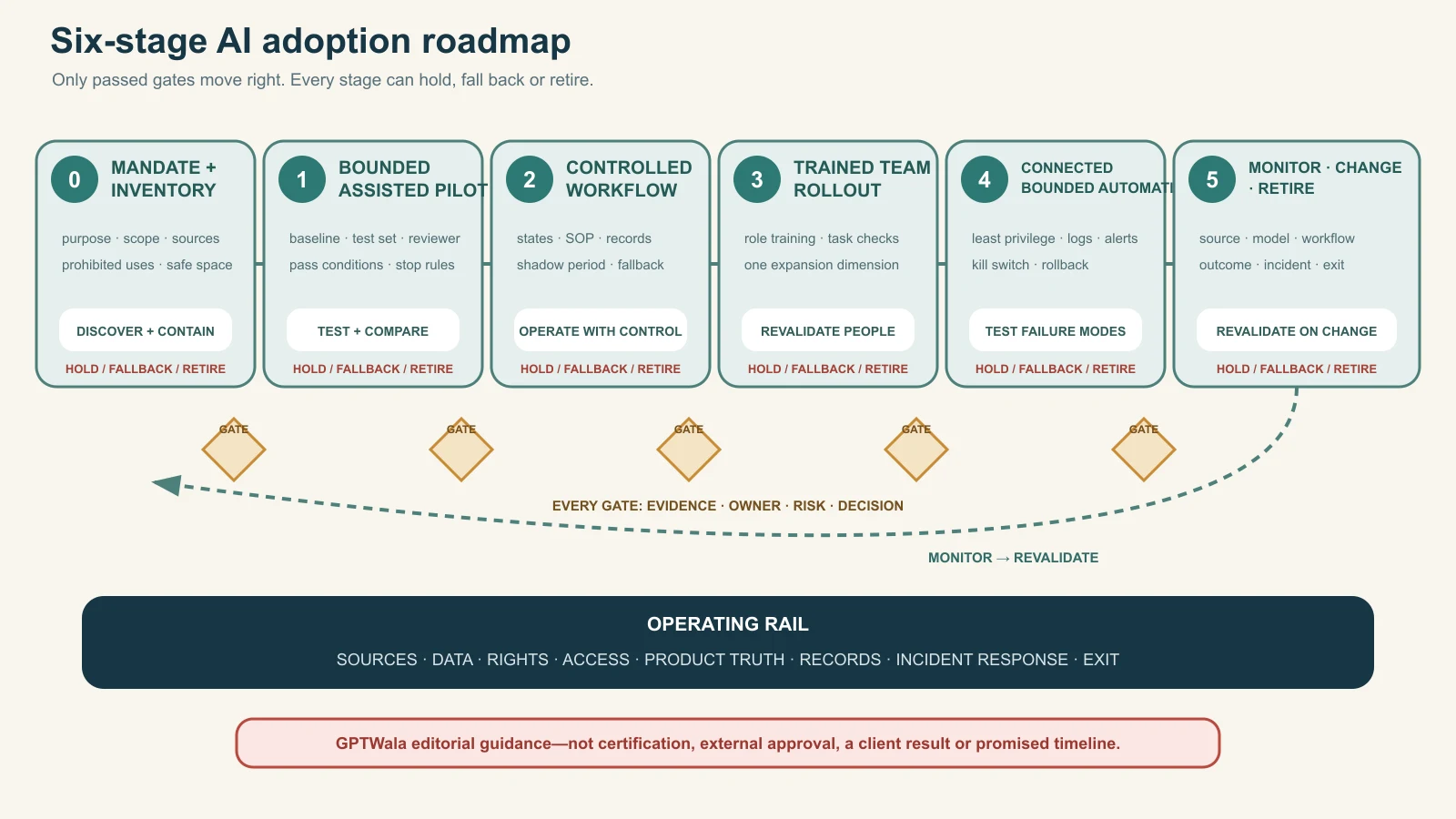
The US National Institute of Standards and Technology’s AI Risk Management Framework organises voluntary risk work around Govern, Map, Measure and Manage across the AI lifecycle. This article is not a NIST implementation or certification. It adapts the lifecycle idea into a practical product-business sequence: mandate → map → pilot → control → scale → monitor/retire.
The OECD AI Principles are another high-level reference, including robustness, safety and accountability. They do not approve a particular tool, workflow or business decision.
Separate four adoption questions
Question
What the business must decide
Weak shortcut
Why
Which business job or risk is worth changing?
“Competitors use AI”
What
Which exact task, input and output are in scope?
“Use AI for marketing/operations”
Who
Who owns source truth, operation, review, release and incident response?
“The AI team”
How controlled
What permissions, gates, records, measures and stop rules apply?
“A human will check it”
If these questions do not have named answers, the organisation has experimentation—not adoption.
Do not confuse capability with readiness
A model may generate an image, classify a file, draft a reply or summarise a specification. That does not prove the task is suitable for release. Readiness also requires:
permitted and current inputs;
enough source evidence;
defined output use and affected people;
product/domain review;
data, rights, security and policy review;
versioned instructions and records;
measurable pass/fail conditions;
a fallback when the tool fails; and
authority to stop or correct downstream use.
Set the non-negotiable sources of truth
AI should sit beside authoritative records, not replace them. Before selecting a use case, name what proves the product, offer, customer, employee, stock, order, payment and business rule.
Use a source-of-truth map
Domain
Authoritative source
AI may assist with
AI must not decide or invent
Product identity
Approved product/SKU master and physical item
Classification, formatting, descriptions from supplied facts
SKU, variant, included parts or unseen feature
Specifications/claims
Current technical, test, compliance and claim records
Find/summarise cited fields for review
Material, performance, safety, certification or compatibility
Images/video
Approved exact-product captures and rights records
Background/context, layout, captions, variants within controls
Product shape, colour, pattern, text, parts, scale or proof
Price/terms
Authorised commercial system/version
Draft a quote explanation from current values
Price, discount, credit, tax, freight or expiry
Stock/capacity
Inventory, production and allocation records
Flag/reformat a current snapshot
Availability, capacity or delivery commitment
Customer/enquiry
Approved CRM/order/support record
Draft summary or next-question checklist
Intent, identity, consent, payment or order status
Payment/accounting
Authorised bank/gateway/accounting record
Reconciliation assistance under approved controls
Settlement, refund, credit or dispatch approval
People/roles
HR/access/permission records
Training support or authorised scheduling
Likeness/voice use, employment decision or sensitive inference
The source can be imperfect. Adoption should expose missing ownership and version control rather than letting AI fill gaps with plausible text.
Create a claim register
For every public or buyer-facing claim, record:
exact claim text or allowed meaning;
product/SKU/facility/process scope;
supporting document or authorised source;
owner and reviewer;
channels/use contexts;
approval/expiry or event-triggered review; and
words/visual implications that are not allowed.
AI can retrieve approved claims from this register. It should not draft stronger claims from a certificate name, test summary, customer conversation or competitor page.
Inventory work, tools and data before adding more
Most businesses already have unofficial AI use: personal accounts, browser extensions, phone apps, agency tools, automated features inside existing software and employee experiments. A new roadmap should first make that use visible without punishing good-faith disclosure.
Build the AI use-case inventory
Field
What to record
Use-case ID and name
One exact job, not a department slogan
Business owner
Accountable person who can approve/stop
Operator and reviewer
Who creates and who independently checks
Tool/model/feature
Provider, product/plan and version or date observed
Input data
Source, classification, rights and permitted fields
Output
Asset, draft, decision support, customer reply or system action
Audience/impact
Internal only, public, customer, employee, supplier or automated downstream use
Source of truth
Record used to verify output
Risk tier
Low, controlled or restricted/high risk under the business rule
Access/integration
Named users, permissions, API/connector and destination
Vendor controls
Retention, model improvement, region, security and admin settings checked
personal: customer, employee, creator or contact information; and
regulated/high-impact: information or decisions whose misuse can create legal, safety, financial or rights harm.
The classification does not itself create legal permission. It tells the operator when a tool/account/configuration is not authorised for an input.
Discover shadow use safely
Ask teams:
which tools/features they use;
what they upload;
what outputs reach customers or systems;
which logins/payment owners exist;
what work would stop if the tool disappeared; and
what errors they have already seen.
Do not respond to disclosure only with a blanket ban. Quarantine high-risk use immediately, then give teams a safe route for suitable work. Otherwise shadow use becomes harder to see.
Choose the first AI use case
The best first task is useful, bounded, reversible and easy to review—not necessarily the most impressive.
Pass the first-use-case gate
Start when:
the current workflow and problem are documented;
inputs have known sources and permissions;
output scope is narrow;
a knowledgeable human can detect material errors;
harm is limited and a fallback exists;
a representative test set can be created;
the baseline cost/time/quality can be measured; and
the team can stop before public or operational release.
Avoid an AI-first pilot when:
the business expects the model to discover missing truth;
the task makes safety, eligibility, employment, credit, payment, pricing or legal decisions;
sensitive/confidential data cannot be protected;
no qualified reviewer exists;
errors are hard to detect before harm;
the vendor/integration cannot be controlled or exited; or
success is defined only as “people used it.”
Use value, feasibility and risk as gates
Dimension
Evidence question
Decision
Value
What avoidable effort, delay, inconsistency or buyer problem exists?
No defined problem → do not pilot
Feasibility
Are sources, permissions, tool capability, reviewer and fallback available?
Critical missing input → hold
Risk
Can material error, data/rights harm and downstream impact be prevented/detected?
Uncontrolled high impact → prohibit or specialist route
Measurability
Is there a baseline and pass/fail test?
No comparison → documentation-only exploration
Ownership
Can one person approve, stop and fund the use case?
No accountable owner → do not launch
Do not average a critical red risk into a high overall score. A useful task with no permitted data remains a no-go.
Classify use cases by risk
Risk depends on the task, data, audience, autonomy, reversibility and impact—not the brand name of the tool.
Green lane: internal, bounded and reversible
Examples:
reformatting approved product records;
grouping supplied SKUs for human review;
drafting meeting notes from authorised content;
creating internal checklists from a current SOP;
brainstorming options that are not released; and
translating internal draft text for fluent review.
Controls still include permitted data, source links, named accounts and human review, but AI has no release authority.
Amber lane: buyer-facing or operational assistance
Examples:
product-description or catalogue drafts;
background/context edits around a real product;
buyer-facing FAQ and reply drafts;
ad variants;
enquiry classification;
specification extraction into a review checklist; and
workflow summaries that influence an operator.
Require versioned sources, product/domain review, release owner, sampling/monitoring and a fallback. One wrong material or price can be more important than fifty correct sentences.
Red lane: restricted, high-impact or specialist-controlled
Examples:
inventing or approving technical/safety compatibility;
autonomous price, discount, credit, refund, stock, payment or dispatch decisions;
medical/health, regulated or safety claims;
employment or worker-performance decisions;
sensitive personal-data profiling;
unauthorised likeness or voice cloning;
realistic deceptive synthetic people/events;
unsupervised customer outreach or contract commitment; and
quality inspection where a missed defect can create material harm.
Red does not always mean “AI can never assist.” It means the business cannot use an ordinary content-tool workflow. It may require prohibition, validated specialist systems, professional review, stronger technical controls and clear human authority.
NIST’s Generative AI Profile is an official cross-sector risk reference for generative AI. It does not certify this three-lane model, and the three lanes are GPTWala editorial guidance.
Stage 0: establish the mandate and guardrails
Before a pilot, the owner approves a short AI mandate.
The minimum mandate
Purpose: which business outcomes AI may support.
Prohibited uses: data, decisions and outputs not allowed.
Source rule: AI never overrides named authoritative records.
Data rule: which classifications may enter which approved tools/accounts.
Human rule: who reviews and who has release/decision authority.
Access rule: named users, least privilege, recovery and offboarding.
Vendor rule: minimum terms, security, retention, rights and exit checks.
Record rule: what prompts/inputs/outputs/versions/decisions must be retained.
Incident rule: how to stop, quarantine, escalate, correct and notify.
Change rule: which tool/model/source/policy changes force revalidation.
Keep it readable enough for operators. A policy nobody can apply will not control a live workflow.
Establish a safe experimentation space
Provide:
approved tools/accounts for low-risk exploration;
synthetic or de-identified training examples where appropriate;
prohibited-data reminders at the point of use;
example tasks and red flags;
a help/escalation route; and
a fast way to report errors without hiding them.
Do not use real customer, employee, confidential design or unreleased product data for training exercises unless that exact use has been approved.
Stage 1: run a bounded assisted pilot
A pilot tests a workflow, not whether the tool can produce one attractive example.
Write the pilot card
Field
Required decision
Job
Exact task and boundary
Business problem
Current delay, cost, inconsistency or capacity issue
Baseline
Current method, quality, time, cost and defect evidence
Inputs
Source IDs, data classes, rights and exclusions
Output/audience
Draft/recommendation/asset and where it may go
Tool/configuration
Approved account, feature/model/version and settings
Test set
Representative products/cases, including difficult and stop cases
Review
Operator, domain reviewer, rights/data reviewer and release owner
Pass conditions
Accuracy, truth, usability, cost/time and zero-tolerance defects
poor or incomplete inputs that should trigger a stop;
long/complex records;
multilingual or unit-format cases where relevant;
buyer-critical labels, patterns, dimensions or claims;
prohibited/sensitive examples the system must reject; and
known historical errors.
Do not train the team only on the cleanest product photograph or simplest spreadsheet.
Keep the pilot human-in-the-loop
The operator uses AI to draft or transform. The reviewer compares the output with sources. The release owner decides whether it may leave the pilot. If the same person holds multiple roles in a small team, require a second review for amber/red-adjacent work.
No pilot output should silently enter a product page, catalogue, customer reply, production instruction, order system or ad account.
Stage 2: turn a passing pilot into a controlled workflow
A passing pilot becomes an SOP only when the team can reproduce the result safely.
Build the controlled workflow pack
purpose and scope;
eligible/ineligible inputs;
source and version requirements;
approved tool/account/configuration;
prompt/template or procedure with protected fields;
output naming and storage;
product/domain/rights/data review checklist;
release authority;
sampling and monitoring frequency;
cost/usage boundary;
incident and rollback route;
model/tool/source change triggers; and
owner, backup and review date.
Prompts are one component, not the control system. A long prompt cannot guarantee that a generative model preserves a product, follows policy or uses the right record.
Separate draft, approved and released states
Use visible states and permissions:
draft: generated/edited; not reviewed;
revise: material issue identified;
approved for defined use: reviewer and scope recorded;
released: exact channel/version/date recorded;
withdrawn: removed from further use; and
retired: workflow/tool no longer authorised.
An approved image for an internal mood board is not approved for a marketplace listing. Approval scope travels with the asset.
Run a shadow period
Before replacing the old workflow, run the controlled AI-assisted process beside the established method for enough representative work to detect differences. “Enough” depends on product variety and risk; no universal number applies.
If the old method provides the only reliable fallback, do not dismantle it before the new workflow proves recoverable.
Stage 3: roll out to a trained team
Rollout is a change in behaviour, access and responsibility—not a link to a recorded webinar.
Train by role
Operators need:
eligible tasks and data;
source requirements;
tool procedure;
common failure examples;
when to stop/escalate; and
how to preserve records.
Reviewers need:
product/domain truth fields;
claim and rights rules;
sampling/inspection method;
approval scope; and
how to reject without “fixing from memory.”
Managers need:
capacity and quality measures;
cost and access ownership;
incident/status review;
vendor/change risks; and
keep/fix/stop/scale authority.
Qualify people for the task and revalidate on change
Use a practical observed exercise on the current workflow and representative test cases. Record which use case/tool/version the person is internally authorised to operate or review. This is task qualification, not an external certification. A general “AI trained” badge does not prove readiness for a new model, product category or high-risk decision.
Expand one dimension at a time
Increase either:
product range;
output type;
audience/channel;
user/team;
volume;
language/geography; or
autonomy/integration.
Changing all dimensions at once makes defects hard to diagnose. Recheck risk and evidence whenever the affected dimension changes.
Stage 4: connect systems and bounded automation
Automation increases the speed and reach of both correct and wrong outputs. Connect systems only after a manual controlled workflow passes.
Approve the integration map
For each connector/API/agent, record:
system and owner;
data read and write permissions;
trigger and frequency;
model/tool/service involved;
transformations and prompts;
human checkpoint;
error/retry behaviour;
logs and alerts;
rate/cost limits;
downstream systems/actions;
credentials and recovery; and
kill switch/rollback.
Grant the minimum permission needed. A catalogue-drafting assistant should not be able to modify prices, issue refunds, message every customer or approve dispatch.
Keep material decisions deterministic or human-authorised
Use validated rules or authorised people for:
price/discount/credit limits;
product/variant and stock commitment;
quality acceptance;
safety/compatibility decision;
legal/compliance approval;
customer opt-out/suppression;
payment/refund status;
hiring/discipline; and
final public claims.
AI may prepare evidence for the decision. It should not silently become the decision owner.
Test failure modes before launch
Simulate:
missing/late/wrong source data;
duplicate trigger;
tool timeout or partial result;
hallucinated/invalid output;
denied permission;
rate/cost spike;
human reviewer unavailable;
downstream system unavailable;
opt-out or deleted record; and
vendor/model change.
The safe outcome may be “do nothing and alert a person.” Automatic retry is not always safe.
Stage 5: monitor, change and retire
An approved AI workflow can drift because products, sources, prices, policies, model behaviour, vendor terms, team members and attack patterns change.
Monitor four layers
Layer
Monitor
Example trigger
Source
Completeness, currency, owner and version
New pack, price, claim or policy
Model/tool
Version, features, output behaviour, terms, cost and availability
Model update or removed control
Workflow
Operator/reviewer adherence, defects, overrides and incidents
Review bypass or repeated repair
Outcome
Accepted quality, downstream errors, buyer/staff harm and business value
Product complaint or rework spike
Do not monitor only usage or token counts.
Revalidate on change
Reopen the use case when:
model/tool/plan/region changes;
source schema or product family changes;
new personal/confidential data enters;
output reaches a new audience/channel;
autonomy or integration increases;
applicable law/platform policy changes;
a material defect or complaint occurs; or
the reviewer/owner leaves.
Retire deliberately
When a workflow no longer passes:
stop new use and downstream release;
preserve required records and open issues;
revoke tokens, connectors and user access;
export business-owned data/templates where permitted;
follow approved retention/deletion and contract steps;
identify live assets/actions that depend on the workflow;
move work to the fallback or replacement;
notify affected teams; and
monitor for residual automated actions.
Do not let an abandoned API key or browser extension remain a hidden production dependency.
Original GPTWala deterministic roadmap. Every stage has evidence, owner, risk and decision gates plus a hold, fallback or retirement route; it is guidance, not certification or a promised implementation timeline.
Assign roles and decision rights
One person can hold several roles in a small business, but each decision still needs an explicit owner. Separate operation from approval when the output can materially affect a product, customer, employee, supplier, payment or public claim.
Minimum role map
Role
Owns
Cannot delegate silently to AI
Accountable business owner
Purpose, budget, risk appetite, stage decision
Final accountability
Use-case owner
Workflow, baseline, value, SOP and ongoing performance
Scope/change decision
Product/domain owner
Product/specification/process truth
Technical/product approval
Data/source owner
Source quality, access, classification and retention
Permission/currency decision
Operator
Executes approved procedure and records exceptions
Release authority unless assigned
Reviewer
Compares output against product/source/rules
Evidence-based sign-off
Privacy/security/rights reviewer
Data flow, access, vendor, content/people rights
Specialist judgement
Release/decision owner
Authorises defined channel/action
Claim, price, stock, payment or safety commitment
Technical/integration owner
Connectors, credentials, logs, rollback and changes
Business approval
Incident owner
Stops, coordinates, corrects, documents and closes
Material incident decision
Use decision rights, not “human oversight” as a slogan
For each use case, state:
who may start a job;
who may access which data;
who reviews which truth fields;
who can approve internal use;
who can release externally;
who can change the tool/prompt/integration;
who can override the output;
who can stop the workflow; and
who owns downstream correction.
A reviewer without time, source access, expertise or authority is not a control.
Small-team pattern
An owner may be accountable and release authority; a product manager may be source owner and reviewer; an operator may create drafts. For amber work, use a second person or delayed second pass. For red/high-impact work, obtain appropriate specialist independence rather than self-approving because the team is small.
Select tools and vendors with an exit route
Choose against the use-case card, not a viral demo or a generic “best AI tools” list.
Provider terms are provider-specific. For example, OpenAI’s current ROW Terms of Use say users are responsible for input rights and output evaluation, and warn outputs may be inaccurate or non-unique. That is not a universal summary of every provider or a warranty for any use case. Read the actual current terms, privacy/data controls and enterprise agreement for the chosen account.
Include the full operating cost
Count:
subscription/usage/API;
setup/integration;
source preparation;
operator and reviewer time;
correction and rejected output;
storage, security and admin;
training/change management;
downtime/fallback; and
incident/exit cost.
A cheaper generation is not cheaper adoption when review and rework rise.
Protect data, confidentiality, rights and access
AI adoption often moves business data to new providers, accounts, extensions and integrations. Review the data flow before the first upload.
Use an AI input gate
Before submitting data, answer:
What exact fields/files are entering?
Who owns or has rights to use them?
Are personal, confidential, regulated or third-party elements present?
Is this provider/account/feature approved for that classification and purpose?
What retention, model-improvement and human-review settings/terms apply?
Where does the output/log go and who can access it?
Can the input be minimised, masked, aggregated or replaced with synthetic training data?
What notice, contract, consent or other authority is required?
How will correction, deletion, access revocation and incident handling work?
Does a safer manual/local/enterprise route exist?
India’s DPDP framework has phased commencement. The current India Code commencement record is a publication-day legal-refresh route, not a checklist proving that a data use is lawful. Obtain current privacy, employment, sector, contract and cross-border advice for the real workflow.
Control likeness, voice and synthetic media
Do not upload an employee, customer, creator or owner’s face/voice merely because the business has a photograph or recording. Record purpose, source, person, consent/contract, languages, products, channels, duration, withdrawal, provider and final approval.
India’s 2026 synthetic-media framework is time-sensitive. MeitY’s official FAQ on synthetically generated information discusses realistic synthetic audio/visual media and current intermediary/platform declaration/labelling context. It does not create a universal merchant label or make impersonation acceptable. Reopen the notified rules, corrigendum, platform controls and real facts before use. The AI spokesperson video guide owns the detailed workflow.
Protect accounts and integrations
use business-owned named accounts;
enable appropriate authentication/recovery;
avoid shared personal logins;
grant least privilege;
separate production and testing;
store credentials in approved systems;
review extensions/connectors;
remove access promptly when roles change; and
inventory renewal/payment owners.
Do not let an agency or one employee become the only person who can access, recover, export or stop a critical AI workflow.
Protect product truth and customer claims
AI can make missing truth look complete. Product businesses need a release gate that compares every material output with the exact item and authorised records.
The current ASCI Code says objectively ascertainable advertising claims should be capable of substantiation and that statements or visual presentation should not mislead through implication, omission, ambiguity or exaggeration. India’s official 2022 misleading-advertisement guidelines are another publication-day check. General guidance cannot replace category-specific legal review.
Product-truth release gate
Reject an asset or answer that changes/invents:
SKU, model, variant or current pack;
shape, proportions, openings, handles, closures or components;
colour, finish, material, transparency, pattern, text or logo;
dimensions, weight, capacity or scale;
number of items or included accessories;
fit, drape, setting, tolerance or compatibility;
stock, production capability, lead time or geographic service;
price, tax, discount, credit, freight, warranty or return terms;
certification, hallmark, test, safety, health, environmental or performance claim; or
customer result, testimonial, rating or endorsement.
Disclosure is separate. “AI-generated” does not repair a wrong product or unsupported claim.
Use risk-specific evidence
Business/product
AI can assist
Human/real-source proof remains essential
Surat apparel
Layout, background/context draft, catalogue copy from records
Exact print/colour/size, seam, transparency, fit and drape
Jaipur jewellery
Classification, captions from approved fields, scene concepts
Stone count/setting, metal/purity/hallmark, weight, clasp, scale
Rajkot components
RFQ extraction, checklist, document search
Drawing, tolerance, material, process, compatibility and quality release
Google’s official guidance on generative AI content focuses on accuracy, quality, relevance and context; scaled low-value pages can conflict with spam policies. Do not use adoption targets such as “publish 1,000 pages.” Set a buyer decision, unique evidence, review owner and maintenance trigger for each public page.
Measure adoption without vanity metrics
Logins, prompts and generated files show activity. They do not prove business value, safety or adoption quality.
Establish the baseline first
For the existing workflow, record a representative period or set:
inputs and volume;
cycle/wait time;
operator/reviewer hours;
cost;
accepted output definition;
first-pass acceptance;
rework and defect types;
downstream errors/complaints;
data/rights/security incidents; and
capacity/quality limits.
If the baseline is not recorded, a faster-looking demo can receive credit for work it did not replace.
Use adoption-quality measures
Measure
Definition
Guardrail
Accepted output
Output passing the defined source/truth/use review
Generated does not equal accepted
First-pass acceptance rate
Accepted without material revision ÷ outputs reviewed
Define material revision and cohort
Material defect rate
Outputs with defined truth/claim/data/rights defect ÷ outputs reviewed
One severe defect may stop regardless of average
Escaped-defect rate
Released outputs later found with material defect ÷ released outputs reviewed
Pilot gate: representative RFQs, known missing/contradictory cases, exact source citations, no auto-reply and no ERP write. Stop if the model invents a specification or maps to the wrong part.
Manufacturer: catalogue-image workflow
Start: controlled background variants around exact approved product captures.
Pilot gate: adjacent variants, reflective/transparent items and incomplete inputs must trigger rejection. Use the phone-to-approved workflow before team rollout.
Retailer: product-enquiry reply assistant
Start: draft replies from current catalogue, service area and approved policy fields; ask a human to select/send.
Pilot gate: no autonomous outreach, no unlimited marketing inference and no request for sensitive payment credentials. Route the sales process to the WhatsApp selling system.
Apparel wholesaler: collection-content system
Start: group verified styles and draft buyer-specific collection text.
Pilot gate: reconcile aggregates to the source, restrict store/customer/employee data, and label inference/uncertainty. Do not let a natural-language summary write inventory changes.
Use a 90-day starting roadmap
Ninety days is an editorial planning frame, not a promise that every business will reach production. High-risk, regulated, integrated or data-heavy work may need much longer; a low-risk task may stop earlier.
Days 1–15: discover and contain
name accountable owner and working group;
inventory current/shadow tools, use cases, data and integrations;
stop obvious restricted/uncontrolled use;
map product/claim/data sources;
publish a short mandate and experiment route; and
shortlist one low/controlled-risk use case.
Days 16–30: design the pilot
define current workflow and baseline;
classify data and rights;
evaluate tool/vendor/account and exit route;
build representative test and stop cases;
assign operator, reviewer, release and incident owners; and
approve pilot card, budget and fallback.
Days 31–60: run and measure
execute in a non-production or draft-only boundary;
record tool/model/configuration and sources;
compare outputs with evidence;
log reviewer effort, defects, stops, cost and cycle time;
test failure/rollback; and
decide keep, fix or stop.
Days 61–75: operationalise a passing use case
write SOP/workflow pack;
define states, permissions, storage and logs;
train operators/reviewers on current cases;
run shadow/parallel work;
complete security/privacy/rights/vendor checks; and
approve limited release.
Days 76–90: decide bounded scale
inspect released quality and escaped defects;
confirm value and total cost against baseline;
recheck vendor/source/model changes;
approve only one expansion dimension;
schedule monitoring and revalidation; and
document fallback/retirement route.
Do not create a second pilot merely to avoid deciding the first. Close each cycle with an evidence-backed stage decision.
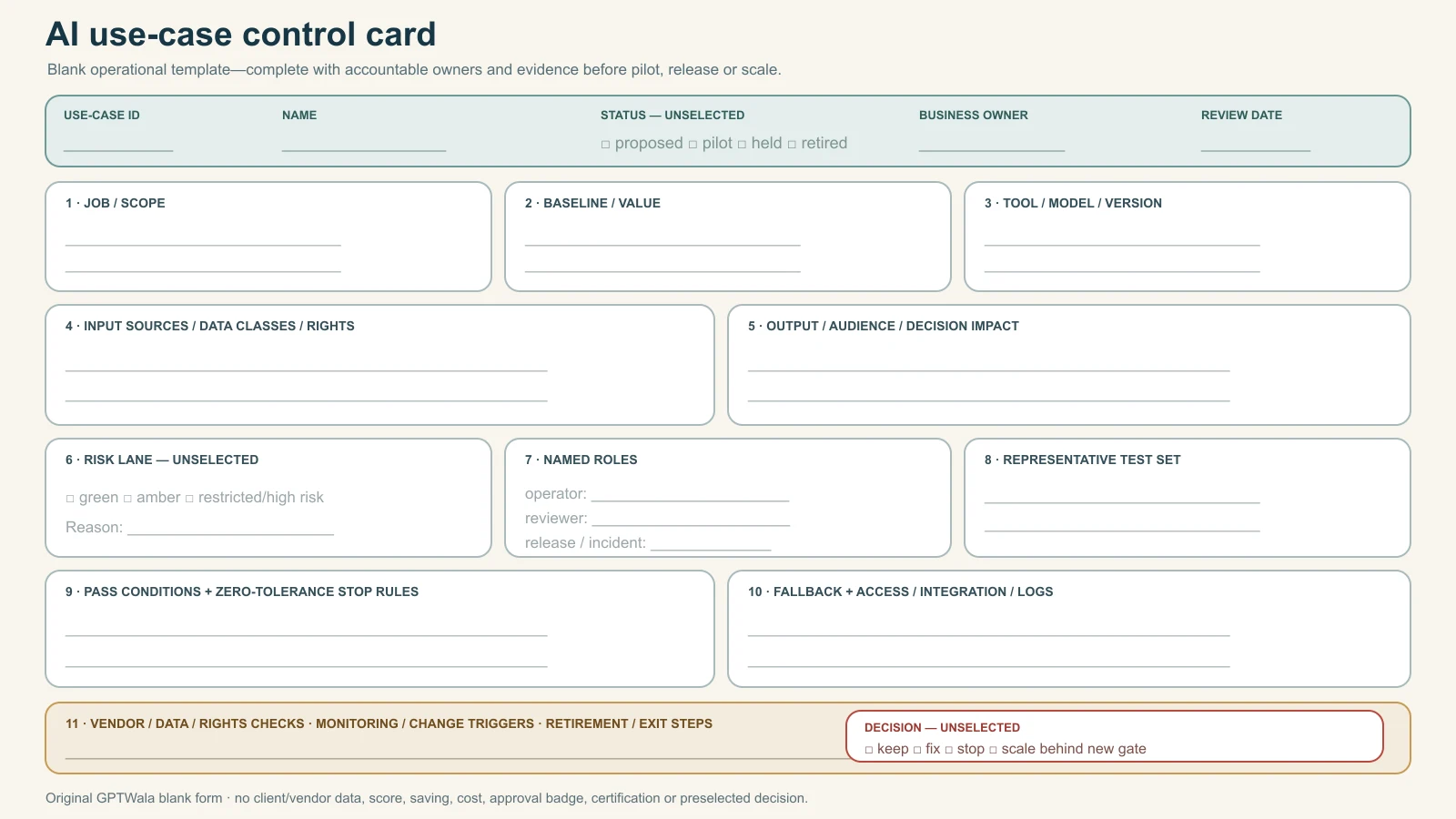
Original GPTWala blank operating template. Status and decisions remain unselected, and the card contains no client or vendor data, approval badge, certification, score, saving or productivity result.
Respond to incidents and stop unsafe use
An incident can be a data exposure, wrong product, misleading claim, unauthorised content, security event, harmful decision, uncontrolled automation, material cost spike or inability to trace/correct an output.
Use the stop-and-correct route
Stop: pause generation, release and automated downstream action.
Quarantine: identify affected outputs, records, accounts, connectors and live destinations.
Preserve: retain relevant input/output/prompt/version/log/decision evidence under approved policy.
Escalate: notify incident, business, product, data/security, rights/compliance and vendor owners as applicable.
Protect: revoke access/keys, block the workflow and prevent further exposure or commitment.
Correct: remove/replace public assets, correct records and contact affected people/partners where required and appropriate.
Assess: determine scope, harm, obligations, source/model/workflow cause and control failure.
Retest: update the system and run the representative/stop test set.
Decide: resume within scope, reduce scope, return to manual, replace vendor or retire.
Learn: update training, inventory, controls and monitoring without hiding the incident.
Do not let the operator silently regenerate until the error disappears. That destroys evidence and leaves the underlying control failure alive.
Define authority before the incident
Every production use case needs a named person who can:
disable access or integration;
stop publication/messages/actions;
inform downstream owners;
approve corrections;
contact vendor/support;
obtain specialist advice; and
decide whether the workflow remains authorised.
If nobody can stop it quickly, it is not ready for automation.
Connect AI adoption to the DAA system
AI adoption should strengthen a product business’s source truth and operating discipline, not create content faster than the business can verify, distribute, answer or fulfil.
GPTWala’s DAA sequence is Digital Presence → AI Content Creation → ₹100/day WhatsApp ads. Article 25’s offline-to-online DAA roadmap explains the customer-growth sequence. This AI adoption roadmap supplies the wider organisational controls underneath it: approved tools, inputs, owners, product-truth gates, release records, measurement and stop rules.
The GPTWala workshop is educational. It does not guarantee productivity, savings, content volume, leads, orders, revenue, profit or return on ad spend.
Frequently asked questions
Where should a manufacturer or retailer start with AI?
Start with one useful, bounded and reversible task whose inputs are permitted and current, whose errors a knowledgeable person can detect and whose baseline can be measured. Examples include formatting approved product data or drafting from a controlled source. Do not start with autonomous pricing, credit, safety, quality release, customer outreach or product claims.
Do we need an AI policy before a pilot?
You need at least a short mandate covering purpose, prohibited uses, sources, data, human review, access, vendors, records, incidents and change. It can begin concise and grow with risk. Do not wait for a perfect policy while employees use unapproved tools invisibly; inventory and contain current use first.
How many AI tools should we test?
There is no universal number. Compare only enough options to answer the use-case requirements and exit risks. One deeply tested workflow is more informative than many shallow demos. Tool count is not an adoption metric.
How do we choose the first AI use case?
Require defined value, known/permitted inputs, bounded output, human reviewer, manageable harm, representative test set, baseline, fallback and accountable owner. Hold the task if a critical condition is missing. Do not average a data, rights or safety failure into a high score.
Can AI approve product specifications or quality?
Not through an ordinary generative-content workflow. AI may extract fields or flag questions, but technical compatibility, tolerance, material, safety and quality release need authoritative sources, validated methods and qualified human/system authority. High-impact machine-vision or engineering systems need specialist validation and governance.
Can employees upload customer or product data to AI tools?
Only when the exact data, purpose, tool/account, settings, retention, rights, security and legal/contract conditions are approved. Public availability does not remove rights or privacy questions. Minimise the input and use synthetic/de-identified training cases where appropriate.
How should we measure AI adoption?
Compare accepted output, material and escaped defects, total cost per accepted output, cycle time, review burden, stop/override rate, authorised-user coverage and a verified downstream outcome where appropriate. Pair measures with cohorts and definitions. Logins, prompts and generated files measure activity only.
When can we automate an AI workflow?
After the manual AI-assisted workflow passes, sources and decision rights are stable, permissions and data controls are approved, failure modes/rollback are tested, logs/alerts exist and a person can stop it. Increase one dimension of autonomy or scope at a time.
What if the AI model or vendor changes?
Treat a material model, feature, plan, term, data-control, region, integration or output change as a revalidation trigger. Pause affected high-risk use if the team cannot show that prior controls still work. Preserve a fallback and exit route before dependency grows.
Is AI adoption successful if it saves time?
Time can be one benefit, but only after accepted quality, product truth, data/rights safety, total cost and downstream outcomes are considered. A faster workflow that increases review, defects, customer harm or lock-in is not a demonstrated improvement.
How is this different from the DAA framework?
DAA is the customer-growth sequence linking Digital Presence, AI Content Creation and a controlled ₹100/day WhatsApp ads system. This article covers AI adoption across teams, tools, data, permissions, use cases, roles, integrations, monitoring and retirement. The two connect, but they solve different operating decisions.